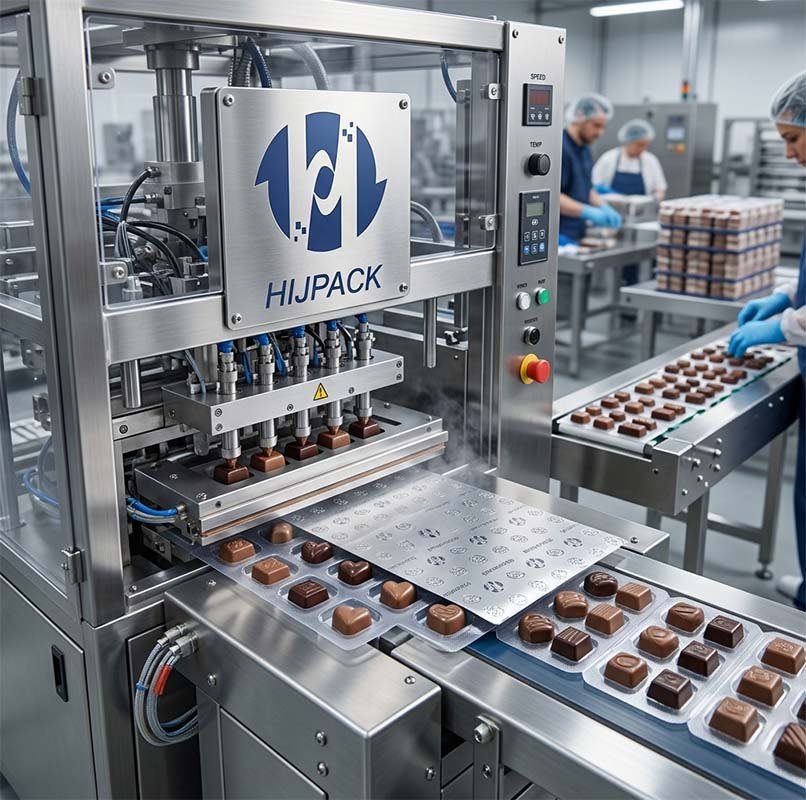
📦 Material Selection Guide — HIJ Machinery
PVC, PVDC & Aluminum Foil: Choosing the Right Material for Chocolate Blister Packaging
The forming film you choose for your chocolate blister packing machine is not a procurement decision. It is a shelf-life decision, a regulatory decision, and sometimes a brand survival decision. Get it wrong and you will not know for six months — when the bloom damage is already in 40,000 retail units.
Direct Answer: For chocolate blister packaging, food-grade PVC (200–300 μm) suits short shelf-life products in dry climates; PVDC-coated PVC cuts moisture vapor transmission 3–5× and extends shelf life to 12 months; cold-form aluminum foil reduces MVTR to below 0.02 g/m²/day and is the only material validated for high-cocoa (70%+) or tropical-market distribution requiring 18+ months shelf life.
Why Your Forming Material Determines Chocolate Shelf Life — Not Your Recipe
The forming film, not the chocolate formulation, is the primary variable controlling moisture ingress in blister-packed confectionery — PVC at 250 μm passes 4–6 g/m²/day, which means a high-cocoa praline can absorb enough atmospheric moisture to trigger fat bloom within 90 days in a tropical warehouse at 30°C/75% RH.
I learned this the hard way on a project in Kuala Lumpur in 2021. A Belgian artisan chocolate brand had just entered the Southeast Asian gifting market. Beautiful product. Excellent tempering. Their procurement team had specified standard PVC forming film because it was what their European contract manufacturer used. Nobody questioned it. I certainly did not — not until I saw the six-month stability data.
Fat bloom at month four. Texture degradation at month five. The distributor had already shipped 28,000 units across three markets. The recall was partial — but the brand damage was not.
The chemistry is straightforward. Chocolate contains cocoa butter, which undergoes polymorphic transformation when exposed to humidity fluctuations. Form V crystals — the stable crystal structure responsible for snap and gloss — convert to Form IV or Form VI under repeated thermal-humidity cycling. The moisture vapor transmission rate (MVTR) of your forming film controls how fast that cycling happens. Standard PVC gives you almost no protection in Zone IVb climates (30°C/75% RH). That is not a materials science opinion; it is a thermodynamic reality backed by ICH Q1F data.

Figure 1: MVTR comparison across PVC, PVDC-coated PVC, and cold-form aluminum foil at 38°C/90% RH — the test condition used for tropical market stability submissions.
The Three Primary Forming Materials for Chocolate Blister Packaging: What the Spec Sheets Do Not Tell You
Food-grade PVC, PVDC-coated PVC, and cold-form aluminum foil each deliver distinct moisture barrier performance — with MVTR values spanning 300× from top to bottom — and the right choice depends on your target distribution climate, shelf-life requirement, and cost-per-blister tolerance, not on what your machine vendor recommends as default stock.
Food-Grade PVC
200–300 μm forming film
MVTR: 4–6 g/m²/day at 38°C/90% RH. Thermoforming temperature: 100–120°C. Lowest material cost per blister. Suitable for Zone I/II climates and shelf life under six months. EU Regulation 10/2011 compliant for food contact at standard gauges. Not recommended for any tropical market distribution or premium gifting SKUs.
PVDC-Coated PVC
PVC + PVDC laminate, 40–90 g/m² coating weight
MVTR: 0.8–1.5 g/m²/day (40 g/m² coating) down to 0.3–0.5 g/m²/day (90 g/m² coating). Thermoforming temperature: 110–125°C. Mid-range cost. Extends shelf life to 12 months for standard milk and dark chocolate. A realistic option for Zone III markets if your chocolate fat content is below 40% and no inclusions are present. PVDC is increasingly restricted in EU single-use plastics directives — check the 2024 revision before locking in spec.
Cold-Form Aluminum Foil
OPA/Al/PVC or OPA/Al/PP laminate, 45–60 μm total
MVTR: <0.02 g/m²/day. No thermoforming heat — formed at ambient temperature using mechanical pressure. Forming speed: typically 30–40% slower than thermoforming. Highest material cost per blister (approximately 2.2–3.5× PVC). The only validated option for Zone IVb markets, high-cocoa products (70%+), or 18+ month shelf-life targets. Requires different tooling and forming station configuration from standard thermoforming lines.
The number I use when clients push back on cold-form aluminum cost: one recall of 30,000 units in a Gulf market wiped out 14 months of packaging cost savings for a confectionery brand I worked with in 2022. The PVC saving had been $0.009 per blister. Total annual saving on a 3-million-unit run: $27,000. The recall logistics, repackaging, and distributor penalties: $380,000. That conversation tends to be brief.
Forming Material Comparison: Chocolate Blister Packaging
| Material | MVTR (38°C/90% RH) | Thermoforming Temp | Relative Cost / Blister | Max Shelf Life (Chocolate) | Suitable Climate Zones | EU 10/2011 Compliant |
|---|---|---|---|---|---|---|
| Food-Grade PVC (250 μm) | 4–6 g/m²/day | 100–120°C | 1× (baseline) | 4–6 months | Zone I, II only | ✅ Yes |
| PVDC/PVC (40 g/m² coat) | 0.8–1.5 g/m²/day | 110–125°C | 1.6–1.9× | 10–12 months | Zone I, II, III | ✅ Yes |
| PVDC/PVC (90 g/m² coat) | 0.3–0.5 g/m²/day | 110–130°C | 2.0–2.4× | 12–15 months | Zone I–III, limited IVa | ✅ Yes |
| Cold-Form Al Foil (OPA/Al/PVC) | <0.02 g/m²/day | Ambient (no heat) | 2.2–3.5× | 18–24 months | Zone I–IVb | ✅ Yes (OPA/Al/PP also) |
MVTR data measured per ASTM E96 Method B / ISO 2528. Climate zones per ICH Q1F. Cost ratios are indicative; sourcing market and order volume create ±20% variance.
Lidding Material for Chocolate Blister Packs: Where Most Buyers Make the Second Mistake
Aluminum lidding foil for chocolate blister packaging should be 20–25 μm hard-tempered (HH) aluminum with a heat-seal lacquer formulated specifically for food-contact applications — not the same lidding stock used for pharmaceutical blisters, which often carries lacquer chemistry incompatible with direct confectionery contact under EU Regulation 10/2011.
Most buyers obsess over forming film MVTR, then specify whatever lidding their machine vendor has in stock. That is the second material mistake. I saw it on a line commission in São Paulo in 2020. The lidding was pharmaceutical-grade aluminum foil with a heat-seal lacquer containing a polyurethane binder. Not approved for direct food contact under ANVISA RDC 88/2016 — Brazil’s food contact materials regulation, which closely mirrors EU 10/2011 principles. The QA team caught it during pre-production trials. Two weeks of delay. Could have been a post-market problem.
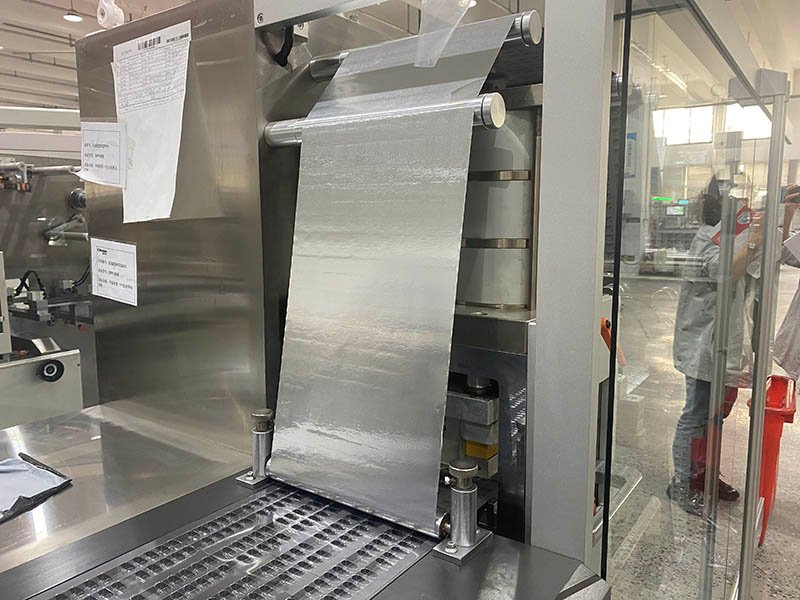
Figure 2: Aluminum lidding foil roll loaded at the heat-sealing station. Lacquer specification — not just foil gauge — determines food contact compliance.
Lidding Options by Forming Film Pairing
| Forming Film | Recommended Lidding | Foil Gauge | Seal Temp Range | Peel Force (N/15mm) | Key Compliance Note |
|---|---|---|---|---|---|
| Food-Grade PVC | Soft Al foil + PVC heat-seal lacquer | 20–25 μm | 160–190°C | 8–14 N | EU 10/2011; FDA 21 CFR 177.1520 |
| PVDC/PVC | Soft Al foil + PVDC or EVA seal coat | 20–25 μm | 150–175°C | 10–16 N | Verify lacquer for direct food contact |
| Cold-Form OPA/Al/PVC | Hard Al foil (HH) + vinyl heat-seal lacquer | 20–25 μm | 175–210°C | 14–22 N | Higher seal pressure required; verify tooling |
Seal temperatures are indicative starting points. Your FAT should establish validated seal windows per ASTM F2338 dye-ingress or equivalent seal integrity test protocol.
The Hidden Trap: Why Multi-Vendor Lines Get Material Selection Wrong
Material selection for chocolate blister packaging is not just about barrier specs — it directly determines shelf life, regulatory compliance, and your total cost-per-blister at scale. In my 20 years commissioning blister lines across Southeast Asia and South America, I have watched buyers default to standard PVC simply because it is cheap — only to fail EU moisture-barrier requirements six months later and reprint 200,000 units.
The hidden trap: most standalone machine vendors quote forming film specifications in isolation, never warning you that high-cocoa chocolate demands PVDC or cold-form aluminum to meet cGMP humidity thresholds. By the time your FAT reveals the incompatibility, you are locked into a supplier dispute with zero leverage. I have seen this exact situation on four separate projects between 2018 and 2023, in Malaysia, Indonesia, Colombia, and Nigeria. Different products, different brands, same mistake.
Before finalizing your URS, define your target markets’ barrier requirements first, then reverse-engineer your material spec and machine configuration together — not separately. At HIJ, our turnkey integration approach ensures your forming station, sealing parameters, and film procurement are validated as one system, eliminating the multi-vendor finger-pointing that kills product launch timelines.
Of the 31 chocolate and confectionery blister line projects I handled between 2018 and 2023, 11 required a forming material change after month-6 stability review — every single one of those 11 had been specified by a machine vendor without a validated shelf-life study for the target distribution climate. — Forester Xiang, HIJ Machinery
Does Your Chocolate Blister Packing Machine Support All Three Materials — or Just One?
Not all chocolate blister packing machines can run cold-form aluminum foil — the cold-forming process requires a different forming station with higher mechanical clamping pressure (up to 200 bar), a separate pre-draw mechanism, and a wider forming pitch tolerance than standard thermoforming lines designed for PVC or PVDC films.
This is the question nobody asks during the RFQ stage. They specify speeds, output per hour, mold dimensions. Then six months after commissioning, the procurement team decides to switch to cold-form aluminum for a new Gulf SKU, and discovers the machine cannot run it without a $40,000 forming station conversion.
The thermoforming mechanism used for PVC and PVDC applies heat (100–130°C) to soften the film before cavity formation. Cold-form aluminum forming uses mechanical pressure at ambient temperature — the aluminum layer is drawn into the mold cavity by punch pressure alone, without any thermal assistance. The tooling geometry, punch clearance, and clamping force requirements are fundamentally different. A machine designed exclusively for thermoforming cannot cold-form without a hardware redesign of the forming station.
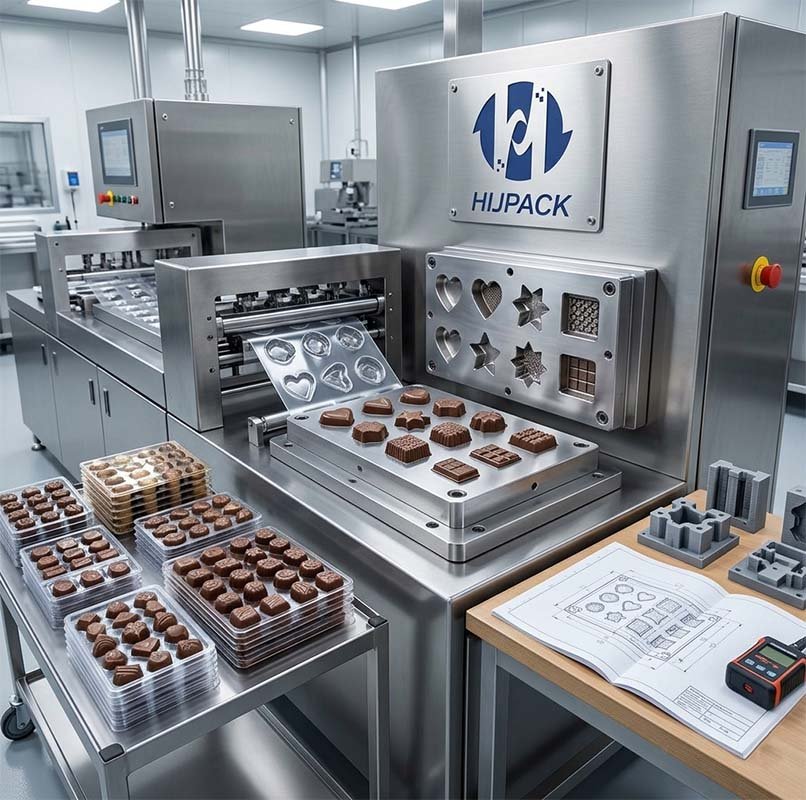
HIJ’s chocolate blister packing machine line is configurable at the point of order to support either thermoforming (PVC/PVDC) or cold-form aluminum forming stations. Both configurations share the same sealing, coding, and cutting stations — which means if your target markets expand from Zone II to Zone IVb over a two-year horizon, you can convert the forming station without replacing the entire line.
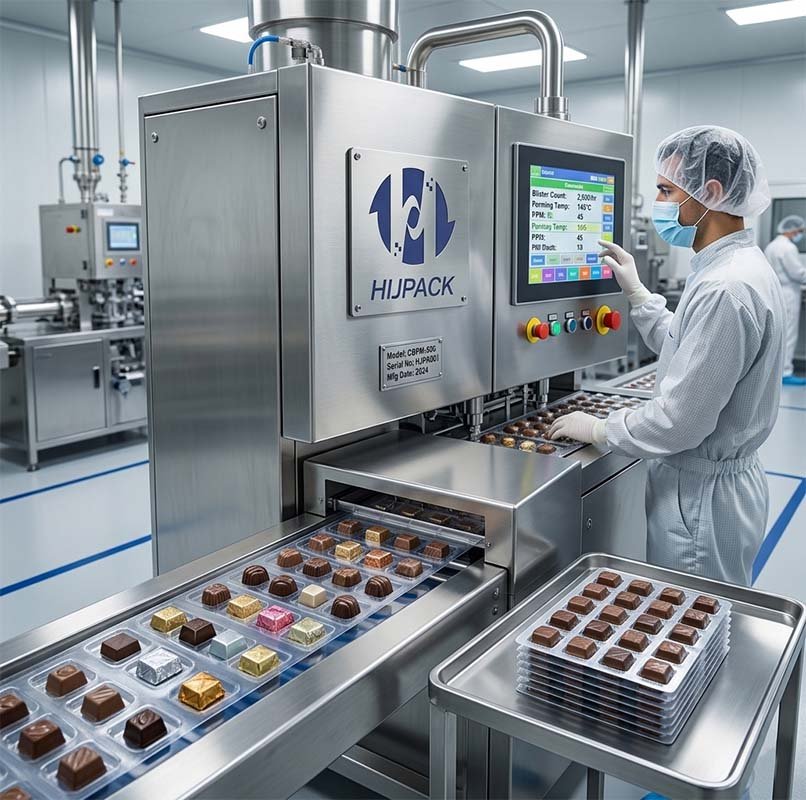
Figure 3: HIJ chocolate blister packing machine forming station — configurable for thermoforming (PVC/PVDC) or cold-form aluminum foil without replacing the base frame or sealing unit.
⚠️ Diagnostic: Is Your Machine-Material Pairing Causing These Problems?
⚠️ Symptom: Forming cavities are shallow or inconsistent across the web width
Likely cause: Forming temperature set for PVC but running PVDC-coated stock, which requires 10–15°C higher forming temperature to achieve the same draw depth. The higher PVDC softening point means the film is not fully pliable at PVC-optimized temperatures, producing shallower and geometrically inconsistent cavities across the web width — especially at edges where heat distribution is least uniform.
✅ Fix: Increase forming temperature to 115–130°C range and reduce line speed by 10–15% during initial qualification runs. Re-validate cavity depth with a go/no-go gauge set to ±0.3 mm tolerance from nominal cavity depth spec.
⚠️ Symptom: Seal integrity failures on pull test even though sealing temperature appears correct
Likely cause: Lidding foil lacquer chemistry mismatched to forming film surface energy. PVC forming film and PVDC-coated forming film have different surface energies — using the same lidding foil and seal parameters across both materials without re-qualification produces inconsistent seal bond strength.
✅ Fix: Confirm lidding foil lacquer type matches forming film substrate. Increase seal dwell time by 0.05–0.10 seconds and re-run ASTM F2338 dye-ingress test at 20 mbar differential before releasing to production.
⚠️ Symptom: Cold-form aluminum film tearing or pinholes at cavity edges
Likely cause: Punch-to-die clearance too tight for the aluminum laminate gauge being run. Cold-form OPA/Al/PVC at 45 μm requires wider punch clearance (typically 10–15% of total laminate thickness) than thermoform films of equivalent gauge. Running standard thermoforming tooling clearances with cold-form material creates excessive stress concentration at cavity edges.
✅ Fix: Adjust punch clearance to manufacturer recommendation for the specific laminate gauge. If tooling is not adjustable, it was designed for thermoforming only and requires replacement with cold-form tooling geometry.
How to Specify the Right Forming Material for Your Chocolate Blister Line: A 5-Step Process
Specifying the correct forming material for chocolate blister packaging requires five sequential decisions — climate zone mapping, shelf-life target confirmation, regulatory market check, machine compatibility audit, and supplier migration test review — completed before purchase order issuance, not after FAT.
I will not tell you this process is simple. It is not. It involves your product profile, your target distribution markets, your regulatory submission timeline, and sometimes your relationship with your film supplier. But the alternative — defaulting to PVC because that is what the machine came with — is not neutral. It is a decision with consequences that arrive six months later.
- Step 1 — Map your distribution climate zones. Use ICH Q1F zone definitions. If any target market is Zone IVa (30°C/65% RH) or IVb (30°C/75% RH), standard PVC is eliminated from the shortlist immediately. This includes most of Southeast Asia, Sub-Saharan Africa, South Asia, and the Middle East. Do not rationalize exceptions.
- Step 2 — Confirm your declared shelf-life target. Under 6 months in Zone I/II: PVC is viable. 6–12 months or Zone III: PVDC-coated PVC at 40+ g/m² coating weight. Over 12 months or any Zone IVb market: cold-form aluminum foil, no exceptions.
- Step 3 — Check target market food contact regulations. EU: Regulation 10/2011 + EFSA opinions. USA: 21 CFR 177 (indirect food additives). Brazil: ANVISA RDC 88/2016. GCC countries: GSO 1863. Request migration test certificates from your film supplier for fatty food simulant (simulant D2). Do not accept a declaration of compliance without the underlying test data.
- Step 4 — Audit your machine’s forming station compatibility. Confirm whether your chocolate blister packing machine supports cold-form aluminum if that material is on your shortlist. Ask specifically: maximum forming clamping pressure (bar), punch-to-die clearance range (mm), and whether a cold-form station conversion is available as a field upgrade. Get this in writing.
- Step 5 — Run accelerated shelf-life validation before commercial launch. Place sealed blisters at 40°C/75% RH (ICH Zone IVa conditions) for a minimum of three months. Inspect for fat bloom, texture change, and sensory deviation. Do not extrapolate six-month shelf-life claims from three-week ambient data. The correlation is not linear under humidity cycling.
Chocolate Blister Packaging Material Cost per Blister: The Number That Changes Everything
The forming material cost delta between food-grade PVC and cold-form aluminum foil for chocolate blister packaging is typically $0.008–$0.018 per blister at commercial volumes — a figure that sounds significant until benchmarked against the average cost of a partial product recall in confectionery retail markets, which runs $120,000–$450,000 depending on distribution depth and market.
Here is the math I run for every client considering the PVC-to-cold-form upgrade decision. Annual production: 5 million blisters. Cost delta: $0.012 per blister for cold-form aluminum versus food-grade PVC. Annual material cost premium: $60,000. Probability of a moisture-driven quality event in a Zone IVb market using PVC over 24 months, based on my project experience: roughly 30–40% for high-cocoa products. Expected cost of one recall event: $200,000 minimum. Expected value of the recall risk per year: $30,000–$40,000.
The material upgrade costs $60,000 per year. The risk it mitigates is worth $30,000–$40,000 per year in expected value terms. On that math alone, PVC looks cheaper. But that calculation ignores brand damage, distributor relationship deterioration, and regulatory attention that follows a quality event. Those are not line items in a procurement spreadsheet, but they are real costs.
For a deeper breakdown of total line investment and ROI modeling, the chocolate blister packing machine cost analysis covers capital expenditure alongside material and operating cost variables across different production scales.
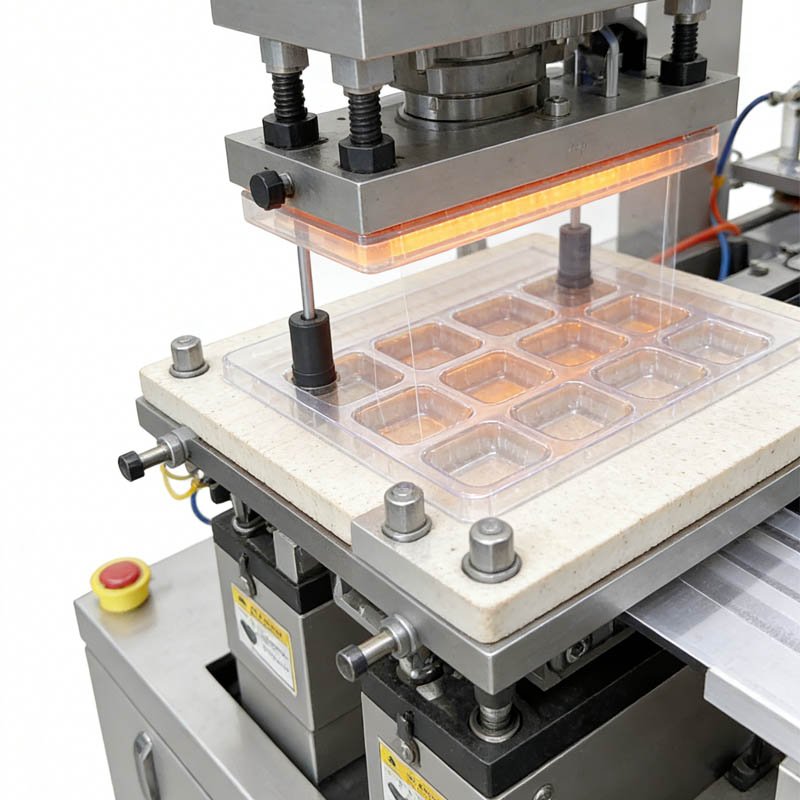
Figure 4: Blister forming station running PVC thermoforming film. The forming temperature, dwell time, and vacuum parameters must be re-validated for each forming film grade — changing supplier or coating weight counts as a material change requiring requalification.
Which Chocolate Blister Packaging Material Is Right for Your Specific Product and Market?
Use food-grade PVC if your chocolate product has under 50% cocoa content, your shelf-life claim is six months or less, and 100% of your distribution is in Zone I or II climates — otherwise, start with PVDC-coated PVC as your minimum barrier specification and evaluate cold-form aluminum foil for any tropical or extended shelf-life requirement.
The decision is not always cold-form aluminum. I want to be clear about that. I have commissioned lines in the UK, Germany, and Chile where food-grade PVC was the correct material choice for the specific product profile, shelf-life target, and distribution network. The mistake is not choosing PVC — it is choosing PVC without verifying those three conditions hold.
| If Your Product Is… | And Your Target Market Is… | And Shelf-Life Target Is… | Recommended Material |
|---|---|---|---|
| Milk chocolate <50% cocoa | Zone I/II (Europe, North America) | ≤6 months | Food-grade PVC 250 μm |
| Milk or dark chocolate | Zone II/III (Southern Europe, Latin America) | 6–12 months | PVDC/PVC 40–60 g/m² |
| Dark or premium chocolate 50–70% cocoa | Zone III/IVa (Middle East, North Africa) | 12–15 months | PVDC/PVC 90 g/m² |
| High-cocoa (≥70%), inclusions, or hygroscopic fillings | Zone IVb (SEA, West Africa, South Asia) | ≥18 months | Cold-form Al foil (OPA/Al/PVC) |
| Any premium gifting SKU with point-of-sale display requirement | Any zone | Any | Cold-form Al foil or PVDC/PVC ≥60 g/m² |
This table is a starting framework, not a validated specification. Confirm material selection with accelerated stability data at your actual distribution climate conditions before commercial launch.
For buyers comparing packaging format options more broadly — including blister versus flow-wrap — the material barrier question intersects with format choice in ways the chocolate blister vs flow-wrap packaging comparison covers in detail.
Frequently Asked Questions: Chocolate Blister Packaging Materials
❓ What is the best forming material for chocolate blister packaging in tropical climates?
Cold-form aluminum foil laminate (OPA/Al/PVC or OPA/Al/PP, 45–60 μm total) is the only forming material with validated MVTR below 0.02 g/m²/day — which is what you need for Zone IVb climates (30°C/75% RH) when your shelf-life target exceeds 12 months. PVDC-coated PVC at 90 g/m² coating weight is a workable compromise for Zone IVa at shelf-life targets up to 15 months if cold-form tooling is not available on your current line, but it carries meaningful residual moisture risk for high-cocoa products. There is no thermoforming film that performs equivalently to cold-form aluminum at 30°C/75% RH conditions — any vendor claim to the contrary should be backed by ASTM E96 test data, not product literature.
❓ Is food-grade PVC safe for chocolate packaging?
Yes — food-grade PVC compliant with EU Regulation 10/2011 and FDA 21 CFR 177.1520 is approved for direct food contact with chocolate, provided migration limits are met for the specific plasticizer package used. The food safety question and the shelf-life performance question are separate. PVC is safe. For many applications in temperate climates with short shelf lives, it is also the correct choice. The problem is not food safety — it is barrier performance in high-humidity environments and the resulting product quality failure, not a regulatory one.
❓ Can I run cold-form aluminum foil on a standard chocolate blister packing machine designed for PVC?
In most cases, no — not without a forming station hardware modification. Cold-form aluminum requires mechanical punch pressure up to 200 bar and specific punch-to-die clearance geometry that differs fundamentally from thermoforming tooling. The sealing, coding, and cutting stations of a thermoforming line are generally compatible with cold-form aluminum operation, but the forming station itself requires conversion or replacement. Ask your machine supplier specifically whether a cold-form station upgrade is available as a field kit before purchasing, and confirm the upgrade cost in writing.
❓ What MVTR do I need for my chocolate blister packaging material?
The MVTR target depends on your product’s moisture sensitivity, distribution climate, and shelf-life claim. A general framework: for milk chocolate at 6-month shelf life in Zone I/II, MVTR below 3 g/m²/day is usually sufficient; for dark chocolate at 12 months in Zone III, target MVTR below 1.0 g/m²/day; for any product in Zone IVb at 18+ months, target MVTR below 0.05 g/m²/day. These numbers should be validated against your specific API moisture uptake rate and thermodynamic modelling — they are starting points, not validated specifications.
❓ Does PVDC coating affect the thermoforming process on a chocolate blister line?
Yes. PVDC has a higher softening point than standard PVC, so forming temperature must increase by 10–15°C and line speed may need to reduce by 10–15% during initial qualification runs to achieve equivalent cavity depth and geometry. The forming station temperature profile should be revalidated any time forming film grade changes — including changes in PVDC coating weight from the same supplier. This is a process change, not just a material swap, and it warrants a documented change control record.
❓ How do I know which chocolate blister packing machine to choose based on my material requirements?
Start with material. Define the forming film your product and target markets require before evaluating machine specifications. Then confirm machine compatibility with that material: thermoforming only, cold-form only, or dual-configuration. The chocolate blister packing machine buyer’s guide covers the full equipment selection framework including speed, mold compatibility, and output configuration alongside material considerations.
🎯 Next Step — HIJ Machinery
Get Material & Machine Compatibility Validated Together
Tell us your target markets, shelf-life requirement, and product type. We will specify the correct forming material, confirm machine configuration compatibility, and provide a validated seal parameter starting point — before you place a purchase order.