
NJP Series · Since 2004
Capsule Filling Machines: Precision Built for Pharma & Nutraceutical Production
From lab-scale encapsulation to fully automatic NJP-Series lines running up to 120,000 capsules per hour, every HIJ capsule filler is cGMP-ready, CE-marked, and engineered around your URS — backed by my 20 years as founder and chief engineer. — Forester Xiang
20+Years Founder Expertise
100+Pharma Facility Audits
30+Countries Served

±2%Filling Accuracy
120,000Capsules/Hour (NJP-2000)
Quick Answer
What is a capsule filling machine?
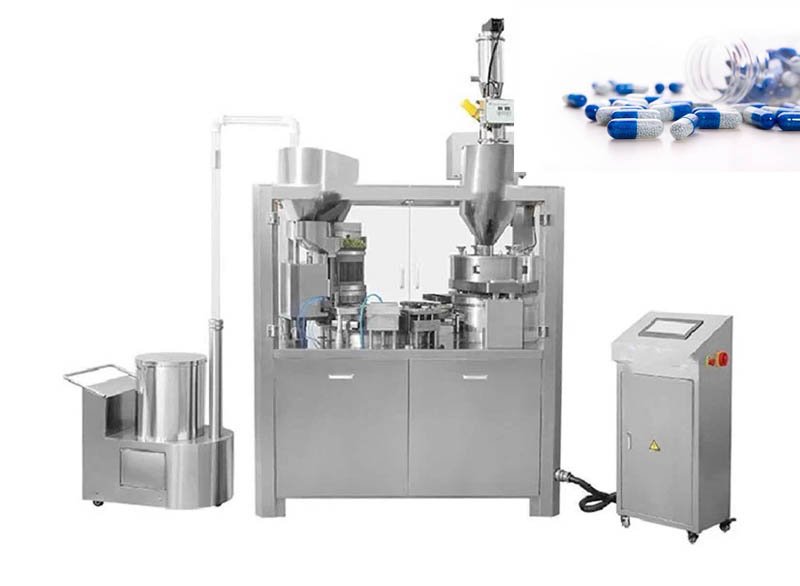
A capsule filling machine is equipment that separates empty hard capsules, doses powder, granules, pellets, or liquid into the capsule body, then rejoins and locks the cap. HIJ's NJP-Series automatic capsule fillers run from 48,000 to 120,000 capsules per hour with ±2% dosing accuracy, handle sizes 00#–5# plus safety capsules A–E, and use 316L stainless steel contact parts in a cGMP-ready, CE-marked design.
Key Takeaways
- Match the machine to your scale: lab/R&D batches suit a small or semi-automatic filler; commercial production from 48,000 capsules/hour and up calls for a fully automatic NJP-Series machine.
- Match the dosing system to your material: tamping-pin dosing suits free-flowing powders and granules; dosator and liquid-pump systems handle cohesive powders, oils, and suspensions.
- Verified NJP performance: ±2% filling accuracy, >99% capsule separation rate, capsule sizes 00#–5# and safety A–E, size-only changeover in 20–30 minutes.
- Compliance done right: HIJ equipment is cGMP-ready and CE-marked, built to ISO 9001 manufacturing standard, and ships with DQ/IQ/OQ documentation that supports your validation program — we never claim self-certification.
- Think in lines, not machines: a capsule filler pays off fastest when integrated with polishing, capsule blister packing, and cartoning in one turnkey project.
Complete Product Range
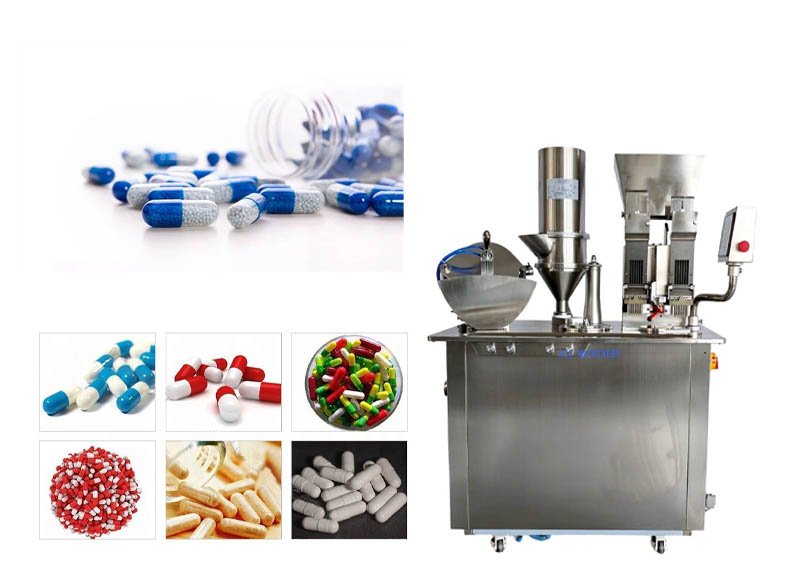

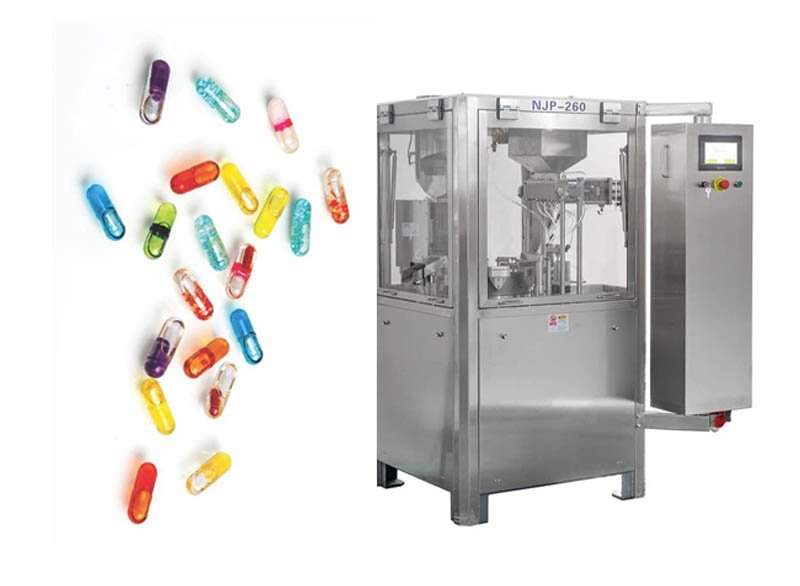
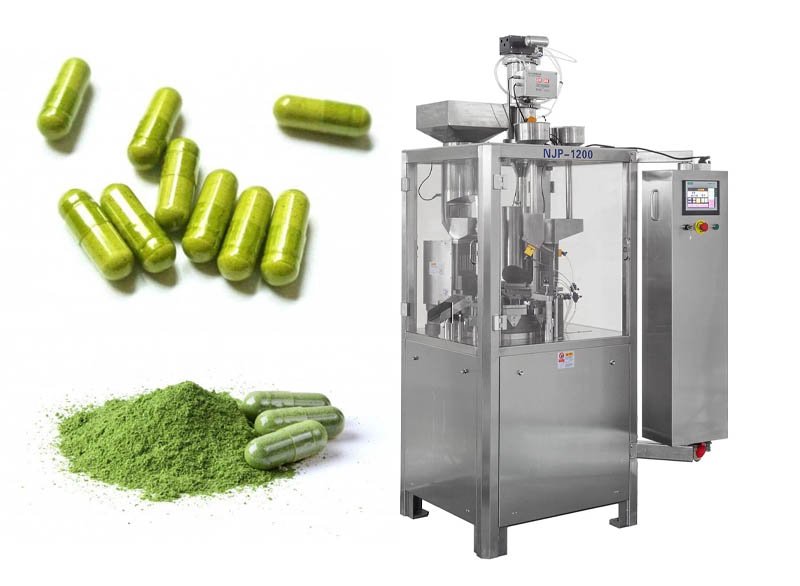
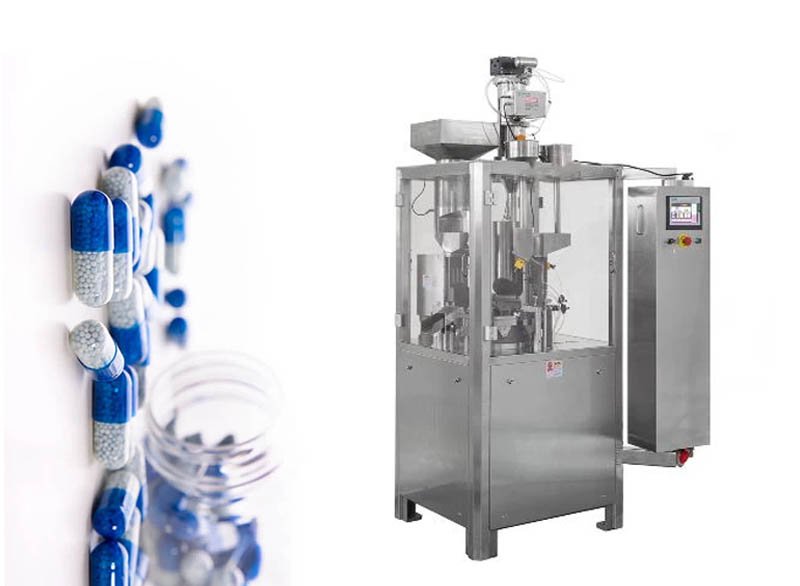

Find the Right Capsule Filler for Your Production Stage
Whether you are running R&D batches, scaling a supplement brand, or operating a 24/7 pharmaceutical line, there is an HIJ capsule filling machine engineered for the job.
Automatic Capsule Filling Machine
Speed48,000–120,000/hr
ModelsNJP-800 / 1200 / 2000
Best ForHigh-Volume Production
The NJP-Series workhorse for large-scale pharmaceutical and nutraceutical manufacturing with ±2% dosing accuracy.
Explore the NJP-Series
Semi-Automatic Capsule Filling Machine
SpeedUp to 25,000/hr
OperationSemi-Automatic
Best ForMid-Scale Production
The balance of affordability and output for growing operations that are not yet ready for full automation.
See Semi-Auto Details
Pharmaceutical Capsule Filling Machine
DesigncGMP-Ready
Contact Parts316L Stainless Steel
Best ForRegulated Pharma
Built for regulated production with full DQ/IQ/OQ documentation to support your validation program.
View Pharma Model
Liquid Capsule Filling Machine
Filling TypeLiquids & Oils
SystemPrecision Liquid Pump
Best ForOils & Suspensions
Specialized pump dosing with anti-leakage design for oil-based, suspension, and liquid-in-hard-capsule formulations.
Discover Liquid Filling
Powder Capsule Filling Machine
Filling TypePowders & Granules
DosingTamping Pin / Dosator
Best ForDry Formulations
Precision dosing-disc technology for powders, granules, and pellets — including sticky and low-density blends.
See Powder Dosing Tech
Small Capsule Filling Machine
FootprintCompact
OperationLab / Small Batch
Best ForR&D & Startups
A space-saving encapsulation solution for research, formulation development, and clinical or pilot batches.
Check Lab-Scale Options
Commercial Capsule Filling Machine
GradeCommercial
ChangeoverQuick-Change Tooling
Best ForCMOs & Supplement Brands
A reliable, cost-effective filler for contract manufacturers and nutraceutical brands running multiple SKUs.
Review Commercial Specs
Industrial Capsule Filling Machine
Duty24/7 Heavy-Duty
ConstructionForged Cam Mechanism
Best ForMass Production
Engineered for continuous operation in the most demanding high-volume pharmaceutical facilities.
Explore Industrial Line
Side-by-Side Comparison
Capsule Filling Machine Comparison Table
Compare every HIJ capsule filler at a glance — by automation level, dosing system, and the production stage it serves best.
| Machine Type | Automation | Dosing System | Typical Use Case | Details |
|---|---|---|---|---|
| Automatic (NJP-800/1200/2000) | Fully automatic | Tamping pin dosing disc | Commercial pharma & nutra lines, 48,000–120,000 caps/hr | NJP-Series specs |
| Semi-Automatic | Operator-assisted | Auger / dosing plate | Mid-scale production, multi-product flexibility | Semi-auto details |
| Pharmaceutical | Fully automatic | Tamping pin, 316L contact parts | Regulated production requiring full validation documentation | Pharma model |
| Liquid | Fully automatic | Precision liquid pump | Oils, suspensions, liquid-in-hard-capsule products | Liquid filler |
| Powder | Fully automatic | Tamping pin / dosator | Powders, granules, pellets incl. sticky & low-density blends | Powder filler |
| Small / Lab-Scale | Manual to semi-auto | Compact dosing | R&D, formulation trials, clinical & pilot batches | Lab-scale range |
| Commercial | Fully automatic | Quick-change tooling | CMOs and supplement brands running many SKUs | Commercial specs |
| Industrial | Fully automatic, 24/7 duty | Forged cam mechanism | Continuous mass production in high-volume facilities | Industrial line |
All NJP-Series machines handle capsule sizes 00#–5# plus safety capsules A–E, with ±2% filling accuracy and >99% capsule separation rate.
Not Sure Which Machine Fits? Ask Forester.
Share your batch size, product type, and output target. I'll personally review your requirements and send back a machine recommendation with a detailed quotation within 48 hours.
Get Expert Recommendation
Expert Guidance

How to Choose a Capsule Filling Machine: Forester's 3-Step Method
Selecting a capsule filler isn't just about speed — it's about matching the technology to your product, your process, and your growth plan.
Forester Xiang — Founder & Chief Engineer, HIJ Machinery
I've spent 20+ years and 100+ pharmaceutical facility audits helping clients in 30+ countries avoid expensive selection mistakes. Work through these three questions in order, and the right machine usually chooses itself. For a deeper dive, read my capsule filling machine size selection guide.
1
By Production Scale
R&D / Lab Scale — under 15,000/hr
Forester recommends
A small capsule filling machine: compact footprint, flexible for formulation trials and clinical batches.
Pilot / Mid-Scale — 15,000–48,000/hr
Forester recommends
A semi-automatic filler for flexibility, or a commercial machine for steady mid-volume output.
Full Production — 48,000/hr and above
Forester recommends
An automatic NJP-Series machine, or the industrial line for 24/7 duty.
2
By Filling Material
Powders & Granules
Forester recommends
A powder capsule filling machine — tamping-pin or dosator dosing keeps weight variation tight even on tricky blends.
Liquids, Oils & Suspensions
Forester recommends
A liquid capsule filling machine with a precision pump system and anti-leakage design.
Pellets & Mini-Tablets
Forester recommends
Specialized counting and dispensing tooling configured on automatic NJP models — accurate filling with zero pellet damage.
3
By Automation Level
Maximum Flexibility, Lower Budget
Forester recommends
A semi-automatic machine: manual control where it matters, easy changeovers across many products, lower initial investment.
High Speed, Repeatability, Lower Labor
Forester recommends
A fully automatic machine: consistent quality, digital recipe storage, and minimal operator intervention shift after shift.
Full Line Integration
Forester recommends
Pair your filler with polishing, checkweighing, and packing in one turnkey production line project — one partner, one responsibility.
Advanced Technology
Engineering Built for Precision and Your Compliance Journey
Every design decision on an HIJ capsule filler solves a real manufacturing problem — and makes your qualification work easier, not harder.
Precision Dosing Technology
Tamping-pin dosing discs with servo-controlled compression deliver ±2% filling accuracy across capsule sizes 00#–5#, cutting API waste and keeping every batch inside specification.
Accuracy ±2%
Separation Rate >99%
Sizes 00#–5# + Safety A–E
Modular Quick-Change Design
Tool-free change parts and digital recipe storage make size-only changeovers possible in 20–30 minutes, with full product changeovers including cleaning typically completed in 45–60 minutes.
Tool-Free Change Parts
Digital Recipe Storage
Size Change 20–30 min
Hygienic, cGMP-Ready Construction
All product-contact parts are 316L stainless steel, the enclosed turntable prevents dust leakage, and an integrated dust collector keeps the workspace clean. Tool-free disassembly of hopper and dosing station simplifies your cleaning validation.
316L Contact Parts
cGMP-Ready Design
CE-Marked
Siemens PLC Control & Data Support
A Siemens (or Delta) PLC with intuitive HMI gives operators clear parameter control, while audit-trail and user-management functions support your 21 CFR Part 11 compliance program — your team validates, our documentation backs you up.
Siemens PLC + HMI
Audit Trail Functions
User Access Control
Industry Applications
Trusted Across Pharmaceutical, Nutraceutical & Contract Manufacturing
Each sector has its own regulatory pressure and formulation challenges. Our capsule fillers are configured to meet each environment head-on.
Pharmaceutical Manufacturing
Regulatory Support & Data IntegrityDesigned so your validation team can qualify the equipment efficiently — from prescription drugs and generics to clinical trial batches.
- DQ/IQ/OQ documentation package delivered with every machine to support your qualification work
- Audit-trail, electronic-record, and user-access functions that support your 21 CFR Part 11 compliance program
- 316L stainless steel contact parts with material certificates
- Factory Acceptance Test (FAT) performed with your own products before shipment
Nutraceuticals & Supplements
Flexibility for Complex FormulationsHandle botanical extracts, sticky herbal powders, and probiotics with dosing technology that adapts to varying powder characteristics across many SKUs.
- Specialized tooling for cohesive, abrasive, and segregation-prone botanical blends
- Quick changeovers between formulations with low cross-contamination risk
- Dosing adjustment for the varying bulk densities common in natural ingredients
- Food-contact compliant materials referencing FDA 21 CFR 175–178 and EU 1935/2004
Contract Manufacturing (CMOs)
Maximum Flexibility & UptimeServe multiple clients efficiently with rapid product changeovers and flexible batch sizing — without compromising documentation quality for any client.
- Size-only changeovers in 20–30 minutes with color-coded tooling
- Segregated digital recipe storage with user-specific access control
- Batch scalability from pilot runs to commercial production
- Cleaning-friendly, tool-free disassembly to support your cleaning validation between projects
The HIJ Partnership
More Than a Machine — A Partner for the Life of Your Line
Founded in 2004 in Rui'an, China, HIJ Machinery combines two decades of encapsulation engineering with pricing that makes world-class equipment accessible.
Performance-Level Quality, Smart Pricing
Precision engineering and quality materials benchmarked against leading European brands — at a significantly more accessible investment level. See why manufacturers choose HIJ.
20+ Years of Application Expertise
We don't just sell machines — we solve formulation and production problems, drawing on 100+ pharma facility audits across 30+ countries.
Global Service & Support
Installation, operator training, remote troubleshooting, and spare parts through our service & support program — across all time zones.
100% FAT Before Shipment
Every machine passes a Factory Acceptance Test with your own products and capsules before it leaves Rui'an — you see the results before you ship.
Forester's Insight
Founder & Chief Engineer, HIJ Machinery
The most common mistake I see buyers make is choosing a capsule filler purely on rated speed. A machine's brochure speed means nothing if your powder bridges in the hopper or your team spends two hours on every changeover. The right question is not "how fast can it run?" but "how fast can it run with my formulation, my capsules, and my operators?"
That's exactly why we insist on a Factory Acceptance Test with your actual product before shipment. When you watch your own powder filling at rated speed with weight data on the screen, the decision stops being a gamble. If a supplier won't run FAT with your product, that tells you everything you need to know.
Knowledge Hub
Capsule Filling Guides from 20 Years on the Factory Floor
Practical, engineering-grade answers to the questions buyers ask before investing in encapsulation equipment.
Buying Guide
Capsule Filling Machine Size Selection Guide
How to match machine capacity, capsule sizes, and dosing systems to your real production requirements — step by step.
Read the guide → Product Deep-DiveNJP-Series Automatic Capsule Fillers: Full Specifications
Compare NJP-800, NJP-1200 and NJP-2000 side by side — capacity, power, dimensions, and the dosing technology behind ±2% accuracy.
Compare NJP models → Line PlanningTurnkey Capsule Production Line Solutions
From filling and polishing to blister packing and cartoning — how a single-source turnkey project protects your timeline and budget.
Plan your line →Complete Your Capsule Packaging Line
About HIJ Machinery & This Page
HIJ Machinery (legal name: Wenzhou Trustar Machinery Technology Co., Ltd) is a pharmaceutical, nutraceutical, and food packaging machinery manufacturer founded in 2004 in Rui'an, Wenzhou, Zhejiang, China. The company designs and builds NJP-Series capsule filling machines, blister packing machines, cartoning machines, and complete turnkey packaging lines exported to 30+ countries.
HIJ capsule filling equipment is cGMP-ready and CE-marked, manufactured under ISO 9001 manufacturing standard, with 316L stainless steel product-contact parts. Each machine ships with DQ/IQ/OQ documentation designed to support the customer's own validation and qualification program.
This page was written and reviewed by Forester Xiang, founder and chief engineer of HIJ Machinery, drawing on 20+ years of encapsulation and packaging engineering experience and 100+ pharmaceutical facility audits worldwide. Contact: hijpackingmachine.com/contact-us · +86 13868822120 · Xinhu Mansion, Rui'an City, Zhejiang Province, China.
Expert Answers
Capsule Filling Machine FAQ
The questions buyers ask most before choosing an encapsulation machine — answered by Forester Xiang.
What is a capsule filling machine and how does it work?
A capsule filling machine separates empty hard capsules into cap and body, doses powder, granules, pellets, or liquid into the body, then rejoins and locks the two halves. Automatic machines like the HIJ NJP-Series complete orienting, separating, filling, faulty-capsule rejection, and closing in one continuous rotary cycle, producing 48,000 to 120,000 finished capsules per hour with ±2% dosing accuracy.
What is the difference between tamping pin and dosator dosing technology?
Tamping pin systems compress powder into a dosing disc in stages before transferring the slug into the capsule, which suits free-flowing powders and granules with predictable flow. Dosator systems draw a measured slug of powder directly into a cylinder, which handles cohesive, sticky, or poorly flowing materials common in herbal and nutraceutical formulations. HIJ machines can be configured with either system, and we run free powder trials with your formulation to confirm the right choice before purchase.
How fast is an automatic capsule filling machine?
HIJ's NJP-Series automatic capsule fillers produce 48,000 capsules per hour on the NJP-800, 72,000 per hour on the NJP-1200, and 120,000 per hour on the NJP-2000. Semi-automatic machines typically run up to about 25,000 capsules per hour, while small lab-scale units are designed for R&D and pilot batches rather than continuous output. All NJP models handle capsule sizes 00# to 5# plus safety capsules A to E.
How long does a capsule size or product changeover take?
A size-only changeover on an NJP-Series machine takes 20 to 30 minutes using tool-free, quick-change format parts. A complete product changeover, including dismantling, cleaning, sanitization, and setup of the new recipe, typically takes 45 to 60 minutes. Machine parameters are stored digitally, so repeat products can be recalled instantly without re-calibration from scratch.
What documentation do you provide to support validation (DQ/IQ/OQ/PQ)?
Every HIJ capsule filling machine ships with a documentation package designed to support your own qualification program: Design Qualification (DQ) specifications, Installation Qualification (IQ) checklists with 316L material certificates and calibration records, Operational Qualification (OQ) test protocols, and Performance Qualification (PQ) templates for your product-specific runs. Your team executes the validation; our documentation and on-site engineers support it, including a Factory Acceptance Test performed with your own products before shipment.
What is the lead time for a capsule filling machine?
A standard-configuration machine typically ships 10 to 12 weeks after deposit, including manufacturing, assembly, and Factory Acceptance Testing. Custom configurations with specialized tooling or containment options generally take 14 to 16 weeks, and complete turnkey lines with polishing, checkweighing, and packing integration take 16 to 20 weeks. We recommend ordering 4 to 6 months before your planned production start to allow for shipping, installation, and operator training.
Ready to Specify Your Capsule Filling Line?
Send me your batch size, formulation type, and output target. I'll personally prepare a machine recommendation, layout suggestion, and detailed quotation — usually within 48 hours.
Get Free Turnkey Quote