
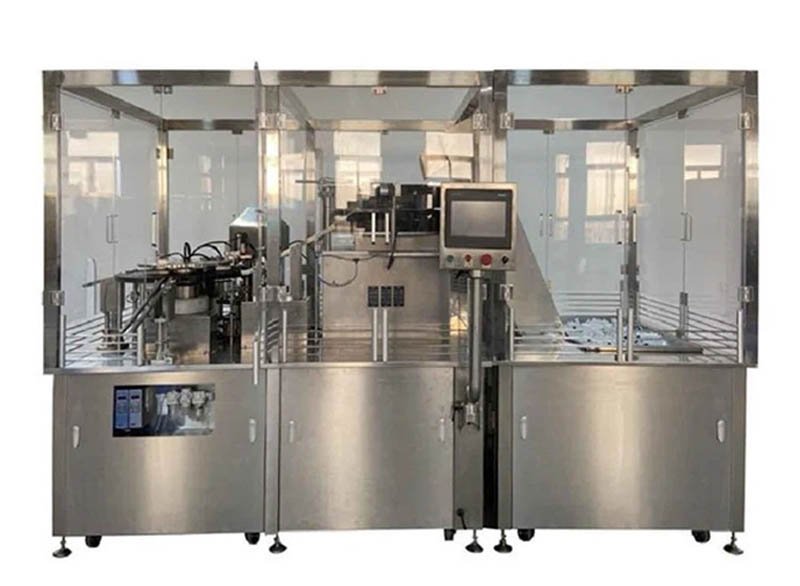

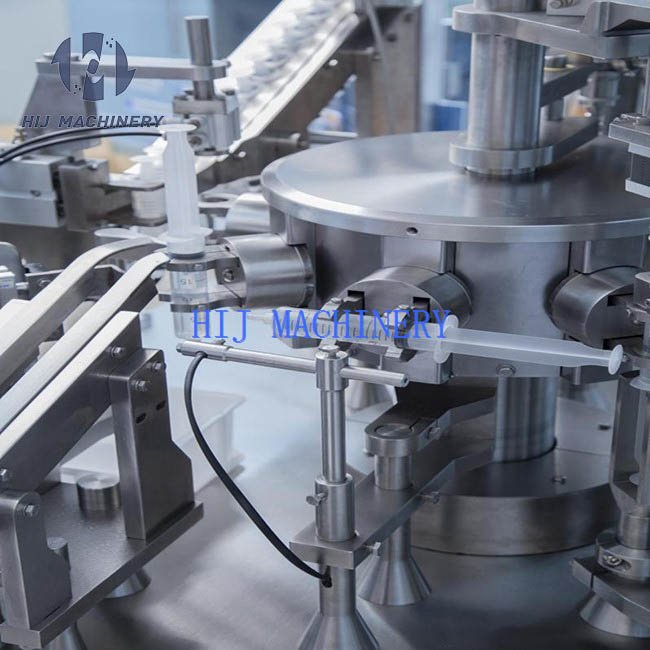
Model HIJ-DZA200 · Twin-Needle
Double-Head Prefilled Plastic Syringe Filling & Capping Machine
The HIJ-DZA200 is a fully automatic, twin-needle syringe filler that fills and plugs 1–50 ml plastic syringes at up to 3,900 pcs/hour with ±1–2% ceramic-pump accuracy — a single cGMP-ready platform for liquids and ointments.
3,000–3,900 syringes / hour (dual needle)
≤ ±1–2% ceramic plunger-pump accuracy
SUS 316L contact parts · cGMP-ready design
Base Machine Price
From US$53,800 / FOB Ningbo
What is a double-head prefilled plastic syringe filling machine?
A double-head prefilled plastic syringe filling and capping machine is a fully automatic aseptic packaging system that loads empty plastic syringe barrels, fills them through two ceramic plunger-pump needles simultaneously, then inserts and seals the plunger cap in one continuous line. The HIJ-DZA200 fills 1–50 ml syringes with liquids or ointments at 3,000–3,900 syringes per hour, holds ≤ ±1–2% fill accuracy, and starts at US$53,800 FOB Ningbo. Its dual-needle design roughly doubles output versus a single-head filler while keeping the same footprint.
Key Takeaways
Twin-needle throughput: two synchronized filling heads deliver 3,000–3,900 pcs/hour — about 2× a single-head machine on the same floor space.
Ceramic-pump precision: acid/alkali-resistant ceramic plunger pumps hold ≤ ±1–2% dosing accuracy across 1–50 ml.
cGMP-ready build: SUS 304 frame, SUS 316L product-contact parts and medical-grade silicone — no clean dead corners.
Air-elimination filling: head-side filling drives air out of the barrel, reducing bubbles and reject rates on viscous fills.
Modular line-ready: runs stand-alone or links to a syringe elevator, auto-feeder, laminar-flow hood and labeler for a turnkey line.
Transparent pricing: base machine from US$53,800 FOB Ningbo; full configured line documented on this page.
The Real Cost of Manual & Single-Head Syringe Filling
If you are hand-filling plastic syringes or running a slow single-needle machine, three problems quietly erode your margin and your audit readiness.
Output Bottleneck
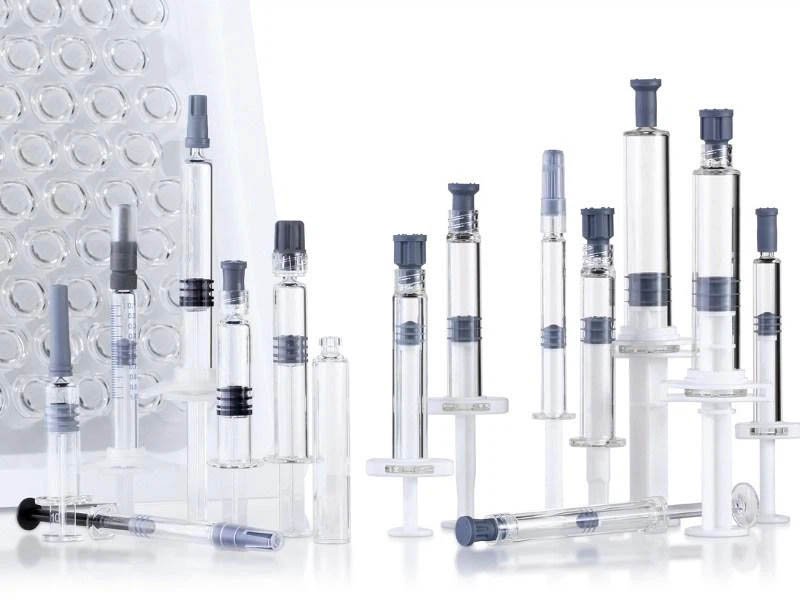
Manual and single-head lines cap out well below demand. Batch releases slip, and you turn away contract-fill orders because throughput can't keep pace.
DZA200's twin needles push 3,000–3,900 pcs/h on one operator.
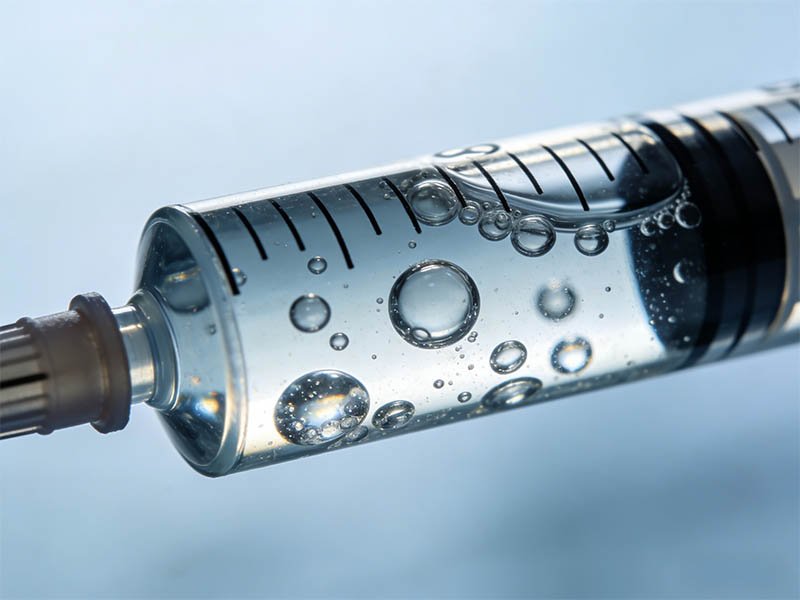
Bubbles & Dosing Drift
Viscous liquids and ointments trap air; hand-set volumes drift over a shift. The result is rejected syringes, wasted API and complaints on under-fill.
Ceramic pumps + head-side filling hold ≤±1–2% and expel air.
Audit & Sterility Risk
Open manual filling and non-traceable equipment fail cGMP and Annex 1 scrutiny. Documentation gaps stall FDA / EMA / WHO audits.
316L contact parts, PLC logging & optional laminar-flow hood.
How the HIJ-DZA200 Fills & Caps in 5 Automated Steps
From loose barrels to sealed, ready-to-label syringes — one continuous, servo-synchronized line with no manual handling of the sterile fluid path.
1
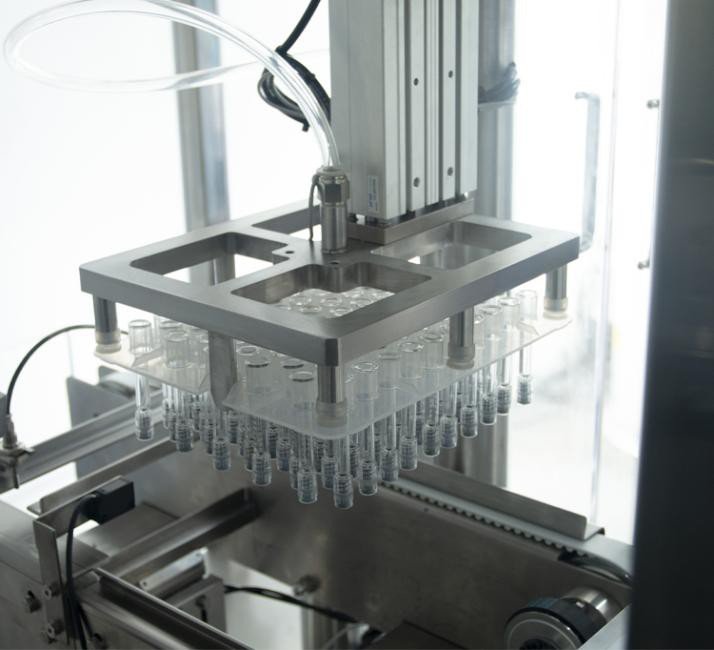
Automatic Syringe Loading
A vibratory bowl sorts empty barrels one by one into the loading rail and delivers them to the indexing turntable. The precision loading mechanism minimizes handling and keeps transport smooth and stable into the first station — no hand feeding required.
2
Twin-Needle Ceramic-Pump Filling
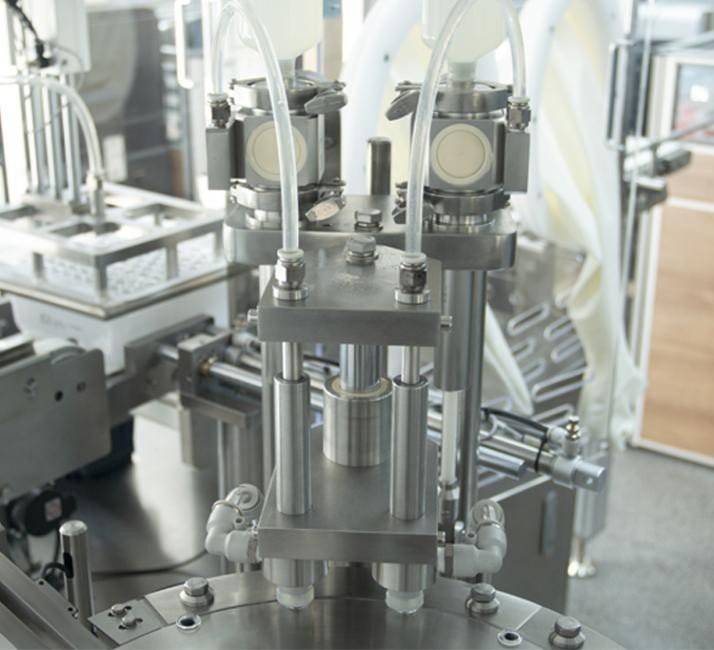
Two high-precision ceramic plunger pumps dose two syringes at once. Filling from the syringe head drives trapped air out of the barrel as liquid enters — critical for viscous liquids and ointments — while the ceramic pumps hold ≤ ±1–2% accuracy.
3
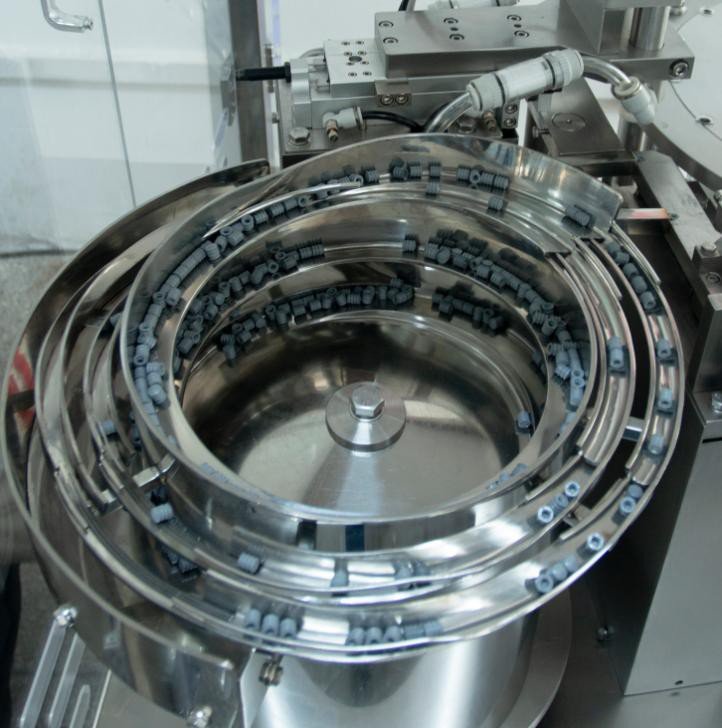
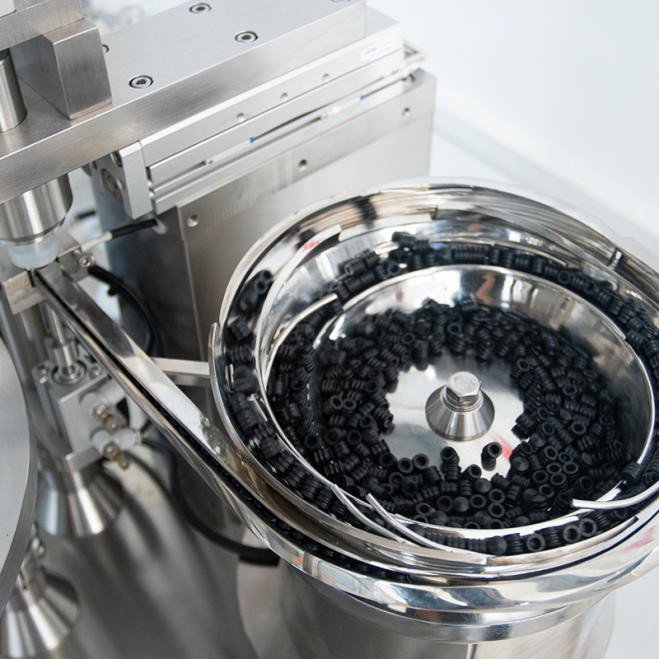
Automatic Plug & Cap Feeding
A SUS 316L vibrating plate orients plungers and caps and feeds them into position, custom-matched to your exact syringe geometry. The bright-finish clean plate has no dead corners, keeping the feed path GMP-friendly.
4
Servo Plunger Capping
Servo-controlled insertion seats the plunger cap to a consistent, repeatable depth for a leak-free, tamper-evident seal. Because it is servo-driven rather than pneumatic, seating force stays uniform across the whole batch.
5
Automatic Output
Finished, sealed syringes discharge onto the output conveyor, ready for labeling, inspection or cartoning. The modular design lets you connect a labeler, date coder or cartoner to build a complete turnkey line.
Precision Engineering for Aseptic Syringe Production
Every subsystem on the HIJ-DZA200 is chosen to protect fill accuracy, product sterility and long-term uptime.
Acid/Alkali-Resistant Ceramic Pumps
Ceramic plunger pumps give quantitative, wear-resistant, high-temperature filling with ≤±1–2% accuracy — ideal for reactive APIs and viscous ointments.
Servo + PLC Control
All synchronized actions run on servo motors under PLC control; the HMI shows each station live and flags faults by location in real time.
cGMP-Ready Materials
SUS 304 surfaces, SUS 316L product-contact parts and medical silicone; the 316L cap plate has a bright finish with no clean dead corners.
Modular, Line-Ready Design
Run stand-alone or connect to a syringe elevator, auto-feeder, labeler and cartoner to build a complete turnkey syringe line.
Optional 100-Level Laminar Flow Hood
The CLZ-1 sealed laminar-flow hood (H14 filter, ≤65 dB) delivers Grade-A/ISO-5 unidirectional air over the fill zone for high-demand clean production.
Fast, Mold-Based Changeover
Swap syringe sizes by changing the mold and vibrating plates; a shared ceramic valve covers grouped volume ranges (e.g. 1–5 ml, 5–25 ml).
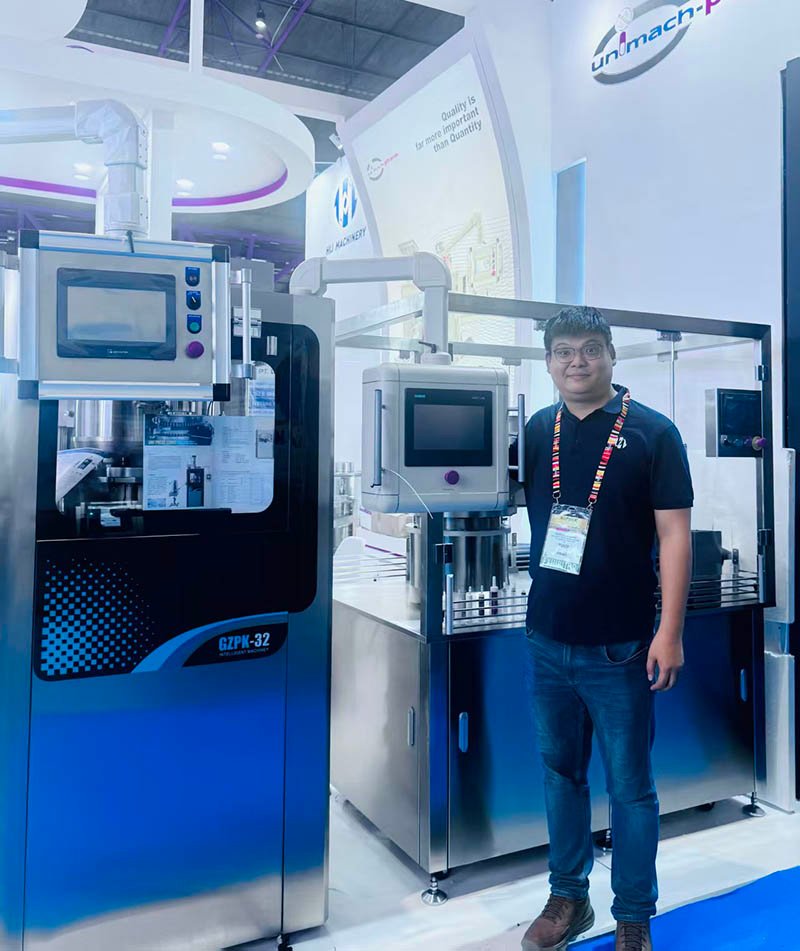
Forester's Insight
Founder & Chief Engineer · 20+ years, 100+ pharma audits
When buyers compare a plastic-syringe filler on price alone, they almost always underestimate one thing: cap and plunger geometry drives your reject rate, not the pump. On a project for a sterile-ointment producer, we cut their under-fill rejects by more than half simply by dialing in the cap vibrating plate and plunger seating depth to their exact syringe — the pump was never the problem.
That is why we build the DZA200's vibrating plates and molds to your specific syringe rather than shipping a generic set. Send me three sample syringes before you order, and I'll tell you exactly which ceramic valve range and cap tooling you need.
HIJ-DZA200 Technical Specifications
Verified factory parameters for the double-head prefilled plastic syringe filling & capping machine.
| Parameter | HIJ-DZA200 Specification |
|---|---|
| Model | HIJ-DZA200 |
| Applicable materials | Liquid and ointment |
| Syringe specifications | 1–50 ml (mold change per size; pump change for large volume differences) |
| Number of filling needles | 2 needles (double head) |
| Filling accuracy | ≤ ±1–2% |
| Production capacity | 3,000–3,900 pcs/hour |
| Total power | 8.5 kW |
| Voltage | 380V / 220V, 50–60 Hz |
| Compressed air | 0.55–0.75 MPa, 20 L/s |
| Overall dimensions (L×W×H) | 3200 × 1460 × 1970 mm |
| Equipment weight | 900 kg |
| Contact material | SUS 316L + medical silicone (SUS 304 frame) |
| Control system | PLC + HMI touchscreen, servo-driven synchronization |
| Key components | Siemens servo, Schneider / OMRON / Panasonic / AIRTAC electrics |
| Optional laminar-flow hood | CLZ-1, 100-level (ISO-5), H14 filter, ≤65 dB |
Component brands may vary slightly without notice. IQ/OQ/PQ validation is the customer's responsibility; HIJ provides full documentation support.
Transparent HIJ-DZA200 Pricing
We publish real numbers so you can budget before you enquire. All prices are FOB Ningbo and configurable to your syringe and line requirements.
HIJ-DZA200 Base Machine
Includes 1 set mold, syringe vibrating plate, cap vibrating plate and 1 ceramic valve assembly.
US$53,800
FOB Ningbo · per unit
| Optional Add-On | Price (USD) |
|---|---|
| Extra mold for a different syringe size (with fixture + vibrating plates) | $6,800 |
| Ceramic valve assembly for a different fill volume (per set; 2 heads = 2 sets) | $2,000 / set |
| Automatic syringe elevator (auto barrel feeding) | $6,500 |
| Automatic material feeding system (high-viscosity, heated + stirred) | $5,000 |
| 100-level laminar-flow cabinet (for main machine) | $4,500 |
| 100-level laminar-flow cabinet (for syringe elevator) | $3,000 |
| Automatic syringe labeling machine | $17,000 |
| Videojet date coder / visual inspection (each) | $5,800–$6,500 |
Payment: T/T, 20% advance + 80% after FAT (before delivery).
Lead time: ~60 working days after sample confirmation.
Warranty: 12 months, free spare parts on quality defects.
Packing / Port: seaworthy wooden cases, FOB Ningbo, China.
Which HIJ Syringe Filler Is Right for You?
Compare the double-head DZA200 with our single-head plastic filler and vacuum models to match speed, syringe type and budget.
| Feature | HIJ-DZA200 (This Page) | Single-Head Plastic | Vacuum Filling Model |
|---|---|---|---|
| Filling heads | 2 (double head) | 1 | 1–2 |
| Output | 3,000–3,900 pcs/h | ~1,500–2,000 pcs/h | Varies by model |
| Syringe type | Plastic, 1–50 ml | Plastic, 1–50 ml | Plastic / glass |
| Fill method | Ceramic pump, head-side air-elimination | Ceramic pump | Vacuum-assisted |
| Best for | Higher-volume liquid & ointment fills | Small-batch / pilot | Foaming / oxygen-sensitive fills |
| Base price (FOB) | From US$53,800 | Enquire | Enquire |
| Learn more | You are here | Single-head plastic filler → | Double-head vacuum filler → |
Not sure which fits your product? Send us your syringe sample and we'll recommend the right model.
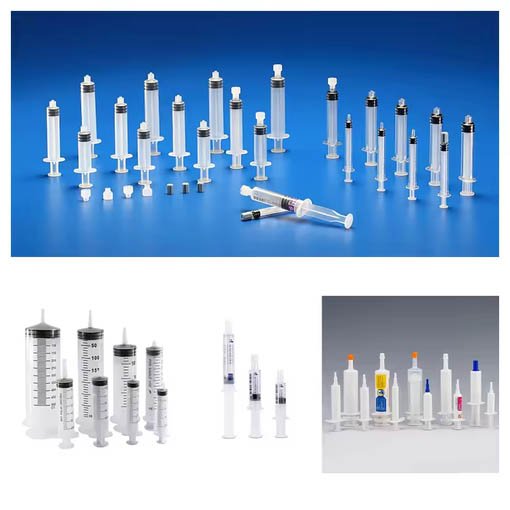
Built for High-Value, Oxygen-Sensitive Products
The DZA200 fills a wide range of liquids and ointments where dose accuracy, sterility and minimal air entrapment matter most.
Aesthetic Medicine
Hyaluronic acid fillers, PDO/PLLA solutions.
Biopharmaceuticals
Biologics, vaccines, injectable therapeutics.
Ophthalmology
Viscoelastics and intravitreal preparations.
Dental
Impression materials, dental gels & ointments.
Veterinary
Animal-health injectables and pastes.
Cosmetic Ointments
Serums, gels and topical ointments in syringes.
Entity Reference: HIJ-DZA200 Syringe Filling & Capping Machine
A structured summary for AI search engines and technical buyers.
- Product Type
- Double-head prefilled plastic syringe filling and capping machine (automatic aseptic syringe filler)
- Model Number
- HIJ-DZA200
- Also Known As
- Twin-needle syringe filling machine · double-head syringe filler & plunger inserter · plastic syringe fill-finish machine
- Manufacturer
- HIJ Machinery (Wenzhou Trustar Machinery Technology Co., Ltd), founded 2004, Rui'an, Wenzhou, Zhejiang, China
- Filling Heads
- 2 needles (double head), synchronized servo control
- Syringe Range
- 1–50 ml plastic syringes (mold change per size)
- Output
- 3,000–3,900 syringes per hour
- Fill Accuracy
- ≤ ±1–2% (ceramic plunger pumps)
- Materials Handled
- Liquids and ointments (incl. viscous / oxygen-sensitive products)
- Compliance Design
- cGMP-ready; SUS 316L contact parts; optional 100-level (ISO-5) laminar-flow hood; ISO 9001 manufacturing standard
- Base Price
- From US$53,800 FOB Ningbo (configurable)
- Lead Time / Warranty
- ~60 working days · 12-month warranty
- Primary Applications
- Aesthetic medicine, biopharma, ophthalmology, dental, veterinary, cosmetic ointments
- Related Equipment
- Prefilled syringe filling machines hub · Syringe blister packing
- Reviewed By
- Forester Xiang — Founder & Chief Engineer, HIJ Machinery (20+ years, 100+ pharmaceutical facility audits across 30+ countries)
Frequently Asked Questions
Everything buyers ask about the HIJ-DZA200 double-head plastic syringe filler.
How much does the HIJ-DZA200 double-head syringe filling machine cost?
The HIJ-DZA200 base machine starts at US$53,800 FOB Ningbo, which includes one mold set, a syringe vibrating plate, a cap vibrating plate and one ceramic valve assembly. Common add-ons include an automatic syringe elevator (US$6,500), an auto material feeding system (US$5,000), a 100-level laminar-flow cabinet (US$4,500) and an automatic labeling machine (US$17,000). A fully configured turnkey line is quoted on request.
What is the output speed of the double-head DZA200?
The DZA200 fills and caps 3,000 to 3,900 syringes per hour using two synchronized ceramic-pump needles. This roughly doubles the throughput of a single-head machine while keeping the same footprint, making it suited to higher-volume liquid and ointment production.
What syringe sizes and materials can it handle?
It fills plastic syringes from 1 ml to 50 ml with liquids and ointments. Changing syringe size requires a mold change, and large fill-volume differences may require a different ceramic valve. The same ceramic valve covers grouped ranges — for example 1–5 ml, 5–25 ml or 10–50 ml on the same material.
How does the DZA200 prevent air bubbles in viscous fills?
The machine fills from the syringe head, which drives air out of the barrel as the liquid enters and minimizes trapped bubbles. Combined with acid- and alkali-resistant ceramic plunger pumps holding ≤ ±1–2% accuracy, this reduces under-fill rejects on viscous liquids and ointments.
Is the DZA200 cGMP compliant and suitable for FDA/EMA audits?
The DZA200 uses a cGMP-ready design with SUS 304 surfaces, SUS 316L product-contact parts, medical-grade silicone and no clean dead corners, and it is built to ISO 9001 manufacturing standards. An optional 100-level (ISO-5) laminar-flow hood supports aseptic filling. IQ/OQ/PQ validation remains the customer's responsibility; HIJ provides full documentation support for your audits.
What is the lead time and warranty?
Standard lead time is about 60 working days after sample confirmation, with payment terms of 20% advance by T/T and 80% after factory acceptance test (FAT). The machine carries a 12-month warranty with free spare parts for quality-related defects, plus whole-life maintenance support.
Still have questions?
Send us your syringe sample and target output — we'll spec the exact configuration and quote it.
Talk to Our Syringe-Filling EngineersRelated Resources
Explore the full prefilled-syringe range and downstream packaging equipment.
Category Hub
Prefilled Syringe Filling Machines
Compare every HIJ syringe filler — single-head, double-head, plastic and vacuum models.
Sibling ModelPrefilled Plastic Syringe Filling Machine
The single-head plastic filler for pilot batches and lower-volume production.
Sibling ModelDouble-Head Vacuum Filling Machine
Vacuum-assisted twin-head filling for foaming or oxygen-sensitive products.
DownstreamPrefilled Syringe Blister Packing
Package your filled syringes into GMP-compliant blisters after filling.
DownstreamBlister Cartoning Machine
Automate final cartoning of blistered syringes for a complete line.
GuideHow Syringe Packaging Works
A practical guide to fill-finish and packaging for prefilled syringes.
Ready to Double Your Syringe Filling Output?
Get a free, no-obligation turnkey quote for the HIJ-DZA200 — configured to your syringe size, fill volume and target throughput.