
Liquid-Filled Hard Capsule (LFHC) Technology
Liquid Capsule Filling Machine — Leak-Proof, cGMP-ReadyHIJ NJP-300 Automatic Liquid Filling & Sealing Machine
Fill oils, suspensions, and semi-solids into hard gelatin or HPMC capsules at 300 capsules/minute (18,000/hour) with ±3% fill accuracy and a ≥99.5% capsule loading rate — Siemens PLC control, 304 stainless steel contact parts, and optional liquid + pellet combination dosing in one machine.
300/min
Max Output
18,000 caps/hour
18,000 caps/hour
±3%
Liquid Fill Accuracy
(≥300 mg dose)
(≥300 mg dose)
99.5%
Capsule Loading Rate
Sizes 00#–2# & A–E
Sizes 00#–2# & A–E
NJP-300 SERIES

Quick Answer
What is a liquid capsule filling machine?
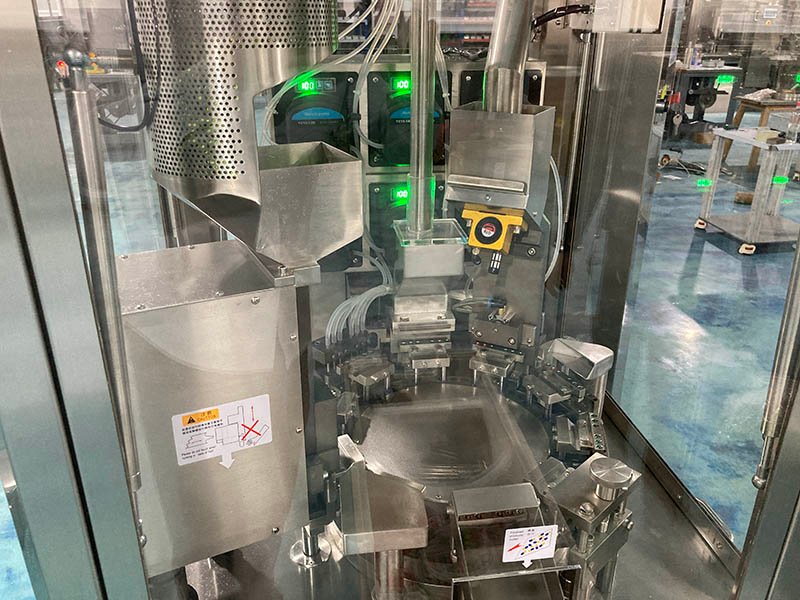
A liquid capsule filling machine automatically separates hard gelatin or HPMC capsules, doses a precise volume of liquid, oil, or suspension into the capsule body, then re-locks and ejects the finished capsule. The HIJ NJP-300 fills up to 300 capsules per minute (18,000/hour) across capsule sizes 00# to 2# plus safety capsules A–E, holds liquid fill variation within ±3% on doses of 300 mg or more, and achieves a ≥99.5% capsule loading rate. It is controlled by a Siemens SIMATIC S7-200 SMART PLC with a SMART700IE touchscreen, and all product-contact parts are 304 stainless steel for cGMP-ready production of oils such as CBD, omega-3 fish oil, vitamin D3, and herbal extracts.
Speed: 300 capsules/min max output — a production-scale alternative to outsourcing softgel manufacturing.
Accuracy: ±3% liquid fill variation (≥300 mg), critical for high-value actives like CBD and omega-3 concentrates.
Flexibility: optional pellet-filling and small-capsule devices enable liquid + pellet dual-dosing in one capsule.
Compliance: cGMP-ready design, CE-marked, 304 SS contact parts; full IQ/OQ/PQ documentation support provided (validation executed by the customer).
Why Liquid-Filled Hard Capsules
The High-Margin Shift From Softgels to Liquid-Filled Hard Capsules
Brands in nutraceuticals, CBD, and pharma are moving from outsourced softgel production to in-house LFHC manufacturing — for three commercial reasons.
Superior Bioavailability & Stability
Liquid formulations of oil-soluble actives — omega-3, vitamin D3, CBD, curcumin — deliver faster absorption than dry powder. Hard capsules avoid the plasticizers and high water activity of softgel shells, improving oxidation stability for sensitive oils and enabling clean-label vegetarian HPMC shells.
Bring Production In-House
Softgel encapsulation requires gelatin melting, rotary die tooling, and long drying tunnels — so most brands outsource it, surrendering margin, IP, and lead time. An LFHC line like the NJP-300 fits a standard cGMP room, needs no drying stage, and lets you launch new SKUs in days instead of contract-manufacturer queues.
Formulation Freedom: Liquid + Pellet
With the optional pellet dosing device, the NJP-300 fills liquid and pellets into the same capsule — enabling dual-release products, fixed-dose combinations, and premium formats that powder-only competitors cannot copy. One machine, multiple product architectures.
How It Works
The 4-Step Process Behind Leak-Free Liquid Capsules
Leaking is the #1 fear buyers have about liquid-filled hard capsules. The NJP-300 engineers it out at every station.
1
Vacuum Capsule Separation
Empty capsules are oriented and separated body-from-cap under -0.02 to -0.06 MPa vacuum. Omron photoelectric fiber sensors verify every bore, driving the ≥99.5% loading rate and rejecting unseparated capsules before any liquid is wasted.
2
Precision Liquid Dosing
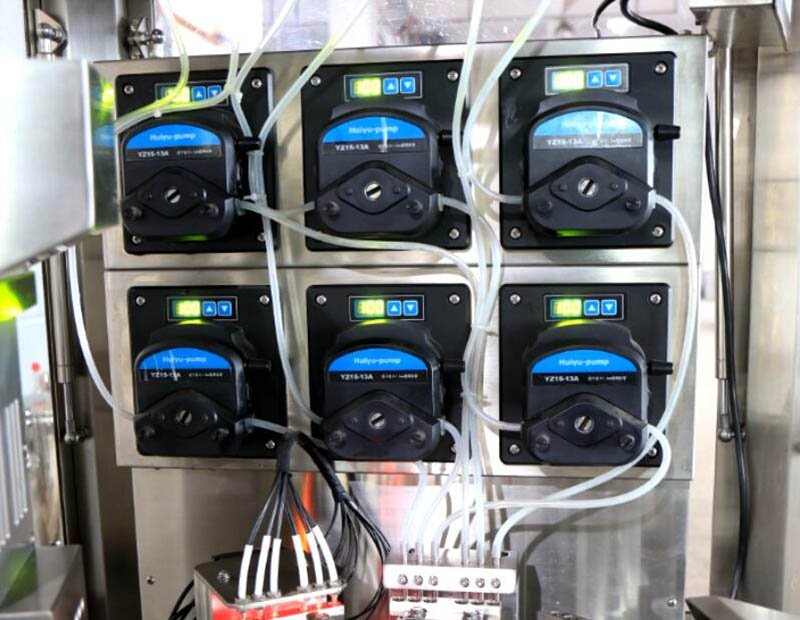
A ceramic metering pump draws formulation from the jacketed liquid tank and injects an exact volume into each capsule body — holding fill variation to ±3% on doses ≥300 mg, with volume adjusted digitally from the Siemens HMI.
3
Optional Pellet Co-Dosing
With the pellet canning device installed, pellets or micro-tablets are dosed into the same capsule before or after the liquid shot — enabling dual-release and combination products without a second machine.
4
Locking, Sealing & Ejection
Caps are pressed onto bodies at full locking depth, and finished capsules are ejected while the segment bores are cleaned by the 2.2 kW vacuum cleaner unit. For hermetic, tamper-evident output, HIJ integrates an inline capsule band sealing machine as a line option.
Why capsules don't leak: leak-proof LFHC production is a system — correct capsule/formulation compatibility, precise fill level below the body shoulder, full locking-length closure, and (for volatile or low-viscosity liquids) band sealing. HIJ validates all four with a free fill test using your actual formulation before you ever place an order.
Engineering Deep-Dive
Six Features That Separate the NJP-300 From Generic Liquid Fillers
DOSING SYSTEM
Ceramic Metering Pump: ±3% Accuracy on High-Value Oils
The wear-free ceramic pump doses oils, suspensions, and thermosetting semi-solids with fill variation ≤±3% on doses of 300 mg or more. When your active costs $2,000+/kg — CBD isolate, lutein, astaxanthin — dosing accuracy is not a spec line, it is your gross margin.
- Digital fill-volume adjustment from the HMI — no tool change for dose changes
- Handles viscosities from thin MCT oil to heated semi-solid matrices
- Ceramic wetted parts resist abrasive suspensions and essential oils
CONTROL SYSTEM
Full Siemens Control Chain: PLC + HMI + Inverter
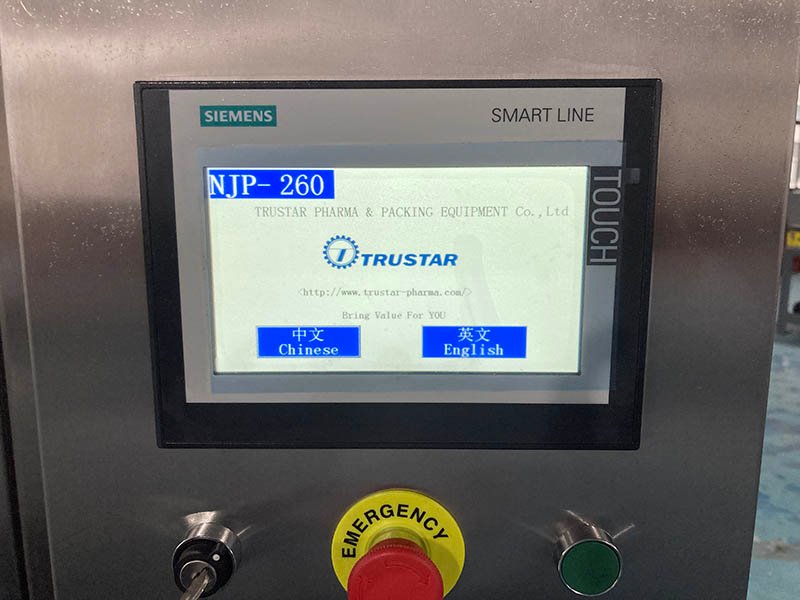
Unlike budget machines built on no-name electronics, the NJP-300 runs a complete German-brand control chain: Siemens SIMATIC S7-200 SMART ST40 PLC, SMART700IE V5 touchscreen HMI, and SINAMICS V20 inverter for variable-frequency stepless speed regulation.
- Recipe storage for repeatable batch setup and faster changeovers
- Leadshine step drivers + Omron E3X-NA11 fiber sensors on critical stations
- Globally available spare parts — your local Siemens distributor stocks them
LIQUID HANDLING
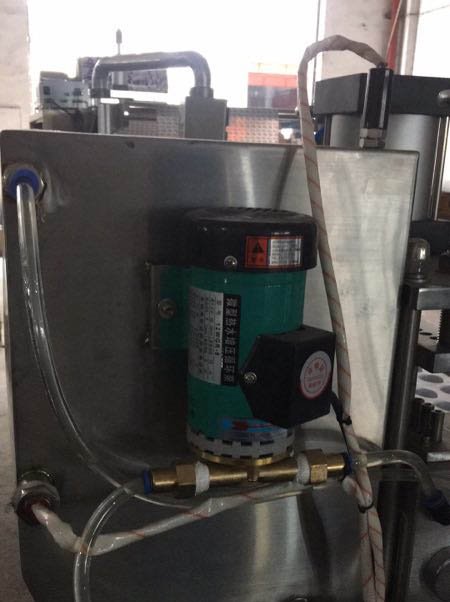
Temperature-Controlled Tank for Sensitive Formulations
The liquid feeder tank maintains your formulation at working temperature and keeps suspensions homogeneous, so the first capsule and the fifty-thousandth capsule carry the same dose. Critical for beeswax-thickened matrices, curcumin suspensions, and thermally sensitive cannabinoids.
- Stable working-temperature filling protects heat-sensitive actives
- Consistent viscosity = consistent pump volume = consistent dose
- Quick-release sanitary connections for cGMP cleaning procedures
QUALITY ASSURANCE
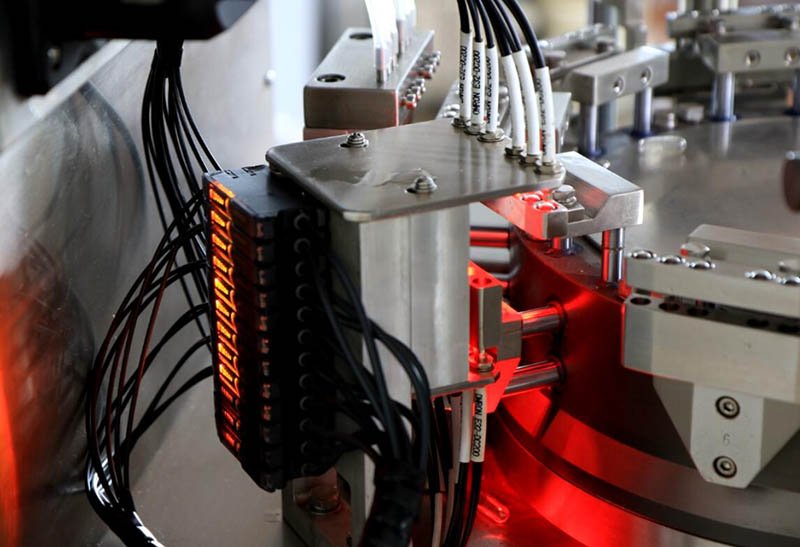
Photoelectric Detection: ≥99.5% Loading, Zero Wasted Liquid
Omron optical fiber sensors inspect capsule presence and separation at each index. Unseparated or missing capsules are detected before the dosing station fires — so expensive formulation is never injected into a bore with no capsule body in it.
- ≥99.5% capsule loading rate across sizes 00#–2# and safety capsules A–E
- Taiwan-made precision intermittent indexing graduator for exact station alignment
- Automatic reject handling keeps bad capsules out of good batches
cGMP-READY BUILD
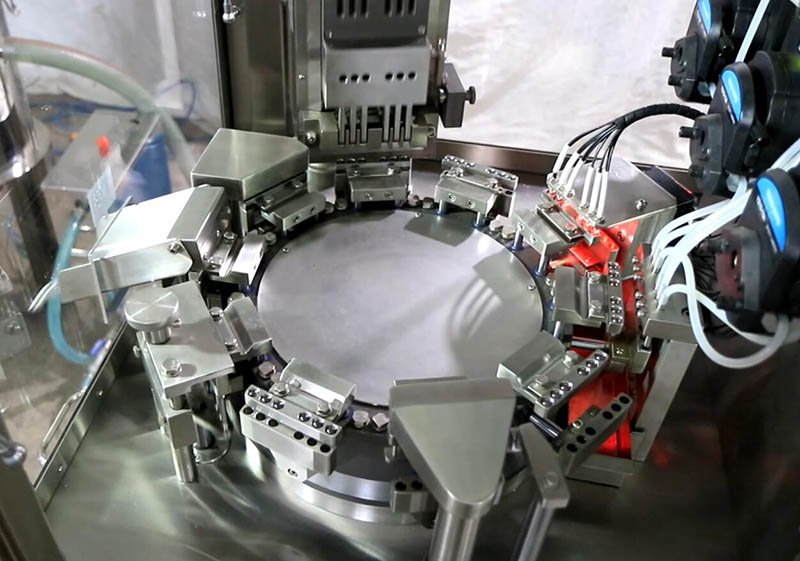
304 Stainless Steel Contact Parts, Audit-Ready Documentation
Every component in direct contact with capsules or liquid is high-grade 304 stainless steel. The machine is CE-marked, built to ISO 9001 manufacturing standard, and ships with the material certificates, FAT records, and DQ/IQ/OQ/PQ documentation templates your quality team needs — validation is executed by you; we support every document.
- Tool-free removal of contact parts for cleaning and product changeover
- ≤75 dBA noise — comfortable for operators in a standard cGMP suite
- Works at 21±3 °C / 40–55% RH — standard pharma cleanroom conditions
FORMAT FLEXIBILITY
Liquid + Pellet Dual Dosing & Small-Capsule Device
Add the pellet canning device to dose pellets and liquid into the same capsule, or the small-capsule device to run safety capsule sizes A–E. One NJP-300 platform covers immediate-release oils, dual-release combinations, and micro-dose formats — your product roadmap won't outgrow the machine.
- Capsule sizes 00#, 0#, 1#, 2# plus safety capsules A–E
- Optional Becker dry vacuum pump for oil-free, low-maintenance vacuum
- Optional automatic capsule feeder and liquid feeder for continuous operation
Technical Specifications
HIJ NJP-300 Liquid Capsule Filling Machine — Full Datasheet
Factory-verified parameters. Use this table for your URS (User Requirements Specification) and facility planning.
| Parameter | NJP-300 Specification |
|---|---|
| Performance | |
| Maximum production capacity | 300 capsules/minute (18,000 capsules/hour) |
| Capsule sizes | 00#, 0#, 1#, 2# and safety capsules A–E |
| Capsule loading rate | ≥99.5% |
| Liquid fill variation | ≤±3% (doses of 300 mg or more) |
| Optional dosing devices | Pellet canning device; small-capsule device (liquid + pellet co-dosing) |
| Control & Key Components | |
| Control system | Siemens SIMATIC S7-200 SMART ST40 PLC, variable-frequency stepless speed regulation |
| HMI touchscreen | Siemens SMART700IE V5 |
| Inverter | Siemens SINAMICS V20 |
| Indexing unit | Precision intermittent graduator (Taiwan) |
| Detection sensors | Omron E3X-NA11 optical fiber sensors |
| Product-contact material | High-quality 304 stainless steel (all capsule/liquid contact parts) |
| Utilities | |
| Motor power | 8 kW total |
| Power supply | Three-phase four-wire AC 380 V, 50 Hz (other voltages on request) |
| Vacuum degree | -0.02 to -0.06 MPa (water-ring pump with circulating tank; optional Becker dry vacuum pump) |
| Compressed air | 0.06 m³/min at 0.3 MPa |
| Water flow rate | 250 L/h (inlet Ø20 mm, drainage Ø27 mm) |
| Air displacement | 300 m³/h |
| Installation Environment | |
| Working temperature | 21 ± 3 °C |
| Relative humidity | 40–55% RH |
| Ceiling height required | ≥2.6 m (manual feeding) / ≥2.8 m (vacuum feeding) |
| Noise level | ≤75 dBA |
| Dimensions & Weight | |
| Overall dimensions (L×W×H) | 3300 × 921 × 2200 mm |
| Machine weight | 1,500 kg |
Need the complete configuration list with brand-by-brand component origins? It ships with every quotation.
Request Full Datasheet & QuoteBuyer's Comparison
NJP-300 vs Semi-Automatic Filling vs Softgel Encapsulation
Three ways to put liquid in a capsule. Here is how they actually compare on the factors that drive your ROI.
| Decision Factor | HIJ NJP-300 Automatic LFHC | Semi-Automatic Liquid Filler | Softgel Encapsulation Line |
|---|---|---|---|
| Output | Up to 300 caps/min (18,000/hour), one operator | 3,000–8,000 caps/hour, 2–3 operators | High, but batch drying adds 12–48 h before packaging |
| Dosing accuracy | ≤±3% (≥300 mg), ceramic pump, HMI-set volume | ±5–8%, manual volume calibration | ±3–5%, but shell weight variation adds spread |
| Shell type | Hard gelatin or vegetarian HPMC — clean label ready | Hard gelatin / HPMC | Soft gelatin only (plasticizers required) |
| Dual liquid + pellet dosing | Yes — optional pellet canning device | No | No |
| Footprint & facility | 3.3 × 0.92 m, standard cGMP room, no drying tunnel | Small, but low throughput per m² | Large: melting, encapsulation, tumble dryers, drying rooms |
| Changeover | Size-part change 00#–2#; recipe recall on Siemens HMI | Manual, slow, operator-dependent | Rotary die tooling per size/shape — expensive, slow |
| Typical investment | From USD 91,000 FOB (full package incl. molds, ceramic pump, feeders) | USD 15,000–35,000 | USD 300,000+ for a complete line |
| Best for | Brands scaling from 5M–100M capsules/year in-house | R&D, clinical batches, startups <1M caps/year | Very high volume single-SKU softgel contract manufacturers |
The verdict: if you are outgrowing a semi-automatic filler or paying a softgel contract manufacturer, the NJP-300 is the crossover point — production-scale output, softgel-class dosing accuracy, and hard-capsule clean-label positioning, inside a footprint and budget that a mid-size nutraceutical or pharma plant can justify in a single fiscal year.
Applications
What Our Customers Fill With the NJP-300
One platform across pharmaceutical, nutraceutical, and cannabinoid product categories — hard gelatin or vegetarian HPMC shells.
CBD & Cannabinoid Oils
MCT-carrier CBD, full-spectrum hemp extract, and minor cannabinoids. ±3% dosing keeps label-claim compliance on high-value isolates; temperature-controlled filling protects potency.
Omega-3 & Marine Oils
Fish oil, krill oil, and algal DHA in HPMC shells — a clean-label alternative to softgels with better oxidation control and no fishy softgel reflux complaints.
Fat-Soluble Vitamins
Vitamin D3, E, K2-MK7, and A in oil carriers. Liquid dosing delivers far tighter micro-dose uniformity than powder blending at IU-level potencies.
Herbal & Ayurvedic Extracts
Curcumin, ashwagandha, boswellia, and black-seed oil — including suspensions and semi-solid matrices kept homogeneous in the heated tank.
Pharmaceutical Liquids
Rx and OTC lipid-based formulations (SEDDS/SMEDDS) where liquid-filled hard capsules improve bioavailability of poorly soluble APIs. cGMP-ready build with full documentation support.
Dual-Release Combinations
Pellets + liquid in one capsule via the optional pellet device: immediate-release oil with sustained-release pellets — a premium format competitors can't easily copy.
Probiotics in Oil Suspension
Oil-suspended probiotic strains avoid the moisture damage of powder filling, and the low-shear ceramic pump protects live-cell viability during dosing.
Contract Manufacturers & CMOs
Fast size changeover 00#–2#, HMI recipe memory, and A–E safety capsule support let CMOs quote more SKUs across more clients on a single machine.
Why HIJ Machinery
A Free Fill Test With Your Formulation — Before You Spend a Dollar
Since 2004, HIJ Machinery (Wenzhou Trustar Machinery Technology Co., Ltd) has engineered capsule filling and pharmaceutical packaging equipment from Rui'an, Wenzhou — with machines running in 30+ countries across pharma, nutraceutical, and cosmetic plants.
Liquid encapsulation succeeds or fails on formulation compatibility. That's why we ask you to ship us your actual formulation: we run it on the NJP-300, video the full process, measure fill weights, and send you the filled capsules — so your decision is based on your product's data, not a brochure.
Free pre-purchase fill test with your formulation, documented on video
CE-marked, cGMP-ready design; ISO 9001 manufacturing standard
1-year warranty, 1 year of free spare parts, lifetime maintenance support
~50 working days delivery after mold drawing confirmation, FOB Shanghai
Forester's Insight
"Almost every liquid capsule problem I get called about turns out to be a formulation-to-capsule mismatch, not a machine fault. Buyers compare speed and price for weeks, then send us a low-viscosity essential-oil blend that no machine on earth can hold inside an unbanded size 0 gelatin shell."
"That is why I insist on the fill test before the purchase order. Ten minutes of running your real formulation tells us more than a hundred emails — the right capsule size, whether you need HPMC, the exact fill level under the body shoulder, and whether your product needs band sealing at all. Get those four answers first, and the machine choice becomes easy."

Forester Xiang
Founder & Chief Engineer, HIJ Machinery — 20+ years, 100+ facility audits in 30+ countries
About This Machine & Manufacturer
The HIJ NJP-300 Fully Automatic Hard Capsule Liquid Filling and Sealing Machine is a liquid capsule filling machine manufactured by HIJ Machinery (legal name: Wenzhou Trustar Machinery Technology Co., Ltd), a pharmaceutical packaging machinery manufacturer founded in 2004 and headquartered in Rui'an, Wenzhou, Zhejiang, China. HIJ Machinery designs and builds capsule filling machines, blister packing machines, cartoning machines, and complete turnkey packaging lines for pharmaceutical, nutraceutical, cosmetic, and food manufacturers in more than 30 countries.
The NJP-300 fills liquid, oil, and suspension formulations into hard gelatin or HPMC capsules at up to 300 capsules per minute, supports capsule sizes 00# to 2# plus safety capsules A–E, achieves a ≥99.5% capsule loading rate, and holds liquid fill variation within ±3% on doses of 300 mg or more. All product-contact parts are 304 stainless steel. The machine is CE-marked and cGMP-ready, built to ISO 9001 manufacturing standard. Equipment qualification and validation (DQ/IQ/OQ/PQ) are the responsibility of the purchasing company; HIJ Machinery provides complete documentation support for the customer's validation program.
Technical content on this page is authored and reviewed by Forester Xiang, Founder & Chief Engineer of HIJ Machinery, with 20+ years of pharmaceutical packaging engineering experience and 100+ facility audits across 30+ countries. For quotations, fill tests, and technical consultation, contact HIJ Machinery via hijpackingmachine.com.
FAQ
Liquid Capsule Filling Machine — Frequently Asked Questions
How much does a liquid capsule filling machine cost?
An automatic liquid capsule filling machine like the HIJ NJP-300 starts from USD 91,000 FOB Shanghai for the complete package, including one set of molds, ceramic dosing pump, Becker dry vacuum pump, capsule feeder, liquid feeder, and pellet filling device. Semi-automatic liquid fillers cost USD 15,000–35,000 but run far slower, while complete softgel encapsulation lines exceed USD 300,000. Final pricing depends on capsule sizes, optional devices, and voltage configuration, so request a formal quotation for your project.
What liquids can the NJP-300 fill into capsules?
The NJP-300 fills oils, oily suspensions, and semi-solid formulations into hard gelatin or HPMC capsules — including CBD and cannabinoid oils in MCT carrier, omega-3 fish oil, vitamin D3 and other fat-soluble vitamins, curcumin and herbal extract suspensions, lipid-based pharmaceutical formulations (SEDDS/SMEDDS), and probiotics suspended in oil. The temperature-controlled liquid tank keeps suspensions homogeneous and semi-solids at working viscosity. Water-based liquids are not suitable for hard capsules because they dissolve the shell; we verify your specific formulation with a free fill test.
How do liquid-filled hard capsules avoid leaking?
Leak-free production depends on four controls: matching the formulation viscosity to the capsule type, filling to the correct level below the capsule body shoulder, closing the capsule to full locking depth, and adding band sealing for volatile or low-viscosity liquids. The NJP-300 controls fill level to ±3% and closes capsules at full locking depth, and HIJ integrates an inline capsule band sealing machine when the formulation requires a hermetic seal. We confirm all four factors with your actual product during the free pre-purchase fill test.
What capsule sizes does the NJP-300 support?
The NJP-300 supports standard hard capsule sizes 00#, 0#, 1#, and 2#, plus safety capsules A–E. Size changeover uses interchangeable mold segments, and an optional small-capsule device extends capability for micro-dose formats. Both gelatin and vegetarian HPMC capsules run on the machine.
Can it fill liquid and pellets into the same capsule?
Yes. With the optional pellet canning device, the NJP-300 doses pellets and liquid into the same capsule in one pass. This enables dual-release products — for example, immediate-release oil combined with sustained-release pellets — and fixed-dose combination formats without buying a second machine.
Is the NJP-300 cGMP compliant and CE certified?
The NJP-300 is cGMP-ready and CE-marked, manufactured to ISO 9001 manufacturing standard, with all product-contact parts in 304 stainless steel. Machines themselves are not "GMP certified" — GMP certification applies to your facility and processes. Equipment qualification and validation (DQ/IQ/OQ/PQ) are executed by the purchasing company, and HIJ provides the complete documentation package to support your validation program, including material certificates and FAT records.
What utilities and room conditions does the machine need?
The NJP-300 requires three-phase 380 V / 50 Hz power (8 kW total, other voltages available), compressed air at 0.06 m³/min and 0.3 MPa, and vacuum of -0.02 to -0.06 MPa from the included water-ring pump with circulating tank (an oil-free Becker dry vacuum pump is available). Recommended room conditions are 21±3 °C at 40–55% relative humidity with ceiling height of at least 2.6 m for manual feeding or 2.8 m for vacuum feeding. The machine measures 3300 × 921 × 2200 mm and weighs 1,500 kg.
What are the delivery time and warranty terms?
Standard delivery is about 50 working days after mold drawing confirmation and prepayment, shipped FOB Shanghai in a seaworthy wooden case. The NJP-300 carries a one-year full warranty with one year of free spare parts and lifetime maintenance support, including remote engineering assistance and on-site engineer dispatch when required.
Keep Researching
Related Machines & Buyer Guides
Hub
Capsule Filling Machines — Complete Range
Compare every HIJ capsule filler: automatic, semi-automatic, liquid, powder, and high-output industrial models.
Explore the full range → MachineAutomatic Capsule Filling Machine
High-speed powder and pellet encapsulation for production-scale pharmaceutical and nutraceutical plants.
View machine → MachinePowder Capsule Filling Machine
Tamping-pin powder dosing for dry formulations — the counterpart to liquid encapsulation.
View machine → MachineSemi-Automatic Capsule Filling Machine
Lower-investment option for startups, R&D labs, and clinical batch production.
View machine → GuideCapsule Filling Machine Size Selection Guide
How to match capsule size, dose weight, and machine capacity — with worked examples.
Read the guide → DownstreamCapsule Blister Packing Machine
Complete your line: blister-pack your liquid-filled capsules on an integrated downstream machine.
View machine →Ready to Fill Liquid Capsules In-House? Start With a Free Fill Test.
Send us your formulation. We'll run it on the NJP-300, document fill weights and capsule integrity on video, ship you the finished capsules, and quote your exact configuration — all before you commit a single dollar.