
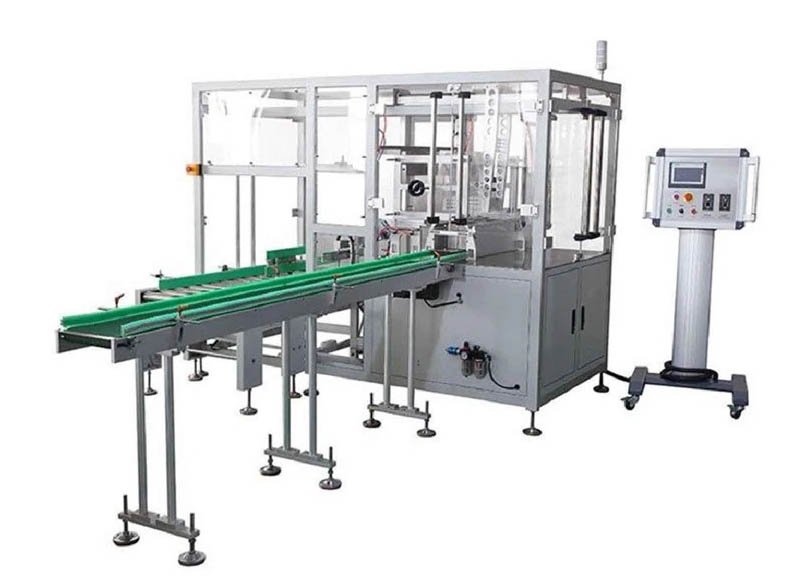
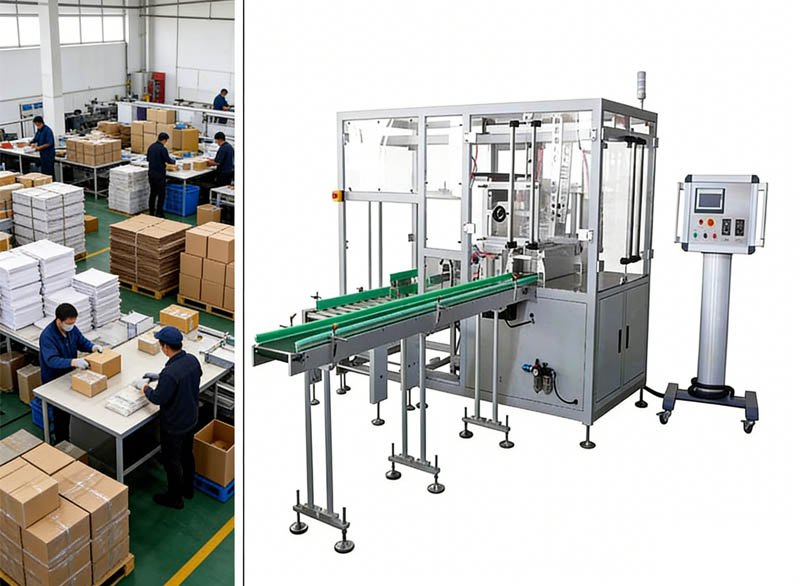
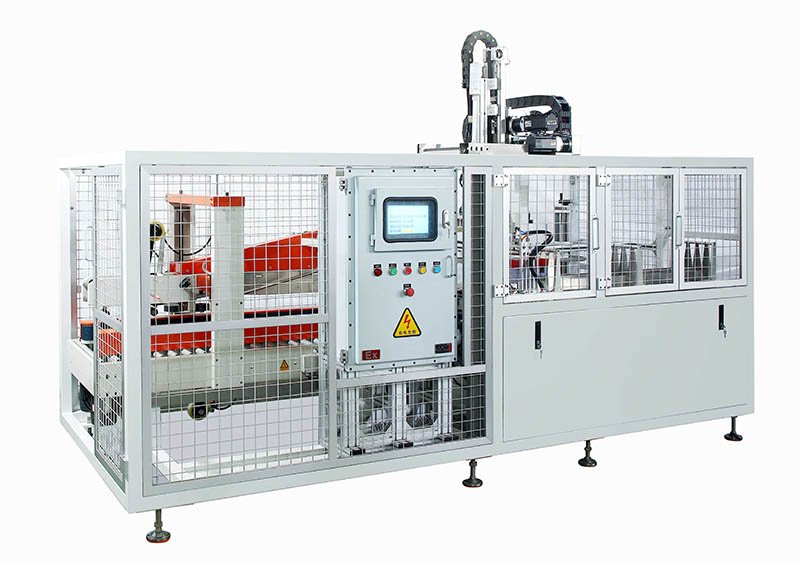

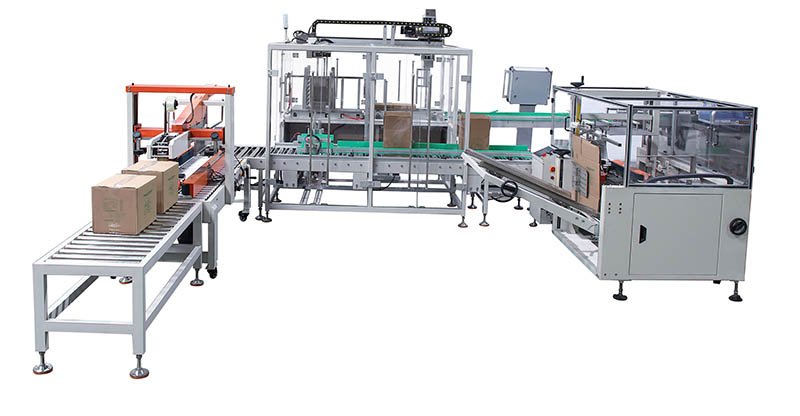
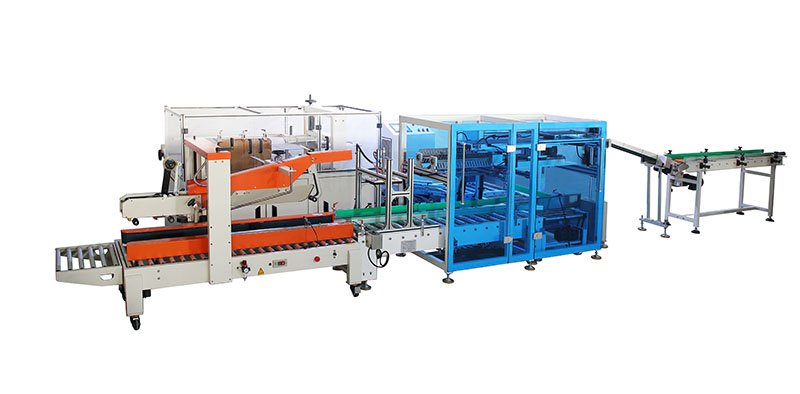
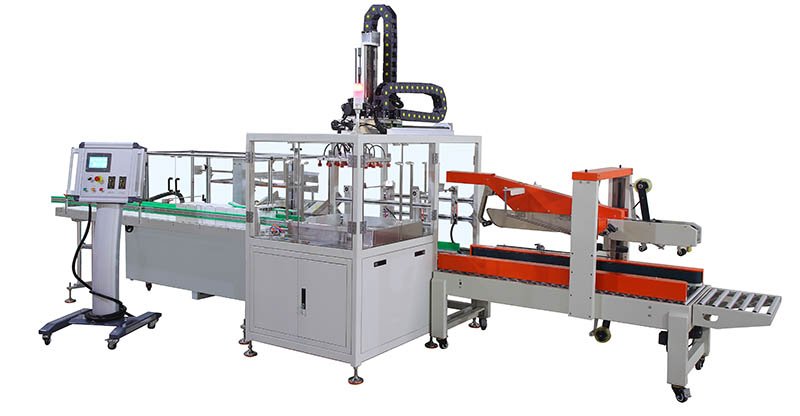
Side Push Type Full-Automatic Case Packing Machine
The HIJ-CP500 automates your entire secondary packaging process — carton erection, product collation, gentle horizontal side-push loading, and flap sealing — at 80–500 boxes per minute, controlled by a Siemens PLC.
- 80–500 boxes/min capacity
- Siemens PLC + HMI touch screen
- Zero-damage side-push loading
- cGMP-ready, CE-marked design
What Is a Side Push Type Case Packing Machine?
A side push type case packing machine is a fully automatic secondary packaging machine that erects corrugated cases, collates products into the required array, and pushes them horizontally into the open case before folding and sealing the flaps. The HIJ-CP500 packs 80–500 boxes per minute and is ideal for stable, rectangular products such as boxed pharmaceuticals, food cartons, and cosmetic boxes, because horizontal loading eliminates the drop impact of top-load packers.
Key Takeaways
- Speed: 80–500 boxes/min depending on box size and packing array — one machine replaces 4–8 manual packing operators per shift.
- Gentle handling: horizontal side-push loading protects product appearance — critical for pharmaceutical and cosmetic cartons where crushed corners mean rejected shipments.
- Control: Siemens PLC with HMI touch screen, multi-language interface, safety interlocks, and an optional explosion-proof configuration.
- Line-ready: integrates directly downstream of any cartoning machine and upstream of an automatic case sealing machine for a complete end-of-line solution.
- Compliance: cGMP-ready design with optional SUS304 stainless steel construction; supplied with full documentation to support your validation process. Explore the full case packing machine range.
Frustrated with Manual Packing Errors and Bottlenecks?
Manual end-of-line packing is the most common bottleneck we find during factory audits. Here is how the HIJ-CP500 removes it.
Pain: High Labor Costs & Inconsistency
Manual case packing requires 4–8 operators per line per shift, with count errors, missed boxes, and rising wages eating your margin.
Solution: Fully Automate Your Process
One HIJ-CP500 handles erection, collation, loading, and sealing automatically — consistent counts, every case, every shift.
Pain: Product Damage
Top-load and drop packers let products fall into the case. For printed cartons, crushed corners and scuffed faces mean rejected shipments.
Solution: Gentle Side-Push Technology
A servo-driven pusher slides the collated group horizontally into the case with controlled, even pressure — zero drop impact.
Pain: Production Bottlenecks
Your cartoner runs fast, but cases pile up at the end of the line because manual packing can't keep pace with upstream output.
Solution: High-Speed & Reliable Operation
With 80–500 boxes/min capacity and Siemens PLC reliability, the CP500 matches the output of any upstream cartoning machine.
Eliminate These Problems and Upgrade Your Production Line
Discuss Your Packing ChallengeSee the HIJ-CP500 in Action: From Carton Erection to Sealing
Play
1
Carton Erection
Flat corrugated blanks are picked from the magazine, opened by vacuum suction, and squared into a rigid case.
2
Product Collation
Incoming products are automatically counted and arranged into your specified array — rows, columns, and layers.
3
Gentle Side Push
The servo-driven pusher slides the entire collated group horizontally into the case in one smooth, controlled stroke.
4
Flap Folding & Sealing
Flaps are folded and sealed, and the finished case is discharged, ready for check-weighing or palletizing.
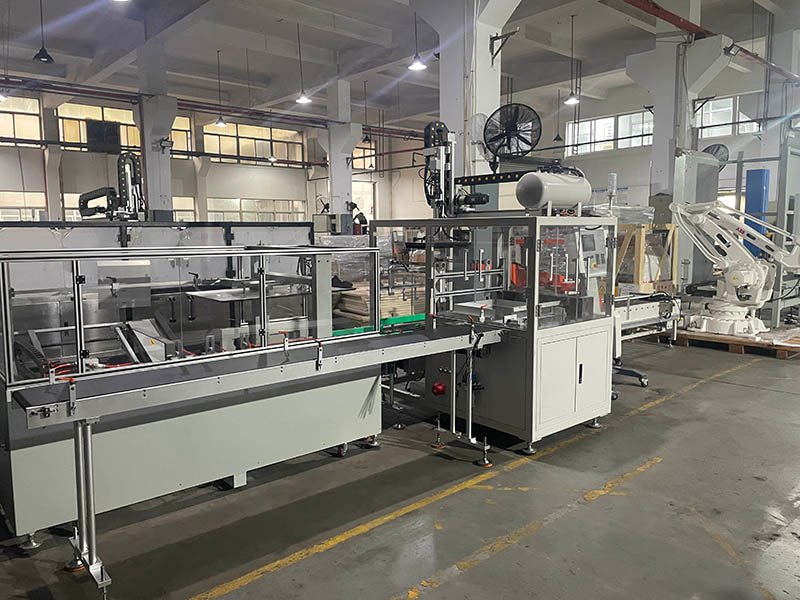
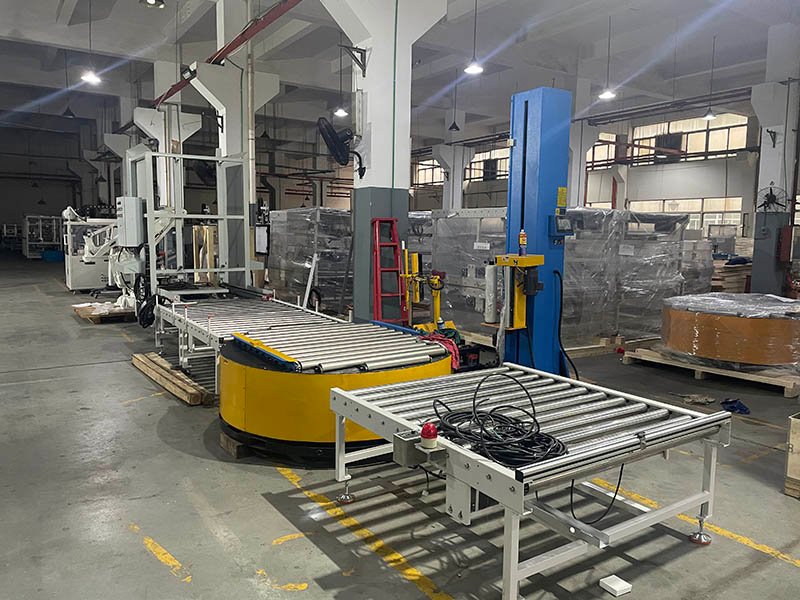
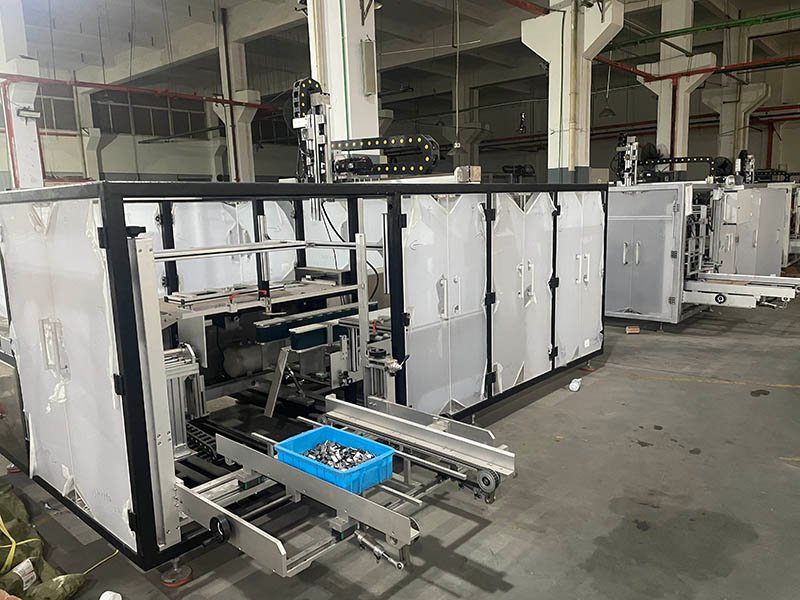
Explore Every Detail: Precision Engineering Close-Up
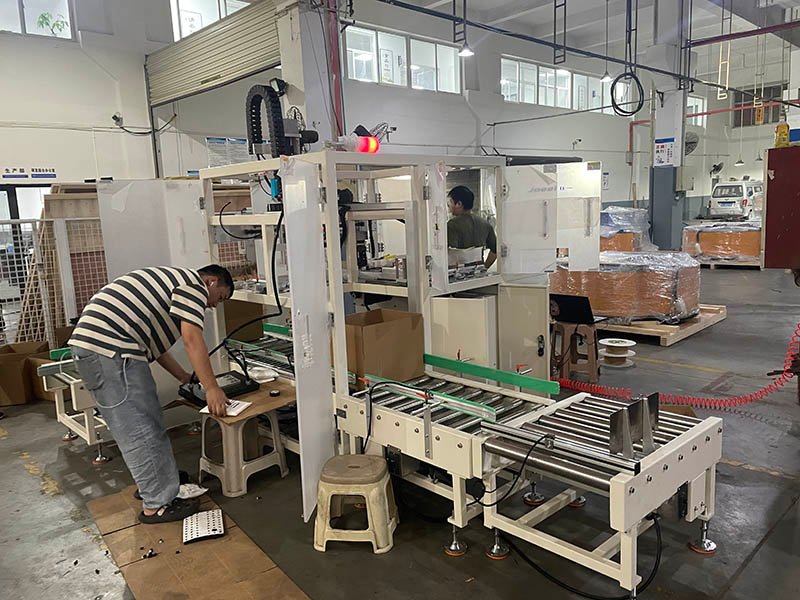
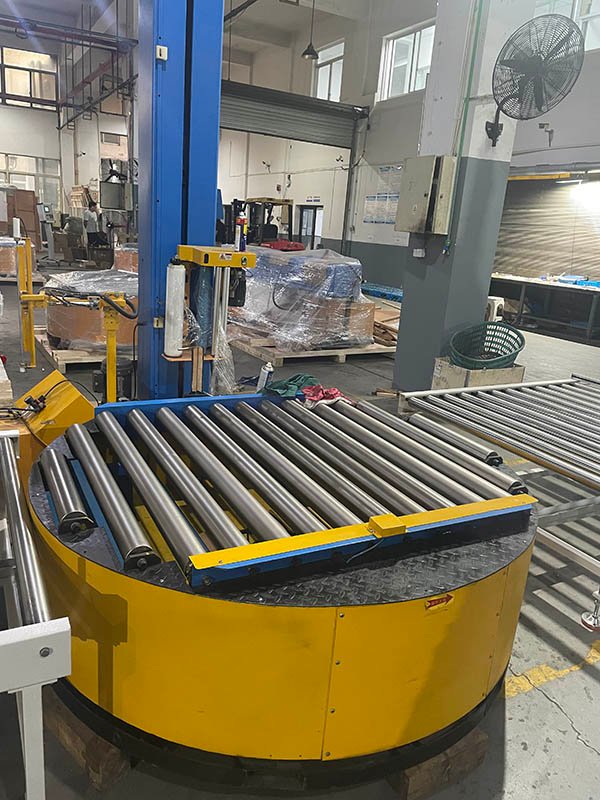
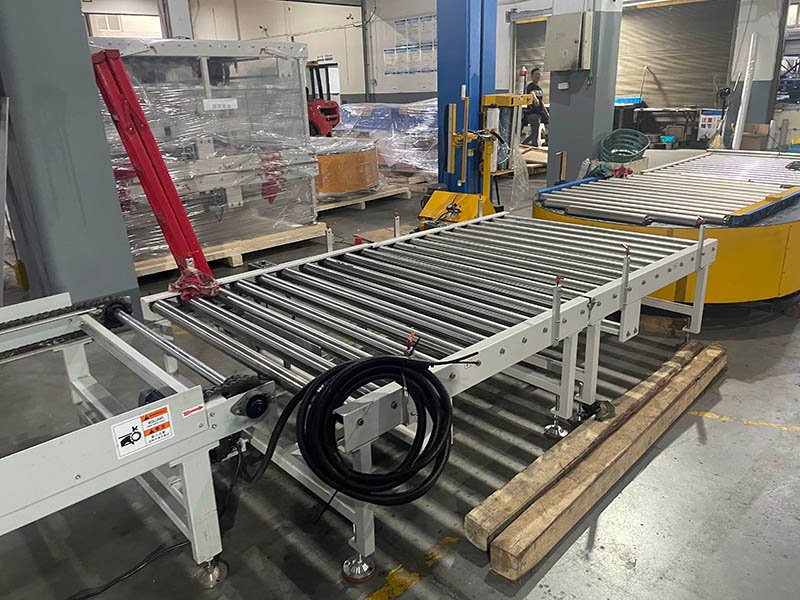

A Word From Our Founder: Engineering for Zero-Damage Packing
"I'm Forester. Over my 20+ years in this industry, I've seen countless clients lose money to damaged packaging from top-load packers. For sensitive products like pharmaceuticals or cosmetics, appearance is everything. That's why I designed the HIJ-CP500 with a side-push system."
"It's not just about speed; it's about delivering your product to your customer in perfect condition. This machine reflects my core belief: robust engineering should serve the product, not compromise it."
Forester Xiang
Founder & Chief Engineer, HIJ Machinery — why 30+ countries trust HIJ
Talk to Forester's Engineering TeamPacked with Technology for Unmatched Performance and Flexibility
Siemens PLC Control System
Industrial-grade Siemens PLC with an intuitive HMI touch screen and multi-language support. Recipes for different box sizes are stored and recalled in seconds.
Precision Servo-Driven Pusher
The side-push stroke is servo-controlled for smooth acceleration and deceleration, applying even pressure across the whole product group — no crushing, no jams.
Quick & Easy Size Changeover
Tool-free adjustments with clear scale indicators let one operator change between case formats in minutes, not hours — ideal for multi-SKU production.
Robust Stainless Steel Construction
Optional SUS304 stainless steel frame and contact parts support a cGMP-ready design for pharmaceutical and food environments.
Safety Interlocks & Alarms
Full safety guarding with interlocked doors, emergency stops, and clear fault alarms on the HMI protect your operators and simplify troubleshooting.
Explosion-Proof Model Available
For solvent-based or hazardous environments, an explosion-proof configuration (ZCP-5040 series) with rated electrical components is available on request.
Engineered for Your Specific Requirements
Request a Custom ConfigurationDetailed Technical Specifications
| Parameter | Specification | Notes |
|---|---|---|
| Model | HIJ-CP500 | Side Push Type |
| Packing Capacity | 80 – 500 boxes/minute | Dependent on box size and packing array |
| Applicable Products | Paper boxes, bottles, pouches, etc. | We offer custom collation systems |
| Control System | Siemens PLC & HMI Touch Screen | Multi-language support available |
| Power Supply | AC220V / 0.4Kw (or customized) | |
| Air Pressure | 0.5 – 0.6 Mpa (5 – 6 Kg/cm²) | |
| Air Consumption | 350 L/min | |
| Machine Dimensions | L2000 × W1300 × H1900 mm | |
| Machine Weight | Approx. 700 kg | |
| Construction | SUS304 Stainless Steel (optional) | cGMP-ready design; documentation supplied to support your validation process |
Need More Detailed Information?
Get the Full Technical DatasheetSide Push vs. Drop vs. Pick-and-Place: Which Case Packer Fits Your Product?
There is no universal "best" case packing machine — the right technology depends on your product shape, fragility, and speed target. Here is how the main loading technologies compare.
| Criteria | Side Push (Horizontal Load) | Drop / Gravity (Top Load) | Pick-and-Place / Grab Type | Wrap-Around |
|---|---|---|---|---|
| Best For | Stable rectangular products: boxed pharma, food cartons, cosmetic boxes | Robust products: cans, jars, rigid bottles | Irregular shapes, pouches, unstable bottles | High-volume retail-ready trays and cases |
| Product Handling | Gentlest — horizontal push, zero drop impact | Highest impact — products fall into the case | Gentle but slower per-cycle handling | Moderate — product is the forming mandrel |
| Typical Speed | High — HIJ-CP500 reaches 80–500 boxes/min | High for robust products | Lower — limited by pick cycles | Medium–high |
| Changeover | Fast, tool-free format adjustment | Fast | Requires gripper/tooling changes | Slower — blank magazine and tooling |
| Relative Cost | Moderate — best speed-to-cost ratio for boxed goods | Lowest | Highest (robotics) | Moderate–high |
Compare the HIJ Case Packing Range
| Machine | HIJ-CP500 Side Push (this page) | All-in-One Opening-Loading-Sealing | Double Station Case Packer | Four Corner Sealing Machine |
|---|---|---|---|---|
| Loading Principle | Horizontal servo side push | Integrated open + load + seal in one frame | Dual stations for parallel throughput | Four-corner carton sealing focus |
| Ideal Application | High-speed boxed products needing gentle handling | Compact lines with limited floor space | Very high output, two-lane production | Premium display-style cartons |
| Next Step | You're here — request a quote below | View machine page | View machine page | View machine page |
A Flexible Case Packing Solution for Your Industry
Pharmaceutical
Case packing blister cartons, medicine boxes, and ampoule trays downstream of your cartoning line, with cGMP-ready construction options.
Pair with a blister cartoning machine →Food & Beverage
Food-contact compliant options for cereal boxes, tea cartons, sachet boxes, and beverage bricks at high line speeds.
Cosmetics & Personal Care
Gentle side-push handling protects premium printed cartons for creams, serums, and gift sets — no scuffed faces or crushed corners.
Explore cosmetic packaging machines →Electronics & Hardware
Accurate collation and firm case sealing for boxed electronic accessories, hardware kits, and consumer goods of consistent shape.
Integrate the HIJ-CP500 into a Full Automatic Packing Line
The CP500 is designed as the end-of-line workhorse of a complete turnkey system — from primary packaging and cartoning through to sealed, palletize-ready cases.
Upstream
Blister packing, bottle filling, and cartoning equipment feeds finished boxes directly into the CP500 collation infeed.
Browse cartoning machines →HIJ-CP500
Erects cases, collates products, side-push loads, folds and seals — at 80–500 boxes per minute.
Get line layout proposal →Downstream
Automatic case sealing, check-weighing, labeling, and palletizing complete the end-of-line process.
See the case sealing machine →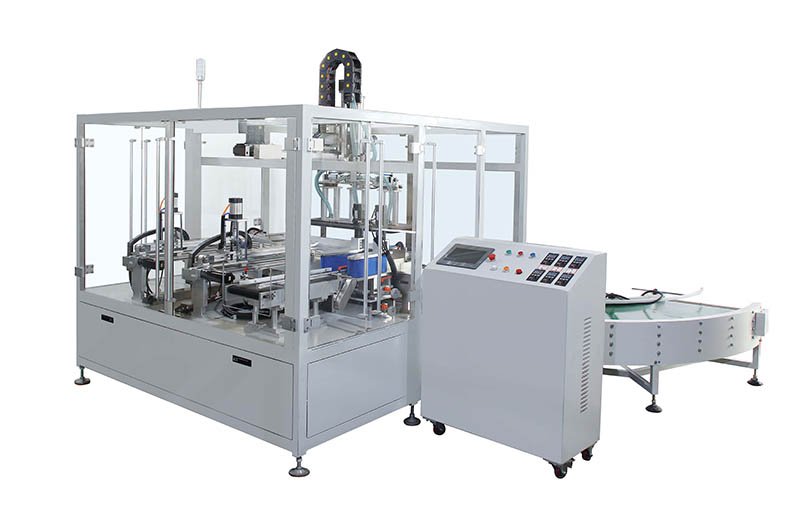
Multi-Station Packing Line
Grab-Type Packing Line
Ready to Design Your Perfect Packing Line?
See how we deliver complete turnkey packaging solutions — or send us your product specs for a free line layout.
Get Free Turnkey QuoteFrequently Asked Questions about the Side Push Case Packer
Your questions answered by our technical experts. Can't find what you need? Contact us directly.
What is a side push type case packing machine?
A side push type case packing machine is a fully automatic secondary packaging machine that erects corrugated cases, collates products into a set array, pushes them horizontally into the case with a servo-driven pusher, and then folds and seals the flaps. Because products are loaded horizontally rather than dropped, it is the gentlest high-speed case packing technology for boxed pharmaceuticals, food cartons, and cosmetic boxes.
What is the difference between a side push and a grab-type case packer?
Side push case packers are ideal for stable, rectangular products such as boxed pharmaceuticals or food cartons. They offer higher speeds (up to 500 boxes/min) and gentler handling because products are smoothly pushed horizontally into cartons. Grab-type case packers are more versatile for irregular shapes, bottles, or pouches but are typically slower and can exert more pressure on the product. Our engineers will recommend the right technology after a free analysis of your product samples.
How many boxes per minute can the HIJ-CP500 pack?
The HIJ-CP500 packs 80 to 500 boxes per minute. The exact output depends on your box dimensions and the packing array (rows, columns, and layers per case). Send us your box size and case configuration and we will confirm the guaranteed speed for your specific application.
How do I know if my product is suitable for this machine?
Simply send us your product and carton specifications—including dimensions, weight, and packaging configuration. Our experienced engineers will conduct a free technical analysis and packing simulation to confirm compatibility. We can even provide video demonstrations of similar products running on our machines. This consultation is completely free and takes only 24-48 hours.
Can the HIJ-CP500 integrate with my existing cartoning machine?
Yes. The CP500 is designed to run directly downstream of any horizontal or vertical cartoning machine, from HIJ or other manufacturers. We match the infeed conveyor height, speed, and product orientation to your existing line, and can supply the complete integrated line—cartoner, case packer, and case sealer—as a single turnkey project with one point of responsibility.
What is the lead time for this machine?
Standard HIJ-CP500 models are typically ready for shipment within 30-45 days after order confirmation. For customized solutions (such as explosion-proof models, special sizes, or integrated lines), lead times may vary from 45-60 days depending on the complexity. Once we understand your specific requirements, we'll provide you with a precise production schedule and keep you updated at every milestone.
Is an explosion-proof model available?
Yes. For solvent-based, alcohol-based, or other hazardous production environments, we offer an explosion-proof configuration (ZCP-5040 series) built with rated electrical components and enclosures. Tell us your zone classification requirements and our engineers will configure the machine accordingly.
Do you provide spare parts and after-sales service?
Absolutely. We maintain a full inventory of spare parts to ensure minimal downtime for your production. Our global after-sales service network provides 24/7 remote diagnostics, video support, and on-site technical assistance when needed. We also offer comprehensive training for your operators and maintenance staff, along with detailed service manuals in multiple languages. Your success is our priority.
Still Have Questions? Let's Talk.
Ask Our Engineers DirectlyExplore More Case Packing Solutions
All Case Packing Machines
Browse the full range →Opening-Loading-Sealing All-in-One Machine
Compact single-frame solution →Double Station Case Packing Machine
Dual-lane high output →Fully Automatic Four Corner Sealing Machine
Premium carton sealing →How Does a Cartoning Machine Work?
Upstream process guide →Tuck-In vs Hot-Melt Carton Sealing
Sealing method guide →About This Machine & Manufacturer
The HIJ-CP500 Side Push Type Full-Automatic Case Packing Machine is a secondary packaging machine manufactured by HIJ Machinery (legal name: Wenzhou Trustar Machinery Technology Co., Ltd), a pharmaceutical, cosmetic, and food packaging machinery manufacturer founded in 2004 in Rui'an, Wenzhou, Zhejiang, China. The machine erects corrugated cases, collates products, loads them horizontally via a servo-driven side pusher at 80–500 boxes per minute, and seals the case flaps.
All technical content on this page is written and reviewed by Forester Xiang, Founder & Chief Engineer of HIJ Machinery, drawing on 20+ years of packaging machinery engineering, 100+ pharmaceutical facility audits, and installations in 30+ countries. Equipment is supplied with a cGMP-ready, CE-marked design and full documentation to support the customer's own validation process. Related equipment categories: case packing machines, cartoning machines, and turnkey packaging lines.
Machine Model
HIJ-CP500 · Side Push Type · 80–500 boxes/min
Manufacturer
HIJ Machinery (Wenzhou Trustar Machinery Technology Co., Ltd), est. 2004
Technical Authority
Forester Xiang — Founder & Chief Engineer, 20+ years, 30+ countries served