
NJP-2500C Series · cGMP-Ready Design · CE-Marked
Commercial Capsule Filling Machine — 150,000 Capsules/Hour Production Power
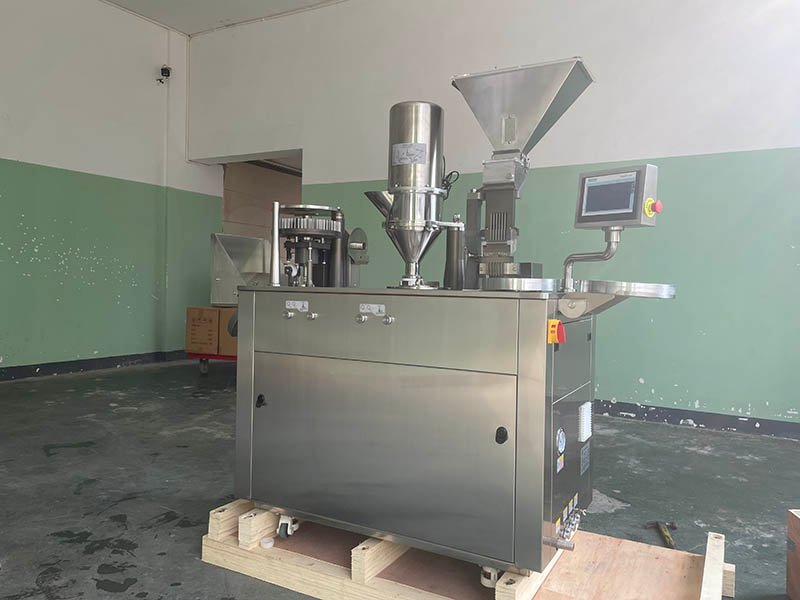
The HIJ NJP-2500C commercial capsule filling machine fills powder, pellets, and granules into size 00#–5# hard capsules at up to 150,000 capsules per hour with ±3% dosing accuracy. Built on 304/316L stainless steel contact parts and PLC + touchscreen control, it is the proven workhorse for supplement brands, contract manufacturers, and pharmaceutical plants scaling from batch to commercial production.
150,000Capsules / Hour
±3%Dosing Accuracy
≥99.5%Capsule Using Rate
00#–5#Capsule Sizes + A–E

Quick Answer
What Is a Commercial Capsule Filling Machine?
A commercial capsule filling machine is a fully automatic encapsulation system that feeds, separates, fills, locks, and ejects hard gelatin or vegetarian capsules in one continuous cycle at production-scale speeds. The HIJ NJP-2500C fills up to 150,000 capsules per hour (2,500 capsules per minute) in sizes 00#–5# with ±3% dosing accuracy, uses 304/316L stainless steel contact parts in a cGMP-ready design, and is priced from USD 60,000 (FOB China) — typically 40–60% below comparable European encapsulators. It suits supplement brands, nutraceutical contract manufacturers, and pharmaceutical plants producing 500,000+ capsules per day.
Key Takeaways
- Output: max 150,000 capsules/hour — one shift ≈ 1 million capsules of real commercial capacity.
- Accuracy: multi-bore hole-plate dosing holds fill weight variation ≤ ±3% (300mg+, 40–80 mesh granules).
- Versatility: powder, pellets, granules, and mixed powder+pellet or granule+tablet filling in capsule sizes 00#–5# plus safety capsules A–E.
- Compliance: cGMP-ready construction with 304 & 316L stainless steel product-contact parts; full documentation support for your IQ/OQ/PQ validation.
- Control: PLC + touchscreen HMI with variable-frequency stepless speed regulation and automatic no-capsule / no-powder pause.
- Investment: from USD 60,000 FOB; complete line with vacuum feeder, capsule loader, polisher, and metal detector from ~USD 89,800.
Is Semi-Automatic Filling Capping Your Growth?
Most supplement and pharma businesses hit the same wall between 100,000 and 500,000 capsules per day: labor costs climb, fill-weight consistency drifts, and retail or export customers start demanding documentation your manual process can't produce.
Labor Costs Eating Margin
A semi-automatic filler needs 2–3 operators per shift to reach 20,000 capsules/hour. The NJP-2500C reaches 150,000 capsules/hour with a single operator — one machine replaces 15–20 manual workstations and pays itself back through labor savings alone.
Fill-Weight Rejection Risk
Manual tamping produces ±8–10% weight variation — enough to fail label-claim audits. Multi-bore hole-plate dosing on the NJP-2500C holds ≤±3% variation batch after batch, protecting you from costly recalls and rejected export shipments.
Audit & Compliance Pressure
Retail chains, Amazon, and export regulators increasingly require documented, enclosed, stainless-steel production. The NJP-2500C's cGMP-ready design with 304/316L contact parts and full documentation package supports your IQ/OQ/PQ validation from day one.
The Solution: One Machine, Commercial-Scale Output
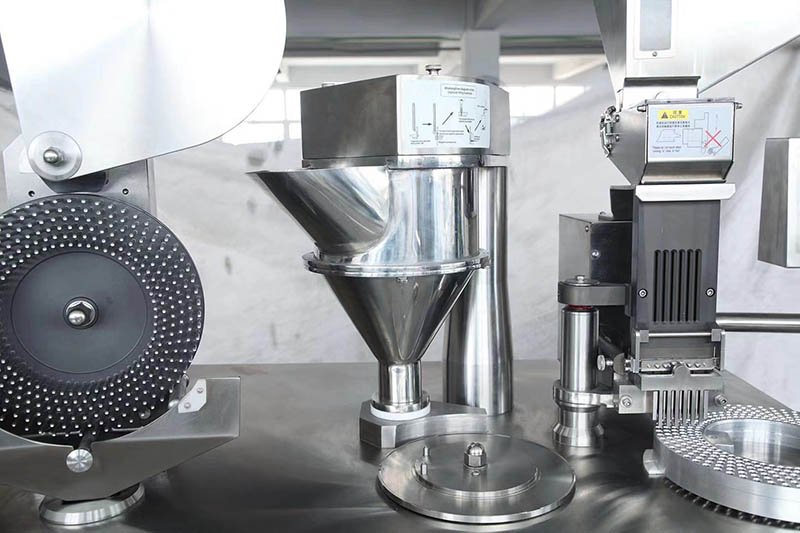
The NJP-2500C completes capsule feeding, separating, powder filling, defective-capsule rejecting, locking, finished-capsule discharge, and die-hole cleaning simultaneously in one intermittent-motion cycle. Built on the proven NJP hole-plate platform with a lifting mechanism for fast cleaning, it converts your bottleneck into a 1-million-capsules-per-shift production asset.
Calculate My Payback PeriodHow the NJP-2500C Commercial Capsule Filler Works
The NJP-2500C uses intermittent-motion, hole-plate dosing: a precision Taiwan-made indexing turret rotates capsule segments through seven synchronized stations, completing every function — from empty capsule to polished, finished product — in a single enclosed cycle.
1
Capsule Feeding & Orientation
Empty capsules load from the hopper (manual or vacuum capsule loader) and are oriented cap-up into the segment bores at up to 2,500 capsules per minute.
2
Vacuum Separation
A −0.02 to −0.06 MPa vacuum pulls capsule bodies down into the lower segment while caps stay in the upper segment, achieving a ≥99.5% capsule opening rate.
3
Multi-Bore Powder Dosing
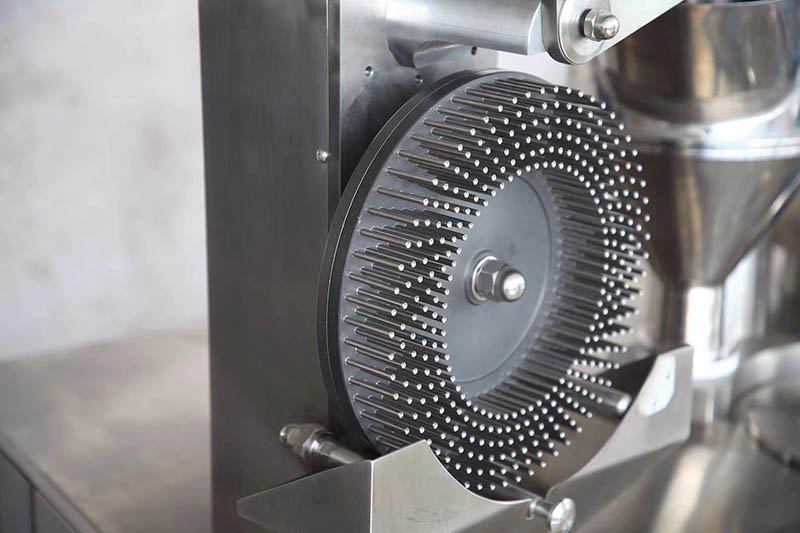
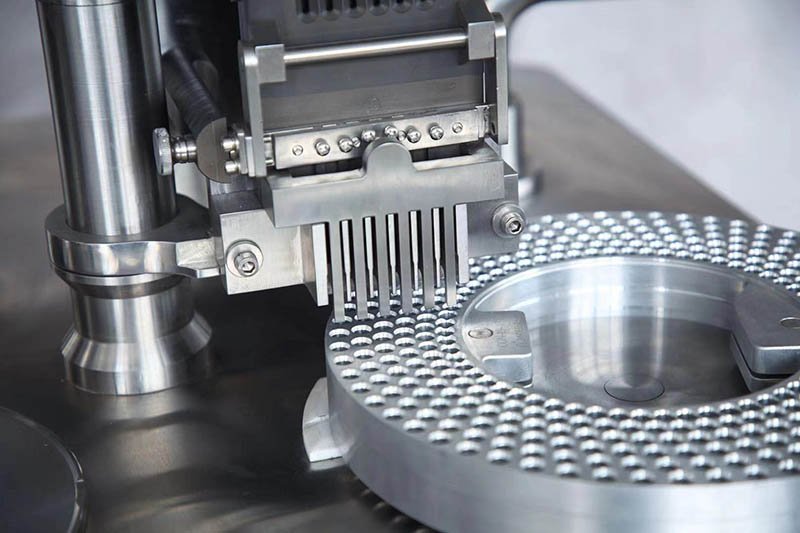
The hole-plate dosing system compresses powder into precise slugs across multiple bores simultaneously, holding fill-weight variation ≤±3% for doses above 300mg with 40–80 mesh granulated material.
4
Defective Capsule Rejection
Unseparated or damaged capsules are automatically detected and rejected before filling — no operator inspection needed, no wasted powder.
5
Capsule Locking & Closing
Filled bodies rejoin their caps and are pressed to the manufacturer's locked length, ensuring tamper-evident closure integrity for downstream blister or bottle packing.
6
Finished Capsule Discharge
Locked capsules eject to the outlet chute — connect a JFP-110A sorting polisher inline to de-dust, polish, and reject lightweight or empty capsules automatically.
7
Die-Hole Cleaning & Powder Recovery
Each cycle ends with automatic module cleaning; the powder collector function recovers dust from the filling port back to a separate pipeline — reducing material loss and cleaning downtime between batches.
Engineered for Uptime, Accuracy, and Fast Changeover
Every NJP-2500C feature exists to solve one commercial-production problem: keeping the machine running profitably, shift after shift, with minimal skilled-labor dependency.
PLC + Touchscreen HMI Control
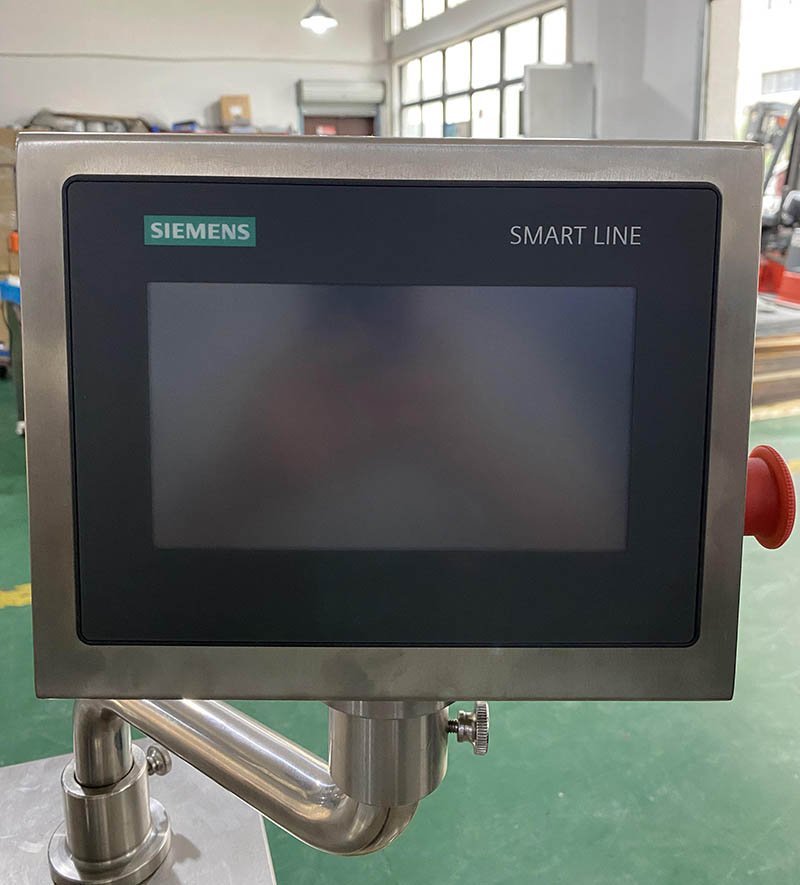
Delta PLC with WEINVIEW touchscreen provides variable-frequency stepless speed regulation, digital batch counting, and one-screen fault diagnosis. New operators are running production within one shift of training — no specialist required per machine.
Multi-Bore Hole-Plate Dosing
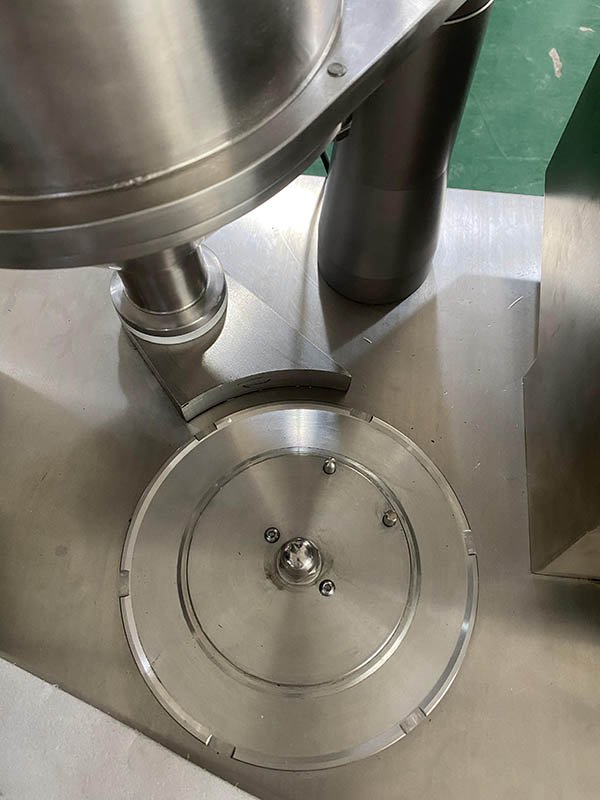
Precision-machined dosing discs compress powder into uniform slugs across every bore simultaneously. Fill-weight variation stays ≤±3% — the difference between passing and failing a label-claim audit when each capsule carries 500mg of active ingredient.

Lifting Mechanism for Fast Cleaning
Unlike the base NJP-1200 platform, the NJP-2500C adds a lifting mechanism that opens the dosing station for direct access. Product changeover cleaning drops from half a day to under two hours — critical for contract manufacturers running multiple SKUs per week.
cGMP-Ready 304/316L Construction
All product-contact parts use 304 and 316L stainless steel; the enclosed station design controls dust and cross-contamination. Combined with our documentation package, the machine supports your IQ/OQ/PQ validation for regulated pharmaceutical and export markets.
Forester's Insight
Buyers always ask me about speed first, but after auditing more than 100 capsule production facilities, I can tell you the machines that disappoint are almost never too slow — they were bought without checking the customer's powder. A 150,000-capsule-per-hour rating means nothing if your formula won't flow through the dosing bores.
Before I quote any NJP-2500C, I ask for a powder sample or the particle-size data. If your material sits in the 40–80 mesh range after granulation, this machine will hold ±3% all day. If you're filling a fluffy, low-density botanical extract, I'll tell you honestly to adjust the formulation or step down to a slower dosing configuration — because an accurate 120,000/hour beats a rejected 150,000/hour every single time.
— Forester Xiang, Founder & Chief Engineer, HIJ Machinery · 20+ years, 100+ facility audits in 30+ countries
NJP-2500C Technical Specifications
Full factory parameters for engineering evaluation. Utility requirements (compressed air, water, workshop conditions) are included so your facility team can pre-plan installation before the machine ships.
| Parameter | NJP-2500C Commercial Capsule Filling Machine |
|---|---|
| Max. Output | 150,000 capsules/hour (2,500 capsules/minute) |
| Capsule Sizes | 00#–5# and safety capsules A–E (with size change parts) |
| Dosing Accuracy | ≤ ±3% (dosing above 300mg, 40–80 mesh granulated material) |
| Capsule Using Rate | ≥ 99.5% |
| Fill Types | Powder; granule+powder mixed; granule+tablet mixed; pellet (optional device) |
| Control System | PLC (Delta) + touchscreen HMI, variable-frequency stepless speed regulation |
| Motor Power | 3.37 kW + 3 kW dust collector |
| Power Supply | 3-phase AC 380V, 50Hz (other voltages on request) |
| Vacuum Degree | −0.02 to −0.06 MPa |
| Compressed Air | 0.06 m³/min at 0.3 MPa |
| Water Supply | Water-cycle pump with compound tank, or external source; 250 L/hour |
| Exhaust Capacity | 300 m³/h |
| Working Environment | 21°C ±3°C, 40–55% relative humidity |
| Noise Index | ≤ 75 dBA |
| Product-Contact Material | 304 & 316L stainless steel (cGMP-ready design) |
| Special Functions | Powder collector pipeline at filling port; lifting mechanism for fast cleaning |
| Overall Dimensions | (1100+50) × (1010+190) × (1950+150) mm |
| Machine Weight | 1,300 kg |
Commercial Capsule Filling Machine Price
From USD 60,000 FOB China Port
The base NJP-2500C includes one complete set of change formats (capsule size of your choice), PLC + touchscreen control, and dust collector. Popular line accessories priced transparently below — a complete automated encapsulation line typically lands between USD 75,000 and 90,000, roughly 40–60% below comparable European equipment.
USD 4,900Vacuum Powder Feeder
USD 3,900Empty Capsule Loader
USD 3,500Capsule Sorting Polisher
USD 3,500Extra Size Change Parts
USD 14,000Metal Detector
NJP-1200C vs NJP-2500C vs NJP-3800C: Which Commercial Capsule Filler Fits Your Volume?
Choose by daily volume, not by maximum speed. As a rule of thumb: size your machine so one shift covers your daily demand at 70–80% of rated output — that leaves headroom for growth without over-investing.
| Parameter | NJP-1200C | NJP-2500C ★ This Page | NJP-3800C |
|---|---|---|---|
| Max. Output | 72,000 caps/hr | 150,000 caps/hr | 228,000 caps/hr |
| Best For (per 8-hr shift) | Up to ~400K caps/day | ~500K–1M caps/day | 1M–1.5M caps/day |
| Capsule Sizes | 00#–5#, A–E | 00#–5#, A–E | 00#–5#, A–E |
| Dosing Accuracy | ≤ ±3% | ≤ ±3% | ≤ ±3% |
| Motor Power | 2.57 kW + 2.2 kW | 3.37 kW + 3 kW | 6.37 kW + 3 kW |
| Lifting Mechanism (fast clean) | — | ✔ Standard | ✔ Standard |
| Machine Weight | 900 kg | 1,300 kg | 2,400 kg |
| Typical Buyer | Growing supplement brand | Commercial CM / mid-size pharma | High-volume industrial plant |
| Indicative Price (FOB) | From USD 19,000 | From USD 60,000 | From USD 45,000* |
*NJP-3800C pricing varies significantly with configuration; the figure shown reflects a base 2022 reference quotation — request current pricing. Producing under 20,000 capsules/hour on a startup budget? See our semi-automatic capsule filling machine or small capsule filling machine. Need 200,000+/hour continuous production? Visit the industrial capsule filling machine page.
What Industries Use the NJP-2500C Commercial Capsule Filler?
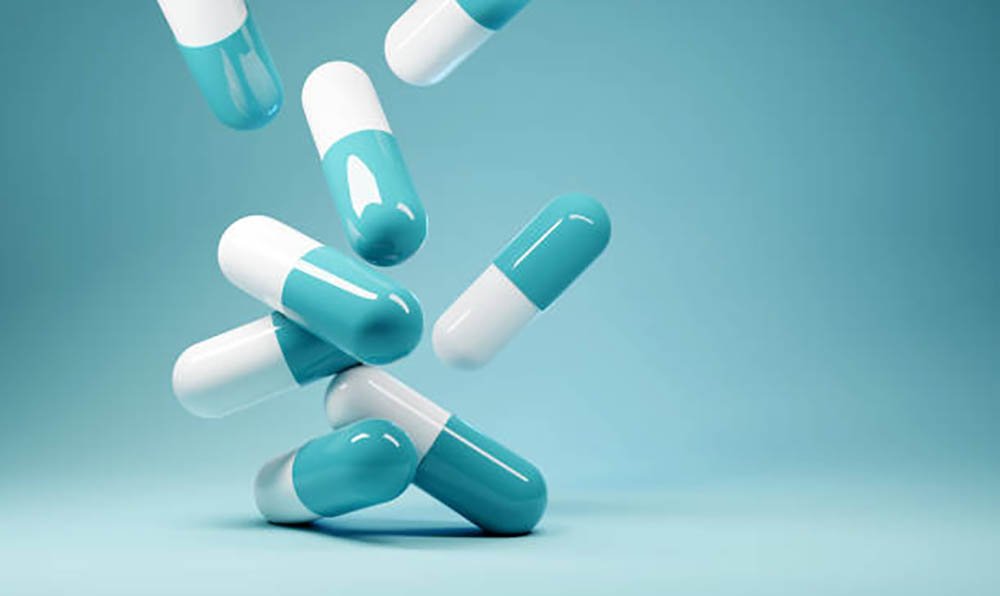
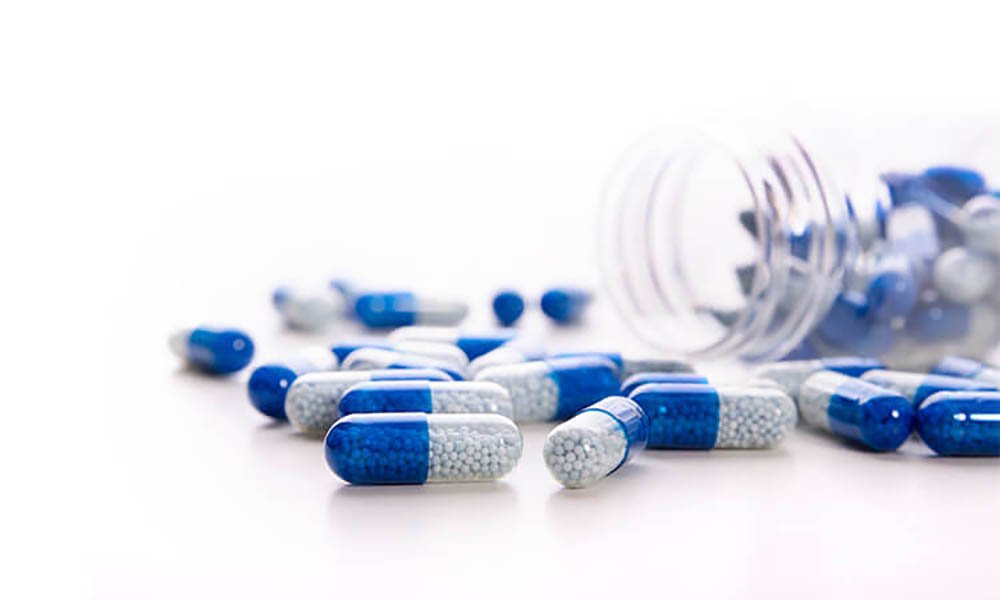
The NJP-2500C fills hard gelatin, HPMC (vegetarian), and pullulan capsules with pharmaceutical powders, nutraceutical blends, herbal extracts, and probiotic formulations — for four core buyer profiles.
Dietary Supplement Brands
Vitamins, minerals, collagen, omega blends, and pre-workout formulas at retail and DTC scale — one shift covers a 500,000-capsule daily order book with a single operator.
Contract Manufacturers (CMOs)
The lifting-mechanism fast-clean design cuts SKU changeover to under two hours — the feature CMOs running 5–10 formulas per week value most in this class.
Pharmaceutical Plants
Generic and OTC capsule lines rely on the 304/316L construction, enclosed stations, and documentation package supporting IQ/OQ/PQ validation in regulated markets.
Herbal & Traditional Medicine
The hole-plate system was optimized around the flow characteristics of botanical and traditional Chinese medicine powders — including mixed granule+powder filling in one capsule.
About This Machine and Its Manufacturer
The NJP-2500C Commercial Capsule Filling Machine is manufactured by HIJ Machinery (legal name: Wenzhou Trustar Machinery Technology Co., Ltd), a packaging machinery manufacturer founded in 2004 and headquartered at Development Road, Rui'an Economic Development Zone, Rui'an 325200, Wenzhou, Zhejiang, China. HIJ Machinery designs and builds capsule filling machines, blister packing machines, cartoning machines, case packing machines, liquid filling machines, and complete turnkey packaging lines for the pharmaceutical, nutraceutical, cosmetic, and food industries, exporting to customers in more than 30 countries.
All HIJ capsule filling equipment follows a cGMP-ready design philosophy: product-contact parts in 304 and 316L stainless steel, enclosed working stations, and CE-marked electrical construction manufactured under an ISO 9001 quality management system. Process validation (DQ/IQ/OQ/PQ) remains the responsibility of the purchasing facility; HIJ Machinery provides the complete documentation package — factory acceptance test records, material certificates, and electrical drawings — to support your validation program.
Technical content on this page is authored and reviewed by Forester Xiang, Founder & Chief Engineer of HIJ Machinery, drawing on 20+ years in pharmaceutical packaging engineering and more than 100 production facility audits across 30+ countries. For equipment consultation, contact HIJ Machinery via the contact page or learn more about HIJ Machinery.
Commercial Capsule Filling Machine FAQs
Direct answers from our engineering team to the questions buyers ask most before purchasing the NJP-2500C.
How much does a commercial capsule filling machine cost?
The HIJ NJP-2500C commercial capsule filling machine costs from USD 60,000 FOB China port, including one set of capsule size change formats, PLC touchscreen control, and dust collector. A complete automated line with vacuum powder feeder (USD 4,900), empty capsule loader (USD 3,900), sorting polisher (USD 3,500), and metal detector (USD 14,000) typically totals USD 75,000–90,000 — roughly 40–60% less than comparable European encapsulation equipment.
How many capsules per hour can the NJP-2500C fill?
The NJP-2500C fills up to 150,000 capsules per hour, equal to 2,500 capsules per minute. In practical commercial production at 70–80% of rated speed, one 8-hour shift produces roughly 850,000–1,000,000 capsules with a single operator.
What capsule sizes can a commercial capsule filling machine handle?
The NJP-2500C fills hard capsule sizes 00#, 0#, 1#, 2#, 3#, 4#, and 5#, plus safety (Supro-type) capsules A–E. Each size requires its own set of change parts (segments and dosing disc); one size is included with the machine and additional size sets cost USD 3,500 each. It works with gelatin, HPMC vegetarian, and pullulan capsules.
Is the NJP-2500C GMP compliant?
The NJP-2500C is built to a cGMP-ready design: all product-contact parts are 304 and 316L stainless steel, working stations are enclosed for dust control, and the machine is CE-marked and manufactured under an ISO 9001 quality system. Formal GMP validation (IQ/OQ/PQ) is performed at your facility as the operator's responsibility; HIJ Machinery supplies the complete documentation package to support that validation.
What is the difference between a commercial and an industrial capsule filling machine?
A commercial capsule filling machine like the NJP-2500C targets 100,000–150,000 capsules per hour for mid-scale brands and contract manufacturers, balancing output with a compact footprint and fast changeover. Industrial capsule filling machines such as the NJP-3800C run 200,000+ capsules per hour with heavier frames, higher power draw, and continuous multi-shift duty cycles for large pharmaceutical plants.
Can the NJP-2500C fill pellets or mixed formulations?
Yes. Beyond standard powder filling, the NJP-2500C supports granule and powder mixed filling, granule and tablet mixed filling, and pellet filling with the optional pellet dosing device — allowing multi-component capsules such as beadlet-plus-powder formulations in a single pass.
What powder characteristics does the machine need for accurate dosing?
For the rated ≤±3% fill-weight accuracy, material should be granulated to roughly 40–80 mesh with reasonable flowability, at fill weights above 300mg. Poorly flowing, low-density powders (for example some botanical extracts) may need formulation adjustment with flow aids or reduced running speed. HIJ Machinery offers free powder testing on your actual formula before purchase.
What are the delivery time and warranty terms?
Standard delivery is 60 working days after receiving the advance payment, shipped in seaworthy wooden cases from any Chinese seaport. The machine carries a 12-month warranty starting from arrival, with free wear spare parts for one year, whole-life maintenance support, and optional on-site installation and commissioning by HIJ engineers.
Explore the Full Capsule Filling Range
Compare configurations across the HIJ capsule filling machine family, or go deeper with our sizing guide before requesting a quotation.
Capsule Filling Machines — All Models
The complete hub: every automatic, semi-automatic, and specialty capsule filler HIJ manufactures, with selection guidance.
Automatic Capsule Filling Machine
The full automatic NJP series overview — how fully enclosed encapsulation works and which output class fits you.
Industrial Capsule Filling Machine
Need more than 200,000 capsules/hour? The NJP-3800C class for high-volume, multi-shift pharmaceutical production.
Semi-Automatic Capsule Filling Machine
Startup or pilot-batch volumes under 20,000 capsules/hour — the lower-investment path before going fully automatic.
Liquid Capsule Filling Machine
Filling oils, softgel alternatives, or liquid herbal extracts into hard capsules with banding/sealing.
Capsule Filling Machine Size Selection Guide
Forester's step-by-step method for matching capsule size, dosing disc, and machine class to your formula.
Ready to Produce 1 Million Capsules Per Shift?
Send us your target output, capsule size, and formula type. Forester's engineering team will return a complete NJP-2500C line quotation — machine, accessories, utilities checklist, and delivery schedule — within 24 hours. Free powder testing available on your actual formulation before you commit.
Founded 2004 · 30+ Countries Served
12-Month Warranty · Lifetime Maintenance
Free Powder Testing
Full IQ/OQ/PQ Documentation Support