



Aseptic Technology
Aseptic Prefilled Syringe Vacuum Filling Machine for Bubble-Free Performance
Achieve precise, bubble-free filling and vacuum stoppering for viscous biologics, hyaluronic acid, and sterile gels. cGMP-ready solution for SCF syringes.
ISO 9001 & CE-Marked
Ideal for Viscous Liquids & Biologics
Vacuum Filling & Stoppering
Quick Answer
What is a prefilled syringe vacuum filling machine?
A prefilled syringe vacuum filling machine is aseptic pharmaceutical equipment that fills and stoppers ready-to-fill (RTF/SCF) glass or plastic syringes under vacuum. Drawing a vacuum during both the fill and stoppering cycles removes trapped air, producing bubble-free, oxygen-free syringes — essential for viscous biologics, hyaluronic acid, and oxygen-sensitive injectables. The HIJ-GZB-100 fills 0.5–20 ml syringes at 600–800 units/hour with ±1–2% dosing accuracy, starting at US$26,000 FOB Ningbo.
Key Takeaways
Bubble-free & oxygen-free — dual-vacuum fill + stoppering eliminates air entrapment and stopper "pop-up".
Ceramic plunger pump delivers ±1–2% accuracy for gels, biologics and ophthalmic ointments.
SCF/RTF ready — accepts BD, BG (Gerresheimer) and SCHOTT nested syringes; custom formats available.
cGMP-ready design — AISI 316L contact parts, no dead corners, Grade A LAF hood optional.
600–800 syringes/hour, single-needle — ideal for R&D, clinical batches and niche biologics.
Transparent pricing — from US$26,000; fully-configured aseptic line to US$42,300 FOB Ningbo.
Critical Challenges
Are Air Bubbles, Oxidation, and Inconsistent Stopper Placement Compromising Your High-Value Injectables?
In the production of sterile injectables—especially viscous biologics, hyaluronic acid, and sensitive formulations—traditional filling methods create three critical failure points that put your product quality, regulatory compliance, and profitability at risk.
Conventional Filling:
Air Bubble Entrapment
Traps air bubbles in viscous products like hyaluronic acid, leading to inaccurate dosage, product degradation, and high rejection rates. In clinical settings, even a single bubble can compromise the precision of dose delivery, putting patient safety at risk and causing costly product waste.
Manual/Atmospheric Stoppering:
Stopper "Pop-Up" Issue
Causes stopper displacement (pop-up) due to trapped air pressure, risks microbial contamination, and fails to meet stringent aseptic processing standards (cGMP, WHO GMP). This defect can lead to failed inspections, product recalls, and loss of customer trust.
Oxygen Exposure:
Product Degradation
Degrades sensitive biologics, vaccines, and other oxygen-labile formulations, shortening shelf life and reducing efficacy. For high-value biopharmaceuticals, oxidation can render entire batches unusable, resulting in massive financial losses and regulatory setbacks.
The Solution
The HIJ-GZB-100 is Engineered to Eliminate These Critical Risks
Our machine utilizes a sophisticated vacuum filling and plugging process to guarantee a bubble-free, oxygen-free, and perfectly sealed final product. This protects your investment, ensures regulatory compliance, and most importantly, safeguards patient safety.
Discuss Your Formulation Challenges
The Technology
Our 4-Stage Aseptic Process for Perfect, Bubble-Free Syringes
From denesting to final stoppering, every stage is engineered to eliminate air entrapment and maintain aseptic integrity. See how our vacuum technology delivers uncompromising quality.
01
Stage
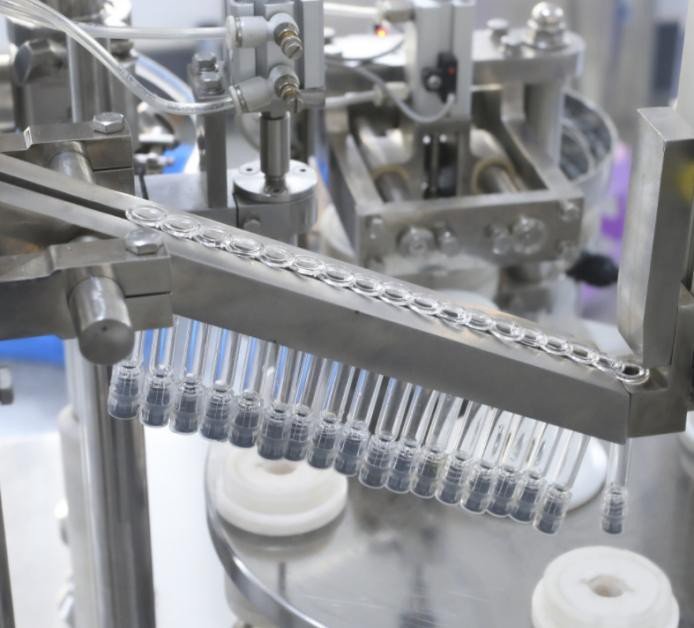
Syringe Denesting & Loading
Syringes are fed from SCF (Sterile, Clean, ready-to-Fill) tubs, either manually or via an automatic denester. The system gently places them into the star wheel for precise transport, maintaining the sterility established by your syringe supplier.
02
Stage
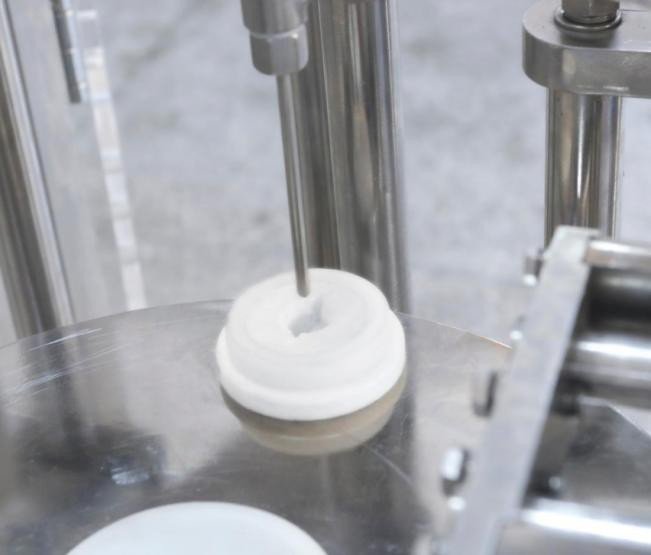
High-Precision Vacuum Filling
The ceramic pump provides precise dosing with ≤±1-2% accuracy. The filling needle rises from the bottom of the syringe as it fills, while a vacuum is drawn to remove all air from the barrel. This ensures a completely bubble-free fill even for highly viscous gels like hyaluronic acid or ophthalmic ointments.
03
Stage
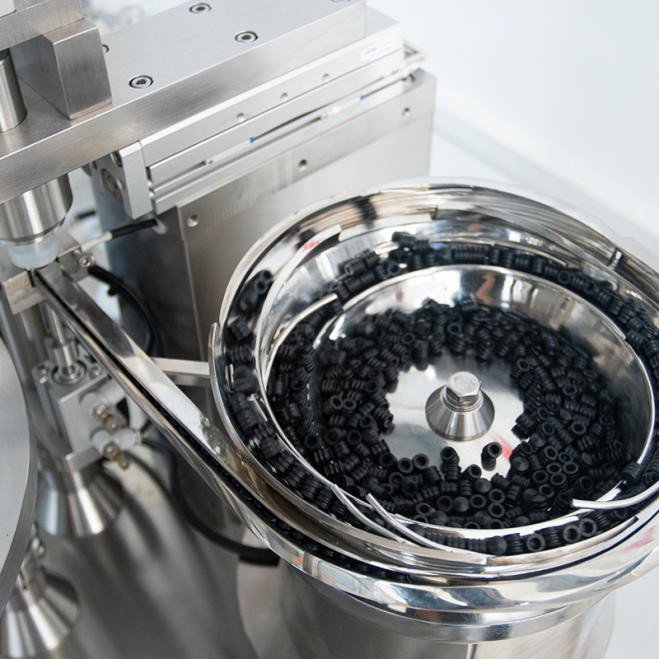
Automatic Stopper Feeding & Placement
Sterile stoppers are fed from a vibratory bowl and precisely oriented for placement. The system is designed to minimize particle generation and mechanical stress on the stoppers, maintaining aseptic conditions throughout the process.
04
Stage
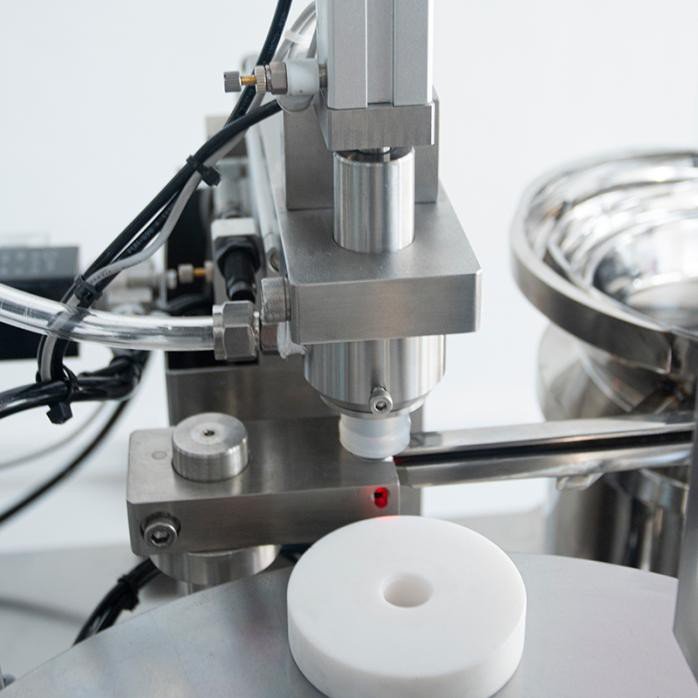
Vacuum Stoppering (Plugging)
The core of our technology. The stopper is held above the liquid while a vacuum is drawn in the syringe headspace. The stopper is then inserted under vacuum, eliminating air gaps and ensuring it remains perfectly seated on the liquid surface without rebound. This critical step prevents oxidation, extends shelf life, and ensures dosage accuracy.
See Our Vacuum Filling Technology in Action
Ready to discuss how this process can be tailored to your specific product? Our pharmaceutical engineering team will walk you through the entire workflow and answer all your technical questions.
Schedule Your Process Review
Core Advantages
Engineered for Aseptic Integrity and Operational Excellence
Our HIJ-GZB-100 isn't just a machine; it's a comprehensive solution. Discover how each core technology directly translates into higher product quality, enhanced compliance, and greater operational efficiency for your facility.
Advanced Vacuum Filling System
Guarantees zero bubbles in your final product, ensuring precise dosage and enhanced product stability. This is critical for maintaining the cosmetic appearance and therapeutic efficacy of high-viscosity materials like hyaluronic acid and dermal fillers.
Servo-Driven Ceramic Pump
Delivers exceptional dosing accuracy of ≤±1-2%, minimizing expensive product waste. The ceramic material is highly resistant to corrosion and high temperatures, and its cGMP-ready design allows for easy cleaning and sterilization (CIP/SIP).
Complete Vacuum Stoppering
Eliminates stopper "pop-up" and ensures a tight seal with no headspace air. This is critical for preventing oxidation and maintaining the sterility and shelf-life of sensitive biologics and vaccines.
Modular, cGMP-Ready Design
Constructed with AISI 316L for contact parts. The compact, modular design with no sanitary dead corners can be easily integrated into an isolator or RABS for higher-level aseptic processing.
Siemens PLC & HMI Control
Provides an intuitive interface for recipe management and real-time monitoring, with secure audit trails and user-access controls to support your 21 CFR Part 11 electronic-records workflows.
Forester's Insight
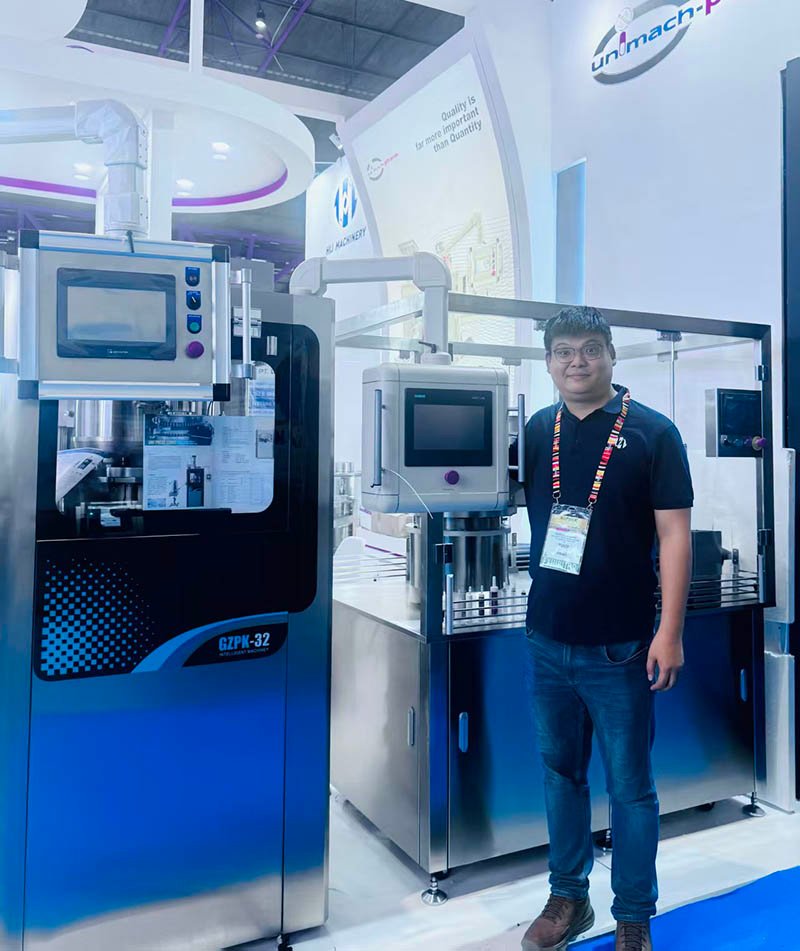
Forester Xiang
Founder & Chief Engineer · 20+ years in sterile filling
The most expensive mistake I see with hyaluronic-acid fillers isn't the fill weight — it's the single micro-bubble that a QC inspector catches after the syringe is already stoppered. On a viscous 20,000 cP gel, atmospheric filling almost guarantees entrapment, and by the time you see it the batch is scrap.
That's why I insist customers evaluate the machine on their own formulation during the FAT, not a water demo. Water fills beautifully on almost any pump; your gel is the real test. The vacuum fill-and-stopper cycle on the GZB-100 exists precisely because I got tired of watching good product rejected for a defect that is entirely preventable.
Technical Data Sheet
Technical Specifications for the Lab Scale Syringe Filler (Model: HIJ-GZB-100)
The HIJ-GZB-100 is a versatile tabletop machine designed for R&D, clinical trials, and small-batch production. It offers the same advanced vacuum technology as our large-scale production lines in a compact footprint.
Core Specifications
Applicable Syringe
0.5ml to 20ml (Plastic or Glass SCF format)
Specify size at order; dedicated format parts required per size
Recommended For
Viscous Liquids, Gels, Ointments, Biologics
Including hyaluronic acid, mAbs, vaccines, and other high-value formulations
Filling System
Servo-driven Ceramic Plunger Pump
Acid/alkali resistant, wear-resistant, high-temperature tolerant
Filling Accuracy
≤±1-2% (product dependent)
Verified during Factory Acceptance Test (FAT) with your formulation
Production Capacity
600-800 syringes/hour
Ideal for R&D, pilot batches, and clinical trial material manufacturing
Vacuum System
Integrated Vacuum Filling & Stoppering
External vacuum pump required (0.6-0.7 MPa, 15 L/s)
Control System
Siemens PLC with HMI Touchscreen
User-friendly interface with recipe management, real-time monitoring, and audit-trail & user-access controls
Power Requirements
2.5 KW | 380V/220V | 50-60Hz
Compressed Air
0.6-0.7 MPa, 15 L/s (clean, dry, oil-free)
Dimensions (L×W×H)
808mm × 758mm × 1760mm
Compact footprint suitable for cleanrooms, isolators, or RABS
Equipment Weight
380 KG
Material Construction
Body: AISI 304 Stainless Steel
Product Contact Parts: AISI 316L Stainless Steel & Medical-Grade Silicone
No sanitary dead corners; cGMP-ready design
Product Contact Parts: AISI 316L Stainless Steel & Medical-Grade Silicone
No sanitary dead corners; cGMP-ready design
Need a Detailed Technical Proposal?
Our engineering team can customize the HIJ-GZB-100 to your exact requirements. Request a comprehensive technical specification document, CAD drawings, and validation support package.
Transparent Pricing
How Much Does the HIJ-GZB-100 Syringe Filling Machine Cost?
Unlike most manufacturers, we publish our pricing openly. The HIJ-GZB-100 starts at US$26,000 FOB Ningbo for the base machine and scales into a complete aseptic line as you add automation and clean-air options.
Base Machine
US$26,000
FOB Ningbo · complete filling & vacuum-stoppering unit
- HIJ-GZB-100 vacuum filling & plugging machine
- One (1) format mold set — your specified syringe size
- Rubber-stopper vibratory feeder
- Siemens PLC + HMI control system
- Servo-driven ceramic plunger pump
- Full cGMP documentation support (FAT/IQ/OQ)
Fully-Configured Aseptic Line
up to US$42,300
FOB Ningbo · base machine + automation + Grade A clean air
- Everything in the base machine
- Automatic nest-removal (denesting) module (+US$12,000–12,500)
- Grade A laminar-flow (LAF) hood for filler (+US$2,000)
- LAF hood for the denesting module (+US$2,300)
- Extra format molds (+US$2,300 each)
- Additional ceramic valve assembly (+US$1,800)
Commercial terms: FOB Ningbo · Payment T/T 40% advance, 60% before delivery · Lead time 45 working days · 12-month warranty with lifetime maintenance support. Final pricing depends on your syringe format, fill volume and automation level.
Choose Your Model
HIJ-GZB-100 vs. Other Prefilled Syringe Filling Machines
| Feature | HIJ-GZB-100 This page | Plastic Syringe Filler | Double-Head Vacuum |
|---|---|---|---|
| Best for | Viscous gels, biologics, HA, ophthalmics | Standard aqueous plastic syringes | Higher-throughput viscous production |
| Vacuum fill & stopper | Yes — bubble-free & oxygen-free | Standard fill & cap | Yes — dual head |
| Filling needles | 1 | 1 | 2 |
| Output | 600–800 pcs/hr | ~1,200–1,800 pcs/hr | ~1,200–1,600 pcs/hr |
| Syringe format | Glass & plastic SCF, 0.5–20 ml | Plastic SCF | Glass & plastic SCF |
| Ideal user | R&D, clinical, niche biologics, aesthetics | Volume plastic-syringe lines | Scale-up viscous production |
| Learn more | You are here | View plastic filler → | View double-head → |
Not sure which fits your formulation and batch size? Ask our engineers for a recommendation →
Versatile Applications
Proven Success in High-Value Pharmaceutical & Aesthetic Applications
From cutting-edge biologics to luxury dermal fillers, the HIJ-GZB-100 delivers bubble-free precision for the world's most demanding injectable products.
Hyaluronic Acid (HA) & Dermal Fillers
Bubble-free filling of high-viscosity gels for the aesthetics industry. Ensure smooth injection and consistent patient outcomes.
Biologics & Monoclonal Antibodies (mAbs)
Gentle, oxygen-free handling to preserve the integrity of sensitive proteins. Protect your high-value biologic investments.
Vaccines
Aseptic processing to ensure the safety and efficacy of vaccine products. Meet the highest global regulatory standards.
Ophthalmic Solutions
Precise, sterile filling for sensitive ophthalmic applications. Deliver crystal-clear formulations without contamination risk.
Is Your Product a Perfect Fit?
Every formulation is unique. Our application specialists will analyze your product's viscosity, particle size, oxygen sensitivity, and regulatory requirements to configure the HIJ-GZB-100 specifically for your needs.
Discuss Your Application Requirements
Why Choose HIJ
Your Partner in Aseptic Filling Technology
Two decades of sterile processing expertise, combined with a relentless commitment to solving your most challenging filling problems.
Forester Xiang
Founder & Chief Technical Officer
"We don't just sell a machine; we provide a complete solution tailored to your product's specific properties. Your success is our validation."
20+ Years in Sterile Filling Engineering
Deep Application Expertise
With over 20 years of experience, our founder Forester Xiang understands the unique challenges of sterile filling. We don't just sell a machine; we provide a complete solution tailored to your product's specific properties.
Turnkey Validation Support
We provide a comprehensive cGMP documentation package, including FAT, SAT, IQ/OQ protocols, and material certificates, to accelerate your validation process.
European Quality, Smart Pricing
Get access to world-class vacuum filling technology and robust engineering without the exorbitant price tag of European manufacturers.
Global Service & Rapid Response
Our global network ensures you get expert support for installation, training, and maintenance, minimizing downtime and maximizing your productivity.
Ready to work with a partner who truly understands your aseptic filling challenges? Let's discuss how we can deliver the perfect solution for your project.
Start Your Consultation Today
Entity Reference · Quick Facts
HIJ-GZB-100 Prefilled Syringe Vacuum Filling Machine — At a Glance
Product typeAseptic prefilled syringe vacuum filling & stoppering machine
ModelHIJ-GZB-100
ManufacturerHIJ Machinery (Wenzhou Trustar Machinery Technology Co., Ltd)
Established2004 · Rui'an, Wenzhou, Zhejiang, China
Output600–800 syringes / hour (single needle)
Syringe range0.5 ml – 20 ml, glass & plastic SCF/RTF
Filling accuracy±1–2% (formulation dependent)
Fill systemServo-driven ceramic plunger pump; vacuum fill + vacuum stopper
MaterialsBody AISI 304; product-contact AISI 316L + medical silicone
ControlSiemens PLC + HMI touchscreen
Power / air2.5 kW · 380V/220V 50–60Hz · 0.6–0.7 MPa, 15 L/s
Dimensions / weight808 × 758 × 1760 mm · 380 kg
ApplicationsHyaluronic acid & dermal fillers, biologics/mAbs, vaccines, ophthalmic solutions
CompliancecGMP-ready design · ISO 9001 manufacturing · CE-marked · IQ/OQ/PQ documentation support
PriceFrom US$26,000 FOB Ningbo; configured line to US$42,300
Lead time / warranty45 working days · 12-month warranty, lifetime maintenance
Technical Answers
Frequently Asked Questions About the HIJ-GZB-100 Syringe Filling Machine
Answers from our pharmaceutical process engineers on vacuum filling, cleanroom integration, pricing and cGMP validation.
How does vacuum filling produce bubble-free prefilled syringes?
During the fill cycle the HIJ-GZB-100 draws a vacuum inside the syringe barrel while the filling needle rises from the bottom of the syringe as liquid enters. This evacuates trapped air before and during filling, so even highly viscous products such as hyaluronic-acid gels and ophthalmic ointments fill completely without bubbles or voids. The vacuum is then maintained in the headspace during stoppering, holding the rubber stopper firmly on the liquid surface so it does not rebound or "pop up". The result is a bubble-free, oxygen-free syringe with accurate, consistent dosing.
What syringe sizes and brands does the HIJ-GZB-100 support?
The machine handles glass and plastic SCF (sterile, clean, ready-to-fill) syringes from 0.5 ml to 20 ml. It is designed around widely used pre-fillable syringe systems from BD, BG (Gerresheimer) and SCHOTT, and other syringe types can be accommodated with custom tooling.
Changing between syringe sizes is done by swapping the dedicated format mold set for that size. One format mold is included with the base machine; additional molds are available so you can run multiple formats on the same line.
Can the machine be installed inside a cleanroom or under laminar flow?
Yes. The compact 808 × 758 mm footprint and crevice-free stainless-steel construction (AISI 316L product-contact parts, no sanitary dead corners) make the HIJ-GZB-100 well suited to aseptic environments. An optional Grade A / ISO Class 5 laminar-flow (LAF) hood can be fitted directly over the filling and stoppering zones to provide clean air at the critical points.
The modular design also allows integration with RABS or isolator systems and with an automatic denesting module for higher-level aseptic processing. Our engineers work with your facility team to plan utilities, pressure differentials and airflow during the project phase.
What cGMP validation documentation is provided?
HIJ provides a comprehensive documentation package to support your validation. This includes Factory Acceptance Test (FAT) protocols, Installation Qualification (IQ) and Operational Qualification (OQ) templates, AISI 316L material certificates for product-contact parts, CE electrical-safety documentation and operation manuals.
Please note that the equipment is supplied with a cGMP-ready design and that final validation (IQ/OQ/PQ) against your own processes is the customer's responsibility — we provide the documentation and engineering support to make that process efficient.
How much does the HIJ-GZB-100 cost?
The base HIJ-GZB-100 starts at US$26,000 FOB Ningbo, which includes one format mold set, the rubber-stopper vibratory feeder, the Siemens PLC/HMI control system and the servo-driven ceramic plunger pump.
A fully-configured aseptic line — adding the automatic nest-removal (denesting) module and Grade A laminar-flow hoods — reaches approximately US$42,300 FOB Ningbo. Extra format molds and additional ceramic valve assemblies are available as options. Final pricing depends on your syringe format, fill volume and level of automation.
What is the production capacity and lead time?
The HIJ-GZB-100 is a single-needle machine with an output of 600–800 syringes per hour, making it ideal for R&D, clinical-trial material, aesthetics and niche biologic production. For higher throughput on viscous products, our double-head vacuum model runs two filling needles.
Standard lead time is 45 working days after the advance payment and approval of samples for testing. Payment terms are T/T, 40% advance and 60% before delivery, and the machine carries a 12-month warranty with lifetime maintenance support.
Have More Technical Questions About Aseptic Syringe Filling?
Our pharmaceutical process engineers are ready to discuss your formulation, cleanroom integration and validation timeline.
Speak With a Vacuum Filling Specialist
Related Resources
Everything You Need to Specify a Prefilled Syringe Line
The machines in the range, the engineering guides that explain the decisions, and the downstream equipment that completes the line.
Machines in the Range
Specification Guides
- How a prefilled syringe filling machine works
- Syringe filling machine price breakdown
- Do you actually need vacuum filling?
- One filling needle or two? Throughput & CAPEX
- Validation documents your supplier must provide
- SCF/RTF formats and change-part costs
- Specifying a line for hyaluronic acid fillers
- Headspace oxygen and biologic shelf life
Ready for Bubble-Free Prefilled Syringe Filling?
Send us your formulation, syringe format and target batch size. Forester's engineering team will configure a HIJ-GZB-100 line to your exact aseptic requirements — and quote it transparently.
20+ years sterile-filling expertise
cGMP-ready design
Full IQ/OQ documentation support
45-day lead time