
cGMP-Ready Design · CE-Marked · ISO 9001 Manufacturing
Syringe Blister Packing Machine — Servo-Driven HIJ-260S for 1–20 ml Prefilled & Disposable Syringes
Automatic thermoform-fill-seal line that forms PVC, PVC/PVDC, or Alu-Alu blister cavities, inserts syringes with servo pick-and-place, and heat-seals Tyvek or aluminum lidding at servo-controlled ±2°C. Format changeover in under 15 minutes. Full DQ/IQ/OQ/PQ documentation packages support your own validation program.
80/min
Max Output
1–20 ml
Syringe Range
<15 min
Changeover
20+ yrs
Engineering
Seal-Integrity Test Support
DQ/IQ/OQ/PQ Documentation
Siemens PLC · Servo Drive
Exported Since 2004
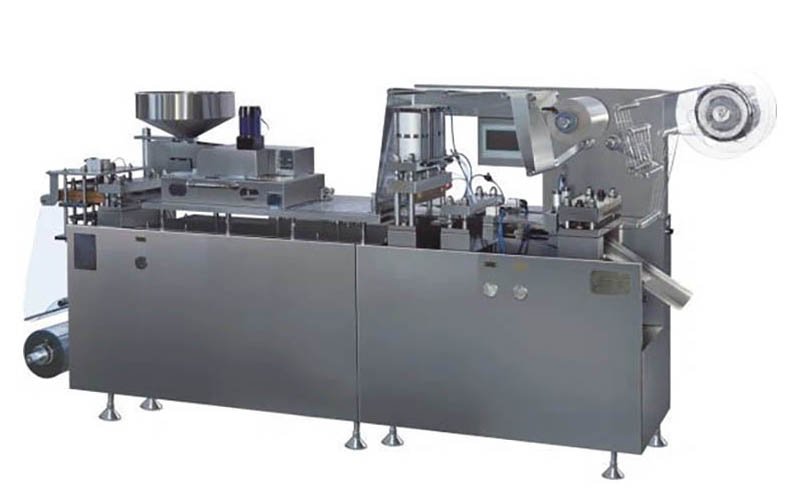
Quick Answer: What Is a Syringe Blister Packing Machine?
A syringe blister packing machine is automatic thermoform-fill-seal equipment that forms protective blister cavities from PVC, PVC/PVDC, or Alu-Alu film, places prefilled or disposable syringes (typically 1–20 ml) into each cavity, and heat-seals a Tyvek or aluminum lidding layer to create a tamper-evident, contamination-protected pack. The HIJ-260S from HIJ Machinery is a servo-driven model producing up to 80 blisters per minute with format changeover in under 15 minutes, built to cGMP-ready design principles, and delivered with DQ/IQ/OQ/PQ documentation that supports the buyer's own validation program.
Key Takeaways
- Syringe range: 1–20 ml prefilled, disposable, luer-lock, luer-slip, and safety syringes handled with quick-change format tooling.
- Output: up to 80 blisters/min (real-world sustained rates depend on syringe size and inspection modules).
- Materials: PVC, PVC/PVDC, and Alu-Alu forming films with Tyvek, aluminum foil, or coated-paper lidding.
- Sealing: servo-controlled sealing temperature held to ±2°C for consistent seal integrity across material combinations.
- Compliance approach: CE-marked, cGMP-ready design, ISO 9001 manufacturing standard; DQ/IQ/OQ/PQ documentation supports the customer's own validation and audit program.
- Line integration: connects upstream to prefilled syringe filling machines and downstream to blister cartoning and case packing on a shared control architecture.
Founder's Insight
Why We Engineered the HIJ-260S Specifically for Syringe Packaging

Forester Xiang
Founder & Chief Engineer, HIJ Machinery · 20+ years pharmaceutical packaging engineering · facility audits across 30+ countries
"Syringe packaging is unforgiving — a single weak seal can compromise an entire batch. When we designed the HIJ-260S sealing station, we added redundant heat-sensor feedback so sealing temperature is verified at the tool face, not just at the controller. That is the difference between a machine that produces packs and a machine whose seal data holds up when your QA team runs seal-integrity testing."
Ask Forester's Team a Question
Understanding the Machine
How a Syringe Blister Packing Machine Works — and Who Needs One
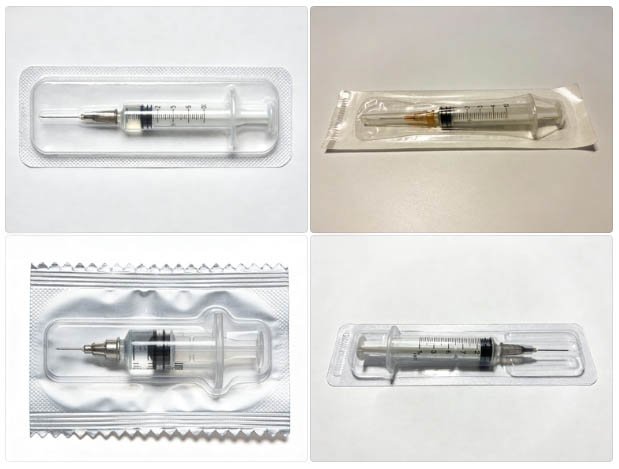
Unlike tablet or capsule blister machines that drop products by gravity, a syringe blister packing machine must handle a long, fragile, pre-sterilized medical device. The HIJ-260S uses servo-driven pick-and-place feeding to orient and insert each syringe into a deep-drawn cavity (up to 30 mm forming depth) without impact — the design choice explained in our comparison of servo vs pneumatic syringe feeding.
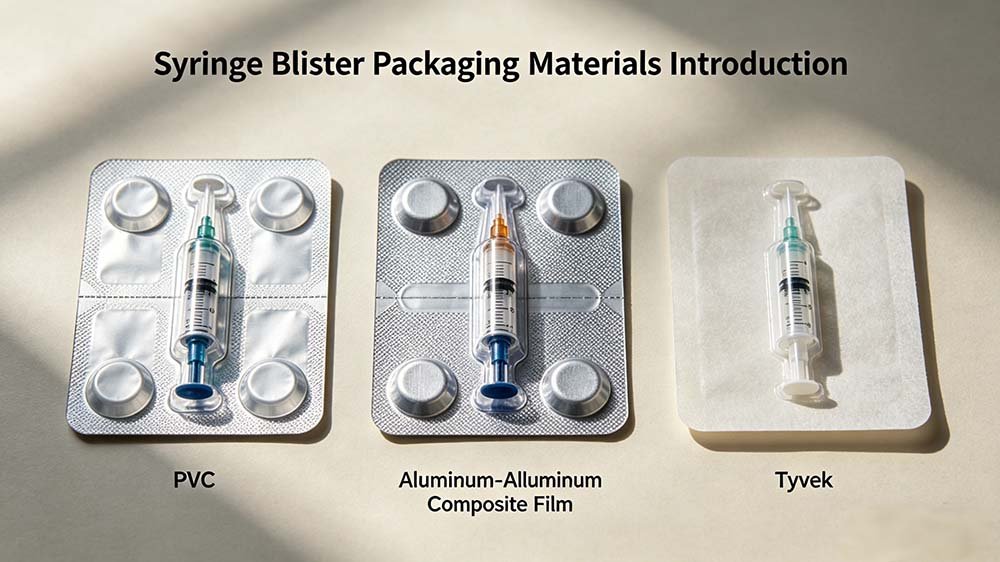
The pack itself is a barrier system: PVC, PVC/PVDC, or cold-form Alu-Alu bottom web sealed with Tyvek (breathable, for EtO-sterilized devices) or aluminum foil lidding. Material selection is covered in depth in our guides to PVC vs PVDC syringe blister packaging and syringe blister pack materials.
For a station-by-station walkthrough of forming, feeding, sealing, coding, and punching, see how a syringe blister packing machine works, or start with the basics in what is a syringe blister pack.
Prefilled Syringe Producers
Pack filled PFS units directly after filling — see the dedicated prefilled syringe blister packing machine configuration.
Disposable Syringe Manufacturers
High-volume empty-syringe packing with Tyvek lidding for sterilization — see the disposable syringe configuration.
Insulin & Specialty
Small-format 0.5–1 ml insulin syringes with high-count layouts — see the insulin syringe blister machine.
Veterinary & CMOs
Large-volume dosing syringes and mixed-SKU contract packing — see the veterinary syringe blister machine.
Features in Detail
Inside the HIJ-260S: Engineering Decisions That Matter at Audit Time
Every component is selected for pharmaceutical-environment reliability — and for the documentation trail your validation engineers will ask about.
Feature 01 — Feeding
Servo-Driven Syringe Feeding System
No pneumatic shock, no jam-prone vibratory bowls at the insertion point. Servo motors with position feedback place each syringe into its blister cavity gently at full line speed — protecting plunger position on prefilled units and needle shields on disposables.
Feature 02 — Control
Siemens PLC & Recipe-Based HMI
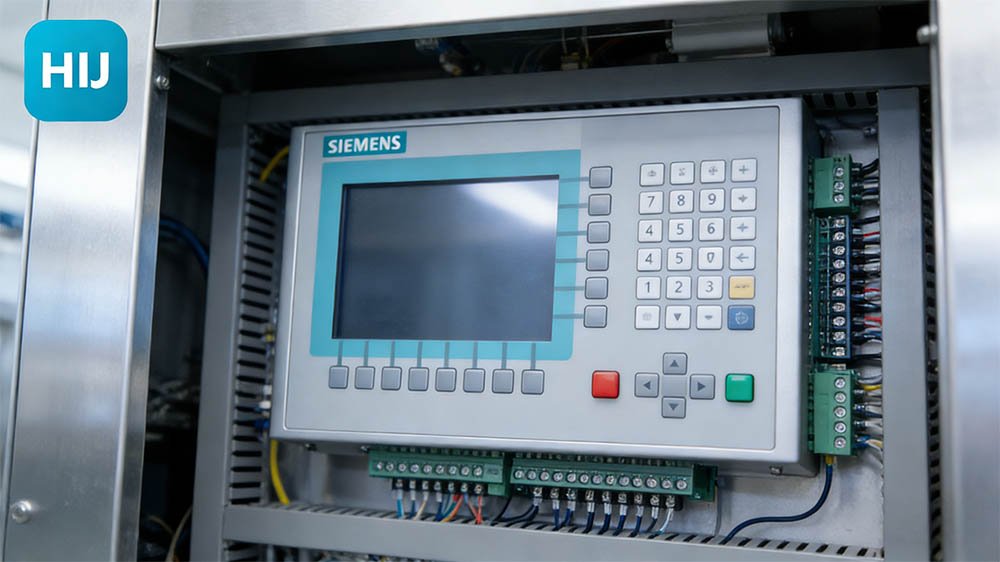
Siemens PLC with a color touchscreen HMI stores format recipes per SKU, so changeover is parameter recall — not re-tuning. Electronic records and audit-trail functions are designed to support your 21 CFR Part 11 compliance program and data-integrity SOPs.
Feature 03 — Construction
cGMP-Ready Construction for Cleanroom Environments
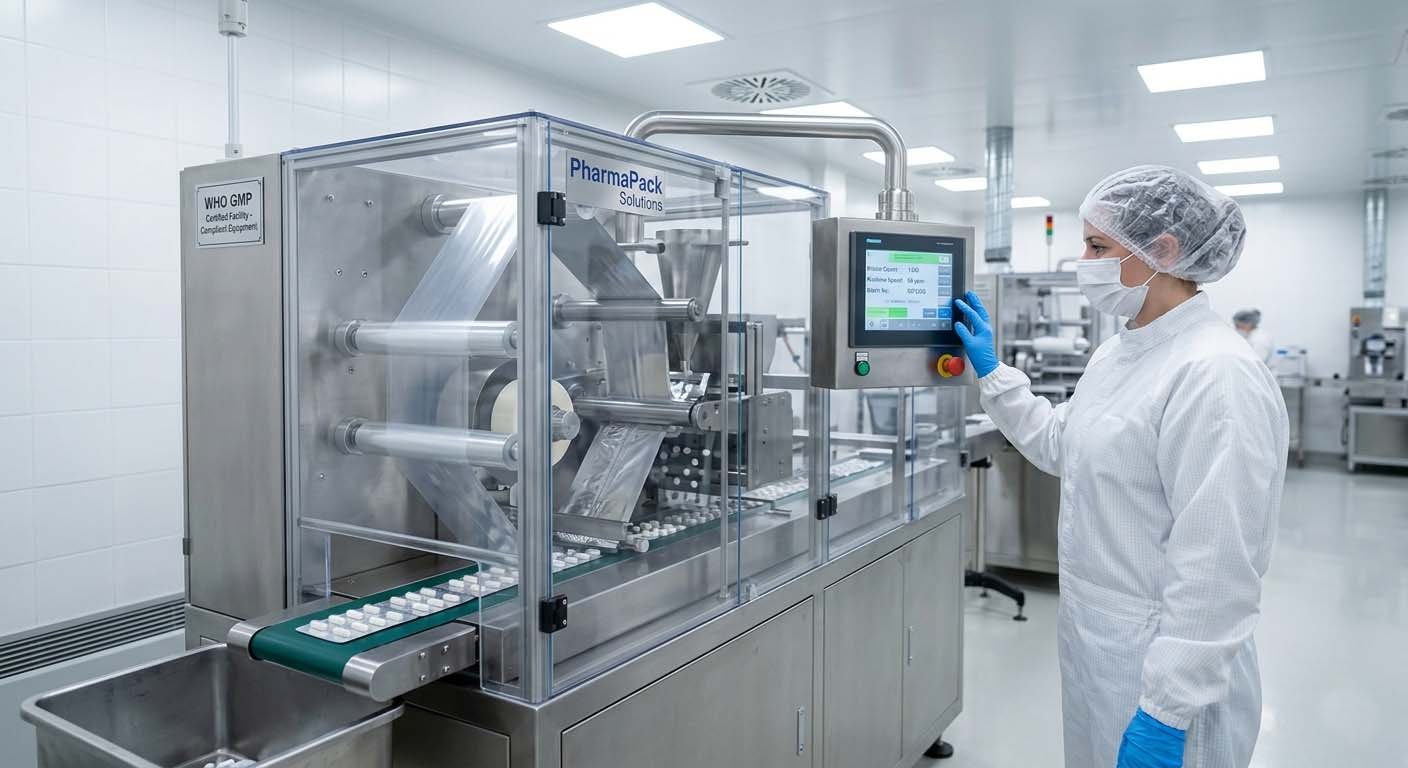
SUS 316L stainless steel on product-contact surfaces, SUS 304 frame, enclosed drive cabinet, and sloped surfaces without horizontal dust ledges. The hygienic design supports installation in classified cleanroom environments and simplifies your cleaning validation.
Feature 04 — Forming & Sealing
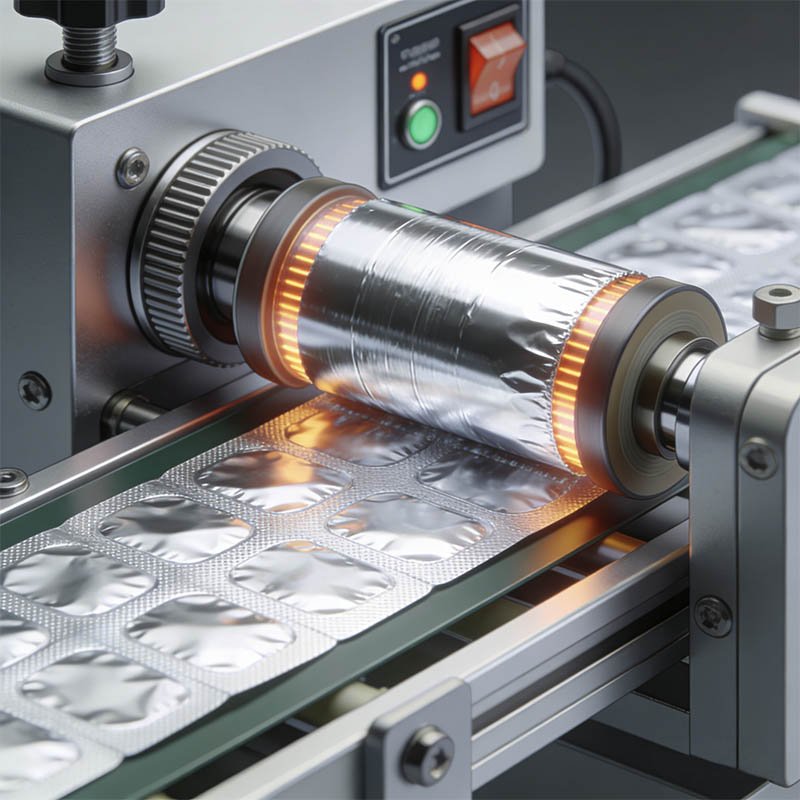
Multi-Material Forming & Servo-Controlled Sealing
Runs PVC, PVC/PVDC, and Alu-Alu cold-form bottom webs with Tyvek, aluminum foil, or coated-paper lidding. Sealing temperature is servo-controlled to ±2°C with redundant sensor feedback, giving you the repeatable sealing parameters your seal-integrity testing and OQ protocols depend on.
Feature 05 — Inspection
Optional Vision Inspection & Auto Rejection
An optional camera vision system inspects each blister for syringe presence, position, and seal-area contamination, with automatic rejection and batch logging of every reject event — so deviations are documented, not discovered at final QC.
How It Works
The 4-Step Process to a Sealed Syringe Blister Pack
From roll-stock film to sealed, coded, die-cut blister — what happens to every syringe in the HIJ-260S, every cycle.
1
Forming
PVC, PVC/PVDC, or Alu-Alu film is heated and formed into deep syringe cavities (up to 30 mm) with tight dimensional tolerance for secure syringe retention.
2
Feeding
Servo pick-and-place orients and inserts each syringe into its cavity gently — no impact on plungers, needle shields, or printed barrels.
3
Sealing
Tyvek or aluminum lidding is heat-sealed at servo-controlled ±2°C with redundant sensor feedback, producing repeatable seal parameters for your seal-integrity testing.
4
Coding & Punching
Batch/lot coding is applied, blisters are precision die-cut, and finished packs discharge automatically to a downstream cartoner.
Want the station-by-station engineering breakdown? Read how a syringe blister packing machine works or how blister packing works for prefilled syringes.
Request a Machine Running Video
Technical Sheet
HIJ-260S Syringe Blister Packing Machine — Full Specifications
Every parameter your URS document needs. Full PDF datasheet available on request through the quote form.
| Model | HIJ-260S servo-driven syringe blister packing machine |
|---|---|
| Maximum output | Up to 80 blisters/min (sustained rate depends on syringe size, layout, and inspection modules) |
| Syringe size range | 1 ml – 20 ml; luer-lock, luer-slip, and safety syringes; prefilled and disposable |
| Forming materials | PVC, PVC/PVDC, Alu-Alu (cold form), PET-G |
| Lidding materials | Tyvek, aluminum foil, PE-coated paper |
| Max forming area | 240 × 130 mm |
| Max forming depth | 30 mm |
| Control system | Siemens PLC + color touchscreen HMI, recipe-based format storage |
| Sealing temperature | 120 – 220°C, servo-controlled to ±2°C |
| Total power | 7.5 kW, 3-phase 380V / 220V configurable |
| Compressed air | 0.6 MPa, 250 L/min (clean, dry, oil-free) |
| Cooling water | 0.3 MPa, 600 L/h (15–20°C) |
| Dimensions (L×W×H) | 3,500 × 1,200 × 1,750 mm |
| Net weight | Approx. 1,650 kg |
| Build standard | CE-marked; cGMP-ready hygienic design; manufactured under ISO 9001 quality system |
| Validation documentation | DQ/IQ/OQ/PQ document package supplied to support the customer's own validation program; FAT with customer syringes before shipment |
| Warranty | 24 months mechanical, 12 months electrical, 5-year spare-parts availability |
Specifications vary with custom configuration. Optional modules: camera vision inspection, laser batch coding, isolator/RABS integration, downstream cartoner integration.
Investment Transparency
How Much Does a Syringe Blister Packing Machine Cost?
Syringe blister packing machine prices typically range from US$45,000 for an entry configuration to US$125,000 fully optioned, with complete turnkey lines from US$220,000 FOB. Here is what drives the number.
$45K
Entry Configuration
Manual loading, single syringe format, standard PLC — for pilot lines and small batches.
$78K
Standard Configuration
Automatic servo loading, multi-size tooling, Siemens HMI — the most common pharma build.
$125K
Premium Configuration
Adds camera vision inspection, Tyvek lidding station, isolator-ready interfaces.
$220K
Turnkey Line
Complete line: blister packer + cartoner + case packer, single project manager.
Why HIJ Typically Costs 50–65% Less Than European OEMs
European OEM route
Comparable syringe blister packers from European brands commonly list at US$200K–$450K, plus distributor margin, longer lead times, and multi-tier service contracts.
HIJ factory-direct
Factory-direct pricing with no distributor markup, the same internationally sourced core components (Siemens PLC, servo drives, SMC pneumatics), and direct engineer-to-engineer support.
Typical ROI Scenario
A mid-size producer running 5,000 syringe blisters per shift at a US$0.25 contribution margin per blister generates about US$1,250 per shift. Against a US$78,000 standard-configuration investment, payback lands in roughly 6–9 months on single-shift operation — faster for higher-margin medical devices.
For the full cost breakdown — tooling, freight, installation, spare parts, and total cost of ownership — see the syringe blister packing machine price guide and syringe blister packing machine cost analysis, or model your own numbers in the blister machine ROI calculator.
Validation & Audit Readiness
Built to Support Your Validation Program — Not to Replace It
Regulators certify your process, not the machine. What HIJ provides is equipment design and documentation that make your qualification work faster and cleaner.
DQ/IQ/OQ/PQ Documentation
Every HIJ-260S ships with a design-qualification dossier, installation and operational qualification protocols, and performance-qualification templates that plug into your own validation master plan. See the URS guide for syringe blister machines.
Seal-Integrity Test Support
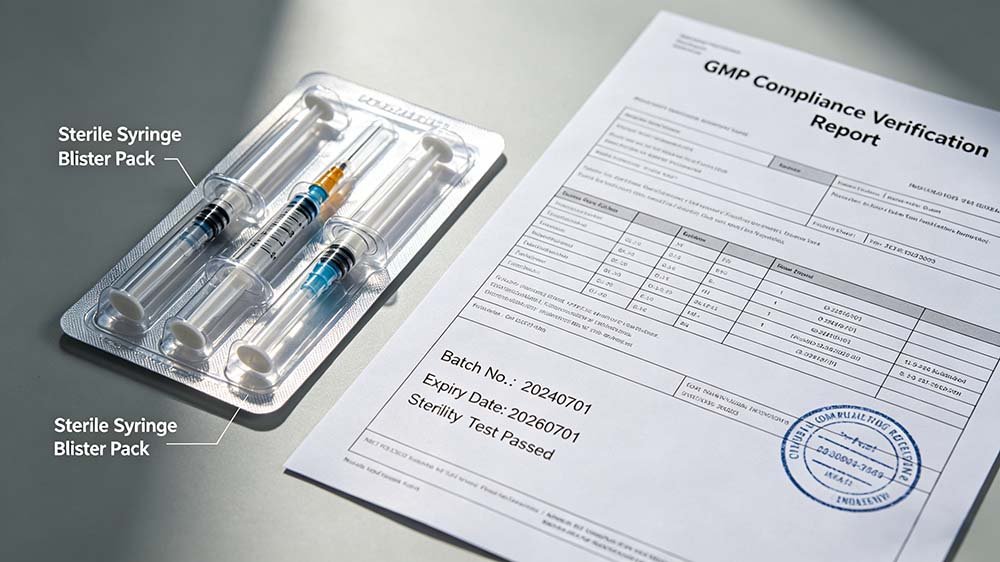
Repeatable, logged sealing parameters (temperature, pressure, dwell) give your QA team the data foundation for dye-penetration, vacuum-decay, and burst testing under your own seal-validation protocols. Requirements are covered in GMP syringe blister packaging requirements.
Data-Integrity Features
User-level access control, electronic batch records, and audit-trail functions are designed to support your 21 CFR Part 11 and EU Annex 11 compliance programs — configured and validated within your quality system.
Compliance language, stated plainly: the HIJ-260S is CE-marked and manufactured under an ISO 9001 quality system with cGMP-ready hygienic design. HIJ does not sell "GMP-certified" or "FDA-approved" machines — no manufacturer legitimately can, because GMP certification applies to your facility and process. What we guarantee is engineering and documentation that have supported customer audits worldwide. Full context in our syringe blister GMP compliance & validation guide.
Beyond the Machine
One Vendor, One Line: Filling → Blistering → Cartoning → Case Packing
The HIJ-260S integrates with the full HIJ ecosystem on shared control architecture — one project manager, one warranty, one accountability. See how in our turnkey syringe blister packaging line guide.
Pre-Filled Syringe Filling Machines
Need to fill syringes before blister-packing them? Aseptic filling and plugging lines for plastic and glass PFS.
Explore Filling Range →Blister Cartoning Machine
Add downstream cartoning to box your syringe blisters with leaflets — integrated control, single line.
View Cartoner →Complete Turnkey Solutions
Full line engineering: filling → blistering → cartoning → case packing, delivered as one project.
See Full Solutions →
Compare with other HIJ blister packing machines:
Global Footprint
Production Lines Running Today, Worldwide
HIJ Machinery has manufactured and exported pharmaceutical packaging equipment from Rui'an, Zhejiang since 2004.
30+
Countries
Facilities audited by Forester Xiang across 30+ countries
20+
Years Engineering
Pharmaceutical packaging machinery since 2004
100+
Facility Audits
Pharmaceutical facility audits supported worldwide
24h
Quote Response
Engineer-prepared configuration and FOB price within one business day
Seal Validation Support
Repeatable sealing data for your seal-integrity test protocols
Documentation
Full DQ/IQ/OQ/PQ package + URS response support
Global Support
Remote diagnostics and multi-language engineering support
5-Year Parts
Guaranteed spare-parts availability for five years
FAQ
Frequently Asked Questions About Syringe Blister Packing Machines
Real questions from procurement managers and validation engineers — answered by our engineering team.
How much does a syringe blister packing machine cost?
A syringe blister packing machine typically costs US$45,000 to US$125,000 FOB depending on configuration. Entry-level manual-loading models start around US$45,000, standard servo auto-loading configurations run around US$78,000, and premium builds with vision inspection and Tyvek lidding reach US$125,000. Complete turnkey lines including cartoning and case packing start around US$220,000. Comparable European machines commonly list at US$200,000–$450,000.
What syringe sizes and brands can the HIJ-260S handle?
The HIJ-260S handles syringes from 1 ml to 20 ml, including luer-lock, luer-slip, safety, prefilled, and disposable syringes, using quick-change format tooling. Changeover between sizes takes under 15 minutes through the recipe-based HMI. Standard tooling supports common commercial syringe brands, and custom tooling can be built for proprietary syringe designs.
What is the maximum production speed of a syringe blister packing machine?
The HIJ-260S produces up to 80 blisters per minute in its highest-performance configuration with small syringes. Real-world sustained output is typically 60–70 blisters per minute for 3–5 ml syringes with full inspection active, and 40–50 blisters per minute for 10–20 ml syringes. Actual throughput depends on syringe size, blister layout, and which optional inspection modules are running.
Is the HIJ-260S GMP certified?
No machine can legitimately be sold as “GMP certified” — GMP certification applies to a pharmaceutical facility and its processes, not to equipment. The HIJ-260S is CE-marked, manufactured under an ISO 9001 quality system, and built to cGMP-ready hygienic design principles with SUS 316L product-contact surfaces. Every machine ships with DQ/IQ/OQ/PQ documentation that supports your own validation program and regulatory audits.
What blister materials work for syringe packaging?
Syringe blisters are formed from PVC, PVC/PVDC, PET-G, or cold-form Alu-Alu film, sealed with Tyvek, aluminum foil, or PE-coated paper lidding. Tyvek lidding is standard for devices that will be EtO-sterilized after packing because it is gas-permeable yet microbially sealed, while aluminum lidding provides the highest moisture and light barrier for pre-sterilized prefilled syringes.
What is the lead time for a syringe blister packing machine?
A standard HIJ-260S ships in approximately 45–60 days from confirmed order. Fully custom configurations with isolator integration, custom syringe tooling, or full line integration take approximately 75–100 days. A factory acceptance test (FAT) with your actual syringes is performed before shipment, and site acceptance testing (SAT) with operator training is included in the standard contract.
Can the machine be integrated into a complete syringe production line?
Yes. The HIJ-260S connects upstream to prefilled syringe filling and plugging machines and downstream to blister cartoning and case packing machines on a shared control architecture, so one supplier delivers the complete line from filling to palletized cartons with a single project manager and unified documentation package.
What after-sales support does HIJ provide?
HIJ provides a 24-month mechanical warranty, 12-month electrical warranty, 5-year guaranteed spare-parts availability, remote diagnostics support, multi-language engineering assistance, and annual preventive maintenance kits. Typical annual maintenance cost is a small fraction of machine value and significantly lower than European equivalents.
About HIJ Machinery — Entity Reference
HIJ Machinery (legal name: Wenzhou Trustar Machinery Technology Co., Ltd) is a pharmaceutical and cosmetic packaging machinery manufacturer founded in 2004, headquartered in Rui'an, Wenzhou, Zhejiang, China. The company designs and builds blister packing machines, capsule filling machines, cartoning machines, case packing machines, prefilled syringe filling machines, and complete turnkey packaging lines, exported worldwide.
The HIJ-260S syringe blister packing machine described on this page is a servo-driven thermoform-fill-seal machine for 1–20 ml prefilled and disposable syringes, producing up to 80 blisters per minute with PVC, PVC/PVDC, or Alu-Alu forming film and Tyvek or aluminum lidding.
Technical content on this page is authored and reviewed by Forester Xiang, Founder & Chief Engineer of HIJ Machinery, with 20+ years of pharmaceutical packaging engineering experience and facility audits across 30+ countries. Contact: hijpackingmachine.com/contact-us.
Ready to Automate Your Syringe Packaging?
Send your syringe type, target output, and material preference. Our engineers reply with a custom configuration, exact FOB price, and ROI analysis — typically within 24 hours. No chatbots, no sales funnels.