
HIJ-DZA100 · Aseptic PFS Solution
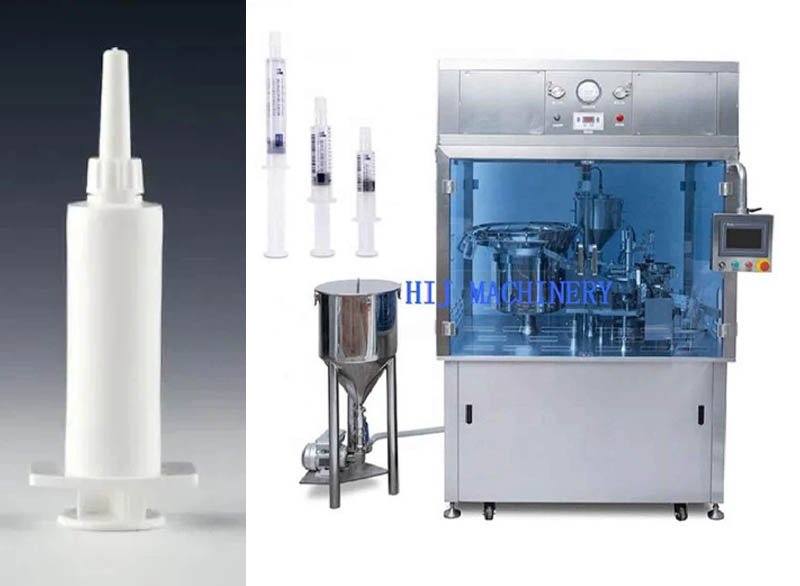
HIJ-DZA100 Prefilled Plastic Syringe Filling and Capping Machine
Fully automatic, servo-driven aseptic filling for plastic syringes from 0.5 ml to 50 ml. Ceramic plunger pump delivers ≤±1% typical filling accuracy at 1,800–2,100 syringes per hour — engineered to a cGMP-ready design for pharmaceutical, veterinary, dental and cosmetic producers.
- ≤±1% Typical Filling Accuracy
- Full Siemens Servo Drive System
- cGMP-Ready · SUS 316L Contact Parts
- Optional ISO 5 (Class 100) Laminar Flow Hood
Quick Answer
What Is the HIJ-DZA100 Prefilled Plastic Syringe Filling Machine?
The HIJ-DZA100 is a fully automatic prefilled plastic syringe filling and capping machine manufactured by HIJ Machinery (Wenzhou Trustar Machinery Technology Co., Ltd., founded 2004). It aseptically fills liquids, gels and ointments into plastic syringes from 0.5 ml to 50 ml at 1,800–2,100 syringes per hour, using a servo-driven ceramic plunger pump with ≤±1% typical filling accuracy. The machine features SUS 316L contact parts, Siemens PLC/HMI control, a cGMP-ready design, and an optional ISO 5 (Class 100) laminar flow hood for aseptic production.
Key Takeaways
- Syringe range: 0.5–50 ml plastic syringes; special formats customizable to your barrel and cap dimensions.
- Accuracy: ceramic plunger pump holds ≤±1–2% (typically ≤±1%), with bottom-up filling that minimizes air bubbles.
- Output: 1,800–2,100 pieces/hour — right-sized for clinical, veterinary, dental and small-to-mid commercial batches.
- Compliance: cGMP-ready design with SUS 316L contact parts and medical silicone; IQ/OQ documentation support provided (validation executed by the customer).
- Automation: full Siemens servo control — no mechanical cams — with real-time fault location on the HMI.
- Scalability: modular design connects to elevators, plunger-rod inserters, labelers and blister-cartoning lines for turnkey PFS packaging.
Navigating the Complexities of Aseptic Syringe Filling?
Pharmaceutical, veterinary and dental-gel manufacturers face three recurring failure points that threaten batch quality, regulatory standing and production economics.
Contamination Risk
Manual and semi-automatic filling exposes sterile product to operator contact and open-air transfer, driving batch rejections and audit findings. Every human touchpoint is a contamination vector regulators will scrutinize.
Inaccurate Dosing & Air Entrapment
Inconsistent fill volumes waste expensive API and fail weight-variation tests, while trapped air bubbles in the barrel cause dose deviations and cosmetic rejects that erode your qualification rate.
Production Bottlenecks
Poorly integrated fillers demand constant operator intervention, can't synchronize with downstream labeling or blister lines, and leave you unable to scale when order volumes grow.
Our Solution
Discover Your Custom Solution
One Machine. Loading, Filling, Capping — Untouched by Hands.
The HIJ-DZA100 replaces every manual step with servo-controlled automation inside a cGMP-ready SUS 316L envelope. Bottom-up nozzle filling expels air for a higher qualification rate, intelligent detection devices alarm and locate faults in real time, and the modular frame drops straight into a full prefilled-syringe production line when you're ready to scale.
How It Works
How Does a Prefilled Plastic Syringe Filling Machine Work?
From empty syringe to finished product, the HIJ-DZA100 executes a five-stage automatic process on a rotary turntable — with intelligent detection at every station, minimal human intervention and maximum sterility.
01
Automatic Syringe Loading
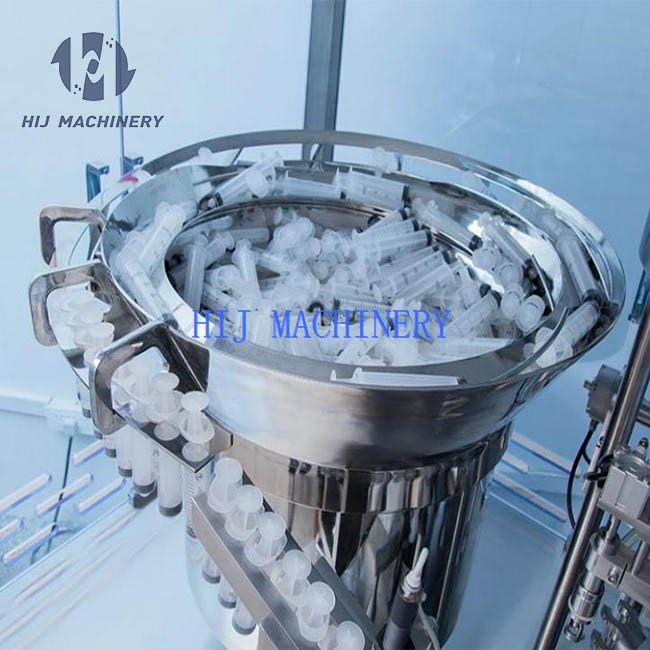
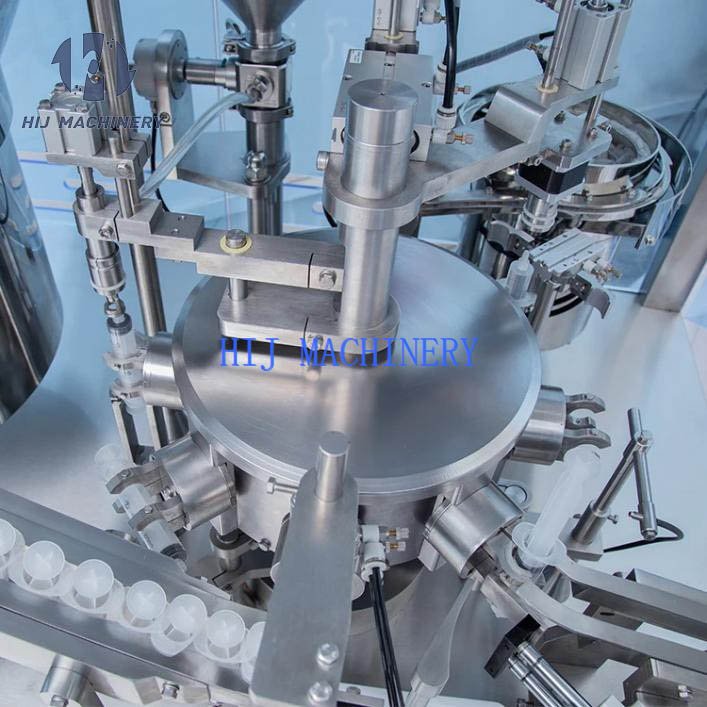
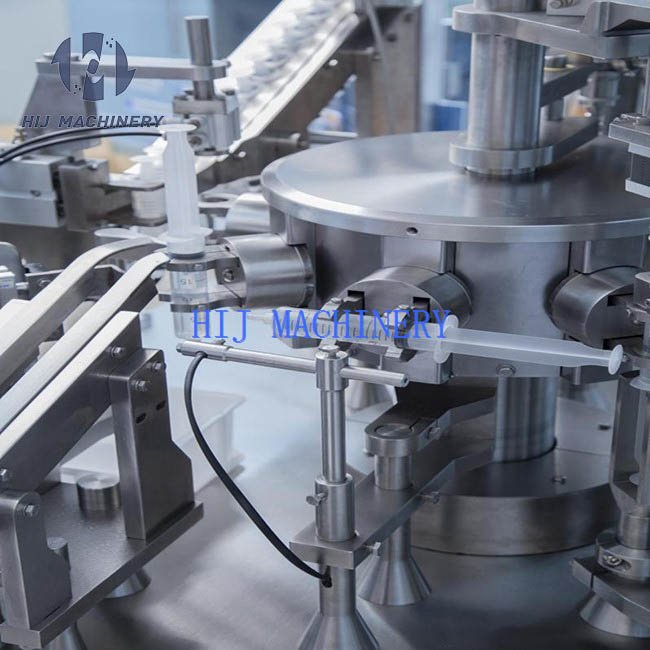
Syringes are gently sorted and oriented by a SUS 316L vibrating plate — bright-finished with no cleaning dead corners — and precisely fed through the loading guider into the rotary turntable one by one. The feeder is custom-machined to your exact syringe dimensions, ensuring a smooth, jam-free start to the filling process.
02
High-Precision Ceramic Pump Filling
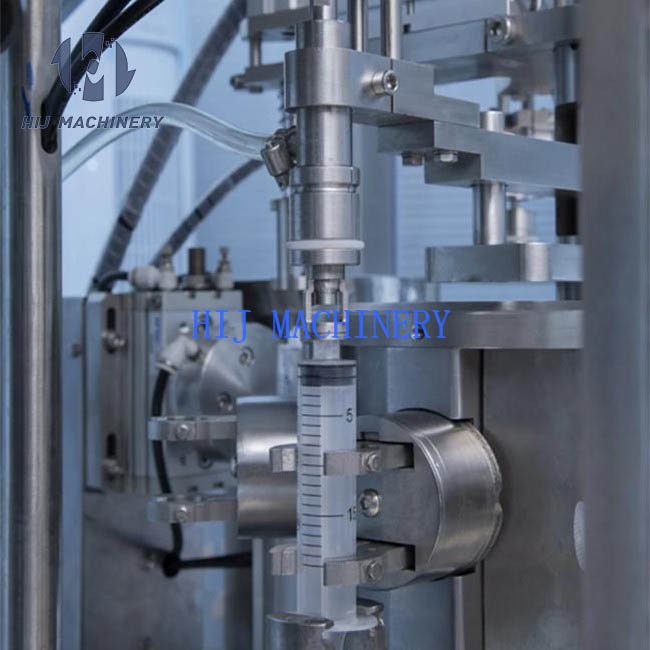
The servo-driven ceramic plunger pump performs quantitative filling at ≤±1–2% accuracy — typically ≤±1% in production. The nozzle fills from the bottom up with a programmable profile that expels air inside the syringe to the greatest extent, raising your batch qualification rate.
03
Automatic Cap Sorting & Placing
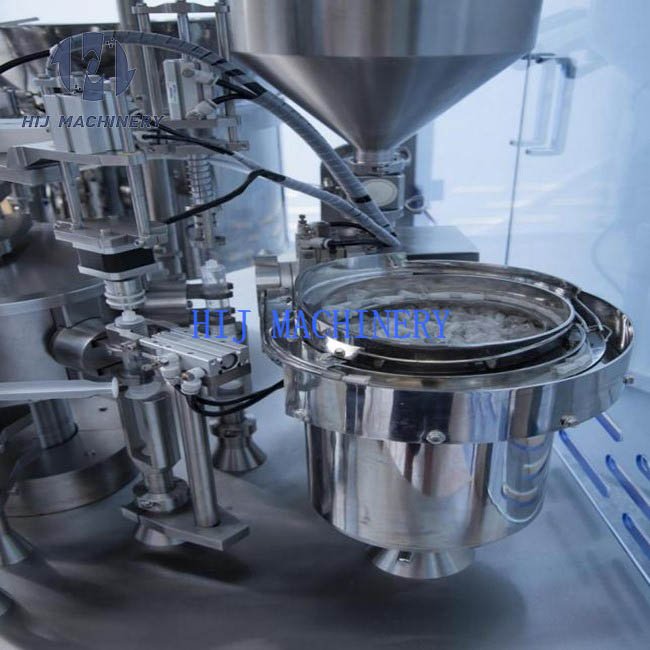
A dedicated vibrating disk — custom-built to your cap dimensions — arranges tip caps in perfect orientation, and a pick-and-place mechanism positions each cap precisely onto the filled syringe, ready for the sealing stage.
04
Precise Servo Capping
The capping station applies a consistent, pre-set torque through servo control — not mechanical cams — sealing every syringe uniformly. This prevents leaks, protects product sterility, and delivers a professional finish on every unit.
05
Finished Product Output
Perfectly filled and capped syringes discharge automatically to a collection tray or conveyor, ready for downstream integration with labeling machines, plunger-rod inserters, or a syringe blister packing line.
Engineering Excellence
Engineered for Precision, Compliance, and Flexibility
Every component of the HIJ-DZA100 is specified for pharmaceutical-grade performance — from contact-part metallurgy to the electrical brands inside the cabinet.
Material Excellence
SUS 316L Contact Parts & SUS 304 Frame
All product-contact parts are SUS 316L stainless steel with medical silicone rubber — a cGMP-ready material specification that resists aggressive cleaning agents, prevents product reaction, and delivers long service life.
Precision Dosing
High-Accuracy Ceramic Plunger Pump
Wear-resistant, acid/alkali-resistant and high-temperature tolerant, the ceramic pump holds ≤±1–2% accuracy (typically ≤±1%) across low-viscosity liquids, gels and thick ointments — and is easily removed for sterilization.
Advanced Automation
Full Servo Motor Control
Every synchronous action — loading, filling, capping — runs on Siemens servo motors with non-interference modular control. No mechanical cams to adjust; change parameters in seconds on the HMI.
Smart Control
Siemens PLC & HMI with Fault Location
The Siemens PLC monitors every station in real time; the touchscreen displays working status, alarms automatically, and pinpoints fault locations with prompts — cutting troubleshooting time for your operators.
Future-Proof Investment
Modular & Line-Expandable Design
Run standalone today, then connect a syringe elevator, plunger-rod inserter, labeling machine and blister-cartoning equipment tomorrow — the DZA100 is designed to anchor a complete PFS packaging line.
Aseptic Excellence
Optional ISO 5 (Class 100) Laminar Flow Hood
For high-demand aseptic applications, an integrated laminar flow hood creates a Class 100 (ISO 5) environment over the filling and capping stations — supporting your facility's aseptic processing strategy.
Forester's Insight
The single most underestimated detail in plastic syringe filling is air management. Buyers compare pumps and speeds, but in facility audits the metric that separates a smooth PQ run from months of deviation reports is the bubble rate. That's why we fill from the syringe head with a programmed bottom-up nozzle profile — it's the difference between a 99%+ qualification rate and a rework pile.
My advice before you request any quote: send your actual syringe and cap samples first. Vibrating plates are custom-machined to your barrel geometry, and matching them correctly at the factory saves you two weeks of commissioning at your site.
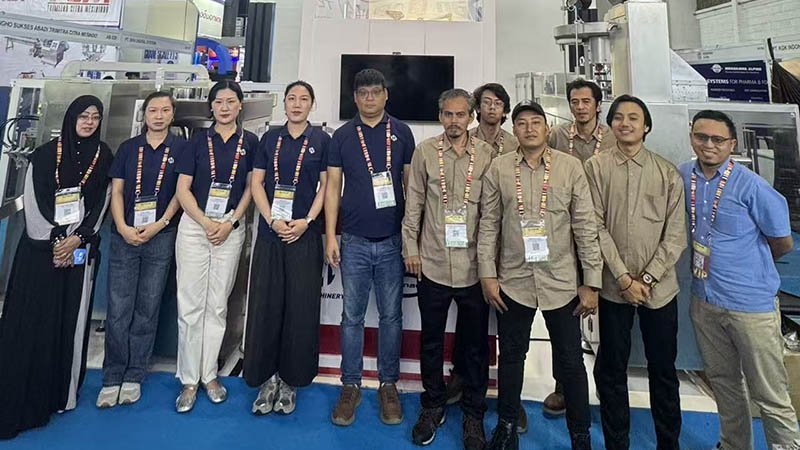
— Forester Xiang · Founder & Chief Engineer, HIJ Machinery · 20+ years, 100+ facility audits across 30+ countries
Detailed Specifications
HIJ-DZA100 Technical Parameters
Verified factory specifications — with the production benefit each parameter delivers to your operation.
| Parameter | Specification | Benefit for Your Production |
|---|---|---|
| Applicable Materials | Liquid, ointment, gel | One machine covers low-viscosity solutions through thick dental and veterinary gels. |
| Syringe Specifications | 0.5 – 50 ml (special formats customizable) | Covers R&D, clinical-trial and commercial plastic syringe formats. |
| Filling Accuracy | ≤±1–2% (typically ≤±1% with ceramic pump) | Minimizes API waste and passes weight-variation testing consistently. |
| Number of Filling Needles | 1 needle | Single-needle precision; twin-head models available for higher throughput. |
| Production Capacity | 1,800 – 2,100 pieces/hour | Right-sized for small-to-medium batch aseptic production. |
| Control System | Siemens PLC + HMI touchscreen | Real-time station monitoring, automatic alarms and fault-location display. |
| Driving System | Full Siemens servo motor system | High repeatability, quick changeover, low maintenance — no mechanical cams. |
| Contact Parts | SUS 316L stainless steel + medical silicone rubber | cGMP-ready materials; no product reaction or contamination. |
| Total Power | 3 kW | Low energy draw for continuous cleanroom operation. |
| Power Supply | 380V / 220V, 50–60 Hz (customizable) | Adaptable to any national power standard worldwide. |
| Compressed Air | 0.55 – 0.75 MPa, 15 L/s | Standard cleanroom utility — no special plant modifications. |
| Dimensions (L×W×H) | 1230 × 850 × 1800 mm | Compact footprint preserves valuable Grade A/B cleanroom space. |
| Equipment Weight | 500 kg | No special floor-loading reinforcement required. |
| Optional | ISO 5 (Class 100) laminar flow hood | Localized aseptic environment over filling and capping stations. |
Standard Electrical Configuration (International Brands)
Every HIJ-DZA100 ships with internationally recognized components for reliability and easy global spare-part sourcing.
HMI / PLC / Servo MotorSiemens
Relays / Contactors / Buttons / Air SwitchSchneider
Proximity SwitchOMRON
Photoelectric SensorPanasonic
Variable-Speed MotorJSCC
Solenoid Valves / CylindersAIRTAC
Pump SystemJINGZHUO
Frame / GuardsSUS 304 Stainless Steel
Component configuration may be updated as equipment evolves; the final configuration list is confirmed in your formal quotation.
Model Comparison
HIJ-DZA100 vs. Other Prefilled Syringe Filling Machines
Which HIJ prefilled syringe filler fits your product and throughput? Compare the four core models in the HIJ PFS range.
| Criteria | HIJ-DZA100 (This Page) | Prefilled Syringe Vacuum Filling Machine | Double-Head Plastic Syringe Filling Machine | Manual / Semi-Automatic Filling |
|---|---|---|---|---|
| Syringe Type | Plastic syringes, 0.5–50 ml | Glass/COP prefillable syringes (vacuum stopper placement) | Plastic syringes, 0.5–50 ml | Any (operator-dependent) |
| Sealing Method | Servo torque capping (tip cap) | Vacuum plunger-stopper insertion | Servo torque capping | Hand capping |
| Output | 1,800–2,100 pcs/h | Model-dependent; single head | ~2× DZA100 throughput (twin needles) | 200–600 pcs/h typical |
| Filling Accuracy | ≤±1–2% (typ. ≤±1%) | ≤±1% with bubble-free vacuum fill | ≤±1–2% | ±3–5%, operator-dependent |
| Air Bubble Control | Bottom-up nozzle profile | Best-in-class (vacuum) | Bottom-up nozzle profile | Poor |
| Contamination Risk | Minimal — fully automatic, optional ISO 5 hood | Minimal — fully automatic | Minimal — fully automatic | High — open manual handling |
| Best For | Dental gels, veterinary pastes, cosmetic serums, ointments in plastic PFS | Injectable drugs requiring bubble-free glass PFS | Mid-to-high volume plastic PFS production | Lab / pilot batches only |
Not sure which model matches your product viscosity and batch size? Explore the prefilled syringe vacuum filling machine, the double-head prefilled plastic syringe filling machine, or send us your syringe samples and our engineers will recommend the right configuration within 24 hours.
Applications & Industries
What Products Can the HIJ-DZA100 Fill?
From free-flowing liquids to high-viscosity gels and ointments — the ceramic plunger pump handles the full viscosity spectrum in plastic syringes from 0.5 to 50 ml.
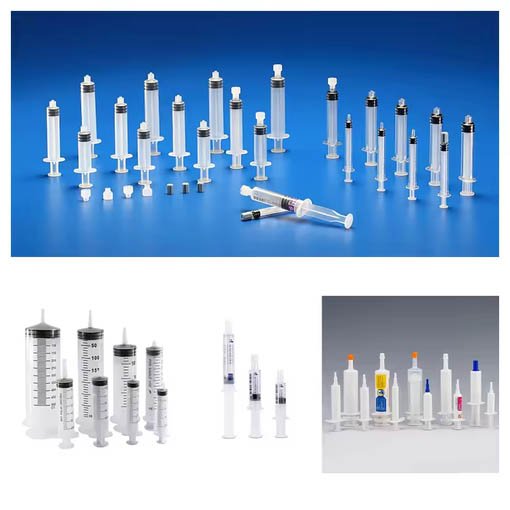
Dental Gels & Composites
Fluoride gels, whitening gels, etchants and impression materials in dose-precise applicator syringes.
Veterinary Pastes & Dewormers
Oral pastes, calcium gels and dewormer formulations in graduated dosing syringes for livestock and pets.
Pharmaceutical Ointments
Topical ointments, wound-care gels and semi-solid formulations requiring aseptic, accurate unit-dose filling.
Cosmetic Serums & Ampoule Gels
Hyaluronic serums, scalp treatments and single-use cosmetic doses in applicator syringe formats.
Adhesives & Industrial Fluids
Precision adhesives, lubricants and reagents where dose repeatability protects downstream processes.
Oral Liquid Doses
Pediatric and clinical-trial oral liquid doses in oral-tip plastic syringes with tamper-evident caps.
Pharmaceutical
Dental
Veterinary
Cosmetic & Medical Aesthetics
About the Manufacturer
About HIJ Machinery — Prefilled Syringe Filling Machine Manufacturer
The HIJ-DZA100 Prefilled Plastic Syringe Filling and Capping Machine is designed and manufactured by HIJ Machinery (legal name: Wenzhou Trustar Machinery Technology Co., Ltd.), a pharmaceutical packaging machinery manufacturer founded in 2004 and headquartered in Rui'an, Wenzhou, Zhejiang, China. HIJ Machinery engineers prefilled syringe filling machines, blister packing machines, cartoning machines, capsule filling machines, liquid filling machines and complete turnkey packaging lines for the pharmaceutical, veterinary, dental, cosmetic and food industries, exporting to customers in more than 30 countries.
All HIJ equipment follows a cGMP-ready design philosophy — SUS 316L product-contact parts, tool-free cleaning access and full documentation traceability — is CE-marked, and is produced under an ISO 9001 manufacturing standard. HIJ provides IQ/OQ documentation support for the HIJ-DZA100; qualification and validation (IQ/OQ/PQ) are executed by the customer within their own quality system.
Technical content on this page is authored and reviewed by Forester Xiang, Founder & Chief Engineer of HIJ Machinery, an engineer with 20+ years of hands-on pharmaceutical packaging experience and 100+ facility audits across 30+ countries. For technical consultation on the HIJ-DZA100, contact HIJ Machinery via WhatsApp/Tel: +86-186-5872-7785 or through the inquiry form on this page. Explore the full range on the pre-filled syringe filling machines hub.
FAQ
Prefilled Plastic Syringe Filling Machine — Frequently Asked Questions
What is a prefilled plastic syringe filling machine?
A prefilled plastic syringe filling machine is automatic packaging equipment that fills liquids, gels or ointments into empty plastic syringes and seals them with tip caps in one continuous aseptic process. The HIJ-DZA100 automates syringe loading, quantitative ceramic-pump filling, cap sorting, servo capping and finished-product output on a single rotary turntable, eliminating manual handling of sterile product.
What syringe sizes can the HIJ-DZA100 handle?
The HIJ-DZA100 fills plastic syringes from 0.5 ml to 50 ml as standard. The vibrating sorting plate and cap-feeding disk are custom-machined to your exact barrel and cap dimensions, and special syringe formats can be customized on request.
What filling accuracy does the machine achieve?
The servo-driven ceramic plunger pump delivers a filling accuracy of ≤±1–2%, typically ≤±1% in production. The nozzle fills from the bottom up with a programmable profile that expels air inside the syringe, improving dose consistency and the batch qualification rate.
What is the production capacity of the HIJ-DZA100?
The HIJ-DZA100 produces 1,800 to 2,100 filled and capped syringes per hour with a single filling needle. For higher throughput, HIJ Machinery offers a double-head prefilled plastic syringe filling machine that approximately doubles output using the same platform.
Is the HIJ-DZA100 suitable for aseptic pharmaceutical production?
Yes. The machine follows a cGMP-ready design: all contact parts are SUS 316L stainless steel with medical silicone rubber, the frame is SUS 304, and the vibrating plates use bright-finished clean plates with no cleaning dead corners. An optional ISO 5 (Class 100) laminar flow hood creates a localized aseptic environment over the filling and capping stations to support your facility's aseptic processing strategy.
Can the machine be integrated into a complete production line?
Yes. The HIJ-DZA100 has a modular, expandable design. It runs as a standalone machine or connects to a syringe elevator, plunger-rod inserting machine, labeling machine and syringe blister packing equipment to form a complete turnkey prefilled syringe production line.
How much does a prefilled plastic syringe filling machine cost?
The final price of the HIJ-DZA100 depends on your syringe format, voltage customization, and options such as the ISO 5 laminar flow hood and line-integration equipment. HIJ Machinery provides a detailed formal quotation, configuration list and technical proposal within 24 hours of receiving your syringe specifications and product details.
What documentation does HIJ provide for GMP validation?
HIJ Machinery supports your qualification project with an IQ/OQ documentation package, FAT and SAT protocols, material certificates for SUS 316L contact parts, and electrical schematics. Validation itself (IQ/OQ/PQ execution) is the customer's responsibility within their own quality system; HIJ's engineering team assists with URS review and documentation throughout.
Related Resources
Explore the Complete Prefilled Syringe Solution
PFS Filling Machines
Downstream Packaging
Ready to Achieve Aseptic, Accurate, Automated Syringe Filling?
Send us your syringe format, product viscosity and target output. Our engineering team — led by Forester Xiang — will analyze your URS, recommend the right HIJ-DZA100 configuration, and deliver a comprehensive, no-obligation quotation within 24 hours.
100% Free Consultation
Formal Quote in 24 Hours
Expert URS Analysis
IQ/OQ Documentation Support
Schedule Your Free Expert Consultation
Trusted by pharmaceutical, dental and veterinary manufacturers in 30+ countries | 20+ years of engineering expertise | Founded 2004