Get Quote
Integrated pharmaceutical and cosmetic packaging systems

Turnkey Packaging Lines Built Around Your URS

Configure the machine sequence, transfers, controls, inspection, documentation and acceptance evidence as one project. HIJ develops turnkey packaging lines from the approved product, final pack, accepted-output target and site boundary—not from a generic equipment list.

URS-defined scopeControlled interfacesAccepted outputIntegrated FAT
Integrated pharmaceutical turnkey packaging line with counting, closing, labeling and case-packing equipment
Product + Pack + Interfaces + Acceptance Evidence
Define the productDosage form, container or pack, formats, batches and representative samples.
Map the processEvery station, transfer, accumulation point, inspection and reject route.
Control the interfacesMechanical, electrical, software, safety, utility and data boundaries.
Test accepted outputGood finished units during an agreed run, with stops and rejects recorded.
Line architectures

Choose the packaging-line route from the product and finished pack

A turnkey solution is not one fixed catalogue line. Start with the closest process route, then confirm each machine, interface and acceptance condition against the actual product, materials, format range and site.

Capsule and tablet bottling line with counting, capping and labeling equipment
Bottle route

Capsule & Tablet Bottling Line

Coordinate container handling, counting or dosing, closing, seal inspection, labeling, cartoning and end-of-line handling. Product behavior, container geometry, cap system, count verification and reject logic determine the final sequence.

  • Container infeed and cleaning boundary
  • Product counting, feeding and dust control
  • Closing, sealing, coding and label inspection
  • Cartoning, case packing and discharge interfaces
Review capsule equipment routes
Integrated blister and cartoning packaging line for pharmaceutical products
Primary-to-secondary pack

Blister & Cartoning Line

Connect forming, product feeding, sealing, inspection, coding, cutting and blister transfer with the cartoner and downstream pack. The approved materials, card geometry, leaflet or insert and accepted-pack criteria control the architecture.

  • Thermoform or cold-form pack construction
  • Feeding, vision, rejection and sample handling
  • Blister-to-cartoner transfer and accumulation
  • Carton, leaflet, coding and case-pack scope
Review blister equipment routes
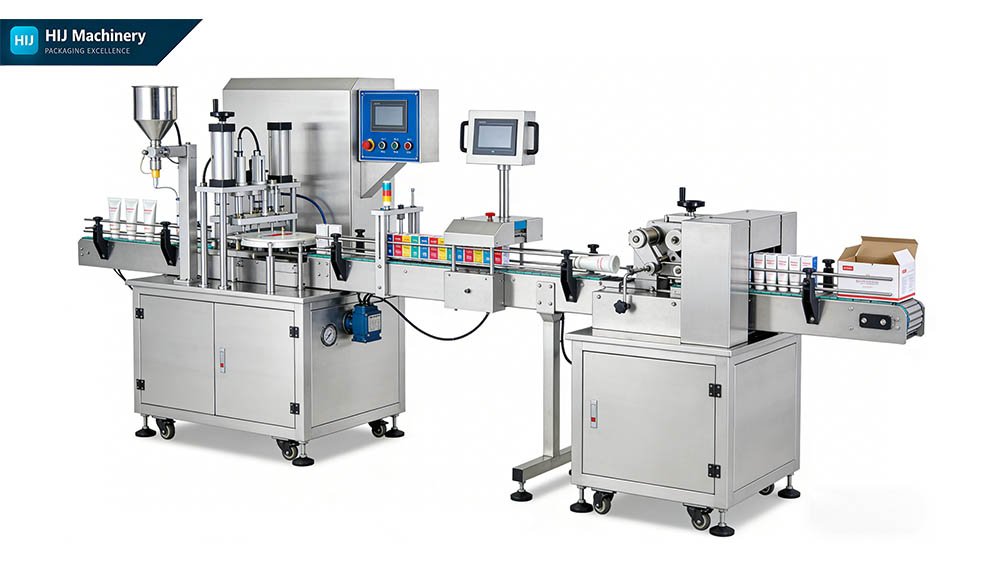
Cosmetic filling and packaging line for tube and container formats
Fill-and-finish route

Cosmetic Filling & Packaging Line

Define the bulk-product feed, dosing method, container handling, closing, coding, inspection, labeling, cartoning and end-of-line steps around the real formula and pack. Changeover and cleaning boundaries must be named before equipment is compared.

  • Viscosity, temperature and product-contact scope
  • Tube, jar, bottle or special-container handling
  • Fill, close, seal, inspect, label and code
  • Carton presentation and case-pack interface
Review cosmetic packaging routes
Case packing and end-of-line system for packaged pharmaceutical products
End-of-line route

Case Packing & End-of-Line System

Coordinate product collation, case presentation, loading, closing, coding, inspection and discharge with the upstream machine. Pack pattern, case style, product protection, accumulation strategy and factory-logistics boundary drive the concept.

  • Upstream product condition and arrival pattern
  • Collation, orientation and case-loading method
  • Case closing, coding and verification
  • Discharge, pallet interface and line controls
Review case-packing routes
Project definition

Define six inputs before selecting the machine sequence

These inputs turn “we need a turnkey line” into a scope that engineering, procurement, quality and suppliers can review on the same basis.

01

Product and variants

Record the dosage form or bulk product, dimensions, behavior, allowable contact, orientation, container or pack variants and representative challenge samples.

02

Finished pack

Provide drawings, materials, closures, labels, leaflets, cartons, cases, artwork controls and the measurable criteria for an accepted finished unit.

03

Accepted output

State good finished units per scheduled minute or run, batch pattern, shifts, planned stops and the operating assumptions used to size the complete line.

04

Inspection and rejection

List defects to detect, challenge methods, reject confirmation, sample routes, reconciliation, disposition and records required by the buyer.

05

Site and interfaces

Name room limits, access, utilities, environmental conditions, upstream and downstream equipment, safety zones, communications and owner-supplied services.

06

Evidence and handover

Define the URS response, drawing reviews, document index, FAT and SAT, training, qualification support, spares, backups and final acceptance boundary.

Integration engineering

Map every interface between packaging machines

A line can fail even when every individual machine passes its own test. The interface matrix should identify who supplies, controls, tests and documents each connection.

InterfaceQuestions the scope must answerEvidence to retain
Product transferHow does the product leave one station, accumulate, orient and enter the next without damage, mixing or uncontrolled loss?Approved layout, transfer drawings, samples, settings and challenge observations
Rate coordinationWhich machine sets the line rate? What happens during starvation, blockage, planned sampling, downstream stop and restart?Speed matrix, buffer logic, state descriptions, alarms and integrated-run record
Inspection and rejectWhere is each defect detected, how is the affected unit tracked, and where is rejection confirmed and reconciled?Defect list, challenge set, sensor or vision results, reject confirmation and disposition record
Controls and dataWhich machine exchanges ready, run, stop, fault, count, recipe or batch information, and which system owns each record?Interface description, signal list, network boundary, record map and tested scenarios
Utilities and environmentWhat power, air, extraction, water, temperature, humidity, drainage or product services are required at each connection?Utility schedule, connection drawing, limits, owner/supplier split and site-verification record
Guarding and accessHow are emergency stops, access doors, safe zones, operator routes, maintenance clearance and material replenishment coordinated?Risk-review inputs, layout, guarding concept, safety interface and inspection records
Responsibility matrix

Make “turnkey” a written project boundary

The word does not prove that every utility, site modification, third-party machine, validation document or service visit is included. Assign each deliverable and interface before the purchase order.

Requirement → responsible party → input needed → deliverable → review/approval → acceptance evidence

Mark every item as supplier, buyer, third party, shared or excluded. Attach the matrix to the quotation and contract so later decisions do not depend on sales-language interpretation.

Before purchase orderURS response, preliminary layout, machine sequence, option list, exclusions, assumptions, trials, document index and acceptance strategy.
During designApproved drawings, product and format data, interface descriptions, utility schedule, software boundary, risk-review inputs and change control.
Before FATApproved protocol, prerequisites, products and materials, challenge set, run condition, sampling, instruments, criteria and deviation route.
Before shipmentFAT report, deviations, configuration baseline, manuals, contracted certificates, backups, spare-parts list and open-item register.
At the buyer siteAccess, utilities, labor, installation or supervision, commissioning, SAT, training, qualification support and handover responsibilities.
During operationWarranty boundary, service access, escalation, change notification, replacement-part traceability, maintenance data and software support terms.
Project path

Move from requirements to an accepted integrated line

The exact activities and deliverables belong in the contract. This five-stage path keeps the key decisions visible without promising a universal schedule or documentation bundle.

STAGE 01

URS & samples

Confirm the product, pack, output, site, records and acceptance boundary; identify missing information and trials.

STAGE 02

Layout & interfaces

Develop the machine sequence, transfers, accumulation, utilities, guarding, access and responsibility matrix.

STAGE 03

Design review

Approve drawings, equipment and options, interface logic, tooling data, documents and change-control baseline.

STAGE 04

Integrated FAT

Test the approved configuration with the agreed challenge set, run conditions, sampling and deviation workflow.

STAGE 05

Site handover

Complete contracted installation, commissioning, SAT, training and qualification support against the open-item list.

Factory acceptance

Test the integrated process—not a row of isolated machines

The FAT protocol should name the approved configuration, representative product and materials, prerequisites, run duration, sampling, instruments, acceptance criteria, deviation workflow and report content.

Integrated packaging line prepared for interface and factory acceptance testing
Configuration baselineMachine identities, options, tooling or format parts, drawings, recipes, software versions and open items show what is being tested.
Start, stop and recoveryNormal start, controlled stop, emergency response, starvation, blockage, upstream or downstream fault and restart test the line states.
Transfers and accumulationRepresentative products and packs test orientation, spacing, buffering, protection and controlled recovery at each interface.
Inspection and rejectionAn agreed challenge set tests detection, product tracking, reject confirmation, reconciliation and disposition.
Coding and recordsApproved samples, code verification and contracted batch or machine records test the defined information boundary.
Sustained accepted outputRun time, good finished units, rejects, waste, stops and interventions test whether the complete process meets the agreed target.
Documentation and actionsResults, deviations, retests, manuals, backups, spare parts and open actions control readiness for shipment and site work.
Site readiness

Prepare the factory before the packaging line arrives

A successful handover depends on buyer-site inputs that cannot be solved by machine delivery alone. Confirm these items during design and again before shipment.

Space, flow and access

  • Final room and line layout
  • Incoming material and finished-goods flow
  • Operator and maintenance access
  • Doors, lifts, rigging and installation route
  • Cleaning and format-part storage

Utilities and infrastructure

  • Power quality and connection points
  • Compressed air, extraction and product services
  • Environmental and drainage requirements
  • Network, data and time synchronization
  • Owner-supplied guards or facility interfaces

People and acceptance

  • Responsible engineering and quality owners
  • Available products, materials and formats
  • Site safety and contractor controls
  • SAT, training and qualification plan
  • Open-item closure and final acceptance authority
Proposal comparison

Normalize the complete project before comparing price

Issue one URS, layout boundary and responsibility matrix. A proposal is only comparable when included scope, assumptions, options, exclusions and acceptance evidence are visible.

Compare these items line by line

  • Machine sequence, models, stations and options
  • Product and format range with open trials
  • Transfers, accumulation and control interfaces
  • Inspection, rejection, coding and data scope
  • Utilities, guarding and owner-supplied items
  • Tooling, format parts and future-change boundary
  • Documents, FAT, SAT, training and qualification support
  • Installation, travel, spares, warranty and service terms

Treat these phrases as unresolved scope

  • “Turnkey” without a responsibility matrix
  • “High speed” without accepted-output conditions
  • “Compatible” without named interface evidence
  • “Compliant” without requirement and deliverable boundaries
  • “Complete documentation” without an index
  • “Easy changeover” without format and test conditions
  • “Global service” without written response and cost terms
  • “All products supported” without samples or trials
Configuration review

Send one project package for a useful turnkey-line proposal

Share the product, pack, output, machine sequence, inspection requirements, site boundary and acceptance expectations. HIJ can respond with a preliminary architecture, missing-input list, open trials and quotation scope against those inputs.

Useful first-review inputs
  • Product and finished-pack drawings
  • Representative samples and format range
  • Accepted-output target and batch pattern
  • Required machine sequence and inspection
  • Room layout, utilities and site interfaces
  • Destination market and document boundary
  • FAT, SAT and handover expectations
Buyer questions

Turnkey line questions, answered clearly

Use these answers to define the quotation boundary before comparing suppliers. For a project-specific answer, send the product, pack, output and site inputs.

Ask about my line
What is a turnkey packaging line?

A turnkey packaging line is a coordinated project covering multiple machines and the interfaces between them. The contracted scope should state the product and pack, machine sequence, transfer logic, controls, utilities, guarding, documents, tests and supplier-versus-buyer responsibilities. Turnkey should describe a defined project boundary, not an assumption that every site or validation activity is included.

What information is needed for a turnkey packaging-line quotation?

Provide product drawings and representative samples, pack and container drawings, material grades, accepted-output target, batch and format pattern, required process stations, inspection and reject rules, coding and data requirements, utilities, room or layout limits, destination market, documentation boundary and FAT expectations. Mark unresolved items as trials or open decisions.

How is a packaging line different from buying individual machines?

Individual machines can meet their own specifications yet still fail as a line if speeds, accumulation, transfers, controls, rejects, guarding or data interfaces are not coordinated. An integrated-line scope assigns those interfaces and defines how the complete process will be tested.

How should accepted output be specified for an integrated packaging line?

Specify good finished units during an agreed run, not only the fastest machine's rated speed. State the product and pack, batch pattern, scheduled run time, sampling, planned stops, reject rules and the evidence used to record output, waste, stoppages and interventions.

What should a turnkey packaging-line FAT cover?

The FAT should compare the approved configuration and interface matrix with controlled evidence from the agreed product and material challenge set. It should cover transfers, rate coordination, accumulation, alarms, stops and restarts, inspection, rejection, coding, data where contracted, sustained accepted output and deviation handling.

Are installation, SAT and qualification documents automatically included?

No universal bundle should be assumed. The quotation and contract should name installation supervision, commissioning, SAT, training, document index, language, format, review cycles, IQ or OQ templates or execution support, travel, utilities, site labor and final acceptance responsibilities.

How should turnkey packaging-line proposals be compared?

Issue the same URS and responsibility matrix to every supplier. Normalize machine sequence, options, tooling, integration, utilities, controls, inspection, coding, documentation, FAT and SAT, installation, training, spares, warranty and service terms. Treat exclusions and unresolved interfaces as commercial and schedule risks.

How are project price and delivery timing determined?

Price and timing depend on the confirmed machine sequence, product and format range, output target, inspection and data scope, tooling, documentation, site services, testing and unresolved trials. A useful proposal separates included scope, options, exclusions, assumptions and milestones instead of relying on a generic price or lead-time range.

Define the complete project

Request a configured turnkey packaging-line proposal

Send the approved product and pack information, machine sequence, accepted-output target, site interfaces, documentation boundary and FAT expectations. HIJ can identify the likely architecture, missing decisions and evidence needed before the scope is finalized.

Let's Design Your Production Line

Share your requirements and I'll personally craft a solution that maximizes your efficiency and profitability.