HIJ Machinery

Get Quote
20+ Years Pharma Machinery Experience
WHO GMP Certified Equipment
Material Compatibility Verified
DQ/IQ/OQ/PQ Support
PVC PVC/PVDC Alu-Alu PCTFE/Aclar

Blister Packaging Forming Materials PVC, PVDC, and Alu-Alu Complete Guide

Blister packaging forming materials determine moisture barrier performance, chemical compatibility, regulatory compliance, and cost for pharmaceutical products. The four primary materials are PVC (polyvinyl chloride), PVDC-coated PVC, PVDC/Aluminum/PE cold form laminate (Alu-Alu), and PCTFE/Aclar films. Selecting the correct forming material directly affects drug stability, shelf life, and GMP compliance. HIJ DPP-series blister machines are compatible with all standard pharmaceutical blister forming materials.

WhatsApp: +86 138 6882 2120 — Response within 24 hours
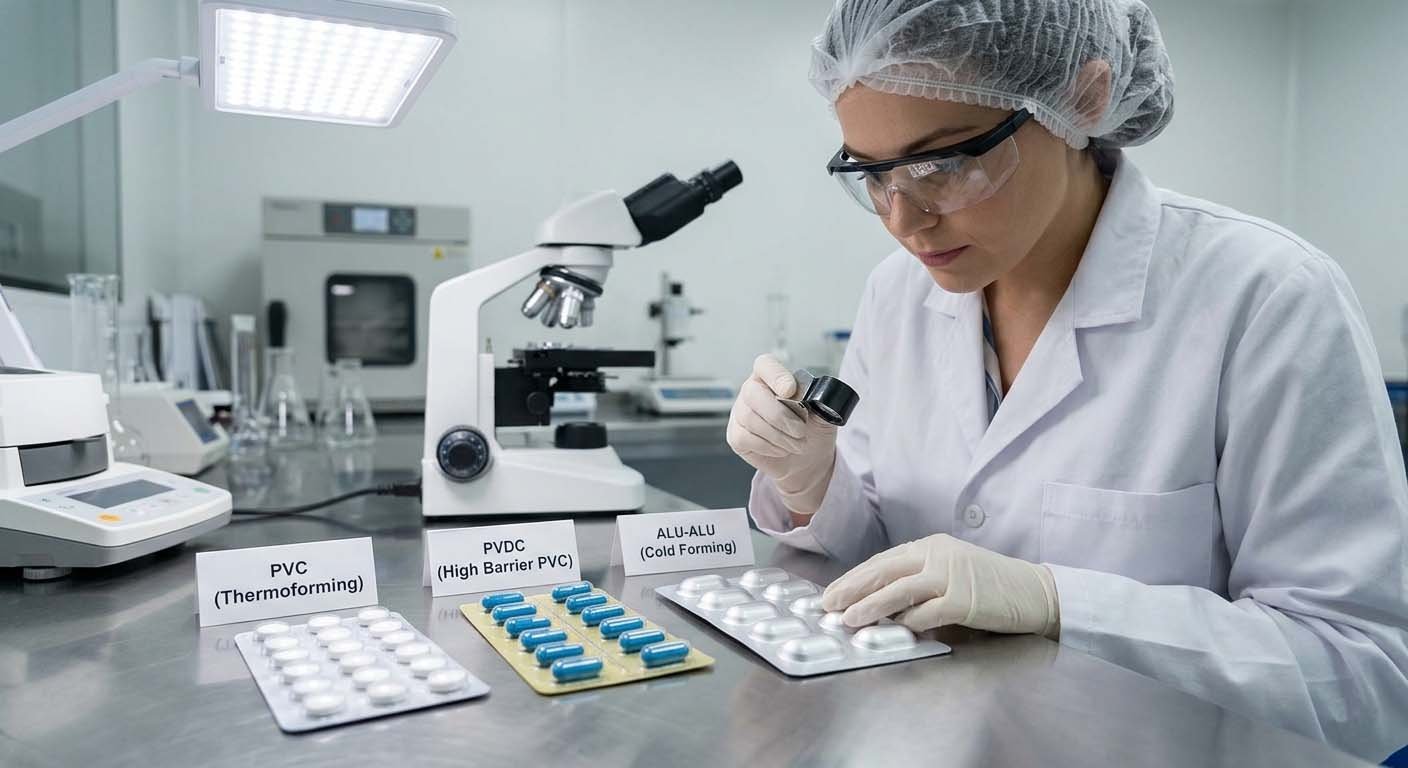
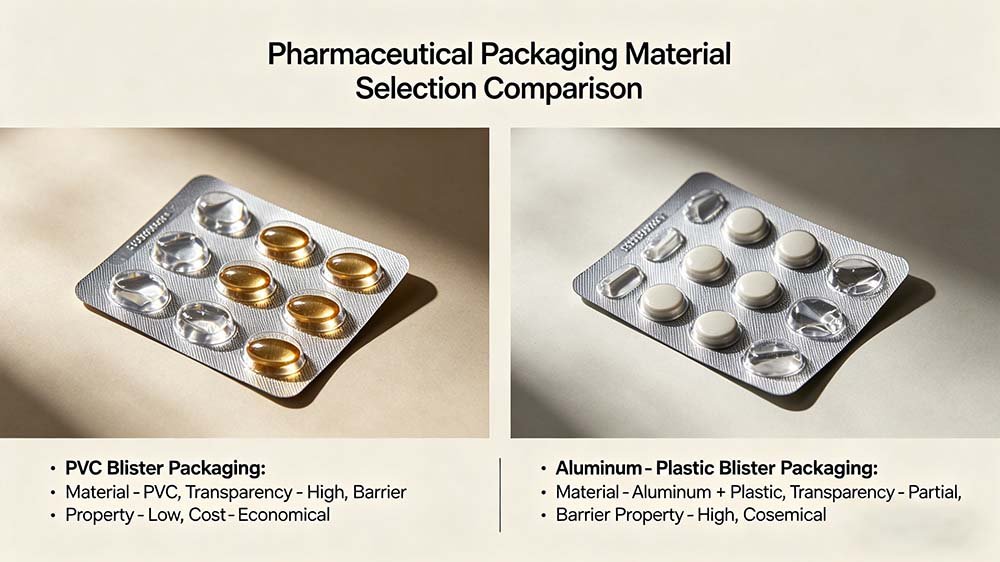
PVC PVDC Alu-Alu blister packaging forming material comparison for pharmaceutical machines
DPP-250 Compatible — All Materials
Moisture Barrier Comparison (MVTR g/m²/24hr)
PVC
3.0–8.0
PVC/PVDC
0.2–3.0
Alu-Alu
<0.005
PCTFE
0.02–0.1
🏭 WHO GMP
🇪🇺 CE Mark
🧪 21 CFR
📋 IQ OQ PQ
4 Forming Materials
Supported
20+ Years Pharma
Experience
100+ Pharma Factories
Worldwide
24hr Engineering
Response
Material Selection Guide

Blister Forming Material Comparison At a Glance

Select the right forming material based on your drug product's moisture sensitivity, target market climate zone, and regulatory requirements.

PVC PVDC Alu-Alu blister packaging forming material comparison
Material MVTR
(g/m²/day)
Thickness
(μm)
Transparency Cost Best For
PVC Polyvinyl Chloride
3.0 – 8.0 200 – 300 🔍 Clear $ Standard oral solids,
low moisture-sensitivity
PVC / PVDC PVDC-coated PVC
0.2 – 3.0 250 – 350 🔍 Clear $$ Moderate moisture-sensitive
Rx products
PVC / PVDC / PE High-barrier laminate
0.1 – 0.5 280 – 380 🔍 Clear $$$ High-sensitivity
Rx products
Alu-Alu MAX BARRIER
Cold Form Laminate
< 0.005 170 – 200 ⬛ Opaque $$$$ Hygroscopic, light-sensitive,
high-value drugs
PCTFE / Aclar® Ultra-high barrier transparent
0.02 – 0.1 51 – 203 🔍 Clear $$$$$ High-barrier transparent
requirement

MVTR = Moisture Vapor Transmission Rate, measured at 38°C / 90% RH. Lower value = Better moisture barrier. All HIJ DPP-series machines are compatible with all materials listed above.

Not Sure Which Material Your Product Needs?

Share your drug product requirements — HIJ engineering team confirms material compatibility and DPP-250 configuration within 24 hours.

PVC Blister Forming Film — Standard Pharmaceutical Grade
PVC blister forming film pharmaceutical grade Quick Specs
Material Type Rigid PVC film (uncoated)
Standard Gauge 200 / 250 / 300 μm
MVTR 3.0–8.0 g/m²/24hr
Test Condition 38°C / 90% RH
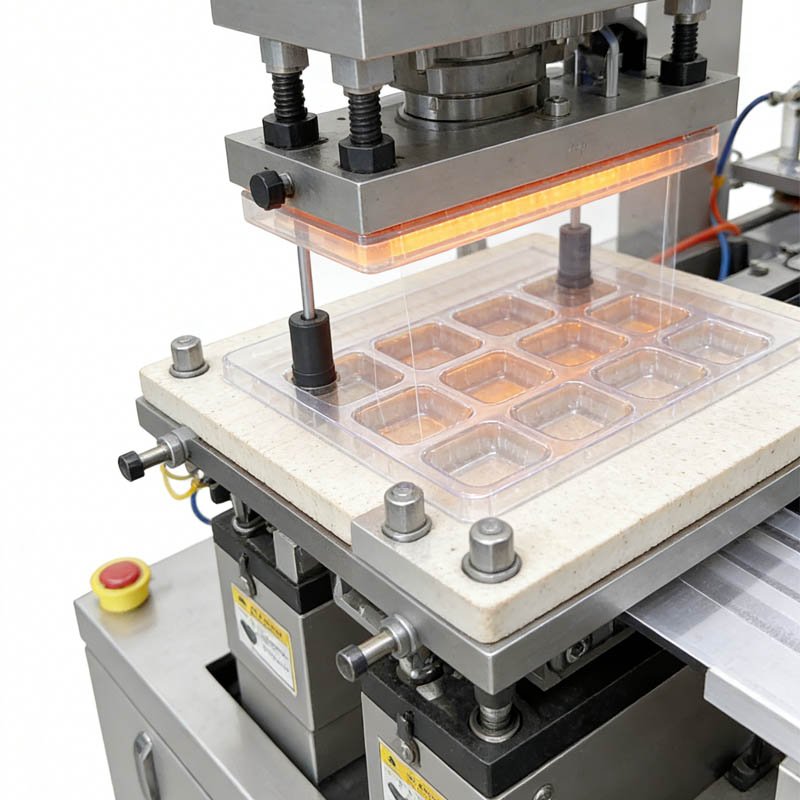
Forming Method Thermoforming (heat + pressure)
Forming Temp 110–130°C
Transparency Excellent — clear visual inspection
Recyclability Challenging (chlorine content)
Regulatory EU Ph. 3.1.11 · USP <661>
Cost Index $ — Lowest among blister materials

PVC is the most widely used blister forming material in pharmaceutical manufacturing. Its moderate moisture barrier, excellent thermoformability, and low cost make it the default choice for products where moisture sensitivity is not a primary concern — including many OTC tablets, vitamins, and non-hygroscopic capsules.

Standard pharmaceutical-grade PVC film contains no plasticizers that would interfere with drug products. All PVC films used with HIJ DPP-series machines comply with EU Pharmacopoeia 3.1.11 and USP <661> requirements for container components.

The primary limitation of plain PVC is its relatively high moisture vapor transmission rate (MVTR) of 3–8 g/m²/24hr. For products requiring Zone III/IV climate storage stability, or ICH Q1A long-term studies at 40°C/75%RH, PVC alone may not provide adequate protection.

⚖️

GMP Compliance Note

WHO GMP TRS 961 Annex 9 requires that packaging materials be evaluated for compatibility with the drug product and maintain product quality throughout the shelf life. PVC blister material selection should be justified in the packaging development report.

HIJ DPP-250 thermoforming blister packaging machine DPP-250 Compatibility

The DPP-250 processes standard 200–300μm PVC forming film at thermoforming temperatures of 110–130°C. Format change for different PVC gauges requires only tooling adjustment — no machine modification needed.

Material Guide

PVC/PVDC Blister Film — Enhanced Moisture Barrier

The most widely adopted upgrade from standard PVC, PVDC-coated film delivers significantly improved moisture protection while maintaining full optical clarity for product identification.

Quick Technical Facts

PVC/PVDC Blister Film

Material Type PVC base + PVDC coating
PVDC Coating 40 / 60 / 90 / 120 gsm
MVTR 0.2–3.0 g/m²/24hr
Forming Method Thermoforming
Forming Temp 110–130°C
Transparency Clear
Barrier Side PVDC coating faces outward
Standard EU Ph. 3.1.11
ASTM F1249
Cost Index $$ — 20–40% premium over PVC
PVC PVDC blister packaging forming material comparison for pharmaceutical blister machines

PVDC Coating Weight vs. MVTR — Performance Reference

Tested at 38°C / 90% RH per ASTM F1249. Lower MVTR = stronger moisture barrier.

PVDC Coating
MVTR (g/m²/24hr)
Typical Application
40 gsm
1.5–3.0
Standard Rx tablets
60 gsm
0.8–1.5
Moisture-sensitive Rx
90 gsm
0.3–0.8
Highly moisture-sensitive
120 gsm
0.1–0.3
Near cold-form performance

Technical Overview

🔬

PVDC-coated PVC represents the most significant upgrade over plain PVC in pharmaceutical blister packaging. The polyvinylidene chloride coating dramatically reduces moisture vapor transmission while maintaining the optical clarity needed for tablet identification and visual inspection.

📊

Moisture barrier performance scales directly with PVDC coating weight. A 60 gsm coating delivers approximately 3× improvement over plain PVC, making it suitable for ICH Zone IVb conditions (30°C/75%RH and 40°C/75%RH). Manufacturers in India, Southeast Asia, and Sub-Saharan Africa routinely specify 60–90 gsm PVDC.

⚙️

Processing consideration: the PVDC-coated surface must face away from the heated forming tool to prevent coating degradation. HIJ DPP-250 machines can be configured for correct PVDC orientation, and setup verification is documented in the IQ protocol.

📋

GMP / Regulatory Note

ICH Q1A(R2) Stability & Packaging Justification

ICH Q1A(R2) accelerated stability testing at 40°C/75%RH for 6 months is required for Zone III/IV registration. Packaging selection — including PVDC coating weight — must be supported by stability data in the regulatory dossier. HIJ provides packaging material specification templates as part of the DPP-250 documentation package.

DPP-250 Material Compatibility

Need PVDC material compatibility confirmed for your product?

HIJ engineering team reviews your URS and confirms DPP-250 configuration for PVC/PVDC, Alu-Alu, or Aclar forming materials — with full IQ/OQ documentation.

Maximum Barrier Protection

Alu-Alu Cold Form Blister Material

Near-zero moisture and oxygen transmission. The definitive choice for hygroscopic, light-sensitive, and high-value pharmaceutical products.

Quick Technical Facts
Full Name Aluminum / Aluminum cold form laminate
Structure
OPA (Nylon) / Aluminum foil / PVC OPA 25μm / Al 45μm / PVC 60μm (typical)
MVTR
<0.005 g/m²/24hr Virtually Zero
OTR <0.005 cm³/m²/24hr
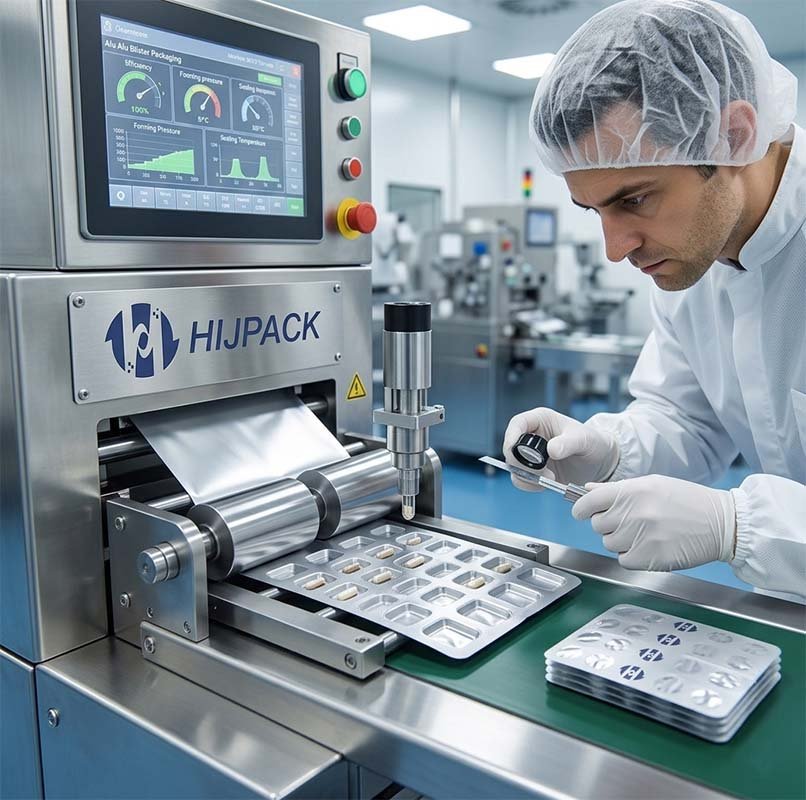
Forming Cold forming — pressure only, no heat applied
Transparency
Opaque (aluminum layer)
Max Depth Up to 12 mm (deeper than thermoform)
Regulatory
EU Pharmacopoeia 3.1.11 Ph. Eur. 3.2.1
Cost Index
$ $ $ $
3–4× plain PVC
HIJ DPH-300 Alu-Alu Cold Form Blister Packaging Machine
HIJ DPH-Series — Cold Form Alu-Alu Configuration
WHO GMP
CE Certified
cGMP 21 CFR
IQ/OQ/PQ
Moisture Barrier vs PVC 600× Better
Plain PVC Alu-Alu (<0.005 g/m²/day)

When Alu-Alu Cold Form Is the Correct Choice

Alu-Alu cold form blister material is required when the drug product exhibits any of the following characteristics:

Hygroscopic Drugs

Products with high water absorption that degrade rapidly above defined moisture levels

Light-Sensitive APIs

Active pharmaceutical ingredients that photodegrade under visible or UV light exposure

Oxygen-Sensitive APIs

Products requiring oxygen barrier to prevent oxidative degradation of the active ingredient

High-Value Substances

Controlled substances and high-value Rx products requiring tamper evidence and complete barrier

Tropical Markets (IVb)

ICH Zone IVb registration requiring long shelf life at 30°C/75%RH in humid conditions

Moisture-Sensitive Biologics

Lyophilized or moisture-critical biologic formulations requiring absolute barrier integrity

Alu-Alu vs PVC/PVDC — Key Difference

The fundamental difference is the forming process and barrier mechanism.

PVC / PVDC — Thermoforming
  • Heat softens polymer at 110–130°C
  • Clear and transparent — visual inspection possible
  • MVTR: 0.1–8.0 g/m²/24hr (coating dependent)
  • Lower material cost — standard tooling
Alu-Alu — Cold Forming
  • Mechanically pressed at room temperature — no heat
  • Permanent non-springback cavity — complete seal
  • MVTR: <0.005 g/m²/24hr — near-perfect barrier
  • Dedicated cold-form tooling required on machine

This cold forming process creates a permanent, non-springback blister cavity with near-perfect moisture and oxygen barrier. The DPP-250 can be configured for Alu-Alu cold form processing with the appropriate cold-form tooling set — this is specified in the URS and confirmed during Design Qualification (DQ).

DPP-250 Cold Form Configuration Requirements

Specifications for Alu-Alu cold form processing on the HIJ DPP-250

01
Cold Form Tooling Set Required No heating element in forming station — cold-form tooling replaces standard thermoform tooling. Must be specified in URS before order confirmation.
02
Increased Forming Pressure Cold forming requires higher mechanical pressure than thermoforming. Exact pressure parameters are confirmed during OQ and recorded in the machine recipe.
03
Reduced Forming Speed Typically 15–20% lower output speed compared to PVC thermoforming configuration. Production capacity is confirmed during PQ with actual Alu-Alu material.
04
Cavity Depth — Up to 12 mm Standard cold-form tooling supports cavity depth up to 12 mm — deeper than PVC thermoforming. Suitable for capsules, large tablets, and specialty dosage forms.
05
IQ Protocol Includes Cold Form Station Verification Complete DQ/IQ/OQ/PQ documentation package covers cold form configuration. HIJ provides all validation protocols — ready for your QA department sign-off.
HIJ DPP-250 Alu-Alu cold form blister machine forming station configuration
WHO GMP · CE · cGMP Certified

Need Alu-Alu Cold Form Configuration
for Your DPP-250?

Send us your URS or product moisture sensitivity data. HIJ engineering will confirm cold form tooling compatibility and provide complete DQ/IQ/OQ/PQ documentation — within 24 hours.

24hr Engineering Response
Full DQ/IQ/OQ/PQ Included
100+ Pharma Factories Served
Premium Barrier Material

PCTFE (Aclar) Blister Film — High-Barrier Transparent Option

PCTFE Aclar blister film high-barrier transparent pharmaceutical packaging material comparison
DPP-250 Compatible
Material Specifications
Full Name
Polychlorotrifluoroethylene
Trade Name
Aclar® (Honeywell)
MVTR
0.02–0.1 g/m²/24hr
Film Thickness
51–203 μm
Transparency
Fully Transparent
Forming Method
Thermoforming 120–150°C
Cost vs PVC
$$$$$ (5–8× PVC)

Barrier Performance

PCTFE (Aclar®) provides near-Alu-Alu moisture barrier performance — MVTR 0.02–0.1 g/m²/24hr — while maintaining complete optical transparency. This combination is unique among pharmaceutical blister forming materials.

Primary Applications

  • Clinical trial supplies requiring visual ID + maximum protection
  • High-barrier transparent packaging for US & EU premium Rx markets
  • Regulatory-mandated transparent barrier packaging

Cost Consideration

Aclar film costs 5–8× more than plain PVC. Most manufacturers accept Alu-Alu opacity rather than pay the Aclar premium — unless clinical or regulatory requirements mandate transparent high-barrier packaging.

PVC
$
Alu-Alu
$$$$
Aclar
$$$$$
DPP-250 Machine Compatibility Note

The HIJ DPP-250 processes PCTFE/Aclar films at thermoforming temperatures of 120–150°C. Confirm exact processing parameters with HIJ engineering for your specific Aclar grade, as MVTR performance and processing window vary by film thickness (51μm vs. 102μm vs. 203μm grades).

Need Aclar / PCTFE Material
Compatibility Confirmed?

Send your URS or product requirements — HIJ engineering team confirms DPP-250 processing parameters for your specific Aclar grade within 24 hours.

Material Selection Framework

How to Select the Right
Blister Forming Material

Follow this 5-step framework to select the correct blister forming material for your pharmaceutical product.

01

Assess Drug Product Moisture Sensitivity

Run a moisture sorption isotherm or review API physicochemical data.

Low sensitivity → PVC acceptable
Moderate → PVC/PVDC 60 gsm
High → PVC/PVDC 90–120 gsm or Alu-Alu
02

Identify Target Markets & ICH Climate Zones

Match your packaging barrier performance to the registration market's climate zone requirement.

Zone I / II — Temperate
PVC or PVC/PVDC 40 gsm typically sufficient
Zone III / IVa
PVC/PVDC 60–90 gsm recommended
Zone IVb — Tropical
PVDC 90–120 gsm or Alu-Alu required (30°C/75%RH)
03

Check Light Sensitivity

Refer to ICH Q1B photostability testing data for your API.

Photostable
Any transparent forming material is acceptable
Light-Sensitive (ICH Q1B)
Alu-Alu (opaque) required — or transparent material + light-blocking secondary carton
04

Evaluate Regulatory Dossier Requirements

Check target market regulatory authority requirements for packaging materials. US FDA, EMA, WHO, and national regulatory agencies may have specific guidelines that influence material selection. Packaging material choice must be justified in the product dossier with compatibility data and stability results.

05

Calculate Total Cost of Ownership

Include material cost, machine tooling cost, potential reformulation cost due to stability failure, and regulatory submission cost for packaging change.

💡 Key insight: Alu-Alu's higher upfront material cost is often lower TCO than the cost of failed stability batches, regulatory resubmission, or product recalls.

Not Sure Which Material
Fits Your Product?

Share your API data or URS — HIJ's engineering team will confirm material compatibility for the DPP-250 within 24 hours.

WHO GMP & cGMP Certified
PVC / PVDC / Alu-Alu Compatible
24-Hour Engineering Response
Regulatory Compliance

GMP Compliance for Blister Forming Materials

All blister forming materials used in pharmaceutical manufacturing must comply with applicable pharmacopoeial standards. Key regulatory references are listed below.

EU / International

  • Ph. Eur. 3.1.11 Non-plasticised PVC for non-injectable preparations
  • EU GMP Annex 11 Computerised Systems — material traceability
  • ICH Q1A(R2) Stability testing — packaging material selection

United States (FDA)

  • USP <661> Containers — Plastics
  • USP <671> Containers — Performance Testing
  • 21 CFR 211.94 Drug product containers and closures

WHO GMP

  • WHO TRS 961 Annex 9 Guidelines on packaging for pharmaceutical products — Section 7: forming & sealing materials

Documentation Required for Regulatory Submission

Material specification — grade, supplier, CoA
Compatibility testing data
Stability study results with final packaging
Packaging material change control procedure
DPP-250 Documentation Package

Need GMP Material Documentation Support?

HIJ engineering team will review your URS and confirm material compatibility for the DPP-250. Packaging material specification template and compatibility checklist included with every machine.

Response within 24 hours
DQ/IQ/OQ/PQ templates included
WHO GMP & 21 CFR aligned

DPP-250 Blister Machine: Multi-Material Compatibility

The HIJ DPP-250 pharmaceutical blister packaging machine is designed for full compatibility with all standard pharmaceutical forming materials.

Forming Material DPP-250 Compatible Configuration Required
PVC 200–300μm Standard None
PVC/PVDC 40–90 gsm Standard Correct film orientation
PVC/PVDC 120 gsm Standard Temperature fine-tuning
Alu-Alu Cold Form With Tooling Cold form tooling set required
PCTFE / Aclar Standard Temperature adjustment

Material changeover on the DPP-250 follows a documented format change procedure included in the OQ protocol. Temperature profile, forming pressure, and speed parameters for each material type are recorded in the machine recipe system, enabling validated changeover between material formats.

HIJ DPP-250 Pharma Blister Packaging Machine
Featured Machine

DPP-250 Pharma Blister Packaging Machine

  • Processes PVC / PVDC / Alu-Alu / Aclar
  • WHO GMP & cGMP Compliant
  • Complete DQ / IQ / OQ / PQ Documentation
  • 12–16 Weeks Delivery (FOB Wenzhou)

Blister Forming Materials —
Frequently Asked Questions

PVC is a rigid polymer film with moderate moisture barrier (MVTR 3–8 g/m²/24hr). PVDC (polyvinylidene chloride) is applied as a coating on PVC to significantly reduce moisture transmission. PVC/PVDC with 60 gsm PVDC coating achieves MVTR of 0.8–1.5 g/m²/24hr — approximately 4–5× better barrier than plain PVC. The choice depends on drug product moisture sensitivity and target market climate zone.

Use Alu-Alu cold form blister material when: (1) the drug product is highly hygroscopic; (2) the product is light-sensitive and requires opaque packaging; (3) you are registering in ICH Zone IVb markets requiring long-term stability at 30°C/75%RH; (4) the product requires oxygen barrier in addition to moisture barrier. Alu-Alu provides MVTR <0.005 g/m²/24hr — effectively zero moisture transmission.

Yes, with appropriate tooling. Alu-Alu cold form requires a dedicated cold-forming tooling set because the process uses mechanical pressure at room temperature rather than heat. The HIJ DPP-250 can be configured for both thermoforming (PVC/PVDC) and cold forming (Alu-Alu) by changing the tooling set. This configuration must be specified in the URS and verified in the IQ/OQ protocol.

WHO GMP and ICH Q1A(R2) do not specify a minimum PVDC coating weight directly. The packaging must demonstrate product stability at the required storage conditions for the registered shelf life. For Zone IVb (30°C/75%RH, 5 years typical shelf life), most pharmaceutical products require minimum 60 gsm PVDC coating, with many sensitive products requiring 90–120 gsm or Alu-Alu.

MVTR stands for Moisture Vapor Transmission Rate, measured in g/m²/24hr. It quantifies how much moisture passes through the packaging material per unit area per day. Lower MVTR = better moisture barrier. For drug products, moisture ingress can cause chemical degradation, physical changes (tablet softening, caking), or microbial growth. Selecting the correct MVTR for your drug product's sensitivity is a fundamental pharmaceutical packaging development decision.

PVC recyclability is a growing concern in the EU under Extended Producer Responsibility (EPR) regulations. Some European markets are actively reducing PVC in pharmaceutical packaging. However, PVC remains the dominant blister forming material globally due to its established regulatory acceptance, machine compatibility, and cost. Alternatives gaining traction include PP (polypropylene) thermoform films and PET-based laminates, though these are not yet widely adopted in primary pharmaceutical packaging.

Yes. Pharmaceutical-grade blister forming materials must comply with applicable pharmacopoeial monographs. EU Pharmacopoeia 3.1.11 covers non-plasticised PVC for non-injectable preparations. USP <661> and <671> apply in the US market. Material suppliers provide certificates of conformance. Pharmaceutical manufacturers must qualify material suppliers and maintain incoming material testing procedures per GMP requirements.

Material Selection Support

Need GMP Material Compatibility Confirmed for Your Product?

Send us your URS or product brief. HIJ engineering team confirms forming material compatibility for DPP-250 within 24 hours.

Material Compatibility Confirmed

Get Material-Specific Machine Configuration from HIJ Engineering

Tell us your forming material requirement — our engineers confirm DPP-250 compatibility and send a full configuration proposal within 24 hours.

Why Engineers Trust HIJ

20+ Years pharmaceutical machinery experience
DPP-250 validated for PVC / PVDC / Alu-Alu / Aclar
Material compatibility confirmed in DQ documentation
WHO GMP, cGMP, CE certified equipment
Engineering response within 24 hours
100+
Pharma
Factories
30+
Countries
Served
24hr
Engineering
Response

DPP-250 Compatible Forming Materials

PVC
Standard · Clear
PVC/PVDC
Enhanced Barrier
Alu-Alu
Max Barrier · Opaque
Aclar / PCTFE
High-Barrier Clear

Confirm Your Material Configuration

Share your product requirements and target market — HIJ engineering confirms forming material compatibility, machine configuration, and pricing for your specific application.

Request Material Compatibility Review WhatsApp Engineering Team

🔒 Confidential  ·  No obligation  ·  24hr response guaranteed

About HIJ Machinery

HIJ Machinery (Wenzhou) is a pharmaceutical blister packaging machine manufacturer based in Wenzhou, China. The company's DPP-series blister machines process all standard pharmaceutical forming materials including PVC, PVC/PVDC, Alu-Alu cold form, and PCTFE (Aclar) films, compliant with WHO GMP TRS 961, cGMP 21 CFR Parts 210/211, and CE Machinery Directive 2006/42/EC. Complete DQ/IQ/OQ/PQ validation documentation is provided with all equipment.

Source & Contact

Expertise Pharmaceutical blister packaging materials, WHO GMP & cGMP compliant machine configuration, DPP-series forming material validation

Let's Design Your Production Line

Share your requirements and I'll personally craft a solution that maximizes your efficiency and profitability.