
Engineering Comparison · Updated 2026
Liquid vs Solid Blister Packaging — Which Is Right for Your Product?
A complete technical comparison of liquid blister packaging and solid blister packaging — covering filling mechanism, tooling, materials, applications, and the gray-zone hybrid cases. Both are HIJ specialties; this page helps you choose by product type, not by hype.
BEST FOR LIQUIDS
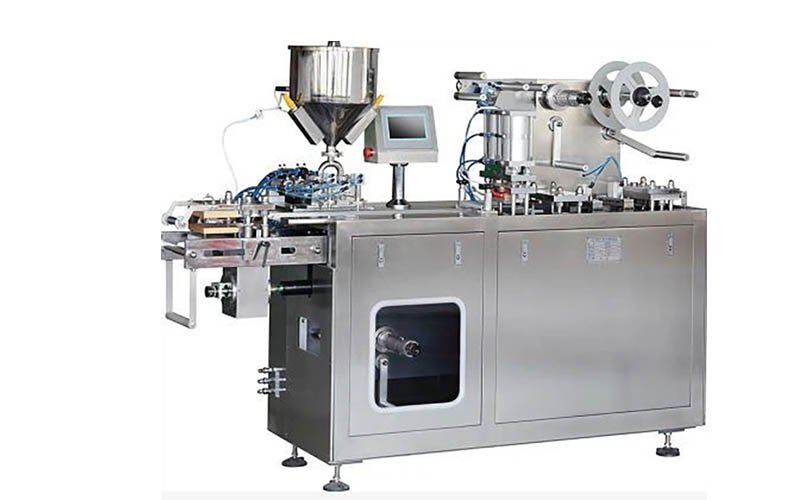
Format A
Liquid Blister
0.5–15 ml dose
Servo piston fill
Hermetic foil seal
VS
BEST FOR SOLIDS
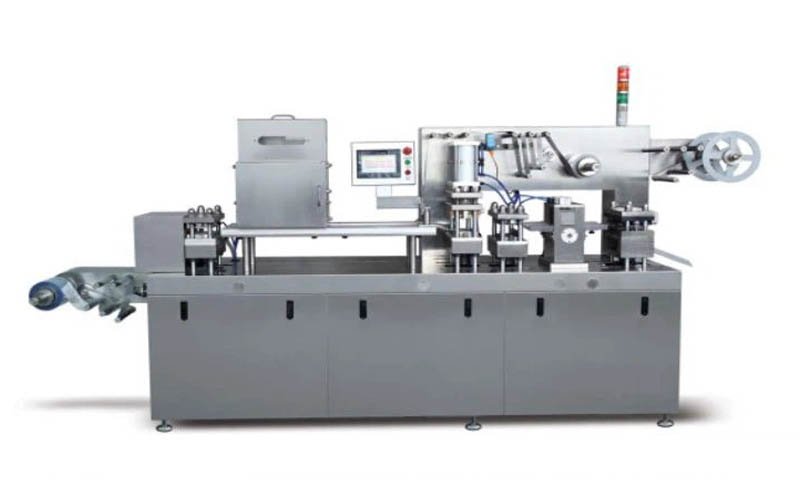
Format B
Solid Blister
Tablets / Capsules
Brush feeder
Up to 12,000 BPM
Quick Verdict — Choose By Product Form, Not Preference
Liquid blister and solid blister aren't competitors — they're sibling formats in the same packaging family. The choice is dictated by your product physics: liquid blister for syrups, drops and emulsions; solid blister for tablets, capsules and lozenges. Soft-gel capsules and semi-solid (jelly) products sit in the hybrid gray zone.
Decision Framework
Which Format Matches Your Product?
The decision is rarely about which packaging is "better" — it's about what your product physically is. Below are the 6 scenarios where each format clearly wins.
Choose Liquid BlisterIf your product is liquid or semi-liquid
- Pharmaceutical liquids — oral syrups, pediatric suspensions, eye drops, nasal sprays
- Liquid nutraceuticals — vitamin shots, probiotic doses, omega-3, B-complex liquids
- Food portions — honey, jam, condiments, syrups, hotel HORECA single-serves
- Cosmetic liquids — serum samples, hotel amenity, retinol single-doses
- Sports nutrition — energy gels, hydration shots, electrolyte single-serves
- Viscosity 1–100,000 cP — anything that pumps through a servo piston dosing system
Choose Solid BlisterIf your product is a discrete solid unit
- Pharmaceutical tablets — round, oval, oblong tablets in 4–22 mm size range
- Hard-shell capsules — size 00 to size 5, gelatin or HPMC vegetarian shells
- Effervescent & chewable tablets — extra-moisture-sensitive solid forms needing Alu-Alu
- Lozenges & throat tablets — sugar-based, with sharp humidity sensitivity
- Confectionery — individual chocolates, bonbons, gummies, hard candy
- Discrete unit products — anything mechanically fed by brush, vibration or pick-and-place
14-Criteria Side-by-Side
Liquid Blister vs Solid Blister — The Complete Technical Comparison
Every dimension that matters when specifying a new blister production line. This is the comparison our engineering team walks customers through during requirements gathering.
| Criteria | Liquid BlisterServo piston dosing · liquid product | Solid BlisterBrush/vibration feeding · solid units |
|---|---|---|
| Product State | Liquid · semi-liquid · viscous fluid | Tablets · capsules · lozenges · candy |
| Dose / Unit Size | 0.5–15 ml per cavity (volume-based) | 4–22 mm tablets · 00–5 capsules (shape-based) |
| Filling Mechanism | Servo piston pump · ±1% accuracy | Brush feeder · vibration · pick & place |
| Sealing Critical Level | Hermetic critical · leak-tested | Moisture barrier critical · less leak-tested |
| Cavity Shape Design | Half-sphere / rounded · spillage-resistant | Shape-matched to tablet/capsule profile |
| Compatible Materials | PVC · PET · PP · Alu-Alu cold-form | PVC · PVC/PVdC · PET · Alu-Alu cold-form |
| Production Speed | Up to 9,800 doses/hr (164 doses/min) | Up to 720,000 tablets/hr (12,000 BPM) |
| Temperature Control Need | Jacketed dosing · 4–80°C product control | Ambient · minimal product heating |
| Dose Accuracy | ±1% by volume (servo precision) | ±0.5% by weight (factory pre-pressed) |
| Vision Inspection | Fill volume / meniscus / bubble check | Pocket presence / broken tablet / wrong-color |
| Tooling / Mold Cost | $3,500–9,000 per mold (precision) | $2,000–6,500 per mold (standard) |
| Machine Investment | $42K–210K USD | $35K–280K USD (high-speed pharma) |
| Pharma cGMP Adoption | Growing (unit-dose pediatric, ophthalmic) | Dominant standard (95% of pharmacy tablets) |
| Cross-Format Capability | Liquid only · cannot fill solids | Solids only · cannot dose liquids |
| VERDICT | 🏆 Winner for liquid products | 🏆 Winner for solid products |
Visual Definitions
What's Inside Each Blister Format?
Both formats use the same fundamental technology — thermoformed cavities sealed with foil lidding — but the filling station, cavity design, and downstream handling differ significantly. Here's what each looks like.
 Liquid Blister
Liquid Blister Packaging
A unit-dose blister format where liquid product is metered into rounded cavities via servo piston pumps and immediately sealed with aluminum foil lidding. The forming station creates spillage-resistant half-sphere cavities; the dosing station injects precise volume; the sealing station applies heat and pressure to bond foil instantly before any leakage.
- ProductLiquids, syrups, gels, emulsions (1–100,000 cP)
- CavityRounded · half-sphere · spillage-shaped
- FillingServo piston volumetric · ±1% accuracy
- SealHeat-sealed Alu foil · hermetic critical
- FormingThermoform PVC/PET/PP · or cold-form Alu-Alu
- Use CaseEye drops, energy shots, honey portions, syrups
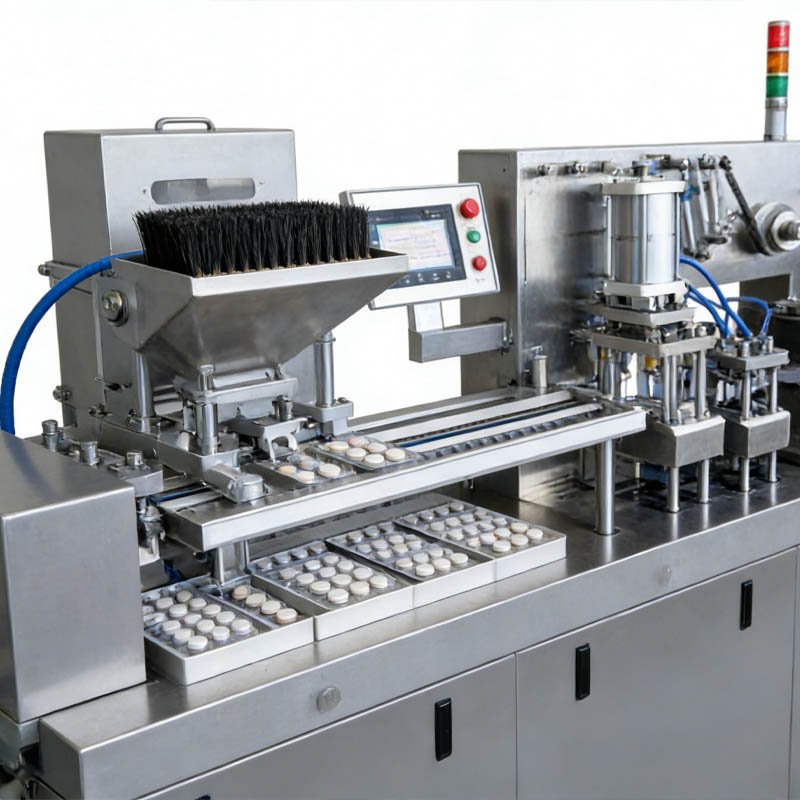 Solid Blister
Solid Blister Packaging
A unit-dose blister format where pre-formed tablets, capsules or solid units are mechanically placed into shape-matched cavities via brush feeders, vibration plates or pick-and-place robotics, then sealed with foil. Cavities are shape-matched to each pill profile; vision systems check pocket presence and reject defects.
- ProductTablets, capsules, lozenges, soft confectionery
- CavityShape-matched to tablet/capsule profile
- FillingBrush feeder · vibration · pick & place
- SealHeat-sealed Alu foil · moisture barrier
- FormingThermoform PVC/PVdC/PET · or cold-form Alu-Alu
- Use CasePrescription pills, OTC tablets, vitamins, chocolates
The Core Technical Difference
Filling Mechanism — Where the Two Formats Diverge
If you understand only one thing about why liquid and solid blister are different machines, understand the filling station. Everything else (forming, sealing, cutting) is largely shared — but how product enters the cavity is fundamentally different.
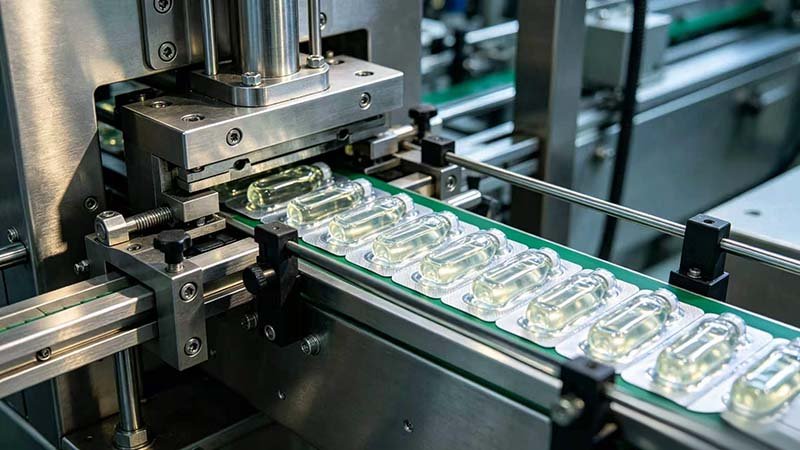 Liquid Filling
Servo Piston Volumetric Dosing
Precision liquid metering · 4-80°C jacket control
Multiple servo-driven piston pumps draw product from a heated/cooled jacketed reservoir and inject precise volume into each cavity through stainless steel diving nozzles. Nozzles dive into the cavity, dispense from the bottom up, and retract — minimizing splashing and foaming. Each piston is independently calibrated; volume accuracy is ±1% across an 8-hour shift.
MechanismServo piston pump
Viscosity Range1–100,000 cP
Volume Accuracy±1%
Temp Range4°C – 80°C
Heads / Machine4–16 typical
Solid Feeding
Brush / Vibration / Pick-and-Place Feeding
Mechanical unit placement · 6,000-12,000 BPM
Pre-formed tablets are gravity-fed onto a vibration plate or moving conveyor, then a rotating soft-bristle brush sweeps them into shape-matched cavities. For premium pharma or fragile products, pick-and-place robotic arms with vision guidance ensure 100% pocket fill rate. Vision system rejects blisters with missing pockets, broken tablets or wrong-color capsules.
MechanismBrush / vibration / robotic
Unit Size Range4–22 mm tablets
Fill Rate99.95%+
Temp RangeAmbient
Output SpeedUp to 12,000 BPM
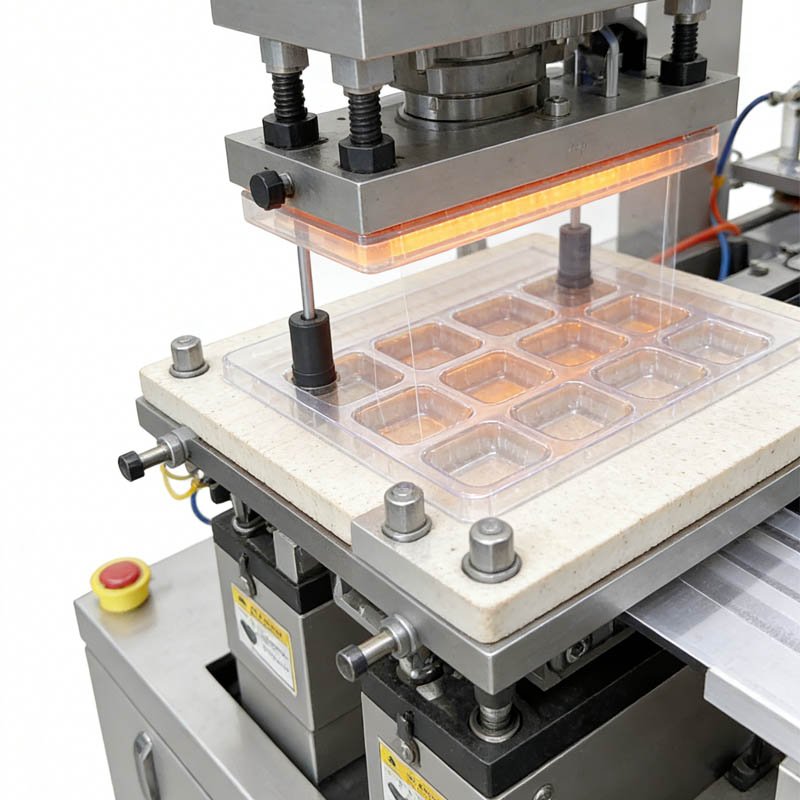
Forming Station (Shared)PVC/PET/Alu film thermoformed
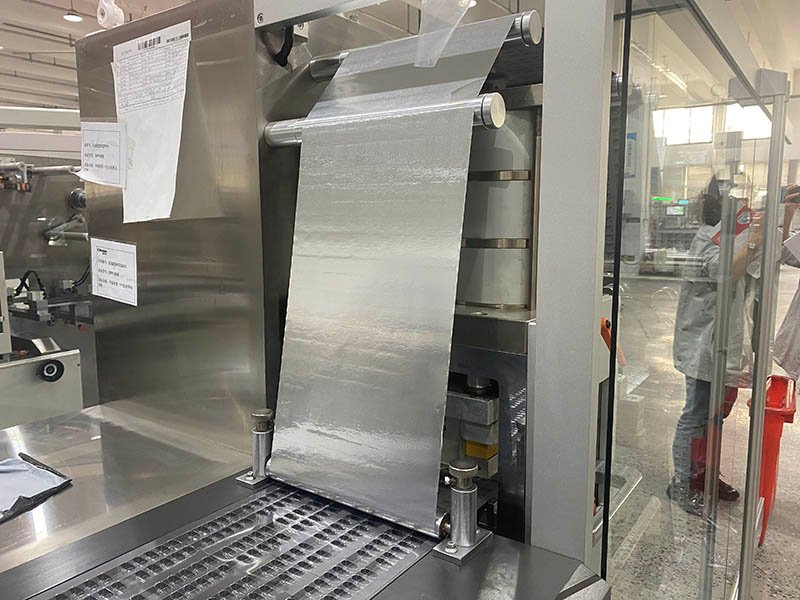
Sealing Station (Shared)Heat-sealed aluminum foil lid
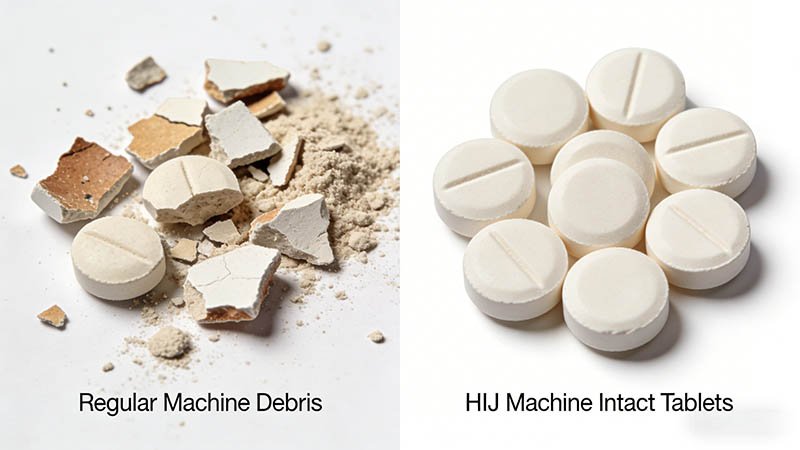
Tablet IntegrityGentle handling critical for solids
Material & Tooling Compatibility
Forming Films & Mold Design
Material compatibility is one of the big overlaps between liquid and solid blister — most films work for both. But cavity mold design is dramatically different, and that's where tooling cost diverges.
Entry-level barrier
PVC / PVC-PVdC Thermoform
Liquid
✓ Best for water-based
Solid
✓ Standard 60% of pharma
PVC 250-300 µm is the most common thermoform film. Adding PVdC coating (PVC/PVdC 60g) lifts moisture barrier 3-5×. Works for both liquid and solid — but solid blister production has the longer history.
Maximum barrier
Alu-Alu Cold-Form (OPA/Alu/PVC)
Liquid
✓ Oxygen-sensitive
Solid
✓ Moisture-sensitive
Cold-formed laminate provides complete gas/moisture barrier (<0.1 cc/m²/day OTR, <0.05 g/m²/day WVTR). Mandatory for moisture-sensitive solids (effervescents) and oxygen-sensitive liquids (probiotics, omega-3). Costs 3× standard PVC.
Premium clarity
PET / APET Thermoform
Liquid
✓ Premium positioning
Solid
✓ Chocolate · candy
Crystal-clear PET shows the product through the cavity — used for premium hotel honey, gourmet chocolates and visual-impact OTC tablets. Mono-PET is recyclable in 40+ countries. Less moisture barrier than PVC/PVdC — pair with high-barrier foil.
Tooling Reality: Liquid Cavities ≠ Solid Cavities
Even though the same machine frame and forming station can be shared, cavity molds are completely different geometries. Liquid cavities are rounded half-spheres optimized for spillage resistance; solid cavities are shape-matched to the specific tablet/capsule profile (round, oval, oblong). You cannot run a liquid product through a solid mold or vice versa. Each new product = new mold ($2,000-9,000 + 4-6 weeks lead time).
Application Mapping
What Product Forms Go Into Each Format?
Pharmaceuticals, nutraceuticals, food and cosmetics all use both liquid and solid blister formats — just for different SKUs within each portfolio. Here's the practical mapping by product form.
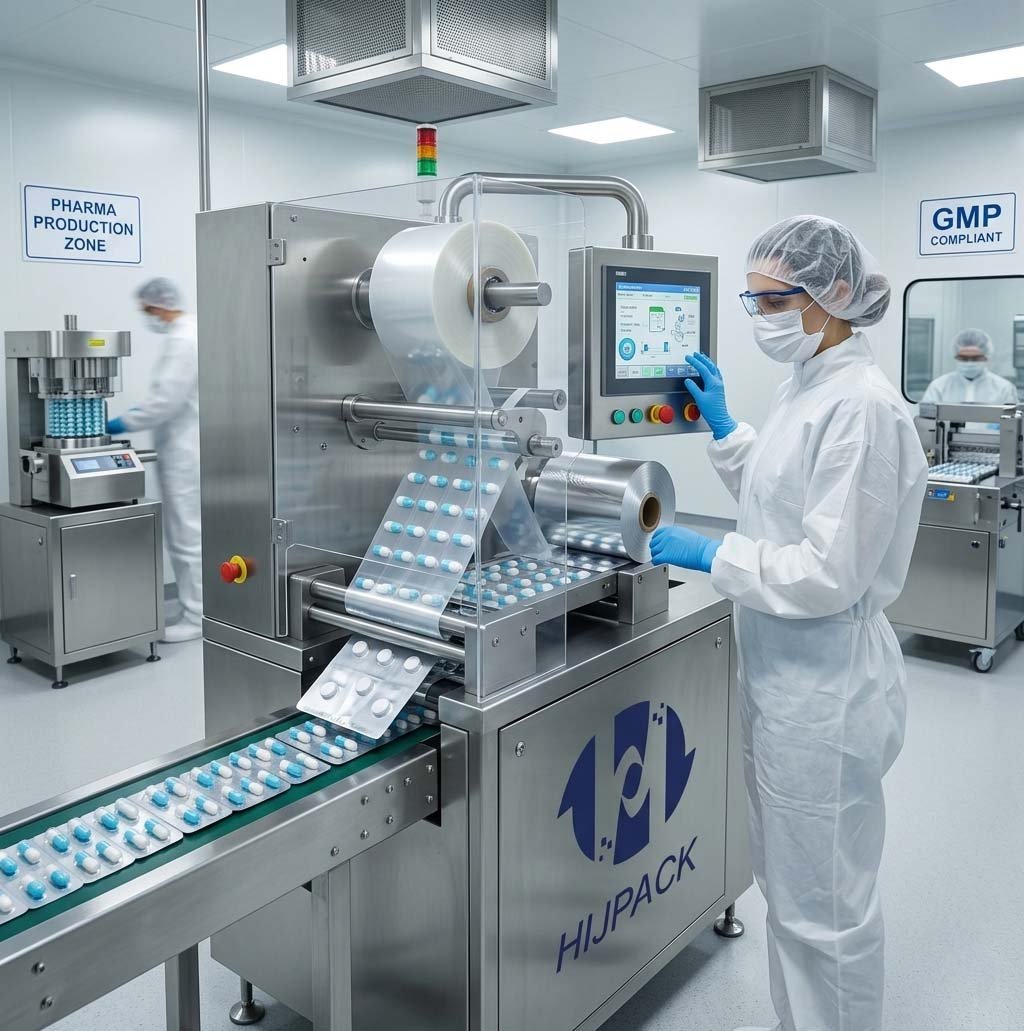
Mixed pharma portfolio · both formats common
Both Formats Coexist in Most Manufacturing Sites
Walk into a major pharmaceutical manufacturer's blister hall and you'll typically find both liquid and solid blister lines running in parallel. The same brand often has solid blister for tablet SKUs and liquid blister for the pediatric syrup or eye drop SKU in the same therapeutic category.
For nutraceutical brands, the pattern is the same: capsule SKU on solid blister, liquid B-complex or vitamin D drops on liquid blister. The two lines share upstream operations (mixing, granulation, weighing) and downstream operations (cartoning, case packing) — but the filling station is dedicated.
68%
Pharma sites run both lines
95%
Of tablets sold worldwide use solid blister
8 Common Product Forms — Mapped to the Right Format
Oral Syrup
Liquid BlisterPediatric antibiotic, cough syrup, vitamin D drops — single-dose 1-15 ml format.
Eye / Nasal Drops
Liquid BlisterPreservative-free ophthalmic and nasal drops, 0.3-1 ml unit dose.
Food Portion
Liquid BlisterHoney, jam, condiments, hotel amenity, gourmet syrups 5-15 ml.
Energy / Sports Gel
Liquid BlisterEndurance gels, electrolyte shots, immunity boosters 10-30 ml.
Compressed Tablet
Solid BlisterPrescription & OTC tablets, vitamins, generics — round/oval/oblong forms.
Hard Capsule
Solid BlisterGelatin or HPMC vegetarian capsules, size 00 to 5, powder or pellet fill.
Lozenge / Throat Tab
Solid BlisterSugar-based throat lozenges, mints, cough drops — humidity-sensitive.
Chocolate / Confectionery
Solid BlisterIndividual chocolates, bonbons, gummies — premium gift positioning.
Production Metrics
Speed, Footprint & Operating Cost
Solid blister lines run dramatically faster than liquid blister lines because solid feeding is mechanical (high throughput) while liquid dosing is volumetric (slower per cycle). Here's how the numbers compare.
Peak Output / Hour
Liquid9,800 doses
Solid720,000 tabs
Machine Footprint
Liquid3.2 × 0.9m
Solid3.5 × 1.0m
SKU Changeover
Liquid15-25 min
Solid20-35 min
Operators / Line
Liquid1 per shift
Solid1 per shift

Edge Cases
Hybrid & Gray-Zone Products
Some products don't fit neatly into "liquid" or "solid" categories — soft-gel capsules, liquid-filled hard capsules, jellies and semi-solids. Here's how to handle each.
 Gray Zone
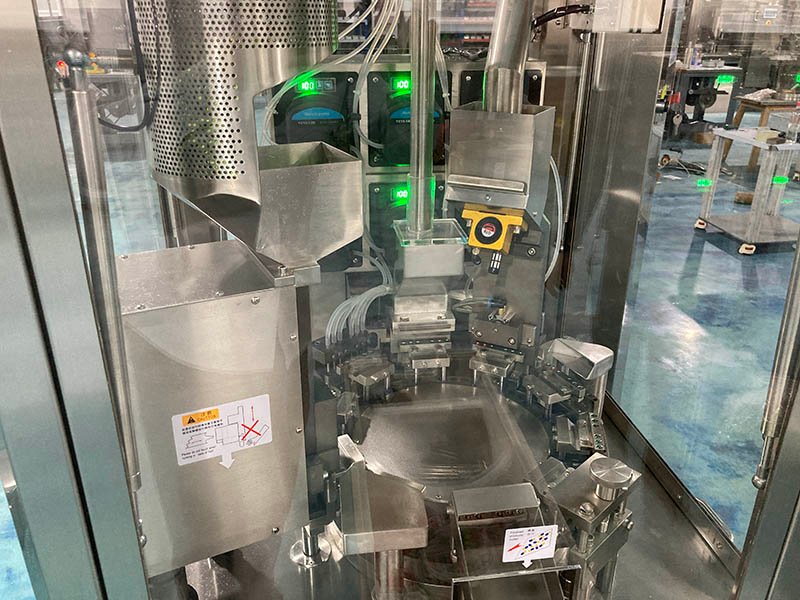
Soft-Gel Capsules
Liquid inside · solid outside
Soft-gels look liquid but are packaged as solids. The gelatin shell makes them a discrete unit — brush-fed exactly like tablets. The internal oil is sealed by the capsule maker upstream, so the blister only needs to protect the capsule from moisture.
Verdict: Use solid blister format. The shell is rigid enough for brush feeding; oxygen barrier needed if shell contains omega-3 or other oxidation-sensitive oils.
 Gray Zone
Liquid-Filled Hard Capsules
Banded HPMC · sealed with liquid inside
Hard HPMC capsules filled with liquid and then band-sealed are pre-formed solid units when they reach the blister stage. They're handled identically to powder-filled hard capsules — brush fed into shape-matched cavities — but need extra-careful handling to prevent banding rupture.
Verdict: Use solid blister format with reduced brush pressure. Vision inspection critical to reject leaking units.
 Gray Zone
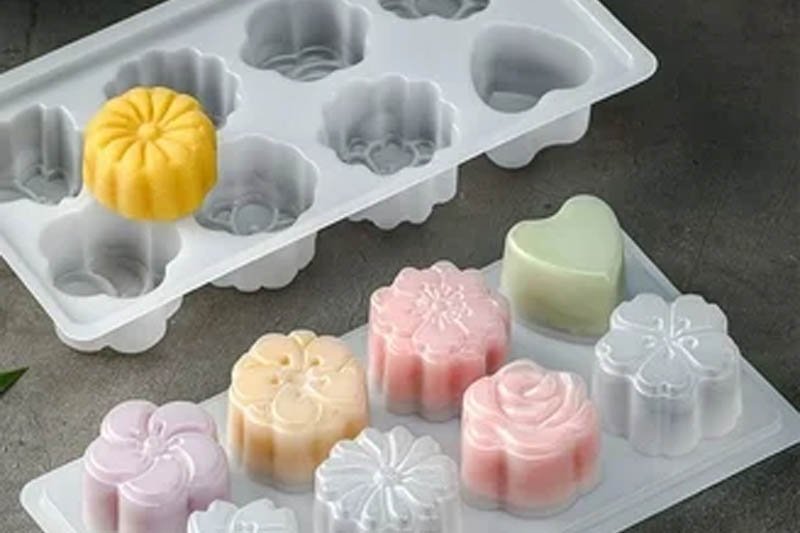
Semi-Solid / Jelly Products
Thick paste · fondant · honey · butter
Products with viscosity above 50,000 cP — fondant centers, thick honey, butter portions, dental gels — can be dosed by either a heated liquid servo piston (if pumpable when hot) or a positive-displacement paste pump. Spillage-resistant rounded cavities are essential.
Verdict: Use liquid blister format with heated jacket. Servo piston works up to 100,000 cP at 40-70°C jacket temperature.
How HIJ Handles Gray-Zone Products
Send us a product sample. Our applications lab will measure viscosity, particle size, and stability — then determine whether liquid or solid blister format fits, and what cavity geometry / dosing pressure / temperature setpoint will work best. For 80% of gray-zone products we provide a definitive recommendation within 48 hours, often with a pilot-trial sample produced on our R&D line.
Industry-by-Industry Mapping
Which Format Each Industry Uses Most
After 200+ customer projects, here's the format distribution we see by industry. Most industries use both — but in different proportions.

Pharmaceuticals
Tablets · capsules · syrups · drops
Both Formats
~85% solid blister (tablets & capsules), ~15% liquid blister (pediatric syrups, ophthalmics). Largest blister-using industry globally. Most large pharma sites have multiple lines of each format running in parallel for different therapeutic categories.

Nutraceuticals & Vitamins
Capsules · gummies · liquid shots
Both Formats
~60% solid blister (vitamins in tablet/capsule), ~40% liquid blister (B-complex liquid, vitamin D drops, immunity shots). Fastest-growing blister segment. Premium brands often launch the same active ingredient in both formats to capture different consumer preferences.
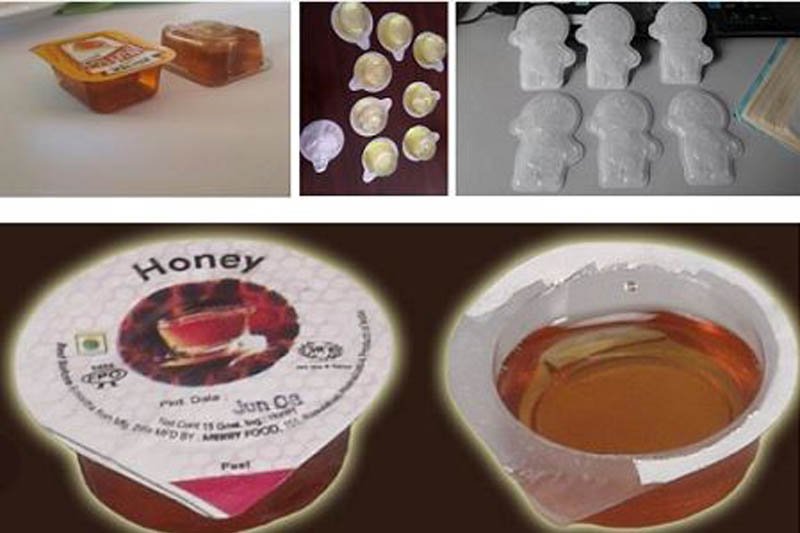
Food & HORECA
Portions · honey · candy · chocolate
Mostly Liquid
~70% liquid blister (honey, jam, syrup, condiment portions for hotel/airline), ~30% solid (chocolate, gourmet bonbons, hard candy). Food blister is mostly liquid because food portions are usually pourable/spreadable; solid food blister is limited to confectionery and chocolate.
Generic OTC Pharma
Aspirin · ibuprofen · cold & flu tablets
Mostly Solid
~95% solid blister. OTC pharma is dominated by tablets and capsules — pain relief, antihistamines, cold & flu, gastric remedies. The remaining 5% liquid is mostly children's cold & flu syrup portions and hospital sample doses.

Cosmetic Samples
Serums · lotions · sample packs
Mostly Liquid
~85% liquid blister (serum, lotion, ampoule sample formats), ~15% solid (sheet mask tablets, cleansing balls). Korean and French luxury beauty has driven a wave of premium liquid blister cosmetic sample packs since 2022.
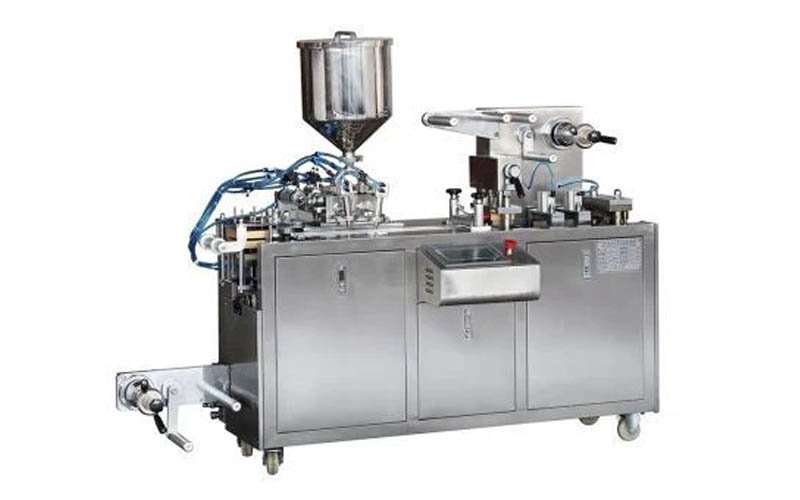
Confectionery
Chocolate · bonbon · gummy · hard candy
Mostly Solid
~80% solid blister (individual chocolate pieces, hard candy, gummies), ~20% liquid (jam-filled chocolates, liquid-center candy, chocolate syrup portions). Premium gift positioning and tamper-evidence drive blister adoption in this segment.
Final Decision Framework
When Liquid Wins · When Solid Wins
Our complete checklist for choosing the right blister format for your new product launch. Tick the boxes that apply — the side with more checks is your answer.
Choose Liquid BlisterIf 3+ of these apply
- Your product is physically liquid — pourable, pumpable, or semi-liquid up to 100,000 cP
- You need volumetric dose accuracy under ±2% for active ingredients
- Product is oxygen- or moisture-sensitive and needs hermetic foil seal
- You target premium positioning with clear PET cavity showing product
- Application is pediatric, ophthalmic, food portion or sample SKU
- You need 4-80°C temperature control on the product during dosing
- Annual volume is 300K-2M doses/year per SKU
Choose Solid BlisterIf 3+ of these apply
- Your product is a discrete solid unit — tablet, capsule, lozenge, hard candy, gummy
- You need high throughput 100K-700K units per hour for cost efficiency
- Product is moisture-sensitive (effervescent tablets, hygroscopic) requiring Alu-Alu
- You target pharmaceutical OTC or Rx markets where solid blister is the standard
- You need individual tablet QR/DataMatrix traceability for serialization
- Tablets have specific shape (round/oval/oblong) requiring shape-matched cavities
- Annual volume is 5M+ units/year per SKU — high-speed lines amortize fast
Frequently Asked Questions
Buyer Questions When Choosing Liquid vs Solid Blister
Direct answers from our applications engineering team to the questions most commonly raised during new-product planning meetings.
Can one blister machine run both liquid and solid products?
Not at the same time, and not without major retrofit. The forming and sealing stations can be shared between liquid and solid products, but the filling station is fundamentally different hardware — servo piston pump vs brush/vibration feeder. Some buyers ask for a "convertible" machine, and while it's technically possible to design a swappable filling module, the changeover takes 4-8 hours and requires re-validation in regulated pharma. For most customers running multiple SKUs, two dedicated machines work better than one convertible.
What's the difference between thermoforming and cold-forming for liquid vs solid?
The forming method depends on the film, not the product state.
- Thermoforming heats PVC/PET/PP film and presses it into cavity molds — used for both liquid and solid blister with PVC, PVC/PVdC or PET films. Faster (up to 12,000 BPM) but limited barrier.
- Cold-forming mechanically stretches Alu-Alu laminate (OPA/Alu/PVC) at room temperature into deeper cavities — used for both liquid and solid when maximum gas/moisture barrier is needed. Slower (max 4,500 BPM) but absolute barrier.
Both processes work for both liquid and solid blister; the choice is driven by product sensitivity, not by what's inside.
If I'm running pharmaceutical tablets, is liquid blister ever relevant to me?
Yes — about 35% of pharma companies with tablet portfolios eventually add liquid blister for line extensions. Common scenarios: launching a pediatric syrup version of an adult tablet (same active, different format); adding ophthalmic drops to a topical product line; expanding into immunity-shot nutraceutical adjacent products. If you already have blister infrastructure (cleanroom, validation systems, cartoning), adding a liquid blister line is much faster than starting from scratch. We frequently quote both lines together for pharma customers.
Why is solid blister so much faster than liquid blister?
Because solid feeding is mechanical and parallel; liquid dosing is hydraulic and serial. A brush feeder can place 4-12 tablets simultaneously into cavities in one pass — adding more lanes scales linearly. A servo piston pump must dispense each volume individually, with viscosity, surface tension and meniscus stability limiting cycle time. Typical max speeds: solid 12,000 BPM (200 strokes/sec), liquid 164 doses/min (3 strokes/sec). The 60-fold speed difference is structural, not a result of better engineering.
Which format has lower tooling cost for new SKU launches?
Solid blister molds are typically 25-35% cheaper ($2,000-6,500 per mold) than liquid blister molds ($3,500-9,000 per mold). Liquid molds need higher precision and surface polish to prevent product residue sticking and to ensure leak-tight foil sealing. For solid blister, mold cost scales with tablet shape complexity — round tablets are cheapest, oblong scored tablets are most expensive. Both have similar lead time (4-6 weeks from approved drawing).
Do liquid and solid blister use the same aluminum foil?
Different foil thicknesses and coatings. Liquid blister typically uses 30-35 µm hard-temper aluminum with heat-seal lacquer optimized for hermetic seal against liquid contact — the foil must resist puncture from internal hydrostatic pressure. Solid blister typically uses 20-25 µm soft-temper aluminum with push-through or peel-push lacquer — the foil only needs to seal against moisture, not retain liquid. Both can be printed in up to 8 colors with serialization codes.
Is there a "mixed" blister where one card has both liquid and solid pockets?
Yes — these are called "combination dose" or "co-blisters" and are increasingly common. Example: a daily-medication blister with a tablet on one side and a liquid vitamin shot on the other side. This requires a specialized machine with both a brush feeder and a servo piston dosing station — typically running at the slower of the two speeds. HIJ has built combo-format machines for several customers; they require custom engineering and validation but unlock unique product offerings worth +60% retail margin.
Does HIJ make both liquid and solid blister machines?
Yes — both are core HIJ products with 20+ years of engineering depth.
- Liquid blister: DPP-80, DPP-140, DPP-150, DPP-260 series with servo piston dosing — see our liquid blister machine range
- Solid blister: DPP-250, DPP-260, DPP-320, high-speed DPP-500 with brush + vibration feeding — see our pharmaceutical blister range
We frequently quote both lines together for customers planning a complete tablet + liquid syrup portfolio. Send your product specs and projected volumes — we'll return a comparative quote within 24 hours.
Ready to Choose
Get a Format Recommendation in 24 Hours
Send us your product details — physical form, dose size, viscosity (if liquid), tablet shape (if solid), annual volume — and our applications team will return a definitive format recommendation: liquid blister, solid blister, or hybrid line. Includes machine spec, mold design, and ROI within one business day.
24 hr
Format Recommendation
7-14 d
Sample Trial Production
8-12 wk
Machine Lead Time
2 yr
Full Warranty
About HIJ MachineryWenzhou, China · Est. 2003 · Led by Forester Xiang
HIJ Machinery is one of the few specialist blister equipment manufacturers that builds both liquid and solid blister production lines under one roof — with shared engineering depth across both formats. Founder Forester Xiang has guided 200+ customer projects across 60+ countries, with cGMP, FDA 21 CFR Part 11, EU 1935/2004 and ISO 22000 compliance built in as standard. Whether you need a single tablet line, a single liquid line, or both running in parallel, HIJ delivers turnkey solutions with unified service support.
20+
Years
200+
Customers
60+
Countries
35+
Engineers