
Capital planning tool · User-supplied inputs
Blister Packaging Machine ROI Calculator
Estimate total initial investment, annual net benefit, simple payback, multi-year ROI and NPV from your own labor, material, output, quality and operating-cost assumptions.
No benchmark claimsTransparent formulasScenario-readyNo sign-up
Calculate a scenario
Use this calculator for a first-pass business case. It does not insert an industry-average payback, labor reduction, waste rate, uptime gain or equipment price. Every financial result comes from the values you enter. Supplier quotations, site records, approved forecasts and finance rules should replace preliminary assumptions before approval.
Calculate blister machine payback, ROI and NPV
Use one currency throughout. Enter annual values on the same production-volume and product-mix basis.
Scenario inputs
Use the same currency for every monetary input.
Use your finance team's review period.
Needed for NPV. Enter 0 if not used.
Use the quoted configured machine scope.
Include every launch format in scope.
Use landed and installed costs, not only FOB price.
Include buyer and supplier responsibilities.
Use comparable shifts, coverage and productive time.
Do not remove labor that is only reassigned.
Use salary, benefits, shift premiums and applicable overhead consistently.
Use the same annual output boundary as the waste rates.
Use measured purchasing and accepted-output records.
Support with a trial, FAT condition or conservative assumption.
Use contribution, not revenue, and only where demand can absorb output.
Enter only documented, non-overlapping savings.
Include service, spares, software, utilities and other added annual costs.
What the calculator includes
The model separates the one-time investment from recurring annual benefits and recurring annual costs. That makes the result easier to trace back to a quotation, staffing model, material report or production record.
Total initial investment
Equipment and controls + tooling and format parts + freight, duties, site work and installation + qualification, training and start-up.
Annual net benefit
Labor change + material change + additional contribution + documented quality/downtime benefit − incremental annual operating cost.
What belongs in total initial investment
Start with the configured machine offer, then add the costs required to place that scope into its intended operating state. Tooling, format parts, inspection options, coding, reject systems and downstream interfaces may sit inside or outside the headline machine price. Freight, insurance, duties, unloading, utilities, site preparation and installation depend on the agreed delivery and responsibility boundary.
Qualification support, buyer testing, training, trial material and start-up batches also consume project resources. Enter them where the buyer's finance policy treats them as capital or project-launch cost. The calculator groups these items for screening; the approved investment request should retain the detailed cost schedule.
What belongs in annual net benefit
Annual net benefit should represent the repeatable economic change after the proposed process reaches its defined operating state. It may include an approved staffing change, lower material required for the same accepted output, contribution from constrained demand that can now be served, and documented reductions in rework or lost production.
Subtract recurring costs created by the investment. Typical categories to investigate include preventive maintenance, critical spares, service support, software, utilities, inspection consumables and added quality-control work. A benefit estimate without the corresponding operating-cost boundary overstates the return.
Use one comparison boundary
Compare the current and proposed states over the same products, pack formats, shifts, calendar time and accepted-output definition. Mixing one-shift labor with three-shift output, or comparing current purchased material with proposed theoretical material, creates an artificial return.
Do not count the same gain twice. If recovered uptime already appears in additional annual contribution, do not also enter the same value under downtime benefit. If labor is reassigned rather than removed or used to support incremental output, describe the economic value consistently.
How the ROI formulas work
Total initial investment
Total initial investment = equipment + tooling + delivery/site/installation + qualification/training/start-up. Add other one-time costs to the closest category or include them in the approved quote comparison before using the result.
Annual labor change
Annual labor change = (current FTE − proposed FTE) × fully loaded annual cost per FTE. A negative result is possible when the proposed process requires more staffing on the same basis.
Annual material change
The calculator normalizes current material spend to the same accepted-output basis: current spend − [current spend × (1 − current waste) ÷ (1 − proposed waste)]. This avoids simply multiplying spend by the percentage-point difference.
Simple payback
Payback months = total initial investment ÷ annual net benefit × 12. When annual net benefit is zero or negative, the calculator reports that simple payback is not reached.
Multi-year simple ROI
Simple ROI = [(annual net benefit × years) − total initial investment] ÷ total initial investment × 100. It assumes the annual net benefit stays flat and does not discount future cash flow.
Net present value
NPV = −initial investment + the discounted value of each year's annual net benefit. The model uses a flat annual net benefit and the discount rate you enter. Finance teams may require taxes, depreciation, working capital, residual value, ramp-up or uneven cash flows; add those in the approved financial model.
Challenge the material-waste assumption
Material waste must use a defined numerator and denominator. Include the categories that the site's purchasing and production records can reconcile, such as start-up web, splice losses, forming or sealing rejects and material remaining after a campaign. Do not compare a current total-waste percentage with a supplier estimate that covers only steady-state web trim.
The proposed rate should be tied to the intended forming web, lidding material, cavity layout, web width, index and changeover pattern. A short demonstration may show that the machine can run, but it does not automatically establish the annual waste rate used in the business case.
Handle ramp-up and uneven cash flow separately
This screening calculator applies one annual net benefit to every year. If installation, qualification, market launch or staff training creates a ramp-up period, calculate a conservative steady-state result here and move the year-by-year cash flow into the buyer's financial model. The same applies to major overhauls, replacement tooling, staged payments and residual value.
Use the expected payment and benefit dates when timing materially affects approval. A project can have an attractive steady-state return but a weaker first-year cash position because installation and qualification occur before saleable output begins.
When payback, ROI and NPV tell different stories
Payback focuses on how quickly the initial investment is recovered. Simple ROI measures the modeled gain over the selected horizon without discounting. NPV applies the entered discount rate to future annual benefits. Two projects can therefore have similar payback periods but different longer-term value, or similar simple ROI but different NPV when timing and risk differ.
Do not convert these outputs into a universal pass/fail score. Compare alternatives using the same horizon, discount rate, scope and evidence standard, then apply the buyer's authorized investment criteria.

Build inputs from records, not generic benchmarks
| Input | Preferred evidence | Common error |
|---|---|---|
| Total investment | Normalized supplier quotation, logistics estimate, site plan and qualification scope | Using the base machine price while omitting tooling, duties or site work |
| Labor | Shift roster, relief coverage and finance-approved loaded cost | Counting reassigned labor as cash savings without an approved alternative use |
| Material spend and waste | Purchase records, issued-versus-accepted output and representative batches | Comparing different products, pack sizes or reporting boundaries |
| Additional contribution | Demand plan, constrained-capacity record and finance-approved unit contribution | Entering revenue instead of contribution or assuming all extra capacity will sell |
| Quality and downtime | Deviation, scrap, rework, maintenance and lost-production records | Counting the same recovered output in two benefit categories |
| Incremental operating cost | Service scope, spare-parts plan, utilities, software and preventive maintenance | Assuming a new machine has no recurring cost |
Separate capacity from financial benefit
Higher rated speed does not automatically create value. The financial model should use accepted packs under a defined run condition, not brochure cycles per minute. Confirm product feeding, forming, sealing, inspection, rejection, changeover, planned stops and operator work before assigning a contribution value to extra output.
For capacity definition, use the blister machine sizing guide. For installed scope, compare the tablet blister machine cost breakdown with the current tablet blister machine price guide.
Model at least three scenarios
- Conservative: use approved costs, slower ramp-up assumptions and only benefits supported by current records or committed demand.
- Base: use the operating condition that the project team expects and can defend through trials, FAT and the site plan.
- Upside: show additional output or efficiency separately so approval does not depend on an optimistic result.
Run each scenario separately and print the result. The calculator intentionally does not label an ROI percentage “good,” “strong” or “excellent”; the buyer's finance policy and risk tolerance define acceptance.
What this calculator does not approve
The result does not select a machine model, establish production capacity, prove product or package quality, approve a staffing reduction or replace validation. It also does not prove that additional capacity has commercial demand. Those decisions belong to the responsible engineering, production, quality, commercial and finance functions.
Use the output to identify which assumptions deserve evidence. A high modeled return driven mainly by one unsupported input is a reason to test that input, not a reason to accelerate approval.
Connect the business case to the URS and FAT
An ROI model is useful only when the machine scope can deliver the assumed operating state. Translate the main value drivers into the user requirement specification and the factory acceptance test.
- Accepted packs per defined run period
- Product and pack formats in scope
- Operator tasks and staffing boundary
- Material lots and waste-accounting method
- Changeover formats and elapsed-time definition
- Inspection and reject challenge boundary
- Utilities and environmental conditions
- Planned stops and restart conditions
- Data needed to reconcile good output
- Deviations and acceptance authority
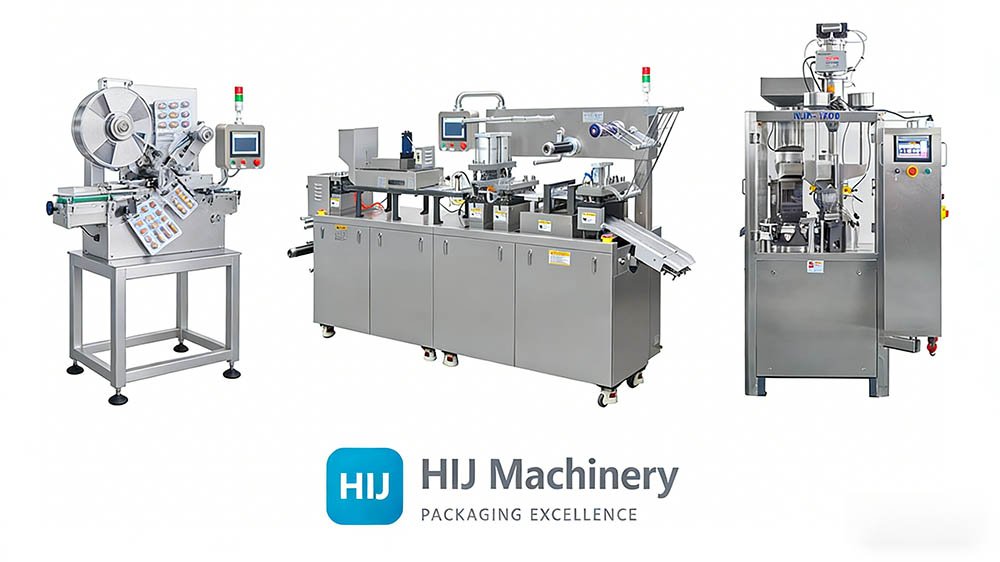
The blister machine URS guide can structure the requirement set. Review the HIJ blister packing machine range only after the product, material, format and acceptance boundary are defined.
Questions to send with an ROI-based machine inquiry
- Which product, dosage form, pack material and cavity drawing define the project?
- What accepted-pack output and operating period support the demand model?
- Which tooling, inspection, coding, rejection and downstream interfaces are included?
- Which costs are included in the commercial offer and which remain with the buyer?
- What evidence will support staffing, waste, changeover and sustained-output assumptions?
- Which FAT conditions and acceptance rules connect the machine offer to the business case?
Frequently asked questions
What does this calculator include in total initial investment?
It adds equipment and controls, tooling and format parts, freight/duties/site/installation, and qualification/training/start-up. Use a normalized quotation and add any other one-time project costs required by the buyer's approval method.
How does the calculator estimate annual labor benefit?
It multiplies the difference between current and proposed full-time-equivalent staffing by the fully loaded annual cost per operator. Use the same shift and coverage basis, and do not treat reassigned labor as cash savings unless its alternative value is approved.
How is material-waste benefit calculated?
It compares current material spend with the estimated spend required to produce the same accepted output at the proposed waste rate. Both rates must use the same products, pack formats and reporting boundary.
What should I enter as additional annual contribution?
Enter finance-approved contribution from saleable output that the proposed process can add and the market can absorb. Do not enter gross revenue, unconstrained rated capacity or output already counted under downtime or quality benefits.
How is the payback period calculated?
Simple payback months equal total initial investment divided by annual net benefit, multiplied by 12. If annual net benefit is zero or negative, the calculator reports that simple payback is not reached.
What is the difference between simple ROI and NPV?
Simple ROI compares undiscounted net benefit over the selected years with the initial investment. NPV discounts each year's modeled net benefit using the entered rate, so it reflects the time value assigned to future cash flow.
Should qualification and validation costs be included?
Include the qualification, validation-support, training and start-up costs assigned to the project by the buyer's quality and finance teams. Confirm what the supplier quotation includes instead of applying a generic percentage.
Can this result replace a supplier quotation or approved business case?
No. It is a transparent screening model. Final approval should use verified quotations, site costs, operating records, demand assumptions, applicable taxes and the buyer's authorized financial method.
Calculation boundary: the tool uses flat annual benefits and costs across the selected horizon. It does not estimate taxes, depreciation, financing, working capital, residual value, ramp-up timing, inflation or probability. Add those items in the buyer's approved financial model when material.
Turn the ROI scenario into a testable machine scope
Send the product and pack definition, accepted-output target, current operating records, preliminary investment boundary and the assumptions that drive your result. HIJ can respond with the configuration and FAT evidence needed to test those assumptions.