The Direct Answer
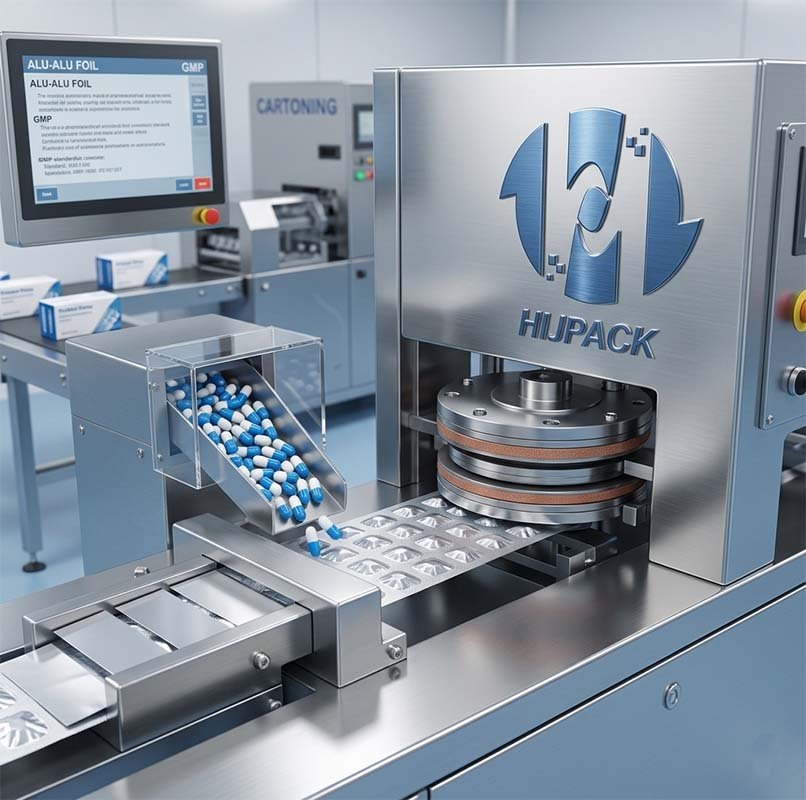
GMP validation for an Alu Alu blister packing machine is defined as a structured, documented process — spanning Design Qualification (DQ), Installation Qualification (IQ), Operational Qualification (OQ), and Process Qualification (PQ) — that proves your cold-form packaging system consistently delivers sealed blisters meeting barrier, integrity, and product-protection specifications required by FDA 21 CFR Part 211, WHO TRS 992 Annex 3, and EU GMP Annex 15 before a single commercial batch ships.
Skip any phase. Your dossier has a gap. Your auditor finds the gap. Production stops. That sequence plays out in more plants than anyone publicly admits.

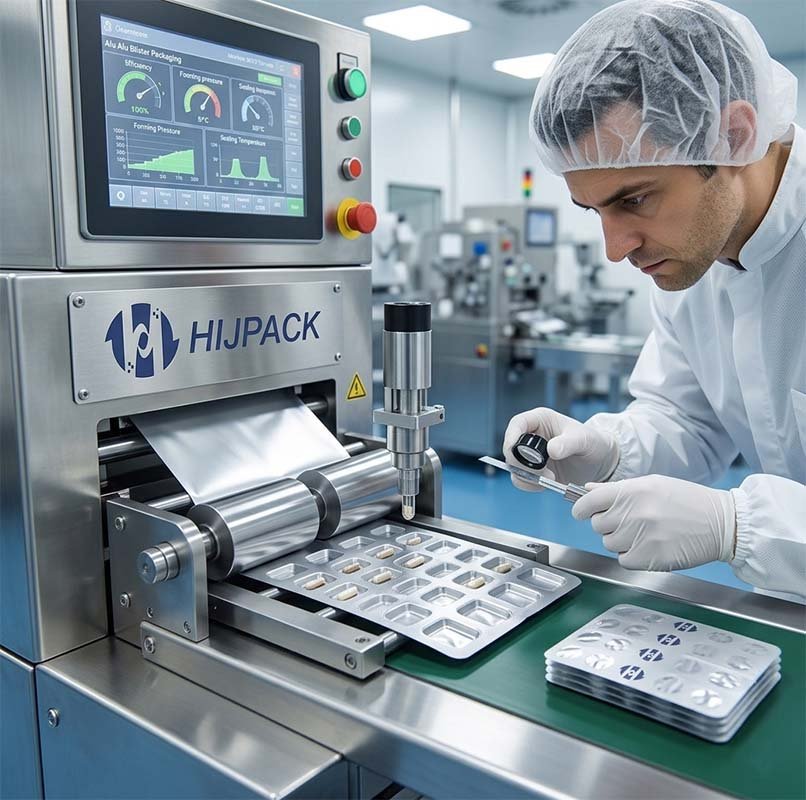
The four-phase GMP validation framework for cold-form Alu Alu blister packaging lines — DQ through PQ.
Why Alu Alu Blister Machine GMP Validation Is Non-Negotiable
FDA Form 483 observations cite packaging equipment validation failures more consistently than almost any other category in pharmaceutical manufacturing inspections. Pull the public 483 database for 2019–2023: inadequate equipment qualification — missing IQ/OQ protocols, absent change control records, unverified calibration baselines — appears as a finding in the majority of packaging line inspections across South Asian and Latin American sites. Not occasionally. Routinely.
Cold-form Alu Alu blister machines carry a specific burden that standard PVC thermoformers do not. The tri-laminate structure — OPA/Aluminum/PVC — achieves WVTR values below 0.5 g/m²/day precisely because the cold-press forming process preserves the aluminum layer's integrity without heat deformation. That integrity only holds if forming pressure, cavity depth, and sealing temperature are validated to specification. If they aren't documented — if your OQ report doesn't carry signed data showing the forming depth held at your target (±0.3 mm tolerance, typically 6–10 mm for tablet cavities) across 30 consecutive cycles — you have no evidence the barrier is what your stability dossier assumes it to be.
WHO TRS 992 Annex 3 is explicit on this. Equipment used in pharmaceutical manufacturing must be qualified before use, and qualification records must be retained and accessible during inspection. The same language appears in ICH Q10 Section 2.7 under pharmaceutical quality systems. No qualification record means the machine, regardless of its actual performance, is regulatory air — it doesn't exist in the eyes of an auditor.
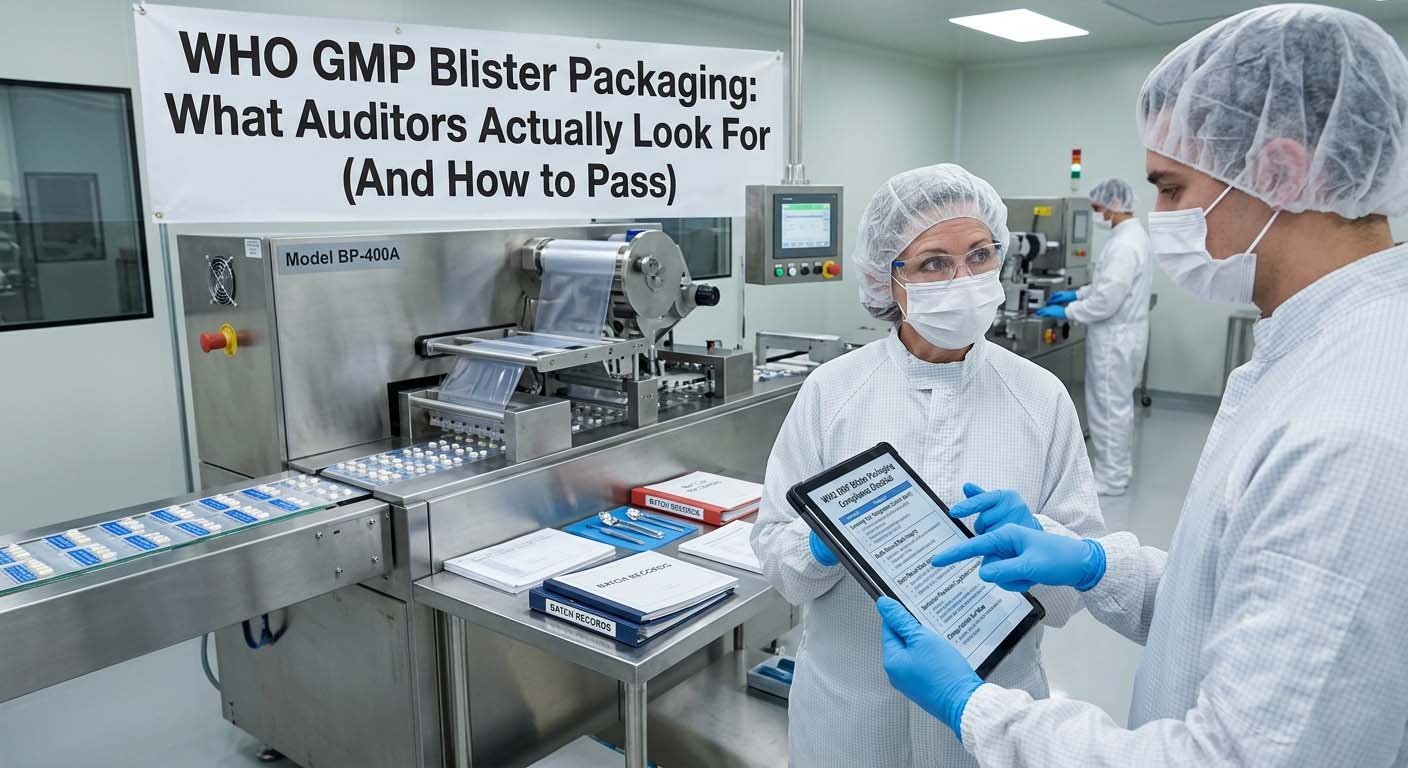
WHO pre-qualification auditors review IQ/OQ/PQ dossiers as a primary inspection gate — missing documents halt commercialization.
💡 Forester's Reflection: I've sat in auditor prep meetings in Karachi and Ho Chi Minh City where the QA director had a machine that worked — seals were good, output was clean — but zero qualification paperwork. The auditor doesn't care that it works. She cares that you can prove it worked, on a specific date, at a specific parameter setting, signed by a qualified person. Those are two completely different things. I was wrong to assume clients understood this distinction until I watched a $2.1 million line sit idle for four months waiting for retrospective qualification to be accepted. It wasn't accepted, by the way. They reran the OQ from scratch.
DQ (Design Qualification): Start With the URS, Not the Brochure
Three weeks before a commissioning job in Jakarta, a client sent me a purchase order for an Alu Alu machine they'd already bought. The URS was two pages. It listed forming width (120 mm), speed (20 cycles/min), and power supply (380V/50Hz). Nothing about GMP material contact surfaces. Nothing about cleanability radius on product-contact parts. Nothing about 21 CFR Part 11 audit trail capability. The machine arrived six weeks later. Fine machine. Wrong spec for their regulatory filing.
DQ — Design Qualification — is the phase where you verify, on paper, that the machine you're about to buy can meet your requirements before money changes hands. The formal output is a DQ report that cross-references every URS requirement against the supplier's design documentation: engineering drawings, material certificates, PLC architecture, HMI specifications, and cGMP compliance declarations.
What a Complete URS for an Alu Alu Machine Must Cover
- Forming depth range: State the target cavity depth in mm (typical range 6–12 mm for tablets/capsules) and acceptable tolerance (±0.3 mm). This number must appear in your OQ protocol later.
- WVTR of target laminate: Specify ≤0.5 g/m²/day for ICH Zone IVb markets; the machine's forming station must demonstrate it does not degrade this barrier specification during cold-press operation.
- Material contact surface specification: Product-contact parts must be 316L stainless steel with Ra ≤0.8 µm surface finish — specify this explicitly. Generic “stainless steel” is insufficient for a GMP dossier.
- Sealing temperature range and control accuracy: Define operating range (typically 160–220°C for Alu Alu lidding) and controller accuracy (±2°C). The sealing station calibration at IQ depends on this spec.
- Electronic records & audit trail: If your product registration requires 21 CFR Part 11 compliance, specify audit trail functionality, timestamp precision, and user access control architecture in the URS — not as an afterthought during commissioning.
- Cleanability and CIP/WIP compatibility: State whether the design requires tool-free disassembly of product-contact assemblies, drainage points, and IP protection rating for wash-down if applicable.
- FAT (Factory Acceptance Test) requirements: Define what tests, witnessed by whom, with which acceptance criteria, constitute a passed FAT. This document becomes the baseline for your IQ checklist.

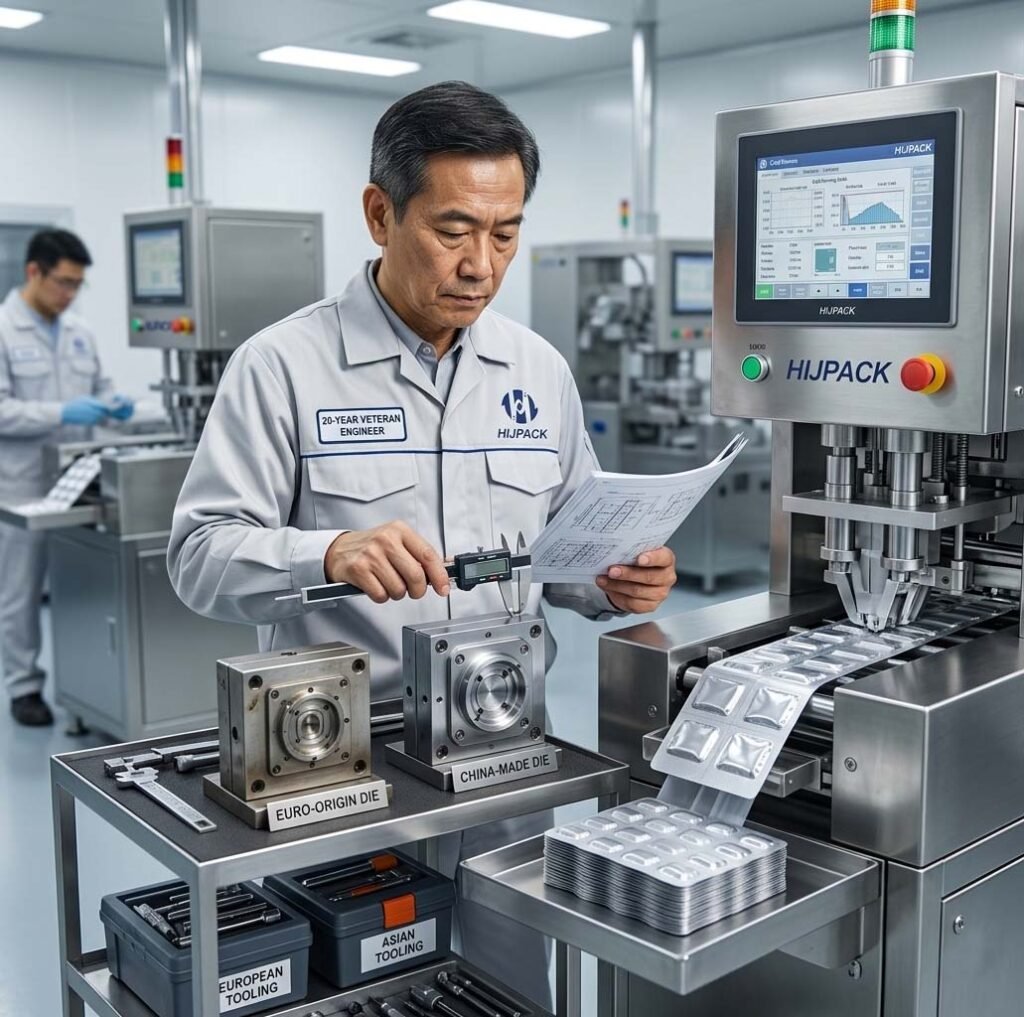
DQ phase: cross-referencing URS requirements against engineering drawings and supplier design documentation before purchase.
At HIJ, the URS process starts on a call — not after the PO. Our engineering team maps each client requirement to a specific design feature, and the DQ report is generated from that mapping. For turnkey projects, DQ covers the entire line, not just the blister machine in isolation. That matters because validation gaps at the interface between machines — conveyor, cartoner, inspection system — are among the most common findings I've seen in regulatory audits.
⚙️ DQ Phase: Common Failure Points
-
🔴 URS signed off without forming depth tolerance specified
I saw this on a project in São Paulo in 2021. The client had a beautiful URS — twelve pages — but forming depth was listed as “per product requirements.” No number. The OQ team arrived six months later and had no agreed acceptance criterion to test against. The OQ protocol had to be revised, sent back for QA sign-off, and the commissioning window moved by three weeks.
What I did: We now require forming depth tolerance (±0.3 mm default, adjustable per product) in the URS template we provide. The number gets locked before FAT. No exceptions. -
🔴 21 CFR Part 11 audit trail not in URS, discovered during IQ
Client needed US FDA compliance for export. PLC was Siemens S7-1500 — capable of full audit trail — but the feature wasn't configured because no one had written it into the URS. Software modification after delivery added 6 weeks and required a re-validation of the electronic records module against Part 11 requirements. That's not a machine problem. That's a document problem that became a timeline problem.
IQ (Installation Qualification): What Inspectors Actually Check
The IQ checklist is not about verifying the machine works. That's OQ. IQ is about proving the machine is what it claims to be, installed where and how the design says it should be. Inspectors know the difference — and they check both.
Installation Qualification documents the physical as-found state of the equipment against the design specification established in DQ. Every instrument, every utility connection, every identification plate gets verified and recorded. A missed calibration sticker on a temperature sensor at the sealing station is an IQ finding. A utility supply pressure outside the specified range is an IQ finding. These aren't technicalities — they're the baseline from which all subsequent OQ data is interpreted.
IQ Document Checklist: Minimum Required Archive
- Equipment identification record: Serial number, model designation, manufacturer name (HIJ Machinery), and installation date — signed by the installing engineer and QA representative. Every single unit.
- Calibration certificates for all critical instruments: Sealing station thermocouples (calibrated to NIST/NPL traceable standard), forming pressure transducers, conveyor speed encoders, and vision inspection cameras. Certificate must show calibration date, next due date, and as-found/as-left readings.
- Material of construction certificates (MOC): 316L SS certification for product-contact parts, FDA-compliant polymer certificates for any seals or gaskets that contact packaging material.
- Utility verification records: Compressed air quality (ISO 8573-1 Class 1 or per URS), electrical supply parameters measured at machine terminal, cleanroom installation environment data (differential pressure, temperature, humidity) at time of IQ.
- Spare parts list and drawing package: As-built P&IDs or equivalent, electrical schematics, pneumatic diagrams, and the full spare parts catalog — archived as part of the IQ dossier. Auditors check this; missing drawings are a recurring 483 observation.
- SOPs for cleaning, operation, and maintenance: Signed and version-controlled at IQ. The IQ report references these SOP document numbers explicitly.
- SAT (Site Acceptance Test) report: Signed by supplier engineer and client QA, confirming machine performance at installation site matches FAT baseline — including any deviations formally documented with impact assessment.
The regulators' concern at IQ isn't complexity — it's traceability. Every instrument that generates data used in your OQ must have a documented calibration history at the time of OQ execution. If the sealing thermocouple wasn't calibrated before your OQ temperature mapping study, the temperature data in that study is unverifiable. The OQ is void. I've seen QA teams discover this at month 11 of a product launch timeline. It is not a discovery you want to make at month 11.
OQ (Operational Qualification): Testing the Machine at Its Operating Limits
Of the 31 blister line commissioning projects I handled in Southeast Asia and Latin America between 2018 and 2023, 14 of them had OQ deviations at the forming depth station. Not failures — deviations. But deviations that required documented investigation and corrective action before the OQ report could be closed. That number tells you where the risk concentrates on a cold-form machine.
Operational Qualification challenges the machine across its defined operating range — not just at nominal settings. For an Alu Alu cold-form blister machine, that means testing sealing temperature from the lower acceptance limit to the upper, forming pressure from minimum to maximum specified, and punch-cut accuracy at the highest and lowest cycle rates in the validated range. The machine must demonstrate consistent performance at each extreme, with every test run documented in the OQ protocol with actual data, not just pass/fail checkboxes.
Critical OQ Parameters for Alu Alu Cold-Form Blister Machines
| Parameter | Typical Acceptance Criterion | Test Method | Regulatory Basis |
|---|---|---|---|
| Sealing temperature uniformity | Set point ±2°C across sealing plate surface | Calibrated thermal mapping, 9-point grid, 3 consecutive runs | EU GMP Annex 15 / WHO TRS 992 |
| Forming depth accuracy | Target depth ±0.3 mm | Calibrated depth gauge, 10 cavities per cycle × 30 cycles | URS specification |
| Servo punch accuracy | ±0.1 mm positional repeatability | Laser displacement measurement at die-cut station | ISO 13849-1 / Machine URS |
| Sealing integrity (CCIT) | Zero dye ingress at 60 mbar, 30-second hold | ASTM F2338 dye-ingress method / USP <1207> framework | USP <1207> / ASTM F2338 |
| Film feed tension control | ±5% of set tension across roll width | Tension load cell, 5 positions across web width | URS specification |
| Reject system accuracy | ≥99.5% correct rejection of seeded defects | Seeded defect challenge: 200 known-defect blisters, 3 runs | cGMP 21 CFR 211.68 |
| PLC program version control | Version locked, unauthorized change alarm active | Attempt unauthorized parameter change, confirm alarm trigger | 21 CFR Part 11 |
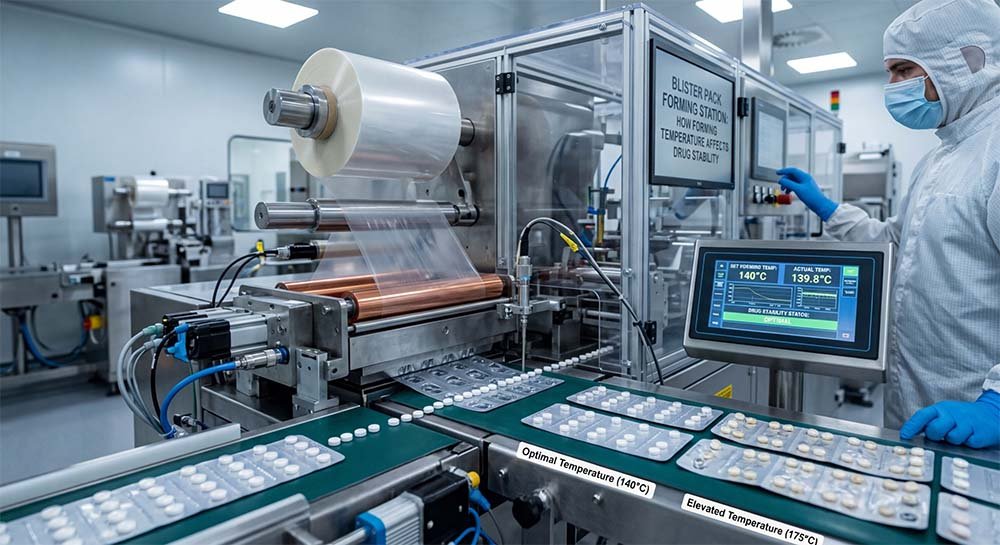
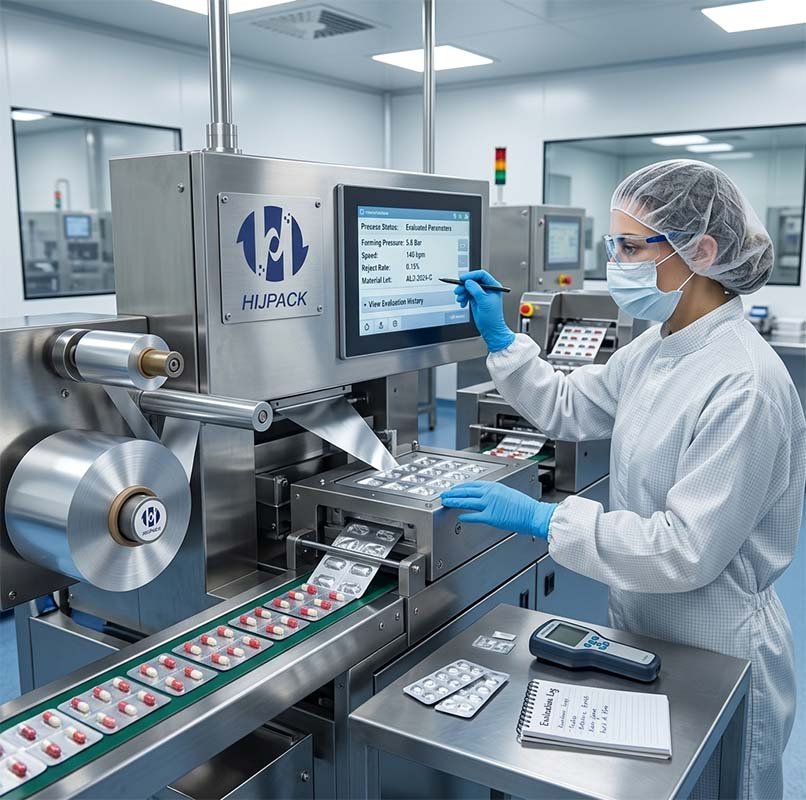
OQ sealing station temperature mapping: 9-point calibrated thermocouple grid across the full sealing plate width — three consecutive runs required.
The sealing integrity test — ASTM F2338 dye-ingress at 60 mbar hold — isn't arbitrary. USP <1207> references dye ingress as a deterministic method for container closure integrity testing of blister packages. If a regulatory reviewer opens a field failure investigation on your product, the first question is whether the CCIT method was validated. If your OQ has no CCIT data, you have no defense. That conversation gets expensive fast.
⚙️ OQ Deviations: What I've Seen and What Fixed Them
-
🔴 Sealing temperature mapping fails at left edge of sealing plate
Thermal imaging showed a 6°C cold zone at the left 15% of the sealing plate — outside the ±2°C criterion. The machine wasn't broken; the heating element had an uneven watt density distribution from the factory. We confirmed this with a calibrated IR camera across three consecutive runs, all showing the same cold zone in the same location.
What I did: Replaced the heating element with a custom-wound version (higher watt density at the edges, 15% increase), re-mapped at 48 hours post-replacement. All 9 points within ±1.8°C. OQ re-run passed on first attempt. Total corrective action time: 11 days. -
🔴 Servo punch accuracy drifts above ±0.1 mm tolerance after 45 minutes of continuous run
Thermal expansion in the punch tooling. Common on machines that run without a warm-up stabilization period defined in the SOP. The OQ protocol didn't specify a warm-up period — so neither did the operator SOP. Positional accuracy was fine at startup. After 45 minutes, the die-cut station was running at ±0.15 mm. Not catastrophic. Still an OQ deviation. What I did: Added a 20-minute warm-up cycle at 60% speed to the OQ protocol and subsequently to the operator SOP. Re-tested: accuracy held at ±0.08 mm from minute 20 through minute 240. Documented in OQ deviation report with root cause (thermal expansion), CAPA, and re-test data. -
🔴 Reject system misses 3 of 200 seeded defects in challenge run
Camera sensitivity set for standard lighting; the seeded defect (micro-pinhole, 0.3 mm diameter) was below the detection threshold at nominal camera gain.
What I did: Increased camera gain by 18% and adjusted reject arm timing by 40 ms. Re-challenge: 200 for 200. Documented as OQ deviation with root cause and re-test evidence.
PQ (Process Qualification): Where the Machine Meets the Product
A quality director in Lahore called me during a PQ dispute with her regulatory team. Her first question: “Forester, our OQ passed — why do we still need PQ?” That conversation took 25 minutes. But the short version is this: OQ proves the machine performs to specification. PQ proves the machine-plus-your-product-plus-your-operator performs to specification, under real production conditions, consistently enough to support the process parameters locked in your product registration dossier.
For an Alu Alu blister line, PQ runs use actual product (or a validated placebo with matching physical properties) at the validated forming and sealing parameters, across a statistically justified number of batches. ICH Q7 recommends a minimum of three consecutive conforming batches. Your specific NRA may require more — the CDSCO in India and BPOM in Indonesia have both asked for five PQ batches on Alu Alu lines destined for their markets during WHO pre-qualification review cycles I've been involved with.
Linking PQ Data to Your Product Registration Dossier
The sealing temperature and forming pressure confirmed in PQ become the process parameters that appear in your CTD Module 3.2.P.3.5 (process validation). They also define the operating ranges for your validated state — any future change outside those ranges triggers a change control review under EU GMP Annex 15 and potentially a regulatory variation. This is why locking parameters too narrowly in PQ creates operational pain later; and locking them too broadly creates regulatory challenge during dossier review.
Specifically: if your PQ sealing temperature range is 180–200°C and your stability data was generated on blisters sealed at 190°C, a reviewer may ask why the range extends to 180°C without supportive seal strength data at the lower limit. I've had that comment returned on a dossier. The answer required supplementary seal integrity data at 180°C, which meant a partial PQ re-run. Four months. One comment. Wrong parameter range in the protocol.

PQ phase integrates machine performance data with product stability outcomes — process parameters locked here define your validated state for regulatory submissions.
⚙️ PQ Phase: The Failure Mode I See Most Often
-
🔴 PQ batch 2 shows seal peel force 12% below batch 1 — OOS result
Film roll splice point introduced a tension variation during batch 2. The splice wasn't flagged in the batch record. Seal peel force dropped from 18.2 N/15mm to 16.1 N/15mm (spec: ≥17 N/15mm). Investigate the splice — that's the root cause 80% of the time. Require roll splice identification in the batch record as a corrective action, discard the affected portion of the run (document the quantity), and re-run batch 2 from a fresh roll. Close the CAPA before restarting PQ batch 3.
21 CFR Part 11 Compliance for Electronic Records on Blister Machines
The FDA inspector's question was direct: “Can you show me who changed the sealing temperature parameter at 14:23 on March 7th, and what authorization they had to make that change?” The plant manager looked at the HMI. The HMI showed current parameters. It did not show history. There was no audit trail. The observation went into the 483 as a standalone finding.
21 CFR Part 11 applies to electronic records and electronic signatures used in pharmaceutical manufacturing and quality systems. For a blister machine, this means: every parameter change, every batch record entry, every alarm acknowledgment, every recipe selection must be logged with a timestamp, the identity of the user who made the change, and — for critical parameters — a reason for the change. The log must be tamper-evident, meaning the system must detect and flag any attempt to modify or delete records.
Part 11 Requirements Specific to Alu Alu Blister Machine PLCs
- Unique user IDs and passwords: Each operator must have an individual login. Shared accounts (e.g., “Operator1”) do not satisfy Part 11 — the system cannot attribute records to a specific individual.
- Audit trail on critical parameter changes: Sealing temperature, forming pressure, cycle rate, and recipe selection must each generate an audit trail entry showing: prior value, new value, timestamp (synchronized to an NTP server), and user ID.
- Electronic record backup and export: Data must be exportable in a human-readable format (CSV, PDF) and stored in a validated backup system. The backup frequency and retention period must be defined in an SOP.
- System access controls: Role-based access — operators can run recipes but not modify parameters; supervisors can modify within validated ranges; only qualified engineers with dual authorization can modify recipe limits. Document the access matrix in the IQ dossier.
- Session timeout and automatic logoff: Inactive sessions must time out and require re-authentication. This prevents unauthorized parameter access via an unattended, logged-in terminal.
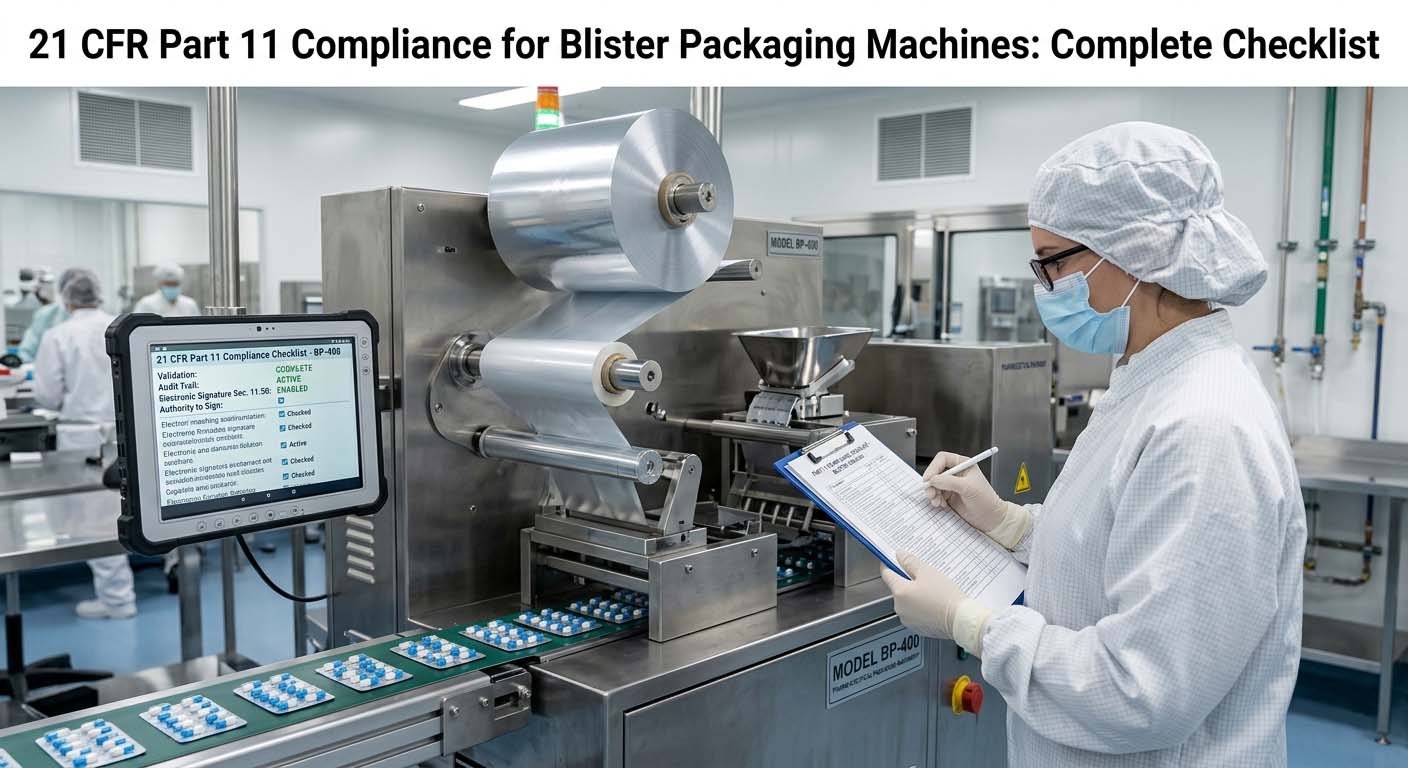
21 CFR Part 11 electronic records compliance: audit trail, unique user authentication, and tamper-evident logging are OQ-verified requirements on GMP blister lines.
💡 Forester's Reflection: I'll be honest about something. In my early commissioning years, I treated the Part 11 module as a software configuration task — something the PLC programmer handled, something I ticked off at IQ and didn't think about again. That was wrong. The audit trail is only useful if someone reviews it. If no SOP defines who reviews the audit trail, when, and what they're looking for, the trail exists but serves no quality function. The FDA inspector doesn't just ask if the audit trail exists. She asks for the review records. That's a different question. I've had to help clients build retrospective audit trail review procedures from scratch — which is an uncomfortable conversation to have four weeks before an inspection.

Forester Xiang
Founder, HIJ Machinery — 20 Years Commissioning GMP Blister Lines Globally
I've helped pharmaceutical clients in Pakistan, Vietnam, and Brazil prepare for WHO pre-qualification audits. The single most common failure point isn't the machine — it's missing or incomplete IQ/OQ documentation from the original supplier.
The pattern is consistent. A plant purchases a capable GMP-compliant Alu Alu blister packing machine from a vendor who treats validation documentation as optional. The machine passes FAT at the factory — good seal integrity, correct forming depth, clean output. It ships. It arrives on-site. It works. Then the WHO auditor arrives. She asks for the IQ protocol. There isn't one. She asks for calibration certificates for the sealing thermocouple at installation. There aren't any. She asks for the OQ temperature mapping study. It doesn't exist.
The machine works. But the machine doesn't exist — not in the regulatory record. That gap costs 3 to 6 months. Sometimes more. I've seen it cost market authorizations.
This is why every HIJ machine ships with a complete validation documentation package: IQ/OQ/PQ protocol templates pre-populated with your machine's serial numbers, calibrated instrument baselines from FAT, as-built drawings, and a SAT checklist ready for site execution. Our field service team supports SAT and IQ execution on-site. Validation isn't an afterthought. It's engineered in from Day 1.
HIJ's Validation-Ready Alu Alu Blister Machine: The DPH-300
Back to the machine for a moment. Validation documentation is only as good as the machine it documents. If the equipment itself isn't designed for GMP environments — if the forming station doesn't hold tolerance, if the sealing station temperature drifts, if the PLC has no audit trail capability — the best validation protocol in the world can't paper over a mechanical problem.
HIJ DPH-300 Cold-Form Alu Alu Blister Machine — GMP-Validated Platform
The HIJ DPH-300 is built specifically for cold-form Alu Alu blister packaging of moisture-sensitive and oxygen-sensitive pharmaceutical products. Key specifications relevant to GMP validation:
- Forming depth: 6–12 mm (adjustable), servo-controlled forming pressure with ±0.3 mm depth accuracy confirmed at FAT
- Sealing station: PID-controlled heating with temperature uniformity ±2°C across full sealing plate; calibrated thermocouple shipped with NIST-traceable calibration certificate
- Servo die-cut accuracy: ±0.1 mm positional repeatability at speeds up to 30 cycles/min
- 21 CFR Part 11 ready: Siemens S7-1500 PLC with full audit trail, role-based access control, and NTP-synchronized timestamping — configured and OQ-tested before delivery
- Material contact surfaces: 316L SS, Ra ≤0.8 µm, with batch MOC certificates included in IQ package
- Validation package included: Pre-populated IQ/OQ/PQ protocol templates, FAT report, calibration certificates, as-built drawings, and SAT checklist — delivered with every unit

HIJ DPH-300 cold-form Alu Alu blister machine — validation documentation package ships with every unit, including pre-populated IQ/OQ/PQ protocols and calibration certificates.
For clients requiring a complete pharmaceutical packaging line, the DPH-300 integrates with our blister cartoning machine through a validated line interface. The interface qualification — conveyor timing, reject system handshake, batch record communication — is part of the DPH-300 IQ/OQ package when ordered as a turnkey solution. Line-level validation is consistently the gap that standalone machine purchases miss.
“The machines that fail regulatory audits rarely fail because they don't work. They fail because no one can prove they work — at the right parameters, on the right date, under the right conditions. Validation is the proof system. IQ, OQ, and PQ are not three separate tasks; they are three layers of the same argument: this machine, installed here, running this process, consistently delivers product that meets specification.”
— Forester Xiang, Founder, HIJ MachineryFrequently Asked Questions: GMP Validation for Alu Alu Blister Machines
❓ Can I run OQ before IQ is complete?
No. EU GMP Annex 15 is explicit: each qualification phase must be completed and approved before the next begins. Running OQ on an unverified installation means the calibration baseline for your OQ instruments is unestablished — your OQ data is scientifically uninterpretable and regulatorily void.
❓ How many PQ batches are required for an Alu Alu blister machine?
ICH Q7 sets a general expectation of three consecutive conforming batches as a minimum for process validation. That number can change. The CDSCO in India and BPOM in Indonesia have both requested five PQ batches on Alu Alu lines I've been involved with during WHO PQ submissions — particularly for products targeting ICH Zone IVb markets at 40°C/75% RH. Check your target NRA's guidance and build conservatively. Running a fourth or fifth PQ batch because a reviewer asks for it — after you've already written three into your dossier — is an avoidable delay.
❓ What does a complete IQ/OQ/PQ documentation package look like from a supplier?
A complete validation package from a qualified supplier includes, at minimum: a pre-populated IQ protocol template with your machine's serial number, model, and utility specifications already filled in; calibration certificates for all critical instruments (sealing thermocouples, pressure transducers, vision inspection cameras) with NIST or NPL-traceable reference; an as-built electrical schematic and pneumatic diagram; a FAT report signed by both supplier engineer and client QA representative; a spare parts list with manufacturer references; and OQ and PQ protocol templates with acceptance criteria pre-written to your URS specifications.
What it does not include: completed OQ data (that gets filled in during site execution), signed PQ batch records (generated during actual PQ runs), or your site-specific SOPs (those must be your documents, not the supplier's). Any supplier who hands you “completed” OQ data generated at the factory is handing you factory test data, not a site qualification. That distinction matters to an auditor.
❓ What happens if I change the sealing temperature after PQ is complete?
It depends on whether the new temperature is within your validated range. If your PQ established a validated sealing temperature range of 185–195°C and you want to run at 190°C — you're operating within the validated state, no re-qualification required (though change control documentation may still apply per your quality system). If you need to run at 200°C — outside the validated range — that triggers a formal change control review, an assessment of impact on product quality, potentially a partial OQ re-run (sealing station temperature mapping at the new setting), and an update to your process validation dossier. In some regulatory jurisdictions, it also requires a variation notification. This is why setting an appropriate parameter range during PQ — not too narrow, not too broad — is a strategic decision, not just a technical one.
Get Your Alu Alu Blister Machine With Full Validation Support
Every HIJ Alu Alu blister machine ships with a complete GMP validation package — IQ/OQ/PQ protocols, calibration certificates, as-built drawings, and on-site SAT support. No scrambling for documentation after delivery. Validation readiness is engineered in from Day 1.
📋 View GMP-Compliant Alu Alu Blister Machine 🎯 Request Validation Package Details