How to Choose an Alu Alu Blister Packing Machine
Selecting an alu alu blister packing machine starts with the product and its approved packaging requirements. Cold-formed aluminium laminate is a high-barrier option, but moisture sensitivity, a cytotoxic classification or a tropical destination does not by itself establish a universal requirement for alu alu. Compare the actual product, forming laminate, lidding and finished-pack performance against the required shelf life and destination-market requirements before specifying the machine.
This guide covers the 7 critical factors pharmaceutical engineers must evaluate before issuing any RFQ — from demonstrated cavity and drive performance to applicable electronic-record requirements and project-specific total cost of ownership.
📌 Direct Answer: The 7-Factor Framework
An alu alu blister packing machine mechanically forms aluminium-based laminate into cavities without thermoforming heat. The resulting pack must be evaluated as a complete system, including the formed laminate, lidding and seal; a raw-film barrier value alone does not establish finished-pack suitability. To choose the correct machine, evaluate: (1) Product-specific cavity geometry and demonstrated forming capability; (2) Demonstrated drive and control performance; (3) Changeover time and format flexibility; (4) Project-specific documentation and qualification evidence; (5) After-sales infrastructure; (6) Total cost of ownership; and (7) Applicable product, process and destination-market requirements, with documented supplier and site responsibilities.

Evaluate the formed cavity, lidding and seal together. Compare moisture-barrier results only with the material structure, test method, units and conditions stated.
and Conditions
and Control Scope
and Material Trial
and Verify Results
Factor 1: Forming Depth and Cavity Feasibility
Forming depth is one dimension of the cavity, not a complete product-fit specification. Define the product envelope and orientation, cavity length, width, depth and radii, pocket spacing and sealing area on a controlled pack drawing. Agree clearances with the machine, tooling and laminate suppliers for the actual product and feeding method.
Compare each proposed machine against your current and planned pack formats. Ask HIJ to confirm the offered model and configuration, permitted tooling envelope and demonstrated capability with the specified laminate. A catalogue maximum depth, a generic clearance allowance or a claimed portfolio percentage cannot establish that every format will run.
Evidence to request: a supplier-reviewed drawing, identified forming material and tooling, representative formed samples, and an agreed trial covering dimensional checks, product feeding and finished-pack acceptance. Constantia Flexibles’ forming guidance identifies material selection, cavity design, plug material and process parameters as interdependent. Its simulation guidance does not certify an HIJ model or replace your project’s physical trial and quality approval.

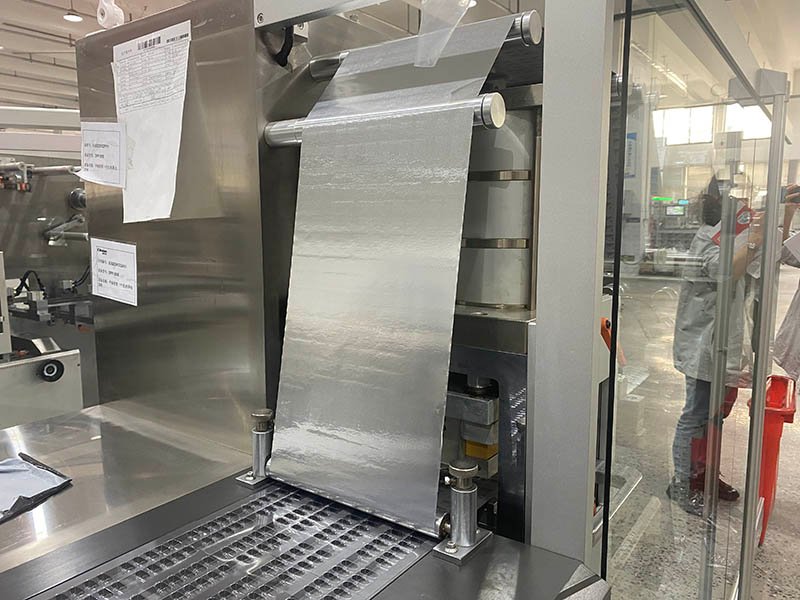
Forming station on a cold-form alu alu blister machine: cavity depth uniformity across the full plate width is critical for foil integrity.
Cavity and Forming Capability: Buyer Evidence Checklist
| Review item | Information to provide | Evidence to request |
|---|---|---|
| Product fit and feeding | Product dimensions and variation, orientation, handling needs and representative samples. | Approved cavity drawing and a feeding trial for the intended product presentation. |
| Pack and tooling geometry | Cavity length, width, depth, radii, spacing, seal area and finished-card layout. | Machine and tooling supplier review of the complete format, with limitations stated. |
| Forming laminate | Named material grade, structure and supplier specification. | Assessment of the specified laminate with the proposed cavity, plug and forming conditions. |
| Demonstrated capability | Required accepted output, product/format range and acceptance criteria. | Identified trial samples and results for dimensions, feeding and applicable finished-pack tests. |
| Future formats | Planned products and pack drawings, including their expected extremes. | Written configuration/tooling feasibility and any development work or exclusions before purchase. |
Common Forming Defects and Checks
-
🔴 Symptom: Visible white stress marks (foil whitening) on formed cavities, product shifting inside pack.
⚙️ Assessment: Record the product dimensions, cavity drawing, laminate grade and current forming conditions. Stress marks or product movement alone do not establish a specific depth error or root cause.
🔧 Forester's Fix: Have the machine and laminate suppliers review cavity geometry, forming conditions and material damage using representative packs. Verify the corrected pack against buyer-approved criteria. ASTM F2338 covers vacuum-decay leak testing, not WVTR measurement; confirm its suitability for the product-package system. Assess moisture transmission separately using an appropriate method and stated test conditions. -
🔴 Symptom: Measured cavity depths vary across the forming plate or fall outside the approved drawing.
⚙️ Assessment: Check the measurement method and compare results with the agreed cavity tolerances. Have qualified personnel assess tooling condition, alignment, guidance and the forming setup against the installed machine instructions.
🔧 Recommended response: Use only the manufacturer-approved adjustment and maintenance procedure. Follow the site’s hazardous-energy controls before work that exposes personnel to unexpected motion or stored energy; OSHA 1910.147 addresses this hazard within its scope. Agree the verification or requalification plan with the responsible engineering and quality teams, including operating conditions, sampling and acceptance criteria. A universal shim tolerance or three full-speed trials cannot substitute for that plan. -
🔴 Symptom: Cracks, pinholes or other laminate damage appear in formed cavities.
⚙️ Assessment: Review the specified laminate, cavity geometry, plug material and forming conditions together with the machine, tooling and laminate suppliers. Constantia Flexibles’ forming guidance identifies these as interdependent factors; it does not establish a universal laminate thickness or forming-force setting.
🔧 Recommended response: Do not increase force or substitute a thicker laminate from a generic recipe. Obtain supplier-approved material and setup recommendations for the actual cavity and equipment. Evaluate proposed changes through the site’s change-control process, then verify representative finished packs against approved dimensional, integrity and product-protection criteria before routine use.
Factor 2: Servo vs. Mechanical Drive System: Evidence to Compare
Compare the offered drive and control configuration against your actual pack formats, material, operating range and accepted-output requirement. Ask which axes are independently controlled, how registration is measured, which adjustments are recipe-controlled and which still require mechanical work. Require the supplier to state the measurement method and test conditions for any accuracy or repeatability claim.
Servo motion control can provide programmable axis coordination and format flexibility, but the result depends on the complete machine and application. Beckhoff’s packaging application example illustrates this on a tea-bag machine; it is not evidence of HIJ blister-machine performance. A drive label alone does not establish a universal accuracy, reject rate, service life or financial return.
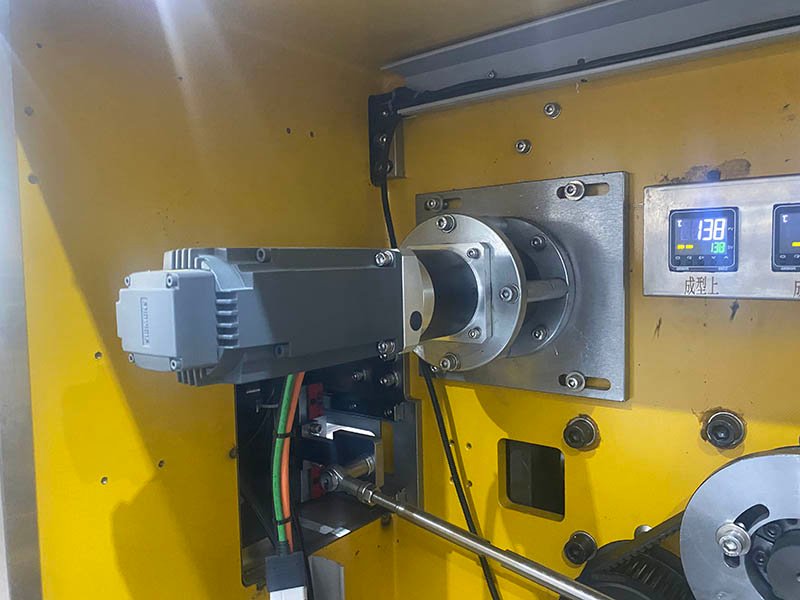
Drive-system reference image. Confirm the offered components and measured machine performance from the supplier’s configuration and trial records; the photograph does not demonstrate registration accuracy.
Servo and Mechanical Drive Proposals: What to Verify
| Decision area | Evidence to request for each offered configuration | Acceptance question |
|---|---|---|
| Registration and repeatability | Measured film-feed, cavity-to-seal and cutting registration under the proposed format, material and operating conditions; measurement method and sample plan. | Do the results meet the agreed pack drawing and acceptance criteria? |
| Motion and operating range | Controlled axes, adjustment limits, synchronization, start/stop behaviour and representative-product trial results. | Is accepted output demonstrated across the required range? |
| Electronic records | Specified software, access roles, record copies, retention, audit-trail functions and validation responsibilities for the intended record scope. | Has the quality team assessed applicable record requirements separately from the drive design? |
| Format changeover | Recipe-controlled settings, required tooling/manual tasks and a witnessed changeover between the actual formats. | Does the measured time include setup checks and the first acceptable packs? |
| Maintenance and support | Installed-component manuals, inspection/lubrication plan, spare-part availability and documented service terms. | Can the site maintain this configuration within its skills, resources and production plan? |
| Cost comparison | Dated itemised quotations and project-specific operation, maintenance and downtime assumptions over the same period. | Are differences supported by comparable evidence rather than a generic premium or payback claim? |
Evaluate electronic records and signatures against their intended use and applicable requirements. For applicable closed systems, 21 CFR 11.10 addresses validation, accurate record copies, access control, retention and audit trails. Servo or mechanical actuation does not by itself establish those controls. See 21 CFR 11.10 and FDA’s scope and application guidance. Have the responsible quality team approve the project-specific assessment.
Common Failure Modes and Checks
-
🔴 Symptom: Cavity, sealing or cutting registration is outside the approved pack specification.
⚙️ Assessment: Hold the affected production under the site’s procedure and record the format, material, settings, measurements and fault history. Have qualified personnel use the installed machine’s instructions to investigate; misregistration alone does not identify cam wear or justify a servo retrofit.
🔧 Recommended response: Control hazardous and stored energy before hands-on inspection. Agree any repair or adjustment with the machine builder and site engineering team, then document the specified registration and pack-quality checks before release. A proposed drive conversion needs a separate engineering, safety and change-control assessment rather than a universal operating-hour trigger. -
🔴 Symptom: Servo drive alarm “position deviation exceeded” at the film feed axis during production.
⚙️ Assessment: A following-error alarm alone does not identify the cause. Record the exact drive/controller model, firmware, fault history and operating conditions for the machine builder to review.
🔧 Recommended response: Keep the configured protection in place while qualified personnel diagnose the fault using the installed machine and drive manuals. Do not widen the error window or add a delay merely to suppress the alarm. Any parameter or component change needs an approved procedure and documented verification before production release. Control hazardous and stored energy before hands-on servicing; see OSHA's hazardous-energy overview for the U.S. context and follow the applicable local requirements.
Factor 3: Changeover Time and Format Flexibility
List the actual product and pack-format transitions, their expected frequency and the parts that must be changed or adjusted. Ask the supplier to identify the required forming/sealing tooling, feeders, guides and other format parts for each transition. Confirm the supported formats, recipe capacity and access controls against the offered alu alu blister packaging machine specifications. Stored recipes can recall settings; they do not establish that physical format parts, cleaning or restart checks are unnecessary.
Agree the timing boundaries before comparing demonstrations. State whether the endpoint is the first accepted pack, sustained acceptable output or acceptable output at the agreed operating speed. Record which cleaning, line-clearance, tooling, adjustment, warm-up and quality-release tasks are included. Vorne’s OEE measurement guidance describes different changeover timing conventions and the need to use a consistent policy. Keep downtime, reduced-speed running and rejected packs distinct in the site’s OEE records.
Set project-specific time and pack-quality criteria using the planned production mix, trained staffing and representative product/material trials. Agree the format pairs, test repetitions, evidence, witnesses and acceptance responsibilities in the FAT/SAT plan. EU GMP Annex 15, sections 3.2–3.7 links applicable supplier testing to the URS and qualification plan. Calculate potential time savings from measured comparable transitions and expected frequency, rather than a universal 30-minute target, recipe count or guaranteed OEE gain.
Common Failure Modes and Checks
-
🔴 Symptom: Packs show cavity-to-fill misalignment after a tooling change.
⚙️ Assessment: Stop the affected run and have trained personnel check the installed tooling, seating and registration against the machine builder’s instructions. The symptom alone does not establish a particular gap or fastening fault.
🔧 Recommended response: Follow the approved energy-control and changeover procedure before hands-on checks. Use the fastening method and torque specified for the actual tooling and fasteners, not a universal value. Do not add or alter a sensor or interlock from a generic checklist; any proposed modification needs machine-builder and site engineering/safety review. Verify pack alignment and the agreed restart checks before production release. For U.S. drug manufacturing, 21 CFR 211.100 addresses approved written procedures, recorded execution and justified deviations. -
🔴 Symptom: Sealing conditions or seal-test results differ from the approved process after changeover.
⚙️ Assessment: Review the selected recipe, installed tooling, temperature measurement and calibration status before assigning a cause. A displayed setpoint or a fixed elapsed warm-up time does not by itself demonstrate acceptable sealing conditions.
🔧 Recommended response: Use the machine and packaging-material suppliers’ instructions and the site’s approved process to define warm-up, measurement method, stabilization and acceptance criteria. Record the required checks and pack-test results before release; investigate deviations rather than adopting a generic five-minute or temperature-tolerance rule. Where U.S. drug CGMP applies, 21 CFR 211.68(a) requires a written program for routine equipment calibration, inspection or checking, with records.
Factor 4: GMP Documentation Package — The Compliance Foundation
For procurement, agree the qualification documents, responsibilities and test scope against the site URS. EU GMP Annex 15 describes a risk-based qualification lifecycle, including DQ, IQ, OQ and PQ, with FAT/SAT where appropriate. Supplier templates support this work; site personnel must review their suitability and approve them under the pharmaceutical quality system.
Ask the supplier for sample protocols, acceptance criteria and a URS-to-DQ traceability matrix before purchase. Agree who authors, reviews and executes each document. A CE declaration or a generic documentation bundle does not replace project-specific qualification evidence.



Minimum GMP Documentation Package Checklist
- User Requirement Specification (URS): Supplier-signed acknowledgement with traceability matrix to DQ.
- Design Qualification (DQ): Engineering drawings, P&ID, BOM with material certificates (SS316L contact parts).
- FAT Protocol & Report: Executed at supplier facility with QP witness option; deviations logged and closed.
- IQ/OQ/PQ Templates: Pre-authored in English with acceptance criteria, test methods, and responsible party fields.
- 21 CFR Part 11 Compliance Matrix: Audit trail, electronic signature, access control, and data backup evidence per FDA regulation.
- Calibration Records: Identify each relevant instrument, its operating range, approved acceptance limits, calibration method and interval. Request results with measurement uncertainty and documented traceability to the SI or another specified reference. Have the site assess fitness for the actual measurement task; a generic tolerance or a “NIST-traceable” label alone is insufficient.
- Change Control Procedure: Documented process for post-qualification modifications per ICH Q10 pharmaceutical quality system.
Annex 15 sections 2.2, 2.4 and 2.6 address document approval, protocol criteria and site review of supplier documents. Section 7 covers packaging-equipment qualification. Annex 1 concerns sterile manufacture; its section 8.3 addresses the filling environment for terminal sterilisation, while sections 8.21–8.23 address closure and integrity controls. For non-sterile tablets or capsules, the quality team should document which guidance applies to the product and process.
Official references: EU GMP Annex 15 and Annex 1 (2022).
Common Failure Modes & Forester's Fix
-
🔴 Symptom: Calibration evidence for a sealing-temperature measurement is incomplete or does not support the approved acceptance limits.
⚙️ Assessment: Review the instrument identity, method, range, results, measurement uncertainty and reference chain. NIST explains that traceability belongs to measurement results and does not by itself establish fitness for purpose. Accreditation is relevant evidence of laboratory competence, not an automatic guarantee of a usable result.
🔧 Recommended response: Have the site’s metrology and quality personnel approve the calibration scope, provider competence and acceptance decision. Check any applicable accreditation or reference-standard requirements; do not reject a result solely because calibration was performed in-house. NIST’s thermometer guidance permits in-house calibration when the necessary capability and traceability conditions are met. Where applicable, 21 CFR 211.68(a) requires a written calibration, inspection or checking program and retained records. Ask HIJ to confirm the actual certificates and service scope for the offered equipment in writing; resolve gaps under the site’s procedure before accepting the affected qualification evidence. -
🔴 Symptom: Audit-trail times do not agree with the site’s approved time reference, or the sequence of recorded events is unclear.
⚙️ Assessment: Check the system’s time source, time-zone handling, access permissions and clock-change history before assigning a cause. 21 CFR 11.10(e) addresses secure, computer-generated, time-stamped audit trails for applicable closed systems; it does not prescribe UTC/NTP, a five-second monthly drift limit or a ten-event test as universal acceptance criteria.
🔧 Recommended response: Preserve the original records and assess the effect of any discrepancy. Have the responsible quality, controls and IT personnel approve the time-management design, access controls, permitted error and test coverage for the actual records and risks. Any clock or network change should follow the approved change-control process, with the machine supplier involved where needed. Test relevant events, clock changes and loss/recovery of the time source against the approved protocol, then document deviations and the acceptance decision. FDA’s scope guidance calls for documented, risk-based decisions alongside the underlying record requirements; enabling a time service alone does not establish compliance.
Factor 5: After-Sales Support Infrastructure — The 2 AM Test
After-sales support infrastructure is the factor most consistently underweighted in pharmaceutical equipment RFQs — and the one that most frequently determines whether a machine investment succeeds or fails within its first 18 months of operation. The benchmark question is: what happens when your forming station throws an alarm at 2 AM on the third night of a GMP audit validation run?
Quantifiable support metrics to demand from any supplier: (a) remote diagnostic response within 4 hours of alarm notification; (b) critical spare parts (forming dies, sealing plates, servo drive modules) available from a regional warehouse with ≤ 48-hour delivery to Southeast Asia, Latin America, and Middle East markets; (c) on-site engineer deployment within 72 hours for major mechanical failures; and (d) documented preventive maintenance schedule with parts cost estimates for a 5-year horizon.

HIJ Machinery's on-site engineer conducting post-installation training and SAT support at a pharmaceutical client facility. On-site deployment within 72 hours of critical failure is a contractual commitment.
After-Sales Support Evaluation Scorecard
| Support Criterion | Minimum Acceptable | HIJ Standard | Budget Supplier Typical |
|---|---|---|---|
| Remote diagnostics response | < 8 hours | ✅ < 4 hours | 24–72 hours |
| Regional spare parts hub | 48-hour delivery | ✅ SEA / LATAM / MENA | China only, 2–4 weeks |
| On-site engineer deployment | ≤ 5 days | ✅ ≤ 72 hours | Not guaranteed |
| IQ/OQ support on-site | Optional paid | ✅ Included in contract | Not available |
| Multi-language documentation | English required | ✅ English + local on request | Chinese only |
Common Failure Modes and Checks
-
🔴 Symptom: The sealing heater fails or cannot maintain the approved process temperature.
⚙️ Assessment: Have qualified personnel diagnose the fault using the installed machine, heater and control-system manuals. Replacement selection requires the approved part specification, including voltage, wattage, dimensions, fit and terminations; a generic cartridge rating is not a universal spare.
🔧 Recommended response: Obtain machine-specific part numbers and agree spare quantities using failure criticality and replenishment lead time. Follow the site’s approved electrical-safety and hazardous-energy procedures, address residual heat and verify safe isolation before servicing. Ask HIJ service & support to confirm the written support scope, response times and site-authorized remote-access arrangements. Durex’s cartridge-heater guidance illustrates application-specific selection; OSHA 1910.147 addresses hazardous-energy control within its scope. Neither source verifies the parts fitted to a particular HIJ machine. -
🔴 Symptom: A recurring drive alarm interrupts the machine during deceleration.
⚙️ Assessment: Fault-code meanings and parameter numbers depend on the installed drive and firmware. Confirm the alarm description in that manual before assigning a cause.
🔧 Recommended response: Give qualified support personnel the motor, drive and braking-unit model numbers plus the fault history. Have the supplier review the motion profile and braking arrangement under the approved maintenance and change-control procedures. Braking resistance, peak and continuous capacity, duty cycle and thermal protection must suit the specified equipment; wattage alone is insufficient. Rockwell's braking-kit manual illustrates manufacturer-specific selection and safety requirements; use the manuals for your installed system rather than copying its values.
Factor 6: Total Cost of Ownership — Not Just the Purchase Price
Build the budget from a dated quotation for the agreed product, pack formats, accepted output and documentation scope. Compare acquisition and operating costs over the same ownership period. PMMI’s OpX TCO guidance recommends identifying and quantifying costs beyond the purchase price, including operation and maintenance.
A ten-year horizon can be used when it matches the investment plan. Record the currency, price date, annual operating hours, output basis, included services and exclusions for every offer. Separate supplier-quoted costs, site estimates and uncertain scenarios. A drive-system label or a higher purchase price alone does not establish a lower lifetime cost.
Project Cost Comparison Checklist
| Cost Category | Inputs to Compare | Evidence to Request |
|---|---|---|
| Equipment and format parts | Base machine, product feeding, forming/sealing tooling, inspection, coding and line interfaces | Dated itemised quotation, configuration list, approved pack drawing and acceptance scope |
| Delivery and site start-up | Freight, insurance, applicable taxes/duties, unloading, utilities, installation and training | Delivery term and named place, included work, exclusions and site-responsibility list |
| Qualification and records | Agreed FAT/SAT and IQ/OQ/PQ support, protocols, test materials, staff time and deviation work | Document list, written supplier/site responsibilities and quality-approved qualification plan |
| Routine operation | Labour, utilities, cleaning, consumables, material usage and changeover time at the planned product mix | Measured trials or documented site assumptions, with units and operating conditions |
| Maintenance and service | Wear parts, preventive maintenance, software/support charges and service travel | Maintenance schedule, parts prices, warranty exclusions and written service terms |
| Downtime and waste | Stop frequency/duration, restart scrap and the agreed financial impact of lost production | Relevant operating records or labelled low/base/high scenarios; avoid counting the same loss twice |
| Changes and end of life | Future tooling, upgrades, change assessment, required requalification, disposal and residual value | Engineering/quality review, quoted options and documented cost or residual-value assumptions |
For a simple undiscounted comparison, add acquisition/start-up costs and the annual operating, maintenance and risk costs over the chosen period, then add end-of-life costs and subtract any supported residual value. Label assumptions and prevent overlap between categories. If finance uses discounted cash flows, apply the same timing and discount-rate convention to every option.
Show each supplier’s low, base and high case using the same workload and cost boundaries. Calculate differences between corresponding cases; do not present a single guaranteed saving from unrelated range endpoints. Where useful, divide the selected scenario total by its projected accepted packs, with the same time and scope basis stated.
Cost Risks to Resolve Before Ordering
- Component replacement and requalification: Budget from a documented change-impact assessment approved by the responsible engineering and quality teams. EU GMP Annex 15 section 11 calls for risk-based assessment and authorised changes. A like-for-like label alone does not define the necessary IQ/OQ/PQ work, and a supplier template does not replace site approval. Read Annex 15 change-control guidance.
- Material usage and scrap: Request trials using the intended laminate, lidding, cavity layout and product. Record material consumed, accepted packs, trim, rejects, start-up losses and changeovers. Investigate the actual cause before proposing a machine modification; use verified trial results rather than a generic waste-reduction percentage in the cost model.
Factor 7: Regulatory Compliance Capability — FDA, EU GMP & WHO Markets
Start with the product, manufacturing process, installation country and destination markets. Have the responsible quality and regulatory teams identify the applicable requirements and translate them into the URS, supplier deliverables and site acceptance plan. Review pharmaceutical GMP, electronic records and machinery safety as distinct parts of that assessment.
EU GMP Annex 1 addresses sterile manufacture. When its principles are applied to non-sterile products, the manufacturer should document which principles apply and demonstrate them. Annex 15, section 7 addresses packaging-equipment qualification across defined critical operating ranges. A general alu alu machine specification cannot establish the complete product or site’s compliance.
For U.S. drug manufacturing, review applicable Part 211 requirements and the intended electronic records under FDA’s Part 11 scope guidance. Specify contact materials and cleaning evidence for the actual use. 21 CFR 211.65 sets suitability requirements for contact surfaces; it does not prescribe one stainless-steel grade or universal roughness limit. Request the applicable machinery legislation, risk assessment, required safety functions and supporting conformity documents for the offered configuration.

Illustrative packaging-line reference. Confirm the offered configuration, applicable requirements and qualification evidence in the project documents; this image is not a record of a verified audit.
Regulatory Scope and Evidence to Confirm
| Project Scope | What to Clarify | Machine Evidence to Request | Responsible Review |
|---|---|---|---|
| U.S. drug manufacturing | Applicable Part 211 requirements and which electronic records/signatures fall within Part 11 | Contact-material and cleaning information; specified record functions and tests | Site quality/regulatory team, with supplier controls documentation |
| EU pharmaceutical manufacturing | Applicable GMP chapters and annexes; sterile or non-sterile process; qualification scope | URS traceability, agreed qualification support and critical packaging-parameter tests | Responsible site quality team; document any Annex 1 principles applied to non-sterile work |
| WHO-related procurement or prequalification | Requirements for the specific programme, product and manufacturing site | Qualification and validation evidence appropriate to that scope | Programme requirements and responsible quality/regulatory review |
| Installation and other destination countries | Local requirements, documentation language and importer/site responsibilities | Agreed technical file, manuals and evidence mapped to the project requirements | Local responsible parties and qualified regulatory/safety specialists |
| Machinery safety and conformity | Applicable legislation, intended use, hazards and required safety functions | Configuration-specific risk assessment, verification and conformity documents | Machine builder and site engineering/safety team |
WHO TRS 1019 Annex 3 provides general qualification and validation guidance. Use the applicable programme and national requirements to define the project’s evidence package.
Evidence Gaps to Resolve Before Acceptance
-
🔴 Symptom: A required electronic batch record cannot be retrieved.
⚙️ Assessment: Investigate record capture, access permissions, storage, backup and retention settings against the approved requirements. The symptom alone does not identify a fixed buffer-size failure.
🔧 Recommended response: Size and test storage, backup and retrieval for the expected records and retention period; do not rely on a universal event-buffer size. 21 CFR 211.180(a) sets batch-record retention at least one year after batch expiry, or three years after distribution for the specified OTC products exempt from expiry dating. Confirm any longer applicable requirements with site quality personnel. -
🔴 Symptom: The proposed contact surface lacks suitable material, finish or cleaning evidence.
⚙️ Assessment: Identify actual product contact, materials, surface condition, cleaning agents and intended use. Have the responsible teams assess compatibility and cleaning effectiveness against approved requirements.
🔧 Recommended response: Agree the evidence and acceptance criteria before ordering. Investigate an inadequate result through the site’s approved quality and change-control procedures. Any material or component change needs documented impact assessment and the necessary verification or qualification before release. Confirm HIJ’s offered materials in the dated configuration; do not infer them from a generic machine-family label.
“After reviewing hundreds of RFQs over 20 years, I can tell you the #1 mistake buyers make is writing a spec sheet based on what the machine CAN do — without asking what it does when something goes wrong at 2 AM during a GMP audit week. I’ve walked into plants in Indonesia, Brazil, and Egypt where engineers showed me beautiful capability datasheets for their alu alu machines. Then I asked them to show me the last 30 days of sealing station audit trail. Three out of four could not retrieve a single electronic record. That is a 483 observation waiting to happen.”
“In my 20 years of auditing packaging lines across South Asian and Latin American pharma plants, I've watched engineers fixate on forming depth and cycle speed while completely ignoring cold-forming station temperature uniformity and PLC data integrity for 21 CFR Part 11 compliance. The hidden trap? Budget suppliers routinely omit traceable FAT/SAT documentation and URS sign-off protocols — then disappear when your qualified person raises a deviation during site qualification. That silence costs you months and six figures in revalidation.”
“Before issuing any RFQ, demand a compliance-first technical checklist: forming force consistency, reject station audit trails, and multi-format changeover validation data. At HIJ, our alu alu machines are engineered around Turnkey integration logic — every component, from sealing station to vision inspection, is pre-validated as a single auditable system, not a patchwork of multi-vendor risks.”
The Evaluation Checklist: 7-Step HowTo for Alu Alu Blister Machine Selection
Use this structured evaluation protocol before issuing any purchase order or RFQ for a cold-form blister packaging machine. Each step generates documented evidence your quality team and qualified person can reference during equipment selection review.
-
1
Define Product Portfolio Requirements
List current and planned dosage forms with dimensions, handling needs and sensitivity to moisture, oxygen and light. Agree the cavity drawing and required forming depth with the tooling and laminate suppliers. Identify the intended markets, shelf life and approved packaging requirements; select the material structure using product-specific stability and finished-pack evidence, not a universal WVTR threshold or climate-zone label.
-
2
Specify Drive and Control Requirements
Define the required pack registration, operating range, accepted output and actual format-change tasks. Compare the offered axis/control configuration and representative trials against agreed acceptance criteria. Specify electronic-record functions and validation responsibilities separately according to their intended use and applicable requirements; SKU count or a servo label alone is not an acceptance criterion.
-
3
Define and Verify Changeover Acceptance
List the planned format transitions and their frequency. Agree timing boundaries, included tasks, staffing, recipe and format-part requirements, and pack-quality criteria. Set project-specific targets and demonstrate representative changes under the agreed FAT/SAT plan, recording elapsed time, restart losses and acceptance decisions. Use measured results to estimate potential savings.
-
4
Audit the GMP Documentation Package
Request sample IQ protocols, a URS-to-DQ traceability matrix and the proposed qualification responsibilities before purchase. Have the site assess the applicable GMP and electronic-record requirements. Review instrument-specific calibration results, uncertainty, reference chain and acceptance limits, with any required accreditation evidence. Agree missing deliverables, responsibilities and acceptance conditions in writing rather than treating a generic certificate label as proof of compliance.
-
5
Benchmark After-Sales Support SLA
Request a written Service Level Agreement covering remote response time (≤ 4 hr), spare parts delivery to your region (≤ 48 hr), and on-site engineer deployment (≤ 72 hr). Verify regional parts inventory through reference checks with existing clients in your geography.
-
6
Build a Project-Specific TCO Model
Compare dated itemised quotations over the same ownership period, workload and cost boundaries. Include acquisition, delivery/start-up, qualification, operation, maintenance, downtime, changes and end-of-life costs. Separate quoted inputs from site estimates, label low/base/high scenarios, avoid double counting and calculate savings only between corresponding scenarios.
-
7
Map Applicable Requirements and Evidence
Identify the product, sterile or non-sterile process, installation country and destination markets. Have the responsible quality, regulatory and safety teams map applicable requirements to the URS, supplier evidence and site acceptance plan. Define electronic-record scope, contact-material and cleaning requirements, qualification responsibilities and machinery-safety evidence. Document any Annex 1 principles applied to non-sterile products. Review the HIJ alu alu blister packing machine specifications page against the agreed project scope.

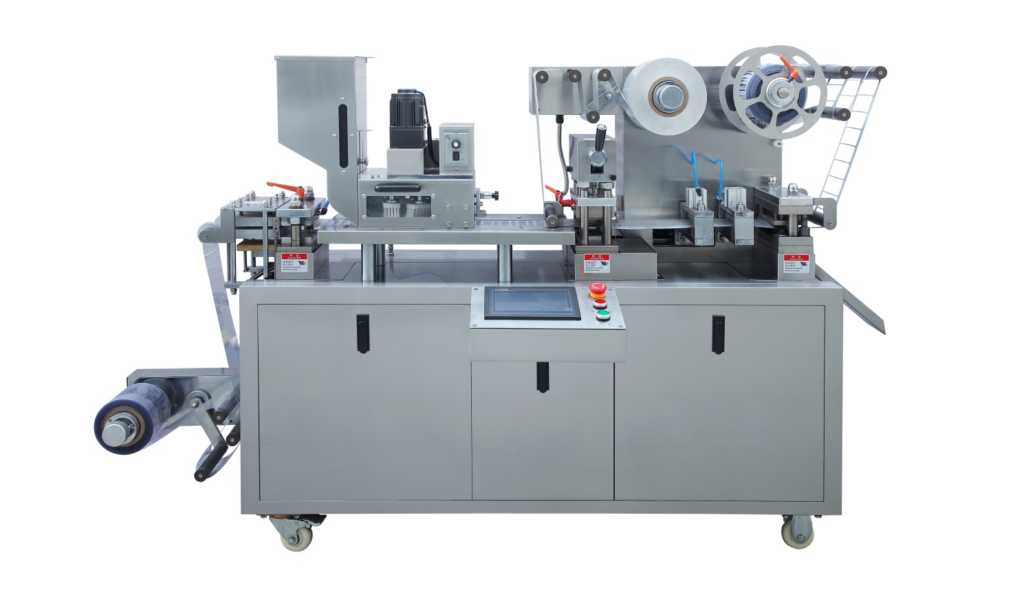
Packaging-machine reference image. Confirm the offered model, forming/tooling limits, control functions and documentation against the dated project proposal and acceptance scope. Explore the complete alu alu blister packing machine specifications.
Completing Your Packaging Line: Integrated Equipment to Consider
An alu alu blister machine operates as one station in a complete pharmaceutical packaging line. Regulatory inspectors evaluate the entire line as an integrated system under ICH Q10. Matching ancillary equipment to the same GMP documentation standard prevents validation bottlenecks downstream. Explore HIJ’s integrated line components:
| Equipment | Integration Point | HIJ Model |
|---|---|---|
| Blister Cartoning Machine | Secondary packaging; blister-to-carton transfer | HIJ Blister Cartoner Series |
| Full Blister Packing Machine Range | PVC/PVDC thermoform lines for complementary SKUs | HIJ DPP-250 / DPP-260 Series |
| Case Packing Machine | Tertiary packaging; end-of-line carton loading | HIJ ZY-CP Series |
| Turnkey Packaging Line | Complete integrated line: blister → carton → case | HIJ Turnkey Project Delivery |
Frequently Asked Questions: Choosing an Alu Alu Blister Packing Machine
EU GMP Annex 15 sections 3.10–3.14 address equipment OQ/PQ, while sections 7.1–7.2 address packaging-equipment qualification across defined critical operating ranges. The three-batch discussion in sections 5.19–5.20 concerns traditional process validation: the manufacturer must justify the batch and sampling plan, alternatives may be justified, and further data may be needed. It is not a universal instruction to perform three OQ runs or a fixed three-batch equipment PQ. Have the responsible quality team approve the applicable scope, acceptance criteria and release conditions. Read EU GMP Annex 15.
Request an Alu Alu Machine Proposal for Your Product
Send HIJ your product dimensions, pack drawing, forming laminate and lidding specification, required accepted packs per minute, format count and installation country. Include line interfaces, available utilities and the documentation or electronic-record functions your quality team requires.
Ask for the proposed machine configuration, tooling limits, representative-product trial and FAT/SAT acceptance scope, qualification-support responsibilities and written service terms. Confirm these details against your project before ordering, including which work remains for site qualification and approval.