📋 GMP Compliance Guide — Liquid Blister Packaging
Your Liquid Blister Line Is Only as GMP-Compliant as Its Weakest Integration Point
Pharmaceutical liquid blister packaging GMP compliance is non-negotiable — but most manufacturers discover the gaps during audits, not during procurement. A capable blister machine running alongside a mismatched filling module creates data integrity violations that no post-install patch can fix. This guide covers every compliance layer: from 21 CFR Part 211 and EU GMP Annex 1 to WHO TRS 992, with the exact failure patterns I’ve audited across Southeast Asia and Latin America.
🎯 Direct Answer
GMP compliance for pharmaceutical liquid blister packaging machines requires documented adherence to 21 CFR Part 211 (manufacturing controls), 21 CFR Part 11 (electronic records), EU GMP Annex 1 (2022 revision for sterile and aseptic liquid formats), and WHO TRS 992 Annex 3. Container closure integrity testing per USP <1207> and a validated IQ/OQ/PQ protocol covering the complete filling-sealing-inspection line are mandatory prerequisites for regulatory submission.

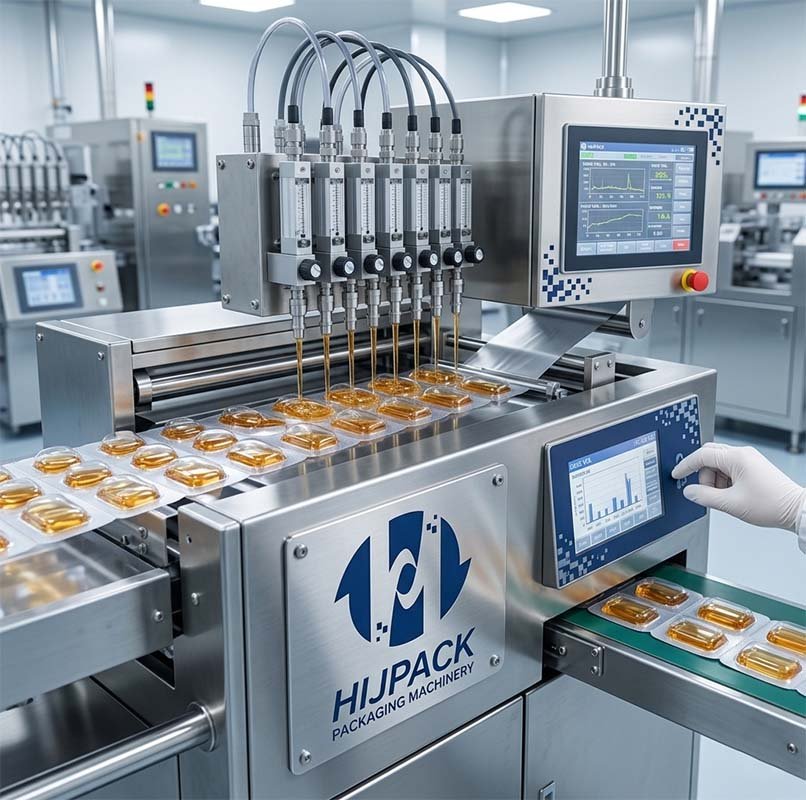
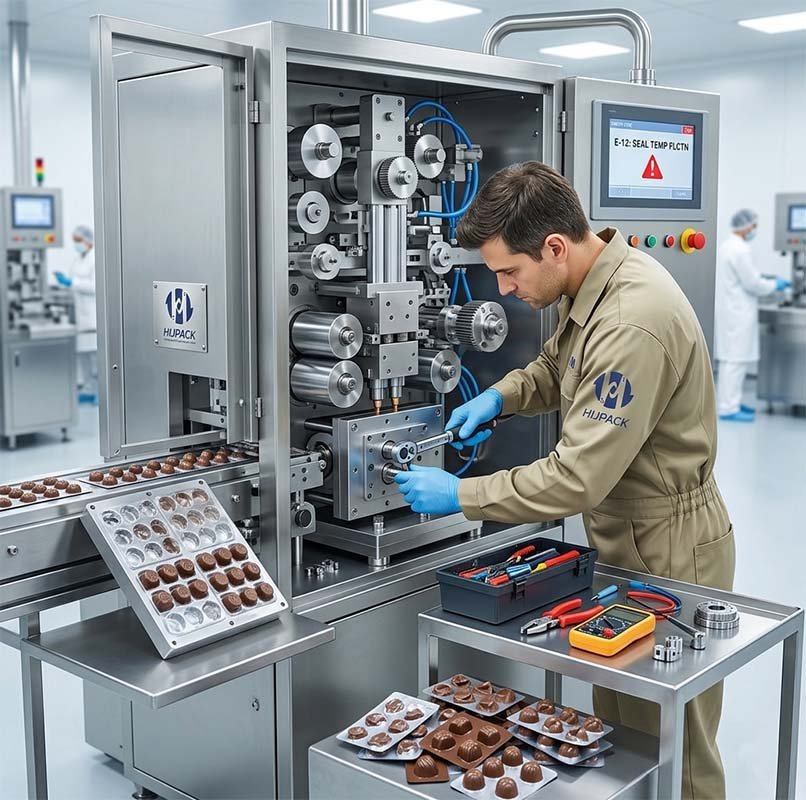
A validated liquid blister packaging line undergoing cGMP integration audit — filling, sealing, and inspection subsystems must operate under a single validation protocol.
Which GMP Regulations Apply to Pharmaceutical Liquid Blister Packaging Machines?
🎯 Direct Answer
Liquid blister packaging machines in pharma manufacturing fall under 21 CFR Part 211 (US), EU GMP Annex 1 (2022 revision), and WHO TRS 992 Annex 3 — with 21 CFR Part 11 and EU GMP Annex 11 governing all electronic records generated by PLC and HMI systems on the line.
Three weeks into a validation project in Bandung in 2021, the site quality director handed me a printed copy of a 483 observation from an FDA inspection of a comparable facility in Malaysia. The cited deficiency: the liquid filling station’s PLC generated batch records that could be altered without audit trail. The machine had been operating for four years. The facility had passed three internal audits. Nobody had mapped the electronic records against 21 CFR Part 11.
That single gap — a $0 engineering fix at procurement stage, a $1.2 million remediation at audit stage — is the regulatory reality of liquid blister packaging compliance. Here is the full framework you need before you sign an equipment contract.
Applicable Regulatory Standards
21 CFR Part 211 21 CFR Part 11 EU GMP Annex 1 (2022) EU GMP Annex 11 WHO TRS 992 Annex 3 USP <1207> ICH Q10 ISO 15223-121 CFR Part 211 — Current Good Manufacturing Practice for Finished Pharmaceuticals
Section 211.68 requires that automatic, mechanical, and electronic equipment — including liquid filling and blister sealing systems — be calibrated, inspected, and checked according to written procedures. Section 211.182 mandates written records of equipment cleaning and maintenance. For liquid blister lines specifically, Section 211.194 requires batch production records capturing actual filling volumes, sealing temperatures, and any deviations. Each of these obligations must be traceable to individual equipment components on the line, not just the line as a whole.
EU GMP Annex 1 (2022 Revision) — Manufacture of Sterile Medicinal Products
The 2022 Annex 1 revision introduced the Contamination Control Strategy (CCS) requirement. For liquid blister packaging — particularly oral liquids, eye drops, and single-dose ampoule-style blisters — the CCS must explicitly map how each production step, including liquid metering and heat sealing, is controlled against contamination risk. Annex 1 Section 8.3 specifies environmental monitoring requirements for packaging zones handling open liquid containers. The key number: Grade D minimum for non-sterile oral liquid blister operations; Grade A local protection for any open sterile liquid filling integrated with blister sealing.
WHO TRS 992 Annex 3 — Good Manufacturing Practices for Pharmaceutical Products
For manufacturers targeting WHO prequalification — critical for emerging markets across Africa, Southeast Asia, and Latin America — TRS 992 Annex 3 sets equivalent requirements to EU GMP. The practical difference I have observed across 14 WHO prequalification projects: WHO inspectors place heavier emphasis on equipment qualification documentation completeness than on the technical specifications themselves. A machine with a 3-page IQ protocol fails WHO review faster than one with a 40-page IQ that is 90% accurate.
Why Multi-Vendor Liquid Blister Lines Create Uncloseable GMP Gaps
🎯 Direct Answer
When a liquid blister line is assembled from separately sourced filling and sealing modules, mismatched PLC protocols create audit trail discontinuities that directly violate 21 CFR Part 11 and EU GMP Annex 11 — gaps that surface during FAT or SAT and cost an average of 4–8 months of remediation time.

Forester Xiang — Founder, HIJ Machinery
20 Years | Pharmaceutical Packaging Line Engineering
I’ve commissioned liquid blister lines in Jakarta, São Paulo, and Lagos. The most expensive mistake I have watched companies make — repeatedly — is sourcing the liquid filling module separately from the blister forming and sealing unit to save 12–18% on equipment cost. What they don’t price in: the engineering hours required to bridge two incompatible PLC architectures, the validation re-work when the FAT reveals data integrity gaps, and the six-month project delay that follows. At one facility outside Guadalajara in 2022, the integration failure between a Siemens S7-1500 on the blister unit and an Allen-Bradley ControlLogix on the filling head took four months to resolve. The equipment cost saving was $47,000. The remediation cost was $310,000. That conversation with the procurement director took 40 minutes. I’m still not sure I convinced them it was avoidable — they had already signed both contracts.
⚠️ Compliance Failure Patterns: Multi-Vendor Integration
Symptom: Filling volume records do not appear in blister machine batch history
Root cause: Two separate PLC data domains with no bridging OPC-UA or API layer. Each unit logs to its own batch record without cross-reference.
Fix before purchase: Demand a single unified batch record output as a URS requirement, confirmed in writing before FAT. The fix at procurement costs $0. Post-install costs $80,000–$200,000.
Symptom: Electronic audit trail shows operator login on blister HMI but no corresponding entry on filling module
Root cause: User access management not synchronized between systems. Violates 21 CFR Part 11.10(d) access controls requirement.
Fix: Single sign-on architecture across both systems, or document a bridged access log with timestamp reconciliation protocol.
Symptom: SAT fails on sealing temperature deviation alarm — alarm generated on sealing unit, not captured in filling module record
Root cause: Alarm management not integrated. EU GMP Annex 11 Section 12 requires all critical alarms to be captured in the computerized system record.
Fix: Define alarm escalation matrix in URS. Confirm integration during DQ phase, not during SAT.
The multi-vendor blame game is the most predictable GMP failure in liquid blister packaging projects — and the most preventable. When the filling module vendor says the data gap is the blister machine vendor’s responsibility, and the blister machine vendor says the opposite, your validation timeline is already six months behind. One vendor. One validation protocol. One batch record. That is the only architecture that closes the compliance loop. — Forester Xiang, HIJ Machinery
What Data Integrity Requirements Apply to Liquid Blister Packaging Under 21 CFR Part 11 and EU Annex 11?
🎯 Direct Answer
21 CFR Part 11 and EU GMP Annex 11 require that every electronic record generated by a liquid blister packaging line — including filling volumes, sealing temperatures, seal integrity test results, and operator interventions — be attributable, legible, contemporaneous, original, and accurate (ALCOA+), with a complete, uneditable audit trail.
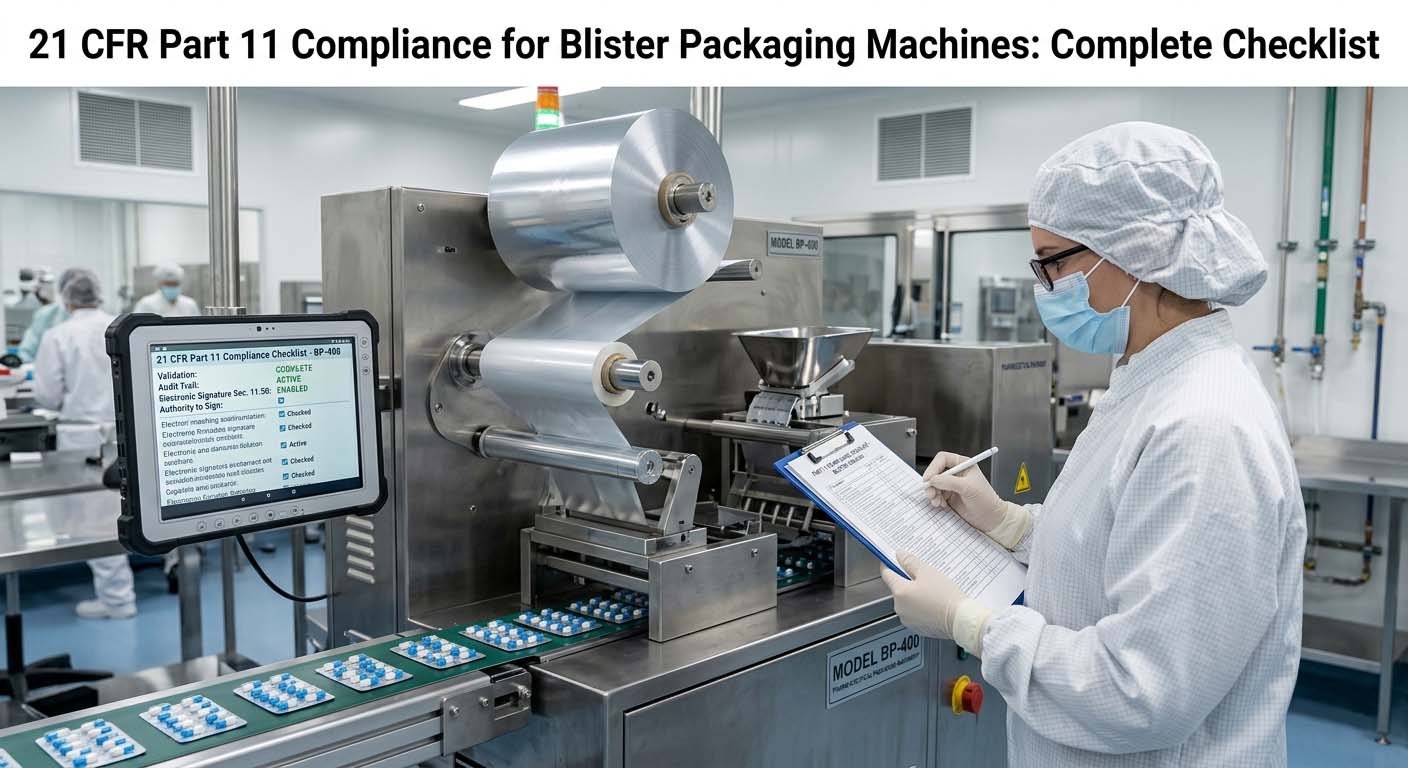
21 CFR Part 11 compliance checklist applied to the electronic records system of a pharmaceutical liquid blister packaging line — audit trail integrity is the most cited deficiency in FDA 483 observations for packaging equipment.
FDA enforcement records for 2019–2023 show data integrity failures as the root cause in 41% of warning letters issued to pharmaceutical manufacturers — and packaging line electronic systems are cited in the majority of those cases. The number I use when engineering teams tell me their existing SCADA system can handle the compliance layer: how many of your blister line records have been reviewed against the ALCOA+ framework by a qualified system validator, not just an IT engineer?
The ALCOA+ Framework Applied to Liquid Blister Line Records
| ALCOA+ Principle | Application to Liquid Blister Packaging Machine | Common Failure Point | Regulatory Reference |
|---|---|---|---|
| Attributable | Every filling volume entry, seal temperature log, and reject event linked to a unique operator ID with timestamp | Shared login credentials across shifts | 21 CFR Part 11.10(d) |
| Legible | Batch records exportable in human-readable format; no proprietary binary-only log files | PLC logs in vendor-specific format requiring proprietary software to read | EU Annex 11 §7.1 |
| Contemporaneous | Sealing temperature recorded at moment of sealing, not retroactively entered from paper notes | Manual transcription of filling volumes from paper log into electronic batch record | 21 CFR Part 211.194(a) |
| Original | First capture is electronic; no parallel paper system that becomes the “original” | Operators printing records and re-entering data into a LIMS system | EU Annex 11 §8.2 |
| Accurate | Calibrated sensors feeding PLC directly; no manual conversion factors applied in software | Fill volume sensor calibration drift not captured in electronic maintenance record | 21 CFR Part 211.68(a) |
| + Complete | Full batch record includes deviations, alarms, and interventions — not just pass/fail summary | Alarm suppression during validation runs not documented | GAMP 5 §5.4 |
| + Consistent | Timestamps synchronized across filling, sealing, and inspection subsystems | System clock drift between PLC and SCADA causing timestamp discrepancies | EU Annex 11 §12.4 |
| + Enduring | Batch records retained for minimum of 1 year post expiry date (US) or 5 years post batch (EU) | Data stored on local PLC only — lost when PLC replaced after 5 years | 21 CFR Part 211.180(a) |
| + Available | Records retrievable within 48 hours of regulatory request without vendor assistance | Archived records in proprietary format requiring vendor decryption key | EU Annex 11 §17.2 |
ALCOA+ compliance matrix for pharmaceutical liquid blister packaging machine electronic records — each principle maps to specific regulatory citations and common implementation failures.
Container Closure Integrity Testing for Liquid Blister Packaging: What GMP Actually Requires
🎯 Direct Answer
GMP requires container closure integrity (CCI) testing for liquid blister packs to be validated per USP <1207> — with dye ingress or vacuum decay methods specified for liquid-containing blisters — and the test method must be demonstrated scientifically superior to visual inspection alone.
A QA director in São Paulo called me in 2023. Her team had just received a health authority query asking for CCI validation data for their oral liquid blister line. The line had been producing for three years. The validation package had a visual inspection protocol. No instrumental CCI method. No ASTM F2338 reference. The health authority’s question was simple: how do you know each blister cavity maintains its seal under distribution conditions? She didn’t have an answer. The product release was suspended for 11 weeks.
USP <1207> establishes container closure integrity testing as a required element of packaging system qualification for liquid drug products. For liquid blister packs specifically, two methods are validated and regulatorily defensible: vacuum decay leak detection (sensitivity threshold: 1–10 microns) and dye ingress testing (60 mbar, 30-minute dwell). Visual inspection alone is not acceptable as a primary CCI method for liquid-containing blisters under either FDA or EMA guidance.
CCI Testing Frequency and Sampling Requirements Under cGMP
- Process validation runs: 100% CCI sampling during initial qualification batches (IQ/OQ phase), minimum 3 batches per 21 CFR Part 211.110
- Routine production: Statistical sampling per AQL Level II, typically AQL 0.65 for critical defects (seal failure) in pharmaceutical liquid blister production
- After planned maintenance: Reduced qualification protocol (minimum 3 consecutive conforming runs) before returning to routine AQL sampling
- After sealing tool change: Full re-qualification of sealing station, including temperature profile verification and CCI confirmation
- Accelerated stability correlation: CCI data points must be included in ICH Q1A(R2) stability submissions for liquid blister formats targeting Zone III/IVb markets
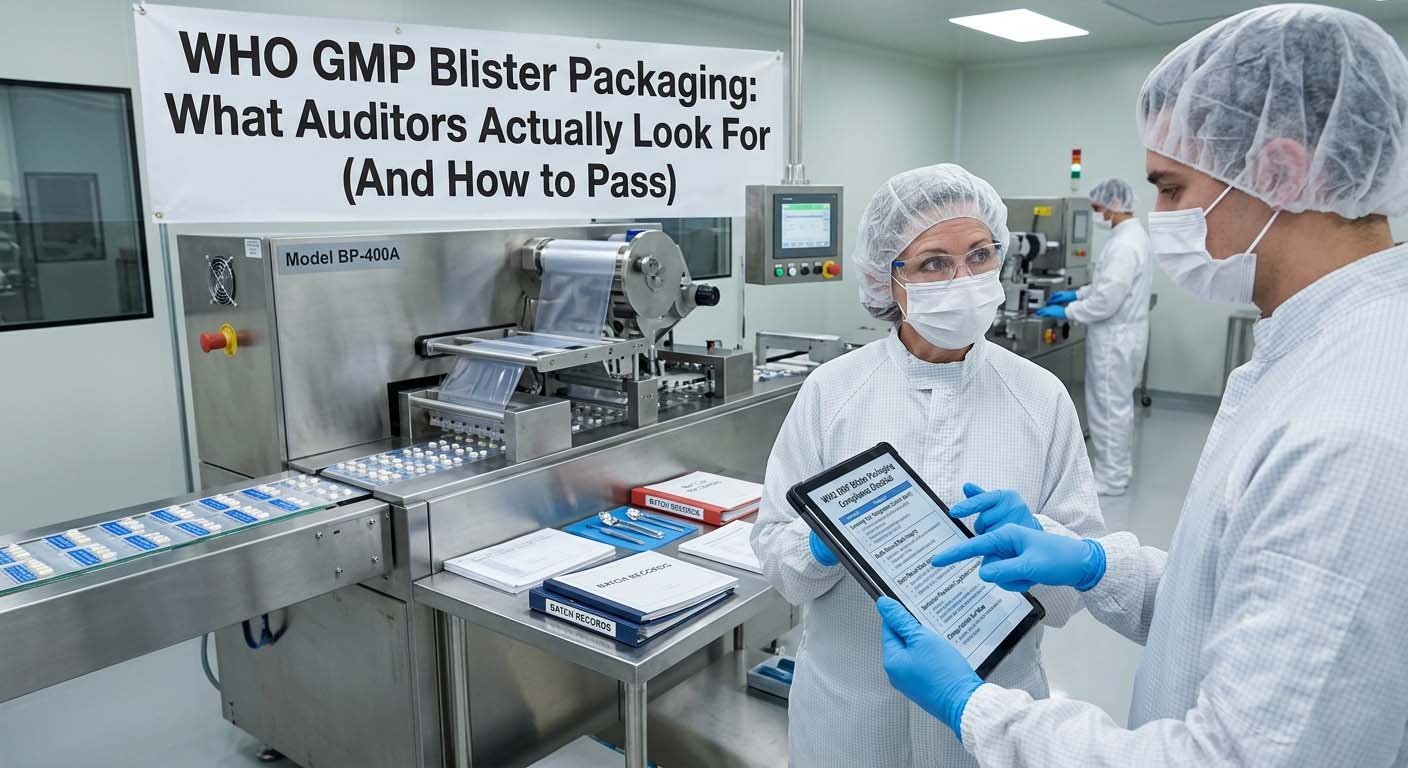
WHO GMP audit documentation review for a liquid blister packaging line — container closure integrity validation per USP <1207> is required for all liquid-containing blister formats targeting WHO-prequalified markets.
Cleanroom and Environmental Requirements for Liquid Blister Packaging Lines Under EU GMP Annex 1
🎯 Direct Answer
EU GMP Annex 1 (2022) requires non-sterile oral liquid blister packaging to operate in Grade D cleanroom conditions at minimum — with Grade A local protection required for any open container exposure during filling before heat sealing. Machine surface materials must be 316L stainless steel or equivalent non-shedding material in direct product contact zones.
The cleanroom integration requirement is where I see the largest gap between what pharma buyers specify in their RFQ and what they actually need. Most RFQs I receive specify “GMP design” without defining what that means in terms of cleanroom classification, surface finish, and airflow integration. Grade D is not a machine specification — it is a room specification. But the machine design must be compatible with Grade D requirements: no flat horizontal surfaces that collect particulates, no exposed lubrication points in the product zone, no pneumatic exhaust directed toward open liquid containers.
Machine Design Requirements for Cleanroom-Compatible Liquid Blister Lines
| Design Parameter | Grade D (Non-Sterile Oral Liquid) | Grade A Local (Sterile / Aseptic Liquid) | Regulatory Basis |
|---|---|---|---|
| Machine surface finish | 304 SS, Ra ≤0.8 µm in product contact zones | 316L SS, Ra ≤0.4 µm, electropolished | EU Annex 1 (2022) §4.3 |
| Filling nozzle material | 316L SS, CIP-compatible | 316L SS, SIP-validated, endotoxin tested | 21 CFR Part 211.65 |
| Pneumatic exhaust | Directed away from product zone, filtered | HEPA-filtered exhaust, directional control | EU Annex 1 (2022) CCS requirement |
| Lubrication points | Food-grade lubricants; no open grease points in product zone | Dry-running bearings or sealed units only | WHO TRS 992 §3.2.1 |
| Cleaning validation | Written CIP/WIP procedure; TOC ≤4 ppm rinse standard | Validated CIP + SIP with documented temperature profiles | 21 CFR Part 211.67 |
| Particle generation | ≤3,520 particles/m³ ≥0.5 µm (at rest) | ≤3,520 particles/m³ (at rest); ≤352,000 (in operation) Grade A HEPA | EU Annex 1 Table 1 |
Cleanroom design specifications for liquid blister packaging machines under EU GMP Annex 1 (2022) — parameters differ significantly between non-sterile oral liquid and aseptic/sterile liquid formats.
⚠️ Cleanroom Integration Failure Patterns
Symptom: Particle counts exceed Grade D limits at rest, immediately after machine installation
Root cause: Machine generates particulates from unsealed cable conduits or exposed drive belt dust during operation.
Fix: Specify fully enclosed drive systems and sealed cable management in URS. Verify with particle count measurement during FAT before shipping.
Symptom: Environmental monitoring shows microbial exceedance in filling zone during production
Root cause: Machine frame design creates dead zones that disrupt unidirectional airflow from HVAC system. Contamination accumulates in horizontal surface pockets.
Require 3D CFD airflow simulation as part of machine design documentation. Review simulation output before tooling fabrication begins.
How to Write a GMP-Compliant URS for a Liquid Blister Packaging Machine
🎯 Direct Answer
A GMP-compliant User Requirements Specification (URS) for a liquid blister packaging machine must define critical quality attributes (CQAs) for the finished blister pack, map each CQA to a machine design parameter, and specify acceptance criteria for IQ, OQ, and PQ testing — before the equipment contract is signed.
The stability report landed in March. A pharmaceutical client in the Philippines had just received month-9 accelerated stability data showing seal integrity failures in 3 of 12 blister cavities per pack — a 25% cavity failure rate at 40°C/75% RH. The product was an oral rehydration liquid in a single-dose blister format. The sealing temperature had been set at commissioning by the machine vendor’s engineer based on their standard protocol for PVC/aluminum lidding. Nobody had specified a minimum peel strength in the URS. Nobody had tested peel strength under Zone IVb stability conditions. The URS had been written in three pages. That was the whole problem.
A properly structured URS for a pharmaceutical liquid blister packaging machine covers eight functional domains. The depth required is not bureaucratic — it is the only mechanism that converts GMP requirements into machine specifications the vendor can actually build and validate against.
-
1
Product and Process Definition
Define liquid type (aqueous, hydroalcoholic, viscous), fill volume range (e.g., 1.0–10.0 mL ±1%), cavity format dimensions, and target throughput (blisters/min). Include worst-case product viscosity (cP) and temperature-viscosity profile for fill accuracy validation.
-
2
Critical Quality Attributes (CQA) Mapping
List each CQA for the finished blister pack: fill volume accuracy (±X%), seal integrity (minimum peel force in N/15mm), headspace oxygen concentration (if applicable), and appearance. Each CQA maps to at least one machine control parameter with a defined setpoint range.
-
3
Electronic Records and Data Integrity Specification
Specify audit trail requirements explicitly: what parameters are logged, at what frequency, under whose user ID, with what time synchronization source. Require 21 CFR Part 11 compliance statement from the vendor with supporting software validation documentation (SVP).
-
4
Cleanroom Compatibility Specification
State the target cleanroom grade (D, C, B, or A), surface finish requirements (Ra value in µm), and machine footprint constraints relative to airflow direction. Require particle generation certification from FAT.
-
5
Changeover and Cleaning Validation Requirements
Define maximum format changeover time, list all product-contact parts requiring disassembly for cleaning, and specify the cleaning validation residue limit (TOC-based or swab-based). These requirements drive machine modular design decisions that cannot be retrofitted.
-
6
IQ / OQ / PQ Acceptance Criteria
Pre-define pass/fail criteria for each qualification phase. IQ: documentation completeness and physical installation verification. OQ: operational range testing across all CPPs. PQ: three consecutive batches meeting all CQA specifications under worst-case production conditions. These criteria belong in the URS, not in the IQ protocol written six months later.
-
7
Integration and Interface Specification
Specify data exchange protocols between the liquid blister machine and upstream/downstream systems: SCADA integration standard (OPC-UA preferred), batch record format (S88 or custom), and ERP connectivity requirements. This section prevents the multi-vendor PLC mismatch described in Section 2.
-
8
Regulatory Market Specification
State all target markets for the product. US: 21 CFR Part 211 + Part 11. EU: Annex 1 (2022) + Annex 11. Emerging markets: WHO TRS 992. Each market may add incremental documentation requirements that affect machine specification (e.g., CDSCO requirements for India differ from ANVISA requirements for Brazil).
For manufacturers preparing their first liquid blister line URS, our IQ OQ PQ validation guide for liquid blister packaging machines covers each qualification phase in step-by-step detail, including template acceptance criteria tables you can adapt to your specific product and market.
GMP Audit Checklist: 12 Things Inspectors Check on Your Liquid Blister Packaging Line
🎯 Direct Answer
FDA, EMA, and WHO GMP inspectors follow a predictable sequence when auditing liquid blister packaging lines: electronic records integrity first, then equipment qualification status, then process control documentation, then cleaning validation. Having these twelve items current and accessible eliminates 80% of packaging-related 483 observations.

EU Annex 1 (2022) compliance documentation review during a GMP audit of a pharmaceutical liquid blister packaging machine — inspectors prioritize electronic records, equipment qualification status, and cleaning validation evidence.
- Current IQ/OQ/PQ qualification status: All three phases completed, approved, and on file. Re-qualification triggered after any major change per your site change control SOP.
- Audit trail review: Inspector will request live demonstration of audit trail retrieval. Show a batch record from 6–12 months ago, complete with all operator entries and alarm history.
- User access management: Current user list with active permissions. Terminated employees removed within 24 hours per your access management SOP.
- Calibration records: All critical instruments (fill volume sensors, sealing temperature thermocouples, pressure transducers) calibrated within validity period, traceable to NIST/NPL standards.
- Cleaning validation documentation: Cleaning procedure, validation report (minimum 3 runs), worst-case residue data (TOC or API-specific), and post-cleaning verification swab results.
- Container closure integrity validation: CCI test method validation per USP <1207>, with method suitability data showing sensitivity threshold ≤10 microns for liquid blister format.
- Environmental monitoring records: At least 12 months of cleanroom monitoring data for the packaging zone, with OOS investigations completed for any exceedances.
- Preventive maintenance records: Completed PM tasks on schedule, with no overdue critical maintenance items. PM records linked to equipment qualification status.
- Alarm management documentation: Complete alarm list with criticality classification, response procedures, and investigation requirements for critical alarms per EU Annex 11 §12.
- Change control history: All equipment changes documented with impact assessment, re-qualification determination, and regulatory notification assessment (where required).
- Training records: Current training completion for all operators and QC staff covering the liquid blister line SOPs, with periodic retraining schedule documented.
- Batch record completeness: Last 5 completed batch records reviewed for completeness, second-person verification signatures, and deviation investigation documentation where applicable.
For buyers evaluating compliance readiness before equipment procurement, our buyer’s technical guide to selecting a liquid blister packaging machine covers the compliance-related vendor evaluation criteria that should appear in every RFQ.
Frequently Asked Questions: GMP Compliance for Pharmaceutical Liquid Blister Packaging
❓ What GMP standards apply to liquid blister packaging machines?
Liquid blister packaging machines in pharmaceutical manufacturing must comply with 21 CFR Part 211 (US cGMP), 21 CFR Part 11 (electronic records), EU GMP Annex 1 (2022 revision, sterile/liquid products), EU GMP Annex 11 (computerized systems), and WHO TRS 992 Annex 3 (global GMP). The applicable standards depend on your target markets — manufacturers exporting to both US and EU markets must satisfy both regulatory frameworks simultaneously.
❓ Is 21 CFR Part 11 compliance required for all liquid blister packaging machines?
Yes, if the machine generates electronic records used as part of batch release. 21 CFR Part 11 applies to any electronic record that is “created, modified, maintained, archived, retrieved, or transmitted” in FDA-regulated manufacturing. Every modern liquid blister machine with a PLC-based HMI generates records within this scope. Machines sold as “21 CFR Part 11 compliant” must provide audit trail functionality, user access controls, and data backup capabilities — demand software validation documentation, not just a compliance declaration.
❓ What cleanroom grade is required for liquid blister packaging?
Grade D minimum for non-sterile oral liquid blister packaging under EU GMP Annex 1. Grade A local protection is required for any process step involving open containers of sterile liquid before sealing. This is a room classification requirement, not a machine specification — but the machine design must be compatible with the required grade’s environmental controls.
❓ How long does IQ OQ PQ validation take for a liquid blister packaging machine?
Realistically, 4–8 months from equipment delivery to completed PQ approval, assuming no major deviations. IQ typically takes 2–4 weeks (documentation and installation verification). OQ takes 4–8 weeks (operational range testing, worst-case runs). PQ requires three consecutive conforming production batches, which can take 4–12 weeks depending on batch cycle time and stability testing requirements. Projects that start with a well-written URS and pre-defined acceptance criteria consistently finish at the lower end of these ranges. Those that do not typically take 50–80% longer. The full process is covered in our dedicated IQ OQ PQ validation guide.
❓ Can a single-vendor turnkey liquid blister line reduce GMP validation time?
Yes. Single-vendor turnkey lines eliminate the multi-PLC integration problem, produce unified batch records, and arrive with a coherent validation master plan covering the complete line. In my experience across 31 liquid packaging projects between 2018 and 2024, single-vendor turnkey lines complete PQ validation an average of 3.4 months faster than multi-vendor assembled lines — and with significantly fewer 483-type observations during post-installation mock audits.
❓ What does container closure integrity testing require for liquid blister packs?
USP <1207> requires a validated deterministic or probabilistic test method. Visual inspection alone is not acceptable. Vacuum decay and dye ingress are the two most commonly validated methods for liquid blister formats. Your CCI test method must demonstrate a sensitivity threshold appropriate for your package headspace and product risk profile — typically ≤10 microns for liquid-containing pharmaceutical blisters.
❓ What happens if my liquid blister packaging machine fails a GMP audit?
Consequences range from a Warning Letter with required CAPA (FDA) to product recall, import alert, or manufacturing license suspension depending on severity. Packaging failures accounted for 12% of pharmaceutical recalls in FDA enforcement actions from 2019–2023 — and liquid dosage forms are disproportionately represented because seal integrity failures directly affect drug stability and dose accuracy. Early investment in compliance architecture costs a fraction of the average recall cost of $9–$14 million per event for liquid pharmaceutical products.
Regulatory Standards Referenced in This Article
21 CFR Part 211 21 CFR Part 11 EU GMP Annex 1 (2022) EU GMP Annex 11 WHO TRS 992 Annex 3 USP <1207> CCI ASTM F2338 ICH Q10 GAMP 5 ISO 15223-1Ready to Build a GMP-Compliant Liquid Blister Line?
HIJ Machinery delivers turnkey liquid blister packaging lines engineered under a single validation protocol — eliminating the multi-vendor data integrity gaps that cost projects 3–8 months of remediation time. Every line ships with a complete IQ/OQ/PQ documentation package and 21 CFR Part 11 and EU GMP Annex 11 compliance certification.