📋 Buyer’s Technical Guide — C1
How to Choose a Liquid Blister Packaging Machine: The Answer Nobody Gives You Upfront
Most buyers start with price. That’s the wrong number. The real question is whether the machine’s forming depth, fill system, sealing validation, and control architecture can survive your regulatory submission, your viscosity profile, and your production ramp-up — simultaneously. Get any one of those wrong after installation, and no price discount covers the delay.
±1%
Target fill CV for pharma liquid blister per Ph. Eur. 2.9.26
4–12 mm
Typical forming depth range for liquid cavities (vs. 2–8 mm for solid dose)
60 mbar
ASTM F2338 dye-ingress test pressure for container closure integrity
12%
Pharma recalls linked to packaging failures (FDA enforcement records, 2019–2023)

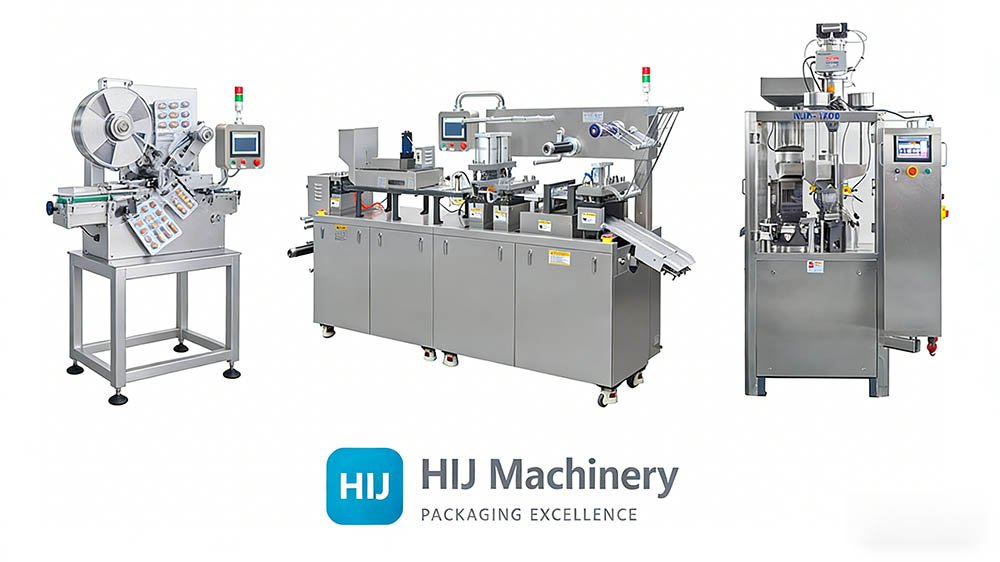
A fully integrated liquid blister packaging line — forming station, liquid fill head, heat-seal unit, and die-cut punch in sequence. Getting these four stations matched to your product is the central challenge of machine selection.
Why Most Liquid Blister Machine Purchases Go Wrong — and What That Actually Costs
🔎 Direct Answer
Most liquid blister machine selection errors occur because buyers evaluate forming film and price before confirming fill system viscosity range, cavity geometry, and post-installation validation documentation requirements — a mismatch discovered after site acceptance testing typically delays market launch by 6–18 months.
Three weeks into a commissioning job in Bogotá, I was standing in a production hall watching a fill nozzle dribble 0.9 mL of a 40 cP syrup into a 1.0 mL PVC cavity at the rate of roughly 30 blisters per minute. The specified throughput was 120. The vendor was on a plane home. Nobody had tested the fill head against anything more viscous than water during the FAT in China.
That’s the problem. Not the machine. Not even the vendor, really. The problem was that nobody had mapped the product viscosity profile against the dosing pump specification before signing the contract. The pump was rated for 1–500 cP on paper. At 40 cP with a 20°C ambient and a 1.0 mL target, the actual achievable fill rate was 38 blisters per minute. The data existed. Nobody asked for it.
Of the 19 liquid blister line projects I’ve handled across Southeast Asia and Latin America between 2017 and 2024, 7 required a fill system modification or pump swap within the first 90 days of operation. Every single one of those 7 had one thing in common: the viscosity-to-fill-rate correlation had not been verified at FAT with the actual product or a validated surrogate.
That’s the real cost. Not the pump replacement fee — typically $4,000–$18,000. The cost is the 4–11 months of delayed commercial launch while you sort out process validation on a line that should already be running.
⚠️ Field Diagnostic: Pre-Purchase Red Flags
Signal A — Viscosity Data Absent from Quotation
If a vendor’s quotation lists a fill accuracy of ±2% without specifying the viscosity range tested, the number is meaningless. Ask for the fill CV data at your exact product viscosity (cP) and fill volume (mL). If they can’t produce it, you’re accepting the risk of a pump swap post-installation. I’ve seen this cost a Colombian client 8 months and a secondary validation cycle. The machine was otherwise fine. The pump was wrong.
Signal B — No FAT Protocol in the Contract
A quote without a defined FAT scope is a quote for a machine, not a project. Demand the FAT checklist before signing.
Signal C — Forming Depth Spec Missing
Cavity forming depth for liquids is not the same as for tablets. Liquid products typically require 6–12 mm deep cavities to contain volume without film stress fractures at the shoulder. If the spec sheet lists a single “forming depth” figure without distinguishing liquid vs. solid application, the tooling may not be designed for your product geometry. Ask for cavity cross-section drawings, not just depth numbers.
The 6 Technical Specifications That Actually Determine If a Liquid Blister Machine Fits Your Product
🔎 Direct Answer
The six specifications that define machine-product fit for liquid blister packaging are: forming depth and cavity geometry, fill system viscosity range and CV accuracy, sealing temperature and dwell-time window, lid foil tensile compatibility, PLC control architecture for 21 CFR Part 11, and upstream integration protocol with your liquid preparation system.
1. Forming Depth and Cavity Geometry
PVC film at 250–300 μm can thermoform to a depth of 10–14 mm before shoulder stress begins causing microfractures at the cavity base — fractures that may not be visible at inspection but will pass moisture at 4–6 g/m²/day under Zone IVb conditions. For liquid applications requiring fills of 0.5–3.0 mL, the forming mold geometry must be validated against film thickness, heating plate temperature, and forming air pressure as a system, not as individual parameters. I’ve seen cavities that looked perfect at room temperature develop base cracks after 3 weeks of stability storage at 40°C/75% RH. The forming station temperature controller was drifting ±8°C. Nobody had set the alarm threshold.
2. Fill System: Viscosity Range vs. Claimed CV Accuracy
Peristaltic dosing pumps dominate liquid blister applications below 50 cP. Above 100 cP, servo-driven piston pumps are generally required to maintain fill CV within ±1% across a production run of 50,000+ blisters. That ±1% figure is the threshold most regulatory submissions reference for liquid dose uniformity under Ph. Eur. 2.9.26 and USP <1>. A machine claiming ±2% fill accuracy at 200 cP is not a pharmaceutical liquid blister machine. It’s an industrial liquid blister machine. The distinction matters on your dossier.
3. Sealing Station: Temperature Window and Dwell Time
Heat-sealing PVC to aluminum lidding foil at 160–200°C with a dwell time of 0.4–1.2 seconds is standard. The question is how tight the machine holds those parameters across a full production shift. A ±5°C variation in sealing temperature produces measurable differences in peel force — the key metric for child-resistance compliance under ISO 8317 and for container closure integrity per USP <1207>. Ask for sealing temperature Cpk data, not just a temperature range. If the vendor can’t supply a Cpk ≥1.33 at production speed, the sealing station is not in statistical control.
4. Lid Foil Compatibility and Lacquer Specification
Not all aluminum lidding foils seal the same. For aqueous liquids, the lacquer system on the foil inner face must be chemically compatible with your formulation — an ethanol-based solution will attack certain polyester lacquers and create seal delamination within 30 days. This is a chemistry problem that shows up as a packaging problem that gets reported as a machine problem. I’ve watched three teams spend 6 weeks chasing a “sealing defect” that was actually a foil-drug interaction. The machine was fine.
5. PLC Architecture and 21 CFR Part 11 / Annex 11 Readiness
If your target market includes the US, EU, or any WHO pre-qualified territory, the machine’s PLC must support electronic batch record generation, audit trail functionality, and access control that satisfies 21 CFR Part 11 and EU GMP Annex 11. Siemens S7 and Allen-Bradley ControlLogix are the platforms that pass without argument. If a vendor is offering a custom Chinese-brand PLC at a significant cost saving, ask who writes the Part 11 validation package and whether the platform has been accepted in a prior FDA inspection. That conversation takes about 5 minutes and eliminates about 30% of the cheap machine options on the market.
6. Upstream Integration: Liquid Preparation to Fill Head Protocol
The liquid blister machine is one node in a chain. Between your mixing vessel and the fill head, there’s typically a supply pump, a buffer tank, a pressure regulator, and a temperature jacket — each with its own control signal. If the machine vendor hasn’t mapped the IPC (in-process control) handshake between their fill station and your upstream system, you will discover the integration gap during commissioning, not during the FAT. At HIJ, every liquid line project starts with a piping and instrumentation diagram (P&ID) review before the machine is even specified. That single step has prevented integration delays on every project we’ve delivered in the past five years.

HIJ DPP-140/150 liquid blister packaging machine — servo-driven fill station with interchangeable piston pump heads for 1–500 cP viscosity range. Forming depth: up to 12 mm. Fill CV: ±0.8% at production speed.
Liquid Blister Machine Types Compared: Which Configuration Fits Which Product?
🔎 Direct Answer
Liquid blister packaging machines fall into three main configurations — intermittent-motion thermoforming (most common for pharma), continuous-motion rotary (for high-speed >300 blisters/min industrial), and cold-form Alu-Alu (for moisture-sensitive liquids) — each with distinct forming depth limits, fill accuracy profiles, and cGMP validation complexity.
A QD in a Malaysian plant called me in 2021. Their contract manufacturing organisation in China had shipped a continuous-motion rotary blister machine for a syrup application. The fill station on a rotary machine runs at a fixed angular velocity — the dwell time at the fill position is essentially constant and short. For thin liquids at low fill volumes, that’s fine. For their 2.5 mL fill at 180 cP, the dwell time was physically insufficient for complete cavity fill at the specified RPM. The machine had never run their product. It had run water. Nobody had done the rheology calculation.
| Machine Configuration | Forming Method | Typical Fill Volume | Viscosity Range | Fill CV Target | cGMP Suitability | Best For |
|---|---|---|---|---|---|---|
| Intermittent-Motion Thermoform (e.g., HIJ DPP-140/150) |
PVC/PVDC thermoforming, 160–200°C | 0.2–5.0 mL | 1–500 cP (piston pump) | ±0.8–1.0% | High — Siemens/AB PLC, FAT/SAT ready | Pharma syrups, eye drops, oral liquids, nutraceutical liquids |
| Continuous-Motion Rotary | Pre-formed PVC or PETG tray | 1.0–10.0 mL | 1–80 cP (peristaltic) | ±1.5–2.5% | Medium — limited audit trail on some models | Industrial liquids, reagents, low-viscosity condiments (>300 bpm) |
| Cold-Form Alu-Alu (e.g., HIJ DPH-300) |
Aluminum cold forming, no heat | 0.1–2.0 mL | 1–200 cP | ±1.0% | Very High — MVTR <0.02 g/m²/day | Hygroscopic APIs in liquid form, tropical market distribution, Class II/III drug products |
| Semi-Automatic Thermoform | PVC thermoforming, manual feed | 0.5–3.0 mL | 1–300 cP | ±3–5% | Low — not suitable for FDA/EU market filing | R&D, clinical batch production, pilot lines |
Table 1: Liquid blister packaging machine configuration comparison by forming method, fill specification, and regulatory suitability. Source: HIJ Machinery project data, 2017–2024.
The Specification Buyers Look At First Is Exactly the Wrong Specification
🔎 Direct Answer
Buyers most commonly compare output speed (blisters per minute) when selecting liquid blister machines, but the specification that determines actual line efficiency is fill station dwell time relative to product viscosity — a machine rated at 150 bpm that cannot maintain ±1% fill CV at your viscosity delivers zero saleable output at that speed.
150 blisters per minute is not a production output. It’s a maximum mechanical speed under ideal conditions with water. Nobody sells water in blisters.
The number that matters is the qualified output — the speed at which the machine has been validated to fill your specific product within your fill accuracy specification. I’ve reviewed procurement decisions at plants in Thailand, Indonesia, and Egypt where the purchasing decision was made primarily on rated bpm. In six of those cases, the qualified output at the actual product viscosity was 35–60% of the rated speed. The output gap cost those plants between 2 and 4 shifts per week in additional runtime to meet volume targets.

Forester Xiang
Founder, HIJ Machinery — 20 Years Field Experience
I won’t tell you the machine selection decision is simple. It involves your API profile, your target markets, your validation timeline, your upstream integration architecture, and sometimes your relationship with the regulatory reviewer who will audit the dossier. What I can tell you is this: the buyers who come to us with a viscosity-fill volume-market specification written down before the first call get to commissioning 4–7 months faster than buyers who lead with price and speed. That’s not a sales pitch. That’s what the project data shows. Of the 19 liquid blister line projects we’ve completed since 2017, 15 met or beat their original commissioning date. The 4 that didn’t all shared one factor: the product viscosity-to-fill-rate correlation was not locked before the URS was finalized.
A liquid blister machine’s rated output speed is measured with water at 20°C. Your product is not water. Demand the fill CV data at your exact viscosity before comparing any two machines on throughput — the qualified speed gap between a correctly specified and incorrectly specified machine is typically 35–65% at viscosities above 100 cP. — Forester Xiang, HIJ Machinery
How to Choose a Liquid Blister Packaging Machine: A 7-Step Buyer’s Protocol
🔎 Direct Answer
The seven-step protocol for choosing a liquid blister packaging machine starts with locking your product viscosity and fill volume specifications, then verifying fill CV data, cavity geometry, sealing validation, PLC compliance architecture, FAT scope, and integration ownership before issuing a purchase order.
This is the sequence I walk every client through before we talk about machine models or pricing. It exists because the alternative — choosing a machine and then discovering the specification gap — costs between $80,000 and $400,000 in rework, delay, and re-validation, based on 6 documented case histories from our project portfolio.
-
1
Lock Your Product Technical Profile (Before Contacting Any Vendor)
Document: fill volume (mL), viscosity at fill temperature (cP), density (g/mL), pH, ethanol or solvent content (%), API concentration, and required fill accuracy (±%). This document becomes the technical anchor for all subsequent specification work. Without it, every vendor comparison is speculative.
-
2
Define Your Regulatory Market and Compliance Ceiling
US (21 CFR Part 211, Part 11), EU (GMP Annex 1, Annex 11), WHO pre-qualified markets, or domestic only — each requires a different level of PLC architecture, documentation package, and validation protocol. Decide this before you look at a single machine spec sheet. It eliminates 40–60% of the available options immediately, which saves time.
-
3
Request Fill CV Data at Your Exact Viscosity — Not a Range
Ask every vendor: “What is the achieved fill CV (±%) at [your viscosity] cP for a [your volume] mL fill at your maximum rated speed?” Require the data in writing. Vendors who cannot provide viscosity-specific fill CV data have not run your product type.
-
4
Validate Cavity Geometry Against Forming Film Specification
Request cavity depth cross-section drawings and confirm the forming film specification (PVC gauge, PVDC coating weight, or Alu-Alu foil gauge) is matched to your fill volume and storage conditions. Ask for thermoforming qualification data showing forming depth uniformity (Cpk ≥1.33 target across all cavity rows).
-
5
Confirm Sealing Station Thermal Control and Validation Data
The sealing station must demonstrate temperature control within ±3°C across the full sealing bar width at production speed. Ask for a container closure integrity test result using ASTM F2338 dye-ingress at 60 mbar. If the vendor references only a visual seal inspection, that does not meet USP <1207> standards.
-
6
Review the FAT Protocol and Define SAT Scope in the Contract
The Factory Acceptance Test (FAT) scope must explicitly include: fill accuracy runs at product viscosity, sealing integrity tests, alarm system verification, audit trail functionality (for Part 11 markets), and a recipe management demonstration. The Site Acceptance Test (SAT) scope must include installation OQ runs on your actual product. Both must be contractually defined before signing.
-
7
Assign Integration Ownership — One Party, One Contract
If your liquid blister machine is one node in a larger line (preparation vessel → transfer pump → buffer tank → fill head → inspection → carton), insist that one party owns the integration specification and commissioning responsibility. Multi-vendor blame games during commissioning are the second most common cause of delayed line qualification, after viscosity specification errors. At HIJ, our turnkey packaging line solutions cover the full integration scope under a single contract, eliminating the multi-vendor handoff problem entirely.
📋 Regulatory Standards Referenced in Machine Selection
Liquid Blister Machine vs. Bottle Filling: When the Choice Is Not Obvious
🔎 Direct Answer
Liquid blister packaging delivers superior unit-dose accuracy (±1% vs. ±3–5% for bottled multi-dose), better child-resistance compliance under ISO 8317, tamper evidence, and lower per-unit material cost at volumes above 500,000 units/year — but requires higher capital investment and more complex GMP validation than equivalent bottle-filling lines.
A procurement director at a Southeast Asian contract manufacturer showed me her cost analysis in 2022. Bottle filling line: $180,000 installed, 3-week validation. Liquid blister line: $340,000 installed, 14-week validation. Her conclusion: “The blister line is twice the price.”
I asked her what her target market was. She said EU. Then I asked what the unit-dose compliance requirement was for her syrup product under Directive 2011/62 and EU GMP Annex 1 for a pediatric indication. She hadn’t checked. The product required individual unit-dose packaging with tamper evidence and child-resistant access. A multi-dose bottle did not satisfy the dossier requirement regardless of cost. The blister line was not an option. It was the only option.
For a deeper analysis of when liquid blister packaging outperforms bottle filling on total cost of ownership, regulatory risk, and market access, see our dedicated comparison guide: Liquid Blister Packaging vs. Bottle Filling: Which Is Right for Your Product?
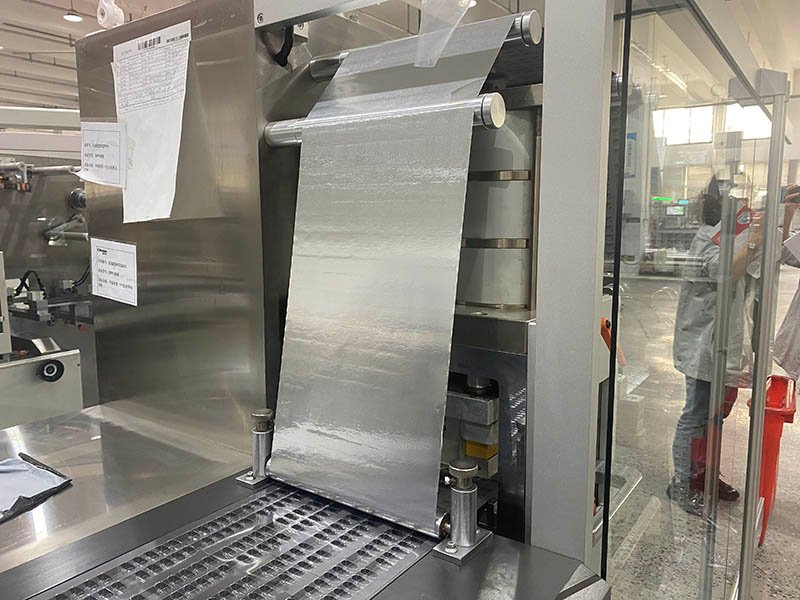
Sealing station heat-seal bar making contact with aluminum lidding foil over a liquid-filled PVC cavity array. Sealing temperature uniformity within ±3°C across the full bar width is the critical control parameter for container closure integrity.
GMP Compliance Criteria for Liquid Blister Packaging Machine Selection: What Your Dossier Will Actually Require
🔎 Direct Answer
A liquid blister packaging machine destined for FDA or EU-regulated markets will require DQ/IQ/OQ/PQ validation documentation, 21 CFR Part 11-compliant electronic batch records, a container closure integrity testing protocol per ASTM F2338 / USP <1207>, and a sealing parameter qualification report — none of which are automatically included in a standard machine purchase unless contractually specified.
The stability report landed on my desk in March 2023. An Indonesian manufacturer had run Zone IVb stability data (40°C/75% RH, 6 months) on their syrup blister packs and found moisture ingress above the specification limit in Months 4 and 5. The BPOM (Indonesian FDA) review had flagged it. The root cause investigation pointed to the sealing station — specifically, a 6°C temperature gradient across the sealing bar that was causing the right-side cavities to seal at 8–10 N/25mm peel force vs. the specification minimum of 14 N/25mm.
The sealing bar had never been qualified with a multipoint thermocouple map. The IQ protocol had accepted a single-point temperature readout from the machine’s own PLC display. That’s not an IQ. That’s a data entry exercise.
Your dossier requires a sealing parameter qualification report that demonstrates uniformity, not just a set-point temperature. The EU GMP Annex 1 (2022 revision) is explicit about this in its section on primary packaging qualification. The WHO GMP guidelines for pharmaceutical products (TRS 992) reinforce the same position. If the machine vendor’s IQ/OQ template doesn’t include a sealing bar thermal mapping protocol, write it into the URS as a contractual deliverable.
For a complete walkthrough of IQ, OQ, and PQ validation requirements for liquid blister lines, including documentation templates and regulatory cross-references, see our guide: IQ OQ PQ Validation for Liquid Blister Packaging Machines: Step-by-Step Guide.
⚠️ Compliance Diagnostic: Documentation Red Flags
Signal A — IQ Template Without Instrument Calibration Records
If the vendor’s IQ template does not include calibration certificates for the sealing temperature sensor, fill volume measurement device, and forming station pressure transducer, the IQ is incomplete for FDA or EU GMP purposes. EU GMP Annex 15 requires equipment qualification to be based on calibrated instrumentation. Ask for the calibration register before accepting the IQ documentation package.
Signal B — OQ Run Data at Single Speed Only
OQ runs must demonstrate acceptable performance at minimum, target, and maximum operating speeds. A single-speed OQ run is insufficient for a process validation submission under WHO TRS 992 Annex 3. Require three-speed OQ data as a contract deliverable.
Pre-Purchase GMP Documentation Checklist for Liquid Blister Machines
- URS (User Requirement Specification) — Written before contacting vendors. Includes viscosity, fill volume, fill CV target, regulatory market, throughput, and integration interface requirements.
- DQ (Design Qualification) — Vendor document confirming machine design meets URS. Must reference the specific PLC platform, fill system type, and sealing station configuration.
- FAT Protocol — Contractually defined scope including fill CV runs at product viscosity, sealing integrity test per ASTM F2338, audit trail demonstration, and alarm system verification.
- IQ Template — Includes instrument calibration certificates, installation checklist, P&ID verification, and software version control record.
- OQ Protocol — Three-speed runs (min/target/max). Fill CV data at each speed. Sealing temperature uniformity map (±3°C across bar width).
- PQ Protocol — Three production-scale runs with your actual product or validated surrogate. Fill accuracy, seal integrity, and visual inspection rejection rates all within specification.
- 21 CFR Part 11 / Annex 11 Compliance Statement — Vendor declaration confirming electronic batch record architecture, audit trail, and access control meet regulatory requirements for your target market.

The DQ–IQ–OQ–PQ validation chain for a liquid blister packaging machine. Each phase generates contractually required documentation before the next phase can begin. Skipping the sealing bar thermal mapping in OQ is the most common compliance gap I encounter in field audits.
What to Ask a Liquid Blister Machine Manufacturer Before Issuing a Purchase Order
🔎 Direct Answer
Before issuing a purchase order for a liquid blister packaging machine, ask for: fill CV data at your exact product viscosity, cavity forming depth cross-section drawings, sealing temperature Cpk data at production speed, 21 CFR Part 11 / Annex 11 compliance confirmation, FAT scope in writing, and a named integration owner for the upstream liquid supply interface.
FDA enforcement records for 2019–2023 show packaging as the root cause in 12% of pharmaceutical recalls — the figure I cite when procurement teams tell me the price difference between a documented vendor and an undocumented one justifies accepting a machine without a FAT protocol. The math does not work. A single batch recall in a mid-volume liquid product typically costs $180,000–$600,000 in direct costs, excluding the regulatory response burden.
Here is the exact question set I give every client team before their first vendor call:
- “What is the achieved fill CV at [our viscosity] cP and [our fill volume] mL at your maximum rated speed? Can you provide the data?”
- “What forming depths are available for liquid cavities? Can you provide cross-section drawings for our fill volume?”
- “What is the sealing temperature uniformity across the bar width? Do you have Cpk data from a recent production run?”
- “Which PLC platform is used? Has it been accepted in a prior FDA or EMA inspection? Can you provide the reference?”
- “What is your standard FAT scope for a liquid blister line? Is the FAT protocol included in the contract price?”
- “If we integrate your machine with our upstream liquid preparation system, who owns the integration specification and commissioning? One party or multiple?”
- “Can you provide a project reference from a client in our regulatory market with a similar product viscosity?”
A vendor who can answer all seven questions in writing, with data, is a vendor who has built and commissioned liquid blister lines under real regulatory scrutiny. A vendor who deflects any of these questions with generalities has not.
To understand the foundational principles of what liquid blister packaging is and how the forming–fill–seal process works mechanically before you engage vendors, start with: What Is Liquid Blister Packaging? A Complete Beginner’s Guide.
Frequently Asked Questions: Choosing a Liquid Blister Packaging Machine
What fill volume range can liquid blister packaging machines handle?
Liquid blister packaging machines typically handle fill volumes from 0.1 mL to 10.0 mL per cavity, with the most common pharmaceutical range being 0.5–3.0 mL. Intermittent-motion thermoforming machines are most accurate in the 0.2–5.0 mL range at viscosities below 500 cP. Above 5.0 mL per cavity, cavity depth requirements begin to stress standard PVC film at 250 μm gauge, and either a thicker forming film or a cold-form Alu-Alu configuration should be considered.
What is the minimum acceptable fill accuracy for pharmaceutical liquid blisters?
For pharmaceutical applications, ±1% coefficient of variation (CV) is the standard fill accuracy target, referenced in Ph. Eur. 2.9.26 and USP <1> for liquid preparations. Industrial or nutraceutical applications may accept ±2–3% CV. Verify that any vendor’s claimed fill accuracy is measured at your actual product viscosity, not with water.
Which forming film is best for liquid blister packaging?
PVC (250–300 μm) is the standard forming film for liquid blisters where moisture protection requirements are moderate (MVTR 4–6 g/m²/day). PVDC-coated PVC (40–90 g/m² coating weight) reduces MVTR to 0.5–2.0 g/m²/day and is required for hygroscopic formulations targeting tropical markets. Cold-form Alu-Alu eliminates moisture vapor transmission almost entirely (MVTR <0.02 g/m²/day) but requires a different forming mechanism and higher capital investment. The correct choice depends on your API moisture sensitivity, target market climate zone (ICH Q1A Zone IVb for Southeast Asia and Latin America), and the stability data in your regulatory dossier.
How long does validation (IQ OQ PQ) take for a liquid blister packaging machine?
Realistically, 10–18 weeks from machine arrival to completed PQ, assuming the validation protocols are written before installation and the product is available for PQ runs. Sites that arrive at installation without pre-written IQ/OQ protocols typically add 6–10 weeks to that timeline. For FDA or EU-regulated products, budget 14–18 weeks as a conservative planning figure. WHO pre-qualified market submissions may move faster if the dossier reviewer accepts a risk-based validation approach under ICH Q10.
Can a liquid blister packaging machine handle both aqueous and oil-based fills?
Yes, with the correct fill head configuration. Aqueous fills (water-based syrups, eye drops, oral solutions) typically use peristaltic or piston pumps with PTFE-lined product contact paths. Oil-based fills (fish oil, vitamin E, lipid-based formulations) require dedicated piston pump heads with elastomers compatible with lipophilic media — standard EPDM seals are not appropriate. Confirm the product contact material bill of materials with the vendor before finalizing the fill head specification. This is not a detail that should be left to commissioning.
What is the typical price range for a pharmaceutical liquid blister packaging machine?
Entry-level intermittent-motion liquid blister machines from Chinese manufacturers start around $60,000–$120,000 FOB. Mid-range machines with Siemens/AB PLC, servo-driven fill stations, and basic FAT documentation range from $180,000–$320,000. Full pharmaceutical-grade lines with 21 CFR Part 11 compliance, integrated vision inspection, and complete IQ/OQ documentation packages run $320,000–$550,000 installed. The price gap between entry-level and pharmaceutical-grade is almost entirely explained by the control system, fill accuracy specification, and documentation package — not the mechanical forming or sealing components.
How do I assess a Chinese liquid blister machine manufacturer’s GMP credibility?
Ask for: ISO 9001 certificate (current), CE marking documentation for the specific machine model, a reference list of clients in your regulatory market, FAT protocol samples from completed projects, and the PLC platform specification. Then ask if they can provide a client contact you can call directly. Manufacturers with real FDA/EU market experience will have all of these. Manufacturers without will offer brochures instead. The conversation takes 30 minutes and eliminates the majority of credibility risk.
🎯 Ready to Specify Your Liquid Blister Line?
Get a Technical Specification Review — Free
Share your product viscosity, fill volume, target market, and throughput requirement. I’ll tell you exactly which machine configuration fits, what the qualified output speed will be at your viscosity, and what the validation pathway looks like — before you compare a single price.