
Liquid medicine blister machine
Form, fill and seal individual oral-liquid packs with HIJ equipment, configured around your formulation, blister design and production requirements.
Request quotation
A line for the finished dose
A liquid medicine blister packaging machine forms cavities from a web, fills the liquid, seals the lidding and separates the packs. The purchasing specification connects all four operations to the finished presentation: its fill, opening method, identification and handling after sealing.
This page covers oral-liquid machine specification. Sterile ophthalmic or injectable projects need a separately established process and evidence plan; an individually sealed pack does not establish sterility.
For formulation-specific syrup handling, use the syrup packaging page. The liquid blister overview covers the wider equipment family; the blister-versus-sachet page compares the two pack routes.
Choose the pack format
Start with the finished unit or strip, not a catalogue cycle rate. Pack geometry determines the forming, filling, sealing and cutting work and the way the product leaves the line.
Single unit
Define one finished cavity, its nominal fill, headspace, sealing flange and opening feature. Review grip, opening and removal of the contents alongside leak and seal checks. Confirm how individual units are collected without damaging the sealed edges.
Multi-unit strip
Show the cavity count, pitch, overall strip size and separation features on one drawing. Decide whether the strip remains intact or is divided later. Keep batch information readable on the unit or strip that reaches the user, according to the approved packaging design.
Cartoner-fed strip
Define strip orientation, count per carton, discharge height and the transfer arrangement. Include accumulation, stop signals and reject handling between the blister line and cartoner. A working blister line does not by itself establish a balanced secondary-packaging line.
The forming web and lidding must be specified together. Include grades, structure, thickness and required compatibility evidence; the materials page covers these choices in more depth.
See the equipment route

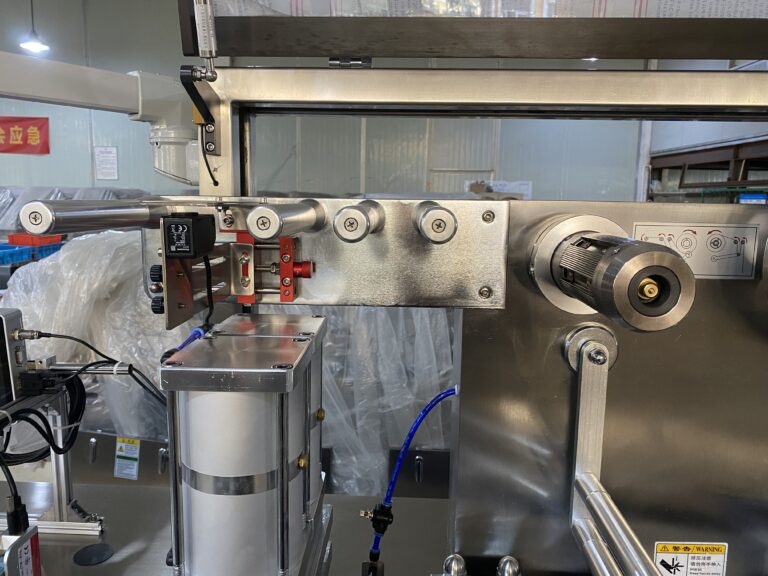
The photographed HIJ liquid blister platform places the web path, filling operations and controls along one machine. Review that route with your packaging engineer before fixing the layout or ordering tools.
For syrup-specific solution, suspension and viscous-product considerations, use the dedicated application page. Solid tablets and capsules follow a different feeding route; compare the pharmaceutical blister machine page rather than treating a liquid filler as universal.
Product path
Match the vessel interface, transfer route and selected dosing arrangement to the formulation. Discuss viscosity at operating temperature, foam, particles, air carried into the fill and nozzle shut-off. List the actual contact materials, seals and parts in the proposal.
Access and changeover
Walk through product recovery, removal of contact parts, cleaning access and reassembly. Identify items dedicated to a product and those intended for reuse. Agree the changeover work, contact-part cleaning and format-specific steps in the proposed process.
Configure the supply
The quotation should describe an identifiable machine and its included equipment. Keep the first pack format, later formats and downstream machines separate so competing proposals can be compared on the same basis.
- Forming, filling and sealing
- Identify the machine configuration, dosing principle, filling positions, feed-vessel interface and sealing arrangement. Match the selected functions to the approved product and pack requirements.
- Format tools and change parts
- List forming, sealing and cutting tools by drawing revision. Name included change parts and pack formats; state the review needed for a future size. Use the tooling page for the interfaces that can change together.
- Checks and reject handling
- Agree which conditions the line detects, where the checks occur and how rejected packs leave the stream. Define alarm and restart behaviour. Separate a presence or code check from package-integrity testing.
- Site and services
- List utilities, available floor space and access around the line. Itemise documentation, factory acceptance, installation, training and any qualification assistance, including who supplies and approves each deliverable.
- Price and delivery
- Request a current configuration-based quotation covering the included supply, optional items, commercial terms and delivery programme. Compare proposals with matching supply boundaries.
Records and pack identity
The main machine interface and coding interface have different jobs. Define the settings and batch information that operators need, then agree the controls, records and tests for the proposed system.


Machine settings
Identify recipe parameters, operator permissions, alarms, event records and the required backup or export route. State any site-system interface and review it with the controls team. A touchscreen brand alone does not establish these functions.
Printed information
Specify the batch and expiry content, location, print area and required verification. Keep registration, cutting and the final pack presentation in the same review. Agree what happens to a pack when a code is missing or unreadable.
For electronic records, define the required functions and evidence with your quality team. The electronic-records page covers that project discussion. For U.S. projects, 21 CFR 211.68 addresses equipment checking and computer-related controls; equipment functions and site procedures still need defined responsibilities.
Agree what the run must prove
Set the trial product, material pair, pack drawing, operating conditions and acceptance limits before the run. Use one agreed protocol to connect the demonstration to the configuration being quoted.
| Result | Evidence to agree |
|---|---|
| Fill quantity | Nominal fill, tolerance, measurement method and sampling across positions and run stages. Record the test conditions and the basis for any mass-to-volume conversion. |
| Finished pack | Seal, leakage, opening and recoverable-contents checks for the selected product and material pair. Define the test method, responsibility, samples and pass criteria. |
| Stops and restarts | Product holding, restart, drips, foam and the condition of the seal area through the agreed interruptions. Include the actual restart sequence in the record. |
| Accepted output | Accepted finished units over the agreed duration, with cavity layout, rejects, stops and downstream limits recorded. Distinguish machine cycles from delivered packs. |
For U.S. drug-product packaging, 21 CFR 211.94 addresses contact compatibility, protection and written container/closure specifications. Your quality team defines the product-specific assessment and approvals.
Keep the approved drawing, equipment schedule and test records linked. Agree the drawings, manuals, calibration evidence and any qualification assistance in the equipment schedule. Name the party that prepares, executes and approves each document; site qualification and product-specific validation belong in the agreed project plan.
Buyer questions
Larger dose, same tooling?
Only if the existing cavity, fill window, headspace, seal area and opening design accommodate the proposed quantity. A pump setting cannot enlarge the cavity. Review the revised filled pack and handling before deciding whether new forming, sealing or cutting tools are needed.
More cavities, more output?
Not automatically. Additional cavities change the work per cycle and can affect filling, heating, sealing, cutting and discharge. Review the complete layout and sustained run result; multiplying a cycle rate by a new cavity count is not a demonstrated production rate.
New artwork, new tooling?
A print-only change may keep the existing tools when the web, pitch, print area and registration remain compatible. Changes to pack dimensions, opening features or seal layout can involve tooling as well. Check both the artwork revision and the dimensioned pack drawing before release.
Discuss your medicine pack
Send the formulation description, nominal fill, dimensioned blister drawing and required accepted output. Add site constraints and any required records or qualification support. HIJ can then discuss the equipment configuration and prepare an itemised quotation for your project.