📋 Compliance Field Guide — Forester Xiang, HIJ Machinery
Chocolate Packaging Compliance: FDA, EU Food Safety & GMP Requirements Explained
Your chocolate blister packing machine must satisfy three regulatory frameworks at once — FDA 21 CFR food contact rules, EU Regulations 1935/2004 and 10/2011, and cGMP hygienic design standards. Miss any one of them and your export channel closes the moment a retail buyer triggers a supplier audit. I’ve watched it happen in Jakarta, Casablanca, and São Paulo. The machine was always running. The documentation never existed.
⚡ Direct Answer
Chocolate blister packaging compliance requires three things simultaneously: (1) food-contact material certifications for every product-touching part under FDA 21 CFR 177 or EU Regulation 10/2011, (2) cGMP-aligned hygienic machine design with documented FAT and SAT records, and (3) a valid Declaration of Conformity issued by the machine manufacturer before the line enters commercial production. Without all three, your packaging line is a regulatory liability — not an asset.
12%
of food packaging non-conformances traced to machinery contact-part certification gaps (EU RASFF 2019–2023)
8mo
average export dossier delay when food-contact documentation is missing at EU import audit stage
30+
countries where HIJ Machinery chocolate packaging lines have passed local food safety authority inspection

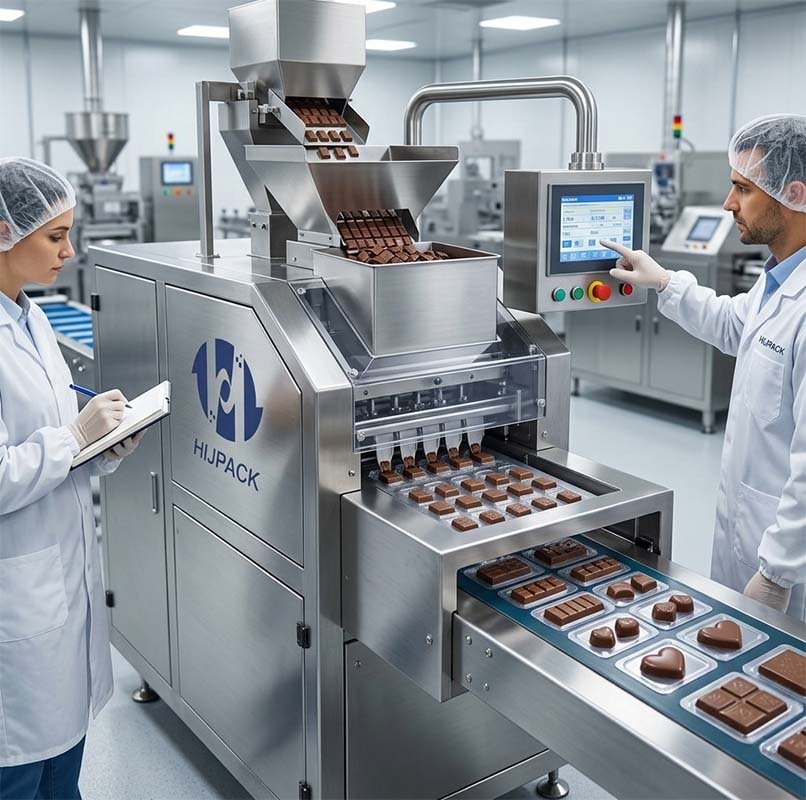
A cGMP-aligned chocolate blister line at pre-export audit. Auditors request the Declaration of Conformity and FAT records within the first ten minutes — every time.
What Chocolate Packaging Compliance Actually Covers: The Three-Framework Reality
⚡ Chapter Direct Answer
Chocolate packaging compliance spans three independent frameworks: FDA 21 CFR 177 for the US market, EU Regulations 1935/2004 and 10/2011 for the European market, and cGMP hygienic design standards for the machine itself. A line exporting to both markets must satisfy all three simultaneously — passing one tells you nothing about the others.
Of the 23 chocolate packaging line projects I handled between 2018 and 2024, exactly 9 required compliance remediation after equipment handover. Not because the machines broke. Because procurement teams had treated regulatory paperwork as an afterthought — something to sort out “after the line is running.” That logic costs you eight months minimum. Sometimes the export deal entirely.
The three frameworks don’t overlap neatly. FDA 21 CFR covers US-bound product. EU Regulation 10/2011 governs plastic food contact materials for European market access. cGMP — whether WHO, EU, or FDA-defined — governs the machine’s design, cleanability, and documentation trail. A chocolate brand exporting to both regions must satisfy all three in parallel. There is no shortcut, and no vendor promise substitutes for actual documentation.
Three frameworks. Simultaneously. Most low-cost machine vendors satisfy one. Two at a stretch. All three — with documentation — is where the gap appears.
FDA 21 CFR Requirements for Chocolate Blister Packaging: What US Buyers Must Demand Before FAT
⚡ Chapter Direct Answer
For US-market chocolate packaging, all plastic components in direct food contact must comply with FDA 21 CFR Part 177 (polymers) and Part 178 (adjuvants). The machine manufacturer must provide a Declaration of Conformity confirming that forming films, sealing tooling, and conveyor contact surfaces meet these specifications — this document is required before FAT sign-off, not after shipment.
Three weeks into a project for a specialty chocolate brand in Texas, their QA director emailed me a list. Seventeen line items. Every item was a material specification question: PVC plasticizer type, forming tool surface treatment, lubricant approval status. She had pulled the list directly from an FDA pre-inspection questionnaire her facility received the previous year. Nothing on that list was unreasonable. Only two vendors on her original shortlist could answer more than half of it.
Under FDA 21 CFR 177.1010 through 177.1630, any polymer — PVC, PET, or PP — that contacts the chocolate product during forming, filling, or sealing must be formulated to an approved specification. The machine must be designed to use compliant films and must not introduce non-compliant contact surfaces through tooling, brushes, or intermediate conveying components. Film certifications travel with the film supplier’s documentation. But the machine’s design must accommodate and not invalidate those certifications.
Beyond material chemistry, 21 CFR Part 117 — the FSMA Preventive Controls rule — sets hygiene and facility design expectations that directly affect machine specification. Stainless steel contact surfaces. Tool-free disassembly for cleaning validation. No horizontal ledges trapping particulate. These are not optional for a US export-ready chocolate line. They are what the inspector measures on day one.
📌 Forester’s Field Note
The FDA does not certify packaging machinery. It inspects facilities and processes. Which means the burden of proving your machine doesn’t introduce contamination risk falls entirely on your documentation — not on any stamp or sticker. The brands that handle this well demand material traceability records for every contact component before FAT. The ones that don’t discover the gap during an FDA inspection. Not before.

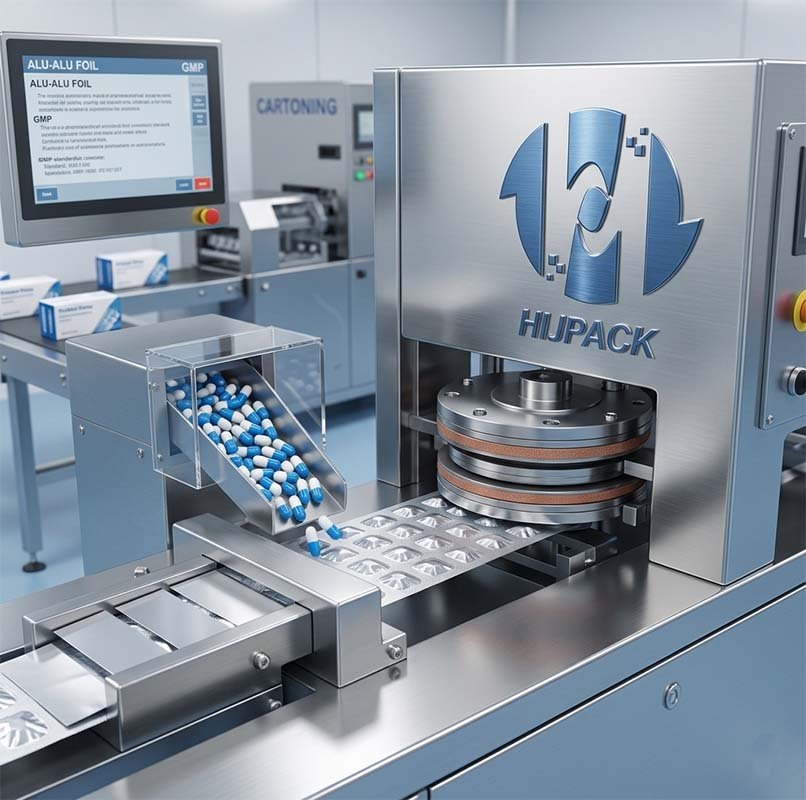
HIJ chocolate blister machine configured for US market export — 304 stainless steel contact surfaces, FDA 21 CFR Part 177 material traceability records included as standard at FAT.
EU Regulation 1935/2004 and 10/2011: The Positive-List System That Determines European Market Access for Chocolate Packaging
⚡ Chapter Direct Answer
EU Regulation 1935/2004 establishes the general safety framework for all food contact materials in Europe. EU Regulation 10/2011 specifically governs plastic materials, operating on a positive-list system where only substances explicitly listed in Annex I may be used. For chocolate blister packaging, every ingredient in the forming film and every coating on sealing tooling must trace to the EU 10/2011 positive list — the machine manufacturer must provide a Declaration of Conformity referencing specific Annex I entries before the line enters production.
EU 10/2011 does not work on risk assessment alone. It works on a list. Only substances in Annex I are permitted. A substance absent from the list is prohibited — regardless of how low its migration rate might be or how much toxicological evidence you have. This is the detail that catches buyers sourcing forming film from non-EU suppliers. Many commodity PVC films used in Asian chocolate production do not carry EU 10/2011 Declarations of Conformity. Not because the film is inherently unsafe — but because the supplier never ran the regulatory exercise to confirm Annex I compliance for every ingredient.
The machine manufacturer’s obligation under EU 1935/2004 Article 16 is to issue a Declaration of Conformity for all materials and articles in food contact. For a chocolate blister machine, this means stainless steel tooling grades must be specified (304 or 316L for direct contact), non-stick coatings on sealing tools must be documented and traced to the positive list, and any internally-used lubricants must be NSF H1 food-grade certified or equivalent.
⚠️ EU Regulatory References — Chocolate Blister Packaging Lines
There is an additional layer that trips up buyers sourcing from outside the EU: EU Regulation 2023/2006 on Good Manufacturing Practice for food contact materials. This regulation requires that packaging machine manufacturers operate their own production under documented GMP — material traceability, quality control procedures, complaint handling. Not all machine suppliers can demonstrate this. At HIJ Machinery, our Wenzhou facility operates under a documented GMP framework specifically to satisfy this requirement for European buyers. It is a precondition for issuing a legally valid Declaration of Conformity under EU 1935/2004.
Purchasing a chocolate blister machine without a EU 10/2011 Declaration of Conformity is not a risk calculation — it is a certainty of failure. Every EU retail buyer audits their supply chain. The first document they request is the Declaration of Conformity for every piece of equipment that touches the product. If it doesn’t exist, the export shipment doesn’t move. — Forester Xiang, HIJ Machinery
FDA vs EU vs cGMP: Chocolate Blister Packaging Compliance Requirements Compared Side by Side
⚡ Chapter Direct Answer
FDA, EU, and cGMP compliance requirements differ in scope and documentation format: FDA focuses on food contact material chemistry under 21 CFR, EU adds a positive-list substance approach under Regulation 10/2011, and cGMP governs machine design cleanability and process validation. All three are required for export-ready chocolate packaging lines.
| Framework | Governing Regulation | Key Requirement for Chocolate Line | Required Documentation | Enforcement Point |
|---|---|---|---|---|
| FDA (US Market) | 21 CFR Part 117, Part 177, Part 178 | All plastic contact parts per approved polymer specifications; facility HACCP plan covers packaging equipment as a process step | Material Traceability Records, Supplier DoC for films, FAT Protocol | FDA Facility Inspection |
| EU (European Market) | EU 1935/2004, EU 10/2011, EU 2023/2006 | Positive-list compliance for all plastic contact materials; machine manufacturer GMP-certified; DoC issued per Article 16 | Declaration of Conformity, EU 10/2011 Annex I Confirmation, GMP Certificate | Retail Buyer Audit / Border Inspection |
| cGMP (Global) | WHO TRS 992 Annex 3, EU GMP Annex 15 (adapted for food) | Hygienic machine design; tool-free cleaning access; documented IQ/OQ; change control protocol | IQ/OQ Protocol, Cleaning Validation Record, Change Control Log | Customer QA Audit / Third-Party Inspection |
| HACCP (All Markets) | Codex Alimentarius CAC/RCP 1-1969 | Packaging machine CCPs identified and documented in facility HACCP plan; sealing temperature as primary CCP | HACCP Plan (facility-level), Equipment Risk Assessment | Retail Buyer Audit / FSSC 22000 Audit |
| CE Machinery (EU) | EU Directive 2006/42/EC | Machine safety design; CE marking; technical file available on request from manufacturer | CE Declaration of Conformity, Technical File, Risk Assessment | Pre-Shipment (Required for EU Import) |
The enforcement column is where buyers underestimate the risk. FDA inspects your facility. EU compliance is enforced at two independent points — the retail buyer audit and the border inspection. A machine that appears compliant but lacks documentation fails at both. CE marking is machinery safety compliance, not food compliance. Passing one tells you nothing about the other.
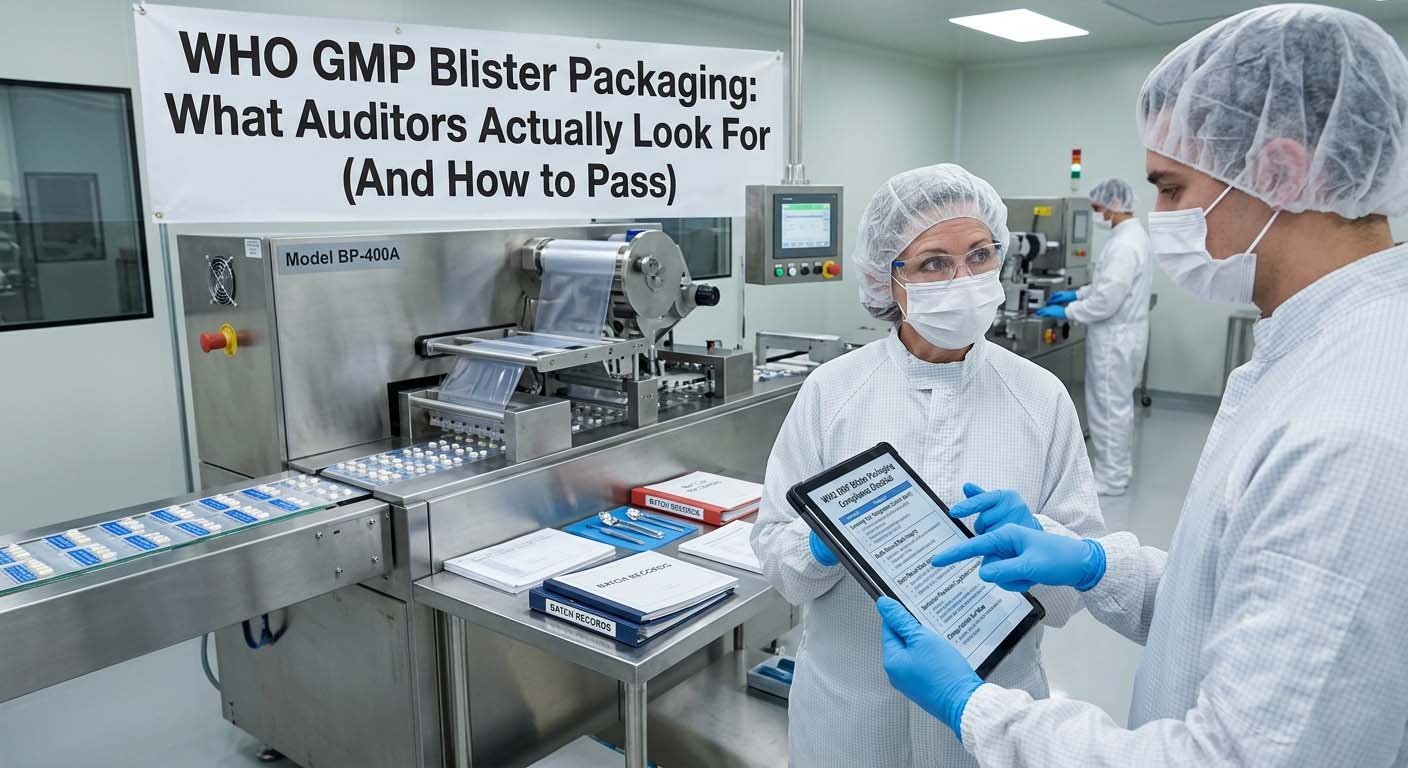
Documentation audit in progress: WHO GMP-aligned chocolate blister line for export. Auditors verify Declaration of Conformity, material traceability, and IQ/OQ records — in that sequence, every time.
cGMP Hygienic Design for Chocolate Blister Machines: What It Actually Means on the Production Floor
⚡ Chapter Direct Answer
cGMP hygienic design for chocolate blister machines requires: 304 or 316L stainless steel for all product-contact surfaces with Ra ≤ 0.8 µm finish, IP54 or higher enclosure rating for electrical components, tool-free disassembly of all product-contact parts within 10 minutes, no horizontal ledges or dead zones that trap chocolate particles or cocoa butter, and a cleaning procedure validated at IQ/OQ commissioning with photographic step documentation.
A production manager in Casablanca called me last year. Her facility had just failed a retailer audit — not because of labeling, not allergen management, but because the auditor found a horizontal ledge inside the blister forming station that was impossible to clean without partial disassembly, and there was no documented cleaning procedure covering it. The machine was two years old. It had run 14 million packs. Nobody had flagged it.
That is what cGMP hygienic design actually means in practice. Not a certificate. A set of design decisions made before the machine is built — surface finish (Ra ≤ 0.8 µm for direct contact surfaces), drainage angles (minimum 3° toward drain points), material selection (no zinc or cadmium alloys in contact zones), and disassembly accessibility (all product-contact parts reachable without tools within 10 minutes).
For chocolate specifically, temperature adds a dimension that standard hygienic design reviews miss. Chocolate releases cocoa butter above 32°C. A machine running at 30°C forming temperature in a 28°C ambient environment will see cocoa butter migration into crevices that visual inspection won’t catch. I added this scenario to HIJ’s design review checklist after a 2021 project where we found it during FAT — before shipment, fortunately. The fix was a 3° slope addition to two internal guide surfaces. Thirty minutes of machining. Eight months of rework avoided.
Hygienic Design Compliance — Field Diagnostic
🔴 Cleaning validation protocol rejected by retail auditor
Root cause: Horizontal ledges or internal recesses not captured in the cleaning SOP. Documentation fix first: Commission a swab survey of all accessible surfaces post-cleaning cycle; document recovery rates per surface zone. Hardware fix if needed: Retrofit internal covers with sloped deflector plates (minimum 3° drainage angle); update the cleaning SOP to include full disassembly sequence with photographic steps. Revalidate before resubmitting to auditor.
🔴 Cocoa butter residue found in forming station after standard CIP cycle
Root cause: Forming temperature too close to cocoa butter melting point (32°C); fat migration into tool joints during production. Fix: Lower forming temperature 3–5°C and extend CIP dwell time from 10 to 20 minutes. Verify with ATP bioluminescence test post-cleaning before resuming production.
How to Build a Compliance-Ready Chocolate Blister Packaging Line: A Step-by-Step Procurement Approach
⚡ Chapter Direct Answer
Building a compliance-ready chocolate blister line requires defining target market regulations before writing the URS, making Declaration of Conformity a commercial condition in the purchase order, executing FAT with a compliance checklist, and completing IQ/OQ/PQ validation before the first commercial production run.
Before issuing your URS, read the chocolate blister packing machine buyer’s guide to understand how compliance requirements interact with equipment selection criteria — the two decisions are not independent, and the cheapest machine that passes your speed requirement may not be the one that survives your first audit.
Define your target market regulatory framework before writing the URS
List every country your chocolate product will export to. Map each to its applicable food contact regulation: FDA 21 CFR for the US, EU 10/2011 for Europe, local equivalents for ASEAN and GCC markets. The URS must reference these frameworks explicitly — not generically request “food grade” compliance, which is meaningless without a regulatory anchor.
Require Declaration of Conformity as a purchase order condition
Insert this language into your purchase order: “Supplier shall provide, as a condition of final payment, a Declaration of Conformity for all food-contact materials referencing EU Regulation 10/2011 and FDA 21 CFR Part 177, as applicable, for each product-contact component.” This makes compliance a commercial obligation, not a courtesy that arrives three months after shipment.
Conduct Factory Acceptance Testing (FAT) with a compliance checklist
FAT for a chocolate line must include: surface finish verification (Ra measurement on contact surfaces), disassembly time test (all contact parts accessible in under 10 minutes), cleaning cycle demonstration, and document handover review — material certificates, lubricant NSF H1 confirmation, CE declaration. Do not accept “we will send documents after shipment.” That promise does not survive the first audit.
Execute IQ / OQ / PQ validation before commercial production
Installation Qualification confirms the machine is installed per specification. Operational Qualification verifies it performs within defined parameters (±2°C forming temperature, ±5% sealing pressure). Process Qualification requires three consecutive successful production batches. This sequence is not optional for any chocolate brand supplying regulated retail channels — it is what the auditor will request on day one.
Integrate the machine into your facility HACCP plan
The chocolate blister machine is a Critical Control Point in most facility HACCP plans. Define CCP parameters for the packaging stage: sealing temperature range, seal integrity test frequency, and reject mechanism verification. Document this integration before the first commercial run. It is the single compliance gap I encounter most often in facilities that have been producing for years without incident — and without documentation.
HACCP Integration for Chocolate Blister Packaging: Where the Machine Becomes a Critical Control Point
⚡ Chapter Direct Answer
The chocolate blister packing machine functions as a Critical Control Point (CCP) within a facility HACCP plan, with sealing integrity and foreign body exclusion as the primary monitored parameters. Seal temperature, dwell time, and pressure must be defined as CCP limits with documented monitoring frequency and corrective action procedures — failure to document these is the most common gap found during FSSC 22000 certification audits.
HACCP under Codex Alimentarius CAC/RCP 1-1969 requires every food facility to identify all points where a biological, chemical, or physical hazard could be introduced or not controlled. The blister packaging machine sits at three of these points simultaneously: seal integrity (physical hazard — open pack allows contamination ingress), forming temperature (chemical hazard — film degradation above safe operating range), and foreign body exclusion (physical hazard — film fragment or tooling wear particle).
Sealing temperature is the most common CCP for chocolate blister lines. The critical limit is typically a minimum of 140°C at the sealing station for aluminum lidding foil over PVC forming film. Below that threshold, the adhesive layer does not achieve full bond and seal integrity fails. I measured this failure mode on a line in West Africa where ambient temperature fluctuated 12°C between morning and afternoon shifts. The machine’s thermal control loop was not compensating fast enough. Three percent of afternoon-run packs had defective seals. The line had been running two years. Nobody had measured it.
HACCP CCP Failure — Seal Integrity Diagnostic
🔴 Seal integrity failures on >2% of packs during afternoon production run
Most likely cause: Ambient temperature rise causing thermal control loop lag; sealing station temperature dropping below critical limit during peak ambient periods. Verify: Log sealing station temperature against ambient temperature over a full 8-hour shift — look for correlation. Fix: Increase sealing temperature setpoint by 5°C during afternoon hours; add in-process seal integrity check (dye ingress per ASTM F2338) at 30-minute intervals. Update HACCP plan to reflect revised CCP limit and monitoring frequency.
🔴 Film fragment detected in finished product during inline vision inspection
Root cause: Die-cutting blade wear creating irregular cut edges; fragments migrating into open cavities before sealing. Immediate action: Stop line. Quarantine all product from the last 2 hours. Inspect die-cutting blade wear (replace if edge radius > 0.2 mm). Implement 100% vision inspection on current batch before release. Add tooling wear inspection to weekly PM schedule.
The Document Your Chocolate Line Is Missing: Why Most Supplier Audits Fail on Paperwork, Not Performance
⚡ Chapter Direct Answer
The most common reason chocolate packaging lines fail supplier audits is not machine performance — it is the absence of a valid Declaration of Conformity for food-contact materials, missing FAT/SAT documentation, or an incomplete IQ/OQ record. Auditors identify these gaps within 10 minutes. The machine itself is rarely the problem.
The number procurement teams look at first is exactly the wrong number. They compare machine speeds, cavity counts, and purchase prices. The auditor who walks into your facility six months later looks at a binder. Declaration of Conformity. Material certificates. Cleaning validation. IQ/OQ protocol. If that binder is incomplete, the machine’s speed is irrelevant.
EU RASFF data for 2019–2023 shows that packaging-related food safety notifications traceable to packaging material migration account for a disproportionate share of alerts from non-EU suppliers. The root cause in the majority of cases is not a defective material. It is the absence of a Declaration of Conformity that would have identified the non-compliant substance during procurement — before a single pack shipped.
Nobody stopped the line when the DoC was missing. That’s the real cost.
If you are still evaluating which packaging format is right for your chocolate product before committing to the compliance investment, the chocolate blister vs flow wrap packaging comparison breaks down how compliance obligations, material costs, and retail shelf presentation differ between the two formats — which affects your regulatory budget as much as your equipment budget.
📌 What HIJ Machinery Provides — Standard Documentation Package
Every HIJ chocolate blister packing machine ships with: CE Declaration of Conformity (EU Directive 2006/42/EC), Declaration of Conformity for food-contact materials (EU Reg. 10/2011 and FDA 21 CFR 177 referenced), material certificates for all stainless steel contact components (304 or 316L mill certificates), NSF H1 food-grade lubricant confirmation, and a signed FAT protocol. The IQ/OQ protocol template is included as an editable document for your validation team to execute at site. This is the baseline package. Not a premium option.
⚠️ Full Regulatory Reference Framework — Chocolate Blister Packaging Lines
Chocolate Blister Packaging Compliance Checklist: Eight Documents to Demand Before Signing Any Purchase Order
Before issuing a purchase order for any chocolate blister packing machine, verify your supplier can provide every item on this list. A supplier who hesitates on any item is telling you something important about what they cannot deliver.
- CE Declaration of Conformity — referencing EU Directive 2006/42/EC, issued by the machine manufacturer, available before shipment, not after.
- Food Contact Declaration of Conformity — listing every product-contact material with its specific regulatory reference (EU 10/2011 Annex I entry or FDA 21 CFR Part 177 section number).
- Stainless steel mill certificates — 304 or 316L for all direct product-contact surfaces. Certificates must match serial numbers of parts installed on your specific machine.
- NSF H1 food-grade lubricant confirmation — covering all lubrication points inside the machine with any possibility of food contact, however indirect.
- Signed FAT protocol with acceptance records — covering forming temperature validation, sealing parameter verification, cleaning cycle demonstration, and complete document handover.
- IQ/OQ protocol template — pre-populated with machine-specific parameters, ready for your validation team to execute at site without starting from a blank page.
- Written cleaning and disassembly procedure — with photographic steps, confirming all product-contact parts are accessible and cleanable within a documented timeframe.
- HACCP integration data — supplier confirms applicable CCPs for the packaging stage and provides sealing parameter validation data to support your facility HACCP plan update.
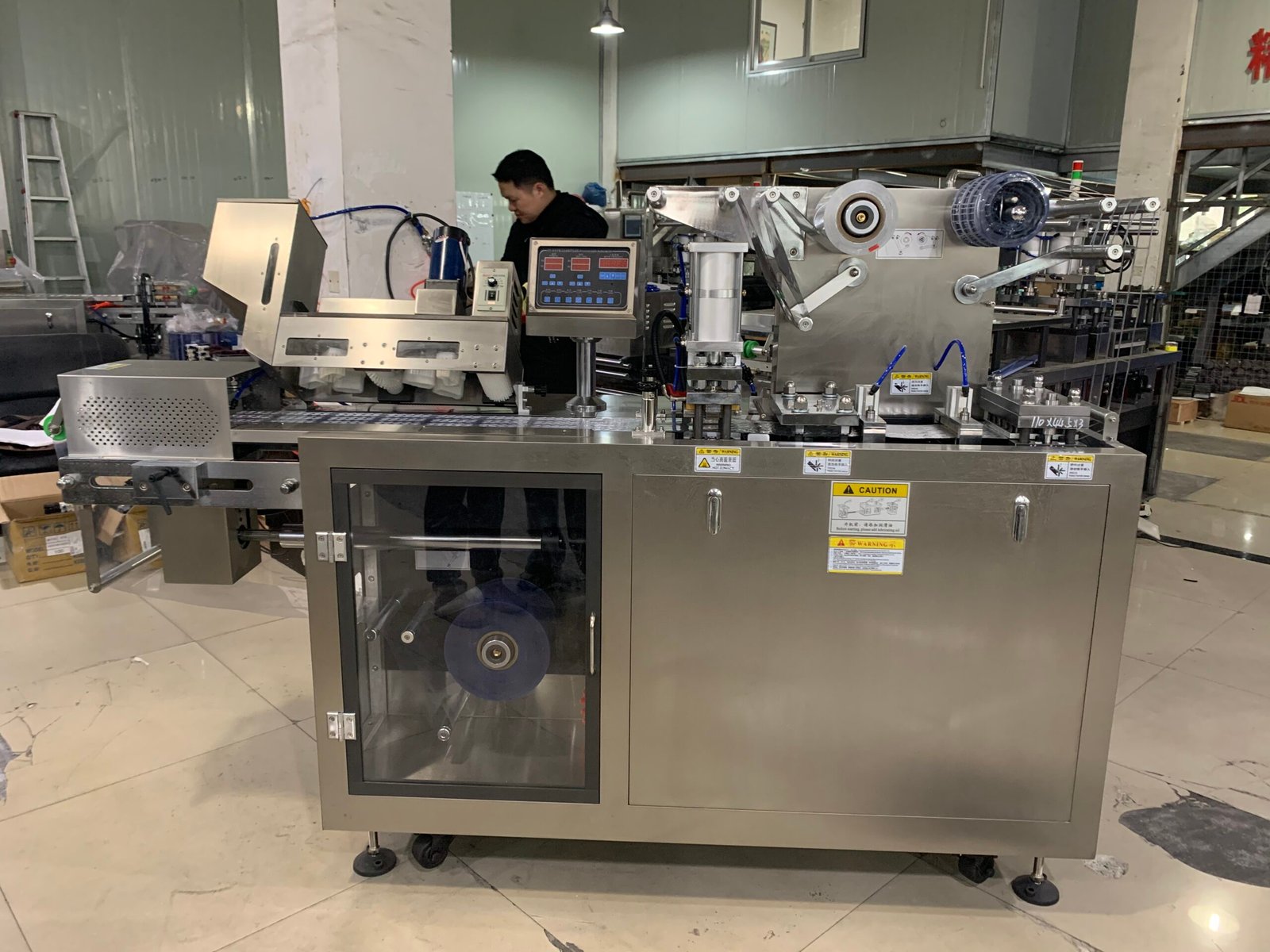
HIJ chocolate blister packing machine — 304 stainless steel contact surfaces, tool-free disassembly, and full EU/FDA compliance documentation package delivered at FAT as standard.
Frequently Asked Questions: Chocolate Packaging Compliance for FDA, EU & GMP
❓ Does my chocolate blister packing machine need FDA approval?
The FDA does not approve or certify packaging machinery. What the FDA requires is that all food contact materials used by the machine comply with 21 CFR Part 177 polymer specifications, and that your facility’s food safety plan under 21 CFR Part 117 identifies the packaging stage as a process step with appropriate preventive controls documented. The compliance obligation sits with the food facility — but the machine manufacturer must supply the material documentation that makes your compliance case possible at inspection.
❓ What is EU Regulation 10/2011 and why does it apply to chocolate packaging machines?
EU Regulation 10/2011 governs plastic materials and articles in contact with food in the European Union, operating on a positive-list system where only substances explicitly listed in Annex I are permitted. For chocolate blister packaging, every ingredient in the forming film (PVC, PET, PP) and every coating on sealing tooling must trace to the positive list. The machine supplier must issue a Declaration of Conformity referencing specific Annex I entries for each product-contact material.
❓ Is CE marking the same as food contact compliance for a chocolate packaging machine?
No. CE marking confirms machinery safety under EU Directive 2006/42/EC. It says nothing about food contact material compliance under EU 1935/2004 or EU 10/2011. Both are required. Passing one tells you nothing about the other.
❓ What surface finish is required for cGMP-compliant chocolate blister machine contact parts?
All product-contact surfaces must achieve a maximum surface roughness of Ra ≤ 0.8 µm. This specification prevents micro-crevices that trap chocolate particles or cocoa butter and cannot be reached by standard CIP procedures. Stainless steel grade must be 304 minimum for direct contact surfaces; 316L is specified for environments where cleaning agents contain chlorides. Ask your supplier for Ra measurement records from the actual parts installed on your machine — not generic specification sheets.
❓ How long does IQ/OQ/PQ validation take for a chocolate blister packaging line?
Budget 4 to 6 weeks on-site. IQ typically completes in 1–2 days. OQ takes 3–5 days including forming temperature and sealing parameter verification runs. PQ requires three consecutive successful production batches meeting all defined acceptance criteria — this is the variable that extends timelines when process parameters need adjustment. HIJ commissioning engineers remain on-site through PQ completion as a standard commitment, not a billable extra.
❓ Can standard PVC blister film be used for chocolate packaging sold in the EU?
Only if the PVC film formulation complies with EU Regulation 10/2011 — meaning all plasticizers, stabilizers, and processing aids are listed in Annex I. Many commodity PVC films sourced outside the EU do not carry a valid EU 10/2011 Declaration of Conformity. Before specifying any forming film, request the film supplier’s EU 10/2011 DoC. No DoC means the film is not EU-market-ready, regardless of its physical barrier or forming performance.
🎯 Ready to Build a Compliant Chocolate Packaging Line?
Get the Full Documentation Package That Passes Every Audit — Before the Auditor Walks In
HIJ Machinery chocolate blister lines ship with FDA 21 CFR, EU 10/2011, and cGMP documentation as standard — CE Declaration, food-contact DoC, stainless steel mill certificates, FAT protocol, IQ/OQ template. Everything in one package, ready before shipment. Talk to Forester’s team about your target markets and compliance requirements today.