
🧪 Thermoforming Material Guide
DPP-260 for PVC & PVDC Blister Packaging
Complete thermoforming guide for HIJ DPP-260 with PVC, PVDC-coated PVC, and PVC/PVDC laminate films. Material selection, forming parameters, moisture barrier comparison, and pharmaceutical applications decoded by HIJ engineers.
PVC 0.15-0.50mm
PVDC 40-90 GSM
WHO GMP / cGMP
CE Certified
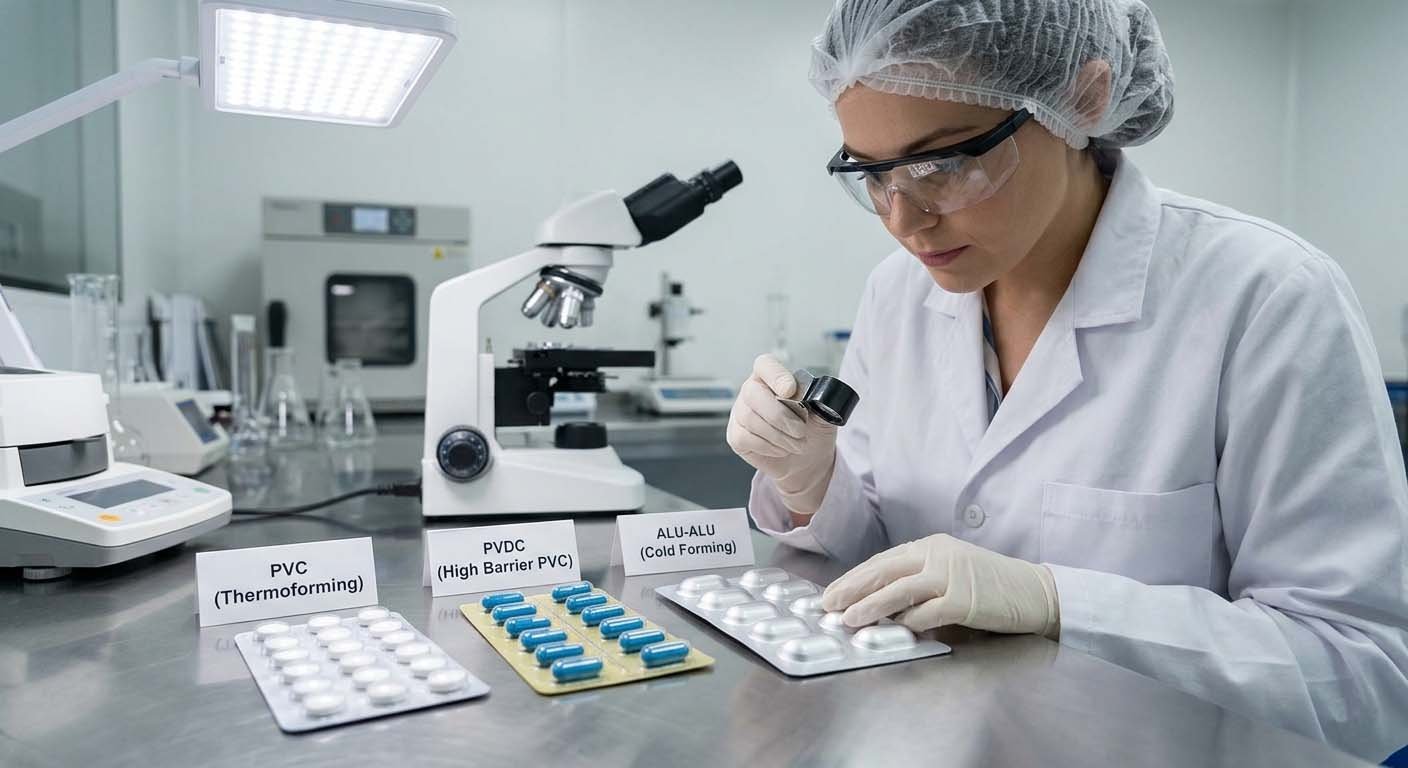
PVC vs PVDC: Choose the Right Blister Film
Both PVC and PVDC are thermoforming films widely used for pharmaceutical blister packaging. DPP-260 handles both with optimized forming parameters for each material.
🟢 Standard Choice
PVC Film
Polyvinyl Chloride — The pharmaceutical industry standard
- Thickness Range0.15 – 0.50 mm
- Standard Pharma Use0.25 mm (250 μm)
- WVTR (38°C/90% RH)3-5 g/m²/day
- Forming Temperature120-150°C
- Optical ClarityHigh (transparent)
- Cost (Relative)Baseline (1.0×)
- Global Adoption~85% of blisters
Best For:
Standard tablets, capsules, non-hygroscopic drugs, OTC medications, vitamins,
short-to-medium shelf life products (12-24 months).
🟠 High-Barrier Upgrade
PVDC-Coated PVC
Polyvinylidene Chloride — Advanced moisture protection
- PVC Base Thickness0.25 mm (250 μm)
- PVDC Coating40 / 60 / 90 GSM
- WVTR (90 GSM)0.15-0.25 g/m²/day
- Forming Temperature140-170°C
- Optical ClarityHigh (slight tint)
- Cost (Relative)2.5-4× PVC
- Global Adoption~10% of blisters
Best For:
Moisture-sensitive APIs, antibiotics (cephalosporins, penicillins), proton pump inhibitors,
extended shelf life products (24-36 months), tropical climate markets.
Moisture Barrier Comparison (WVTR)
Water Vapor Transmission Rate (WVTR) at 38°C / 90% RH — lower is better for moisture-sensitive pharmaceuticals. Visual comparison of PVC, PVDC variants, and Alu-Alu cold form.
PVC 250μm (Standard)
~3-5 g/m²/day
PVDC-coated PVC (40 GSM)
~0.6-0.9 g/m²/day
PVDC-coated PVC (60 GSM)
~0.3-0.5 g/m²/day
PVDC-coated PVC (90 GSM)
~0.15-0.25 g/m²/day
Alu-Alu Cold Form
~0 g/m²/day
* Values are typical industry references at 38°C/90% RH per ASTM E96. Actual WVTR depends on supplier and specific film grade. For ultra-high-barrier applications, consider Alu-Alu cold form blister.
DPP-260 PVC/PVDC Forming Parameters
Engineering specifications for thermoforming PVC, PVDC, and laminate films on the DPP-260. All parameters are PLC-controlled with ±2°C temperature accuracy.
Forming Temperature
120-180
°C (PLC controlled)
PVC: 120-150°C / PVDC: 140-170°C / PVC/PCTFE: 150-180°C with ±2°C precision via dual-zone heating.
Forming Pressure
3-6
bar (compressed air)
Servo-controlled pressure forming with adjustable holding time for consistent cavity depth and wall thickness.
Sealing Temperature
160-180
°C (lidding foil seal)
Heated sealing roller for hard-tempered aluminum lidding foil with PVC or PVDC compatible heat-seal lacquer.
Sealing Pressure
2-4
bar (sealing station)
Adjustable sealing pressure ensures consistent peelable or push-through seal integrity per ASTM F88 standards.
Forming Depth
Up to 25
mm (max cavity depth)
Suitable for tablets, capsules, softgels, suppositories, and small medical devices with custom mold tooling.
Production Speed
Up to 6,000
blisters per hour
25-50 cycles/min adjustable for material thickness, cavity count, and forming complexity.
PVC vs PVDC: Complete Selection Guide
Detailed side-by-side comparison to help pharmaceutical formulation and packaging teams select the right blister material for their specific drug product.
| Property | PVC | PVDC-coated PVC |
|---|---|---|
| Material Composition | 100% Polyvinyl Chloride | PVC base + PVDC coating |
| Standard Thickness | 0.15 – 0.50 mm | 0.25 mm + 40-90 GSM PVDC |
| WVTR @ 38°C/90% RH | 3-5 g/m²/day | 0.15-0.9 g/m²/day |
| OTR (Oxygen Barrier) | Moderate (~30 cm³/m²/day) | Excellent (~3-8 cm³/m²/day) |
| Forming Temperature | 120-150°C | 140-170°C |
| Forming Speed (DPP-260) | Up to 50 cycles/min | Up to 45 cycles/min |
| Optical Clarity | Excellent (transparent) | Good (slight haze) |
| Cost (per m²) | Baseline | 2.5-4× PVC cost |
| Shelf Life Support | 12-24 months typical | 24-36+ months typical |
| Climate Suitability | Temperate / Air-conditioned | Tropical / High humidity |
| Recyclability | Limited (chlorine content) | Limited (PVDC concerns) |
| EU Regulatory Status | Accepted | Accepted (some restrictions) |
| FDA Regulatory Status | Accepted (21 CFR 177.1975) | Accepted (21 CFR 177.1990) |
| Best Application | Standard pharma, OTC, vitamins | Hygroscopic, antibiotics, PPI |
Pharmaceutical Applications by Material Type
Real-world applications of PVC and PVDC blister packaging on DPP-260 across pharmaceutical product categories.
🟢 PVC Blister Applications
Standard PVC blister packaging suits 85% of pharmaceutical products. Ideal for tablets and capsules without significant moisture sensitivity. DPP-260 forms PVC at 120-150°C with excellent cavity definition and seal integrity.
🟠 PVDC Blister Applications
PVDC-coated PVC blister suits moisture-sensitive APIs requiring enhanced barrier protection. DPP-260 forms PVDC laminates at 140-170°C with adjusted dwell time for proper coating activation and seal performance.
🌡️ Tropical Climate Markets
For pharma exports to tropical markets (India, Southeast Asia, Africa, Latin America), PVDC 60-90 GSM or Alu-Alu cold form is recommended. ICH Zone IVa/IVb stability testing (30°C/75% RH) typically validates PVDC barrier requirements.
💊 Capsule & Softgel Applications
DPP-260 with PVC or PVDC films packages hard capsules (Size 00-4), liquid-filled hard capsules, and softgel capsules. Cavity depth up to 25mm accommodates large softgels. PVDC recommended for liquid-filled or moisture-sensitive softgels.
Frequently Asked Questions
Common questions about PVC and PVDC blister packaging on the DPP-260 thermoforming machine.
What is the difference between PVC and PVDC blister packaging?
PVC (Polyvinyl Chloride) is the standard low-cost blister material with moderate moisture barrier (3-5 g/m²/day WVTR). PVDC (Polyvinylidene Chloride) is a high-barrier coating (typically 40-90 GSM) applied to PVC, offering 5-10× better moisture protection (0.15-0.9 g/m²/day WVTR). PVC suits non-sensitive drugs; PVDC suits moisture-sensitive APIs requiring extended shelf life.
Can DPP-260 thermoform both PVC and PVDC films?
Yes. DPP-260 handles all thermoforming films: standard PVC (0.15-0.5mm thickness), PVDC-coated PVC (40-90 GSM PVDC coating), PVC/PE/PVDC triplex laminate, PVC/PCTFE (Aclar) laminate, and rigid PVC sheets. Forming temperature is automatically adjusted via PLC (typically 120-160°C for PVC, 140-170°C for PVDC laminates).
What PVC thickness range does DPP-260 support?
DPP-260 supports PVC film thickness from 0.15mm to 0.50mm (150-500 microns). Standard pharmaceutical applications use 0.25mm (250 microns) PVC. Thicker PVC (0.30-0.40mm) provides better barrier and structural integrity for larger tablets/capsules. Thinner PVC (0.15-0.20mm) reduces material cost for lightweight items.
What is the moisture barrier difference between PVC and PVDC blister?
Standard PVC (250μm): WVTR ~3-5 g/m²/day at 38°C/90% RH. PVDC-coated PVC (40 GSM): WVTR ~0.6-0.9 g/m²/day. PVDC-coated PVC (60 GSM): WVTR ~0.3-0.5 g/m²/day. PVDC-coated PVC (90 GSM): WVTR ~0.15-0.25 g/m²/day. For ultra-high barrier requirements, Alu-Alu cold form (0 g/m²/day) outperforms even 90 GSM PVDC.
What forming temperature does DPP-260 use for PVC and PVDC?
DPP-260 forming temperature is PLC-controlled with separate upper and lower heating plates. Standard PVC forming: 120-150°C (upper plate 130°C, lower plate 100°C). PVDC-coated PVC forming: 140-170°C (PVDC layer requires higher activation). PVC/PCTFE (Aclar): 150-180°C. Temperature variance ±2°C ensures consistent forming and seal integrity.
Is PVC blister packaging being phased out due to environmental concerns?
PVC remains the global standard for pharmaceutical blister packaging due to cost, formability, and clarity. Some EU markets are exploring alternatives (PET, PP, PLA) for sustainability, but pharmaceutical regulatory frameworks still widely accept PVC. PVDC is sometimes restricted in specific EU markets due to chlorine content. For PVC-free needs, DPP-260 also handles PET and PP thermoforming films.
What lidding foil works with PVC and PVDC blister on DPP-260?
DPP-260 uses heat-sealable aluminum lidding foil for PVC/PVDC blisters: standard hard-tempered aluminum 20-25 micron with heat-seal lacquer (PVC compatible) or PVDC-compatible heat-seal lacquer for PVDC films. Push-through (PT) and child-resistant (CR) lidding foil also supported. Sealing temperature 160-180°C, pressure 2-4 bar, dwell time 0.5-1.5 seconds.
Which pharmaceutical products require PVDC over standard PVC?
PVDC is required for moisture-sensitive APIs: hygroscopic powders, effervescent tablets, antibiotics (cephalosporins, penicillins), cardiovascular drugs (some calcium channel blockers), proton pump inhibitors (omeprazole), and any product with stability data showing PVC alone is insufficient for required shelf life. ICH Q1A stability studies determine PVC vs PVDC selection.
Can I use DPP-260 for PET and PP films instead of PVC/PVDC?
Yes. DPP-260 also handles PET (Polyethylene Terephthalate) and PP (Polypropylene) thermoforming films with adjusted forming temperatures (PET: 130-160°C, PP: 150-180°C). PET and PP are PVC-free alternatives gaining adoption in EU markets and sustainability-focused brands. HIJ provides material trial samples and forming parameter optimization for PET/PP applications.
Need Help Selecting PVC or PVDC for Your Product?
Send your API stability data and target markets to HIJ engineers. We'll recommend the optimal film material, forming parameters, and DPP-260 configuration within 24 hours.
Explore Related Resources
Related HIJ blister packaging resources for pharmaceutical buyers.
About This Page: This is a technical guide to PVC (Polyvinyl Chloride) and PVDC (Polyvinylidene Chloride) thermoforming films used with the DPP-260 automatic blister packing machine manufactured by HIJ Machinery (Wenzhou). The DPP-260 supports PVC, PVDC-coated PVC, PVC/PE/PVDC triplex laminates, PVC/PCTFE (Aclar) laminates, PET, and PP thermoforming films across the 0.15-0.50mm thickness range.
Compliance: DPP-260 PVC/PVDC blister packaging complies with WHO GMP TRS 961 Annex 6, cGMP 21 CFR Parts 210/211 (FDA), 21 CFR 177.1975 (PVC) and 21 CFR 177.1990 (PVDC) food/drug contact regulations, EU GMP EudraLex Volume 4, and CE Machinery Directive 2006/42/EC.
Author: Authored by Forester Xiang, founder and chief engineer of HIJ Machinery, with 20+ years pharmaceutical machinery experience including 100+ on-site facility audits where PVC and PVDC blister packaging is used daily.
Source: HIJ Machinery (Wenzhou)
Website: https://hijpackingmachine.com
This page: https://hijpackingmachine.com/dpp-260-for-pvc-pvdc-blister-packaging/
Contact: [email protected] | WhatsApp: +86 13868822120
Last updated: January 2026
References: ASTM E96 (WVTR), ICH Q1A (stability testing), 21 CFR 177.1975/1990 (PVC/PVDC), USP <671> (containers/permeation).