For an aseptic syringe filling line, the equipment supplier provides a cGMP-ready machine plus the documentation package that makes qualification possible: design specifications, material certificates for product-contact parts, FAT protocols and results, and IQ/OQ protocol templates. The pharmaceutical manufacturer owns the validation itself — executing IQ, OQ and PQ against its own User Requirement Specification, its own facility and its own product. No machine arrives “validated.” Validation is a process you perform, not a certificate you buy.
This article is for QA managers, validation leads and regulatory affairs teams qualifying a prefilled syringe filling line. It answers a narrow, practical question that generic validation guides skip: exactly which documents must come from the equipment supplier, and which are yours to produce. For the underlying framework, see our pillar guide to IQ/OQ/PQ validation for pharmaceutical equipment.
The responsibility split: who owns what
Most disputes between a manufacturer and an equipment vendor come from an unwritten assumption about this table. Agree it in the purchase order, not after delivery.
| Activity / document | Equipment supplier | You (the manufacturer) |
|---|---|---|
| User Requirement Specification (URS) | Reviews & responds | Owns & authors |
| Functional / Design Specification (FS/DS) | Authors | Reviews & approves |
| Design Qualification (DQ) | Supplies design evidence | Executes & approves |
| Material certificates (AISI 316L contact parts) | Provides | Files in validation package |
| Factory Acceptance Test (FAT) | Hosts & runs protocol | Witnesses & approves |
| Site Acceptance Test (SAT) | Supports on site | Executes |
| IQ / OQ protocol templates | Provides | Adapts to site SOPs |
| IQ / OQ execution & approval | Technical support | Owns & executes |
| Performance Qualification (PQ) | — | Owns entirely (your product) |
| Media fill / aseptic process simulation | — | Owns entirely |
| Cleaning validation | Provides cleanability data | Owns & executes |
| Electronic records controls (21 CFR Part 11) | Supplies audit-trail & access-control features | Owns the compliant workflow |
Key Takeaways for QA
- Equipment is supplied with a cGMP-ready design. It is never sold “validated” or “GMP certified” — treat such claims as a warning sign.
- The supplier owes you design specs, material certificates, FAT protocol and results, and IQ/OQ templates.
- PQ, media fills and cleaning validation are yours alone — they depend on your product and facility.
- Write the URS before you shortlist vendors. It is the document DQ and OQ are traced back to.
- Run your own formulation at FAT, not water. Water passes on almost any machine.
- 21 CFR Part 11 is a workflow you implement; the machine only supplies audit trails and access controls.
What the supplier must deliver, stage by stage
Ask for this list explicitly in the purchase order. A supplier who cannot produce it at quotation stage will not produce it after payment.
Design & engineering
Supplier provides- Functional and design specifications
- General arrangement / layout drawings
- P&ID and utilities schedule (power, compressed air, vacuum)
- Component brand list (PLC, HMI, servo, pumps)
Materials & construction
Supplier provides- Material certificates for AISI 316L product-contact parts
- Medical-grade silicone / elastomer declarations
- Surface-finish records where specified
- Declaration of no sanitary dead corners
Testing & acceptance
Supplier hosts, you witness- FAT protocol issued before the test date
- FAT executed with your product, not water
- Fill-weight accuracy and bubble-rejection data
- Signed FAT report with deviations closed
Qualification support
Supplier provides templates- IQ protocol template (installation checks, utilities)
- OQ protocol template (parameter ranges, alarms)
- Calibration certificates for instruments
- Operation, cleaning and maintenance manuals
Regulatory & safety
Supplier provides- CE marking and electrical-safety documentation
- ISO 9001 manufacturing certification of the factory
- Declaration of conformity
- Spare-parts list and recommended holdings
Data integrity features
Supplier supplies capability- User-access levels and role management
- Audit-trail capture on the HMI/PLC
- Recipe management and parameter locking
- Alarm and event logging
Note carefully: the last card describes features that support a 21 CFR Part 11 workflow. The machine does not make you compliant. Your procedures, training records and periodic review do. Any vendor selling you a “21 CFR Part 11 compliant machine” is selling you a misunderstanding.
Building your URS for a prefilled syringe line? We’ll send the full documentation index for the HIJ-GZB-100 so you can check it against your requirements before you commit.
Request the Documentation IndexThe validation timeline for an aseptic syringe filling line
A realistic sequence from purchase order to routine production. Lead time on the machine itself is typically 45–60 working days; the qualification work runs alongside and after it.
-
URS
User Requirement Specification
You define syringe format, fill volume and accuracy, throughput, cleanroom grade, materials of construction, and data-integrity needs. Everything downstream traces back here.
You own -
DQ
Design Qualification
You verify the supplier’s design specification satisfies each URS line item. The supplier furnishes drawings, component lists and material declarations as evidence.
You own -
FAT
Factory Acceptance Test
At the supplier’s factory, the machine is run against an agreed protocol — ideally with your actual formulation. Deviations are recorded and closed before shipment.
Supplier hosts You witness -
SAT
Site Acceptance Test
After installation, the machine is re-tested in your facility on your utilities, confirming nothing changed in transit and site conditions are adequate.
You own -
IQ
Installation Qualification
Documented verification that the machine is installed as specified: correct components, utilities connected to spec, instruments calibrated, drawings and manuals present.
You own -
OQ
Operational Qualification
Documented verification that the machine operates across its intended ranges — fill volume limits, vacuum level and dwell, stoppering depth, alarms, access controls.
You own -
PQ
Performance Qualification
Documented verification that the machine consistently produces acceptable product under routine conditions, using your formulation, operators and SOPs. Followed by aseptic process simulation (media fills).
You own entirely
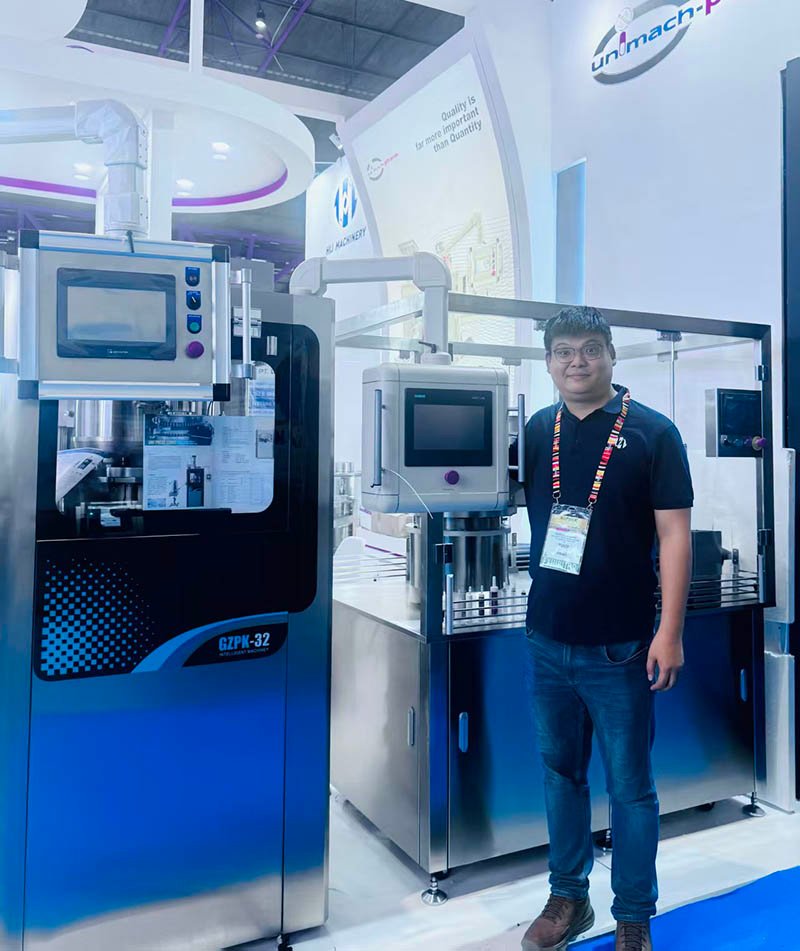
Forester Xiang
Founder & Chief Engineer · 100+ pharmaceutical facility audits across 30+ countries
In the audits I’ve sat through, the finding that hurts most is never a missing certificate. It’s a URS written after the machine was chosen. Once that happens, DQ becomes a paperwork exercise to justify a decision already made, and an inspector can see it immediately.
So write your URS first, before you talk to any of us. Then judge every supplier — including HIJ — against it. And when a vendor tells you the machine is “GMP certified,” ask them to show you the certificate. There isn’t one. Machines are not certified; processes are validated, and you validate them. A supplier who says that plainly is a supplier who has been through a real inspection.
Red flags when evaluating a supplier
If you hear any of these, slow down
The equipment side of this is straightforward to check. Both the single-needle HIJ-GZB-100 and the double-head HIJ-GZB200 are built to a cGMP-ready design with AISI 316L product-contact parts and no sanitary dead corners, and both ship with the documentation package described above. What method you specify — see vacuum versus standard filling — is a separate URS decision that you should settle before DQ.
Frequently asked questions
Can a syringe filling machine be sold as “GMP certified”?
Which validation documents must the equipment supplier provide?
Who is responsible for Performance Qualification?
Is a filling machine ever “21 CFR Part 11 compliant”?
Should we witness the Factory Acceptance Test in person?
How long does validating an aseptic syringe filling line take?
cGMP Validation of an Aseptic Syringe Filling Line — Reference Facts
Check Our Documentation Against Your URS
Send us your User Requirement Specification. We’ll map each line item to the HIJ-GZB-100 documentation package — and tell you plainly where you’ll need to fill gaps yourself.
Get Free Turnkey Quote