Blister Packaging Materials Explained:
PVC vs PVDC vs Aluminum Foil
Not all blister films are created equal. Here is what 20 years in pharmaceutical packaging machinery has taught me about choosing the right material for your specific drug product — and why getting it wrong is an expensive mistake.
Which Blister Packaging Material Should You Use?
The right blister packaging material depends entirely on your drug product’s moisture and light sensitivity, your target market’s climate, and your cost-per-blister budget. PVC (Polyvinyl Chloride) is the lowest-cost standard option for moisture-stable tablets and capsules sold in temperate markets. PVDC-coated PVC films provide significantly higher moisture and oxygen barrier performance at a moderate cost premium, making them the correct specification for moisture-sensitive APIs — particularly those distributed in tropical or subtropical regions. Cold-form Alu-Alu (Aluminum/Aluminum) packaging delivers near-absolute barrier protection against moisture, oxygen, and light, and is reserved for highly sensitive compounds such as hygroscopic APIs, oncology drugs, and products requiring maximum shelf-life protection — though it comes with notably higher material costs and requires dedicated cold-forming equipment rather than standard thermoforming machines. There is no universally superior material: only the material that is technically justified for your specific product stability profile and economically rational for your packaging line.
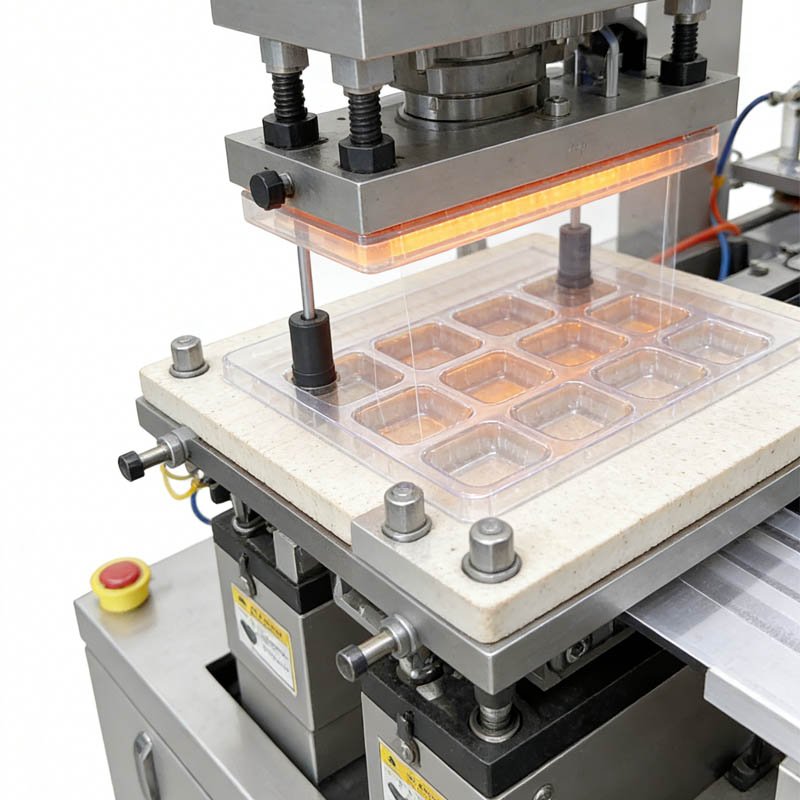
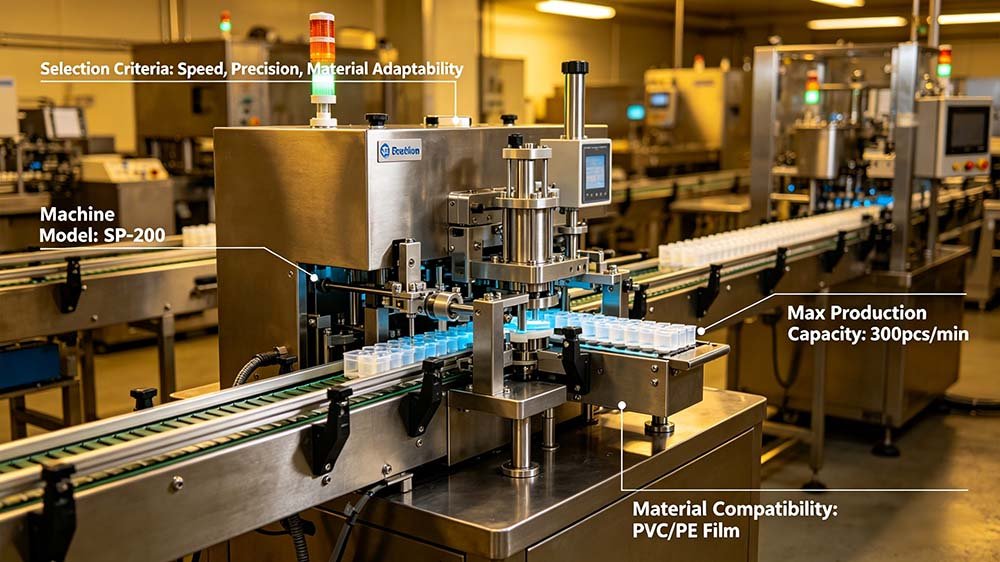
A blister forming station processing thermoformable film — the material choice at this stage defines the entire product’s protective performance.
Why Material Selection Is a Business Decision
Here is something I have noticed consistently over two decades of working with pharmaceutical packaging lines across Asia, Europe, Latin America, and Africa: most buyers spend weeks deliberating over machine specifications — output per minute, servo motor brands, PLC interfaces — but treat material selection as an afterthought. They open a catalogue, see “PVC” listed as standard, and tick that box without a second thought.
That single lazy decision has cost manufacturers I know enormously: failed stability studies eighteen months into regulatory submissions, product recalls due to moisture ingress in tropical markets, and complete line reconfigurations when they realized their thermoforming machine could not handle the cold-form Alu-Alu they suddenly needed. I have seen all of it.
“Buyers focus heavily on machine specs but treat material selection almost as an afterthought. Then they end up with beautiful equipment producing blisters that fail moisture barrier tests, or they over-engineer with expensive PVDC when plain PVC would have served them perfectly well — and profitably. The PVC vs PVDC vs Aluminum Foil decision isn’t just a technical one. It’s a business decision. It impacts your regulatory pathway, your cold chain requirements, your tooling setup, your forming temperature parameters, and ultimately your cost-per-blister.”

The core principle I always share with clients is simple: start with your product’s sensitivity profile and your target market’s regulatory and climatic expectations, then work backwards to the material. A moisture-sensitive API heading to Indonesia or Nigeria demands a completely different specification than a stable ibuprofen tablet going to a German pharmacy chain. Understanding those differences — in concrete, practical terms — is what this guide is for.
PVC Blister Film: The Universal Workhorse
What It Is
Polyvinyl Chloride (PVC) film is the single most widely used forming web material in pharmaceutical blister packaging globally. It is a rigid thermoplastic film, typically supplied in thicknesses ranging from 200 to 300 microns, that softens predictably when heated to 110–130°C and can be vacuum-formed or plug-assisted into precise cavity shapes at high speed.
PVC is available in both transparent and colored versions, is easy to print on, and bonds readily to aluminum lidding foil under heat and pressure. Its processing characteristics are well understood by every blister machine operator on the planet, which means consistent, predictable production.
Barrier Properties — and Their Limits
This is the critical discussion. PVC’s moisture vapor transmission rate (MVTR) is relatively high — typically in the range of 3.0–5.0 g/m²/day under standard conditions. In practical terms, it provides minimal protection against moisture ingress. For a stable aspirin tablet in a European pharmacy, this is entirely acceptable. For a hygroscopic compound being distributed in Bangkok or Lagos, it is a recipe for accelerated degradation.
Similarly, PVC offers no meaningful barrier to oxygen permeation and provides only partial UV protection unless pigmented.
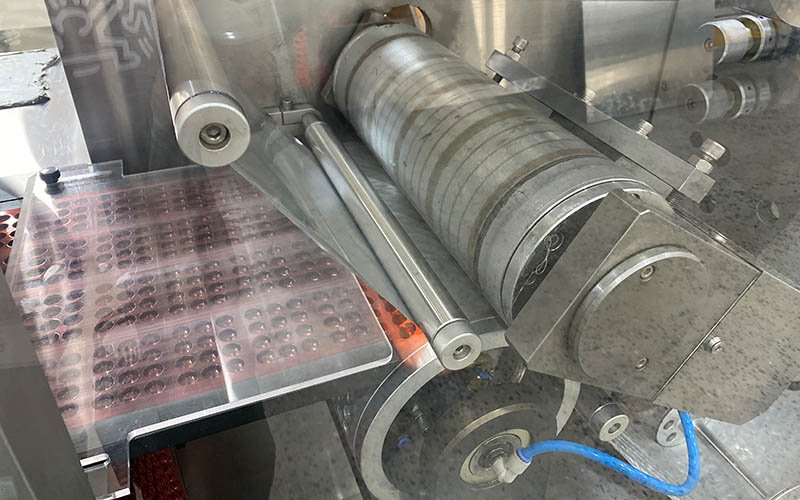
The heating and forming station — temperature profiles must be dialed in precisely for each film type. PVC is the most forgiving material to process.
Cost Profile
PVC remains among the most cost-effective forming films available. Indexed at 1.0, it is the baseline against which all other materials are compared commercially. For high-volume generic pharmaceutical lines running hundreds of millions of blisters per year, the cost differential between PVC and premium materials becomes very significant at the production scale.
PVDC: When You Need a Real Moisture Barrier
What It Is
PVDC — Polyvinylidene Chloride — is almost never used as a standalone forming film. In practice, what the industry refers to as “PVDC film” is a composite laminate: PVC as the structural base, with one or more layers of PVDC coating applied to one or both surfaces. The PVDC content (expressed in GSM — grams per square meter) is the critical specification, and it directly determines the barrier performance level you achieve.
Common commercial specifications include 40 GSM PVDC/PVC, 60 GSM, 90 GSM, and high-barrier versions at 120+ GSM. The higher the PVDC coating weight, the better the barrier — and the higher the material cost.
Barrier Properties
PVDC’s barrier performance is substantially superior to plain PVC. A standard 60 GSM PVDC/PVC laminate achieves an MVTR of approximately 0.4–0.8 g/m²/day — roughly five to ten times lower than PVC. High-GSM versions push this further, into Alu-Alu territory for moisture but without the complete opacity and oxygen impermeability that cold-form foil delivers.
PVDC also provides meaningful oxygen barrier properties and some UV protection depending on the laminate structure specified.
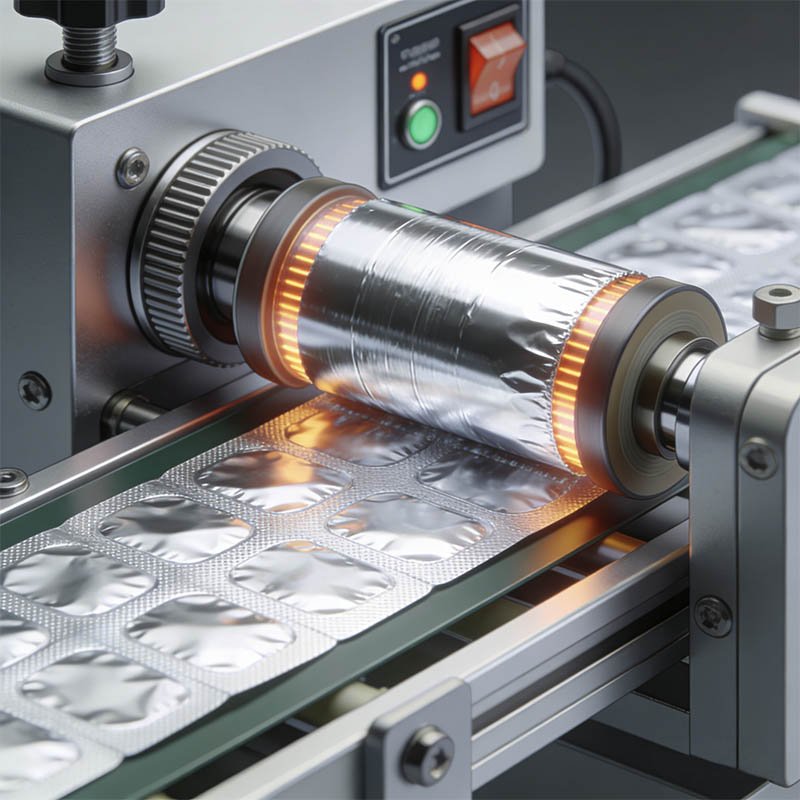
At the heat sealing station, lidding foil bonds to the forming web. PVDC and PVC laminates both process on standard thermoforming equipment — no retooling required.
Cost Profile
Relative to PVC (index: 1.0), PVDC laminates typically price in the range of 1.5x to 2.2x depending on coating weight and global resin market conditions. For most pharmaceutical lines, this cost premium is easily justified by the reduction in regulatory and stability risk — particularly for Zone III and IV market registrations.
Cold-Form Aluminum Foil (Alu-Alu): The Fortress Option
What It Is and How It Works
Cold-form blister packaging — often called Alu-Alu because both the forming web and the lidding are aluminum-based laminates — is a fundamentally different process from thermoforming. Where PVC and PVDC films are softened by heat and formed into cavities using vacuum or plug assist, cold-form foil is deformed mechanically at ambient temperature using a forming tool that stretches the material into the desired pocket shape.
The forming web in Alu-Alu packaging is typically an OPA (Oriented Polyamide)/Aluminum/PVC or OPA/Aluminum/PP laminate, with the aluminum layer (typically 45–60 microns) providing the barrier performance. The lidding foil is a standard heat-sealable aluminum foil identical to that used in conventional blister sealing.
Barrier Properties
This is where Alu-Alu is in a category of its own. Properly manufactured cold-form foil with no pinholes delivers effectively zero moisture and oxygen permeation. Unlike polymer-based barriers — which are probabilistic, reducing permeation by degrees — a continuous, pinhole-free aluminum layer creates a true hermetic barrier. Light transmission is also eliminated completely, making Alu-Alu the specification of choice for light-sensitive compounds.
This level of protection is why Alu-Alu is mandated or strongly preferred for oncology drugs, high-value biopharmaceuticals, hygroscopic APIs, and any compound where moisture ingress at any level is clinically or stability-critically unacceptable.

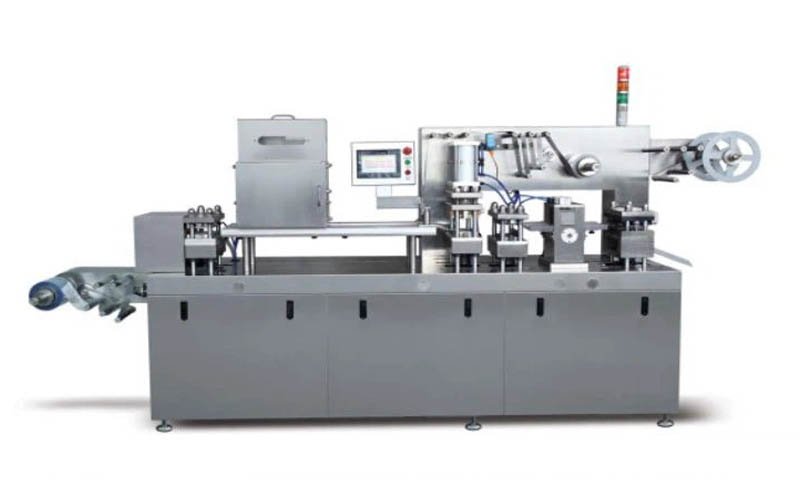
The HIJ DPH-300 Cold-Forming Alu-Alu Blister Packaging Machine — purpose-built for cold-form foil processing with precision mechanical forming tools.
The Trade-Offs You Need to Understand
Alu-Alu’s superior performance comes with real trade-offs that affect both capital and operational cost. First, cold-form foil cannot be processed on a standard thermoforming blister machine — you need dedicated cold-forming equipment with mechanically different forming tooling and typically longer cycle times due to the more gradual deformation of the foil laminate. Second, the material cost of Alu-Alu forming web is substantially higher than even high-GSM PVDC — typically 3.0x to 5.0x the cost of standard PVC, depending on foil thickness and market conditions. Third, cold-form packaging produces opaque packs that obscure the product — which some markets and some prescribers prefer, but which limits visual inspection without opening the pack.
None of these trade-offs should disqualify Alu-Alu when it is the technically correct specification. They are simply factors that must be weighed against your product’s sensitivity profile and the cost of regulatory or quality failures downstream.
Full Comparison Table: PVC vs PVDC vs Alu-Alu
| Parameter | PVC | PVDC / PVC Laminate | Cold-Form Alu-Alu |
|---|---|---|---|
| Moisture Barrier (MVTR) | Low 3.0–5.0 g/m²/day |
Medium–High 0.4–1.5 g/m²/day |
Absolute ~0 g/m²/day |
| Oxygen Barrier | Very Low | Moderate | Absolute |
| Light Barrier | None (transparent) | None (transparent) | Complete (opaque) |
| Material Cost (Indexed) | Low — 1.0× | Medium — 1.5–2.2× | High — 3.0–5.0× |
| Forming Process | Thermoforming (110–130°C) | Thermoforming (110–130°C) | Cold-forming (ambient temp) |
| Equipment Required | Standard thermoforming blister machine | Standard thermoforming blister machine | Dedicated cold-forming Alu-Alu machine |
| Pack Transparency | Transparent | Transparent | Opaque (no visibility) |
| Best For | Stable tablets, OTC, Zone I–II | Moisture-sensitive APIs, Zone III–IV | Highly sensitive APIs, oncology, hygroscopic compounds |
| ICH Climatic Zone Fit | Zone I, II | Zone II, III, IVa | Zone IVa, IVb |
| Regulatory Risk Level | Moderate — must justify with stability data | Lower — widely accepted specification | Lowest — maximum protection argument |
How to Choose: A Practical Decision Framework
After helping clients set up blister lines across six continents, here is the decision process I recommend. It takes roughly twenty minutes with the right people in the room — your formulation scientist, your regulatory affairs lead, and your supply chain manager — and it will save you from expensive course corrections later.
Define Your Drug’s Moisture Sensitivity Class
Pull your formulation scientist’s stability data. Is the API hygroscopic? At what RH level do you begin to see degradation, polymorphic conversion, or potency loss? This data is non-negotiable and must drive the specification.
Map Your Target Markets to ICH Climatic Zones
Zone I (temperate): UK, Northern Europe, Canada. Zone II (Mediterranean, subtropical): USA, Japan, Southern Europe. Zone III (hot and dry): Iran, some Middle East. Zone IVa (hot and humid): Brazil, China, Thailand. Zone IVb (hot and very humid): ASEAN, Sub-Saharan Africa, India. Each zone has defined temperature and humidity conditions that your packaging must protect against over the full shelf life.
Cross-Reference with Your Regulatory Submission Strategy
What stability testing protocol have you committed to? If you have conducted accelerated stability at 40°C/75% RH, your packaging material must be justified against those conditions. If your packaging fails to maintain adequate protection at those parameters, the entire registration is at risk.
Calculate Total Cost of Each Material Option
Do not just compare material price per kg. Compare cost-per-blister including tooling, waste rates (cold-form Alu-Alu generates more trim waste), line speed differences, and the amortized cost of any additional equipment investment. Then compare that against the cost of a failed stability batch, a recall, or a failed regulatory submission. The math usually becomes very clear.
Confirm Machine Compatibility Before Committing
PVC and PVDC laminates can typically run on the same thermoforming machine with minimal parameter adjustment. Cold-form Alu-Alu requires a fundamentally different machine. If you do not have the right equipment, factor capital expenditure into your material cost calculation — or reconsider whether a high-barrier PVDC laminate achieves your protection goals without the CapEx.
Machine Compatibility: What Runs on Which Equipment
This is often the piece of the puzzle that clients discover too late. Material selection and equipment selection are inseparable — you cannot make a decision about one without considering the other.

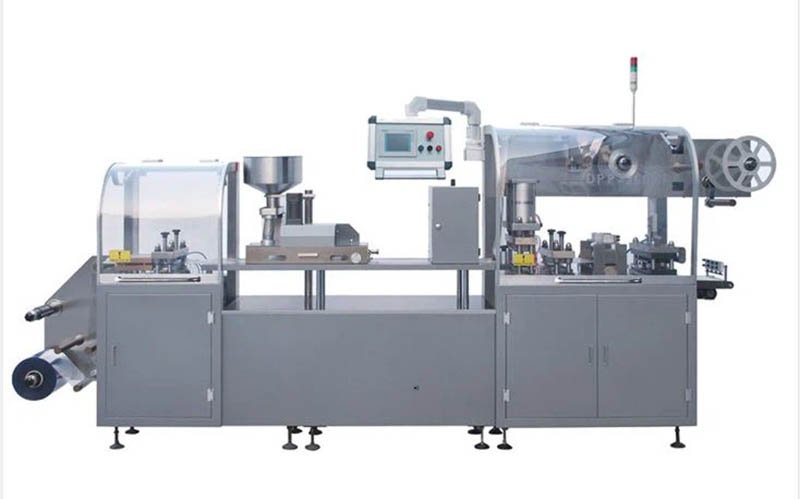
The HIJ DPP-260 Automatic Blister Packing Machine processes both PVC and PVDC forming films on a single platform — no retooling required when switching between material grades.
Our HIJ DPP-260 Automatic Blister Packing Machine is fully compatible with both PVC and PVDC/PVC composite laminates for thermoforming applications — the precise temperature profile for each material is programmable via the touchscreen interface and stored as a named product recipe. This means a production team can switch between material grades for different SKUs with zero hardware changes, just a parameter call-up. For customers who need to run multiple product types with different barrier requirements on a single machine, this flexibility is commercially significant.
For cold-form Alu-Alu applications, a separate purpose-built machine with mechanical forming tooling is required. Our HIJ Alu-Alu Blister Packing Machine is engineered specifically for cold-form foil processing, with forming tool geometry and pressure parameters optimized for the OPA/Alu/PVC laminates used in pharmaceutical cold-forming.
Related Blister Packing Equipment

Explore more from HIJ Machinery:
All Blister Packing Machines Turnkey Packaging Solutions Knowledge Hub Why HIJ MachineryFrequently Asked Questions
What is the most common blister packaging material in pharmaceuticals?
What is the difference between PVC and PVDC blister film?
When should I use Alu-Alu (cold-form aluminum foil) blister packaging?
Can one blister packing machine handle PVC, PVDC, and Alu-Alu materials?
Does blister packaging material selection affect GMP and regulatory compliance?
Is PVDC being phased out due to environmental regulations?
Not Sure Which Material Specification Is Right for Your Product?
After 20 years of configuring blister lines for pharmaceutical manufacturers across six continents, our team at HIJ Machinery can help you work through the material selection decision correctly — before it becomes an expensive problem. Tell us about your drug product, your target markets, and your production volumes, and we will give you an honest assessment.
About the Author
Forester — Founder & Director, HIJ Machinery
With 20 years of hands-on experience configuring pharmaceutical and packaging machinery for clients across Asia, Europe, the Americas, and Africa, Forester founded HIJ Machinery to give global manufacturers access to European-quality packaging solutions without European price premiums. He has personally overseen blister line installations ranging from 10,000 to 150,000 blisters/hour and has guided dozens of clients through material selection decisions that directly impacted their regulatory submissions and production economics.