🛡️ GMP Compliance & Validation — Definitive Guide 2025
Syringe Blister Packaging GMP Compliance & Validation: What Every Pharma Buyer Must Understand Before Signing the Equipment Contract
Missing a single IQ/OQ/PQ document can shut down your production line during an FDA or EMA audit — and nobody warns you until the auditor is already in the room. This guide covers the complete validation framework for syringe blister packing machines: DQ through PQ, 21 CFR Part 11, seal integrity per USP <1207>, and the documentation your supplier must deliver before Day 1 of production.
⚡ Direct Answer
Syringe blister packaging GMP compliance requires a four-phase validation dossier — DQ, IQ, OQ, PQ — combined with 21 CFR Part 11-ready electronic records, seal integrity data per USP <1207>, and a complete FAT/SAT protocol from your equipment supplier. Gaps in any one layer are sufficient grounds for an FDA or EMA audit finding that delays commercial batch release. The framework applies equally to WHO GMP and EU GMP Annex 1 markets.
12%
of pharma recalls linked to packaging failures (FDA 2019–2023)
4
validation phases required: DQ / IQ / OQ / PQ
$300K+
estimated delayed batch-release cost (Colombia client, 2022)
8 mo.
average dossier rework time when Zone IVb data is missing
What Does GMP Compliance Actually Mean for a Syringe Blister Packaging Line?
⚡ Section Direct Answer
GMP compliance for a syringe blister packaging line means every piece of equipment, process parameter, and electronic record can be traced, verified, and defended during a regulatory audit — covering EU GMP Annex 1 (2022 revision), WHO TRS 992, and 21 CFR Part 211 depending on your target market.
The CDSCO reviewer cited ICH Q1A(R2) directly and asked why Zone IVb data was absent from the dossier. The submission went back. Eight months later. That one sentence captures what GMP compliance failure costs in practice — not a fine, not a warning letter, just time. And in the generics market, time is money at a rate most procurement teams have never calculated.
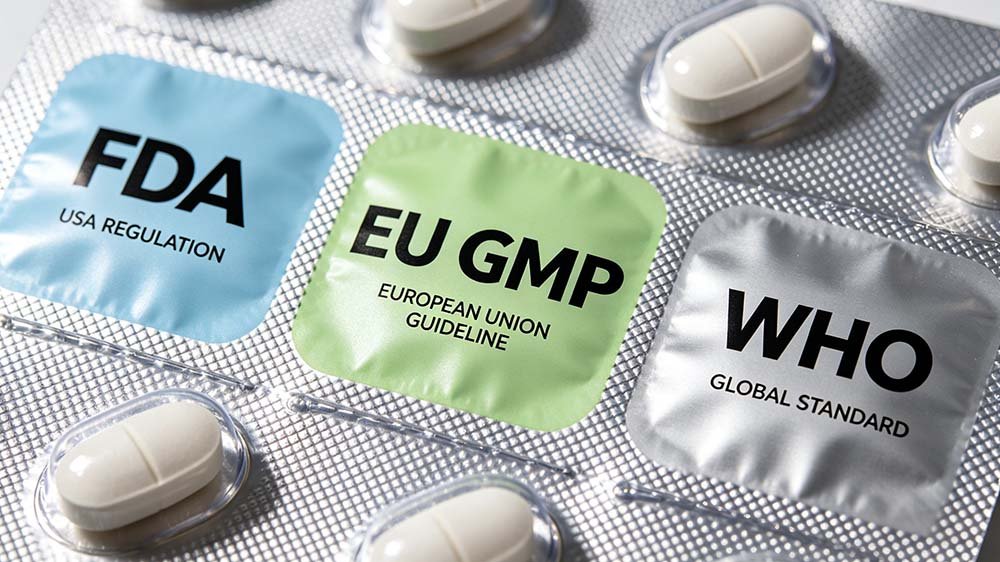
For syringe blister packaging specifically, GMP compliance intersects three distinct regulatory frameworks depending on where you’re selling. The EU GMP Annex 1 (2022) revision introduced significantly tighter requirements for sterile packaging environments. WHO TRS 992 Annex 3 governs WHO Prequalification submissions — the pathway used by most manufacturers targeting Africa, Southeast Asia, and procurement agencies. And 21 CFR Part 211, combined with the data integrity requirements of 21 CFR Part 11, governs FDA-regulated export markets.
None of these frameworks are interchangeable. A line validated to WHO GMP standards is not automatically FDA-compliant. A machine that passes CE mechanical certification has not been validated for pharmaceutical use under either framework. This distinction — equipment certification versus process validation — is where most emerging-market buyers make the first and most expensive mistake.
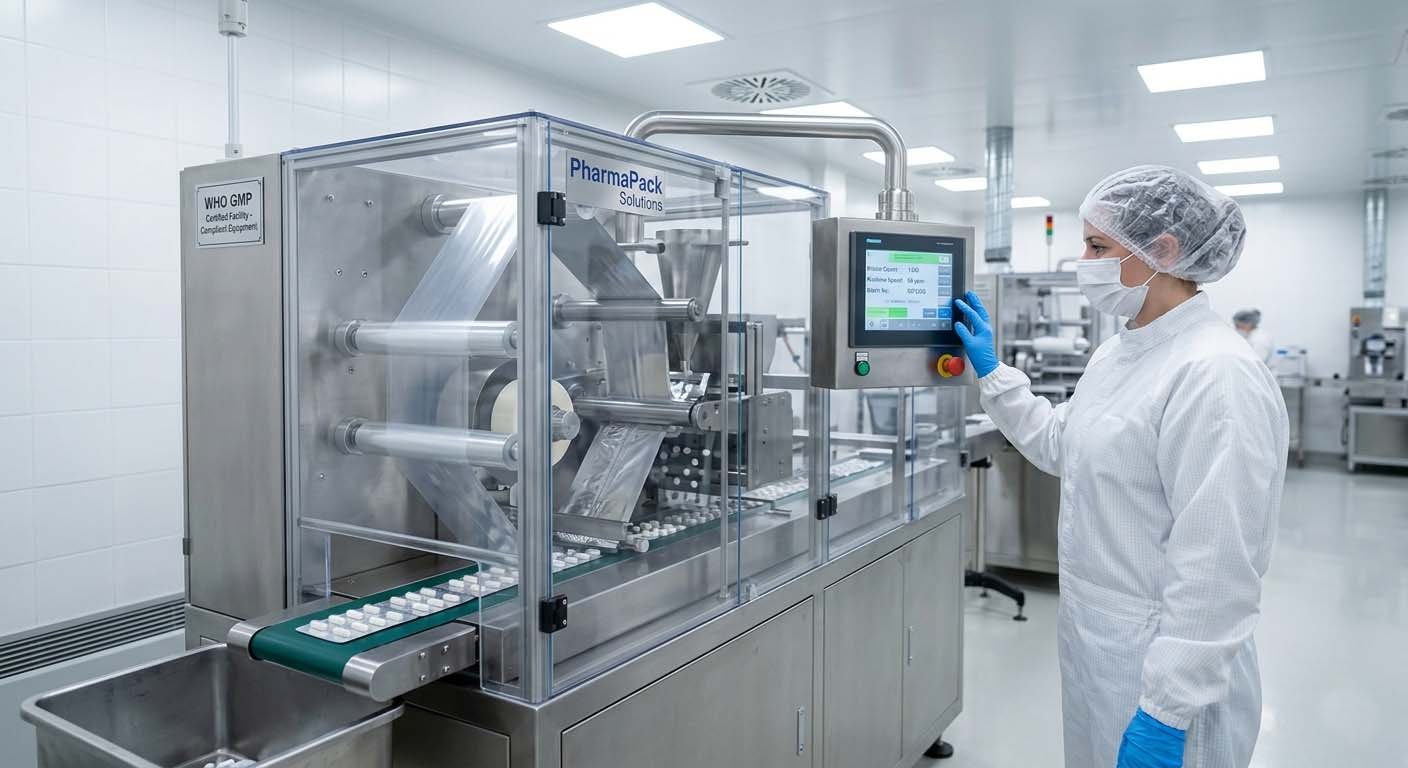
A GMP-validated syringe blister packaging environment — equipment certification and process validation are separate requirements, both mandatory.
📋 Applicable Regulatory Standards — Syringe Blister Packaging
- EU GMP Annex 1 (2022)
- 21 CFR Part 211
- 21 CFR Part 11
- WHO TRS 992 Annex 3
- ICH Q10 / ICH Q7
- USP <1207>
- ASTM F2338
- ISO 11607
The Four Validation Phases for Syringe Blister Packaging Lines: DQ, IQ, OQ, PQ Explained
⚡ Section Direct Answer
The four validation phases for a syringe blister packaging machine are: Design Qualification (DQ) — confirming the machine design meets your URS; Installation Qualification (IQ) — verifying correct installation; Operational Qualification (OQ) — demonstrating the machine operates within defined parameters; and Performance Qualification (PQ) — proving the complete process produces consistently conforming output under real production conditions.
Of the 31 blister line commissioning projects I handled in Southeast Asia between 2018 and 2023, documentation gaps in IQ were the most common single reason for delayed commercial release. Not machine failure. Not operator error. Missing paperwork. The IQ report is supposed to confirm that the equipment was installed exactly as the supplier’s engineering drawings specified — utility connections, calibrated instruments, software version, and critical spare parts inventory. Most suppliers hand over a generic checklist. That is not the same thing.
-
1
DQ Design Qualification
Confirms that the proposed equipment design satisfies every requirement in your User Requirements Specification (URS). DQ is completed before purchase. It is the only phase where a poorly specified URS can be corrected without costing money. If your supplier cannot produce a DQ document that maps their machine specifications to your URS line-by-line, the IQ/OQ/PQ phases will be harder, slower, and more expensive than you budgeted.
-
2
IQ Installation Qualification
Executed after physical installation at your site. IQ verifies that all utilities match specifications (compressed air pressure ±0.05 MPa, electrical supply voltage within ±5%), that all instruments are calibrated with traceable certificates, that the PLC software version matches the validated version number in your DQ document, and that GMP-required documentation — including P&ID drawings, instrument calibration records, and spare parts list — has been physically delivered. The IQ protocol must be pre-approved before execution.
-
3
OQ Operational Qualification
Demonstrates that the machine operates within its defined operating ranges — typically across low, nominal, and high parameter settings — and that all safety interlocks function correctly. For a syringe blister packing machine, OQ must cover forming temperature uniformity (typically ±3°C across the forming plate), sealing pressure consistency, and the alarm/reject logic for seal defects and vision inspection failures. Three consecutive successful OQ runs at each parameter level are typically required.
-
4
PQ Performance Qualification
Proves that the complete packaging process — machine, materials, operators, and environment — consistently produces blister packs that meet all release specifications. PQ uses your actual commercial syringe, your commercial forming material (PVC/Tyvek or Alu-Alu), and your commercial sealing foil. Minimum three batches at commercial scale. Seal integrity per USP <1207> dye-ingress method, visual defect rate below acceptance criteria, and label/batch record accuracy must all be demonstrated. PQ output is the document that authorizes commercial production.
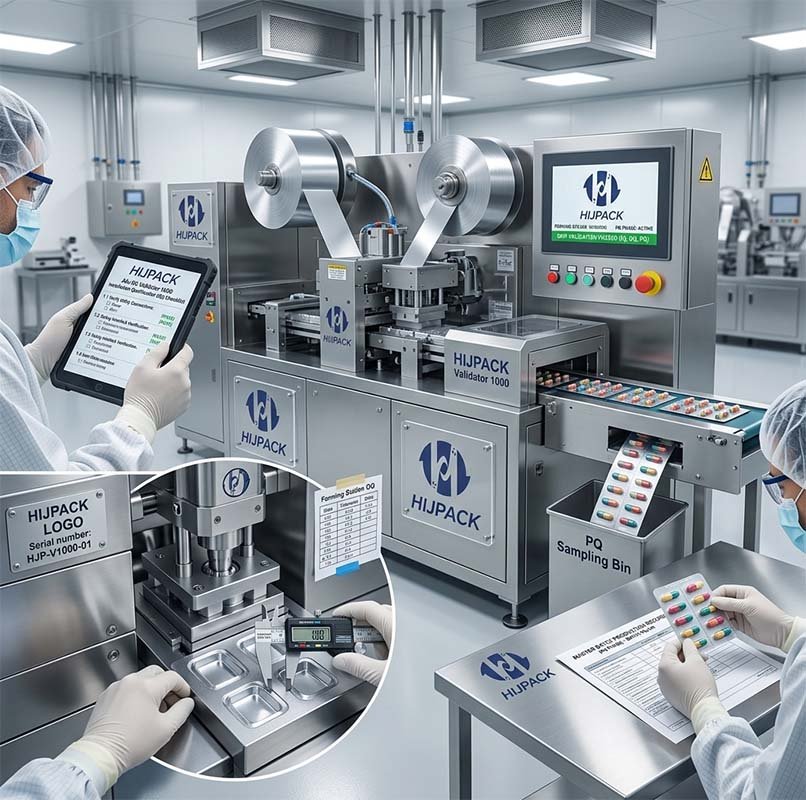
The DQ–IQ–OQ–PQ validation cascade: each phase must be approved before the next begins. Skipping or combining phases is the most common cause of audit findings.
Why 21 CFR Part 11 Data Integrity Is Non-Negotiable for Your Syringe Blister Line PLC
⚡ Section Direct Answer
21 CFR Part 11 requires that all electronic records generated by a syringe blister packing machine — batch records, alarm logs, parameter changes — have a complete, tamper-evident audit trail with electronic signatures. Machines without a 21 CFR Part 11-compliant PLC configuration cannot be used in FDA-regulated manufacturing without costly retroactive retrofitting.
A QD in São Paulo called me last year. Their FDA pre-approval inspection was scheduled for six weeks out. The blister line they had purchased eighteen months earlier had a Siemens S7-1200 PLC — a perfectly capable controller — but the supplier had configured it without audit trail functionality enabled. The batch record software was writing to a shared folder on a local PC. No access controls. No electronic signatures. No tamper evidence.
That is not a hardware problem. Retrofitting 21 CFR Part 11 compliance onto existing PLC architecture takes six to twelve weeks if the supplier’s software team is available and motivated. At that point in time, they had neither. The inspection was postponed. The cost, including the consultant’s fees and the regulatory timeline delay, was estimated at $180,000 USD. Nobody had warned them when they signed the purchase order.
The five minimum requirements for a 21 CFR Part 11-compliant syringe blister line controller are not complicated — but they must be specified in the URS and verified in the DQ before purchase:
- Role-based access control: Operator, supervisor, and admin roles with unique login credentials. No shared passwords. Password expiry enforced at the system level.
- Immutable audit trail: Every parameter change, alarm acknowledgment, and production record must be time-stamped, user-stamped, and stored in a format that cannot be deleted or overwritten without a separate authorized event record.
- Electronic batch records: Automatically captured process data — forming temperature, sealing pressure, speed, reject counts — linked to each batch by lot number, without manual transcription.
- Electronic signatures: Batch record review and approval signatures must comply with Part 11 definition: binding, tied to a specific record, executed at the time of signing.
- Backup and recovery: Validated backup procedures with documented recovery testing. The backup medium must be in a physically separate location from the production system.
Symptom: Audit trail shows gaps — parameter changes recorded without user ID
Root Cause: PLC access control not configured; operators sharing a single login, or auto-login enabled at machine startup. This is a 21 CFR Part 11 Section 11.10(d) violation.
Fix: Disable auto-login. Assign unique credentials per operator role. Re-execute OQ section covering access control. Document in a deviation report and CAPA before the next batch.
Symptom: Batch record data exists on a local PC folder with no version control
Root Cause: Supplier provided standard HMI software without pharmaceutical data management configuration. The batch data is technically present but not 21 CFR Part 11-compliant.
Fix: Either retrofit a validated batch record system (e.g., Rockwell FactoryTalk or equivalent), or migrate to a compliant MES integration. Engage your supplier’s software team immediately — this is not a site-level fix.
Seal Integrity Validation for Syringe Blister Packs: USP <1207>, ASTM F2338, and What Auditors Actually Check
⚡ Section Direct Answer
Seal integrity validation for syringe blister packs requires dye-ingress testing per ASTM F2338 at ≤60 mbar, or helium leak testing, as specified in USP <1207>. Seal strength data from peel-force testing (typically 1.5–3.0 N/15mm for Tyvek/foil laminates) must be included in the PQ report. FDA and EU GMP auditors increasingly request container closure integrity test (CCIT) method validation data, not just results.
The stability report landed in March. The batch had been released six months earlier. The CCIT data in the PQ report showed passing results at T=0 — but the method had never been validated. The auditor asked one question: “What is the detection sensitivity of your dye-ingress method for this specific pack geometry?” Nobody in the room could answer it. That is the difference between a result and a validated method.
USP <1207> — Container Closure Integrity Testing — was substantially revised and expanded into a suite of chapters covering deterministic methods (Chapter <1207.1>) and probabilistic methods (Chapter <1207.2>). For syringe blister packs, the relevant test method is typically dye-ingress per ASTM F2338, but the USP guidance now requires that the method be validated for sensitivity, specificity, and ruggedness for your specific pack size and configuration. A generic “we used dye ingress” statement in a PQ report is no longer sufficient for FDA or EMA submissions.
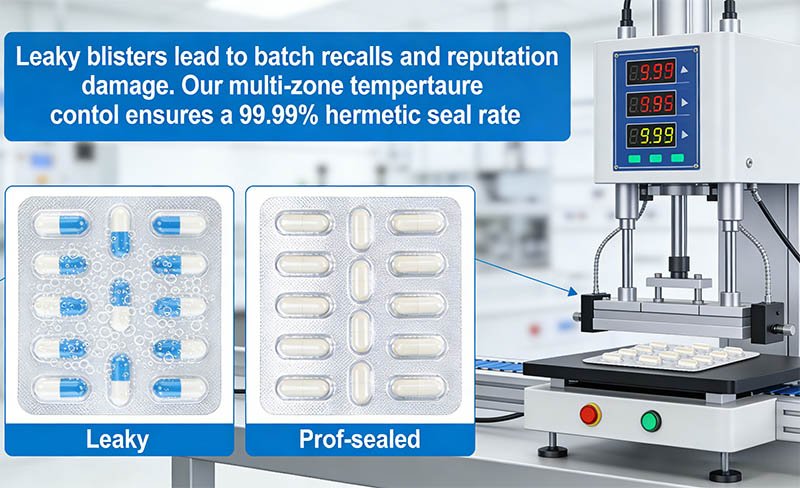
Seal integrity testing per ASTM F2338 — the method validation data, not just the pass/fail result, is what regulatory auditors request during GMP inspections.
| CCIT Method | Regulatory Standard | Sensitivity Level | Applicable Pack Type | Validation Requirement | Auditor Acceptance (FDA/EMA) |
|---|---|---|---|---|---|
| Dye Ingress | ASTM F2338 / USP <1207.2> | 50 μm defect size | Syringe blister, foil-lidded trays | Method sensitivity, specificity, ruggedness | Accepted — with validated method |
| Vacuum Decay | ASTM F2338 / USP <1207.1> | 10 μm defect size | Rigid blister, formed PVC/Alu-Alu | Instrument calibration + method validation | Strongly preferred (deterministic) |
| Helium Leak | USP <1207.1> | <1 μm defect size | High-value biologics blister | Full analytical method validation | Gold standard for parenteral |
| Visual Inspection Only | Internal SOP (no standard) | >200 μm visible defects only | Any | N/A | Not accepted as CCIT method |
| Bubble Emission | ASTM F2096 | 250 μm defect size | Flexible/semi-rigid packaging | Positive control samples required | Accepted for non-sterile only |
👨🔧 Forester’s Insight — 20-Year Field Perspective
The Documentation Gap Nobody Talks About Before the Contract Is Signed
In my 20 years commissioning blister lines across facilities in Southeast Asia and Latin America, the most dangerous mistake I’ve witnessed is purchasing a technically capable machine from a vendor who cannot supply a compliant FAT protocol or a URS-aligned validation dossier. The equipment runs fine on Day 1 — but when FDA or EMA auditors arrive, the missing documentation shuts down the entire production line. That downtime cost one client in Colombia over $300,000 in delayed batch release.
Cheap standalone machines rarely come with pre-validated PLC audit trails or 21 CFR Part 11-ready data integrity features — and nobody warns you upfront. I saw this pattern again in a plant outside Pune in 2019. The stability data had been generated in Germany at 25°C/60% RH. The product was going to Maharashtra. Nobody had done the Zone IVb extrapolation. The validation dossier was technically complete — and completely wrong for the market.
Always demand a full validation package — FAT/SAT protocols, IQ/OQ templates, and seal integrity test reports — before signing any equipment contract. At HIJ, our syringe blister packing lines are engineered as turnkey-ready systems, designed to enter your validation cycle on Day 1, not after months of costly retrofitting.
Factory Acceptance Testing (FAT) and Site Acceptance Testing (SAT): What Your Syringe Blister Machine Supplier Must Deliver
⚡ Section Direct Answer
A GMP-compliant FAT for a syringe blister packing machine must include: pre-approved test protocols mapped to your URS, witnessed execution of all functional tests with syringe dummies or product simulants, documentation of all deviations and their resolutions, PLC software version lock, and a signed FAT report before equipment release for shipping. SAT repeats critical IQ/OQ tests at your site after installation.
“The procurement director showed me the sheet. The European supplier: $385,000, full FAT documentation package included. The Chinese competitor: $94,000, ‘FAT available on request.’ Annual volume: 6 million syringe blisters. I asked the procurement director what a six-month validation delay cost them per year. He didn’t have the number. We spent forty minutes calculating it. $210,000 in delayed market entry revenue, not including the consultant fees for documentation remediation. That conversation shifted the decision.”
FAT is not a factory tour. A proper FAT protocol for a syringe blister packaging machine runs two to four days at the supplier’s facility and covers:
- URS traceability matrix review: Every URS requirement mapped to a specific test or documented design feature. Unverified requirements must be listed as open actions.
- Functional test execution: Forming temperature uniformity across the full plate area (±3°C tolerance), sealing pressure consistency across all cavities, feeder performance with syringe geometry, and vision system rejection accuracy with pre-prepared defect samples.
- Safety and interlock verification: Emergency stop response, guard interlocks, alarm logic for out-of-specification parameters, and auto-reject activation for detected seal failures.
- PLC audit trail demonstration: Live demonstration of audit trail capture for parameter changes, login/logout events, and batch record generation. The factory engineer must show the audit trail — not describe it.
- Documentation handover checklist: IQ/OQ template documents, calibration certificates for all critical instruments, P&ID drawings, electrical schematics, spare parts list, and operator and maintenance manuals — all delivered before FAT sign-off.

The IQ–OQ–PQ execution sequence — each phase must be documented, reviewed, and formally approved before execution of the next phase. No shortcuts.
The Complete Validation Dossier Checklist: What GMP Auditors Expect to Find on Day One of Inspection
⚡ Section Direct Answer
A complete GMP validation dossier for a syringe blister packaging machine includes 14 core documents: URS, DQ report, FAT protocol and report, IQ protocol and report, OQ protocol and report, PQ protocol and report, CCIT method validation, calibration certificates, change control procedure, deviation log, training records, preventive maintenance SOP, and the 21 CFR Part 11 system assessment. Missing any one of these triggers an audit observation.
FDA enforcement records for 2019–2023 show packaging equipment documentation deficiencies as a contributing factor in 12% of pharmaceutical recalls — the data point I use when procurement teams tell me the documentation cost is an unnecessary overhead. It is not overhead. It is insurance, and the premium is significantly cheaper than a single recall event.
| Document | Validation Phase | Responsible Party | Regulatory Requirement | HIJ Supply Status |
|---|---|---|---|---|
| User Requirements Specification (URS) | Pre-purchase | Buyer | EU GMP Annex 15 / WHO TRS 992 | Template provided |
| Design Qualification (DQ) Report | DQ | Supplier | EU GMP Annex 15 | Included standard |
| FAT Protocol & Report | Pre-shipment | Supplier + Buyer QA | EU GMP Annex 15 / ICH Q10 | Included standard |
| IQ Protocol & Report | IQ | Supplier + Buyer QA | 21 CFR Part 211 / Annex 15 | Template + on-site support |
| OQ Protocol & Report | OQ | Supplier + Buyer QA | 21 CFR Part 211 / Annex 15 | Template + on-site support |
| PQ Protocol & Report | PQ | Buyer QA | 21 CFR Part 211 / Annex 15 | Protocol template provided |
| CCIT Method Validation | PQ | Buyer QA / Lab | USP <1207> / ASTM F2338 | Guidance document provided |
| Calibration Certificates | IQ | Supplier | 21 CFR Part 211.68 | Traceable certificates supplied |
| 21 CFR Part 11 System Assessment | DQ / IQ | Supplier + IT | 21 CFR Part 11 | Included for FDA-market lines |
| Change Control SOP | Post-PQ ongoing | Buyer QA | ICH Q10 / EU GMP Chapter 4 | Guidance provided |
| Preventive Maintenance SOP | IQ / ongoing | Supplier + Buyer | 21 CFR Part 211.67 | Full PM manual included |
| Operator Training Records | Pre-PQ | Buyer HR/QA | 21 CFR Part 211.68 / Annex 1 | Training program template |
Symptom: IQ was completed, but calibration certificates have expired by audit date
Root Cause: No calibration recall system in place. Certificates issued at FAT (12–18 months before PQ execution) expired before the first regulatory inspection.
Fix: Recalibrate all critical instruments (temperature sensors, pressure gauges, force sensors) and issue updated certificates. Enter into a calibration management program with automated recall alerts. Recalibration event must be documented under change control and does not require repeat IQ unless calibration results fall outside original specifications.
Symptom: PQ report approved but uses a different syringe lot than will be used in commercial production
Root Cause: PQ executed with engineering samples. This is a common shortcut — and a direct audit finding under EU GMP Annex 15 Section 9.3, which requires PQ to use materials representative of commercial manufacturing.
Fix: Repeat PQ batches using commercially representative syringe lots from your qualified supplier. Document the rationale in a PQ deviation and CAPA. Plan for this from the start — commercial-grade syringe samples should be ordered at the same time as the equipment.
Symptom: Auditor asks for the URS-to-DQ traceability matrix; it doesn’t exist
Root Cause: DQ was issued as a generic machine specification document, not mapped to the buyer’s specific URS. This is a documentation structure failure, not a technical one — but it looks identical to a technical failure during an audit.
Fix: Retrospective gap analysis against the URS. For each URS requirement, identify the corresponding DQ section or generate a supplementary design verification record. This is 40–80 hours of QA work. Do it before the next inspection. For all future purchases, make the traceability matrix a contract deliverable.
A syringe blister line that runs at 200 blisters per minute is commercially worthless if its validation dossier has a gap on page 47 of the IQ report. The machine cost is $80,000. The documentation remediation cost, including regulatory timeline delay, is $150,000 to $300,000. Buy the documentation first — the machine comes with it. — Forester Xiang, Founder, HIJ Machinery
How to Evaluate a Syringe Blister Packing Machine Supplier on GMP Documentation Capability — 7 Questions That Matter
⚡ Section Direct Answer
The 7 supplier evaluation questions that separate GMP-capable vendors from technically capable ones are: Can you provide a pre-approved FAT protocol? Is your PLC 21 CFR Part 11-ready out of configuration? Can you show a previous customer’s IQ/OQ execution report (redacted)? What is your change control process for software updates post-delivery? Do you have a dedicated validation support team or outsource documentation? What is the current software version under validation? And, critically: have any of your machines been cited in an FDA 483 observation?
I won’t tell you the supplier selection decision is simple. It involves your API profile, your target markets, your validation timeline, and sometimes your relationship with the regulatory reviewer who will be sitting across the table at your next inspection. But the seven questions above filter out approximately 60% of problematic vendor situations before a contract is ever signed.
The sixth question — software version — is the one most buyers skip. Software changes after delivery require change control documentation, re-execution of affected OQ sections, and sometimes a partial IQ repeat. A supplier who cannot tell you the exact PLC software version under their current validation protocol is a supplier who has not thought about what happens after delivery. That is a significant signal about how they will behave when your validation auditor calls them six months later at 11 PM asking for a calibration certificate.
If you are at the stage of evaluating suppliers, the complete syringe blister machine selection guide covers technical specification criteria, output calculation, and mold tooling considerations alongside the compliance questions above. Both dimensions matter equally for a successful project.
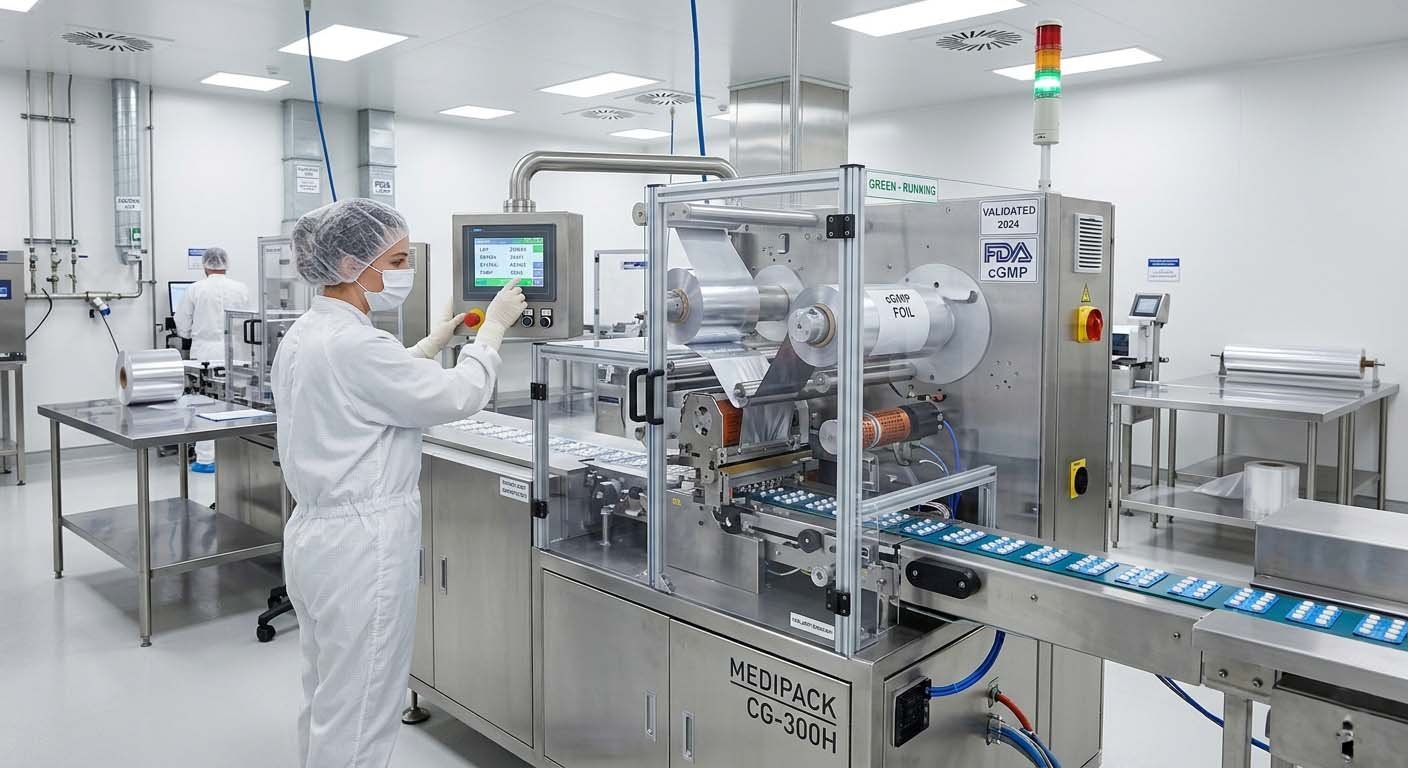
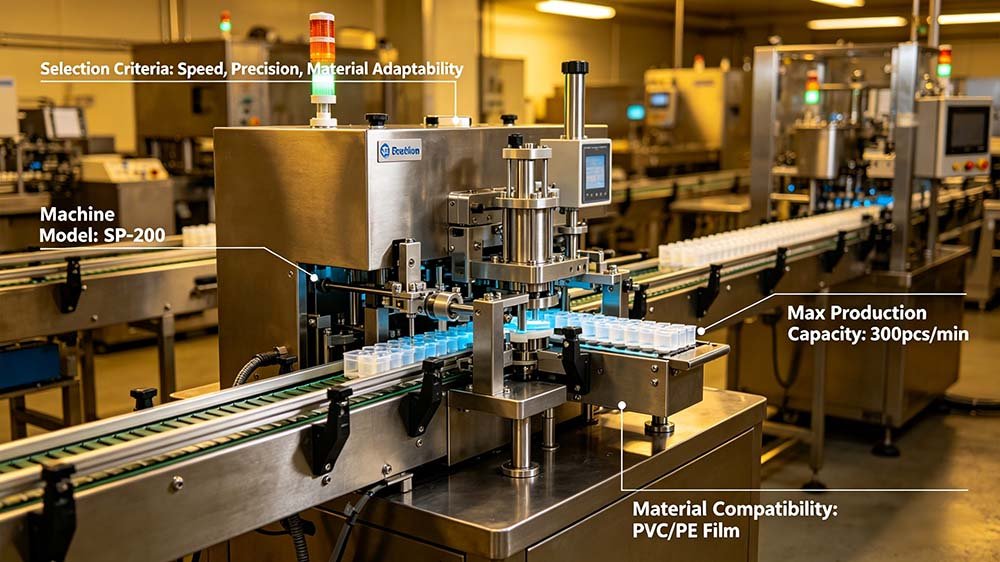
A cGMP-compliant syringe blister packaging machine must combine validated mechanical performance with a complete documentation dossier — both are non-negotiable for regulatory approval.
The Real Cost of GMP Non-Compliance in Syringe Blister Packaging: Numbers Procurement Teams Rarely Calculate
⚡ Section Direct Answer
GMP documentation gaps in syringe blister packaging validation typically cost $150,000–$400,000 per incident when accounting for regulatory consultant fees, production line downtime, batch release delays, and potential market re-entry costs — compared to a comprehensive validation documentation package that typically adds $8,000–$25,000 to the initial equipment cost.
The procurement director showed me the sheet. Standard machine without validation package: $94,000. Machine with complete FAT/IQ/OQ documentation support: $112,000. The difference: $18,000. Annual syringe blister production volume: 8 million units. Estimated market entry delay due to documentation remediation if they chose the cheaper option: 7 months. Revenue cost of that delay at their target market price point: $340,000. I asked which line item they wanted to put in the budget justification. The conversation ended quickly.
The full cost model for GMP non-compliance in syringe blister packaging includes components that are rarely itemized in procurement analysis:
- Regulatory consultant fees: $15,000–$60,000 for documentation gap analysis and remediation support, depending on market and scope of deficiency.
- Production line downtime: A line that cannot be commercially released pending validation completion costs the equivalent of its daily production value every day it stands idle. At 12,000 syringe blisters/day at $0.35 margin, that is $4,200/day.
- Repeat validation testing: If OQ must be re-executed due to documentation failure, the cost includes supplier engineer travel, material consumption during re-testing (typically 500–2,000 syringes), and internal QA time.
- Regulatory timeline extension: For WHO Prequalification or FDA ANDA submissions, a validation deficiency letter adds 6–18 months to market entry. For time-sensitive product launches, this cost typically dwarfs every other line item in the equipment budget.
For a full analysis of how GMP compliance costs fit into the total equipment cost picture — including mold tooling, spare parts, and installation costs — the syringe blister packing machine cost guide breaks down every cost component that buyers frequently underestimate at the purchase stage.
❓ Frequently Asked Questions: Syringe Blister Packaging GMP Compliance & Validation
🎯 Ready to Commission a GMP-Validated Syringe Blister Line?
HIJ Machinery Delivers Validation-Ready Syringe Blister Lines — FAT Protocol, IQ/OQ Templates, and 21 CFR Part 11 Compliance Included
Every HIJ syringe blister packing machine ships with a complete validation documentation package: DQ report, FAT protocol, IQ/OQ templates, calibration certificates, and on-site commissioning support. Built to enter your validation cycle on Day 1. Contact Forester Xiang’s team directly — WhatsApp: +86 13868822120 | sales@hijpackingmachine.com