
Regulatory Compliance Guide
GMP Requirements for Syringe Blister Packaging
A complete engineer's reference to the GMP, FDA, EU, and ISO requirements governing syringe blister packaging — and exactly how to validate your equipment to meet them.
FDA 21 CFR Part 11
EU GMP Annex 1
ISO 11607
ISO 15378
What are the GMP Requirements for Syringe Blister Packaging?
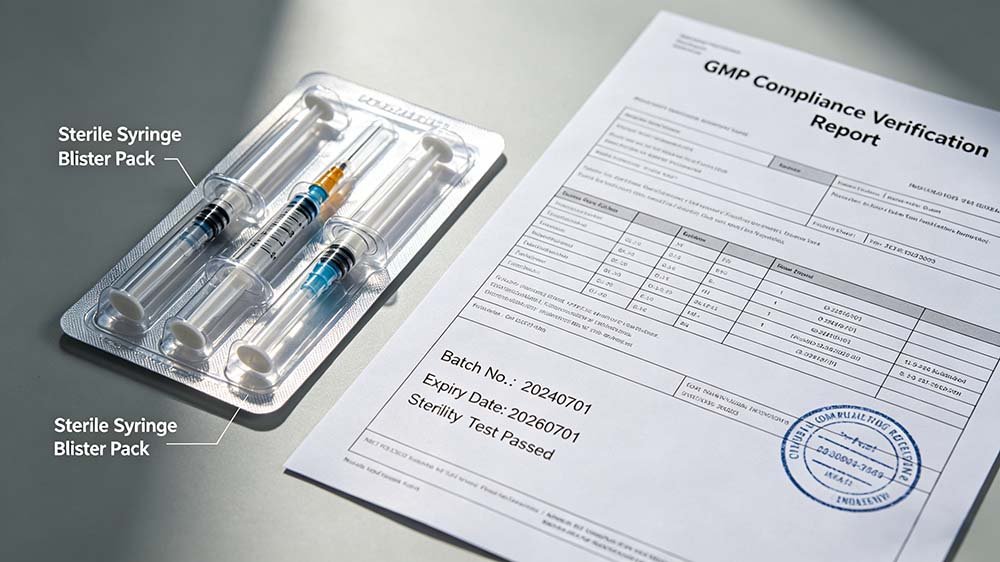
GMP requirements for syringe blister packaging cover five core areas: (1) sterile barrier integrity validated per ISO 11607, (2) primary packaging material qualification under ISO 15378, (3) equipment validation through IQ/OQ/PQ protocols, (4) data integrity and electronic records per FDA 21 CFR Part 11, and (5) contamination control and cleanroom standards under EU GMP Annex 1.
Compliance requires that packaging equipment maintain documented control over sealing temperature, pressure, and dwell time; produce tamper-evident sterile barriers; log all production parameters with audit trails; and pass three consecutive validation batches. The HIJ-260S ships with complete IQ/OQ/PQ documentation and validated Siemens controls supporting FDA, EMA, and PMDA submissions.
The Core Standards
5 Regulatory Frameworks You Must Meet
Syringe blister packaging sits at the intersection of medical device, pharmaceutical, and data integrity regulations. Here are the five that matter most.
International
ISO 11607
Packaging for terminally sterilized medical devices. Governs the sterile barrier system — the single most critical requirement for syringe packaging.
Key requirement: Validated seal integrity, burst & peel testing (ASTM F88), microbial barrier verification.
International
ISO 15378
Primary packaging materials for medicinal products, applying GMP principles to packaging material manufacture and qualification.
Key requirement: Material traceability, supplier qualification, contamination control of contact materials.
United States
FDA 21 CFR Part 11
Electronic records and electronic signatures. Defines how packaging machine data and batch records must be captured and protected.
Key requirement: Audit trails, electronic signatures, role-based access, time-stamped records.
European Union
EU GMP Annex 1
Manufacture of sterile medicinal products (2022 revision). Sets contamination control and cleanroom requirements for the packaging environment.
Key requirement: Contamination Control Strategy (CCS), environmental monitoring, cleanroom classification.
Validation
GAMP 5 / IQ-OQ-PQ
Good Automated Manufacturing Practice. The framework for validating that packaging equipment performs reliably and reproducibly.
Key requirement: Installation, Operational & Performance Qualification with documented evidence.
Serialization
EU FMD / US DSCSA
Track-and-trace regulations requiring serialization and aggregation for prescription pharmaceutical packaging.
Key requirement: Unique serial numbers, GS1 DataMatrix coding, aggregation to case level.
Equipment Validation
The IQ/OQ/PQ Validation Process
Every GMP packaging machine must complete a three-stage qualification before commercial production. Here's what each stage involves and how long it takes.
IQ
~1 Week
Installation Qualification
Documented verification that the machine is installed correctly per manufacturer specifications and design requirements.
- Utilities verified (power, air, environment)
- Components match purchase specification
- Calibration certificates for all instruments
- Software version & configuration documented
OQ
2–3 Weeks
Operational Qualification
Documented evidence that the machine operates as intended across the full range of operating parameters.
- Sealing temperature range verified (180–210°C)
- Speed range tested (10–60 strokes/min)
- Alarm & safety functions challenged
- 21 CFR Part 11 audit trail verified
PQ
2–4 Weeks
Performance Qualification
Documented evidence that the machine consistently produces compliant product under actual production conditions.
- Three consecutive successful validation batches
- Seal integrity testing (ISO 11607, ASTM F88)
- Process capability indices (Cpk) established
- Worst-case scenario challenges passed
Compliance Checklist
Syringe Packaging GMP Checklist
Use this checklist when specifying or auditing a syringe blister packaging line for GMP compliance.
Sterile Barrier
- Seal integrity validated per ISO 11607
- Burst & peel testing per ASTM F88/F1929
- Microbial barrier verification
- Tamper-evident packaging design
- Aging & stability studies completed
Equipment Controls
- PID temperature control with ±1°C accuracy
- Validated sealing pressure regulation
- Servo-driven feeding for placement accuracy
- Automatic rejection of defective packs
- Vision inspection system installed
Data Integrity
- 21 CFR Part 11 compliant audit trail
- Electronic signature support
- Role-based access control (4 levels)
- Time-stamped batch records
- ALCOA+ data principles applied
Documentation
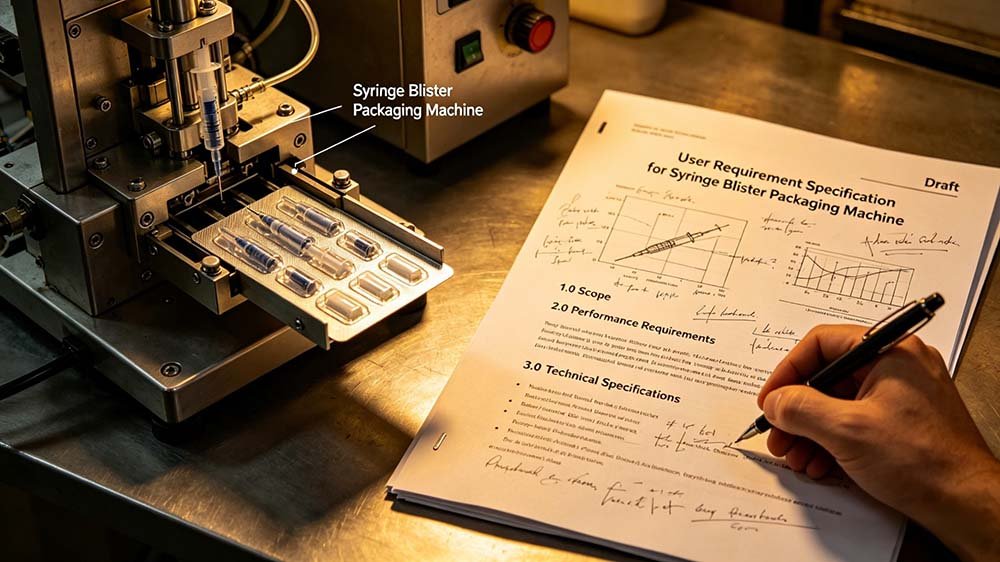
- User Requirement Specification (URS)
- Complete IQ/OQ/PQ protocols
- GAMP 5 software categorization
- FAT & SAT reports
- Material qualification per ISO 15378
Compliance Built In
HIJ-260S Ships GMP-Ready
Compliance isn't an afterthought. The HIJ-260S syringe blister packing machine is engineered from the ground up to meet global GMP requirements, with full documentation and validated controls included as standard.
- Complete IQ/OQ/PQ documentation package
- Validated Siemens PLC with 21 CFR Part 11 audit trails
- Factory Acceptance Test (FAT) at our facility
- On-site validation engineer support
- DMF support for FDA submissions
- GAMP 5 Category 4 software validation
Avoid These
5 Common GMP Compliance Failures
From 20 years of installations, these are the mistakes that most often cause audit findings or failed validations.
1
Buying a machine without 21 CFR Part 11 audit trails
Generic PLC packages save money upfront but lack the data integrity features FDA requires. Retrofitting later costs far more than specifying it correctly from the start.
Fix: Specify validated Siemens/Allen-Bradley PLC with audit trail2
Inadequate seal validation documentation
Producing seals isn't enough — you must prove seal integrity with ASTM F88 peel testing and ISO 11607 protocols. Missing documentation is the #1 audit finding.
Fix: Require full seal validation protocols with the machine3
Skipping the User Requirement Specification (URS)
Without a URS defining what the machine must do, you can't prove validation traceability. Auditors trace every test back to a documented requirement.
Fix: Write a complete URS before procurement4
Ignoring EU Annex 1 contamination control
The 2022 Annex 1 revision requires a documented Contamination Control Strategy. Many manufacturers focus on the machine but neglect the cleanroom environment around it.
Fix: Develop a CCS covering equipment + environment5
Using unqualified packaging materials
ISO 15378 requires that primary packaging materials (PVC, foil) be qualified and traceable. Using unqualified film from unverified suppliers fails material control requirements.
Fix: Qualify all film/foil suppliers per ISO 15378
GMP Compliance FAQ
Common Questions on Syringe Packaging GMP
What is the most important GMP standard for syringe blister packaging?
ISO 11607 is the single most critical standard, as it governs the sterile barrier system that protects the syringe from contamination. It requires validated seal integrity through burst testing, peel-strength testing (ASTM F88), and microbial barrier verification. For drug-containing prefilled syringes, FDA 21 CFR Part 11 (data integrity) and EU GMP Annex 1 (sterile manufacturing) are equally mandatory.
How long does full GMP validation take for a packaging machine?
Complete IQ/OQ/PQ validation typically takes 5–8 weeks after installation: IQ (Installation Qualification) about 1 week, OQ (Operational Qualification) 2–3 weeks, and PQ (Performance Qualification) 2–4 weeks requiring three consecutive successful validation batches. Having complete documentation templates from the manufacturer significantly compresses this timeline.
What does 21 CFR Part 11 require for packaging equipment?
FDA 21 CFR Part 11 requires that electronic records be trustworthy, reliable, and equivalent to paper records. For packaging machines this means: audit-trail logging of all parameter changes, electronic signatures for batch release, role-based access control, time-stamped records that cannot be altered, and data backup procedures. The HIJ-260S Siemens HMI provides all of these as standard.
Do disposable syringes need the same GMP level as prefilled syringes?
Both require sterile barrier validation (ISO 11607), but prefilled syringes face stricter requirements because they contain drug product. PFS packaging must additionally comply with full 21 CFR Part 11 data integrity, EU Annex 1 contamination control, and often serialization (EU FMD/US DSCSA). Empty disposable syringes have a lighter compliance burden focused mainly on sterile barrier and basic GMP.
What is a Contamination Control Strategy (CCS)?
Introduced in the 2022 revision of EU GMP Annex 1, a Contamination Control Strategy is a documented, holistic plan covering all sources of contamination — equipment, environment, personnel, materials, and processes — and the controls applied to each. It is now mandatory for sterile manufacturing facilities, including syringe packaging operations in the EU.
Can a Chinese-made machine meet FDA and EU GMP requirements?
Yes. GMP compliance depends on equipment design, controls, and documentation — not country of manufacture. HIJ machines use validated Siemens PLCs with 21 CFR Part 11 audit trails, ship with complete IQ/OQ/PQ documentation, and have passed FDA and EMA inspections at customer sites across 35+ countries. The key is specifying the correct compliance configuration at purchase.
What documentation should I require from the machine supplier?
Require a complete package: URS template, IQ/OQ/PQ protocols, FAT/SAT reports, GAMP 5 software categorization, calibration certificates, seal validation protocols (ISO 11607/ASTM F88), material certificates, and a Device Master File (DMF) reference for FDA submissions. A reputable manufacturer provides all of these — if a supplier can't, that's a red flag for your audit.
Get a GMP-Ready Syringe Packaging Line
Tell us your target markets and regulatory requirements. We'll specify a fully compliant configuration with complete validation documentation and on-site qualification support.