

Food liquid blister packing
Configure a HIJ liquid blister packaging machine for single-serve honey, syrups, sauces and other food portions.
Request quotationBuild around your food
A food liquid blister packaging machine forms cavities from a web, meters the food into them, seals the lidding and separates the finished portions. The food, serving size, opening method and storage conditions define the project—not the product name alone.
Use this route for a formed single-serving pack. If you buy ready-made cups or trays, make that a separate feeding and sealing requirement. If your package is a bottle, jar or flexible sachet, compare the relevant food filling equipment or blister-versus-sachet route before selecting a machine.
For the wider station sequence and machine overview, see the liquid blister packaging pillar. This page focuses on the food-specific decisions needed for a usable proposal.
Your food, your fill
Compare your formulation at the temperature and condition in which it will reach the filling point. The same food name can describe very different flow behaviour.
Honey and syrup
Review flow at the proposed filling temperature, crystallisation, air introduced during transfer and nozzle cut-off. Identify any temperature-control requirement for the hopper, transfer path and filling point separately. The syrup packaging page covers that application in more detail.
Sauce and dressing
Describe whether the product is uniform, an emulsion or a mixture that separates during holding. Review transfer, agitation needs, splashing, foaming and the condition of the sealing flange after filling. Include the intended hold time and cleaning method in the discussion.
Gel and smooth spread
Review transfer through the proposed product path, stringing at shut-off and how residual product is recovered. Define the acceptable product temperature and handling limits before choosing a filling arrangement. A smooth sample and a particle-containing version require separate evaluation.
These are starting points for configuration, not a claim that one dosing arrangement covers every recipe. Use a representative product and pack for the agreed trial.

A pack people can open
Define the forming web and lidding together. Include the layer structure, supplier grade, thickness, food-contact documentation and proposed sealing window. Give the supplier the food composition, contact conditions and intended market so material suitability can be reviewed on the right basis.
The finished pack drawing should show the dose, cavity shape and depth, usable seal flange, opening tab or peel feature, code area and cut edge. Agree the headspace and how a portion is held and opened by its intended user. A good-looking empty cavity is not the same as a filled pack that dispenses cleanly.
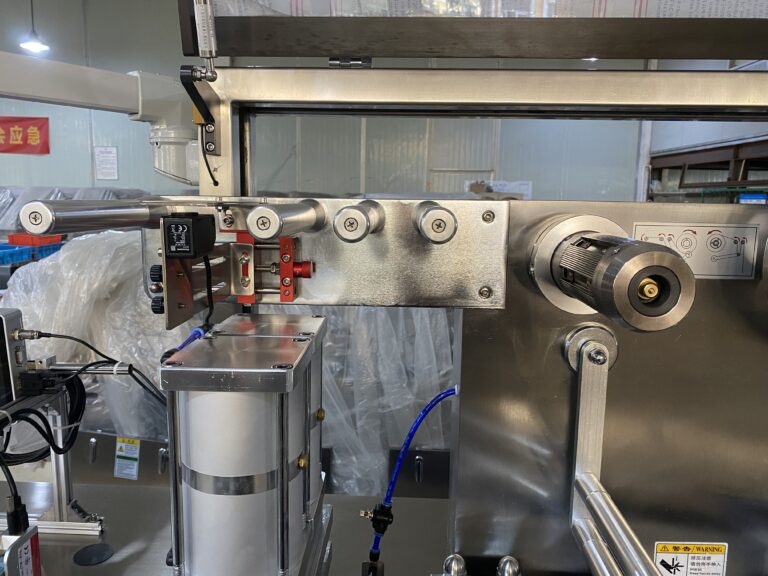
Choose the opening behaviour deliberately: a peelable lid, a puncture opening and a break-open portion use different pack details. State the required opening force and handling checks in the trial plan. Do not assume the photographed machine includes every opening format.
Keep food preservation separate from the machine specification. Required storage life, distribution conditions and product-processing controls belong to the food-and-package assessment; a film name or a sealed cavity does not establish them.
For U.S. projects, the FDA's food types and conditions of use help structure the material discussion.
Plan the product change
List each food-contact component from the feed connection to the nozzle: hopper, transfer parts, pump or dosing chamber, valves, hoses, seals and fittings. Specify the required contact materials and the supporting records for the selected construction.
Review which parts can be accessed, drained and removed, where residual food remains, and which items need dedicated change parts. Distinguish changing the pack tooling from cleaning the product path; they are different tasks and should not share an unsupported changeover-time promise.
For products with different allergen profiles, agree the production sequence, cleaning method, verification responsibility and any dedicated parts with the site's food-safety team. State whether cleaning is manual, an agreed clean-in-place arrangement or another defined method. Include the suitable cleaning media and utility requirements; do not assume steam sterilisation or wash-down protection is standard.
Agree the trial evidence
Use the actual food, intended web and lidding, pack drawing and operating conditions. The trial should answer purchase decisions with retained records, not just show that the machine can move.
- Fill result
- Agree the nominal dose, tolerance, measurement method and sampling across filling positions and the run. If ordering by mass but measuring by volume, state the basis used to compare the results.
- Seal and opening
- Check flange condition, seal continuity, opening behaviour and the specified package-integrity tests. Define the method, acceptance limits and who performs each test.
- Product condition
- Check the agreed temperature and the observations relevant to your food, such as separation, foaming, stringing or visible product damage. Record the feed and holding conditions for the run.
- Accepted output
- Record finished portions accepted during the agreed run, together with stops and rejects. State cavity layout, loading conditions and any downstream limitation rather than quoting cycle speed as finished output.
- Cleaning and restart
- Demonstrate the agreed access, part removal and restart checks. Identify the records required after cleaning or a product change, including site responsibilities that are outside the machine demonstration.
Compare the same supply
Request an itemised quotation for the machine, food-contact path, included pack formats and tooling. Name the coding, inspection and reject functions, and separate production equipment from trial materials and other consumables.
Include roll handling, discharge and the connection to downstream cartoning where required. The turnkey solutions overview provides the wider line route; its interface and supply responsibilities still need to be listed for this project.
Give the available floor space, power, air, cooling and cleaning utilities before agreeing the layout. List the drawings, manuals, training, installation and acceptance support required in the proposal. Price, production schedule and service terms should come from the current quotation for that defined scope.


Keep the print requirement clear
List the required batch and date information, its position on the finished portion and any registration or code-verification requirement. Agree what the inspection checks, how a rejected portion is handled and which results are recorded. Code readability and seal testing answer different acceptance questions.
Food buyer questions
Can it fill jam with seeds?
Evaluate the particles as well as the liquid phase. Provide particle dimensions, concentration, consistency and whether they settle, together with a representative sample. The product path, valve and nozzle clearances need to suit that mixture; approval of a smooth jam does not establish suitability for a seeded recipe.
Are production films included?
List them separately in the quotation. Distinguish trial rolls, any start-up allowance and routine production supply. Agree the web specification, sourcing responsibility and acceptable alternatives so the approved trial material can be identified when production rolls are ordered.
Can chilled food become ambient-stable?
Not simply by changing the pack or buying the machine. Treat ambient storage as a separate food-process and package-validation requirement. Define the formulation, processing controls, distribution conditions and evidence needed with the responsible food specialists before setting a storage-life claim.
Discuss your food portion
Send your food description and dose, a reference pack or drawing, the intended storage and opening requirements, and the accepted output you need. Note any material or layout decisions that are still open. HIJ can then discuss the forming, filling and sealing configuration and prepare a quotation around the agreed supply boundary.