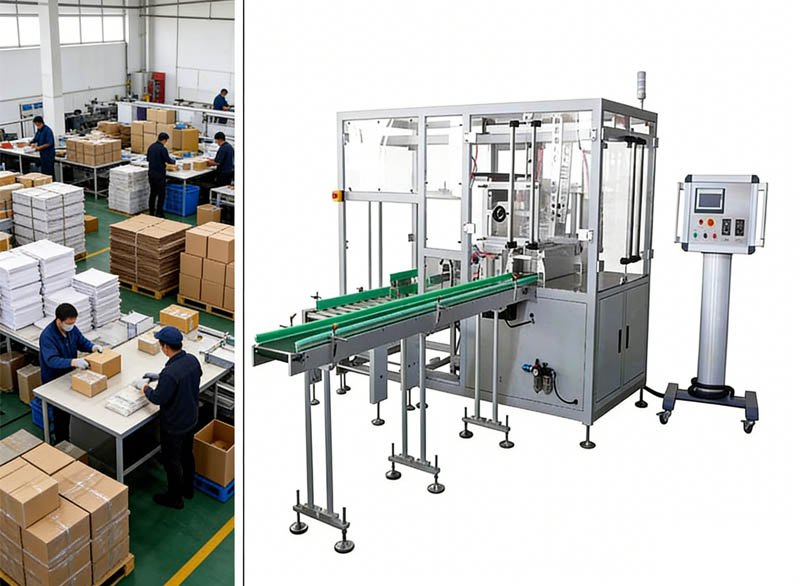
Blister packaging material selection starts with the drug product and the proposed market pack. PVC, PVDC-coated PVC, PCTFE-based laminates and cold-form Alu-Alu each create a different balance of transparency, barrier, cavity geometry and machinability. There is no universally best film: the suitable structure is the one supported by stability, supplier specifications, pack testing and a verified machine operating window.
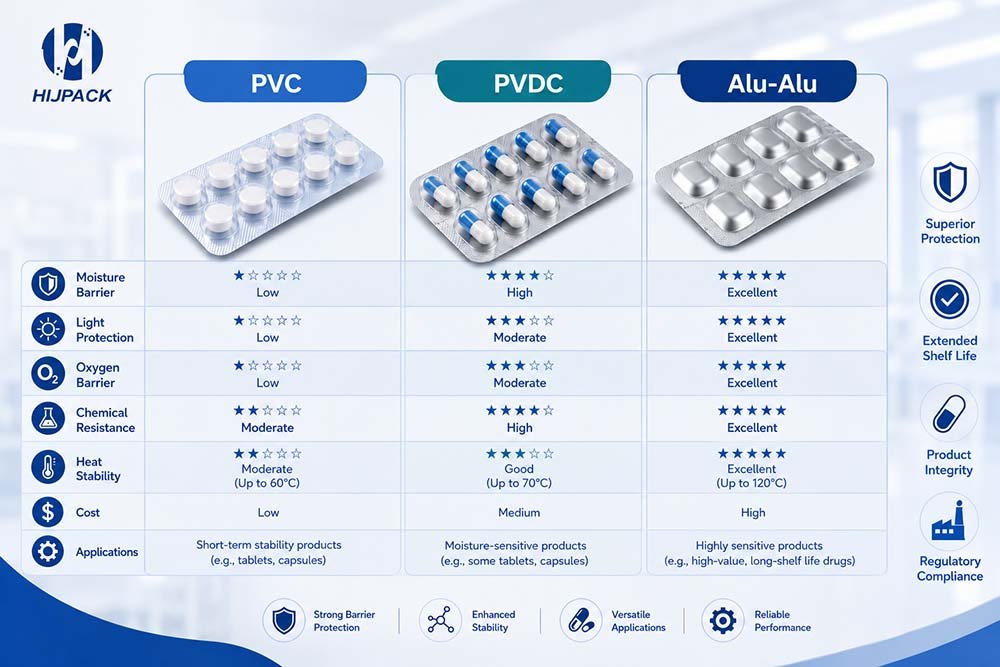
What Materials Are Used in Pharmaceutical Blister Packaging?
A pharmaceutical blister normally combines a forming web with a lidding material. The forming web creates the cavity around the tablet or capsule. The lidding closes the cavity and provides the intended opening function. Both components, their seal interface and the formed geometry belong to the container-closure system.
Common thermoforming webs include rigid PVC, PVDC-coated PVC and transparent PCTFE-based laminates. Cold-form laminates containing aluminum are usually described as Alu-Alu or cold-form foil. Other polymer structures can be used for specific projects, but their suitability cannot be inferred from the polymer name alone.
Important terminology: aluminum lidding foil is not the same component as cold-form aluminum laminate. A PVC/Alu pack usually means a plastic forming web sealed to aluminum lidding. An Alu-Alu pack uses an aluminum-containing cold-form laminate for the cavity as well as a compatible lidding structure.
The FDA’s final container-closure guidance explains that a packaging system accepted for one drug product is not automatically suitable for another. ICH Q1A(R2) likewise places stability testing on the dosage form in the container-closure system proposed for marketing. Material selection should therefore follow product evidence and market requirements, not a generic ranking copied from a film table.
PVC Blister Film: The Transparent Thermoforming Baseline
Rigid, non-plasticized PVC is a frequent starting point for pharmaceutical blister development because it is transparent and can be thermoformed into defined cavities. It allows visual inspection through the forming web and is familiar to many tooling and line platforms.
Those advantages do not make every PVC grade interchangeable. Film gauge, width, shrink behavior, roll geometry, surface treatment, color and the approved lidding system affect the operating window. Plain PVC also occupies the lower barrier position among the four families compared here, so its suitability must come from product-specific stability data rather than low material cost or easy forming alone.
When PVC may remain a candidate
- The proposed market pack meets stability requirements with the selected PVC and lidding combination.
- The product does not require an opaque forming web and visibility is useful for inspection.
- The cavity can be formed without unacceptable thinning, distortion or stress.
- The supplier’s grade, dimensions and certificates can be controlled from development through commercial supply.
PVDC-Coated PVC: More Barrier Without Losing Visibility
PVDC-coated PVC uses a PVC base web with a barrier coating. It remains a thermoforming structure and can preserve product visibility while offering a stronger barrier position than the corresponding uncoated PVC. This makes it an important intermediate option between plain PVC and opaque cold-form foil.
“PVDC film” is still incomplete as a specification. Coating weight, coating distribution, base-film gauge, total construction, coating orientation and the supplier’s test conditions all matter. Two films carrying the same generic label may not deliver the same barrier or run within the same settings.
During trials, document which side faces the product and tooling, how the web responds to preheating and forming, and whether registration, sealing and cutting remain stable over an agreed run. If the material grade changes, assess the effect through the site’s change-control and stability strategy rather than treating the new roll as an equivalent consumable.
PCTFE and Aclar Blister Films: A Transparent High-Barrier Route
PCTFE is a transparent fluoropolymer used in pharmaceutical blister laminates. Aclar® is a commercial family of PCTFE films. The current manufacturer describes it as a clear thermoformable pharmaceutical packaging film available in multiple grades. In practice, PCTFE is commonly supplied as part of a laminate, so the complete laminate structure and supplier designation must be recorded.
This route can be considered when a project seeks higher moisture-barrier performance while retaining a transparent cavity. It is not a universal substitute for PVDC or cold-form foil. Laminate stiffness, forming behavior, cavity depth, sealing compatibility, roll handling, supply qualification and the stability result all remain project-specific.
Use “PCTFE” for the polymer family and “Aclar” only when that branded material is actually specified. Procurement documents should name the manufacturer, grade, laminate construction and current technical specification rather than using the trademark as a generic acceptance criterion.
Cold-Form Alu-Alu: Opaque Cavities and a Different Forming Process
Cold-form foil is shaped mechanically rather than heated and thermoformed. Pharmaceutical structures commonly combine polymer layers with aluminum; the exact construction varies by supplier and application. The aluminum-containing layer gives cold-form packs a strong barrier position when the laminate, formed cavity and seals remain intact.
The trade-offs are substantial enough to affect the whole project. The cavity is opaque, so inspection cannot look through the forming web. Cold forming often needs a larger plan area for a given product because the laminate must be drawn into the cavity without the same stretching behavior as a heated plastic web. Tooling, web path, forming station, registration, inspection method and pack dimensions may all change.
Do not select Alu-Alu merely because it appears at the top of a generic barrier chart. Select it when the proposed structure earns its place through stability, pack design, line capability and total project requirements.

Blister Lidding Foil and Opening Function
Lidding is the second half of the pack. A common push-through blister uses aluminum lidding carrying a heat-seal coating compatible with the forming web. Printed surfaces, primers, protective lacquers and seal coatings can form a multilayer functional structure even when buyers simply call it “aluminum foil.”
Opening requirements may change the construction. Push-through, peel-open and peel-push designs do not have the same force profile or patient interaction. Child-resistant and senior-friendly performance must be defined against the target market and supported by the applicable testing; material names alone do not prove either outcome.
A usable lidding specification should identify the supplier and grade, substrate and coating structure, reel width, winding direction, print or registration requirements, splice rules, seal surface orientation and the agreed seal-window evidence. Coordinate artwork and variable data through the separate blister packaging printing guide.
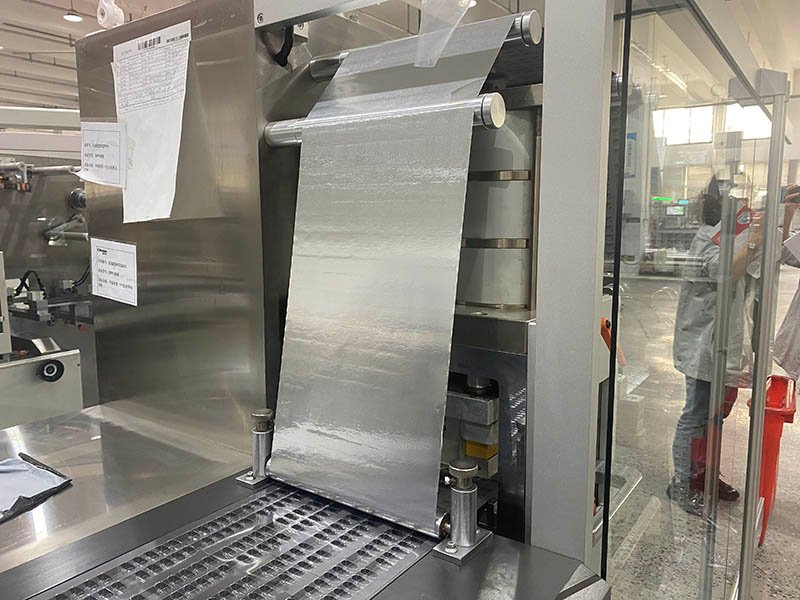
PVC vs PVDC vs PCTFE vs Alu-Alu
| Decision point | PVC | PVDC-coated PVC | PCTFE-based laminate | Cold-form Alu-Alu |
|---|---|---|---|---|
| Forming route | Thermoforming | Thermoforming | Thermoforming | Mechanical cold forming |
| Visibility through cavity | Normally transparent | Normally transparent | Transparent | Opaque |
| Relative barrier position | Baseline of these four | Higher than its uncoated PVC base; grade dependent | High transparent option; grade and laminate dependent | Strong opaque option when correctly formed and sealed |
| Specification focus | Gauge, dimensions, forming behavior and lidding match | Base web, coating weight, orientation and barrier data | PCTFE grade, laminate construction and forming response | Full laminate, draw geometry, pinhole control and tooling |
| Typical project question | Does the proposed PVC pack pass stability? | Which exact coating structure meets the requirement? | Can transparency be retained at the required barrier? | Does the required protection justify an opaque, larger-format pack? |
| Machine review | Heating, forming, sealing and web control | Thermoforming and sealing window for the coated web | Heating profile, laminate forming and sealing compatibility | Cold-form station, dedicated tooling, transfer and inspection |
The table is a screening aid, not a material approval. Final selection requires the exact supplier structure and test conditions. For the machine-focused commercial route, use the blister machine forming-material compatibility page.
How to Read WVTR and OTR Without a False Comparison
WVTR describes water-vapor transmission and OTR describes oxygen transmission. A lower reported value can indicate stronger barrier performance only when the compared results use aligned methods, units, temperature, relative humidity, specimen construction and conditioning.
ASTM F1249 addresses WVTR through flexible barrier materials. ASTM D3985 addresses steady-state oxygen transmission through films and related structures. These methods help describe flat material, but the formed blister introduces cavity thinning, draw geometry, seal interfaces and conversion defects. ASTM D7709 includes methods for reporting WVTR of closed pharmaceutical bottles and blister cavities.
Compare data in this order: exact structure and grade; method and edition; temperature and humidity; units and specimen orientation; mean, variation and detection limit; then the finished-cavity result. Never compare a flat-film value from one condition with a formed-cavity value from another as if they were equivalent.
Barrier data also does not establish drug-product shelf life by itself. The proposed market pack still belongs in the applicable stability programme, and changes to the structure, source or cavity may need assessment under the site’s pharmaceutical quality system.
A Seven-Step Blister Material Selection Process
- Define the degradation risks. Use development and stability knowledge to identify relevant moisture, oxygen, light, mechanical and compatibility concerns.
- Define the market pack. Record proposed shelf life, storage statement, target markets, distribution route, opening function and secondary packaging.
- Screen complete structures. Compare forming web plus lidding, not the forming film in isolation. Include transparent high-barrier and cold-form options only where they answer an identified requirement.
- Freeze the pack drawing. Define product orientation, cavity dimensions, land area, web width, index pitch, perforation, cut profile and print registration.
- Generate pack evidence. Test representative materials and formed packs using agreed methods, then place the proposed market pack into the applicable stability programme.
- Verify manufacturability. Demonstrate forming, feeding, sealing, registration, coding, inspection, rejection and sustained output using production-intent material.
- Control the approved state. Link the final material grade, drawing, process window, test methods, artwork and supplier documents to change control and routine incoming inspection.
Climate matters, but a climate-zone label is not a film-selection formula. Use the product’s stability plan and the intended distribution conditions. The tropical-climate blister packaging guide explains how humidity and distribution assumptions should enter the project without turning them into universal material rules.

How the Material Choice Changes the Blister Machine
Material selection reaches beyond the forming station. A different structure can change reel handling, tension, preheating, forming force, sealing conditions, cooling, registration, cutting and inspection. It can also change the web width and number of accepted packs produced per index.
Forming and tooling
Thermoforming profiles must suit the exact polymer or laminate. Tool geometry should control cavity shape without unacceptable thinning, web distortion or product clearance problems. Cold-form projects need the correct forming mechanism and tooling for the laminate and draw direction.
Sealing and lidding
The seal window depends on the chosen forming surface, lidding coating, contact conditions and tooling state. The approved process should be defined by measured pack results rather than a single nominal temperature copied from a supplier sheet.
Inspection and rejection
A transparent cavity can support some optical checks that are unavailable through an opaque cold-form web. Inspection design must also account for print, registration marks, web reflectivity, product color and the required reject confirmation.
Output and material use
Rated machine cycles do not equal accepted packs. Cavity layout, web pitch, forming behavior, scrap at changeover, stoppages and rejected packs affect usable output and material consumption. Review pack protection and stability before optimizing the layout solely for material yield.
Material Inputs to Put in the Blister Machine URS
The machine supplier needs the real product and material inputs before confirming configuration. Broad phrases such as “PVC/PVDC/Alu-Alu compatible” leave critical engineering decisions undefined.
- Product drawing, dimensions, weight and orientation
- Forming-web supplier, grade and full layer structure
- Lidding supplier, grade, coating and opening function
- Approved blister drawing and cavity depth
- Web width, index pitch, reel core and winding direction
- Print, registration mark, coding and vision requirements
- Forming and sealing development ranges
- Pack-integrity method and acceptance criteria
- Sustained accepted-output target and sampling basis
- Inspection challenges and reject confirmation
- Format inventory and change-part scope
- Utilities, room conditions and documentation boundary
Use the blister packing machine URS guide to structure these inputs. If cold-form foil remains in scope, review the Alu-Alu blister machine application page and confirm the exact configuration rather than assuming every blister platform includes cold forming.
What to Request From the Material Supplier
Supplier evidence should be specific enough to connect incoming material to development, machine trials and routine production. Request the current document revision for the exact grade under review.
- Technical data sheet and complete layer or coating description.
- Certificate-of-analysis format and agreed release properties.
- Dimensions, tolerances, reel construction, splice rules and storage conditions.
- Barrier test method, conditions, units and representative results.
- Forming, sealing and orientation guidance where applicable.
- Regulatory, compositional and change-notification documents required by the buyer’s market and quality system.
- Representative development rolls and production-intent lots for trials.
Do not turn a supplier declaration into an automatic finished-product compliance claim. The buyer remains responsible for the product, market pack, stability strategy and regulatory submission.
What the FAT Should Prove About the Material
A dry run with a convenient factory film does not prove the buyer’s approved structure. The FAT protocol should name the product or representative challenge product, material grades, lot identification, tooling revision, sampling plan and acceptance criteria.
| FAT check | Evidence to retain | Decision answered |
|---|---|---|
| Web handling | Material lot, reel setup, tension settings, splice and tracking observations | Can the exact web feed consistently? |
| Forming repeatability | Approved samples, settings, cavity measurements and defect log | Does the web form the approved geometry? |
| Seal process | Recorded settings and agreed seal or integrity test results | Is there a usable operating window for the material pair? |
| Registration and cutting | Printed samples, cut position, perforation and acceptance limits | Does the finished card match drawing and artwork controls? |
| Inspection and rejection | Challenge set, detection results, reject confirmation and disposition record | Are defined defects detected and segregated? |
| Sustained run | Run duration, total output, accepted packs, rejects, waste and stoppage log | Can the complete process meet the agreed accepted-output target? |
The blister machine FAT checklist can be adapted to the project. Final site qualification, routine controls and product release remain within the buyer’s quality system and contracted validation scope.
Common Blister Material Specification Mistakes
- Specifying only “PVC” or “Alu foil.” This omits grade, structure, gauge, coating, orientation and supplier controls.
- Comparing unmatched barrier values. Different methods, conditions, units or specimens can reverse the apparent conclusion.
- Approving the film but not the formed pack. Cavity draw and seals can change package performance.
- Choosing by climate label alone. Distribution assumptions inform stability; they do not automatically select a film.
- Assuming a brochure compatibility list is qualification. The exact grade, drawing and run conditions still need evidence.
- Changing material after tooling approval. A seemingly similar structure can alter forming, sealing, registration and pack dimensions.
- Ignoring lidding and opening performance. Barrier, seal and patient access depend on both sides of the pack.
- Using quoted machine speed as accepted output. Material waste, rejects and stops belong in the acceptance calculation.
For a process-level comparison of the two main forming routes, read thermoforming versus cold-form blister packaging. For equipment selection after the pack is defined, continue to the HIJ blister packing machine range.
Frequently Asked Questions
What materials are used in pharmaceutical blister packaging?
Common forming webs include rigid PVC, PVDC-coated PVC, PCTFE-based laminates and cold-form aluminum laminates known as Alu-Alu. A compatible lidding material completes the blister. The exact forming and lidding structure should be selected from product stability, pack testing, supplier data and machine trials.
What is the difference between PVC and PVDC blister film?
PVC is the base transparent thermoforming film. PVDC-coated PVC adds a barrier coating to a PVC web and normally offers a stronger barrier position while retaining visibility. Performance depends on the exact coating, base film, structure and test conditions.
What is PCTFE or Aclar blister packaging?
PCTFE is a transparent high-barrier fluoropolymer used in pharmaceutical blister laminates. Aclar is a branded family of PCTFE films. Buyers should specify the actual manufacturer, grade and complete laminate construction rather than treating the brand name as a generic film specification.
Is blister lidding foil the same as Alu-Alu forming foil?
No. Lidding foil closes the formed cavity. Cold-form Alu-Alu laminate creates the cavity. A PVC/Alu blister can therefore use a transparent PVC forming web with aluminum lidding, while an Alu-Alu pack uses an opaque cold-form web and compatible lidding.
Is Alu-Alu always the best blister material?
No. Cold-form Alu-Alu offers a strong opaque barrier route, but it changes forming, tooling, inspection and pack geometry. It should be selected only when the approved pack and stability strategy justify those trade-offs.
Can one blister machine run PVC, PVDC, PCTFE and Alu-Alu?
Some configured platforms can process several thermoforming webs and may include cold-form capability. Compatibility must still be verified for the exact machine, material grade, web dimensions, cavity drawing, tooling, inspection and accepted-output requirement.
How should buyers compare WVTR and OTR data?
Compare the same test method, temperature, humidity, units, specimen structure and orientation. Distinguish flat-film data from formed-cavity data, request current supplier reports and confirm the proposed market pack through the applicable stability programme.
What is tropical blister packaging?
The term often describes an additional formed aluminum overwrap used around a thermoformed blister to increase protection for demanding distribution conditions. It is a separate pack architecture with its own material, tooling, equipment and validation requirements, not simply another name for PVDC or Alu-Alu.
Regulatory and Technical References
- ICH Q1A(R2), Stability Testing of New Drug Substances and Products.
- FDA, Container Closure Systems for Packaging Human Drugs and Biologics, final guidance.
- 21 CFR 211.94, Drug product containers and closures.
- Solstice Advanced Materials, Aclar PCTFE barrier films.
- ASTM F1249-25, WVTR through plastic film and sheeting.
- ASTM D3985-24, oxygen transmission through plastic film and sheeting.
- ASTM D7709-12(2023), WVTR of pharmaceutical bottles and blisters.
Check the Material Against the Machine Scope
Send the product drawing, proposed forming web and lidding grades, blister layout, accepted-output target and validation boundary. HIJ can review the required forming route, tooling and FAT evidence before a machine configuration is quoted.
Discuss Material and Machine Fit