Direct answer: choose blister packaging materials from the drug product’s stability evidence, required shelf life, target markets and the complete forming plus lidding structure. PVC is the baseline transparent thermoforming web. PVDC-coated PVC increases barrier while retaining visibility. Cold-form Alu-Alu provides the strongest barrier position of these three, but changes forming, tooling, pack size and line qualification requirements.
What Materials Are Used in Pharmaceutical Blister Packaging?
A pharmaceutical blister normally combines two functional components: a forming web that creates the cavity and a lidding material that seals the product inside it. Treating “aluminum foil” as one material can cause a specification error because aluminum lidding foil and cold-form aluminum laminate perform different jobs.
Common forming webs: rigid PVC, PVDC-coated PVC and cold-form laminate commonly called Alu-Alu. Other structures can include PP, PET-based materials or fluoropolymer barrier laminates, subject to product and market requirements.
Common lidding: heat-seal-coated aluminum foil for push-through packs. Peelable or child-resistant structures require a separate functional specification.
PVC forming film
Rigid PVC is transparent and readily thermoformed. It is often the starting material for products that do not need a high-barrier package. The final decision still depends on the supplier grade, film thickness, cavity geometry, lidding system and stability result. “PVC compatible” is not a complete purchasing specification.
PVDC-coated PVC
PVDC coating raises the barrier performance of a PVC base web while preserving a transparent cavity. Barrier changes with coating weight, layer construction and test conditions, so a generic PVDC label cannot replace the supplier’s technical data sheet and certificate of analysis. The line also needs a forming and sealing window that has been demonstrated with the intended structure.
Cold-form Alu-Alu
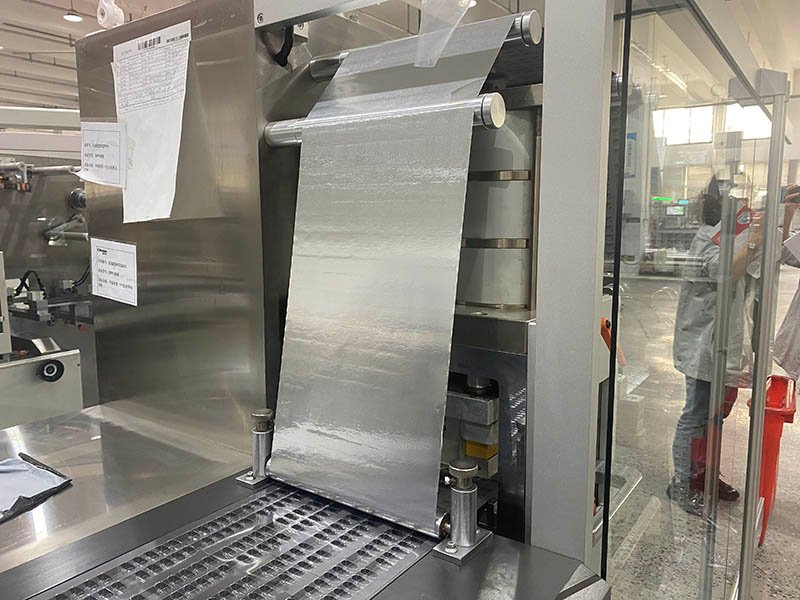
Cold-form laminate is shaped without the thermoforming process used for PVC. Its opaque aluminum-containing structure is selected when the stability programme requires a stronger barrier position. The trade-offs include different forming mechanics, larger cavity footprint in many formats, no visual inspection through the forming web and dedicated tooling or machine configuration.
Aluminum lidding foil is not Alu-Alu forming foil
A PVC/Alu blister can use a transparent PVC cavity and aluminum lidding. An Alu-Alu blister uses cold-form laminate for the cavity and a compatible lidding structure. Write both components in the URS, drawing and batch record. Do not use “aluminum foil blister” as the only material description.
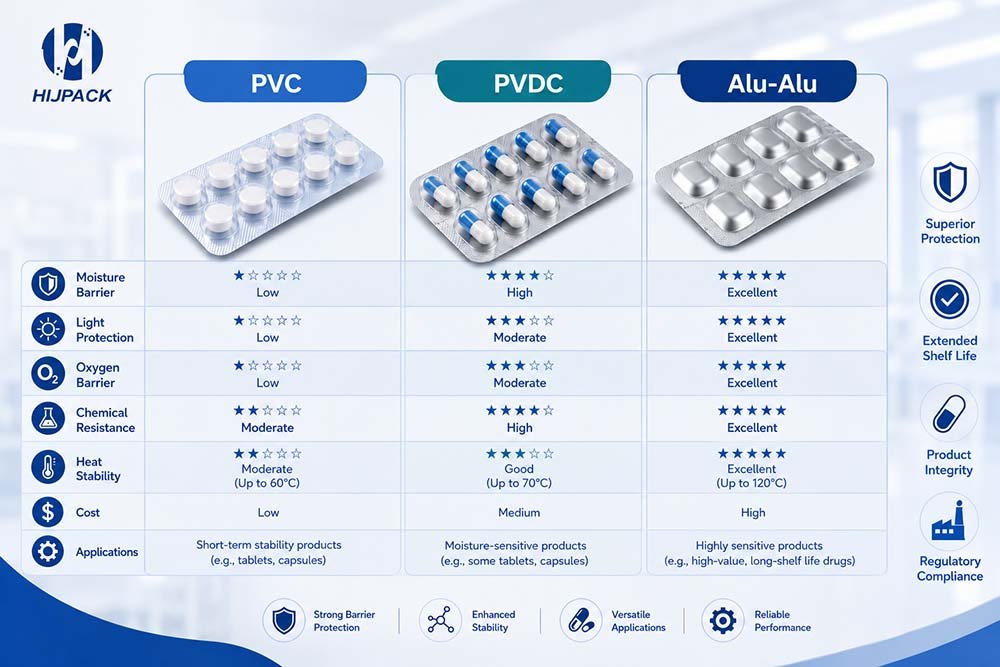
PVC vs PVDC vs Alu-Alu: Procurement Comparison
| Decision point | PVC | PVDC-coated PVC | Cold-form Alu-Alu |
|---|---|---|---|
| Typical role | Baseline transparent thermoforming web | Higher-barrier transparent thermoforming web | High-barrier opaque cold-form web |
| Forming method | Heat plus forming pressure | Heat plus forming pressure | Mechanical cold forming |
| Product visibility | Yes, subject to colour and print | Yes, subject to colour, coating and print | No through the forming web |
| Barrier position | Lowest of these three | Higher than uncoated PVC, grade dependent | Highest of these three when intact and correctly converted |
| Machine effect | Thermoforming station and matching tooling | Thermoforming window must match the coated structure | Cold-form station, tooling and material path required |
| Evidence to request | Supplier TDS/CoA, drawing, sealing data, stability result | All PVC evidence plus coating and barrier specification | Laminate construction, forming limits, drawing and stability result |
| Main procurement risk | Selecting on price before confirming protection | Treating all coating grades as equivalent | Assuming a thermoforming machine can cold-form without qualification |
Barrier values should be compared only when test method, temperature, humidity, sample structure and units are aligned. Use the converter’s current specification rather than a generic internet value.
How to Read WVTR and OTR Data Without a False Comparison
WVTR measures water-vapour transmission, while OTR measures oxygen transmission. A lower reported value can indicate a stronger barrier only when the test method, temperature, relative humidity, specimen structure, conditioning and units are comparable. A value copied from a generic material table is not a purchasing limit.
For film data: record the cited method and test conditions. ASTM F1249 addresses WVTR through flexible barrier films and coated or multilayer materials; ASTM D3985 addresses steady-state OTR through films, laminates and related structures.
For the finished blister: do not assume flat-film data represents the formed cavity. Forming strain, cavity geometry, seals and conversion quality belong to the pack assessment. ASTM D7709 provides methods for reporting WVTR of pharmaceutical blister cavities, while the proposed market pack still requires the applicable stability programme.
Ask each shortlisted supplier for the current TDS, test report and acceptance specification for the exact grade and structure. Compare like with like, then use cavity-level and stability evidence to decide whether the package is suitable.
How to Select a Blister Material Without Guesswork
The FDA notes that a packaging system accepted for one drug product is not automatically appropriate for another. ICH Q1A(R2) also directs stability testing on the dosage form in the container closure system proposed for marketing. The material decision therefore belongs inside the stability and CMC strategy, not after the machine order.
- Define the product risks. Record moisture, oxygen, light, mechanical and chemical compatibility concerns using development and stability evidence.
- Define the commercial boundary. Confirm proposed shelf life, storage statement, target markets, distribution route and pack presentation.
- Shortlist complete structures. Compare forming web plus lidding, not a forming film in isolation. Obtain current supplier TDS, CoA and regulatory declarations.
- Build candidate blister formats. Freeze the product orientation, cavity drawing, web width, pitch, forming depth and print registration requirement.
- Generate stability evidence. Use the proposed market pack. If the material or cavity changes, assess the effect through the applicable change-control and stability programme.
- Qualify the machine window. Demonstrate forming, feeding, sealing, coding, inspection, rejection and sustained output with production-intent materials.
My Insight
Do not write “PVC, PVDC and Alu-Alu compatible” as a single unchecked URS line. A machine can accept a material family and still fail the actual project because coating grade, laminate stiffness, cavity depth, web width or sealing window is outside the qualified range. Freeze the material supplier data, blister drawing and acceptance tests before tooling approval.
Forester Xiang, Founder & Chief Engineer, HIJ Machinery
Material Inputs to Put in the Blister Machine URS
A useful URS lets the machine supplier engineer and test the real process. Attach source documents instead of relying on broad labels.
- Product drawing, dimensions and orientation
- Forming web supplier, grade and full structure
- Lidding supplier, grade and seal coating
- Approved blister drawing and cavity depth
- Web width, index pitch and registration marks
- Required forming and sealing operating window
- Sustained output target and sample basis
- Inspection and reject acceptance logic
- Coding, batch data and vision requirements
- Changeover scope and format inventory
- Utilities and production environment
- DQ, IQ, OQ and PQ documentation boundary
For a structured procurement document, use the blister packing machine URS guide. If cold-form is under consideration, review the verified Alu-Alu blister packing machine application page and confirm the exact model configuration before purchase.
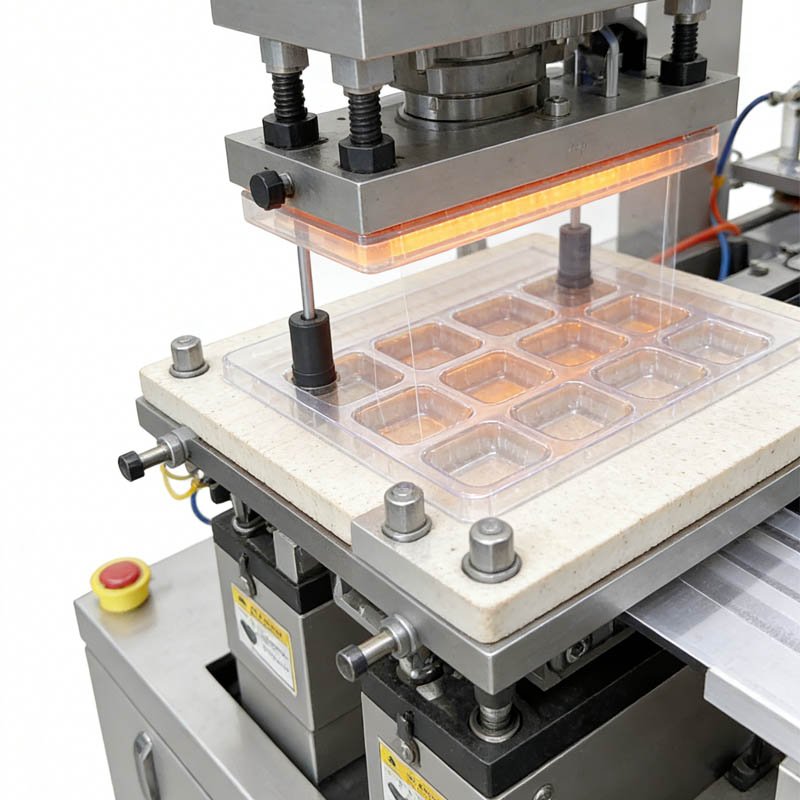
What the FAT Should Prove About the Material
A dry run with a convenient factory film does not qualify the buyer’s final blister structure. The FAT protocol should identify the approved material lots and the agreed sampling plan.
| FAT check | Evidence to retain | Why it matters |
|---|---|---|
| Forming repeatability | Approved samples, settings, cavity checks and defect record | Confirms the actual web can form the approved geometry |
| Seal process | Temperature, pressure, dwell or speed settings plus agreed integrity test | Connects the lidding system to a controlled operating window |
| Registration and coding | Printed samples and acceptance limits | Prevents artwork and batch data drift after format approval |
| Product feeding | Missing, damaged and double-fill challenge results | Separates material performance from feeding defects |
| Inspection and rejection | Challenge set, reject confirmation and fail-safe response | Shows that defective packs are detected and segregated |
| Sustained run | Run duration, good output, scrap and stoppage log | Tests the complete process rather than an instantaneous speed |
Machine configuration and site qualification remain project-specific. Review the HIJ blister packing machine range only after the product, material and validation boundary are defined.
Frequently Asked Questions
What materials are used in pharmaceutical blister packaging?
Common forming webs include rigid PVC, PVDC-coated PVC and cold-form Alu-Alu laminate. A compatible lidding material, often heat-seal-coated aluminum foil for push-through packs, completes the blister. Other structures may be used when supported by product, supplier and regulatory evidence.
What is the difference between PVC and PVDC blister film?
PVDC blister film is normally a PVC base coated with a PVDC barrier layer. It retains a transparent thermoformed cavity while providing a stronger barrier position than uncoated PVC. Performance depends on the exact coating and test conditions, so supplier data and stability results control the choice.
Is aluminum lidding foil the same as Alu-Alu forming foil?
No. Aluminum lidding closes a formed cavity. Cold-form Alu-Alu laminate creates the cavity itself. A PVC/Alu blister and an Alu-Alu blister therefore require different material and process definitions.
Is Alu-Alu always the best pharmaceutical blister material?
No. It offers the strongest barrier position among PVC, PVDC-coated PVC and cold-form Alu-Alu, but it is opaque and changes forming, tooling and pack geometry. Select it only when stability and commercial requirements justify those trade-offs.
Can one blister machine run PVC, PVDC and Alu-Alu?
Some configured machines can process both thermoformed and cold-formed structures, but compatibility must be verified for the exact model, material grade, web width, cavity drawing, tooling and output requirement. A general brochure statement is not qualification evidence.
How should a buyer compare barrier data from film suppliers?
Align the test method, temperature, humidity, units and complete sample structure before comparing results. Request current TDS and CoA documents, then confirm the chosen market pack through the applicable stability programme.
Regulatory and Technical Basis
- ICH Q1A(R2), Stability Testing of New Drug Substances and Products, including container closure system requirements.
- FDA, Container Closure Systems for Packaging Human Drugs and Biologics, including suitability and product-specific qualification principles.
- WHO, stability conditions for Member States by region, for market-specific stability planning.
- ASTM F1249, Water Vapor Transmission Rate Through Plastic Film and Sheeting, for film-level WVTR terminology and test controls.
- ASTM D3985, Oxygen Gas Transmission Rate Through Plastic Film and Sheeting, for film-level OTR measurement.
- ASTM D7709, Water Vapor Transmission Rate of Pharmaceutical Bottles and Blisters, for cavity-level blister WVTR reporting.

Founder & Chief Engineer, HIJ Machinery
Technical review focus: pharmaceutical packaging equipment, URS definition and line qualification boundaries.
Need a Material and Machine Compatibility Review?
Send your product drawing, forming web, lidding foil, blister layout, output target and validation scope. HIJ will review the required machine configuration before quoting.
Request a Material & URS Review