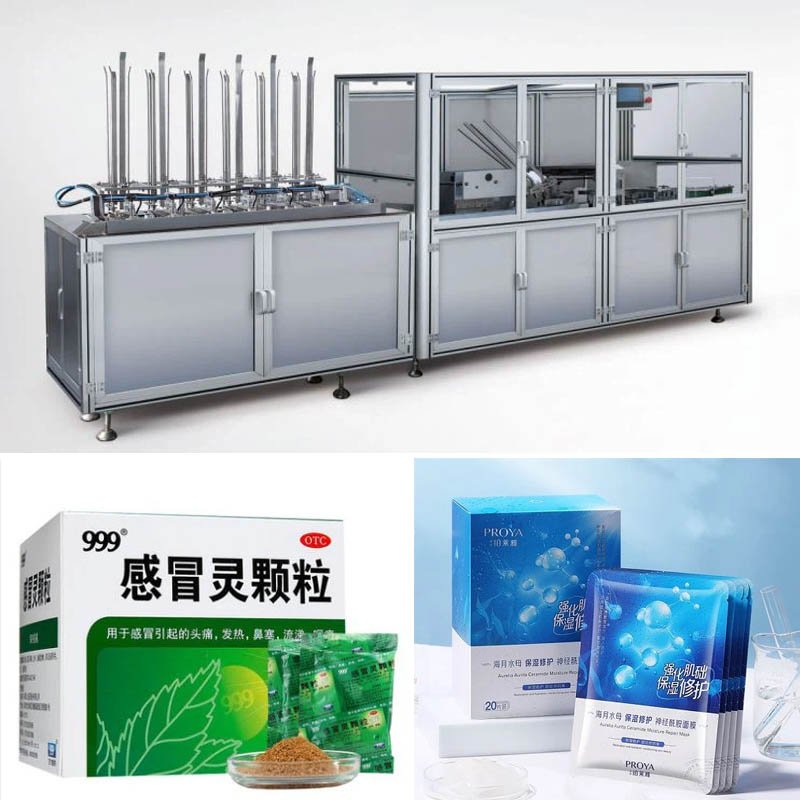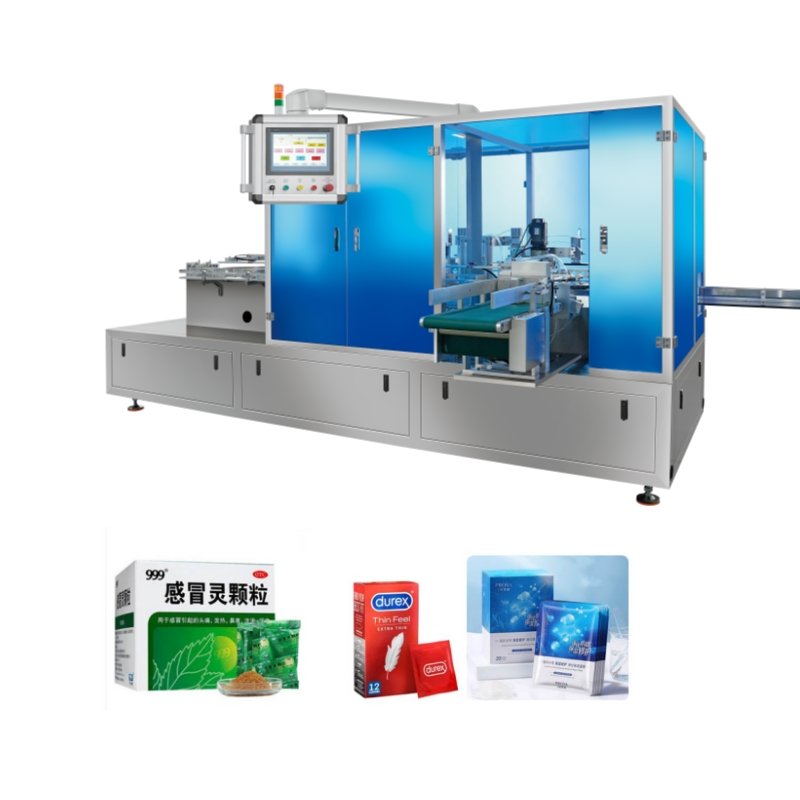
Quick Answer: How Does a Side Push Case Packer Work?
A side push case packer works in four automated stages: (1) it erects a flat corrugated blank into a rigid case, (2) counts and collates incoming products into the required array, (3) a servo-driven pusher slides the entire group horizontally into the open case in one smooth stroke, and (4) folds and seals the case flaps. Because the product never falls, side push loading is the gentlest high-speed case packing method — machines like the HIJ-CP500 reach 80–500 product boxes per minute.
Key Takeaways
- Four stations work in sync: case erection → product collation → horizontal side-push loading → flap folding and sealing.
- The defining difference from top-load packers is zero drop impact: products are pushed, never dropped, so printed cartons arrive undamaged.
- Servo control of the pusher stroke lets the machine accelerate and decelerate smoothly, applying even pressure across the whole product group.
- Output is determined by the packing array (rows × columns × layers), not just cycle speed — the same machine can be fast or slow depending on your case configuration.
- See the full specifications and comparison tables on the HIJ-CP500 side push case packing machine page.
Watch the Full Cycle First
Before we break down each station, watch one complete cycle — carton erection, collation, side push, and sealing — running as a synchronized sequence:
Stage 1: Case Erection — From Flat Blank to Rigid Case
Flat corrugated blanks are stacked in a magazine at the side of the machine. For each cycle, vacuum suction cups pick a single blank, pull it open, and mechanical guides square it into shape while the bottom flaps are folded and held. The result is a rigid, open case presented at the loading station at exactly the right position and moment.
Two details matter for B2B buyers here. First, magazine capacity determines how often an operator must reload blanks — on a high-speed line, a small magazine quietly becomes a full-time job. Second, blank quality matters: warped or damp corrugated board is the single most common cause of erection faults, which is why board storage conditions belong in your operating procedures, not just machine settings.
Stage 2: Product Collation — Building the Array
Finished products — typically folding cartons arriving from your cartoning machine — enter on the infeed conveyor. Sensors count them and gates or lane dividers arrange them into the programmed array: for example, 4 rows × 5 columns, stacked 2 layers high for 40 cartons per case.
Collation is where a good machine earns its money. The array must be built at line speed without stalling upstream equipment, and every position must be verified before the push — a missing carton means an underweight case reaching your customer. On the HIJ-CP500, the Siemens PLC tracks the count at each stage and stops the push if the array is incomplete.
Stage 3: The Side Push — Why Horizontal Loading Is Gentler
This is the defining stage. A flat pusher plate, driven by a servo motor, slides the entire collated group horizontally into the open case in one controlled stroke. The servo profile accelerates gently, moves the group at speed, then decelerates before the products reach the far wall of the case.
Compare that with a top-load (drop) packer, where products fall into the case under gravity. For robust products like cans, dropping is fine. For printed pharmaceutical cartons, premium cosmetic boxes, or any product where a crushed corner is a rejected shipment, the drop is the damage. Horizontal loading applies even, distributed pressure across the whole group — no impact, no edge crush, no scuffed print.
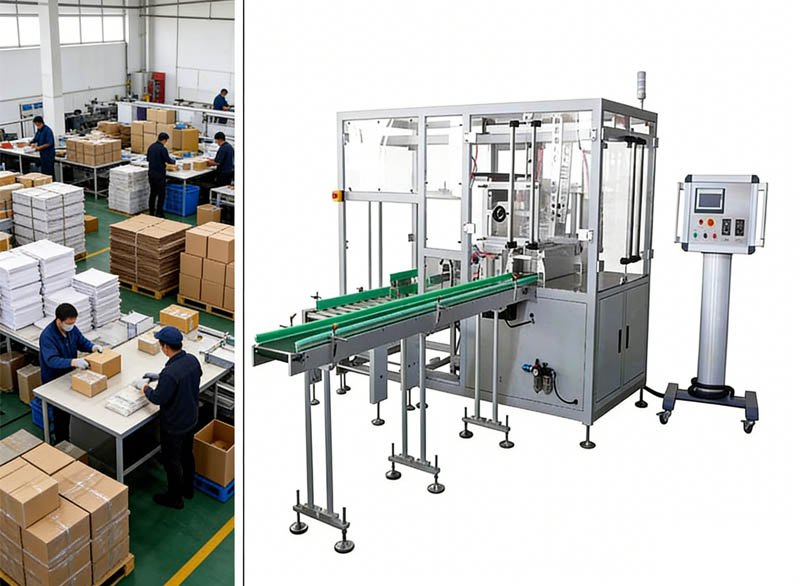
The collation infeed and horizontal loading station of a side push case packing machine.
Stage 4: Flap Folding and Sealing
Once the products are inside, folding arms close the minor and major flaps in sequence and the case passes through the sealing section — tape or hot-melt adhesive, depending on your specification. The finished case discharges toward check-weighing, labeling, or palletizing. Where a separate sealing step is preferred, the packer pairs with a dedicated automatic case sealing machine downstream.
What Actually Determines the Speed
| Factor | Effect on output |
|---|---|
| Packing array | More products per case = fewer machine cycles needed for the same product throughput. A 40-per-case array at 10 cases/min moves 400 boxes/min. |
| Product size & stability | Small, stable cartons collate faster; tall or unstable products need slower, more controlled handling. |
| Case size | Larger cases take longer to erect and seal; the loading stroke is longer. |
| Upstream consistency | The packer can only pack what arrives. Gaps in upstream flow show up as case packer “slowness” that isn’t the packer’s fault. |
| Changeover discipline | Tool-free scale-indicated adjustment keeps format changes in minutes and protects real daily output. |
This is why the HIJ-CP500’s capacity is stated as a range — 80 to 500 boxes per minute — and why a serious supplier will only guarantee a number after reviewing your exact box dimensions and array. New to the technology comparison? Start with our guide to what a case packing machine is and the four main types.
Forester’s Insight
“The question I ask when a client reports a ‘slow case packer’ is never about the packer. It’s: what does the product flow look like sixty seconds upstream? In most of the underperforming lines I’ve walked, the packer was starving — waiting on an upstream cartoner with a mismatched speed profile or an accumulation table that was never sized for peak flow.”
“That’s why I push every buyer to design the line as a system, not as a shopping list of machines. When we quote a CP500, we ask for the upstream machine’s real cycle chart, not its brochure speed. Ten minutes with that chart prevents ten months of finger-pointing between suppliers after installation.”
— Forester Xiang, Founder & Chief Engineer, HIJ Machinery
Frequently Asked Questions
What products can a side push case packer handle?
Side push case packers are designed for stable, regular-shaped products that can be pushed as a group: folding cartons, boxed pharmaceuticals, food cartons, cosmetic boxes, and similar rectangular items. Bottles and pouches can also be handled with custom collation systems, but irregular or unstable products are usually better suited to robotic pick-and-place loading.
Does the side push damage the first row of products?
No. The pusher plate is flat and spans the full face of the collated group, so force is distributed evenly across every product in the first row rather than concentrated on one point. The servo drive also decelerates the stroke before the group reaches the far wall of the case, so there is no impact at the end of travel.
What happens if a product is missing from the array?
Sensors count products at the infeed and verify the array before the push cycle is released. If the count is incomplete, the machine holds the push, alarms on the HMI, and waits for the array to complete — so underfilled cases are prevented rather than detected afterwards.
How long does a format changeover take on a side push case packer?
On a well-designed machine, a single operator changes between case formats in minutes using tool-free adjustments with scale indicators, and recalls the matching recipe on the HMI. Ask your supplier to demonstrate a live changeover with your own formats during the factory acceptance test.
Can a side push case packer seal the case as well?
Yes. Fully automatic models fold the flaps and seal with tape or hot-melt adhesive in the same frame, discharging a closed case. Alternatively, the packer can discharge to a separate automatic case sealing machine when your line layout or maintenance strategy favors dedicated stations.
What maintenance does a side push case packer need?
Routine care is straightforward: keep vacuum cups clean and replace them on schedule, check pusher guide rails and lubrication points, verify sensor alignment, and drain the air preparation unit. With a Siemens PLC platform and standard pneumatic components, most maintenance can be handled by your own technicians with remote support from the manufacturer.
About the Author & Publisher
This guide is written and reviewed by Forester Xiang, Founder & Chief Engineer of HIJ Machinery (legal name: Wenzhou Trustar Machinery Technology Co., Ltd), a pharmaceutical, cosmetic, and food packaging machinery manufacturer founded in 2004 in Rui’an, Wenzhou, Zhejiang, China. Forester has 20+ years of packaging machinery engineering experience, has completed 100+ pharmaceutical facility audits, and has delivered equipment to customers in 30+ countries.
HIJ Machinery manufactures case packing machines, cartoning machines, and complete turnkey packaging lines, all supplied with cGMP-ready, CE-marked designs and documentation that supports the customer’s own validation program (IQ/OQ/PQ).
See Your Product Running on a Side Push Case Packer
Send us your box dimensions and packing array — we’ll run a free packing simulation, share video of similar products running on our machines, and return a formal quote within 24–48 hours.
Get Free Quote & Packing Simulation