Blister Pack Tooling & Mold Design: The Secret to a Perfect Pack and Fast Changeover
In the world of pharmaceutical packaging, the blister machine often gets all the attention. We talk about its cycles per minute, its footprint, and its control system. But the true, day-to-day performance of your entire packaging line hinges on something far less discussed yet infinitely more critical: the tooling. The forming molds, sealing plates, and cutting dies are the heart of the operation, where product quality and production efficiency are truly won or lost.
The secret to a perfect blister pack and fast changeover lies in a three-part engineering philosophy for tooling design. First, it requires using superior materials like aerospace-grade aluminum for optimal heat transfer and durability. Second, it demands micron-level precision achieved through advanced CNC machining for flawless cavity formation and perfect seals. Finally, it necessitates an intelligent quick-change design, incorporating features like tool-less mechanisms and fool-proof positioning guides (poka-yoke) to reduce changeover downtime from hours to mere minutes.
“Over my 20 years in the pharmaceutical packaging industry, I’ve seen countless production managers lose sleep over a simple reality: a blister machine is only as good as its tooling. Many buyers focus entirely on the machine’s speed on paper, only to realize later that cheap, poorly designed molds lead to micro-leaks, failed GMP inspections, and agonizing hours of downtime during format changeovers.
A perfect seal and a fast changeover don’t happen by accident—they are deliberately engineered. That’s why at HIJ, we don’t just ‘cut metal.’ We design our blister tooling to strict European standards, integrating tool-less, ‘poka-yoke’ (foolproof) mechanisms. This allows your operators to swap out molds in minutes without endless wrench-turning and manual calibration. For you, it means passing vacuum leak tests with 100% confidence, maximizing your OEE, and turning what used to be a frustrating bottleneck into a competitive advantage.”
– Forester, Founder of HIJ Machinery
The Anatomy of a Perfect Pack: The HIJ Tooling Design Philosophy
A “perfect pack” is one with a uniform, hermetically sealed cavity that protects the product’s integrity until it reaches the patient. Achieving this level of quality consistently across millions of units starts with the design and manufacturing of the tooling itself.
1. Material Science: Starting with an Aerospace-Grade Foundation
You can’t build a strong house on a weak foundation. For blister tooling, the foundation is the material. We exclusively use high-grade, aerospace-quality aluminum alloys. Why?
- Superior Thermal Conductivity: Aluminum heats up and cools down evenly and quickly. This is critical for the forming station to create consistent, well-defined blister cavities without weak spots or material stress.
- Lightweight Durability: While strong and resistant to wear, these alloys are lightweight. This reduces the strain on the machine’s moving parts and makes handling during changeovers safer and easier for operators.
- Corrosion Resistance: Essential for longevity and meeting GMP standards for cleanliness and preventing product contamination.
2. Precision Manufacturing: The Power of CNC Machining
Every cavity, every guide pin, every sealing ridge is machined on state-of-the-art CNC (Computer Numerical Control) centers. This isn’t just about making the parts look good; it’s about achieving tolerances measured in microns. This precision guarantees:
- Perfect Alignment: The forming mold, sealing plate, and cutting die align perfectly every time, ensuring the lidding foil is sealed precisely over the center of the cavity. This is the key to preventing channel leaks.
- Flawless Cavity Surfaces: CNC machining creates an ultra-smooth cavity surface, allowing for easy release of the formed plastic film and preventing product damage.

3. Advanced Surface Treatments
After machining, our tooling undergoes specialized surface treatments like hard anodizing. This creates a harder, smoother, and more durable surface than raw aluminum. This final step enhances lubricity (for better film release) and makes the tooling even more resistant to scratches and the abrasive nature of certain packaging films.
Engineering for Speed: The Art of the Fast Changeover
In today’s market of smaller batch sizes and more product SKUs, Overall Equipment Effectiveness (OEE) is king. The single biggest killer of OEE is often downtime during format changeovers. A machine that takes 3 hours to change over is a massive drain on profitability. This is where intelligent tooling design creates a powerful competitive advantage.
Our quick-changeover tooling is built around a simple principle: minimize adjustments and eliminate errors. We achieve this through:
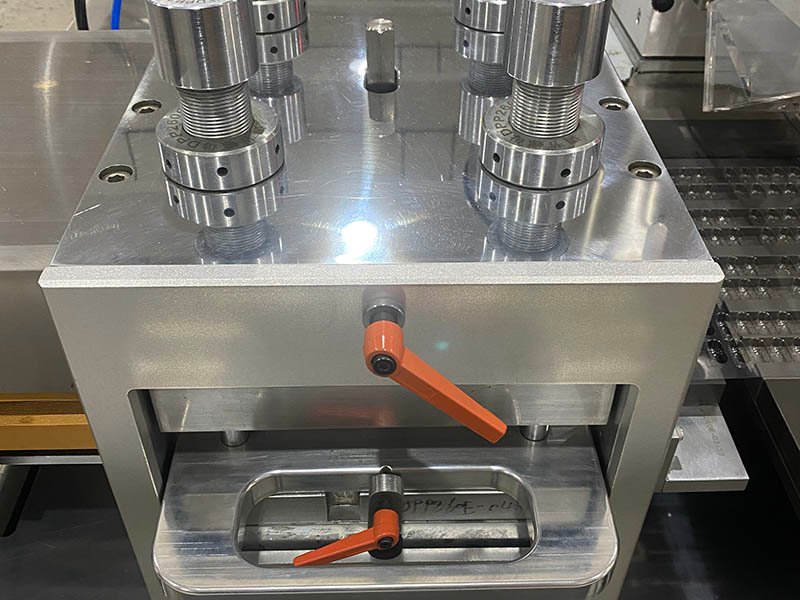
- Tool-less Mechanisms: Using quick-release clamps, locking levers, and ergonomic knobs instead of dozens of different-sized bolts. This means operators don’t waste time searching for the right wrench.
- Poka-Yoke (Mistake-Proofing): Designing tooling with unique shapes, guide pins, and slots that only allow it to be installed in the one, correct orientation. This eliminates the risk of human error, misalignment, and costly trial-and-error adjustments.
- Positioning Memory: Using location dowels and preset stoppers that ensure when a new mold set is installed, it returns to the exact pre-validated position, drastically reducing the need for re-calibration.

The result? Changeover times on our line of blister packing machines are reduced from hours to as little as 15-30 minutes, turning what was once a major production bottleneck into a simple, routine task.
Protect Your Investment: An Essential Blister Mold Maintenance Checklist
High-quality tooling is a significant investment. Proper care and maintenance will ensure it performs flawlessly for years and continues to produce compliant, perfect packs. Share this checklist with your team:
- Clean After Every Batch: Use approved solvents (like isopropyl alcohol) and soft, lint-free cloths to remove any product residue or film fragments. Never use abrasive scrapers or pads that could scratch the surface.
- Inspect for Damage Regularly: Before storing a mold set, carefully inspect it under good lighting. Look for any nicks, dents, or signs of wear on the sealing surfaces or cutting edges. Address minor issues immediately.
- Store Properly: Store tooling in a clean, dry, designated area. Use custom-made carts or shelving that prevents the molds from being knocked or damaged. Never stack tooling directly on top of each other.
- Lubricate Guide Components: Lightly lubricate guide pins and bushings according to the manufacturer’s recommendations to ensure smooth, precise movement.
- Verify Alignment Periodically: Even with poka-yoke designs, it’s good practice to periodically use a carbon paper test or similar method to verify that the sealing plate is applying even pressure across the entire surface.
Stop Tolerating Bad Seals and Slow Changeovers
Your tooling shouldn’t be a source of frustration. It should be a source of reliability. Contact our engineering team to discuss how a blister machine with intelligently designed tooling can transform your production efficiency.
Get a Custom Tooling & Machine QuoteFrequently Asked Questions About Blister Tooling
What is the typical changeover time with HIJ quick-change tooling?
For a trained operator, a full format changeover—including the feeder, forming mold, sealing plate, and cutting die—can typically be completed in 15 to 30 minutes on our machines. This is a dramatic reduction from the 2-4 hours common on older or poorly designed equipment.
Can you design tooling for our unique tablet or capsule shape?
Absolutely. Custom tooling design is one of our core competencies. Our engineering team works directly with your product specifications and 3D models to design and manufacture tooling that provides a perfect, secure fit for any shape, from complex ovals to unique branded tablets.
How long does a set of HIJ blister tooling last?
With proper care and maintenance as outlined in our checklist, a set of our tooling, made from aerospace-grade aluminum and with surface treatments, is designed to last for many years of multi-shift production. Its lifespan will far exceed that of tooling made from cheaper, softer materials.
Can we order replacement tooling for a non-HIJ machine?
While our tooling is specifically designed for perfect integration with HIJ machines, we do have the capability to reverse-engineer and manufacture high-quality replacement tooling for other brands. Contact our technical team with your machine model and tooling specifications to discuss possibilities.