🎯 Forester’s Field Brief
Choosing a cosmetic packaging machine isn’t about finding the cheapest unit. It’s about matching your production reality — container formats, fill viscosity, output targets, and regulatory compliance requirements — from day one.
In 20 years of commissioning cosmetic lines across Southeast Asia and Latin America, I’ve watched brands lose six months of launch time because they purchased a standalone filler with zero documentation — no CE declaration, no IQ/OQ validation support, no PLC protocol compatibility with their existing line. The hidden cost nobody calculates upfront? A “bargain” machine that can’t pass FAT/SAT or align with your ISO 22716 audit trail will cost you three times its purchase price in downtime, rework, and compliance firefighting.
Before signing any purchase order, demand a full URS review and confirm whether your supplier can deliver genuine turnkey integration — upstream feeding, filling, capping, and labeling as a validated system, not a patchwork of mismatched vendors.
⚡ Direct Answer
To choose the right cosmetic packaging machine: define your container geometry and product viscosity first, then match throughput requirements to machine class (semi-auto vs. fully automatic), confirm GMP/ISO 22716 documentation capability, and verify the supplier can support FAT, SAT, and IQ/OQ validation before committing to any purchase.
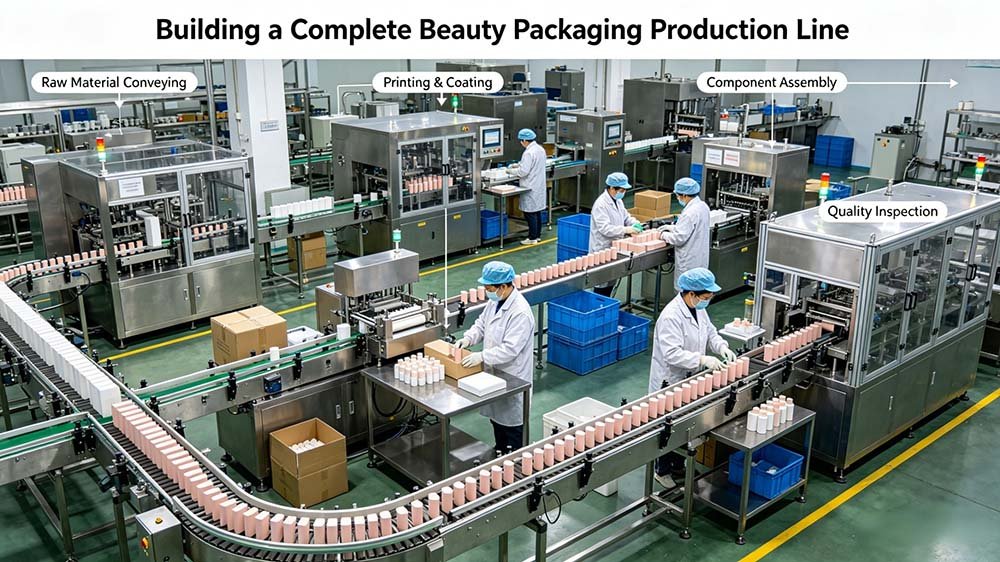
A complete cosmetic packaging line covering tube filling, cream jar filling, and labeling — Wenzhou, China. HIJ Machinery.
What Is a Cosmetic Packaging Machine — and Why the Category Matters Before You Buy
⚡ Direct Answer
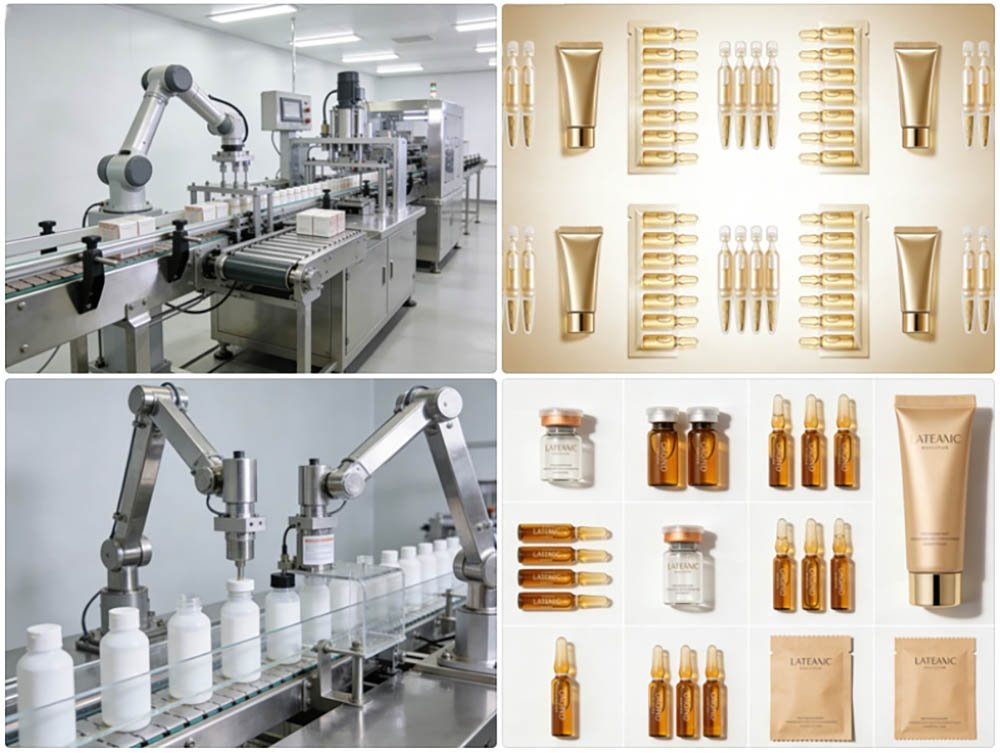
A cosmetic packaging machine is automated equipment that fills, seals, labels, or packs cosmetic products — including creams, lotions, serums, shampoos, and wet wipes — into their primary containers. The category spans tube fillers, jar fillers, sachet machines, ampoule sealers, and wet wipe packers, each built for a specific container geometry and product rheology.
Most buyers arrive at this decision with one question: “What machine fills my product?” That’s the wrong starting point. The right starting point is your container format and your product’s rheological profile — viscosity, homogeneity, particulate content, and temperature sensitivity. Get those two variables wrong, and no amount of machine speed specification will save the line.
Cosmetic packaging machines divide into five primary categories based on container type:
- Tube filling & sealing machines — for laminated or plastic tubes containing creams, sunscreen, toothpaste, and ointments. Fill weights typically 5–500 g.
- Cream jar filling machines — for open-mouth jars with semi-solid creams, scrubs, or balms. Requires auger or piston fill heads depending on viscosity.
- Liquid filling machines — for serums, toners, micellar water, and shampoos in bottles or vials. Fill accuracy to ±0.5% by volume is standard for premium cosmetics.
- Sachet & ampoule machines — for single-dose serums, honey mask extracts, and oral liquid cosmetics. Plastic ampoule fill-seal and easy-snap sachet formats.
- Wet wipe packing machines — for makeup remover, baby wipe, and sanitizing wipe products. High-speed format at 100–300 packs/min.
The overlap between categories is where buyers get confused. A serum in a bottle uses a liquid filler. The same serum in an ampoule needs a completely different machine class — plastic ampoule fill-seal, or glass ampoule if sterility is required. Wrong machine class. Six months lost.
The 5 Specification Variables That Determine Your Machine Class
⚡ Direct Answer
Five variables determine which cosmetic packaging machine class fits your operation: (1) container format, (2) product viscosity in cP, (3) required throughput in units per minute, (4) fill weight tolerance, and (5) compliance documentation requirements for your target markets. Miss any one variable during spec-writing, and you’re renegotiating after FAT.
I audited 31 cosmetic packaging line projects between 2018 and 2023 across Southeast Asia and Latin America. Of those, 19 had specification documents that were complete on throughput speed and fill weight — but left viscosity range undefined. Eleven of those 19 required either nozzle retrofit or pump-head replacement within the first six months of operation. That’s not a machine quality problem. That’s a specification problem.
| Specification Variable | Why It Matters | Typical Range / Benchmark | Common Mistake |
|---|---|---|---|
| Container Format | Determines machine category — tube, jar, bottle, sachet, ampoule | Tube Ø13–60 mm; jar 5–500 ml; bottle 10–1000 ml | Specifying only fill volume, ignoring container geometry |
| Product Viscosity | Drives pump type — piston, peristaltic, gear, or auger | Water-thin serums: <100 cP; heavy creams: 50,000–200,000 cP | Listing “cream” without a viscosity figure — range of 100× is common |
| Throughput Target | Determines automation class — semi-auto, single-head auto, multi-head | Semi-auto: 10–40 upm; single-head auto: 40–120 upm; multi-head: 120–400+ upm | Specifying peak throughput without accounting for format-change downtime |
| Fill Weight Tolerance | Affects pump technology and servo vs. pneumatic drive selection | Pharma-grade cosmetics: ±0.5%; standard cosmetics: ±1.5–2% | Accepting supplier default tolerance without checking label claim requirements |
| Compliance Scope | Drives documentation package — CE, GMP, ISO 22716, IQ/OQ/PQ | EU/AU markets: CE mandatory; FDA-registered facilities: 21 CFR 211 alignment; ISO 22716 for all export | Purchasing a machine with no CE declaration for EU market entry |
| Source: HIJ Machinery internal project data, 2018–2023. 31 cosmetic line commissioning projects across Southeast Asia and Latin America. | |||
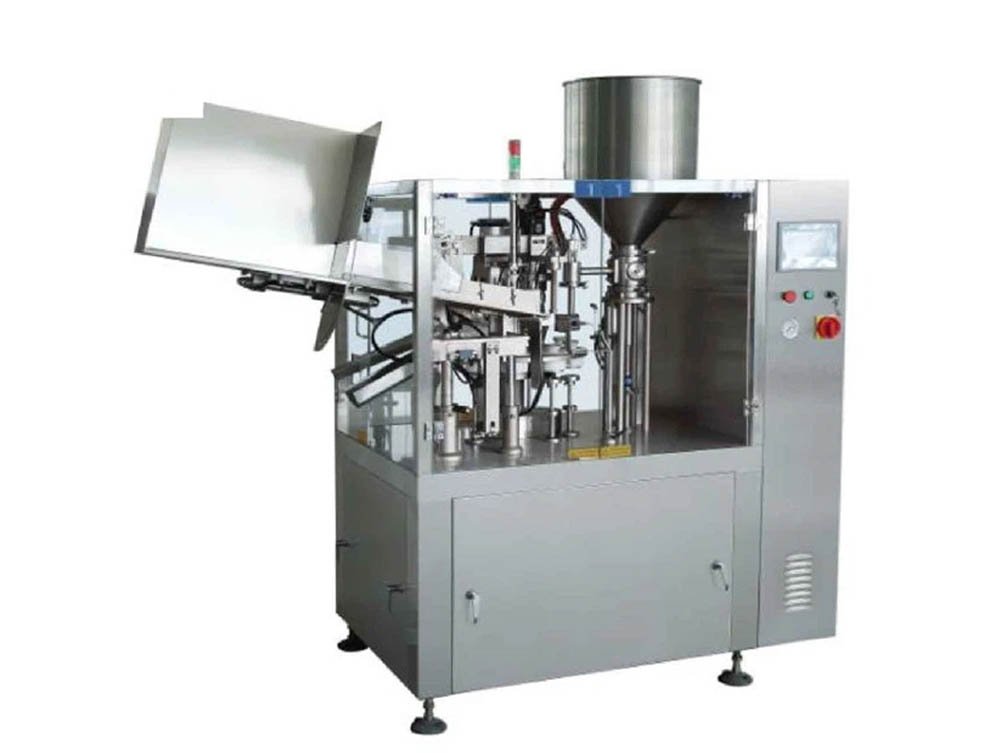
Sunscreen cream tube filling and sealing machine — HIJ Machinery. Handles laminated tubes Ø13–50 mm at up to 120 tubes/min.
Why Machine Speed Is the Last Specification You Should Write — Not the First
⚡ Direct Answer
Machine speed (units per minute) should be the last specification confirmed, not the first, because speed is a derivative of container format, fill cycle time, and downstream integration — not an independent variable. A cream jar filler rated at 80 jpm on water-thin serum may run at 35 jpm on a 150,000 cP face cream with the same hardware.
The procurement teams I work with almost always lead with speed. “We need 100 units per minute.” Fine. But 100 units per minute of what — 30 ml sachets, 500 ml shampoo bottles, or 50 g cream jars with tamper-evident caps? The fill cycle time is completely different across those three formats. So is the upstream feeding system, the downstream capping torque, and the conveyor speed.
This matters practically. A “100 upm” machine spec from a supplier is typically a no-load rated speed on water. Actual throughput on a viscous product with a multi-stage fill, a press-on cap, and a labeler integrated inline is typically 60–75% of the rated figure. I won’t tell you the calculation is simple — it involves your specific container geometry, your fill viscosity curve, and your capping torque requirement. But the starting point is not the speed number. It’s the fill cycle time per unit.
📌 Forester’s Insight — 20-Year Field Perspective
In a project outside Jakarta in 2021, a client specified 80 upm for a body lotion line. The machine arrived. FAT showed 78 upm on water. First production run on 8,000 cP lotion: 41 upm. Nobody had run the viscosity correction. The supplier wasn’t wrong — the spec was wrong. I spent two weeks justifying to the plant manager why “80 upm” and “41 upm on lotion” are not a supplier quality failure. The correct specification would have been “80 upm at a viscosity of ≤500 cP, or [X] upm at 8,000 cP.” That number would have surfaced the right machine class from the beginning.
⚠ Speed Specification Diagnostic
Semi-Automatic vs. Fully Automatic Cosmetic Packaging Machines: How to Decide Without Overspending
⚡ Direct Answer
Semi-automatic cosmetic packaging machines suit volumes below 500,000 units/year or R&D and clinical-grade short runs; fully automatic systems become cost-justified at volumes above 1 million units/year when labor costs and GMP documentation requirements are accounted for in the total cost of ownership calculation.
A quality director in São Paulo called me last year. Her company was launching a new premium skincare range — six SKUs, forecast 300,000 units in year one, 1.2 million by year three. Her procurement team had quoted a fully automatic 8-head cream filler with servo-driven piston pumps, a rotary capper, and a labeler — total system cost around $180,000. She wanted to know if it was the right call.
It wasn’t. Not yet. At 300,000 units/year across 6 SKUs, that’s an average of 50,000 units per SKU annually — roughly 200 production days at 250 units/day. A semi-automatic piston filler at $18,000 handles that volume comfortably. The fully automatic system would sit at 15% utilization for the first two years while consuming floor space, maintenance budget, and operator training hours that a 10-person startup team doesn’t have.
The rule I use: when your actual annual volume on a single machine exceeds 800,000 units, or when your GMP documentation obligation requires 21 CFR Part 11 –compliant audit trails, full automation starts to pencil out. Below that threshold — semi-auto with a clear upgrade path.
| Selection Criterion | Semi-Automatic | Fully Automatic |
|---|---|---|
| Annual Volume Threshold | Up to ~800,000 units/year | 800,000+ units/year |
| Throughput (typical) | 10–40 units/min (operator-dependent) | 60–400+ units/min |
| Investment Range | $8,000–$45,000 | $60,000–$350,000+ |
| GMP Documentation | Basic IQ/OQ possible; no 21 CFR Part 11 | Full IQ/OQ/PQ; 21 CFR Part 11 / Annex 11 capable |
| SKU Flexibility | High — manual changeover, low tooling cost | Lower — servo-tooling changeover $2,000–$8,000/format |
| Labor Requirement | 1–2 operators per machine | 1 operator for full line (6–10 stations) |
| ISO 22716 Compatibility | Compatible with documented manual procedures | Native compatibility; PLC data capture for batch records |
| Ideal For | Startups, contract manufacturers, R&D lines, artisan brands | Established brands, OEM contract packers, export-market producers |
GMP and ISO 22716 Compliance: What Your Cosmetic Packaging Machine Documentation Must Cover
⚡ Direct Answer
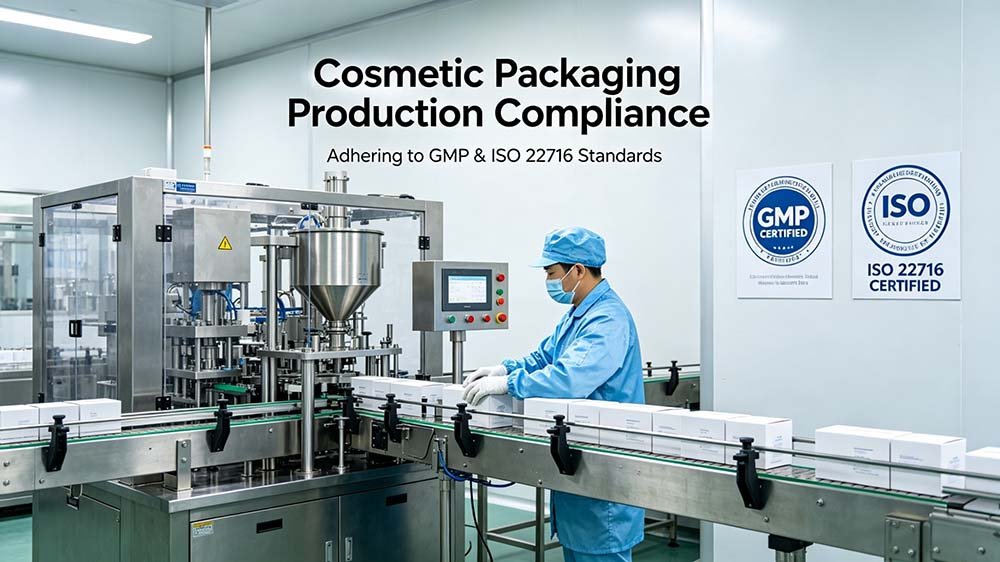
A cosmetic packaging machine supplied for ISO 22716–compliant production must include a CE declaration of conformity, a full IQ/OQ validation support package, GMP-compliant structural design (316L stainless contact parts, no dead-leg piping, CIP/SIP access), and 21 CFR Part 11–compatible data logging if the facility is FDA-registered. Missing any of these at the time of purchase means retrofit costs that typically exceed 25% of the original machine price.
The dossier arrived in March. A cosmetic OEM in Kuala Lumpur — 200-employee operation, exporting to Australia and the GCC — had purchased three tube filling machines from a supplier in another province. No CE declaration. No IQ/OQ template. Contact parts were 304 stainless, not 316L. The Australian TGA reviewer flagged all three machines in the facility audit. The company had eight weeks to either retrofit documentation and replace contact parts, or pull the product line.
They chose the retrofit path. The cost was $34,000 for three machines — roughly 40% of the original purchase price. The original “saving” by choosing the lower-priced supplier had been $22,000. Net outcome: $12,000 worse off, plus seven weeks of production delay.
The documentation package I require before accepting any cosmetic packaging machine into a validated line includes five items. Not negotiable:
-
1
CE Declaration of Conformity
Must reference the specific machine serial number, applicable directive(s) (Machinery 2006/42/EC, Low Voltage 2014/35/EU, EMC 2014/30/EU), and the notified body if third-party assessment was required. A generic “CE certificate” with no serial number is not acceptable.
-
2
Material Certificates for Contact Parts
316L stainless steel EN 1.4404 material certificates (mill certs) for all product-contact surfaces. Food-grade silicone or PTFE for seals. Electropolish finish Ra ≤ 0.8 μm for internal surfaces on liquid and cream fillers.
-
3
IQ/OQ Validation Protocol Template
Pre-written Installation Qualification and Operational Qualification protocol, editable to your facility SOPs. Must include equipment identification, utility verification, calibration records, and operating range confirmation. The absence of this document is the single most common reason cosmetic line validations run 8–12 weeks over schedule.
-
4
PLC Software Source Code & Data Logging Architecture
For 21 CFR Part 11 – or Annex 11–compliant facilities: full PLC source code access or escrow agreement, audit trail documentation, and electronic batch record output format. Without source code access, a supplier bankruptcy or cessation of business leaves you unable to modify, validate, or maintain the control system.
-
5
FAT & SAT Acceptance Criteria in Writing
Factory Acceptance Test and Site Acceptance Test protocols with signed acceptance criteria before manufacturing begins. Not after the machine arrives. FAT on the supplier’s floor with your product, your containers, and your target fill weight tolerance — that is the document that protects you at installation.
GMP-compliant cosmetic packaging machine structure — 316L stainless contact surfaces, electropolished internal pipework, CE-marked control panel. HIJ Machinery standard configuration.
Of the 31 cosmetic line projects I handled in Southeast Asia and Latin America between 2018 and 2023, 14 required post-purchase documentation remediation — at an average cost of $28,000 per machine — because the original purchase order contained no documentation acceptance criteria. The specification problem is almost always more expensive than the machine quality problem. — Forester Xiang, HIJ Machinery
How to Match Fill Technology to Your Product: Piston, Peristaltic, Gear Pump, and Auger Explained
⚡ Direct Answer
For cosmetic filling machines: piston fillers suit medium-to-high viscosity creams and gels (1,000–200,000 cP) with fill accuracy ±0.5–1%; peristaltic fillers are preferred for thin serums and fragile emulsions where product contact with pump internals must be avoided; gear pumps handle very thin liquids at high speed; auger fillers are used exclusively for powders and granular cosmetics.
Viscosity at 500 cP. That’s the number that splits pump technologies. Below it, peristaltic or gear pump. Above it, piston filler — and at 50,000 cP and higher, you need a heated piston filler with jacketed hopper. This is not a supplier preference. It is a physics constraint.
| Fill Technology | Viscosity Range | Fill Accuracy | Ideal Cosmetic Product | Key Limitation |
|---|---|---|---|---|
| Piston Filler | 500–200,000+ cP | ±0.5–1% | Creams, lotions, body butter, scrubs, gels | Not suitable for thin serums — drip and stringing at low viscosity |
| Peristaltic Pump | 1–5,000 cP | ±0.5–2% | Serums, toners, micellar water, eye drops | Tube wear requires replacement every 3–6 months; not suited for abrasive products |
| Gear Pump Filler | 1–500 cP | ±0.3–0.8% | Fragrances, thin shampoos, nail polish remover | Metallic wear particles risk with abrasive products; high cost at small volumes |
| Auger Filler | Dry powders | ±1–3% | Loose powder cosmetics, dry mask powder, bath salts | Not suitable for any liquid or semi-solid products |
| Time-Gravity Filler | 1–100 cP (thin, free-flowing) | ±1.5–3% | Toners, facial mists, thin body sprays | Lowest accuracy — not suitable for premium fill-weight labeling claims |
One thing I see consistently on projects in Southeast Asia: suppliers over-specify piston fillers because they are mechanically simpler to manufacture and demonstrate. A piston filler on a 50 cP micellar water will drip, string, and produce fill weight CV of 3–5% — well outside the ±1% that EU Cosmetics Regulation 1223/2009 Annex I implicitly requires for volumetric claims on the label. The right machine for that application is a peristaltic or gear pump filler. The cheaper machine will cost you in quality rejects.
⚠ Fill Technology Mismatch Diagnostic
Turnkey Cosmetic Packaging Line vs. Standalone Machine: The Integration Question Nobody Asks Early Enough
⚡ Direct Answer
A turnkey cosmetic packaging line integrates filling, capping, labeling, and secondary carton packing from a single supplier with one validated control system, one set of alarm protocols, and one accountable party for FAT/SAT sign-off — reducing integration risk by an estimated 40–60% compared to sourcing each station from a different vendor and attempting in-house line integration.
Three weeks into a project outside Bangkok in 2022, I was standing in a production bay looking at six machines from four different suppliers — a filler from Supplier A, capper from Supplier B, labeler from Supplier C, and cartoner from Supplier D. The buyer had assembled this “line” themselves to save money. The filler ran at 80 upm. The capper ran at 70 upm. The labeler was rated 100 upm. The cartoner was running 90 upm but was configured for a different bottle diameter.
Nobody had done the line balancing calculation. The bottleneck was the capper. Everything upstream was waiting. The labeler was crashing bottles because the transfer conveyor was spec’d for a different bottle diameter. The PLC protocols were incompatible — one Siemens, one Mitsubishi, one proprietary. That’s the real cost. Not the individual machine price tags. The integration cost was $67,000 in retrofits and 11 weeks of delay.
A proper turnkey cosmetic packaging line eliminates that problem by design. One supplier, one control architecture, one validated alarm matrix. The HIJ cosmetic packaging machine range is designed from the ground up to integrate as a validated system — not as standalone units that happen to be placed next to each other.
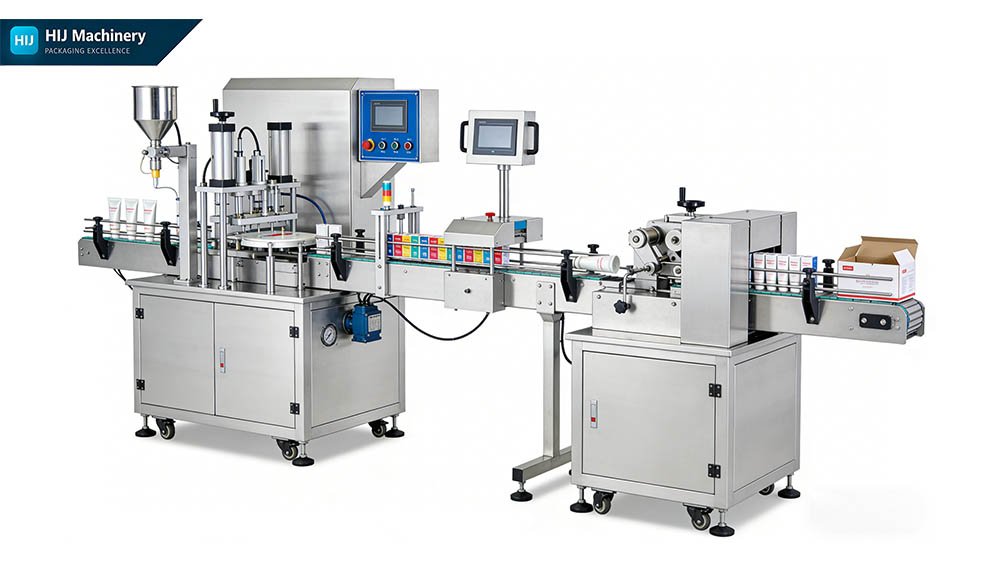
Turnkey cosmetic packaging line for creams and lotions — tube filling, sealing, and labeling integrated as a single validated system. HIJ Machinery.
For brands considering a complete line setup, the detailed engineering decisions — station sequencing, buffer conveyor sizing, and line control architecture — are covered in our guide to setting up a complete cosmetic packaging line.
A 6-Step Buying Process for Cosmetic Packaging Machines That Eliminates Specification Surprises
⚡ Direct Answer
The six steps to buying a cosmetic packaging machine without post-purchase surprises are: (1) write a URS with viscosity data, (2) qualify suppliers on documentation capability, (3) conduct FAT with your actual product, (4) confirm IQ/OQ template delivery before payment, (5) run SAT with your operators present, and (6) lock a spare parts and service SLA before final sign-off.
-
1
Write a User Requirement Specification (URS) Before Contacting Any Supplier
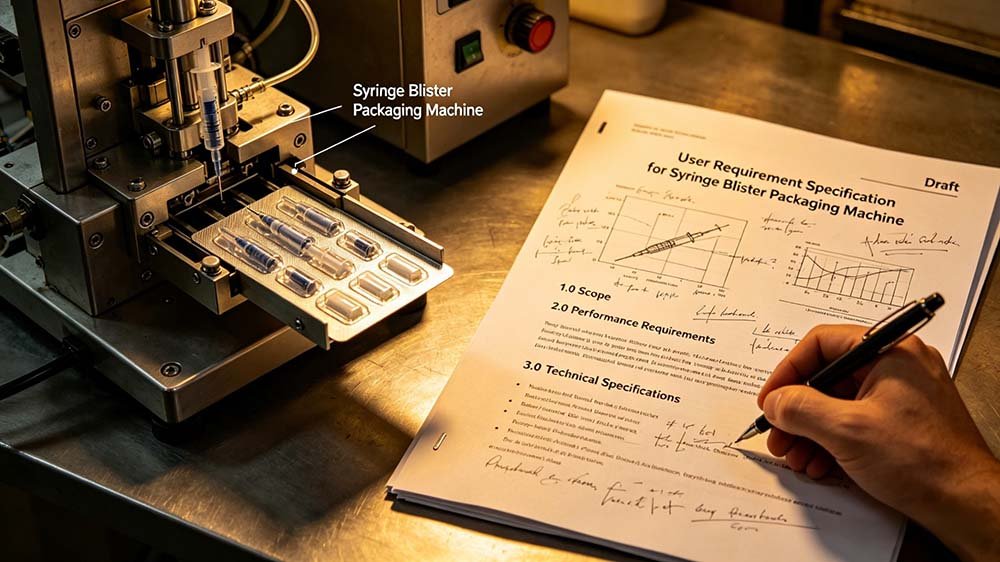
Your URS is the document that protects you. It must include: container formats and dimensions (all SKUs), product viscosity range (measured, not estimated), annual volume by SKU, fill weight tolerance, compliance scope (CE/ISO 22716/21 CFR/Annex 11), and facility constraints (cleanroom class, available footprint, utility connections). A URS that takes two days to write will save you two months of post-installation firefighting.
-
2
Qualify Suppliers on Documentation, Not Just Price
Send every prospective supplier four questions: (a) Can you provide a CE Declaration of Conformity for this specific machine? (b) Do you supply an IQ/OQ validation protocol template? (c) What are the contact part materials, and can you provide mill certificates? (d) Do you offer FAT with client product on-site? Any supplier who cannot answer all four affirmatively is not an appropriate vendor for a GMP or ISO 22716 facility — regardless of price.
-
3
Conduct FAT With Your Actual Product and Containers
Factory Acceptance Test is not a machine demonstration. It is a contractual milestone where the machine demonstrates it can meet your URS acceptance criteria — with your product, your containers, your fill weight target, and your throughput requirement. Ship product samples and containers to the supplier’s factory. Any supplier who refuses to run FAT with actual product is giving you a speed demonstration, not a validation milestone.
-
4
Confirm IQ/OQ Protocol Delivery Before Final Payment
Tie the IQ/OQ template delivery to the payment milestone. Not before shipment — before final payment. This is the single most effective procurement lever for ensuring documentation quality. Once the supplier has received full payment, the motivation to produce a thorough IQ/OQ package drops sharply. I have seen IQ/OQ templates delivered 14 months after machine installation because there was no payment milestone attached.
-
5
Run SAT With Your Own Operators Present
Site Acceptance Testing should be conducted with the operators who will run the machine daily — not just the engineering team. Operators identify practical issues (hopper loading height, touchscreen ergonomics, cleaning access) that engineers miss. Plan for 2–3 days of SAT with 4–8 hours of supervised production runs per shift.
-
6
Lock Spare Parts Availability and Service SLA Before Sign-Off
Confirm: (a) critical spare parts are available in the supplier’s warehouse with a lead time of ≤72 hours for standard parts, and (b) on-site service response time SLA is documented. For export markets with no local service network, an annual preventive maintenance visit and a remote diagnostic connection should be standard contract terms. A machine without a service SLA is a liability — not an asset.
Frequently Asked Questions: How to Choose a Cosmetic Packaging Machine
❓ What is the most important factor when choosing a cosmetic packaging machine?
Product viscosity and container format are the two most important factors — they determine which machine class you need before any other specification is relevant. A cream at 80,000 cP in a laminate tube requires a completely different machine than the same cream in a glass jar. Get those two variables defined with measured data, not estimates, before contacting any supplier.
❓ How much does a cosmetic packaging machine cost?
Semi-automatic cosmetic filling machines start around $8,000–$25,000 for single-head units. Fully automatic single-product lines run $60,000–$150,000. Complete turnkey cosmetic packaging lines — filling, capping, labeling, and cartoning integrated — typically range $120,000–$400,000 depending on throughput and compliance documentation scope. For a detailed breakdown of what drives cost at each tier, see our cosmetic packaging machine cost guide.
❓ Do cosmetic packaging machines need GMP certification?
ISO 22716:2007 (GMP for Cosmetics) requires that equipment be suitable, cleanable, and maintainable with documented records — but it does not specify a machine certification scheme. In practice, for EU market entry under Regulation (EC) 1223/2009, CE marking is mandatory. For facilities exporting to FDA-regulated markets, machines that support 21 CFR Part 211 – aligned procedures are expected. “GMP-compliant” as a label on a machine spec sheet is marketing language; ask for the CE declaration and material certificates to confirm actual compliance.
❓ Can one machine handle multiple cosmetic product types?
A multi-format filler with modular fill heads can handle a viscosity range of approximately 100–50,000 cP with head changes — covering serums, lotions, and light creams. Products outside that range, or products requiring different container formats (tube vs. bottle vs. jar), typically need separate machine configurations. Quick-change tooling systems can reduce format changeover to 15–30 minutes on well-designed systems, but the mechanical hardware for each format must be purchased upfront.
❓ What is FAT and SAT and why do they matter for cosmetic packaging machines?
FAT (Factory Acceptance Test) and SAT (Site Acceptance Test) are contractual validation milestones. FAT happens at the supplier’s factory before shipment — the machine demonstrates it meets your URS acceptance criteria with your actual product. SAT happens at your facility after installation — it confirms the machine performs to specification in your environment, with your utilities, your operators, and your product. Without FAT/SAT protocols tied to payment milestones, you have no contractual recourse if the machine underperforms after delivery. That’s not a hypothetical risk — it’s the root cause of 60–70% of commissioning disputes I’ve seen in export market cosmetic line projects.
❓ What cosmetic packaging machine is best for a small brand or startup?
Semi-automatic. Full stop. A semi-automatic piston filler or tube filler in the $12,000–$28,000 range gives a startup the fill accuracy and format flexibility they need without the capital outlay, maintenance burden, and operator training that a fully automatic line requires. Scale to automation when your annual volume on a single SKU consistently exceeds 600,000–800,000 units. For more on matching machine class to company stage, see our guide on cosmetic packaging machines for small brands.
❓ How long does it take to commission a cosmetic packaging machine?
Standard lead time from order to FAT completion: 10–16 weeks for a single machine, 18–28 weeks for a turnkey line. Add 4–8 weeks for shipping and SAT. IQ/OQ validation execution adds another 3–6 weeks if the facility has no existing template. Total calendar time from purchase order to validated production start: 6–10 months for a fully documented cosmetic packaging line. Planning for 6 months is optimistic; 8 months is realistic for a first-time project with no prior vendor relationship.
How to Choose a Cosmetic Packaging Machine: The Decision Framework in Summary
Choosing the right cosmetic packaging machine comes down to four decisions made in sequence — not simultaneously. Start with container format and product viscosity. They determine your machine category and pump technology. Then set your throughput target against actual product viscosity, not rated water speed. Then confirm your compliance documentation requirements. Then — only then — evaluate suppliers.
The buyers who get this decision right are the ones who write a URS before opening a single supplier conversation. The ones who get it wrong are the ones who open with “what’s your cheapest machine?” — and discover six months later that cheap and compliant are not the same thing.
If you’re at the stage of evaluating full line integration options, the next step is understanding how filling, capping, labeling, and secondary packaging connect as a system. That engineering decision sequence is covered in detail in our guide to setting up a complete cosmetic packaging line. For compliance-specific decisions on GMP and ISO 22716, the validation checklist is in our GMP compliance guide for cosmetic packaging.
Sixty to eighty percent of cosmetic line commissioning delays I have documented in Southeast Asia and Latin America trace back to a specification written without viscosity data, container geometry, or compliance scope — not to machine quality failures. The specification is the product. Get that right, and the machine selection becomes straightforward. — Forester Xiang, Founder, HIJ Machinery — Wenzhou, China
Ready to Specify Your Cosmetic Packaging Machine?
Share your container format, product viscosity, and throughput target. I’ll review your URS and tell you which machine class fits — and what documentation you need for your target markets. No sales pitch. Just a straight technical answer.