7 Costly Cosmetic Packaging Mistakes — and How to Avoid Every One
The most expensive cosmetic packaging mistakes are not design errors. They are engineering oversights baked into your line specification before a single bottle is filled — mismatched pump viscosity profiles, multi-vendor integration gaps, and compliance documentation holes that only surface when a regulatory reviewer asks for records you never generated.
I have commissioned cosmetic packaging lines in Jakarta, Ho Chi Minh City, São Paulo, and Casablanca. The same seven failure patterns appear every time. This article names them precisely, shows you where they hide, and tells you how to close each gap before it costs you a batch, a launch delay, or a regulatory non-conformance.
In my 20 years auditing cosmetic facilities across Southeast Asia and Latin America, I’ve watched brands lose entire production batches not from bad formulas, but from mismatched filling tolerances and pumps never validated against their actual viscosity range.
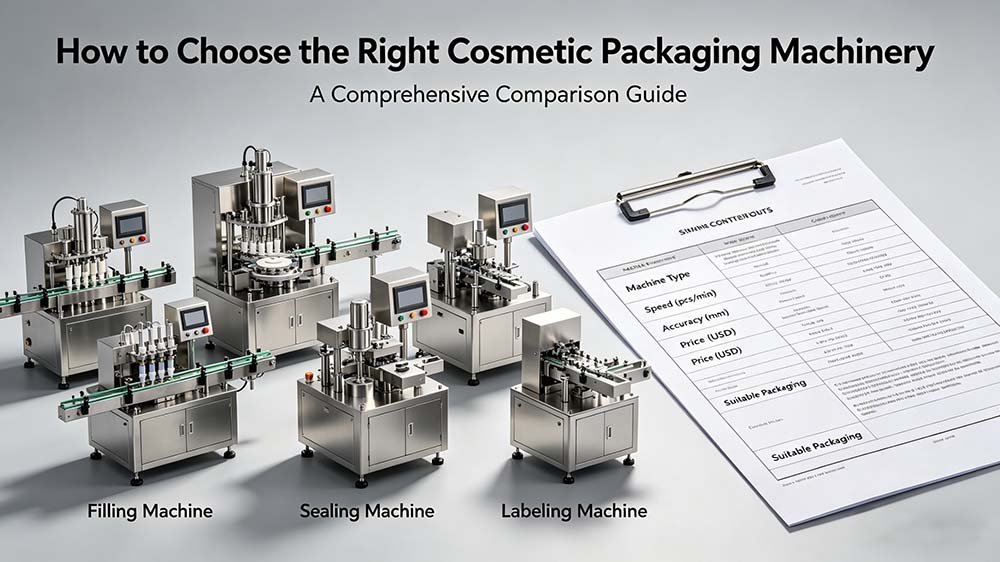
The hidden trap nobody talks about: procurement teams source fillers, cappers, and labelers from three separate vendors — each machine passes standalone FAT, yet the integrated line fails SAT catastrophically. Nobody owns the problem. The brand pays in downtime, rework, and delayed market launches. Before you finalize any equipment URS, pressure your supplier on turnkey integration accountability — who debugs the interfaces, not just the individual machines.
Mistake #1: Specifying Filling Pump Without Validating Against Your Actual Viscosity Range
A procurement manager in Ho Chi Minh City called me fourteen months after commissioning. Fill-weight on their SPF 50 sunscreen was drifting ±4.2% by shift three every day. The gear pump they’d sourced was rated to 50,000 cP at 25°C. Their product peaked at 68,000 cP during the cold-start morning cycle. Nobody had run the product at ambient factory temperature before FAT. FAT was done in a climate-controlled demo room at 24°C. The factory floor hit 31°C by 10 AM and a different product behavior entirely.
The number is not just viscosity at 25°C. It’s viscosity at your operating temperature, at your fill speed, after shear from the transfer pump, and after any in-line heating or cooling. That combination. Suppliers rarely test all four conditions simultaneously unless you ask explicitly — in writing, in the URS.
Require your supplier to validate pump performance at the maximum operational viscosity your product reaches in actual factory conditions, not laboratory conditions. Specify testing temperature, fill speed, and minimum fill-weight tolerance (±1.5% for most premium cosmetics, ±0.5% for dose-critical serums) directly in the URS. Get a signed validation report before FAT sign-off.
Mistake #2: Skipping Integrated SAT — Because Every Machine Passed FAT
Three weeks into a commissioning job in Jakarta, I watched a line grind to a stop. The tube filler, cap sorter, and labeler had each passed FAT independently at three different vendor facilities in Wenzhou, Guangzhou, and Suzhou. On the integrated line, the cap sorter’s output conveyor ran 12% faster than the labeler’s infeed timing allowed. Bottles backed up. The labeler’s registration sensor triggered a fault. Nobody owned the interface.
The brand had three separate warranties. None covered “interaction between machines from different manufacturers.” They spent nine weeks resolving the interface and lost a planned Q3 launch window entirely.
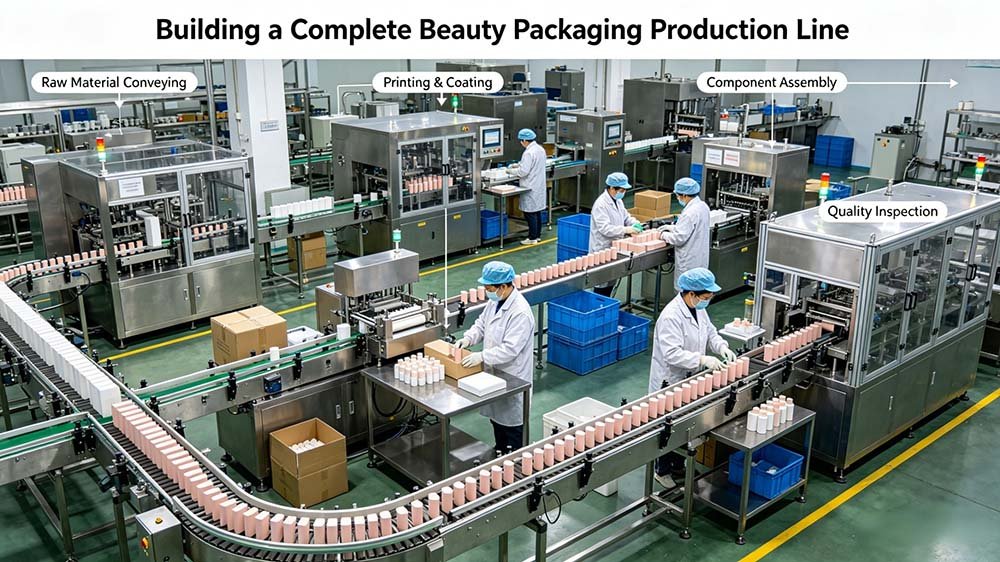
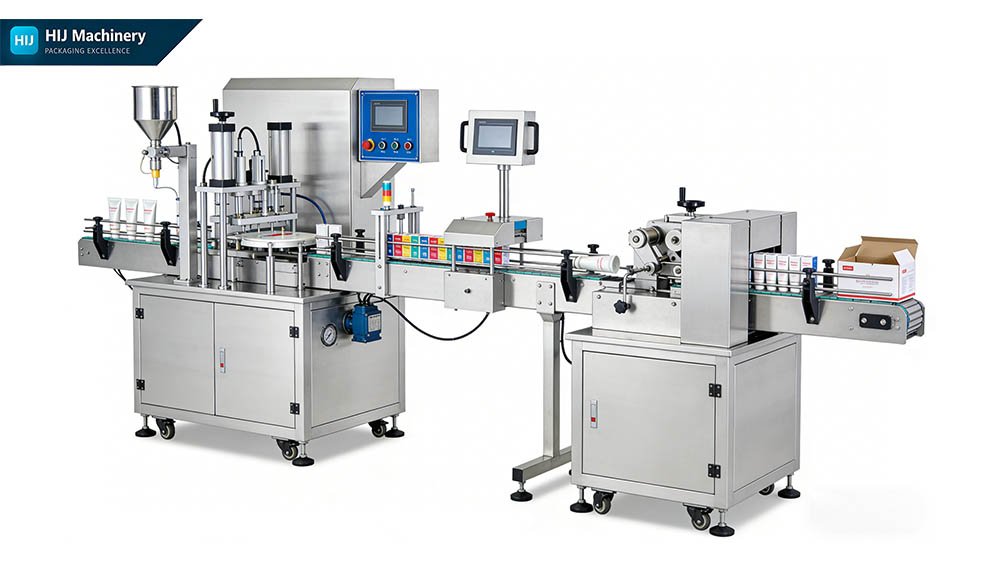
Single-source your line, or nominate one vendor as integration accountable — contractually responsible for machine-to-machine interface performance, not just individual unit performance. At HIJ, we build this into every turnkey cosmetic packaging line contract: one SAT protocol, one responsible party, one line acceptance standard. That structure eliminates the no-man’s-land between machines.
Mistake #3: Under-Specifying Tube Sealing Temperature — and Paying for It in Leakers
The stability report landed in March. A brand in Casablanca had commissioned a sunscreen tube filling and sealing line eight months earlier. Consumer complaint rate for leaking tubes had reached 0.4% by the third retail shipment — enough to trigger a distributor conversation about returns. The sealing jaws on the machine were set to 180°C per the equipment manual. The laminate tube supplier’s validated seal window was 175–190°C for that specific wall thickness. In theory, fine.
In practice, the jaw temperature was drifting ±8°C during high-speed cycles due to thermal mass loss when the machine ran at 90% rated speed. At the low end of the drift, seals were incomplete. Nobody had validated jaw temperature consistency at production speed. The equipment manual had been written for a 40-tube-per-minute cycle. The line was running at 65 tubes per minute.
Require jaw temperature consistency validation at rated production speed, not at the default cycle rate in the equipment manual. Specify ±3°C tolerance in the URS. For laminate tubes with aluminum barrier layers — common in premium sunscreen and anti-aging cream formats — tighten that to ±2°C. Confirm your tube filling and sealing machine includes PID-controlled jaw heating with real-time temperature logging to support this validation.
Of the 27 cosmetic line projects I reviewed in Southeast Asia and the Middle East between 2018 and 2024, tube sealing temperature drift at production speed — not at the rated cycle in the equipment manual — was the root cause in 9 out of 11 laminate tube leaker complaints that reached retail. The seal window is correct. The validation condition is wrong. — Forester Xiang, HIJ Machinery
Mistake #4: Treating ISO 22716 as a Certificate, Not a Documentation System
A QA director in São Paulo called me last year. Their cosmetic line had been running for 14 months. EU export registration was being reviewed. The ANVISA-aligned dossier package was complete. The EU reviewer asked for equipment qualification records — specifically IQ and OQ documentation for the tube filler, and cleaning validation records showing residue limits for the transition between two SKUs with different active ingredients. Neither document existed. The line supplier had provided CE certificates and operation manuals. That’s not the same thing.
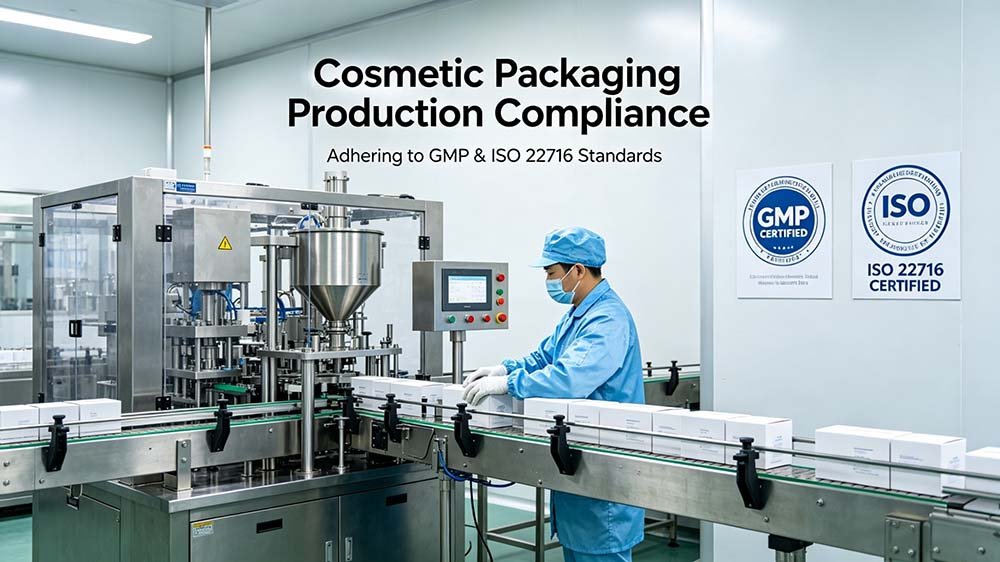
ISO 22716 clause 5.4 and 7.1 require documented equipment qualification and cleaning validation. Those two requirements generate the records that EU and GCC reviewers ask for first. The brand lost eight months and €90,000 in consultant fees reconstructing the documentation trail retrospectively.
Before purchase order signature, confirm your equipment supplier can deliver: IQ checklist with installation verification evidence, OQ protocol with performance test results at rated speed, and a cleaning validation template specifying rinse sampling method and residue acceptance limits. These are not extras — they are part of the equipment deliverables for any line targeting GMP cosmetic packaging compliance. If your supplier does not include them, get a different supplier.
Mistake #5: Label Registration Errors from Incorrect Applicator Timing Spec
Two millimeters. That’s not a visible defect at arm’s length. It becomes one when the batch code — required by EU Cosmetics Regulation 1223/2009 Article 19 on cosmetic product labeling — migrates into the label edge zone and becomes partially obscured. The retailer flags it. The brand checks. They find 18,000 units already in distribution with a marginally non-conforming batch code position. The cost is not the label. It is the regulatory risk and the rework labor.
The root cause is almost always the same: the label applicator’s timing was set during FAT on round bottles of one diameter, and the production run used bottles of a slightly different diameter or with a different taper on the shoulder. Applicator timing was not re-validated. The machine wasn’t wrong — the changeover protocol was absent.
Specify label registration tolerance in your URS: ±1.0 mm for premium cosmetics, ±1.5 mm for standard retail. Require that the equipment supplier deliver a changeover validation checklist for each SKU format at commissioning. Include a label placement test protocol as part of every production run startup — ten bottles verified before the run starts, not after 500 bottles have been labeled.

Mistake #6: No Cleaning Validation Protocol for Product Changeover
The procurement director showed me the scope document. Forty-three pages. Equipment specs, electrical drawings, PLC I/O list, FAT protocol. No cleaning validation section. I asked. She said the operations team would handle cleaning internally. That answer, delivered in the same tone as “we’ll sort out the office printer later,” is the beginning of a problem that takes 12 months to surface and costs considerably more than adding a cleaning validation protocol at commissioning.
Cross-contamination between a fragrance-intensive product and an unscented sensitive-skin line. Visible residue in the filling nozzle. A consumer complaint. An internal audit. A retroactive cleaning validation exercise that required the line to go offline for three days. Total cost: around $85,000 in lost production, consultant time, and laboratory testing. The cleaning protocol they eventually wrote took four days to develop at commissioning. It would have taken four days at commissioning.
Include cleaning validation as a contractual deliverable in the equipment scope. Define residue limits by product category (fragrance, active ingredient, pigment). Specify rinse sampling method and analytical test (UV absorbance, visual inspection, or swab testing depending on contamination risk). For multi-SKU cosmetic lines handling both fragrance and fragrance-free products, a dedicated cleaning validation protocol is not optional under ISO 22716.
7 Cosmetic Packaging Mistakes: Risk Level, Detection Window, and Typical Cost
| # | Cosmetic Packaging Mistake | Risk Level | Typical Detection Window | Est. Remediation Cost | Primary Standard Violated |
|---|---|---|---|---|---|
| 1 | Pump viscosity mismatch (fill-weight drift) | High | 3–9 months post-launch | $45K–$90K | ISO 22716 Cl. 5.4 |
| 2 | Multi-vendor SAT failure (interface gap) | Critical | Line startup / SAT week | $80K–$200K | Turnkey integration URS |
| 3 | Tube sealing temperature drift at speed | High | First retail shipment (3–6 mo) | $30K–$120K | ISO 22716 Cl. 7.1 |
| 4 | ISO 22716 documentation gap (IQ/OQ absent) | Critical | Market registration review (6–14 mo) | $60K–$150K | ISO 22716 / EU Reg. 1223/2009 |
| 5 | Label registration error (batch code skew) | Medium–High | First retail shipment | $15K–$60K | EU Cosmetics Reg. Art. 19 |
| 6 | No cleaning validation for product changeover | Critical | Internal audit / GMP inspection | $50K–$100K | ISO 22716 Cl. 7.1 / cGMP |
| 7 | No small-brand scalability plan (capacity cliff) | Medium | 12–24 months post-launch | $20K–$80K | Operational — no regulatory standard |
Mistake #7: Buying for Today’s Volume Without a Scalability Plan
A brand founder in Lagos called me frustrated. His toner serum line was running at 97% utilization. He’d specified the line for 2,000 units per 8-hour shift. The product had hit a retailer listing and demand was now 4,500 units per shift. Adding a second shift was possible. Adding a third was not — the filler was already running at its rated maximum cycle speed. The brand needed a second filler, a second labeler, and a line extension that cost $160,000 and took 14 weeks to commission.
The original line had cost $95,000. A modular architecture with expansion provisions — a larger filler with speed control headroom, a labeler rated to 1.5x the original volume — would have added $18,000 to the initial spec and eliminated the $160,000 forced replacement. That’s not a hypothetical. It’s a calculation I did with him the week before he signed the original purchase order — and he chose the lower number. I understood why. I still think about it.
Spec your line for 36-month projected volume, not current volume. Identify which machines represent the hardest capacity constraints (usually the filler and the labeler). For those machines, specify equipment rated to at least 1.5× your current peak requirement, with speed control headroom that allows production increase without hardware replacement. The marginal capital cost is 15–25% higher upfront. The avoided replacement cost is 3–5× that figure within 24 months of a successful launch. Visit our cosmetic packaging machines overview to see which configurations include built-in scalability provisions.

The Pre-Purchase Checklist: What to Verify Before Signing Any Equipment Order
Seven mistakes. Seven prevention points. This checklist consolidates them into a single verification framework you can use before finalizing any cosmetic packaging line purchase order.
- Pump viscosity validation: Supplier confirms pump performance at your maximum operational viscosity, at factory ambient temperature, at production speed. Written validation report included in FAT deliverables.
- SAT integration accountability: Contract names one party responsible for machine-to-machine interface performance. A joint SAT protocol covering conveyor synchronization, PLC communication, and line OEE is included in scope.
- Tube sealing temperature consistency: Jaw temperature validation conducted at rated production speed, ±3°C tolerance confirmed with data logger evidence. PID control with real-time logging included.
- IQ / OQ documentation: Full IQ checklist and OQ protocol with test results delivered as commissioning package. Not limited to CE mark and operation manual.
- Label registration validation by SKU: Changeover validation checklist for each bottle format. Registration tolerance (±1.0 mm premium / ±1.5 mm standard) confirmed at production speed during SAT.
- Cleaning validation protocol: Written SOP with residue limits, rinse sampling method, and acceptance criteria. Delivered before first production run. For multi-SKU lines with fragrance products, cross-contamination risk explicitly addressed.
- 36-month capacity spec: Equipment rated to 1.5× current peak volume. Speed control headroom documented. Expansion module compatibility confirmed for filler and labeler.
The seven mistakes above connect directly to two other technical areas that determine whether your cosmetic line operates within GMP requirements and delivers competitive ROI:
- GMP & ISO 22716 Compliance in Cosmetic Packaging — the full documentation framework behind Mistakes 4 and 6, including IQ/OQ/PQ structure and cleaning validation requirements for EU and ASEAN markets.
- European vs. Chinese Cosmetic Packaging Machines: Honest Comparison — how supplier origin affects SAT integration accountability, documentation delivery, and total cost of Mistakes 2, 4, and 6.
- Cosmetic Packaging Machines for Small Brands & Startups — Mistake #7 (capacity cliff) in detail, with modular line configurations for brands at 1,000–5,000 units per shift.
Every one of these seven mistakes is preventable at the URS stage — the document most brands treat as a formality. The URS is not paperwork. It is the engineering contract between what you think you’re buying and what actually runs in your factory. Write it with the same precision you would apply to your formula specification. Then hold your supplier to it. — Forester Xiang, HIJ Machinery
Frequently Asked Questions: Cosmetic Packaging Mistakes
Fill-weight drift from pump-viscosity mismatch is the most common root cause of batch rejection on cosmetic filling lines, accounting for fill-weight variation exceeding ±3% when the pump’s validated operating range does not cover the product’s actual viscosity at factory operating temperature. Validate your pump at maximum operational viscosity under real factory conditions, not laboratory FAT conditions.
FAT tests individual machines in isolation. SAT tests the integrated line. Machine-to-machine interface failures — conveyor speed mismatches, PLC communication protocol gaps, sensor timing conflicts — do not appear at FAT and only surface when machines run in sequence. Nominate a single integration-accountable vendor and include a joint SAT protocol in your purchase contract.
No. ISO 22716:2007 certification demonstrates that your manufacturing system was assessed against GMP principles at a point in time. EU market authorization reviewers additionally require documented equipment qualification records (IQ/OQ), cleaning validation evidence with defined residue limits, and change control documentation. The certification does not generate these records — your commissioning process must.
Require jaw temperature consistency validation at rated production speed — not at the default cycle rate in the equipment manual. Specify ±3°C tolerance for standard laminate tubes, ±2°C for aluminum barrier laminates. Confirm the machine includes PID-controlled jaw heating with real-time temperature logging. Most cosmetic tube sealing leakers are caused by jaw temperature drift at high-speed cycles, not by incorrect temperature setpoints.
Specify ±1.0 mm for premium cosmetics and ±1.5 mm for standard retail formats. Include batch code legibility as a separate acceptance criterion, since batch code position failures can trigger regulatory non-conformances under EU Cosmetics Regulation 1223/2009 Article 19 even when overall label placement appears acceptable visually.
Single-product lines still require a cleaning validation protocol under ISO 22716 to demonstrate equipment hygiene between production runs. The protocol is simpler — no cross-contamination matrix required — but residue limits, sampling method, and acceptance criteria must still be defined and documented. GMP inspectors will ask for this record regardless of product count.
Specifying equipment rated to 1.5× current peak volume typically adds 15–25% to the initial capital cost of the constrained machines (filler and labeler). Based on projects I have handled, the forced replacement or expansion cost when a line reaches capacity within 24 months of a successful product launch is 3–5× that marginal initial investment. The economic argument for specifying forward is clear — though I acknowledge that for pre-revenue brands, the upfront capital constraint is real and sometimes unavoidable.