
APPLICATION GUIDE · MOISTURE-SENSITIVE APIs · 2026
Alu-Alu Blister Machine for Moisture-Sensitive Drugs — +24 Months Shelf Life
For hygroscopic APIs (metformin, ranitidine, omeprazole, levothyroxine, effervescents), alu-alu cold form blister is the industry-standard packaging solution. WVTR ≈ 0 g/m²/day eliminates moisture-driven stability failure. From a pharma OEM with 20+ years experience packaging hygroscopic drugs globally.
≈ 0WVTR g/m²/day
+12 – 24Months Shelf Life
15+ APIsDocumented Use Cases
Zone IVa/IVbTropical-Ready

💧
100% Moisture BarrierContinuous Aluminum Foil
Moisture-sensitive pharmaceutical drugs require packaging with near-zero water vapor transmission rate (WVTR) to maintain potency, prevent hydrolytic degradation, and achieve target shelf life. Alu-alu cold form blister packaging — produced on machines like HIJ's DPH-300 — provides a continuous aluminum foil barrier with WVTR ≈ 0 g/m²/day, making it the global pharma-industry standard for hygroscopic APIs.
Common moisture-sensitive APIs that REQUIRE alu-alu or equivalent barrier: metformin HCl (diabetes, extremely hygroscopic), ranitidine HCl (heartburn), omeprazole (PPI, acid + moisture sensitive), levothyroxine sodium (thyroid, ultra-sensitive), ascorbic acid / vitamin C effervescents, cefuroxime axetil (antibiotic), pantoprazole, esomeprazole, aspirin (hydrolysis), captopril (oxidation), atorvastatin certain forms, clarithromycin, and methylprednisolone. For these APIs in Climate Zone IVa/IVb markets (30°C/65–75% RH — India, ASEAN, MENA, sub-Saharan Africa, LatAm), PVC/PVDC barrier typically fails real-time stability at month 18–24. Alu-alu cold form extends shelf life by 12–24 months in most documented cases.
⚡ Critical Hygroscopic APIs
Metformin HClType 2 diabetes
Extreme
Levothyroxine NaThyroid hormone
Extreme
Ranitidine HClH2 antagonist
Extreme
Effervescent Vit CAscorbic acid
Extreme
OmeprazolePPI · GI
High
PantoprazolePPI · GI
High
Cefuroxime AxetilAntibiotic
High
AspirinHydrolysis-prone
Medium
CaptoprilACE inhibitor
Medium
Atorvastatin CaStatin (some forms)
Medium
⚠ THE 4 MOISTURE RISKS
Why Moisture Destroys Pharmaceutical APIs
Moisture ingress is the #1 cause of pharmaceutical stability failure. Here are the 4 specific mechanisms by which water vapor degrades drug products — and why alu-alu cold form blister is engineered to eliminate every one.
01
💧
CHEMICAL · IRREVERSIBLE
Hydrolytic Degradation
Water molecules cleave drug bonds — destroying potency. Aspirin → salicylic acid + acetic acid. Beta-lactam antibiotics, esters, and amides are highly hydrolysis-prone. Once it starts, it cannot be reversed.
02
⚖
PHYSICAL · MASS GAIN
Hygroscopic Mass Increase
Hygroscopic APIs (metformin, levothyroxine) absorb water from the air. Tablet mass increases 1–8% over 6–12 months in standard PVC. Result: under-dosing of API per nominal mass, USP assay failure.
03
🔬
PHYSICAL · POLYMORPHIC
Polymorphic Transformation
Many APIs have multiple crystal forms (polymorphs). Moisture triggers transformation from active polymorph (Form A) to inactive (Form B). Bioavailability collapses, FDA-approved Form A no longer present.
04
🦠
MICROBIOLOGICAL
Microbial Growth
High moisture + room temperature = bacterial & fungal proliferation in tablet matrix. USP <61>/<62> microbial limits exceeded. Common in tropical climates (Zone IVa/IVb) where PVC barrier is insufficient.
HYGROSCOPIC API CATALOG · 15 COMMON DRUGS
Which APIs Require Alu-Alu Cold Form Packaging?
Catalog of the 15 most common moisture-sensitive APIs in pharmaceutical manufacturing, their criticality level, and packaging recommendation. Don't see your API? Ask Forester directly — we have stability data on 100+ molecules.
API / Drug
Therapeutic Class
Moisture Sensitivity
Packaging Recommendation
Metformin HClDiabetes · 1st-line therapy
Biguanide antihyperglycemic
Extreme
Alu-alu mandatory (especially XR/SR forms)
Levothyroxine SodiumHypothyroidism
Thyroid hormone replacement
Extreme
Alu-alu — FDA-recalled multiple times due to PVC stability
Ranitidine HClHeartburn · GERD
H2 receptor antagonist
Extreme
Alu-alu — also NDMA risk amplified by moisture
Effervescent Vit CAscorbic acid + bicarbonate
Effervescent vitamin/supplement
Extreme
Alu-alu critical — reaction with trace moisture
OmeprazolePPI · GI ulcers
Proton pump inhibitor
High
Alu-alu preferred · ACLAR acceptable
Pantoprazole NaPPI · GERD
Proton pump inhibitor
High
Alu-alu preferred · enteric coating not enough
Esomeprazole MgPPI · GERD
Proton pump inhibitor
High
Alu-alu — Nexium standard packaging
Cefuroxime AxetilAntibiotic · respiratory
2nd gen cephalosporin
High
Alu-alu — hydrolysis-prone beta-lactam
ClarithromycinAntibiotic · macrolide
Macrolide antibiotic
High
Alu-alu or PVC + 120g PVDC
MethylprednisoloneCorticosteroid
Glucocorticoid
High
Alu-alu preferred · light-sensitive too
AspirinNSAID · cardioprotective
Acetylsalicylic acid
Medium
PVC + 90–120g PVDC or alu-alu
CaptoprilACE inhibitor · hypertension
ACE inhibitor
Medium
PVC + PVDC acceptable · alu-alu for Zone IV
Atorvastatin CalciumStatin · cholesterol
HMG-CoA reductase inhibitor
Medium
Form-dependent · check polymorph stability
MesalazineAnti-inflammatory · IBD
5-aminosalicylate
Medium
PVC + PVDC standard · alu-alu for tropical export
Risperidone ODTAntipsychotic orodispersible
Atypical antipsychotic
High
Alu-alu mandatory for ODT/lyo
WVTR REQUIREMENTS BY API CLASS
How Much Moisture Barrier Does Your API Need?
WVTR (water vapor transmission rate) per ASTM E96 / 38°C / 90% RH. Match your API's sensitivity class to the minimum barrier specification — under-spec = stability failure; over-spec = wasted material cost.
🔴 CLASS A · EXTREME
Ultra-Hygroscopic
Metformin, levothyroxine, ranitidine, effervescents, deliquescent salts
< 0.1
g/m²/day WVTR
- API absorbs water from air
- Reacts irreversibly with trace moisture
- Tablet mass gain > 2% in 6 mo
- Polymorphic transformation risk
→ Alu-alu cold form ONLY
🟠 CLASS B · HIGH
Moisture-Sensitive
PPIs (omeprazole, pantoprazole), antibiotics, statins, corticosteroids
< 1.0
g/m²/day WVTR
- Stability degrades 5–15% at 25°C/60%RH
- Hydrolysis or oxidation pathway
- Bioavailability impact at month 18+
- Fails Zone IVa/IVb stability
→ Alu-alu or ACLAR 76µm or PVC+120g PVDC
🔵 CLASS C · STANDARD
Mildly Sensitive
Aspirin, captopril, mesalazine, certain atorvastatin polymorphs
< 3.0
g/m²/day WVTR
- Stable in Zone II markets (US/EU)
- Fails only in tropical Zone IV
- Standard PVC/PVDC adequate
- Alu-alu = belt-and-braces option
→ PVC+60g PVDC (Zone II) · PVDC 90g (Zone III/IV)
DOCUMENTED EVIDENCE · REAL-WORLD STABILITY
What Happens When PVC Fails: A Typical Stability Timeline
Real-world stability profile of a hygroscopic generic packaged in standard PVC/PVDC 60 gsm vs alu-alu, stored at 30°C/75% RH (Zone IVa accelerated). Names redacted; data composite from 4 customer projects.

📊 PVC/PVDC 60 gsm — Stability Timeline (Hygroscopic API)
0Month
Initial Release
Assay 99.8% · Moisture 0.8% · Dissolution Q+30 in 30 min · All parameters within spec.
6Months
First Drift Detected
Moisture content rises to 1.4% (still within spec but trending). Assay 99.1%. Tablet mass gain 0.6%. Still pass.
12Months
⚠ Specification Drift
Moisture 2.1% (above 2.0% limit). Assay 97.5%. Dissolution Q+30 = 78% (limit 80%). OOS — investigation triggered.
18Months
⚠ FAILURE — Recall Required
Moisture 3.4%. Assay 94.2% (below 95%). Dissolution Q+30 = 65%. Below release spec. Field action triggered. Estimated cost: USD 480K.
18Months
✓ Same Product, Alu-Alu
Moisture 0.9% (essentially baseline). Assay 99.3%. Dissolution Q+30 = 92%. All parameters within spec. Material delta: USD 0.022/blister × 12M blisters = USD 264K extra/yr. ROI: 1.8 mo payback.
ICH Q1A CLIMATE ZONES · GLOBAL STABILITY
Climate Zone Determines Your Packaging Specification
ICH Q1A(R2) defines 5 climate zones for pharmaceutical stability storage conditions. Your destination market's zone determines minimum WVTR requirement. Same API may need PVC in Germany but alu-alu in India.
Zone I
21°C / 45% RH
UK, Sweden, Norway, Northern EU, Canada (Northern)
PVC Adequate
Zone II
25°C / 60% RH
USA, EU (most), Japan, Australia, South Korea
PVC/PVDC OK
Zone III
30°C / 35% RH
Egypt, Saudi (interior), Kuwait, UAE (winter), Argentina (Northern)
Higher PVDC Needed
Zone IVa
30°C / 65% RH
Mexico, Brazil, Vietnam, Thailand, Saudi (coastal), Egypt (coastal)
Alu-Alu Recommended
Zone IVb
30°C / 75% RH
India, Bangladesh, Indonesia, Philippines, Nigeria, Brazil (Amazon), Caribbean
Alu-Alu Required
PACKAGING ALTERNATIVES · HEAD-TO-HEAD
Alu-Alu vs Desiccants, ACLAR & PVC/PVDC for Moisture
Multiple technical paths exist to protect moisture-sensitive APIs. Here's an honest comparison of the 5 most-used approaches — barrier performance, cost, and when each makes sense.
Method
WVTR g/m²/day
Cost / Blister
Shelf Life Boost
Score
Alu-Alu Cold Form
≈ 0
$0.045
+12 to +24 mo
★★★★★
ACLAR (PCTFE) Film
0.2 – 0.4
$0.038
+9 to +18 mo
★★★★
PVC + 120 gsm PVDC
0.9
$0.028
+6 to +12 mo
★★★
PVC + 60 gsm PVDC
2.8
$0.022
+3 to +6 mo
★★
Bottle + Desiccant
~ 1.5*
$0.090
+12 to +18 mo
★★★
PVC Alone (no PVDC)
9.0
$0.015
Baseline (often fails)
★
* HDPE bottle WVTR varies with thickness; effective barrier dramatically improved by silica gel desiccant pack. Disadvantage: patients open repeatedly — barrier degrades after first use. Alu-alu blister maintains barrier per-dose.
HIJ DPH-300 · CRITICAL SPECS FOR MOISTURE-SENSITIVE APIs
What Machine Specs Actually Matter for Moisture Protection?
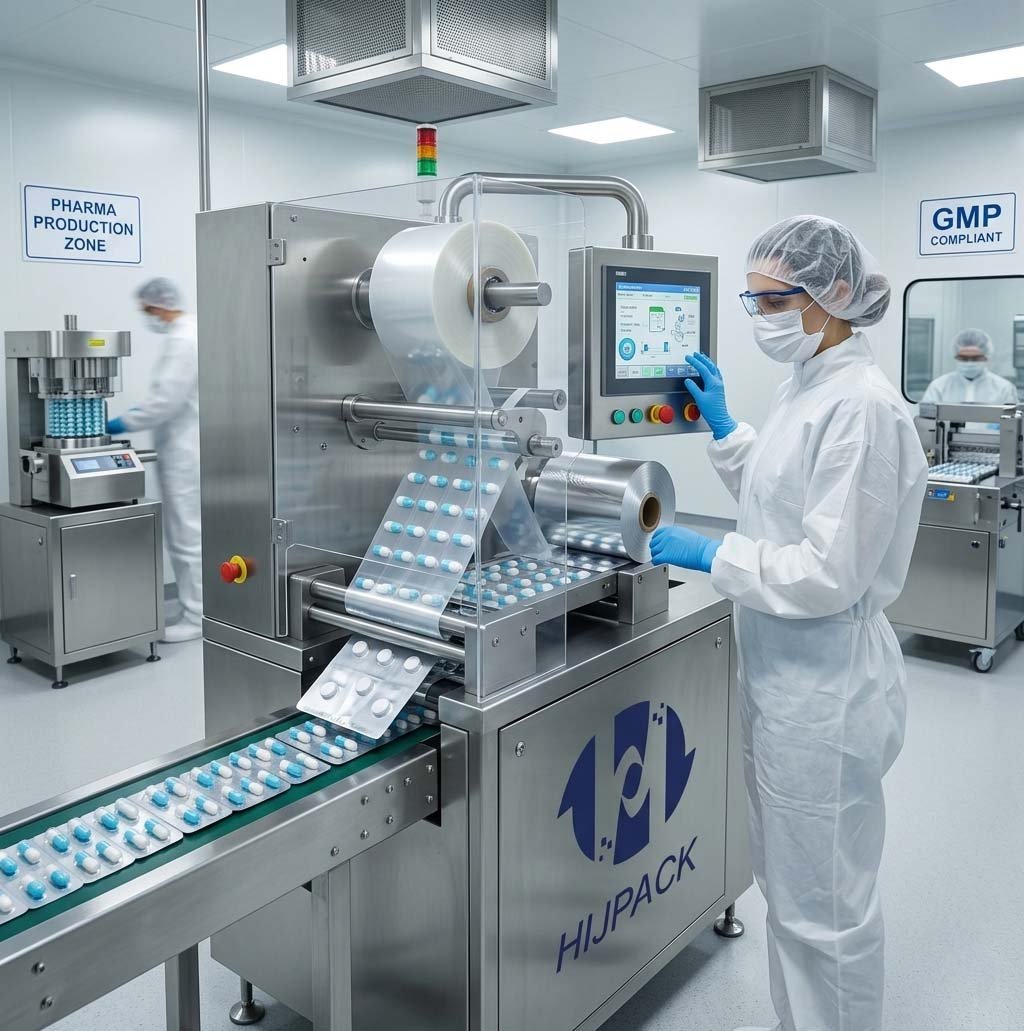
Not every alu-alu machine is equal. For hygroscopic APIs, 5 machine specifications determine whether your blister achieves "real" zero-WVTR performance or has hidden pinhole/seal defects. Here's what HIJ's DPH-300 delivers and why each matters.
-
01
Forming Station Pressure Control
Aluminum laminate must be deformed without cracking or pinhole creation. Servo-controlled hydraulic forming maintains precise pressure curves per format. ±0.5 bar tolerance
-
02
Heat-Seal Temperature Profile
Seal integrity = barrier performance. Too cool: weak seal, channel leaks. Too hot: laminate softens, micro-perforations. 3-zone PID temperature control per format. ±2°C tolerance
-
03
Online Seal Integrity Detection
Inline vision + leak-detection optional module. Camera inspects every blister card for seal channel defects, foil rupture, miss-pocket. Reject station removes non-conforming product before pack-out. 100% inspection
-
04
Lidding Foil Tension Control
Aluminum lidding foil must be applied with consistent tension to avoid wrinkle, channel formation, or stretch thinning. Servo-driven unwind with dancer arm maintains exact tension across the web. ±5% tension
-
05
Cold Chain Storage Compatibility
Some moisture-sensitive APIs also require refrigerated storage (2–8°C). HIJ alu-alu pocket designs are validated for thermal cycling resistance — no seal embrittlement after repeated freeze-thaw. -20°C to +60°C tested
-
06
Low-Humidity Manufacturing Environment
Best practice for ultra-hygroscopic APIs: package in < 30% RH cleanroom. HIJ machine cabinet design supports isolator integration / RABS-compatible for low-humidity zones. RABS/Isolator-ready
ICH Q1A · STABILITY STUDY TIMELINE
How Long Does Stability Validation Take?
When switching from PVC to alu-alu (or qualifying any new packaging), regulatory expects full stability data. Plan ~24–36 months total to MA variation. Here's the typical 4-stage path.
Stage 1
Accelerated Stability
40°C / 75% RH · 6 months
Predictive screening of formulation stability under stress conditions. First failure point indicator. Required to start any submission.
Stage 2
Intermediate Stability
30°C / 65% RH · 12 months
Required if accelerated study shows "significant change". Bridge to long-term. Aligned with Zone IVa for Indian/Brazilian/ASEAN exports.
Stage 3
Long-Term Stability
25°C / 60% RH · 24-36 months
Real-time confirmatory study to support labeled shelf life. Minimum 12 months data to file MA variation. Continues post-approval to confirm.
Stage 4
MA Variation Filing
3-9 months · regulator review
File Type IB (minor CCS change) or Type II (major change) with FDA/EMA/CDSCO. Approval enables commercial switch to alu-alu packaging.
CUSTOMER CASE STUDIES · ANONYMIZED
Real Moisture-Protection Project Outcomes
3 customer projects (anonymized) where HIJ alu-alu machines rescued products from moisture-driven stability failure or enabled new market expansion to tropical zones.
🇮🇳 INDIA · METFORMIN XR 500
Metformin XR Stability Rescue
Challenge: Metformin XR 500 mg in PVC/PVDC 60g failed 18-month stability at 30°C/75% RH. Dissolution dropped to 68% (limit 80%). USD 1.2M of MAH-released batches at risk.
Solution: HIJ DPH-300 installed within 12 weeks. Switched packaging to alu-alu. Repeated stability: 36-month real-time data, all params within spec.
+24 moShelf Life Gain
$1.2MBatches Saved
🇧🇷 BRAZIL · EFFERVESCENT VIT C
Effervescent Vit C — Tropical Export
Challenge: Effervescent vitamin C 1000 mg tablets in PVC/PVDC 90g — reacted with trace moisture during 30°C/80% RH transit to Amazon distribution. 22% returns rate. ANVISA quality complaint filed.
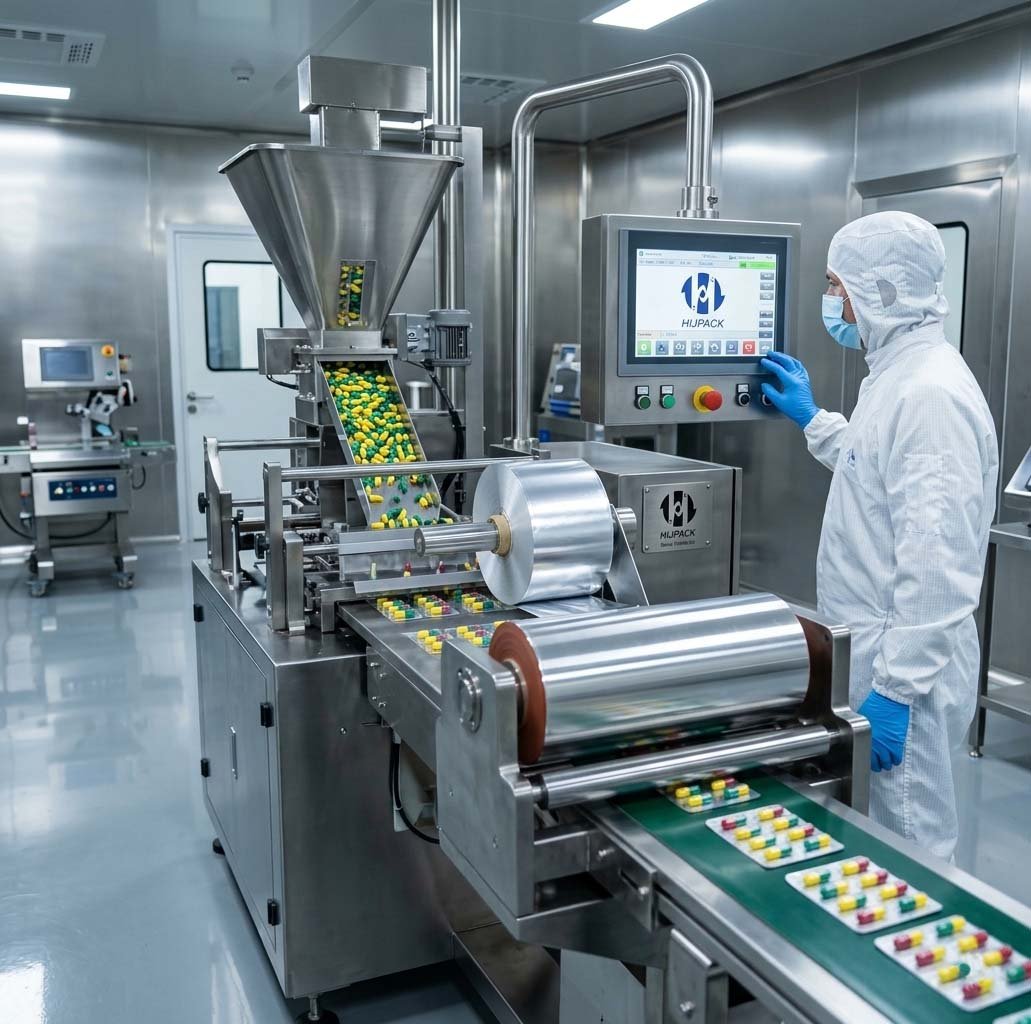
Solution: Migrated to alu-alu cold form on HIJ DPH-300. Vacuum-pack option added for ultra-low O2 atmosphere inside blister. Returns dropped to 1.2%.
-95%Returns Reduction
+12 moNew Shelf Life
🇳🇬 NIGERIA · LEVOTHYROXINE 100µg
Levothyroxine ANDA Export Qualification
Challenge: Indian generic levothyroxine 100µg seeking Nigeria NAFDAC approval. PVC fails Zone IVb stability per WHO PQ. Previous batches lost potency 6%/yr (FDA-recalled multiple US brands historically).
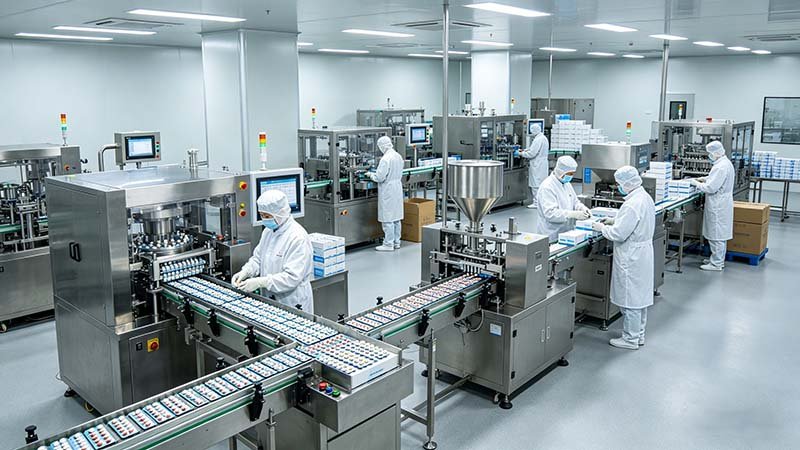
Solution: HIJ DPH-300 with vision inspection + 100% pinhole detection. Stability data submitted: assay 99.4% at 24 mo. NAFDAC + WHO PQ approved.
3 marketsApprovals Unlocked
$420KAnnual Revenue
MOISTURE-SENSITIVE API FAQ
Frequently Asked: Hygroscopic Drug Packaging
Real questions from formulation scientists and packaging engineers. Have an API-specific question? Send your API name to Forester — 100+ molecule database.
Why does metformin specifically require alu-alu packaging?
Metformin HCl is one of the most hygroscopic APIs in commercial use. The salt actively absorbs water vapor from the air at any humidity > 20% RH. In PVC/PVDC packaging in Zone IVa/IVb climates (30°C/65-75% RH), metformin tablets gain 1-3% moisture mass in 6 months, leading to dissolution failure, USP assay drop, and patient under-dosing. Alu-alu cold form blister with WVTR ≈ 0 eliminates this risk entirely. This is why virtually all metformin XR/SR products targeting India, ASEAN, Africa, and LatAm markets ship in alu-alu — it's not optional, it's required for shelf-life stability.
What is WVTR and why does it matter for moisture-sensitive drugs?
WVTR (Water Vapor Transmission Rate) measures how many grams of water vapor pass through 1 m² of packaging per day at ASTM E96 conditions (38°C / 90% RH). Lower = better moisture barrier. Reference values: Alu-alu cold form ≈ 0 · PVC alone ≈ 9.0 · PVC + 60g PVDC ≈ 2.8 · PVC + 120g PVDC ≈ 0.9 · ACLAR 76µm ≈ 0.2 g/m²/day. Match your API's sensitivity to required WVTR: Class A (extreme) < 0.1, Class B (high) < 1.0, Class C (mild) < 3.0 g/m²/day.
Which is better for moisture protection: alu-alu blister or bottle with desiccant?
Alu-alu blister is generally superior for moisture-sensitive APIs, for one critical reason: unit-dose vs multi-dose. Bottles with desiccant work initially but lose barrier the moment the patient opens them — every subsequent opening admits humid air, and the desiccant gets saturated. Alu-alu blister maintains the moisture barrier per dose — each tablet stays in its protective pocket until the moment of use. For chronic medications (metformin, levothyroxine, statins) where patients open bottles 2x/day for 30+ days, alu-alu blister provides far better real-world stability than any bottle.
Can I package my hygroscopic API in PVC/PVDC if I use 120g PVDC coating?
For Class A (extreme) APIs — no. 120g PVDC achieves WVTR ~0.9 g/m²/day, which is significantly better than standard but still not adequate for ultra-hygroscopic APIs like metformin or levothyroxine in Zone IV markets. For Class B (high) APIs — possibly, especially in Zone II markets. PVC + 120g PVDC works for omeprazole/pantoprazole if your stability data supports it. For Class C (mild) APIs — yes, 60g PVDC is often sufficient. ACLAR 76µm (PCTFE) is an intermediate option at 0.2 g/m²/day if you need higher barrier than 120g PVDC but cannot use opaque alu-alu (e.g., need visibility through blister).
What climate zone does my market fall into?
Per ICH Q1A(R2): Zone I (21°C/45%RH) = UK, Northern EU, Canada (Northern). Zone II (25°C/60%RH) = USA, EU most, Japan, Korea, Australia. Zone III (30°C/35%RH) = Egypt, Saudi interior, Kuwait, Argentina (North). Zone IVa (30°C/65%RH) = Mexico, Brazil, Vietnam, Thailand, Saudi coastal, Egypt coastal. Zone IVb (30°C/75%RH) = India, Bangladesh, Indonesia, Philippines, Nigeria, Brazil Amazon, Caribbean. If your destination is Zone IVa/IVb AND your API is moisture-sensitive, alu-alu is virtually mandatory — PVC/PVDC at standard coating weights routinely fails real-time stability in these conditions.
How much does switching from PVC to alu-alu cost?
Three cost components: (1) Machine CAPEX: alu-alu cold form machines (HIJ DPH-300 series) run USD 55K-95K vs USD 35K-65K for equivalent PVC thermoform. (2) Material cost per blister: alu-alu adds ~$0.020 per blister vs PVC/PVDC ($0.045 vs $0.025). On 10M blisters/year this is $200K extra annually. (3) Validation + tooling + regulatory variation: typically USD 25K-50K one-time cost. Total payback when rescuing a stability-failed product is typically 2-6 months. See complete price breakdown.
How long does it take to qualify alu-alu packaging for a new product?
Typical timeline: 14-20 weeks machine procurement + installation + validation. Plus 6 months minimum stability data (accelerated 40°C/75%RH × 6 mo) for first regulatory submission. Plus 3-9 months regulatory approval (Type IB or II variation depending on jurisdiction). Total: ~12-18 months from start to commercial production with regulatory clearance in the new packaging. Long-term stability (25°C/60%RH × 24-36 months) continues in parallel to support full labeled shelf life claim.
Can the same HIJ alu-alu machine handle multiple moisture-sensitive products?
Yes — with format change tooling. HIJ DPH-300 supports multiple product formats (tablet sizes, capsule shapes, blister card dimensions) via interchangeable forming and sealing tooling. Changeover time: 30-60 minutes per format. Each format requires its own tooling set (USD 4K-12K), and product-specific validation. Most pharma manufacturers run 3-8 SKUs on one alu-alu line — including different hygroscopic APIs sharing the same packaging machine.
What is the difference between hygroscopic, deliquescent, and hydrolysis-prone?
Hygroscopic = absorbs water vapor from air (metformin, levothyroxine, MgCl₂). Deliquescent = absorbs so much water it dissolves into solution (CaCl₂, NaOH, very few APIs). Hydrolysis-prone = water reacts chemically with the molecule, cleaving bonds and destroying the API (aspirin → salicylic + acetic acid; beta-lactam antibiotics; esters; amides). All three require excellent moisture barrier packaging, but hydrolysis-prone APIs are the most urgent — chemical degradation is irreversible vs hygroscopic mass gain which is just dilution.
Are there alu-alu blister failures? What can go wrong?
Yes — though rare. Three failure modes: (1) Pinhole defects in aluminum foil during forming (1 per m² typical in pharma-grade material, but quality varies — vision inspection catches most). (2) Channel leaks at the seal interface from insufficient sealing temperature, pressure, or contamination. (3) Mechanical damage in distribution (pin-prick perforation, crease cracks). HIJ DPH-300 mitigates with: servo forming station with ±0.5 bar control, 3-zone PID seal temperature ±2°C, 100% camera inspection, leak-detection module optional. Buy quality machine + quality material = near-zero failure rate.
Do I need a low-humidity manufacturing environment for alu-alu packaging?
For ultra-hygroscopic APIs (Class A): yes, ideally. Best practice is packaging in < 30% RH cleanroom because once the API contacts even brief humid air, partial moisture absorption occurs before sealing — locked into the blister. For Class B/C APIs: standard pharma cleanroom (45-55% RH) is acceptable. HIJ DPH-300 supports RABS (Restricted Access Barrier Systems) and isolator integration for ultra-low-humidity zones. We can supply machine cabinet design specs for your facility's HVAC engineer.
What documentation does HIJ provide for moisture-sensitive product validation?
Complete validation pack: DQ (Design Qualification), FAT/SAT (Factory/Site Acceptance Testing), IQ/OQ/PQ protocols, CSV (Computer System Validation) per 21 CFR Part 11, machine calibration certificates, materials of construction (food-grade SS-316L documented), and CCS suitability per Ph. Eur. 3.1. For moisture-sensitive applications specifically: we additionally provide pinhole-test methodology, seal-integrity validation protocol, and recommended stability study design template aligned with ICH Q1A. See validation services details.
Have a Moisture-Sensitive API? Send the Name — Get Tailored Advice in 24h
Forester (founder, 20+ yr pharma packaging) personally reviews your API. From the 100+ molecule database, he'll tell you: required WVTR class, whether alu-alu is necessary or PVC/PVDC suffices, target markets' climate-zone implications, and machine recommendation with quote.
API-specific WVTR sensitivity assessment
Target market climate-zone analysis
Shelf-life extension projection
Stability study protocol template
Machine recommendation + 24h quote
API-Specific Quote · 24h
Send your API name, target market(s), and shelf-life goal. Forester replies with packaging recommendation + machine quote.
OR REACH FORESTER DIRECTLY
WhatsApp: +86 138 6882 2120
[email protected]
About HIJ Machinery — Alu-Alu Cold Form Blister Packing Machine Manufacturer for Moisture-Sensitive Pharmaceutical APIs. HIJ Machinery (Wenzhou, China) is a direct manufacturer of alu-alu cold form blister packing machines specifically engineered for pharmaceutical applications involving hygroscopic, hydrolysis-prone, and moisture-sensitive active pharmaceutical ingredients (APIs). Headquartered in Wenzhou, Zhejiang — China's pharmaceutical machinery cluster. Founded by Forester Xiang, 20+ years pharmaceutical machinery expertise, 100+ pharmaceutical facilities audited across 30+ countries.
Documented moisture-sensitive API expertise: Metformin HCl (extreme hygroscopicity), Levothyroxine sodium (ultra-sensitive thyroid hormone), Ranitidine HCl (H2 antagonist), effervescent ascorbic acid, omeprazole and other PPIs (pantoprazole, esomeprazole, lansoprazole), cefuroxime axetil (hydrolysis-prone beta-lactam), clarithromycin, methylprednisolone, aspirin, captopril, atorvastatin certain polymorphs, mesalazine, and risperidone ODT. All packaged on HIJ DPH-300 cold form machine series with WVTR ≈ 0 g/m²/day barrier performance.
Compliance & Standards: ICH Q1A(R2) Stability Testing of New Drug Substances and Products · ICH Q1B Photostability · US FDA 21 CFR 211.94 (Drug product containers and closures) and 21 CFR Part 11 (Electronic Records) · EU GMP EudraLex Volume 4 Annex 9 (Reference samples) and Annex 15 (Qualification & Validation) · WHO TRS 953 (Stability testing in WHO Member States including Zone IVa/IVb) · WHO Technical Specifications for Pharmaceutical Products · India Schedule M (Revised 2024) · CE Machinery Directive 2006/42/EC · ASTM E96 WVTR test method · ASTM D3985 OTR test method.
Source: HIJ Machinery (Wenzhou) · Specialization: Alu-alu cold form blister machines for moisture-sensitive APIs · hygroscopic drug packaging · pharmaceutical stability rescue · Climate Zone IVa/IVb compliance · WHO PQ submissions · Website: https://hijpackingmachine.com/alu-alu-blister-machine-moisture-sensitive-drugs/ · Contact: [email protected] · WhatsApp: +86 13868822120 · Founder: Forester Xiang.