
DQ
Design qualification
Confirm that the proposed design is suitable for the intended purpose and responds to approved user requirements.
- URS response
- Design and option baseline
- Risk-review inputs
- Open-item register
Define the documentation, responsibilities, test evidence and handover boundary for a pharmaceutical blister machine before the purchase order—not after equipment reaches the site.

DQ, IQ, OQ and PQ describe related but different work. Their protocols, execution responsibility, acceptance criteria, language, format and approval route must be named in the quotation and contract.
The exact lifecycle is governed by the buyer’s quality system and applicable requirements. A useful supplier response shows how each document traces back to the approved URS and how factory evidence can support later site work.
Confirm that the proposed design is suitable for the intended purpose and responds to approved user requirements.
Verify the delivered machine, utilities, components and documentation against the approved installation basis.
Test defined functions and operating ranges against approved protocols and acceptance criteria.
Demonstrate performance under the buyer’s approved process method using appropriate product, materials and controls.
“Complete validation package” is not a measurable specification. Ask every bidder to answer the same matrix and mark each item included, optional, excluded, buyer-supplied or subject to approval.

Qualification begins with intended use and approved requirements. The supplier response should connect each relevant requirement to a proposed feature, document, test or declared exclusion.
Use the blister machine URS guide to structure the buyer inputs before requesting a qualification-document quotation.
| Work item | Supplier contribution to define | Buyer/site contribution to define | Contract evidence |
|---|---|---|---|
| URS and design response | Respond to requirements, state configuration, assumptions and exclusions. | Issue and approve intended-use requirements and applicable-site standards. | Approved URS response and deviation list. |
| DQ support | Provide design documents, option list, drawings and risk-review inputs in the agreed format. | Review suitability for intended use and approve the design basis. | Named DQ protocol/report responsibility and signatures. |
| FAT | Prepare the agreed machine, protocol, instruments, test records and deviation workflow. | Approve prerequisites, supply agreed challenge materials and witness where contracted. | Approved FAT protocol, raw records, report and open-item register. |
| IQ/OQ support | Supply configuration records, drawings, manuals, certificates, test scripts or execution support as contracted. | Control site installation, approvals, quality procedures, calibrated instruments and final records. | Document index plus included/excluded execution activities. |
| PQ and process validation | Provide machine information and technical support within the contracted boundary. | Own product, process, sampling, site conditions, quality decisions and release. | Explicit boundary; never imply supplier documents equal site approval. |
| Change control | Notify and document agreed changes to configuration, software, components or drawings. | Assess impact on qualified/validated state and approve actions. | Change log, revised baseline and closure evidence. |
A FAT can capture valuable evidence before shipment when the approved configuration, materials, methods and instruments are controlled. Whether any FAT record is reused later must be justified and approved within the buyer’s quality system.
Review the blister machine FAT checklist for a focused factory-test structure.
Part 11 applies to electronic records and electronic signatures within its regulatory scope. A touch screen, PLC or recipe function alone does not establish applicability or compliance.
Use the dedicated Part 11 checklist when electronic records or signatures are in scope.
Qualification evidence becomes useful only when it names the approved machine, product and packaging-material challenge. The protocol should cover the stations and risks that exist in the purchased configuration.
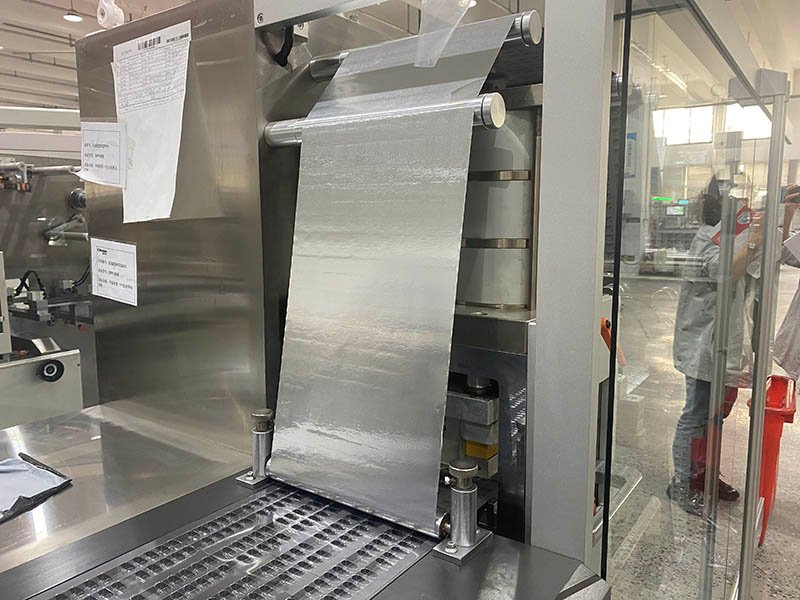


Typical discussion areas include web handling, forming repeatability, product feeding, seal-process evidence, print and registration, cutting, inspection, rejection, safety functions, alarms, recipes, changeover and interfaces. Only the functions present in the approved configuration belong in the protocol.
For each test, name the challenge condition and the evidence that answers a decision. A temperature setpoint screenshot proves that a value was entered; it does not by itself prove a usable sealing process.
Mechanical cycles and catalog speed do not establish acceptable production. A sustained run should define run time, packs per stroke, scheduled stops, interventions, total packs, accepted packs, rejects, waste and the disposition of defects.
Retain representative finished samples and records for seal, cavity, registration, cut position, coding and inspection results according to the approved sampling plan. The buyer should define which quality tests remain outside the machine supplier’s scope.
Open material grades, unfinished artwork, missing samples, unapproved blister drawings, uncertain line interfaces or an undefined electronic-record strategy can change the document package and test plan. Listing them early creates a controlled assumption; hiding them creates late rework.
Require suppliers to separate standard deliverables, project-specific customization, optional site services, buyer prerequisites, exclusions and change-order triggers. This makes the commercial comparison about the same evidence boundary rather than similar-sounding document labels.
References describe regulatory principles and should be interpreted for the buyer’s product, market, facility and quality system. They do not certify a machine or replace advice from the buyer’s quality and regulatory teams.
Send the product and blister definition, proposed machine configuration, URS, accepted-output target, inspection boundary and site documentation expectations. HIJ can respond with a project-specific document index, responsibility matrix and FAT-support scope for commercial discussion.