Filling hyaluronic acid and dermal fillers requires vacuum filling and vacuum stoppering with a servo-driven ceramic plunger pump. Cross-linked HA is highly viscous and shear-thinning, so it traps air on any atmospheric filler and its apparent viscosity changes with fill speed. Because cross-linked HA bulk is extremely valuable per millilitre, the equipment decision is driven less by machine price than by product loss — hold-up volume, changeover waste and bubble rejects.
This guide is written for aesthetics manufacturers, dermal-filler brands and the CDMOs that fill for them. It assumes you are specifying capital equipment against a real formulation and a real batch size. Note the regulatory context differs from pharmaceuticals: in most major markets dermal fillers are regulated as medical devices rather than as drug products, which changes your qualification pathway even though the aseptic filling requirements are just as demanding.
Why HA is not “just a viscous liquid”
The most common specification error is treating hyaluronic acid as a single viscosity number. Cross-linked HA gels are pseudoplastic (shear-thinning): their apparent viscosity falls as shear rate rises. A gel that behaves like a solid at rest flows readily when forced through a needle.
This has two direct consequences for equipment selection:
| Condition | What the HA gel does | Equipment implication |
|---|---|---|
| At rest (in the hopper / tank) | High apparent viscosity; holds entrained air indefinitely | Needs vacuum de-aeration before filling — a defoaming vessel |
| Under shear (through the needle) | Apparent viscosity drops sharply; flows readily | A single “cP” figure is meaningless without a stated shear rate |
| Filled too fast | Jetting, folding and air entrainment at the meniscus | Slower fill + bottom-up needle retraction required |
| After the fill, at rest again | Viscosity recovers; any trapped bubble is locked in place | Bubbles will not rise out — they must never be created |
| During stoppering | Gel resists displacement; stopper can rebound | Vacuum stoppering holds the plunger on the gel surface |
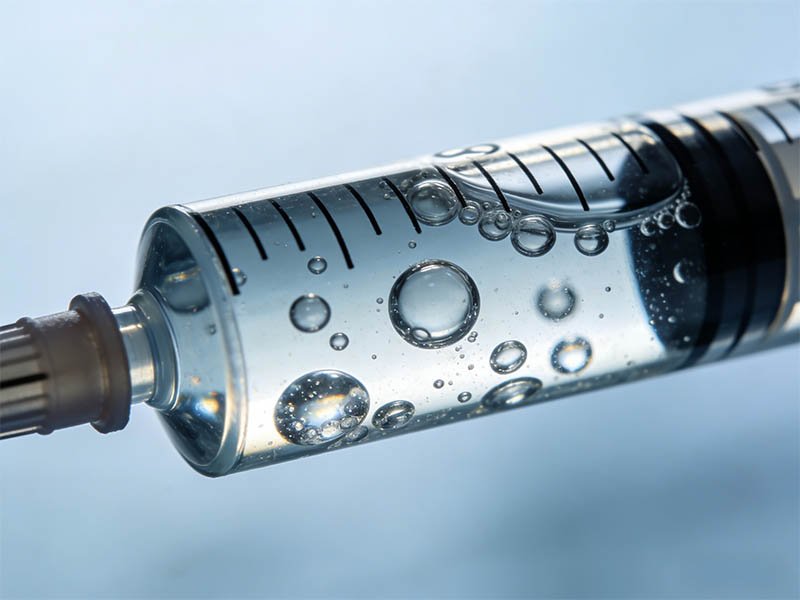
The fourth row is the one that costs money. In a low-viscosity aqueous product an entrained bubble will migrate to the headspace and disappear. In a cross-linked HA gel the bubble stays exactly where it formed, and a visual inspector will reject that syringe. This is why the choice between vacuum and standard filling is effectively made for you.
Key Takeaways for Specifiers
HA is shear-thinning. Ask any supplier for viscosity at a stated shear rate, or the number means nothing.
A bubble in cross-linked gel never rises out. Prevention is the only control — vacuum fill plus vacuum stopper.
De-aerate the bulk before filling. A vacuum defoaming vessel removes air the mixing step entrained.
Ceramic plunger pump, not peristaltic. Positive displacement gives ±1–2% on a shear-thinning gel.
The dominant cost is product loss, not machine price. Model hold-up volume before you compare quotes.
Fillers are usually regulated as medical devices. Your qualification pathway differs from a drug product.
The number that decides the purchase: product loss
Machine price is a one-time cost. Product loss is a cost you pay on every batch, forever. For cross-linked HA — where bulk gel carries a high value per millilitre after synthesis, cross-linking, purification and QC release — this asymmetry is decisive.
Worked example: annual cost of product loss
Three loss mechanisms, one batch of 20,000 × 1 ml syringes, 12 batches per year
Eliminating only the bubble rejects (mechanism ③) recovers roughly US$288,000 per year — more than ten times the price of the base filling machine. On HA, the machine is not the investment. The gel is.
Illustrative model. Substitute your own bulk value, hold-up volume and reject rate — the bulk value per ml is by far the most sensitive input. The point is directional, not a quotation.
This is also why hold-up volume deserves a line item in your User Requirement Specification. Ask every vendor to state, in writing, the minimum residual volume in the product path after a batch. Then multiply by your gel value and by batches per year before you look at the machine price.
Filling a cross-linked HA gel? Send us the rheology data and your batch size — we’ll state our hold-up volume in writing and run the loss model with you.
Request a Formulation ReviewWhat to specify for a hyaluronic acid filling line
Vacuum filling & vacuum stoppering
Barrel evacuated during the fill, and the stopper set under vacuum onto the gel surface.
Why: prevents bubble entrapment and stopper rebound — the two dominant HA reject modes.Servo-driven ceramic plunger pump
Positive displacement with a hard, low-wear ceramic pair. Holds ±1–2% on viscous gel.
Why: peristaltic pumps shear the gel and lose accuracy; ceramic resists abrasion from particulate cross-linked HA.Vacuum defoaming vessel
A jacketed vacuum tank (e.g. 15 L) that de-aerates the bulk before it reaches the pump.
Why: mixing and transfer entrain air. Removing it upstream is far cheaper than rejecting syringes downstream.Bottom-up needle retraction
The filling needle starts at the base of the barrel and rises as the gel enters.
Why: prevents jetting and meniscus folding, which entrain air even under vacuum.Adjustable, slow fill profile
Servo control of fill speed and acceleration, tuned to your gel’s shear-thinning curve.
Why: fill speed changes the gel’s apparent viscosity. Speed is a process parameter to qualify at OQ.Minimal hold-up volume, AISI 316L path
Short product path, no dead corners, 316L stainless and medical-grade silicone contact parts.
Why: every millilitre stranded in the line is money. Dead corners also fail cleaning validation.
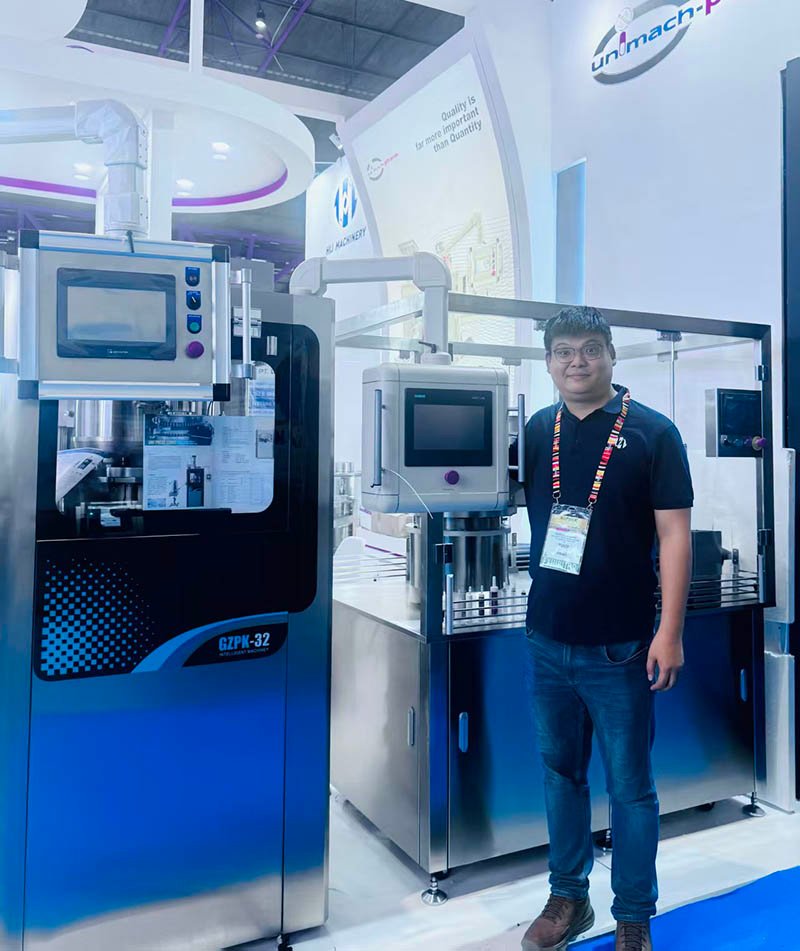
Forester Xiang
Founder & Chief Engineer · 20+ years in sterile filling
When someone sends me a dermal-filler enquiry, the document I want is not the machine specification. It’s the rheology curve. Give me apparent viscosity across a shear range and I can tell you the fill speed, the needle geometry and whether you need a defoaming vessel. Give me a single number in centipoise and I can tell you almost nothing.
And then send us the actual gel. Not a substitute, not glycerol, not a “similar viscosity” stand-in — the real cross-linked material you intend to sell. Gel is expensive to ship and customers hate parting with it. But a litre of your gel at FAT is the cheapest insurance you will ever buy against a machine that fills water beautifully and your product badly.
Terminal sterilisation and headspace: plan it before you buy
Many HA filler products are terminally sterilised in the final syringe rather than aseptically processed end-to-end. That changes two things about the fill.
The headspace becomes a design parameter
During autoclaving the headspace gas expands and the gel itself may expand slightly. Too little headspace and the stopper is driven along the barrel or the syringe deforms; too much and you have an oversized air pocket in an oxygen-sensitive product. Vacuum stoppering lets you set the stoppering depth precisely and start from a minimal, low-oxygen headspace — which is exactly the control you need. Confirm your target headspace with your sterilisation cycle team before you finalise the machine’s stoppering specification.
Whether your product is terminally sterilised or aseptically filled, the equipment obligations are the same: a cGMP-ready design with AISI 316L product-contact parts, no sanitary dead corners, and a documentation package that supports your own qualification work. For exactly which documents the supplier owes you, see our guide to cGMP and IQ/OQ/PQ for an aseptic syringe filling line.
On throughput: most aesthetics manufacturers begin on a single-needle machine such as the HIJ-GZB-100 at 600–800 syringes/hour, which suits typical filler batch sizes. If your annual volume grows past roughly 175,000 syringes, review the economics in our comparison of single-head versus double-head fillers.
Frequently asked questions
What viscosity of hyaluronic acid can a syringe filling machine handle?
Why do air bubbles in hyaluronic acid syringes cause rejects?
Do I need a vacuum defoaming vessel as well as a vacuum filler?
Which pump type is right for dermal filler gels?
How does terminal sterilisation affect the filling specification?
Are dermal fillers regulated as drugs or as medical devices?
Hyaluronic Acid & Dermal Filler Syringe Filling — Reference Facts
Send Us Your Gel, Not Just Your Spec Sheet
Share your rheology data, syringe format and batch size. We’ll state our hold-up volume in writing, run the product-loss model with you, and test your actual gel at FAT.
Get Free Turnkey Quote