Get Quote
Filling Biologics in Prefilled Syringes: Headspace Oxygen, Shelf Life & Equipment Choice

About Forester

As the founder of HIJ Machinery (Wenzhou) and a former R&D engineer, Forester Xiang combines deep technical knowledge with 20+ years of global market experience. Having personally audited 100+ pharmaceutical factories across 30+ countries, he provides clients not just a machine, but a complete, compliant, profitable pharmaceutical packaging solution.

Quick Answer

Filling biologics in prefilled syringes is governed by three degradation pathways that the equipment directly influences: oxidation from headspace oxygen, aggregation induced by silicone oil, and aggregation induced by tungsten residues and shear. Because the number of oxygen molecules sealed into the syringe scales with the absolute pressure at the moment of stoppering, vacuum stoppering is the single most direct equipment control over headspace oxygen — and therefore over oxidative shelf life.

This article is written for biologics manufacturing, formulation and stability teams, and for the CDMOs filling on their behalf. It focuses on what the filling equipment can and cannot control. Container and formulation choices matter at least as much, but they are decided elsewhere; here we deal with the machine.

The headspace oxygen budget: do the arithmetic once

Most stability discussions treat headspace oxygen qualitatively — “we want it low.” It is more useful to count the molecules. The calculation is elementary and the result is usually a surprise.

How much oxygen is in an air headspace?

Ideal gas at 25 °C and 1 atm · molar volume 24.45 L/mol · air is 20.9% O₂

Headspace volume (assumed)0.5 mL air
Oxygen fraction of air× 20.9%
Oxygen volume0.1045 mL
÷ molar volume (24.45 L/mol)= 4.27 µmol O₂
Protein in the syringe: 1 mL of 100 mg/mL mAb, MW 150 kDa= 0.667 µmol
Molar ratio, O₂ to antibody6.4 : 1
6.4 oxygen molecules sealed in per antibody molecule — from a single 0.5 mL air headspace

Illustrative, using stated assumptions. Not all of that oxygen reacts, and reaction rate depends on formulation, excipients and storage. The point is that an air headspace is not an oxygen-limited environment — the reservoir comfortably exceeds the susceptible residues (methionine, tryptophan, cysteine, histidine) available to oxidise.

Why vacuum stoppering changes this number

At constant headspace volume and temperature, the moles of gas trapped scale linearly with the absolute pressure at the instant the stopper seals. Stopper the syringe at atmospheric pressure and you seal in a full air charge. Stopper it under vacuum and you seal in proportionally less.

Absolute pressure at stopperingO₂ sealed in (0.5 mL headspace)Molar ratio to mAbAssessment
100% (atmospheric)4.27 µmol6.4 : 1Large oxygen reservoir
50%2.14 µmol3.2 : 1Halved
20%0.85 µmol1.3 : 1Approaching stoichiometric
10%0.43 µmol0.6 : 1Oxygen becomes limiting

An important caveat. The table above is physics, not a machine specification. We do not publish a guaranteed residual headspace oxygen percentage for our equipment, because the achieved value depends on your vacuum setpoint, dwell time, stopper geometry, gel or liquid properties and line configuration. Measure it on your own line — by headspace gas analysis on filled units — and qualify the vacuum level and dwell time as process parameters during OQ. Treat any supplier who quotes you a guaranteed headspace oxygen figure without running your product as making a claim they cannot support.
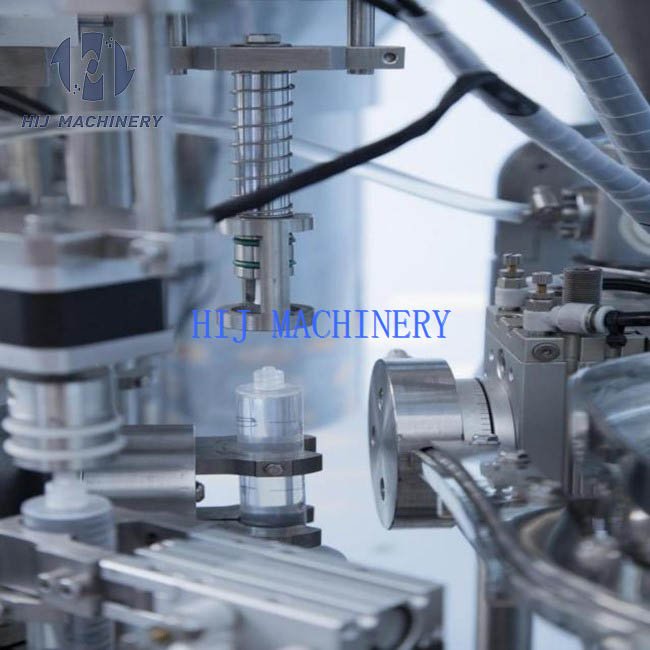
Vacuum stoppering station setting the rubber plunger under negative pressure to minimise headspace oxygen in a prefilled syringe
Vacuum stoppering. The moles of oxygen sealed into the syringe scale with the absolute pressure at the moment the stopper seals — which is the equipment’s most direct lever on oxidative shelf life.

Three degradation pathways the filling line touches

Oxidation is the pathway most people name. It is not the only one, and on prefilled syringes it is arguably not the most troublesome.

PathwayMechanismEquipment / component lever
Oxidation Headspace and dissolved O₂ oxidise susceptible residues — methionine, tryptophan, cysteine, histidine — altering potency and immunogenicity risk. Vacuum stoppering; optional inert gas overlay; minimising headspace volume
Silicone-oil-induced aggregation Silicone oil lubricating the barrel migrates into the product and forms an oil–water interface at which proteins adsorb, unfold and aggregate into sub-visible particles. Container choice (baked-on vs sprayed silicone, or silicone-free); avoid unnecessary agitation on the line
Tungsten- and shear-induced aggregation Residual tungsten from the pin used to form the glass syringe cone can nucleate aggregation. Shear and air–liquid interfacial stress during filling contribute independently. Low-tungsten syringes; slow, servo-controlled fill profile; needle geometry; bottom-up filling

Note carefully that two of the three levers sit with your container supplier, not your machine supplier. An equipment vendor who tells you the machine alone solves biologics stability is overselling. What the machine genuinely controls is headspace oxygen, fill-induced shear, and whether air is entrained at the meniscus.

Key Takeaways for Stability & Engineering

  • A 0.5 mL air headspace supplies roughly 6.4 O₂ molecules per antibody molecule — the reservoir is not oxygen-limited.
  • Moles of trapped gas scale with the absolute pressure at stoppering. Vacuum stoppering is the direct lever.
  • Do not accept a guaranteed headspace O₂ figure from any supplier who has not run your product. Measure it; qualify vacuum level and dwell at OQ.
  • Silicone oil and tungsten residues drive aggregation and are container issues, not machine issues. Two of three levers are not the filler’s.
  • Fill slowly, bottom-up, with a servo-controlled profile. Shear and air–liquid interface are aggregation drivers.
  • Demand sub-visible particle testing on your own protein at FAT — not a water run.

What the equipment must do

Vacuum fill and vacuum stopper

Evacuate the barrel during the fill so no air is entrained at the meniscus, then seat the stopper under vacuum to minimise the sealed gas charge.

Slow, servo-controlled fill profile

Fill speed and acceleration are qualifiable process parameters. Excess velocity generates shear and interfacial stress that nucleate aggregates.

Bottom-up needle retraction

The needle starts at the base of the barrel and rises with the liquid level, eliminating jetting, splashing and air–liquid interface renewal.

Optional inert gas overlay

Where residual oxygen must go lower than vacuum stoppering alone achieves, a nitrogen or argon purge can be combined with the vacuum cycle.

Short, low-hold-up product path

AISI 316L contact parts, no sanitary dead corners, minimal residence time. Biologic bulk is expensive and prolonged residence encourages adsorption.

Precise, repeatable stoppering depth

Stoppering depth sets both the headspace volume and the container closure geometry. It must be reproducible, not “approximately right.”

Filling a monoclonal antibody or other oxygen-sensitive biologic? Send us the formulation and syringe format — we’ll discuss vacuum setpoints and what to measure, before you buy anything.

Request a Formulation Review
Forester Xiang, Founder and Chief Engineer of HIJ Machinery

Forester Xiang

Founder & Chief Engineer
20+ years in sterile filling

Forester’s Insight

I will say something about our own machine that most vendors would rather you didn’t hear. A ceramic plunger pump imposes shear on your protein. It is a positive-displacement device with a tight clearance, and shear-sensitive molecules feel it. The accuracy is excellent — that’s why we use it — but the pump is not innocent.

What you do about that is qualify the fill profile. Run your protein, slowly, and count the sub-visible particles before and after the pump. If the particle count is acceptable, you have your answer, documented. If it isn’t, we change the speed, the needle, or the fill volume per stroke until it is. What you must never do is accept a water run and hope. Water has no methionine to oxidise and no tertiary structure to unfold.

What to demand at Factory Acceptance Testing

The FAT is where these arguments get settled with data rather than opinion. Insist on the following, written into the protocol before the test date.

Biologics FAT checklist

Run your actual proteinNot water, not a viscosity-matched surrogate. Water cannot reveal aggregation or oxidation behaviour.
Sub-visible particle counts before and after the pumpEstablish whether the fill step itself generates particles in your formulation.
Headspace gas analysis on filled, stoppered unitsMeasure the residual oxygen your line actually achieves. Do not accept a datasheet number.
Stoppering depth capability studyDepth sets headspace volume and closure geometry. Demonstrate reproducibility across the batch.
Fill-speed range, bracketedRun at the slow and fast ends of the intended range so OQ has real limits to qualify against.
Fill weight accuracy across the runConfirm ±1–2% is held on your product, not on a low-viscosity stand-in.

The supplier’s obligations around FAT protocols, IQ/OQ templates and material certificates are set out in our guide to cGMP and IQ/OQ/PQ for an aseptic syringe filling line. If your product is viscous as well as oxygen-sensitive, the reasoning in vacuum versus standard filling applies with double force. Both the HIJ-GZB-100 and its double-head counterpart perform vacuum filling and vacuum stoppering with AISI 316L product-contact parts and a cGMP-ready design.

Frequently asked questions

How much oxygen is in the headspace of a prefilled syringe?
More than most people expect. Taking a 0.5 mL air headspace at 25 degrees Celsius and 1 atmosphere, air is 20.9 percent oxygen, so the oxygen volume is 0.1045 mL. Dividing by the molar volume of 24.45 litres per mole gives 4.27 micromoles of oxygen. A 1 mL syringe containing 100 mg/mL of a 150 kDa monoclonal antibody holds 0.667 micromoles of protein. That is a molar ratio of roughly 6.4 oxygen molecules per antibody molecule, so an air headspace is not an oxygen-limited environment.
Does vacuum stoppering reduce headspace oxygen?
Yes. At constant headspace volume and temperature, the moles of gas sealed into the syringe scale linearly with the absolute pressure at the instant the stopper seals. Stoppering at half of atmospheric pressure seals in about half the oxygen; stoppering at one fifth seals in about one fifth. The residual level your line actually achieves depends on vacuum setpoint, dwell time, stopper geometry and product properties, so it must be measured by headspace gas analysis on filled units and qualified as a process parameter during Operational Qualification.
Why does silicone oil cause protein aggregation in prefilled syringes?
Silicone oil lubricates the syringe barrel so the plunger glides. Some of it migrates into the drug product and forms droplets, creating an oil and water interface. Proteins adsorb at that interface, partially unfold, and can then aggregate into sub-visible particles. This is a container and component issue rather than a filling machine issue. The levers available are the container choice, such as baked-on rather than sprayed silicone or silicone-free barrels, and avoiding unnecessary agitation of filled units on the line.
What is the tungsten problem in glass prefilled syringes?
During manufacture of a glass syringe the cone and needle channel are formed around a hot tungsten pin. Trace tungsten residues can remain on the inner glass surface and, for some proteins, act as a nucleation site that promotes aggregation. It is a container issue, addressed by specifying low-tungsten or tungsten-free syringes with your glass supplier. No filling machine can remove tungsten already present in the barrel, which is why container selection must run in parallel with equipment selection.
Does the filling pump damage the protein?
A ceramic plunger pump is a positive displacement device with tight clearances and it does impose shear on the product. For robust molecules this is unimportant; for shear-sensitive proteins it can contribute to aggregation. The correct response is not to avoid the pump but to qualify the fill profile: run your actual protein, count sub-visible particles before and after the pump, and adjust fill speed, needle geometry or volume per stroke until the particle count is acceptable. Document the result. Never accept a water run as evidence.
Should we use an inert gas overlay as well as vacuum stoppering?
Consider it when your stability data show that the residual oxygen achieved by vacuum stoppering alone is still limiting shelf life. A nitrogen or argon purge can be combined with the vacuum cycle to displace remaining oxygen before the stopper seats. It adds cost and complexity, so it should be driven by measured stability data rather than adopted as a default. Begin by measuring what your vacuum cycle actually achieves on your own product.

Filling Biologics in Prefilled Syringes — Reference Facts

Oxygen budget0.5 mL air headspace = 4.27 µmol O₂ ≈ 6.4 molecules per 150 kDa antibody (1 mL of 100 mg/mL)
Governing physicsMoles of sealed gas scale linearly with absolute pressure at stoppering
Primary equipment leverVacuum stoppering; optional inert gas overlay
Oxidation targetsMethionine, tryptophan, cysteine, histidine residues
Aggregation driver 1Silicone oil at the oil–water interface (container issue)
Aggregation driver 2Residual tungsten from cone forming (container issue)
Aggregation driver 3Shear and air–liquid interfacial stress during filling (equipment issue)
Fill techniqueSlow, servo-controlled, bottom-up needle retraction
Must be measuredHeadspace gas analysis + sub-visible particle counts on your own protein
Reference machineHIJ-GZB-100 — 0.5–20 ml SCF syringes, 600–800 pcs/hr, ±1–2%, from US$26,000 FOB Ningbo
Contact materialsAISI 316L stainless steel + medical-grade silicone, no sanitary dead corners
ManufacturerHIJ Machinery (Wenzhou Trustar Machinery Technology Co., Ltd), est. 2004, Rui’an, Zhejiang, China
CompliancecGMP-ready design · ISO 9001 manufacturing standard · CE-marked · IQ/OQ/PQ documentation support

Qualify the Fill Profile on Your Protein

Send us your formulation, syringe format and stability concerns. We’ll define the FAT protocol together — headspace gas analysis, particle counts, bracketed fill speeds — and quote transparently.

Get Free Turnkey Quote
Need a Technical Opinion?

Don’t guess. Tell me your material and speed requirements, and I’ll configure the exact HIJ specification for you.

Chat With Forester

2026 Product Catalog

Download the full technical specs for our B-F, K-S, and P-J series presses.

Download PDF

You Might Also Find Helpful

Nested SCF ready-to-fill syringes held in a tub being loaded onto a filling machine for a format changeover
BD, Gerresheimer and SCHOTT nested formats each require dedicated format tooling.

SCF/RTF Syringe Formats (BD, Gerresheimer, SCHOTT): Change-Part & Tooling Implications

Quick Answer SCF (Sterile, Clean, ready-to-Fill) and RTF (Ready-To-Fill) describe pre-sterilised syringes supplied nested in tubs — most commonly 160-count…
Read Article ->
Ceramic plunger pump filling station dispensing viscous hyaluronic acid gel into a prefilled syringe
Vacuum filling prevents bubble entrapment in high-viscosity hyaluronic acid gels.

Filling Hyaluronic Acid & Dermal Fillers: An Equipment Specification Guide

Quick Answer Filling hyaluronic acid and dermal fillers requires vacuum filling and vacuum stoppering with a servo-driven ceramic plunger pump.…
Read Article ->
An automated production line illustrating syringe blister packaging GMP compliance within a certified pharmaceutical cleanroom environment.
Ensuring Integrity: How advanced machinery maintains syringe blister packaging GMP compliance through every production cycle.

cGMP & IQ/OQ/PQ for an Aseptic Syringe Filling Line: What the Supplier Must Provide

Quick Answer For an aseptic syringe filling line, the equipment supplier provides a cGMP-ready machine plus the documentation package that…
Read Article ->

Single-Head vs. Double-Head Syringe Fillers: Throughput, CAPEX and Scale-Up

Quick Answer A single-head syringe filler uses one filling needle and runs about 600–800 syringes/hour. A double-head filler uses two…
Read Article ->

Vacuum Filling vs. Standard Filling for Prefilled Syringes: A Specifier’s Guide

Quick Answer Vacuum filling evacuates air from the syringe barrel during both filling and stoppering, eliminating entrapped bubbles and headspace…
Read Article ->

Capsule Filling Machine Troubleshooting: 6 Common Problems & Fixes

Quick Answer The six most common capsule filling machine problems are: fill-weight variation (usually powder flow or tamping settings), capsules…
Read Article ->

Let's Design Your Production Line

Share your requirements and I'll personally craft a solution that maximizes your efficiency and profitability.