
One bar. One carton.
A straightforward starting point for individually wrapped bars. Specify the wrapped length, width and height, including foil folds or film seals, and which face should be visible when the carton opens.
From an individually wrapped bar to a finished retail carton. HIJ supplies cartoning equipment with the feeding, loading and closing configuration selected around your chocolate pack.

The retail pack determines the feeder, group arrangement and loading path. Bring one complete example—not only the dimensions of the chocolate inside its wrapper.
A straightforward starting point for individually wrapped bars. Specify the wrapped length, width and height, including foil folds or film seals, and which face should be visible when the carton opens.
Define bars per box, rows, layers and flavour mix. The configuration can then be reviewed for prepared-group loading or automatic grouping, with the operator tasks and count checks clearly separated.
For a prepared tray or divider, assess the entire loaded assembly. Tray lips, load stability and the outer carton opening matter as much as the size of each bar. Compatibility is reviewed by format.
Pack-format illustrations, not photographs of HIJ trial samples. This page covers secondary folding-carton packing of already wrapped chocolate; primary wrapping and rigid gift-box production are separate scopes.
For chocolate, the important question is not simply whether the carton closes. It is whether the wrapped product reaches the shelf in the condition you expect.
These three priorities shape the sample review and the proposed loading arrangement.
Allow space for raised fin seals, folded foil corners and end-seal overhangs. Review their orientation through guides and carton flaps to address snagging, wrapper damage and uneven insertion.
Assess transfer gaps, the loading pocket and contact points with the actual product condition after wrapping. Include the least rigid or most fragile bar in trials, then inspect the chocolate as well as its outer pack.
Set the total count and, for assortments, the quantity of each variety. Individual-bar counting and flavour verification need an explicit scope; a finished-carton counter does not establish either result.
Match the wrapper discharge height, spacing and bar orientation. Separate rejected bars before they enter the accepted stream.
Present one bar or form the requested multipack. Define support, counting and what happens to an incomplete group.
Open the carton and transfer the load through a controlled path. Keep wrapper seams and inserts clear of the closing flaps.
Select tuck or glue closure, coding and inspection. Agree the reject response and the conditions for releasing a good carton.
A quotation should make clear whether groups are operator-presented or automatically assembled. The cartoner infeed guide explains the broader feeder choices; your pack determines the suitable arrangement.
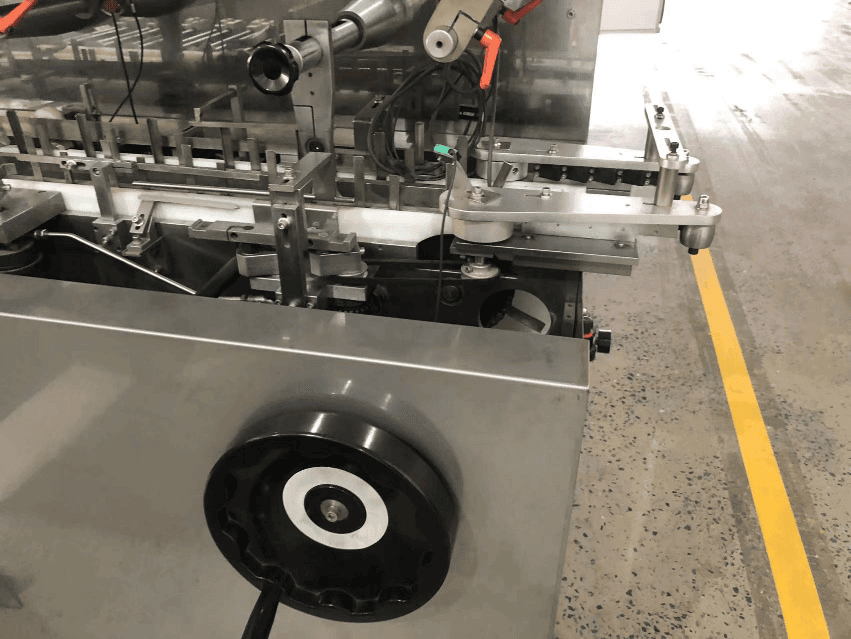
The HIJ WZTS-130 automatic cartoning platform provides the folding-carton handling reference. Feeding, grouped loads and inspection are selected for your product.
| Item | Documented reference | Project decision |
|---|---|---|
| Carton dimensions | 70–200 × 30–150 × 13–70 mm (L × W × H) | Approved drawing and clearance around the complete wrapped load. |
| Carton board | 300–350 g/m², depending on carton size | Production board, caliper, creases and opening behaviour. |
| Counting | Finished-product count display | Individual bars, mixed-flavour recipes and incomplete-group rejection. |
| Closing | Tuck closing; hot-melt applicability described | Flap design, closure tooling and glue equipment if selected. |
Source: supplied WZTS-130 documentation. These are platform values, not guaranteed chocolate output or all-format compatibility. The complete feeder, inspection, guarding and operator-access layout defines the project footprint and utilities.
List every launch SKU and identify the guides, pockets and format parts it needs. Distinguish saved settings from physical adjustments, and measure changeover through first-piece approval—not just recipe selection.
Clear bars, cartons and inserts from the previous recipe. Where allergen changeover matters, include your cleaning and verification requirements in the scope.
Start with good bars reaching the cartoner after upstream rejection. Bars per minute divided by bars per carton gives the supply ceiling—not the finished-line guarantee.
For a mixed assortment, calculate the required flavour streams separately. A surplus of one variety cannot replace a shortage of another. Agree how held bars and partial groups are handled during a stop and restart.
Use representative bars and production carton blanks to turn requirements into observable tests. Agree the sample condition and acceptable result before running the trial.
| Test | Look for | Record |
|---|---|---|
| Wrapper seam through the load path | Snagging, tearing, fold damage or a trapped seal. | Pack orientation and acceptable wrapper condition. |
| Fragile bar at intended handling condition | Support through gaps and loading; damage after unpacking. | Sample condition, inspection method and acceptance limits. |
| Missing bar or wrong variety | Detection and removal of the incorrect group. | Challenge samples, actual response and reject disposition. |
| Stop, hold and restart | Partial groups, held product and the first finished cartons. | Recovery procedure and release of accepted output. |
| Largest loaded carton | Flap closure, distortion, retained wrapper edges and movement. | Carton blank, arrangement and closure criteria. |
When weight is used for count checking, evaluate normal variation in the bars, wrappers and carton against the missing-bar condition. Inspection equipment must demonstrate the required result. Use the cartoning machine FAT checklist to document the agreed tests and responsibilities.
If product temperature or time spent waiting changes firmness, include those conditions in the trial. Cooling and temperature-controlled operation are separate requirements, not assumed cartoner features.
For a chocolate bar carton packing machine, the main price differences often sit around the cartoner: feeding, grouping, format parts and inspection. Compare the complete configuration.
HIJ quotes by configuration. A single-bar project and an automatically grouped assortment are different purchases; the proposal should identify included equipment and options before price and delivery are agreed.
This application loads already wrapped chocolate into outer folding cartons. Foil wrapping, flow wrapping, cooling and blister forming are separate stages unless included in a specific line proposal.
Both formats can be included in the project review. Their feeders, grouping pockets, loading parts and cartons may differ, so the proposal needs a defined format list and sample-based compatibility check.
Define the quantity and position of each variety, how each stream arrives and how the recipe is verified. Total-count checking alone does not verify the flavour mix. Include the response to a missing variety or incomplete group.
The review addresses product support, transfer gaps, contact points, seam orientation and carton clearance. Representative samples establish the acceptable chocolate and wrapper condition; a platform name alone does not prove damage-free handling.
Each construction needs a separate blank, forming and loading assessment. Folding-carton capability does not establish compatibility with wrap-around packs, sleeves or rigid gift boxes. Send the proposed construction with the product samples.
Start with a wrapped-product photo, dimensions, bars per carton and carton drawing. Add the arrangement, flavour recipe, accepted upstream supply, target finished output and required formats. Include inspection and layout requirements when available.
Show HIJ the wrapped bar and the retail carton you want to produce. Include your pack count and target output so the discussion starts with the right feeding and loading scope.
Arrange drawings or sample transfer through the contact channel agreed with HIJ; this page does not upload files.