
One product, repeated count
For a carton containing identical pouches, define the quantity, orientation and stack. The feeder must separate soft packs and keep an incomplete group from being loaded as a complete multipack.
Group already-sealed pet food pouches into the right count and load them into retail cartons. HIJ supplies project-configured cartoning equipment for this application, with the feeder, pack arrangement and inspection scope matched to your samples.
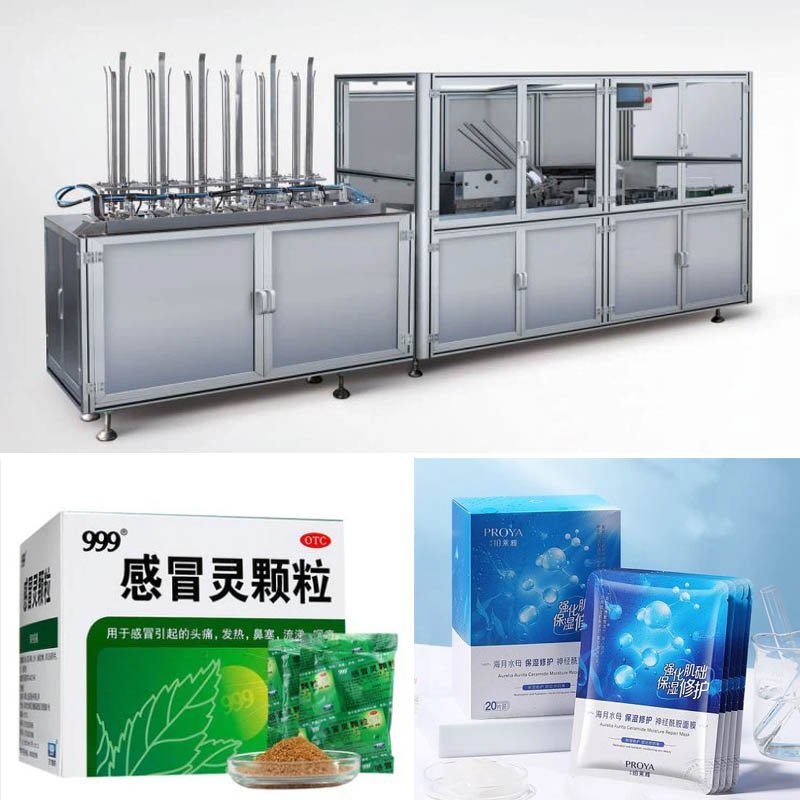
A pet food cartoning machine handles secondary packaging: it erects a folding carton, loads the specified pouch group, closes the carton and coordinates the agreed checks and rejection. It does not make the food, fill the pouch or establish the integrity of the upstream sealing process.
For a carton containing identical pouches, define the quantity, orientation and stack. The feeder must separate soft packs and keep an incomplete group from being loaded as a complete multipack.
Specify the exact number of each flavour or SKU. A correct total count is not enough: the grouping and checking method must also protect the required assortment.
Send the full format list for wet-food portions or sealed treat bags. A change in filled thickness, gusset, wrapper friction or product weight can require different handling parts and tests.
Measure representative filled and sealed packs, including the fullest and least stable examples. Flat film dimensions do not describe a pouch's actual thickness, centre of gravity or behaviour during transfer. Confirm the group in a physical carton before freezing the machine format.
| Decision | What to provide | What the trial must establish |
|---|---|---|
| Pouch geometry | Filled length, width, thickness range, weight and seal overhang | The group passes through guides and the carton opening without trapped seals or excessive compression. |
| Pack arrangement | Count, rows, layers, orientation and a photo of the finished multipack | The arrangement stays controlled through grouping, transfer and closure. |
| Carton construction | Die-line, internal clearances, board grade, closure and print orientation | The blank opens squarely and the flaps close without catching a pouch. |
| Assortment | SKU identities, quantity of each SKU and permitted substitutions, if any | A missing or wrong flavour cannot be accepted merely because the total count is correct. |
| Arrival condition | Lane count, spacing, orientation, surface condition and upstream stops | The feeder works with actual production packs, not only dry, hand-arranged demonstration samples. |
Retail folding cartons and corrugated shipping cases are different packaging tasks. This page covers the retail multipack; review case-packing equipment for loading those finished cartons into shipping cases.
The machine layout should show where products are counted, where incomplete groups wait or are removed, and which station owns each reject. Feeding equipment and inspection options are selected for the project, not assumed from the base cartoner model.
Transfer sealed packs from the agreed conveyor or loading point. Establish lane identity and the response to irregular spacing.
Singulate and group the required pouches. Define how overlapping packs, double feeds and shortages are detected.
Keep the complete arrangement supported during insertion. Review guides, transfer clearances and allowable pouch contact.
Close the carton with the agreed tuck or adhesive method. Allocate count, SKU, code and closure verification explicitly.
Separate rejected cartons, confirm removal and coordinate discharge with the next conveyor or case packer.
For mixed cat food or dog food cartons, total pouch supply alone is a misleading capacity measure. Each required SKU has to arrive in the correct proportion. For each SKU, divide its available pouches per minute by the number needed in one carton; the lowest result is the assortment supply limit.
Agree whether an upstream shortage pauses grouping, uses a controlled buffer or stops the line. A buffer can cover a short interruption, but it cannot make up for a sustained shortage of one flavour.
Wrong-SKU protection also needs a defined method. Lane separation, operator replenishment checks and any barcode or vision system should be specified together. Weight checking alone cannot distinguish different flavours with the same pack weight.
Example supply rates: A = 120, B = 80 and C = 60 pouches/minute. Divide each rate by four.
This is a hypothetical supply ceiling, not a HIJ machine rating or accepted-output guarantee. Loading cycle, stops, rejects and downstream constraints may reduce actual good output.
The WZTS-130 is one HIJ automatic cartoning platform to assess for an end-loading configuration. Its supplied technical document includes food applications, automatic feeding, carton closing and missing-material rejection. That establishes a platform reference, not a proven pet-food multipack recipe.
For your project, HIJ must confirm the group envelope, insertion method, feeder arrangement and required changes to the base machine. Do not select a model only because an empty carton lies within its published size range.
These document values are not the specification or guaranteed speed of your pet-food configuration. Feeders, format parts, carton geometry and approved sample tests determine the final proposal.
Define acceptable scuffing, deformation and compression before the trial. Use the filled-thickness range and actual seal overhang to check the guide and pusher clearances. Include sample packs that represent normal production variation.
Specify how operators isolate a damaged pouch and clean the affected path. If leak detection is required, name the detection method and its scope separately. A cartoner's product-presence check does not prove pouch seal integrity.
Trial the selected board, tuck design or adhesive closure with the complete pack. Recycled-content board or reduced board weight needs its own opening and closure assessment; neither proves a sustainability benefit or universal machine compatibility.
State the actual cleaning procedure and operating environment in the enquiry. Accessible product paths, cleaning compatibility and recovery after a damaged pack matter even when the machine normally handles sealed food. Do not infer washdown protection from the frame's appearance.
A variety-pack change can leave the previous SKU in a conveyor, buffer or grouping pocket. Define a line-clearance process for the product path and carton supply before restarting. A stored screen recipe does not by itself verify that the correct pouches and cartons are loaded.
Agree the start and finish: from the last accepted carton of recipe A to sustained accepted output of recipe B. Include material removal, parts replacement, adjustments, inspection setup and first-piece approval.
If every shift includes several flavour or carton changes, put representative changes in the sample-test plan. Use the measured process to estimate operator work and available production time.
A factory acceptance test (FAT) should use agreed filled pouches, carton blanks and acceptance criteria. Document the exact feeder and inspection options present. A successful single-flavour demonstration is not evidence that a mixed-flavour recipe has been proven.
| Test | Challenge to agree | Evidence to record |
|---|---|---|
| Pack count & recipe | Missing pouch, double feed, wrong flavour and shortage in one lane | Detection point, machine response, rejected group and restart reconciliation |
| Pack integrity | Fullest pouch, largest seal overhang and least stable group | Condition before and after loading, trapped seals, deformation and closure result |
| Good output | Agreed recipe, materials, run duration and upstream supply | Accepted cartons, rejects, stops and reasons, not just empty-machine cycles |
| Line recovery | Upstream shortage, downstream blockage and controlled stop/restart | Buffer behaviour, retained products, incomplete-group handling and correct restart |
| Changeover | Representative SKU, count and carton-format change | People, parts, settings, clearance, first-piece checks and measured duration |
Use the cartoning machine FAT checklist to develop your acceptance protocol. Inspection capability, test materials, document scope and any on-site acceptance work belong in the agreed project scope.
HIJ quotes by configuration. Two machines that handle the same nominal carton size can have very different costs when one runs identical pouches and the other assembles a checked variety pack from several feeds.
Number of incoming streams, singulation, pouch support, assortment rules, buffer requirements and the expected response to shortages.
Launch formats, later expansion, change parts, tuck or adhesive closure, code verification, SKU checks and reject confirmation.
Conveyors, controls interfaces, layout, site utilities, trials, documents, shipping, commissioning, training and agreed spare parts.
Ask for itemised inclusions and exclusions, a layout and the acceptance basis. Confirm electrical supply, compressed air, maintenance clearances and service arrangements for the selected build. Pricing, delivery milestones and warranty terms should come from the current quotation.
Yes. HIJ supplies project-configured equipment to group already-sealed cat or dog food pouches and load them into retail cartons. The pouch samples, count, arrangement, carton and required output must be reviewed before the feeder and final configuration are specified.
A mixed-flavour configuration can be reviewed against a defined recipe. Provide the quantity of each SKU, incoming supply pattern and required identity checks. Correct total count alone does not prove that the flavour mix is correct; the feeding, verification and reject scope must be agreed.
Accepted output depends on pouch supply by SKU, pieces per carton, grouping, loading, inspection, stops and downstream capacity. The WZTS-130 document lists a 30–80 cartons/minute platform reference, not a pet-food performance guarantee. Confirm your target using the approved packs and a written sample-test protocol.
No. This page covers secondary cartoning of pouches that have already been filled and sealed. Food preparation, dosing, primary pouch sealing, retorting and any related process validation require a separately defined equipment and process scope.
Possibly, within an agreed format set. Changes to filled thickness, seal overhang, count or arrangement may require feeder parts, guides, carton tooling and inspection adjustments. Provide all required formats and request representative changeover trials before ordering.
Proposed board can be assessed with the actual die-line and pouch group. Opening, stiffness, closure and handling must be tested. Material choice alone does not establish recyclability, a lower environmental footprint or compatibility with a particular configuration.
Start with filled-pouch photos or samples, pouch dimensions and weight, pieces of each SKU per carton, the intended pack arrangement, a carton drawing and your accepted-output target. Add upstream delivery details, inspection needs, site layout, utilities and destination so the proposal can define its inclusions and exclusions.
Start with your sealed pouch and the finished carton you want to produce. Tell HIJ whether it is a single-flavour pack or a mixed assortment, and which requirements are still open.
Describe your project in the enquiry. Arrange the transfer of photos, drawings or samples through the contact channel agreed with HIJ.