Opens in a new tab
Get Quote

GGS-118P5 · Roll-film form-fill-seal

Cosmetic Liquid Filling Machine for Plastic Ampoules

The GGS-118P5 forms plastic ampoules from roll film, doses the liquid and heat-seals the pack before cutting. It is a cosmetic liquid filling machine for projects using formed plastic packs, with a reference filling range of 0.3–200 ml and five filling heads.

Discuss perfume, essential oil or another flowable cosmetic formulation with HIJ. Pump selection, film compatibility and output are confirmed for your product and pack.

GGS-118P5 liquid filling and sealing equipment for formed plastic ampoules
Plastic ampoule forming, filling and sealing equipment. The supplied mold and dosing configuration depend on your approved samples.
0.3–200 mlReference fill range
5 headsGGS-118P5 configuration
PVC/PE · PET/PEListed film structures
SUS316LListed contact-part material

Start with the package

Is This the Right Cosmetic Liquid Filler for Your Pack?

A cosmetic liquid filler meters product into a package. The GGS-118P5 combines dosing with plastic ampoule forming and sealing, so the package is made on the machine. It is not a general-purpose filler for purchased bottles, jars or tubes.

Choose this route for formed plastic ampoules

  • You want to form, fill, seal and cut compatible roll film in one machine.
  • Your proposed fill volume falls within the reference range and can be matched to an approved ampoule drawing.
  • You can supply the actual formulation, film and pack requirements for an application trial.
  • You need to evaluate individual ampoules or strips, including their opening and downstream handling.

Use a different route for other containers

For purchased bottles and jars, compare the cosmetic filling machine range. Those projects require container handling and closure selection rather than roll-film forming.

For creams in soft tubes, review cosmetic tube filling and sealing. Glass ampoules, flat-bottom packs and aseptic filling require a separate equipment review.

Cosmetic Oils, Perfume and Flowable Formulations

Product names alone do not establish compatibility. A liquid filling machine for cosmetic oil must be assessed with the actual oil, contact materials and packaging film. A serum or lotion may behave very differently from a water-like sample.

Perfume and fragrance

Perfume is a listed application. Provide the formulation safety information, filling temperature and intended film. Where solvents are present, the project needs a specific materials and equipment-safety review; standard suitability is not assumed.

Essential and cosmetic oils

Essential oil is a listed application. Confirm viscosity at the filling temperature, contact-part compatibility, dripping after dosing and the finished-pack seal result using the actual oil.

Serums, essences and lotions

Submit samples for feasibility review before selecting this model. Thick, foaming, particle-containing or temperature-sensitive products may need a different pump, product-handling arrangement or filling platform.

How the Plastic Ampoule Filling and Sealing Process Works

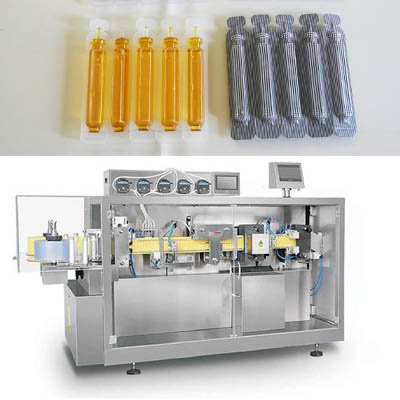
Plastic ampoule liquid filling and sealing machine configuration
Machine reference image. Confirm the actual pump, tooling, utilities and finished-pack layout in the project specification.

The process starts with roll film rather than a conveyor of premade bottles. Heating and tooling create the pack shape, the selected pump meters the product, and the machine seals and cuts the pack.

For the buyer, film selection, mold design and filling performance are linked. A change in pack shape or fill volume should be reviewed together with the forming and sealing requirements.

This is a roll-film thermoforming form-fill-seal route, not extrusion blow-fill-seal. The page does not claim sterile or aseptic production.

  1. Unwind film

    Feed the approved roll material into the forming section.

  2. Heat and form

    Shape the pack using tooling selected for the ampoule drawing.

  3. Fill the product

    Dose through the five-head configuration with the selected pump system.

  4. Heat-seal

    Close the filled pack with settings established for the film and product.

  5. Code and cut

    Apply the agreed batch-code arrangement and cut the pack layout.

  6. Discharge

    Release finished strips or individual ampoules for inspection and handling.

GGS-118P5 Reference Specifications

Use these model reference values to start the technical discussion. The agreed project specification should identify the supplied configuration and the acceptance conditions for your product.

Swipe the table horizontally to view both columns.

GGS-118P5 liquid filling and sealing machine
Filling configuration5 filling heads
Reference filling range0.3–200 ml; confirm pump and tooling for each required volume
Reference outputApproximately 100 pieces/min at 10 ml and 40 pieces/min at 200 ml. These are separate reference conditions, not guaranteed rates for every formulation or pack.
Maximum forming depth12 mm
Listed packaging filmsPVC/PE and PET/PE; other films require confirmation
Listed product-contact materialSUS316L; confirm the complete wetted path, including tubing and seals
ControlsPLC, HMI and stepless frequency adjustment
Reference machine power4.5 kW
Electrical supply220 V / 380 V, 50 Hz reference; confirm the required site supply
Reference machine dimensions2300 × 850 × 1500 mm
Reference machine weight750 kg

Plan output using accepted packs. Confirm the sustained rate with your ampoule geometry, liquid and film. Agree on the test duration, rejected-pack criteria and required good output, rather than treating a catalog speed as the production guarantee.

Confirm Film, Ampoule Shape and Artwork Before Tooling

Film and seal compatibility

PVC/PE and PET/PE describe film structures, not a complete purchase specification. Provide the film supplier's specification and samples, including thickness, roll dimensions and any printed artwork.

Evaluate forming quality, seal integrity and opening behavior with the actual product. Packaging compatibility and shelf-life requirements need their own evidence; a successful machine run does not establish them on its own.

Pack geometry and print position

The reference GGS-118 configuration is intended for packs without a flat bottom and without a fixed-position print requirement. Provide the required shape and artwork before selecting the model.

If every pack needs registered artwork in the same position, ask for a separate model/configuration review. Do not assume that changing a mold alone adds this capability.

Select the Pump and Cleaning Arrangement Together

The model documentation describes mechanical, peristaltic and rotary-valve pump routes, with pump choice depending on product flow behavior. The reference water-like liquid configuration uses a peristaltic pump. This does not make one pump suitable for all cosmetics.

Check the dosing result

  • Test the minimum, normal and maximum required fill volumes.
  • Define the sampling method and permitted dose variation before acceptance.
  • Observe start-up, stopping, dripping, foaming and product stringing.
  • Review tubing, seals and other contact components against the formulation.

Check product changeover

  • Identify which contact parts need removal or replacement.
  • Agree on the cleaning method and access needed by operators.
  • Review residual product and cross-contamination concerns between formulations.
  • List required spare tubing, seals and format parts in the quotation.

Hygienic design is more than a material grade. SUS316L is a listed material, not proof of machine certification or site GMP compliance. Request the relevant design, cleaning and documentation details for your intended use. Do not assume clean-in-place or aseptic capability.

Agree on the Sample Trial and FAT Acceptance Plan

Before purchase, define what the factory acceptance test (FAT) must demonstrate. Use the intended formulation and film, or agree in writing on any representative materials and their limitations.

Filling and output

Record the fill-volume results and sustained accepted-pack rate under agreed conditions. Include start-up and stopping behavior where they affect your production.

Seal, cut and opening

Agree on the inspection method and acceptance limits for leakage, seal quality, cut position, legible batch codes and the finished pack's opening behavior.

Changeover and handover

Review the required product or format changeover, operator access, supplied manuals, spare parts and any agreed training or qualification support.

Configuration and quotation

What Determines the Cosmetic Liquid Filling Machine Price?

The quotation depends on the selected pump, ampoule tooling, film and artwork requirements, utilities and downstream scope. Compare proposals using the same product, pack drawing and acceptance plan.

Product and package inputs

  • Formulation name, sample and relevant safety information
  • Flow behavior at the intended filling temperature
  • Required fill volumes and ampoule drawing
  • Film specification, sample roll and artwork requirements

Production and supply scope

  • Required sustained output and batch sizes
  • Site power supply, compressed air and cooling provision
  • Extra molds, spare parts, coder and downstream interfaces
  • FAT, documentation, installation and training requirements

Confirm whether an air compressor, chiller and any labeling interface are included or supplied separately. Obtain current pricing, delivery, warranty and payment terms in the written quotation; this page does not publish a fixed price or stock promise.

Cosmetic Liquid Filling Machine FAQ

What is a cosmetic liquid filling machine?
A cosmetic liquid filling machine meters a formulation into its package. The GGS-118P5 combines filling with roll-film plastic ampoule forming, heat-sealing and cutting. It is not a general filler for premade bottles, jars or tubes.
Can the GGS-118P5 fill cosmetic oil, perfume and serum?
Perfume and essential oil are listed applications. Each actual formulation still needs pump, contact-material and film compatibility review. Serums, lotions and other products should be submitted for feasibility testing; their names alone do not establish suitability.
What filling range and output should I use for planning?
The reference filling range is 0.3–200 ml with five filling heads. Reference outputs are approximately 100 pieces per minute at 10 ml and 40 pieces per minute at 200 ml. Confirm sustained accepted-pack output with your product, ampoule geometry, film and agreed test conditions.
Which films and ampoule shapes can it use?
The reference specification lists PVC/PE and PET/PE film. The GGS-118 configuration is intended for packs without a flat bottom and without a fixed-position print requirement. Submit the film, drawing and artwork for confirmation; registered print or a different pack geometry needs a separate configuration review.
Does SUS316L mean the machine is GMP certified?
No. SUS316L is a material specification, not proof of machine certification or site GMP compliance. Confirm hygienic design, cleaning, documentation and any qualification responsibilities in the current technical proposal. Aseptic performance is not claimed for this configuration.
What should a current quotation include?
Request the pump, mold, required film and fill volumes, output acceptance conditions, electrical supply, utilities, optional equipment and documentation scope. Confirm the current price, delivery, warranty, payment and installation terms in writing. No fixed price or stock availability is stated on this page.

Discuss Your Liquid and Plastic Ampoule Format

Start with your formulation, target fill volume, pack drawing and desired output. HIJ can review the proposed GGS-118P5 configuration or identify where a different equipment route needs evaluation.

Let's Design Your Production Line

Share your requirements and I'll personally craft a solution that maximizes your efficiency and profitability.