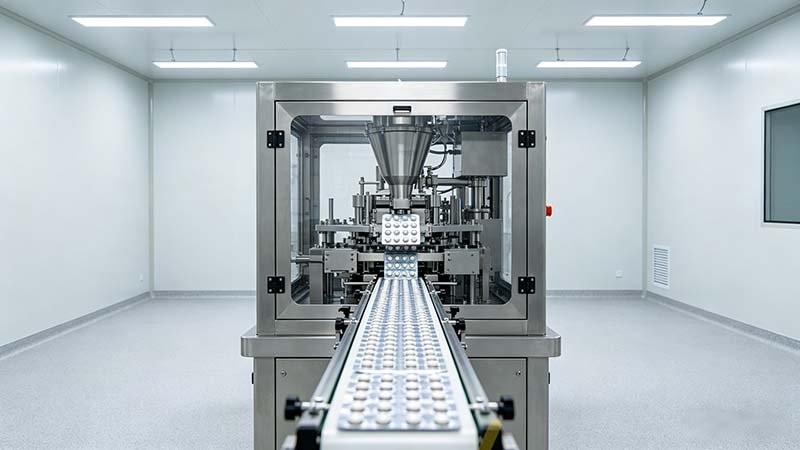
A tablet blister packing machine and a capsule blister packing machine share the same forming-filling-sealing core, but differ in three places that actually matter on the production floor: pocket geometry, feeding mechanism, and reject logic. Get those three wrong and you will face deformed cavities, missed fills, and failed seal integrity tests — none of which show up in a supplier brochure.
This guide breaks down every critical difference, explains when a dual-purpose line makes economic sense, and tells you exactly what to specify in your URS before you issue a single RFQ. If you need the broader selection framework, start with our guide on how to choose a tablet blister packing machine.

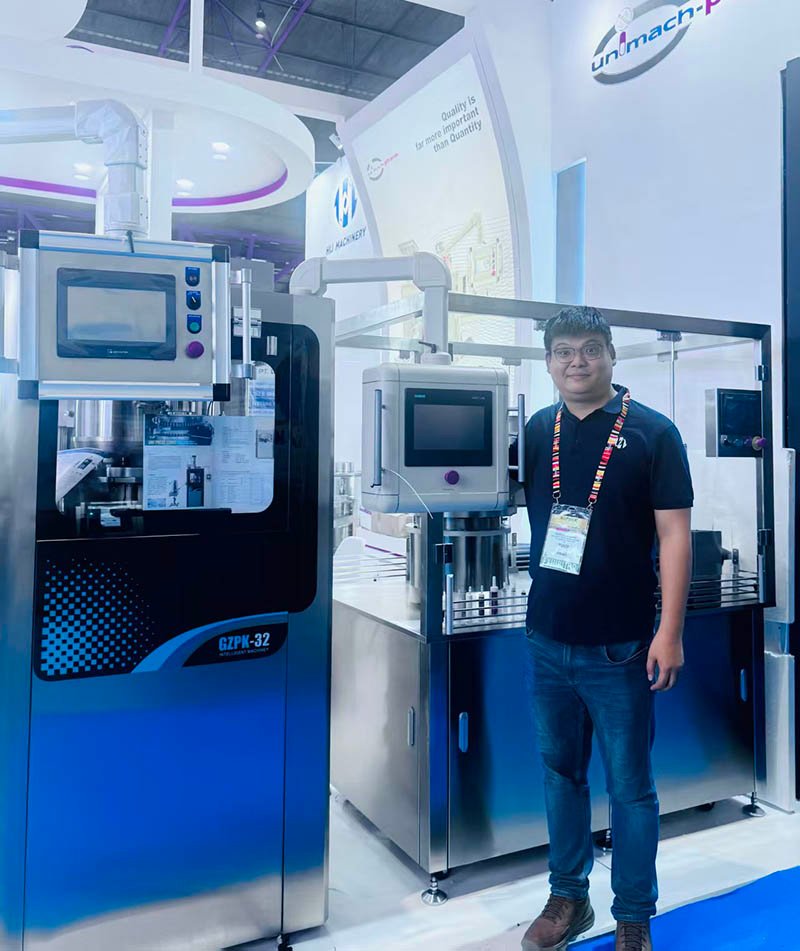
Figure 1: Tablet blister (flat circular pocket, left) vs. capsule blister (elongated oval pocket, right) — the geometry difference that drives every downstream decision.
What Tablet and Capsule Blister Packing Machines Have in Common
Both machine types run the identical five-station sequence: film unwind → forming station → filling station → sealing station → punching and discharge. The PLC control architecture, servo motor topology, heat-sealing principle, and aluminum lidding foil handling are functionally the same. A tablet blister packing machine and its capsule counterpart can even share the same machine frame in a dual-format configuration — provided the tooling and feeder have been validated for both products.
That shared architecture is precisely why so many procurement teams assume they are buying the same machine with a different label. They are not. The forming station die, the filling mechanism, and the reject detection logic are engineered around product-specific physical properties — and those properties are fundamentally different between a compressed tablet and a two-piece hard gelatin capsule.
“The forming-filling-sealing sequence is identical across tablet and capsule lines. The critical differences — pocket depth tolerance, feeder orientation channel width, and camera-based reject sensitivity — are what determine whether you get 98.5% efficiency or 84% efficiency on the first week of production.”
— Forester Xiang, Founder, HIJ Machinery
How Does Pocket Geometry Differ Between Tablet and Capsule Blister Machines?
Pocket geometry is where the split happens. Completely different. A standard round tablet — say, 10mm diameter, 4mm height — requires a flat-base cylindrical cavity with a nominal forming depth of 5mm to 6mm. The thermoforming temperature for PVC at 250μm runs between 120°C and 140°C at that geometry.
A size-0 hard gelatin capsule is 21.7mm long and 7.65mm in diameter. The cavity must be elongated oval, oriented lengthwise, with a forming depth of 9mm to 11mm depending on capsule lock engagement. At that depth, the PVC draw ratio increases, requiring 145°C to 160°C forming temperature and longer dwell time — or you get thinning at the pocket shoulders that fails the seal integrity test under ASTM F2338 dye-ingress at 60 mbar.
The table below maps forming parameters across common product types. These are the numbers I use when a client asks whether their existing tablet machine can “just run capsules with a mold change.”
| Parameter | Tablet Blister Machine | Capsule Blister Machine | Dual-Format Line |
|---|---|---|---|
| Pocket Shape | Circular / oval flat-base | Elongated oval / cylindrical deep-draw | Interchangeable via validated tooling set |
| Forming Depth (typical) | 4–8 mm | 9–14 mm | 4–14 mm (servo-adjustable dwell) |
| Forming Temperature (PVC) | 120–140 °C | 145–165 °C | 120–165 °C (zone-controlled) |
| Primary Feeder Type | Brush feeder / vibrating plate | Orientation channel / gravity chute | Both, with automated changeover |
| Cavity Orientation | Radially symmetrical (any) | Axially fixed (head/tail defined) | Vision-corrected orientation system |
| Reject Detection Logic | Missing tablet / broken tablet | Missing / inverted / cross-loaded capsule | Dual-mode camera + reject pusher |
| Tooling Changeover Cost | Base mold set: $4,000–$8,000 | Base mold set: $6,000–$12,000 | $8,000–$15,000 incremental per format |
| Typical Line Speed | 100–500 blisters/min | 80–350 blisters/min | 80–400 blisters/min |
| GMP Validation Scope | IQ / OQ / PQ per product | IQ / OQ / PQ per product + capsule orientation PQ | Full re-validation per format change |
| WHO GMP / FDA 21 CFR Ready | Yes | Yes | Yes, with format-specific documentation |
Table 1: Tablet vs capsule blister packing machine — technical comparison across 10 critical parameters. Data based on HIJ production line projects 2018–2025.
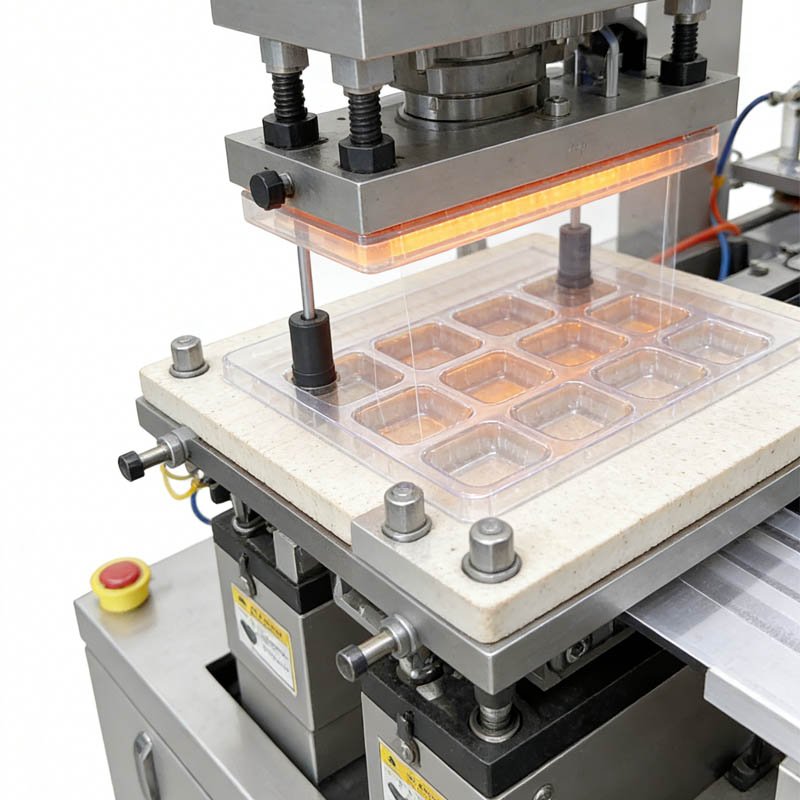
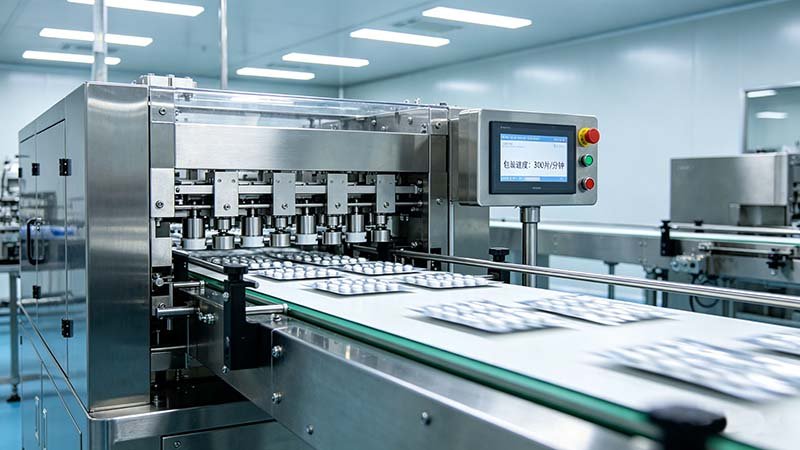
Figure 2: Forming station showing thermoform pocket geometry — depth and draw ratio are the first variables to lock down when specifying a capsule blister line.
Why the Feeding Mechanism Is the Highest-Risk Component in a Capsule Blister Line
A QD in São Paulo called me last year. Her line was running size-1 capsules at 180 blisters per minute. The machine had originally been specified for 10mm round tablets. Nobody had documented the feeder validation gap in the URS. The brush feeder — perfectly adequate for tablets — was breaking capsule joints at a rate of 0.3% per batch. On a 200,000-unit run, that is 600 damaged capsules reaching the sealing station.
Capsules fail differently from tablets. A compressed tablet that misses a cavity produces a simple empty pocket — detected immediately by standard camera vision at the filling station. An inverted capsule, a cross-loaded capsule, or a capsule with a broken lock ring sitting flush in the pocket will often clear the basic camera check and reach the seal station. The defect only surfaces at the seal integrity test. That is not an early catch. That is a batch rejection event.
The correct feeder architecture for capsules uses an orientation channel — a V-groove or slot guide that aligns capsule bodies axially before they drop into the cavity. Size range matters here. A line validated for size 0 (21.7mm length) will not correctly orient size 2 (15.3mm length) without a channel adjustment. Of the 31 blister line projects I handled in Southeast Asia between 2018 and 2023, 8 required a feeder channel redesign within six months of commissioning because the original spec had listed only the largest capsule size.
● Symptom: Inverted capsules reaching the sealing station (1 or more per 500 cycles)
Cause: Orientation channel width set for largest capsule size only; smaller sizes tumble freely before cavity entry.
Fix: Specify channel width ±0.2mm per capsule diameter for every size in your product matrix. Document in URS before tooling order.
● Symptom: Capsule joint cracking visible at filling station exit (>0.1% per batch)
Cause: Brush feeder contact pressure designed for tablet hardness (>60 N); capsule lock ring shear strength is 8–15 N depending on size and shell supplier.
Fix: Replace brush feeder with gravity-orientation channel + soft-contact vibration plate. Validate at 70%, 85%, 100% rated speed. This is the number one feeder specification error I see on dual-format RFQs.
● Symptom: Empty pockets detected at filling station camera but capsules confirmed loaded in hopper
Cause: Camera FOV calibrated for tablet diameter; capsule length exceeds FOV boundary at edges of the forming web.
Fix: Recalibrate camera zone boundaries per capsule body length, not diameter. Request format-specific camera qualification report from supplier before SAT.
Reject Logic Differences: Why the Same Camera System Does Not Work for Both Products
The reject logic architecture is the third difference — and the one most frequently underspecified. Standard tablet blister machines run a binary detection model: cavity full or empty, tablet intact or broken. Two camera zones. Straightforward.
Capsule lines need at least four detection states: present and correctly oriented; present but inverted; present but cross-loaded (lying transversely); absent. A fifth state — cracked cap seated flush — requires near-infrared imaging or mechanical vacuum test integration, not standard visible-light cameras. FDA enforcement records for 2019–2023 show packaging as root cause in 12% of pharmaceutical recalls — the number I use when engineering teams tell me the camera upgrade adds $18,000 to the project and isn’t justified for capsules.
The reject pusher geometry also differs. Tablet reject pushers are designed for compact, rigid objects. Capsule reject pushers must apply force along the capsule body axis without contacting the cap-body joint — otherwise the reject action itself creates damaged product that must be manually segregated. I have seen plants where the reject rate was zero on paper and 0.4% post-rejection damage in the waste bin. Both numbers are real. Neither is the one you want in your batch records.
Capsule blister packing machines require 4-state reject detection (present/oriented correctly, inverted, cross-loaded, absent) versus the 2-state model (present/absent) standard in tablet lines. Using a tablet reject system on a capsule line risks passing inverted capsules as compliant — a GMP non-conformance that will surface at audit, not at the camera station.

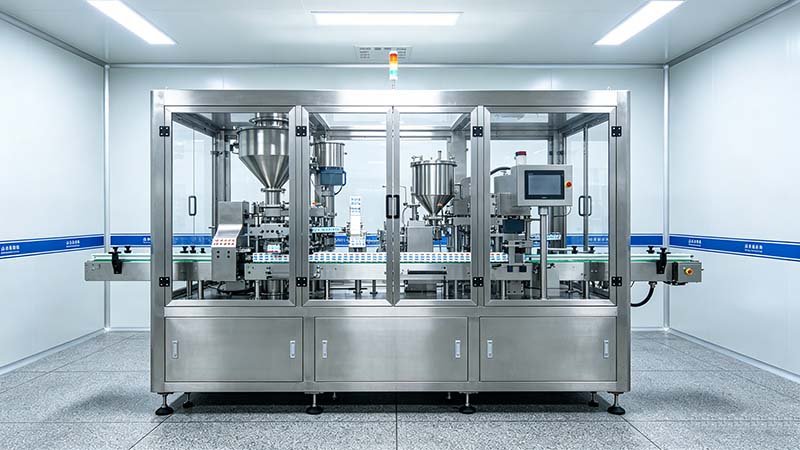
Figure 3: Capsule blister packing machine application — orientation channel feeder (left) and dual-zone camera reject system (right) are mandatory for GMP-compliant capsule packaging.
When “Universal” Blister Machines Create Project Risk Instead of Saving Cost
I’ve commissioned lines in Jakarta, Nairobi, and Monterrey. In every market, at least once per year, a procurement team shows me a quotation for a “tablet & capsule compatible” blister machine that comes in 15% below our proposal. The brochure says flexible tooling. The fine print says tooling sold separately, validated separately, and — most critically — re-qualified separately under IQ/OQ/PQ per EU GMP Annex 15 each time the format changes.
The hidden trap is not the tooling purchase price. It’s the validation timeline. A format change on a dual-purpose line requires a minimum IQ and OQ re-run — typically 3 to 6 weeks in a regulated market — every time you switch from tablets to capsules or vice versa. If your production schedule has both products running in alternating batches, that timeline competes directly with your delivery commitments. I’ve seen plants where the “flexible” machine ran one format for 11 months because no one had budgeted the re-validation window for the second format.
The strategic advice: before issuing your URS, define your exact product matrix — tablet diameter tolerance (±0.1mm is the realistic minimum for tooling spec), capsule size range (size 00 to size 5, or a narrower subset), and whether cGMP leak-test documentation under USP <1207> is mandatory for your target market. At HIJ, our turnkey capsule blister packing machine proposals always include format-specific tooling validation documentation and a unified PLC protocol — so you never face a multi-vendor blame game at SAT.
I won’t tell you the dual-format decision is simple. It involves your API profile, your production scheduling reality, your validation timeline, and sometimes your relationship with the regulatory reviewer who will audit the changeover SOP. That conversation took 40 minutes with a QD in Pune last March. I’m still not sure I convinced them — but they left with the right questions to ask their supplier.
Can One Blister Machine Handle Both Tablets and Capsules? The Honest Answer
Yes — under specific conditions. A dual-format blister line makes economic sense when: your annual production volume for each format exceeds 20 million units (below that, dedicated lines are often cheaper when validation cost is factored in); your product matrix is stable (three formats or fewer, with changeover occurring fewer than six times per year); and your regulatory framework permits format-change documentation without full re-validation (some WHO GMP markets accept change-control records in lieu of full OQ repeat).
It does not make sense when you have a hygroscopic capsule fill that requires Alu-Alu cold-form packaging running on the same line as a standard PVC tablet pack. The forming station parameters are incompatible without a complete tooling and temperature profile change — effectively a full format changeover that negates the flexibility argument entirely.
- Volume threshold met: Both tablet and capsule annual volumes exceed 20 million units before dual-format investment is justified on cost alone.
- Capsule size range defined: Full size range (00–5) specified in URS; orientation channel and reject camera calibrated for the smallest size in the matrix, not the most common.
- Forming material compatibility confirmed: If any capsule product requires Alu-Alu cold forming, that format needs a separate machine — not a dual-purpose PVC/Alu-Alu line.
- Validation window budgeted: 3–6 weeks per format change for IQ/OQ per EU GMP Annex 15 is included in the production schedule before line commissioning.
- Reject detection specified per format: 4-state capsule detection and 2-state tablet detection documented as separate camera qualification reports in the DQ package.
- Tooling cost budgeted separately: $8,000–$15,000 per additional format tooling set included in capital budget, not assumed to be bundled in machine price.
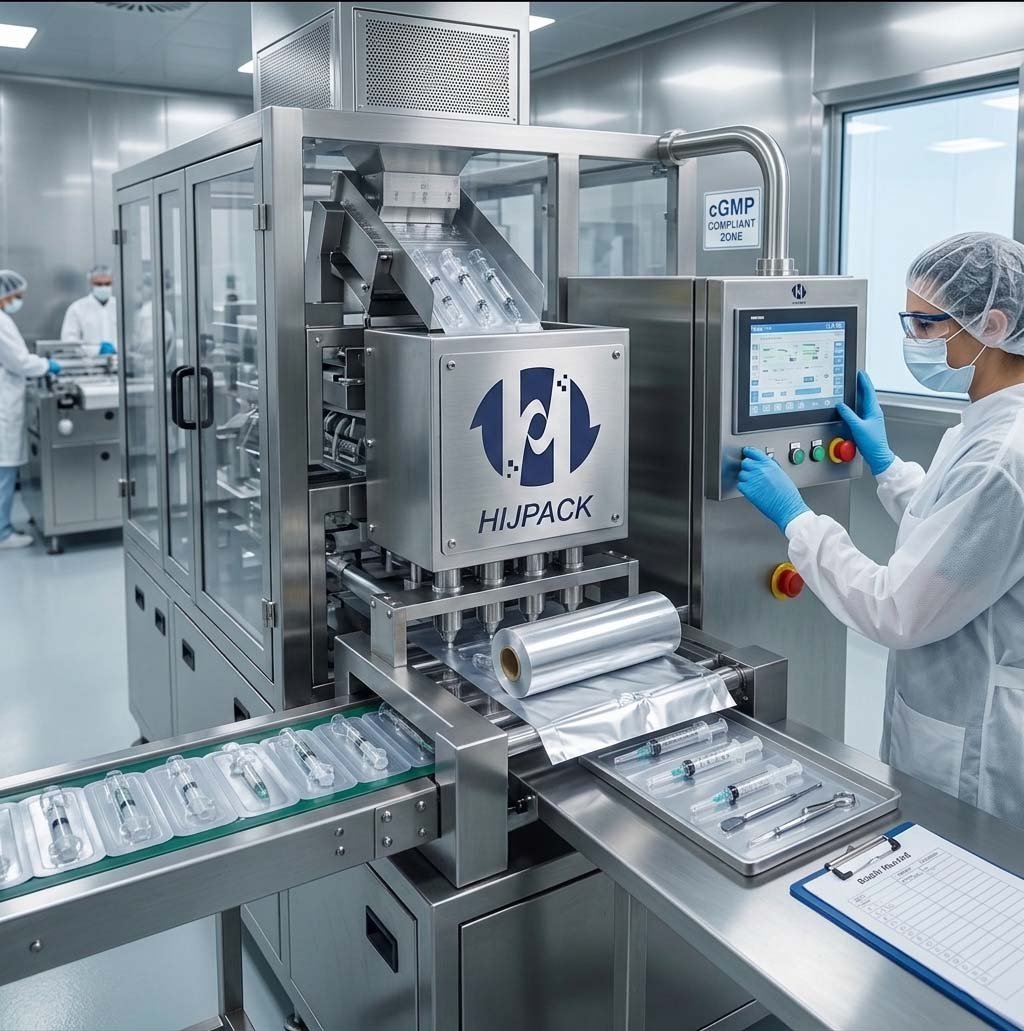
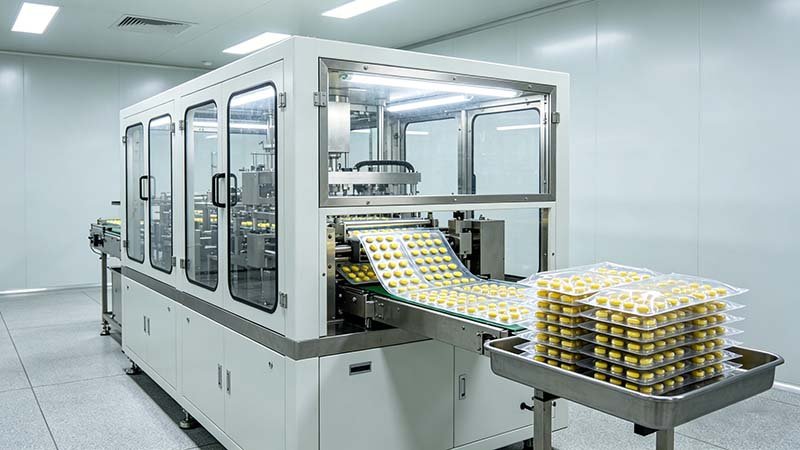
Figure 4: A dual-format blister line at commissioning — tablet tooling installed, capsule orientation channel visible in holding position. Validated for both formats with separate IQ/OQ documentation packages.
How to Specify the Right Blister Machine for Your Tablet or Capsule Product Matrix
The procurement director at a plant outside Bangalore showed me their RFQ template two years ago. It listed “blister speed: 200 per minute” and “product: tablets and capsules.” That was it. No tablet diameter range. No capsule size range. No forming depth specification. No reject detection mode. Four suppliers quoted four completely different machines, all technically compliant with the RFQ. The spread was $340,000. Every single quote was useless for an apples-to-apples comparison.
The minimum URS parameters for a tablet blister machine: tablet diameter (mm, ±tolerance), tablet height (mm), tablet hardness (N, for brush feeder sizing), target speed (blisters per minute at nominal), forming material (PVC, PVDC, Alu-Alu), and market regulatory standard (FDA, WHO GMP, EU). That is the floor. Not the ceiling. If you want a proper selection guide with decision trees and specification templates, the full framework is in our tablet blister machine selection guide.
For capsule additions, layer these on top: capsule size range (list every size, not just the primary), capsule shell supplier and shell hardness specification (HPMC vs gelatin behave differently at forming temperatures above 150°C), orientation sensitivity (does your capsule require head-down or head-up presentation for tamper-evidence printing on the lid?), and whether cGMP leak-test documentation per USP <1207> must be generated per batch or per campaign. Those four variables alone will filter out 60% of the market’s budget-tier suppliers.
One more thing. The flat die vs roller die forming decision — which affects both tablet and capsule lines differently — is covered separately in our flat die vs roller die comparison for tablet blister machines. Read that before finalizing your forming station specification.
● Symptom: FAT rejected because capsule orientation channel not tested during factory acceptance (supplier claims it was “standard”)
Cause: URS listed “capsule compatible” without specifying orientation validation requirement. Supplier treated it as a hardware feature, not a validated function.
Fix: Add to URS: “Orientation channel shall be validated at FAT using production-grade capsules across the full specified size range (size [X] to size [Y]) at 70%, 85%, and 100% rated speed. Acceptance criterion: zero inverted capsules in 1,000-cycle test.”
● Symptom: Seal integrity failures detected at third-party testing lab 6 weeks after SAT sign-off, traced to capsule pocket shoulder thinning
Cause: Forming temperature for capsule pocket depth validated at FAT with standard PVC 250μm, but production shifted to PVDC 250μm after SAT. PVDC requires 10–15°C higher forming temperature at the same depth. Nobody re-qualified the temperature profile.
Fix: This is a change-control failure, not a machine failure — but the machine spec should have documented material-specific temperature profiles for every film type in the approved material list. Retroactive IQOQ for temperature profile: 2 weeks minimum. Request this documentation pre-SAT.
Frequently Asked Questions: Tablet vs Capsule Blister Packing Machine
What is the main difference between a tablet blister packing machine and a capsule blister packing machine?
The three critical differences are pocket geometry (circular flat-base for tablets vs elongated oval deep-draw for capsules), feeding mechanism (brush/vibration feeder for tablets vs orientation channel feeder for capsules), and reject detection logic (2-state for tablets vs 4-state for capsules including inverted and cross-loaded detection). The forming-filling-sealing core architecture is identical across both types.
Can I run capsules on a tablet blister machine by changing the mold only?
Not safely — and not in a GMP-regulated environment. A mold change addresses pocket geometry but does not resolve the feeder orientation gap (a tablet brush feeder will crack capsule joints at measurable rates), the forming temperature profile gap (capsule depths require higher temperatures and longer dwell), or the reject logic gap (a 2-state camera system will pass inverted capsules). All three subsystems require engineering changes and re-validation, not just a tooling swap.
How much does it cost to add capsule capability to an existing tablet blister line?
Budget $8,000–$15,000 for the format-specific tooling set (cavity mold, feeder channel, and reject pusher geometry). Add $5,000–$12,000 for camera system reconfiguration or upgrade to 4-state detection if your existing system is 2-state. Validation (IQ/OQ/PQ per format) runs $15,000–$40,000 depending on market regulatory standard and whether your QA team manages it internally or uses a third-party CRO. Total realistic incremental cost: $28,000–$67,000 before validation labor.
Does capsule size (00 to 5) affect the blister machine specification significantly?
Yes. Each capsule size requires a distinct pocket dimension, orientation channel width, and camera FOV calibration. A line validated for size 0 will not correctly orient size 2 without a channel adjustment. Specify every size in your product matrix in the URS — not just the primary size — and require FAT validation across the full range.
Is HPMC capsule shell compatible with the same blister forming parameters as gelatin?
No. HPMC (hydroxypropyl methylcellulose) shells have a higher glass transition temperature than standard gelatin and are more brittle at low relative humidity. At forming temperatures above 155°C with extended dwell — common in deep-draw capsule pockets — HPMC shells show micro-cracking that standard visible-light cameras miss. If your product matrix includes HPMC capsules, specify near-infrared inspection or mandatory mechanical leak test per USP <1207> at the filling station exit.
What WHO GMP or FDA documentation is required for a dual-format tablet and capsule blister line?
Each format requires its own IQ/OQ/PQ documentation package under EU GMP Annex 15 and WHO TRS 992 Annex 3. For FDA-regulated markets, 21 CFR Part 211 requires that packaging operations be validated for each dosage form. A single combined validation covering both tablets and capsules is not accepted. Format changeover must be covered by a written change-control SOP, and if electronic batch records are used, 21 CFR Part 11 audit trail requirements apply to all parameter changes logged during changeover.
How do I write a URS for a blister machine that needs to handle both tablets and capsules?
List every product individually with its physical parameters: tablet diameter/height/hardness and capsule size/shell material/orientation sensitivity. Specify the rejection detection mode per product (not per machine). Define the changeover time target and the validation requirement per change. Include a clause requiring that all tooling sets be validated at FAT before shipment. Our detailed guide to URS writing for blister machines covers this in full — see our article on how to write a URS for a tablet blister packing machine.
Tell us your product matrix — tablet dimensions, capsule size range, target market — and our engineering team will return a format-specific proposal with validated tooling, IQ/OQ scope, and a clear timeline. No generic quotes.