LINE SELECTION · FORMAT MIX · CHANGEOVER PLANNING
Tablet blister machine speed requirements depend on every pack you must produce within the available schedule. Compare the time needed for each SKU, changeovers and the downstream carton recipe before selecting a machine or a connected line.
Convert each SKU’s tablet demand into accepted blister cards. Divide each card demand by its supported accepted rate, add the run times and separately excluded changeovers, then compare the total with your production window. Check the cartoner in cartons/min using that SKU’s cards/carton.
For buyers planning several tablet formats on one line. Every numerical scenario below is hypothetical, not a HIJ trial result or machine guarantee.
Build the requirement for each SKU, not an average tablet
Two products with the same tablet demand can require different card counts, cutting layouts, feeding arrangements and changeover work. A single average cards/min value can hide the product that consumes most of the schedule.
| Input | Define for each SKU | Why it changes the decision |
|---|---|---|
| Accepted demand | Tablets or finished cards in the same planning period. | Separates customer demand from nominal equipment output. |
| Market pack | Tablets/card, card drawing and cards/carton. | Sets card and carton quantities; pockets are not finished cards. |
| Product and materials | Tablet dimensions, handling characteristics, forming and lidding specifications. | Establishes the conditions that a rate must support. |
| Layout and rate | Finished cards/cycle and a format-specific rate with evidence. | Avoids transferring one format’s trial result to another. |
| Time and losses | Schedule, changeover boundaries and documented operating factors. | Prevents excluded time or rejects from being counted twice. |
| Connected scope | Transfer, inspection, printing, cartoning and any further required operations. | Sets the final accepted-output boundary and test responsibility. |
Convert tablet demand into cards using the approved tablets/card. Convert cards into cartons separately. If packing losses require additional tablet supply, record that material allowance explicitly; it does not change the required number of accepted market packs.
The pill blister speed and output guide explains cycles, card layouts and operating factors in more detail. This article focuses on whether the combination of formats fits the schedule.
Engineering insight: two adequate rates can still miss the schedule
Consider one hypothetical production day with 840 minutes available after breaks and other excluded periods. Reserve 120 minutes for the day’s planned start-up/changeover work and another 60 minutes as an explicit contingency. That leaves 660 minutes for the SKU run blocks.
Within each run block, the planning factor covers local blister stops, rate losses and rejects up to the accepted-card transfer point. It excludes the 120-minute work allowance and 60-minute reserve already taken out. Factors and nominal rates are assumptions requiring format-specific evidence.
| SKU | Accepted demand and pack | Proposed rate and factor | Required run time |
|---|---|---|---|
| A | 600,000 tablets ÷ 10 tablets/card = 60,000 accepted cards | 200 nominal cards/min × 0.80 = 160 accepted cards/min | 60,000 ÷ 160 = 375 min |
| B | 240,000 tablets ÷ 6 tablets/card = 40,000 accepted cards | 160 nominal cards/min × 0.75 = 120 accepted cards/min | 40,000 ÷ 120 ≈ 333.33 min |
Required blister run time = 375 + 333.33 ≈ 708.33 min.
Total with separately excluded work and reserve = 708.33 + 120 + 60 ≈ 888.33 min.
Available window = 840 min. The planning shortfall is ≈48.33 min.
Each SKU can appear feasible when compared with the full day on its own. Together they do not fit this plan. The quantities also represent different carton recipes, which must be checked before declaring the whole line feasible.
Use full-precision calculations internally and round only for presentation. This example assumes sufficient tablet and material supply, an achievable sequence and no other shared resource constraint. A real schedule also needs release timing, cleaning rules, staffing and downstream evidence.
Compare schedule changes and proven rates on the same basis
The shortfall does not automatically justify buying the fastest model. Examine which constraint can be changed and what evidence is needed. Keep the accepted demand, time exclusions and factor definition consistent when comparing alternatives.
| Alternative | Calculation | Planning result and condition |
|---|---|---|
| Prove 10% higher nominal rates for both SKUs | 375 ÷ 1.10 + 333.333333 ÷ 1.10 ≈ 643.94 run min | 643.94 + 120 + 60 ≈ 823.94 min; about 16.06 min spare. Assumes unchanged factors and tested quality at the higher rates. |
| Reduce separately excluded work from 120 to 60 min | 708.33 + 60 + 60 ≈ 828.33 min | About 11.67 min spare. This requires a demonstrated complete changeover method, not a tooling-swap claim alone. |
| Remove the 60-minute contingency | 708.33 + 120 ≈ 828.33 min | Numerically fits, but removes the chosen reserve. It does not improve equipment capability or resolve uncertainty. |
| Allocate additional time or split capacity | Retain the same per-SKU time calculation for the revised plan. | Check operators, material supply, cleaning, releases and connected capacity for the new arrangement. |
These are separate scenarios, not recommendations or promises. A higher nominal rate may reduce the factor if feeding or quality becomes unstable. A shorter changeover claim must include the agreed starting condition, tooling, material threading, recipe checks, cleaning and first acceptable output.
Do not count a changeover benefit both as fewer excluded minutes and as an improvement in a factor that already excludes changeovers. Keep demand growth and contingency as explicit scenarios, rather than hiding them in a universal “20% buffer.”
Check the carton recipe before declaring line capacity
The same accepted-card supply produces different carton rates when the count recipe changes. A cartoner specification in cartons/min cannot be compared directly with blister cards/min.
The first schedule ends at accepted blister cards at the transfer point. For this connected check, treat 60,000 and 40,000 as card-equivalents required in accepted cartons: 20,000 cartons of each SKU. This changes the acceptance boundary. Plan any additional card supply for downstream rejects separately.
In this hypothetical check, the cartoner offers 50 nominal cartons/min for each pack. A separately defined downstream factor of 0.90 gives 45 accepted cartons/min within its run block. Assume those losses are downstream of the blister transfer point and are not already included in the blister-stage factors.
| SKU | Carton recipe and requirement | Downstream card-equivalent capacity | Indicative constraint |
|---|---|---|---|
| A | 3 cards/carton. 160 cards/min ÷ 3 ≈ 53.33 accepted cartons/min needed to match blister output. | 45 accepted cartons/min × 3 = 135 cards/min. | Below the assumed 160-card blister rate. 60,000 ÷ 135 ≈ 444.44 min at this ceiling. |
| B | 2 cards/carton. 120 cards/min ÷ 2 = 60 accepted cartons/min needed to match blister output. | 45 accepted cartons/min × 2 = 90 cards/min. | Below the assumed 120-card blister rate. 40,000 ÷ 90 ≈ 444.44 min at this ceiling. |
Under this simplified connected-flow check, the two run blocks need at least approximately 888.89 minutes at those final-output ceilings. Adding the same 120-minute excluded work and 60-minute reserve gives approximately 1,068.89 minutes. Improving blister speed alone cannot make that 840-minute plan fit.
To match the original blister-stage assumptions with the same downstream factor, the nominal cartoner requirement would be about 59.26 cartons/min for A and 66.67 cartons/min for B. Those are calculated requirements, not proof that a quoted cartoner can sustain either pack.
The card-equivalent comparison is a first constraint check. Actual connected losses, finite buffers, stop/restart timing and accumulation need an integrated trial. Do not multiply or combine independently quoted factors into a guaranteed line result. If cards are staged and cartoned later, build a separate schedule for both resources, storage and transfer; the simultaneous-flow check no longer describes the entire plan.
Use the horizontal cartoning configuration page to discuss count grouping and transfer, then define connected acceptance using the cartoning FAT checklist.
Use the actual tablet and material to support each speed

A tablet’s geometry, orientation, coating and handling needs can affect feeding and inspection. Forming and lidding materials, pocket depth, registration, sealing and cutting also belong to the format definition. This guide assigns no universal maximum speed to a tablet shape or material.
For each proposed configuration, request representative product and material trials with the approved card layout. Record offered functions, feeder/tooling, settings, nominal cycles, finished cards/cycle, timing, accepted counts, rejects and stops. Demonstrate required print/inspection/rejection functions under the same operating conditions.
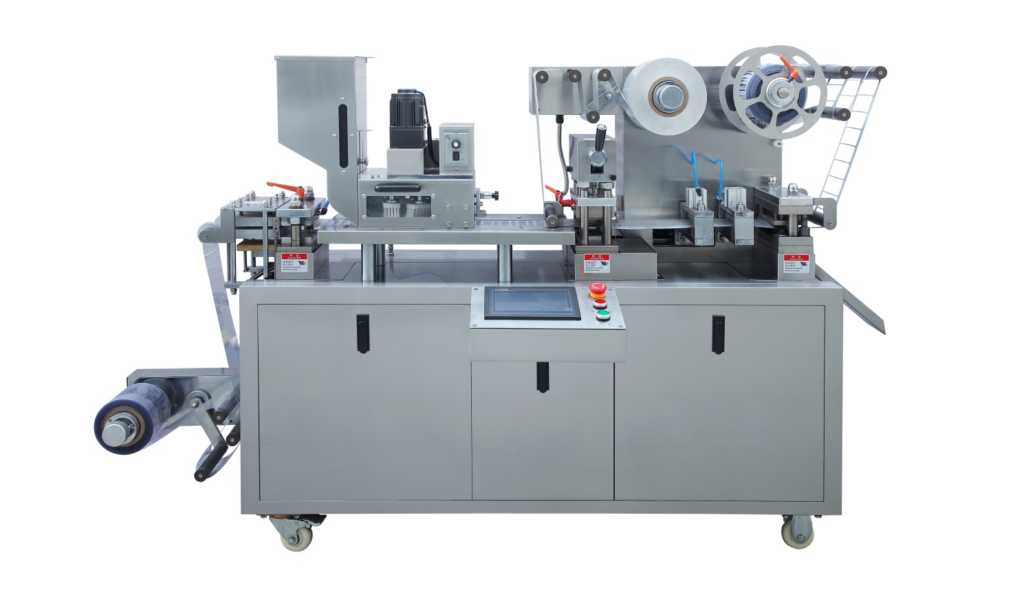
Review the DPP-260 configuration page or the HIJ blister machine range against the requirement. The model designation is not a cycles/min rating. Do not select from a nameplate number or transfer another product’s demonstration rate to your pack.
Agree the output clock and count boundary before testing. A complete changeover test should end at an agreed acceptable production condition. A burst at maximum speed or a tool exchange with no cleaning and start-up scope does not establish the full daily plan.
Put a per-format capacity requirement in the RFQ
Describe what the line must deliver and what the supplier must demonstrate. The purchaser’s quality team should define product acceptance and any qualification or record requirements for the actual application; a speed table alone is not a regulatory approval or validation package.
| Requirement | Useful wording or evidence |
|---|---|
| Demand and sequence | List each SKU, accepted quantity, due period, production order and planned growth scenario. |
| Time boundaries | State the available schedule, exclusions, complete changeover definition and separate reserve. |
| Format-specific output | Require proposed nominal rate, layout, factor basis and accepted-output trial for every initial pack. |
| Final accepted unit | Define whether the commitment ends at good blister cards, accepted cartons or a later line boundary. |
| Connected functions | Identify count recipe, leaflets, printing, inspection, reject handling, buffers and hold/restart signals. |
| Responsibility and evidence | List trial materials, test duration, passing criteria, records, integration owner and remaining site tests. |
For detailed tests, use the blister FAT checklist. The supplier evaluation guide helps compare evidence; the price and quote-scope guide helps check which tooling, trials and integration items are included.
Send the information you have
Share a SKU list, tablet dimensions and handling needs, blister/carton drawings, material specifications, accepted demand, shift plan and connected-equipment details. Mark unconfirmed inputs so the review can identify the open decisions.
HIJ can review the proposed equipment scope and the trial questions with your team. A format-specific output commitment requires an agreed configuration and supporting evidence.
Tablet blister machine speed requirement questions
What speed do I need when one line runs several tablet SKUs?
Calculate each SKU’s accepted-card demand and supported rate, then sum the required run minutes. Add separately excluded work and reserve. Compare that total with the available schedule and verify the downstream recipe for each pack.
Can I use one average blister rate for all formats?
Only if a justified model represents the actual product mix and its conditions. A per-format calculation is easier to review and can expose a slow, high-volume SKU that an average hides. Different tablet counts per card also change the demand conversion.
Is a 20% speed buffer enough?
There is no universal buffer in this guide. Define demand growth, reserve time and documented loss assumptions separately. Demonstrate the proposed rate on the actual format and avoid counting an excluded changeover twice.
Should I prioritize faster cycles or shorter changeovers?
Compare the minutes each option recovers in the same schedule. A speed increase must preserve acceptable packs and supported factors; a changeover reduction must cover the complete agreed sequence. Check the downstream constraint before buying more upstream speed.
How do cards per carton affect the cartoner requirement?
Divide the accepted-card supply by cards/carton to obtain the required carton rate before downstream losses. Specify the complete carton contents. For the same card supply, a two-card carton requires more cartons/min than a three-card carton.
Can a buffer solve a permanently undersized cartoner?
A finite buffer can accommodate certain temporary differences, but sustained upstream production above downstream consumption fills it. Define accumulation, hold and recovery behavior. A later separate cartoning campaign needs its own resource and storage plan.
Does changing tablet shape require a new speed review?
Review the changed product, feeding, pack drawing and material conditions with the supplier. Do not assume another tablet’s demonstrated speed transfers. The purchaser should assess the applicable trial and qualification needs for the change.
What should I send HIJ before requesting a line quotation?
Send initial SKU quantities, tablet/card/carton drawings, material specifications, schedule, complete changeover needs, inspection tasks and existing equipment interfaces. Representative samples and a clear accepted-output boundary make the capacity review more useful.
Technical basis and calculation limits
Prepared by HIJ Machinery as a capacity planning guide. All demand, rate, factor, changeover, contingency and cartoner values in the examples are illustrative assumptions. Arithmetic can establish a planning requirement; it cannot establish machine capability, regulatory compliance or production performance.
Use the offered model documents, approved pack drawings and representative trial records for the project. Actual production scheduling and connected acceptance remain subject to the purchaser’s product, materials, quality criteria and operating conditions.