📌 Foundational Guide — S1
What Is a Tablet Blister Packing Machine?
A tablet blister packing machine is a forming‑filling‑sealing system that thermoforms cavities in PVC, PVDC, or Alu‑Alu film, precisely seats each tablet, then heat‑seals aluminum lidding foil — delivering tamper‑evident, moisture‑controlled unit‑dose packs compliant with WHO GMP and cGMP standards. This guide covers every stage of the process, the four machine stations you need to understand before buying, and the real‑world traps I’ve watched buyers fall into over 20 years of commissioning pharma lines across Asia, Latin America, and the Middle East.
✅ Direct Answer
A tablet blister packing machine thermoforms individual cavities in pharmaceutical-grade film at 120–180°C, fills each cavity with a single tablet via gravity or brush-type feeder, then heat-seals an aluminum lidding foil at 150–220°C and 200–400 N/cm² — producing tamper-evident, unit-dose blister packs at speeds of 40–500+ blisters per minute, depending on format and automation level.
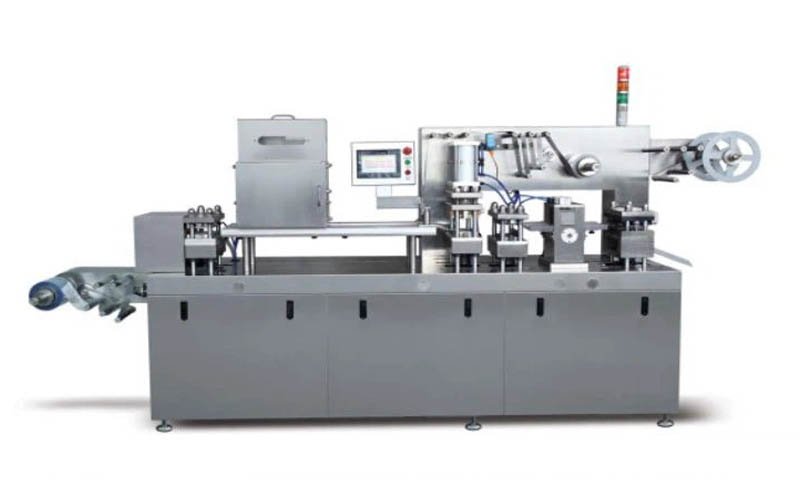
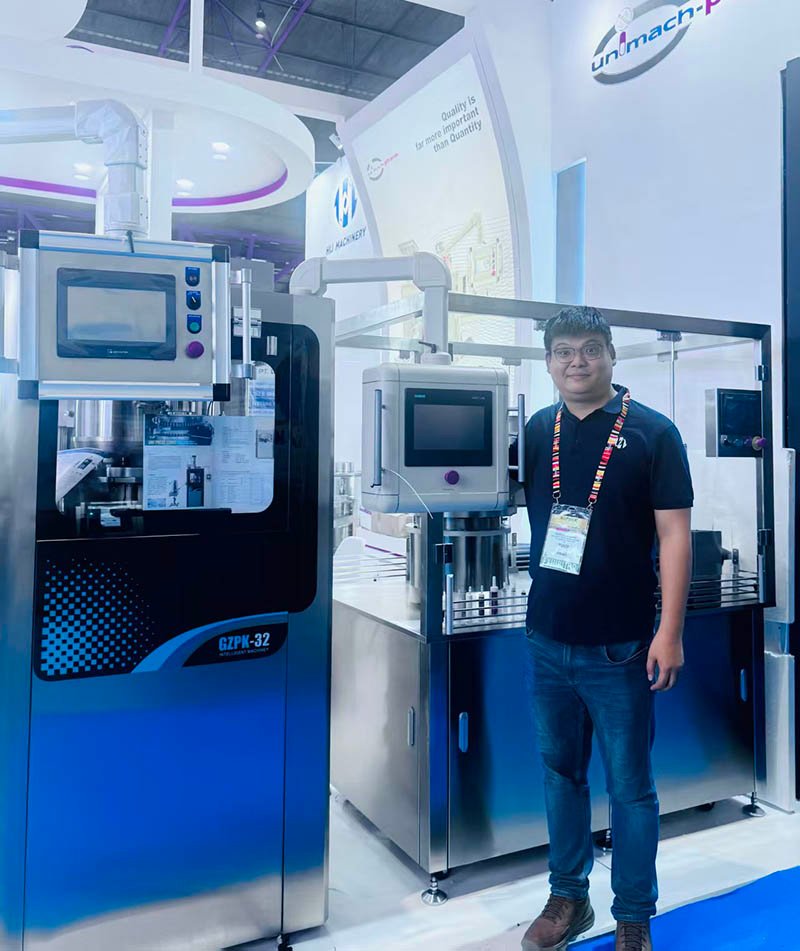
HIJ HU-DPP260 tablet blister packing machine — thermoforming, filling, and heat-sealing in a single automated line.
What Does a Tablet Blister Packing Machine Actually Do? The Four-Station Breakdown
A tablet blister packing machine executes four sequential operations — forming, filling, sealing, and cutting — in a single continuous pass, producing individual unit-dose packs that meet pharmaceutical tamper-evidence and moisture-barrier requirements. Each station has its own tolerance window; failure at any one of them propagates defects through the entire run.
Most buyers I talk to understand the concept. The detail that catches them is how precisely those four stations must be synchronized. I’ve watched lines where forming temperature was 3°C below spec and nobody noticed until leak-test data from SAT came back with an 8% failure rate — 6,000 rejected blisters on the first production run. Not a catastrophic number. Enough to cost the project two weeks and a serious conversation with the QA director.
Station 1 — Forming: Thermoforming Cavities in Pharmaceutical Film
The forming station heats the base film — typically PVC (200–300 μm), PVDC laminate, or Alu‑Alu cold-form foil — and presses it into a mold to create the individual cavities that will hold each tablet. For thermoforming (PVC/PVDC), film temperature runs at 120–180°C. Cold forming (Alu‑Alu) uses mechanical pressure only, no heat, which is why it delivers superior moisture barrier performance — down to 0.02–0.5 g/m²/day MVTR versus 4–6 g/m²/day for standard PVC.
Cavity depth, wall thinning, and corner radius are all consequences of forming parameter accuracy. A 5°C drift in heating plate temperature typically causes 0.1–0.3 mm cavity depth variation — enough to seat tablets loosely, which produces rattling packs that fail consumer perception tests even if they pass seal integrity checks.
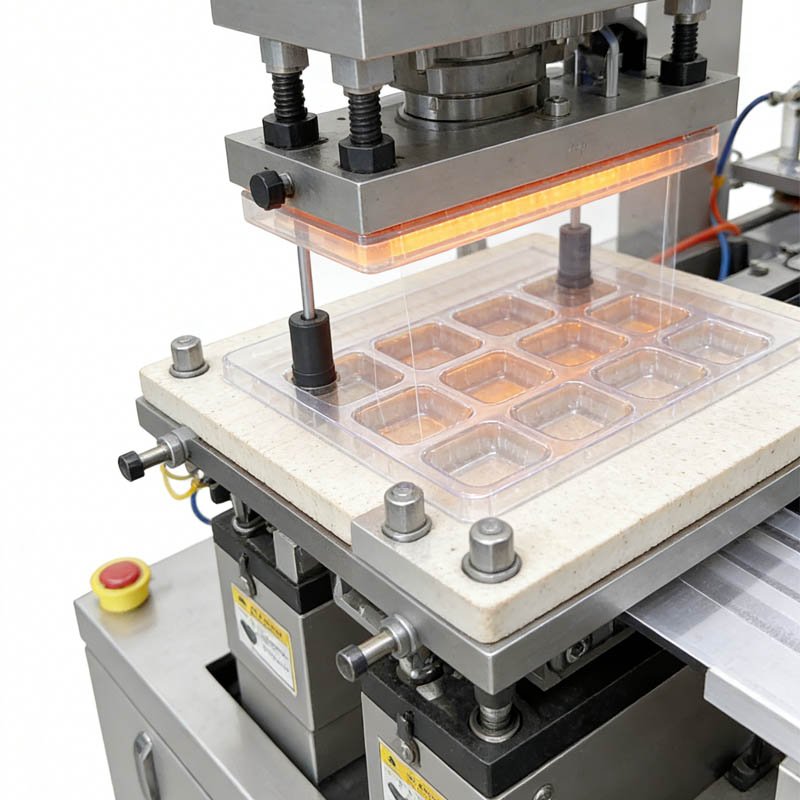
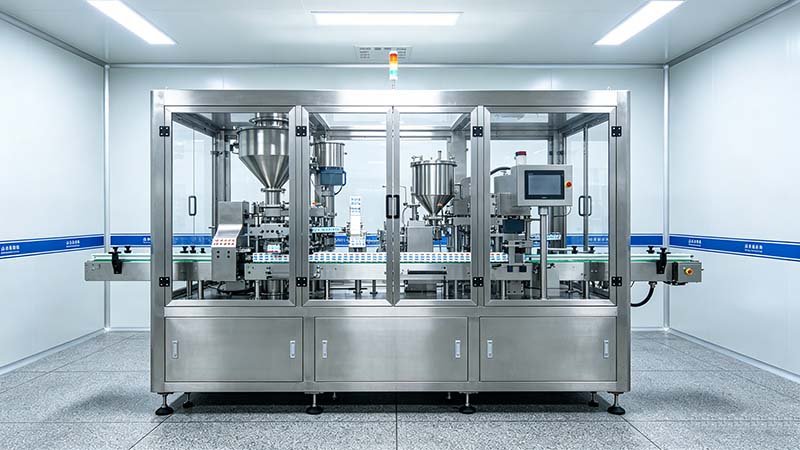
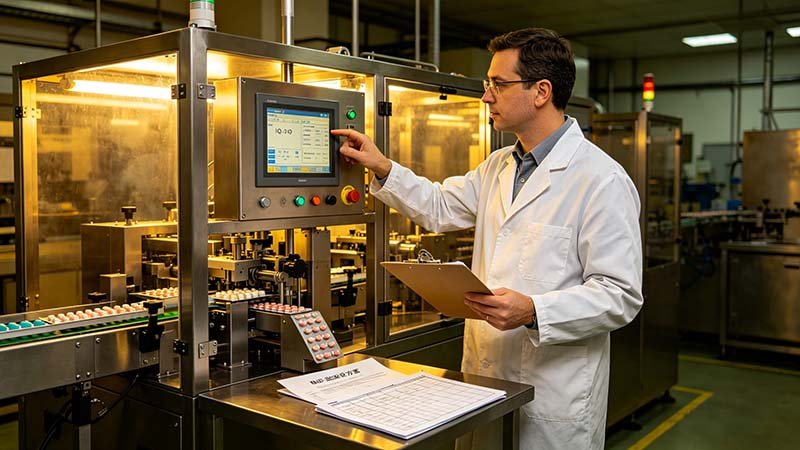
Forming station: PVC/PET film being shaped into tablet cavities under controlled temperature (120–180°C).
Station 2 — Filling: Placing Each Tablet Precisely Into Its Cavity
The filling station feeds tablets from a hopper into the formed cavities. Three mechanism types exist: gravity feed (vibratory), brush-type rotary feeder, and vacuum pick-and-place. Gravity and brush-type systems handle standard round or oval tablets at 40–200 blisters per minute reliably. Oddly shaped tablets — triangle, capsule-shaped, or embossed — often require vacuum placement to avoid chip damage, particularly with coated tablets where edge chips fail visual inspection under 21 CFR Part 211.68.
Filling accuracy matters. Empty cavities sealed with lidding foil reach end consumers. That outcome generates complaints, recall risk, and regulatory attention that no procurement saving justifies. A properly specified detection system — photoelectric or vision-based — rejects incomplete blisters before sealing. I’ve specified this as non-negotiable on every project since 2011.
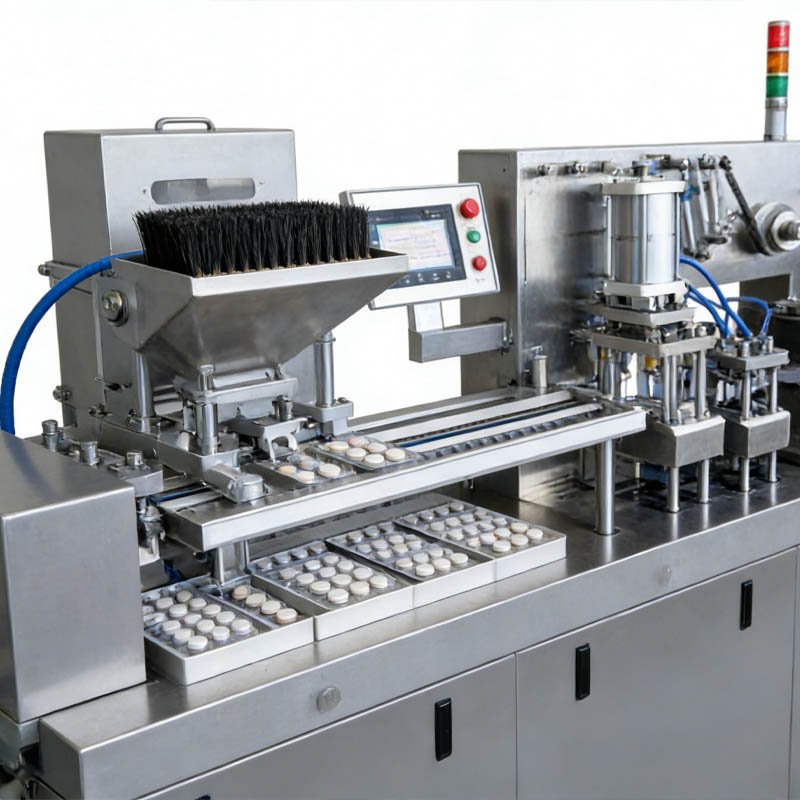
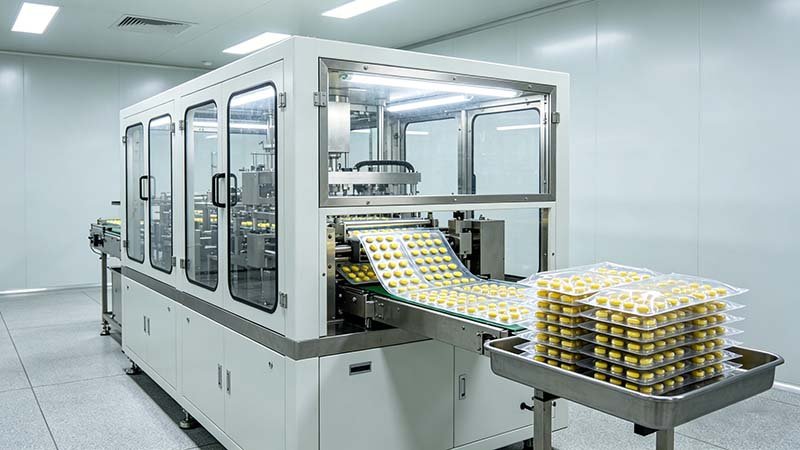
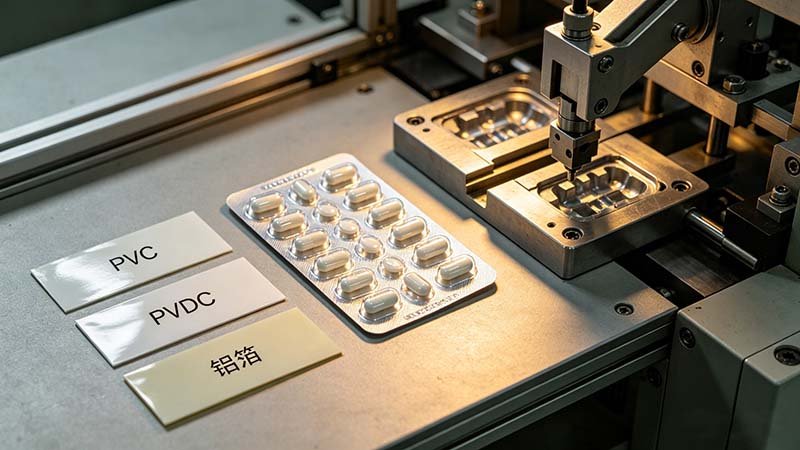
Brush-type feeder station: tablets seated precisely into thermoformed cavities before sealing.
Station 3 — Sealing: Heat-Bonding Aluminum Lidding Foil
The sealing station presses aluminum lidding foil onto the filled base film using a heated die at 150–220°C and 200–400 N/cm². Seal quality determines container closure integrity — the property audited under USP <1207> and ASTM F2338. Uniform temperature across the sealing die face is the technical challenge most frequently underspecified. A ±5°C variation across a 260 mm sealing width produces inconsistent bond strength — strong seals on the center, weak seals on the periphery, which is exactly where dye-ingress failures show up during shelf-life testing.
On a 2022 project in Vietnam, the client’s existing machine had a documented ±9°C sealing die variation. Their stability data from month‑9 showed 3 of 12 samples with detectable moisture uptake at the pack periphery. The solution required replacing the sealing die assembly entirely. That was a $14,000 repair on a machine originally purchased to save $22,000 versus a higher-spec alternative.
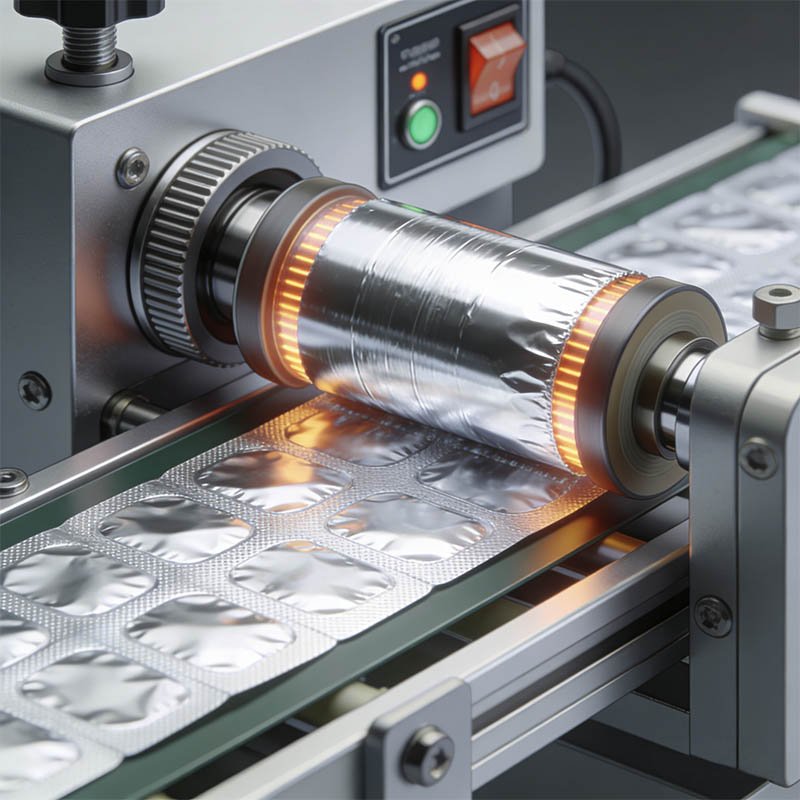
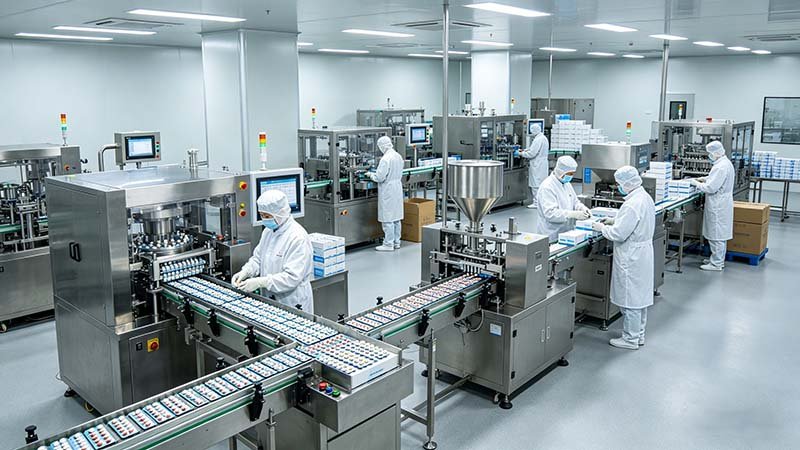
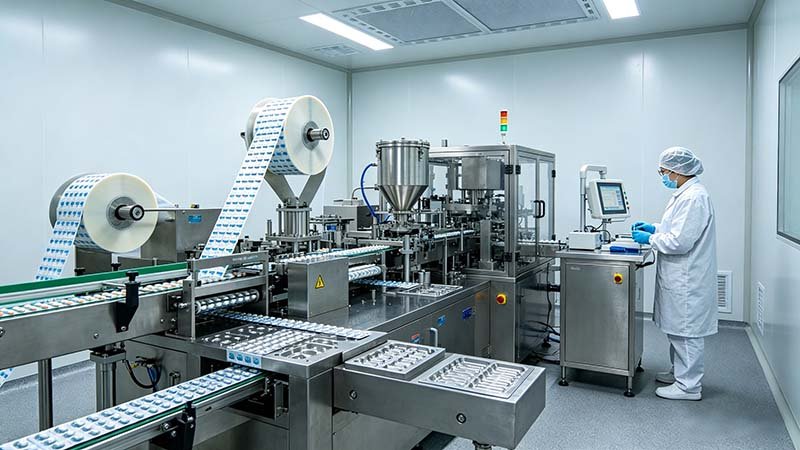
Heat-sealing station: aluminum lidding foil bonded to filled blister base film under controlled temperature and pressure.
Station 4 — Punching & Cutting: Separating Individual Blister Cards
The final station punches or cuts the continuous sealed web into individual blister cards of specified dimensions. Rotary die-cutting handles most high-speed lines above 200 blisters per minute; reciprocating punch tooling is standard on mid-range machines. Cut edge quality affects downstream cartoning performance — rough edges cause card jams in blister-to-carton feeders at a rate that compounds quickly at high volumes.
Batch number and expiry date printing typically occurs immediately before cutting, either via inkjet or embossing. This step is where 21 CFR Part 11 electronic batch record requirements intersect with machine design — specifically whether the printing system logs verified data or simply applies ink without audit trail.
What Types of Tablet Blister Packing Machines Exist? Format and Speed Guide
Three primary machine configurations exist for tablet blister packaging, differentiated by forming mechanism and automation level. The right choice depends on your API moisture sensitivity, target market regulatory requirements, production volume, and tooling changeover frequency.
| Machine Type | Forming Method | Film Options | MVTR (g/m²/day) | Speed Range | Best For |
|---|---|---|---|---|---|
| Thermoforming PVC/PVDC | Heat + pressure mold | PVC, PVDC, PVC/PE, PVC/PVDC/PE | 0.5–6 g/m²/day | 40–500+ bpm | Standard API, tropical WHO GMP, cost-sensitive lines |
| Cold-Form Alu‑Alu | Mechanical cold-press only | OPA/Al/PVC laminate | 0.02–0.5 g/m²/day | 30–200 bpm | Hygroscopic API, Zone IVb markets, oncology, biologics |
| Semi-Automatic | Manual feed + heat seal | PVC standard | 0.5–6 g/m²/day | 5–40 bpm | R&D, small-batch clinical trial supply, pilot scale |
MVTR = Moisture Vapor Transmission Rate. bpm = blisters per minute. Zone IVb = 30°C/75%RH ICH stability zone.
The MVTR differential between thermoforming PVC and cold-form Alu‑Alu is not incremental. It is 10x to 300x, depending on film gauge and laminate construction. For an API with 0.8% w/w moisture uptake at 75% RH — the kind that shows up on every tropical-market formulary — choosing PVC over Alu‑Alu means selecting a packaging system that slows degradation rather than prevents it. That decision should be made at product development stage, not at procurement stage.
I’ve seen it made at procurement stage. Twice in 2019. Both times the stability data failed at month 18.
120–180°C
Thermoforming temperature range for PVC/PVDC base film
±2°C
Maximum acceptable sealing die temperature variation for WHO GMP compliance
40–500+
Blisters per minute — from semi-auto R&D to high-speed production
12%
FDA enforcement records (2019–2023): packaging as root cause of pharma recalls
Why Do Buyers Get Tablet Blister Machine Selection Wrong? A Field Perspective
💡 Forester’s Insight — 20-Year Field Perspective
The number teams fixate on first is exactly the wrong number. Speed — blisters per minute — is visible on every spec sheet and easy to compare. Sealing station temperature uniformity, control system audit trail architecture, and forming die clearance tolerances are not on the spec sheet. They are in the validation documentation, which most vendors don’t provide until after the PO is signed.
I spent three days in a plant outside Karachi in 2020. They had purchased a machine rated at 320 bpm — impressive on paper. The sealing station had no independent zone temperature monitoring. The PLC logged a single average temperature value, not a spatial map across the die. During IQ, the customer discovered that the actual die face showed ±11°C variation. The machine was technically operating within its stated spec. The spec had been written to make a non-uniform die look compliant.
Before signing any PO, demand FAT documentation showing sealing die thermal mapping at 5 positions across the die face, with ±3°C or better uniformity under production load conditions. If the vendor can’t provide that data during FAT, the machine was not designed for GMP environments. Speed numbers are irrelevant if seal integrity fails regulatory review.
A tablet blister packing machine that achieves 320 bpm with ±11°C sealing die variation is not a fast machine — it is a fast way to generate seal integrity failures at scale. Thermal uniformity across the die face, verified under production load during FAT, is the single specification that separates GMP-capable equipment from spec-sheet equipment.
— Forester Xiang, Founder, HIJ Machinery
What Are the Key Technical Components of a Tablet Blister Packing Machine?
A GMP-capable tablet blister packing machine integrates eight core subsystems, each with its own compliance relevance. Understanding what each does — and what can fail — is necessary before evaluating vendor proposals.
- Film unwind & tension control: Servo-driven dual-roll holder maintains constant film tension (typically ±5 N) across forming speed changes. Tension fluctuation causes cavity dimension drift and wrinkle defects in PVDC laminate.
- Heating & forming station: Independently zoned heating plates (minimum 3 zones on machines ≥260 mm web width) with PID control. Zone separation allows compensation for edge cooling effects inherent in thermoforming PVC.
- Tablet feeding system: Brush-type rotary feeder (standard) or vision-guided pick-and-place (irregular tablets). Missing tablet detection via photoelectric or camera inspection before the sealing station is non-negotiable for cGMP lines.
- Heat sealing station: Temperature-controlled die with minimum 3-point thermal verification. Sealing pressure controlled via pneumatic or servo actuator. Dwell time (0.3–1.5 sec) determines bond strength for different foil-to-film combinations.
- Batch coding system: Inkjet or embossing unit for lot number and expiry date. On 21 CFR Part 11 lines, the coding system must interface with the machine PLC to log verified print events with operator ID and timestamp.
- Punch & die-cutting station: Rotary or reciprocating tool steel die. Clearance between punch and die (typically 0.03–0.08 mm) determines cut edge quality and card dimensional tolerance for downstream cartoning compatibility.
- PLC / HMI control architecture: Siemens S7, Allen-Bradley, or equivalent. 21 CFR Part 11 compliance requires audit trail, electronic signature, and data integrity controls. These must be built into the architecture — they cannot be retrofitted cost-effectively post-installation.
- Waste removal system: Suction or mechanical collection of film skeleton waste from the punching station. A clogged waste system causes web tension spikes that propagate back to the forming station — a failure mode I have seen cause three consecutive batches of seal-integrity rejects before the root cause was identified.
📋 Regulatory Standards Applicable to Tablet Blister Packing Machines
WHO GMP TRS 992 Annex 3 21 CFR Part 211 21 CFR Part 11 EU GMP Annex 1 (2022) ICH Q1A(R2) USP <1207> ASTM F2338 ISO 13849-1What Are the Most Common Tablet Blister Machine Failures? Field Diagnostics
Of the 31 blister line projects I handled in Southeast Asia and Latin America between 2018 and 2023, 19 required at least one corrective action during or within 6 months of commissioning. The following defects account for the majority — and every one of them was either predictable from the spec sheet or identifiable during FAT.
⚠️ Field Diagnostics — Tablet Blister Machine
🔴 Seal integrity failures at pack periphery (>2% leak rate)
Root cause: Sealing die temperature non-uniformity — typically ±6°C or greater across the die face under production load conditions.
Fix: Commission independent thermal mapping of the sealing die at operating temperature using a contact thermocouple array at minimum 5 positions. Require vendor to demonstrate ±3°C uniformity during FAT before shipping. Retrofitting a non-uniform die after installation typically costs $12,000–$18,000 plus 3–5 weeks downtime.
🔴 Incomplete cavity fill detected post-sealing (missing tablets)
Root cause: Missing tablet detection system either absent or incorrectly calibrated for tablet color/reflectivity. I’ve seen this on three machines supplied without any detection system — the vendor called it “optional.” Under 21 CFR Part 211 and WHO GMP, it is not optional.
Fix: Specify a 100% in-line detection system (photoelectric minimum, vision-camera preferred for light-colored tablets) as a purchase contract requirement. Verify calibration against a set of intentionally empty blisters during IQ protocol execution.
🔴 Cavity depth variation (>0.3 mm) causing tablet rattle
Root cause: Forming station heating plate temperature drift — usually a degraded PID sensor or inconsistent film tension upstream of the forming zone.
Fix: Verify forming temperature stability over a 60-minute continuous run (not a 5-minute warm-up check) during FAT. Cavity depth should be measured at 20-minute intervals using a calibrated depth gauge on sample blisters.
Which GMP and Regulatory Standards Apply to Tablet Blister Packing Machines?
A tablet blister packing machine used in a licensed pharmaceutical facility must satisfy the requirements of the applicable regulatory framework for that market — and in most cases, that means satisfying multiple frameworks simultaneously, because the product is manufactured in one jurisdiction and distributed in several others.
The WHO TRS 992 Annex 3 requirements for packaging equipment cover equipment design (cleanable surfaces, no unintended product contact), process parameter control (temperature, pressure, speed with calibrated instrumentation), and documentation (equipment logbooks, cleaning records, change control). These requirements are the baseline for WHO-prequalified markets — which covers the vast majority of procurement in Sub-Saharan Africa, Southeast Asia, and parts of Latin America.
For FDA-regulated markets, the relevant reference is 21 CFR Part 211 Subpart G (packaging and labeling controls) and, for automated equipment with electronic records, 21 CFR Part 11. The Part 11 implications are often underestimated. A 2021 FDA Warning Letter to a Southeast Asian manufacturer cited the tablet packaging line’s PLC audit trail as the specific deficiency — not the machine’s physical performance, but its data integrity architecture. The machine ran perfectly. The software was wrong.
EU GMP Annex 1 (2022 revision) introduces contamination control strategy requirements that affect blister packaging equipment design, particularly for aseptic-adjacent solid-dose facilities. The 2022 revision expanded scope beyond sterile manufacturing to include environments where packaging occurs in proximity to exposed product. Worth reviewing with your QA team before specifying machine airflow and enclosure design.
PVC, PVDC, and Alu-Alu: Which Blister Film Does a Tablet Blister Packing Machine Use?
Film selection is not a packaging decision. It is a formulation decision that should be made using ICH Q1A(R2) stability data — specifically the accelerated and intermediate stability results for your API under conditions matching your target market’s ICH climate zone.
Standard PVC (250–300 μm) passes 4–6 g/m²/day moisture vapor. That’s the number that matters. For a hygroscopic API with known sensitivity to moisture-accelerated degradation, distributing in Zone IVb markets (30°C/75% RH) in PVC blisters means you are relying on cold-chain logistics — which you do not control — to protect product stability. PVDC coatings (40–90 g/m² coating weight) reduce MVTR to 0.5–3.0 g/m²/day. Alu‑Alu cold-form reduces it to 0.02–0.5 g/m²/day, essentially eliminating moisture transmission as a degradation variable.
The machine implications of film choice are direct. Cold-form Alu‑Alu requires a different forming station — no heating plates, mechanical cold-press tooling, different mold geometry. A machine designed for PVC thermoforming cannot run Alu‑Alu without a substantial mechanical conversion. That conversion is not a parameter change. It is a hardware modification that requires re-validation. Plan accordingly.
What Should You Know Before Buying a Tablet Blister Packing Machine?
A procurement director in Jakarta showed me the comparison sheet in 2021. Two machines, side by side. The lower-cost option was $47,000 cheaper. Speed was identical. Footprint was similar. The PO was already being drafted.
I asked three questions: Does the lower-cost machine include a validated PLC audit trail for 21 CFR Part 11? What is the sealing die temperature uniformity specification and how is it verified? Does the vendor provide IQ/OQ protocol templates pre-written for this machine?
The answers were: no audit trail standard (optional upgrade), no thermal mapping data available, and IQ/OQ documentation would be provided “after installation.” The $47,000 saving would have generated $150,000–$200,000 in validation remediation costs and at minimum a 4-month delay to first batch release. The PO was revised.
Before signing, verify these five non-negotiables. Read more about the full selection framework in our guide to how to choose a tablet blister packing machine for your pharma line.
- FAT protocol with sealing die thermal mapping at minimum 5 positions, ±3°C uniformity requirement documented in the PO.
- PLC control architecture with built-in audit trail, electronic signature, and user access level management — not as an upgrade option, as a standard feature.
- IQ/OQ/PQ protocol templates pre-written and reviewed by the vendor’s validation team before the machine ships.
- 100% in-line missing-tablet detection system, specified with detection sensitivity for your tablet color and surface finish.
- Spare parts list with lead times for critical components, and confirmation of local service availability in your country within 48 hours response time.
Frequently Asked Questions: Tablet Blister Packing Machines
❓ What is a tablet blister packing machine?
A tablet blister packing machine is a forming-filling-sealing system that thermoforms individual cavities in PVC, PVDC, or Alu-Alu base film at 120–180°C, fills each cavity with a single tablet, and heat-seals aluminum lidding foil at 150–220°C and 200–400 N/cm² — producing tamper-evident, moisture-controlled unit-dose pharmaceutical packs at speeds ranging from 40 to 500+ blisters per minute depending on machine configuration.
❓ What is the difference between a blister packing machine and a strip packing machine?
A blister packing machine forms rigid or semi-rigid individual cavities that hold each tablet separately in a pre-formed pocket sealed with lidding foil, providing tamper evidence and individual dose identification. A strip packing machine heat-seals two flat film layers around each tablet without pre-forming cavities, producing a continuous strip that is cut between doses. Blister packs offer superior moisture barrier performance (with PVDC or Alu-Alu film) and are required by most modern pharmacopeias for unit-dose hospital dispensing; strip packs have lower tooling cost and simpler mechanics but provide less protection and no individual cavity separation.
❓ How fast does a tablet blister packing machine run?
Semi-automatic machines produce 5–40 blisters per minute. Standard automatic machines (DPP-260 class) run at 40–200 bpm. High-speed production machines exceed 500 bpm for round tablet formats with simple blister layouts. Speed is largely irrelevant, however, if the machine cannot maintain seal integrity specifications at rated speed — a distinction that should be verified during FAT, not assumed from the spec sheet.
❓ Is a tablet blister packing machine GMP compliant?
GMP compliance is not a fixed property of a machine — it is the outcome of machine design, installation qualification, and operational validation in your specific facility and regulatory context. A machine can be designed to support GMP compliance (GMP-capable) without automatically being GMP compliant in your facility. The applicable standards are WHO TRS 992 Annex 3 for WHO-prequalified markets, 21 CFR Part 211 and 21 CFR Part 11 for FDA-regulated markets, and EU GMP Annex 1 (2022) for European markets. GMP-capable machine design features include cleanable stainless steel product-contact surfaces, calibrated process parameter instrumentation, audit trail-enabled PLC, and validated cleaning procedures — all of which require verified documentation, not vendor assurances.
❓ What film materials can a tablet blister packing machine use?
Thermoforming blister machines process PVC (standard, 200–300 μm), PVDC-coated PVC, PET, and PVC/PVDC/PE laminates. Cold-form Alu-Alu machines process OPA/Al/PVC laminate only, using mechanical pressure rather than heat. The choice of film is determined by your API’s moisture sensitivity and the ICH climate zone of your target markets — not by machine capability. A machine capable of running both thermoforming and cold-form materials requires two separate forming station configurations and separate validation protocols for each.
❓ How much does a tablet blister packing machine cost?
Machine purchase price ranges from $8,000–$25,000 for semi-automatic units, $40,000–$120,000 for standard automatic machines (DPP-260 class, 40–200 bpm), and $150,000–$400,000+ for high-speed GMP-certified lines. Machine price is typically 45–55% of total project cost. Tooling adds $8,000–$30,000 per format. Installation and commissioning adds $15,000–$40,000. Validation (IQ/OQ/PQ) adds $20,000–$60,000 for a first-time line. Training, spare parts inventory, and integration with upstream and downstream equipment add further cost. Buyers who evaluate only machine price consistently underestimate total project cost by 40–60%.
❓ What is the difference between cold-form and thermoform blister packing for tablets?
Thermoforming heats PVC or PVDC film to 120–180°C and presses it into a mold, creating transparent or translucent cavities. Cold forming presses Alu-Alu laminate (OPA/Al/PVC) mechanically without heat, creating opaque metallic cavities with MVTR of 0.02–0.5 g/m²/day — versus 4–6 g/m²/day for standard PVC. Cold-form is required for highly moisture-sensitive APIs, photosensitive compounds, and products distributed in ICH Zone IVb (tropical) markets without reliable cold chain. The trade-off: cold-form machines run 30–50% slower, tooling is more expensive, and material cost is 3–5x higher per card than PVC.
❓ Can a tablet blister packing machine also pack capsules?
Yes, with tooling changes. Most automatic blister machines are format-flexible — switching from tablets to capsules requires changing the forming mold (different cavity geometry), the feeder plate or brush configuration (different product dimensions), and the sealing die (different track layout if blister card format changes). Changeover time ranges from 45 minutes to 4 hours depending on machine design and operator experience. The important caveat: each product-format combination requires its own validated process parameters under cGMP, meaning a machine running 6 tablet SKUs and 3 capsule SKUs carries 9 separate validation protocols.
Tablet Blister Packing Machine: The Summary a Buyer Should Print Out
A tablet blister packing machine executes four operations — forming, filling, sealing, and cutting — with sufficient precision to produce unit-dose pharmaceutical packs that satisfy tamper-evidence, moisture barrier, and traceability requirements across WHO GMP, FDA, and EU GMP regulatory frameworks. The technology is mature. The differences between vendors are not speed claims — they are sealing die thermal uniformity, PLC data integrity architecture, and the quality of documentation that supports your IQ/OQ/PQ without requiring your QA team to write everything from scratch.
FDA enforcement records for 2019–2023 show packaging as root cause in 12% of pharmaceutical recalls. That number doesn’t change because you bought from a reputable brand. It changes because the machine was correctly specified, properly installed, and validated against the regulatory requirements of your target markets — not the requirements of the country where the machine was built.
For a structured framework on how to evaluate and select the right machine for your specific production requirements, read our guide to choosing a tablet blister packing machine. Or go directly to the HIJ tablet blister packing machine product page to review specifications, tooling options, and FAT protocols.
Ready to Specify Your Tablet Blister Line?
Tell us your tablet format, target output, and regulatory markets. We’ll send you a machine recommendation with sealing die thermal mapping data, IQ/OQ protocol templates, and a line integration schematic — before you commit to anything.