What Is a Cosmetic Filling Machine? The Answer Most Buyers Get Wrong.
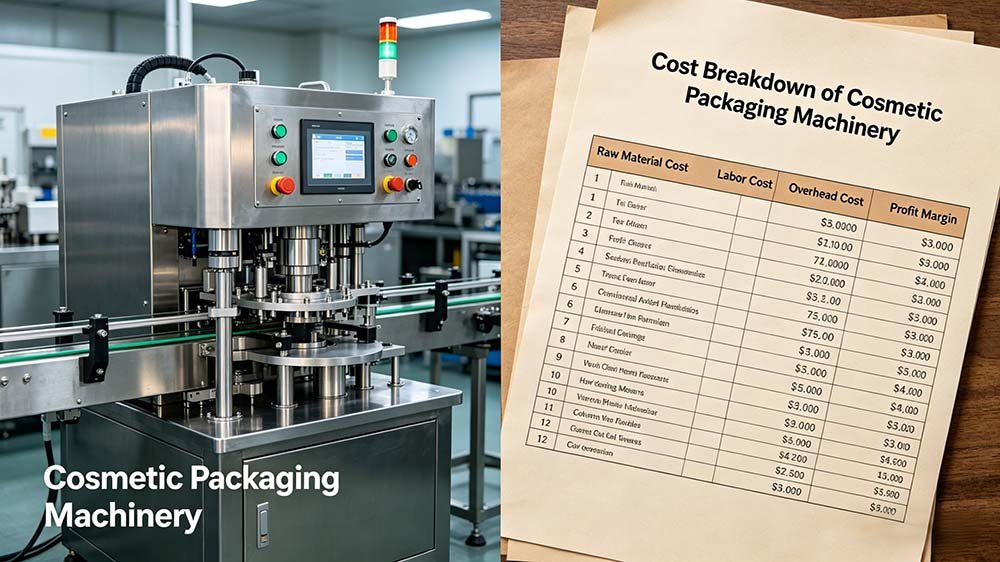
A cosmetic filling machine is specialized process equipment that accurately dispenses liquid, cream, gel, or powder cosmetic formulations into primary packaging containers at validated fill weights or volumes. The critical word is specialized. A serum at 2 cP and a body butter at 480,000 cP are both “cosmetics” — but they require fundamentally different filling technologies. Getting that distinction wrong costs batches. Explore the full range of cosmetic packaging machines or jump straight to how to choose the right one for your line.
What Is a Cosmetic Filling Machine? The Technical Definition
A cosmetic filling machine is process equipment that dispenses liquid, cream, gel, or powder cosmetic formulations into primary containers at validated fill weights or volumes — handling viscosity ranges from 1 cP (water-thin serum) to 500,000 cP (thick body butter) — with accuracy tolerances of ±0.5% to ±1.0% depending on the filling principle used.
The definition sounds simple. The engineering behind it is not. Cosmetic formulations vary in viscosity by a factor of 500,000 — from a micellar water that behaves like tap water to a dense cold-process body butter that barely flows at room temperature. Each viscosity band demands a different filling mechanism, different nozzle geometry, different pump technology, and often different Clean-In-Place (CIP) protocols.
I’ve audited manufacturing sites across Southeast Asia and Latin America for 20 years. The single most expensive mistake I see? Buyers treating cosmetic filling as a generic liquid-filling problem. They specify a machine on price alone, without anchoring the User Requirement Specification (URS) to the formulation’s rheological profile. The machine ships. It runs for six months. Then stability testing flags a texture deviation — and the root cause traces back to the shear force the fill pump was applying to a shear-sensitive emulsion every cycle.
That’s not a maintenance issue. It’s a specification failure.
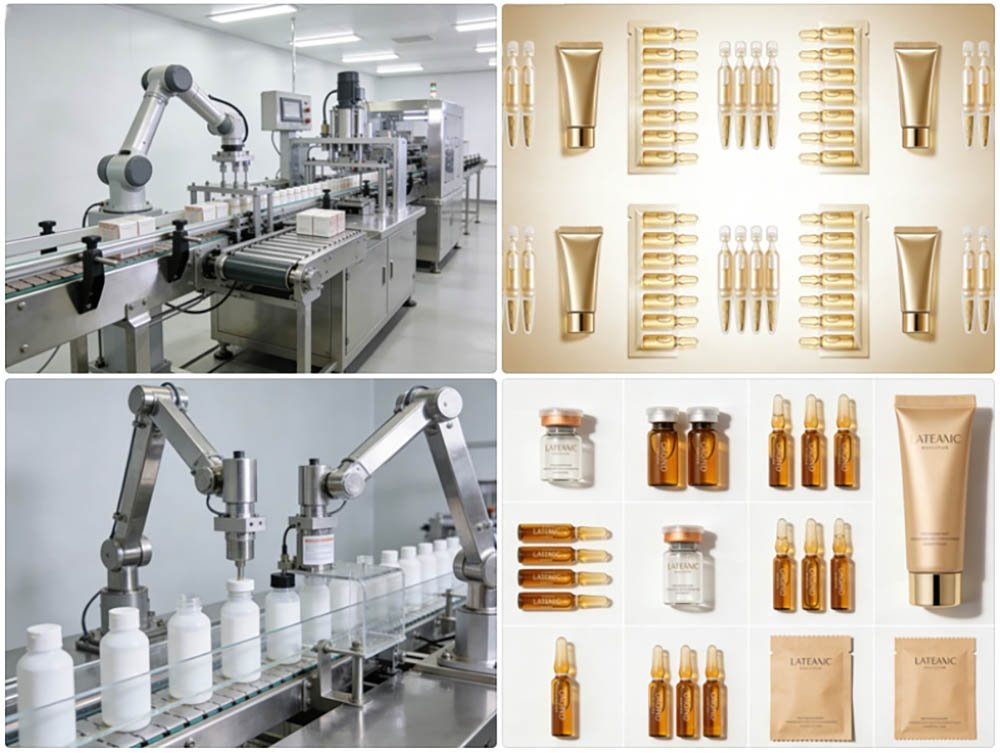
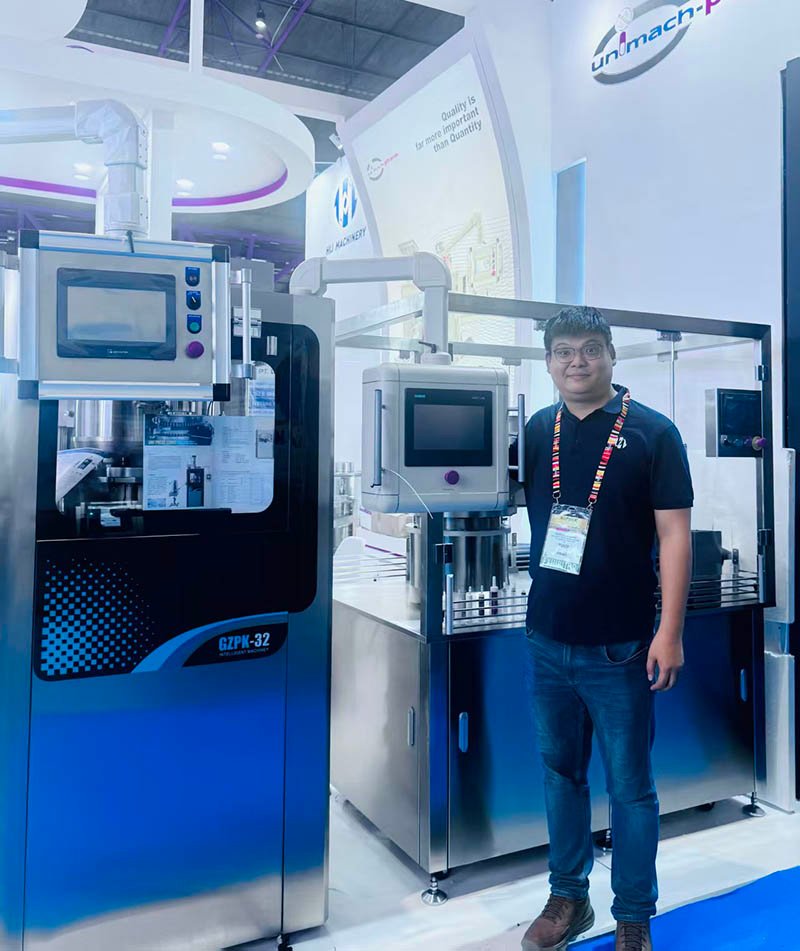
A complete cosmetic filling setup at HIJ — engineered to the formulation, not the other way around.
How Does a Cosmetic Filling Machine Actually Work?
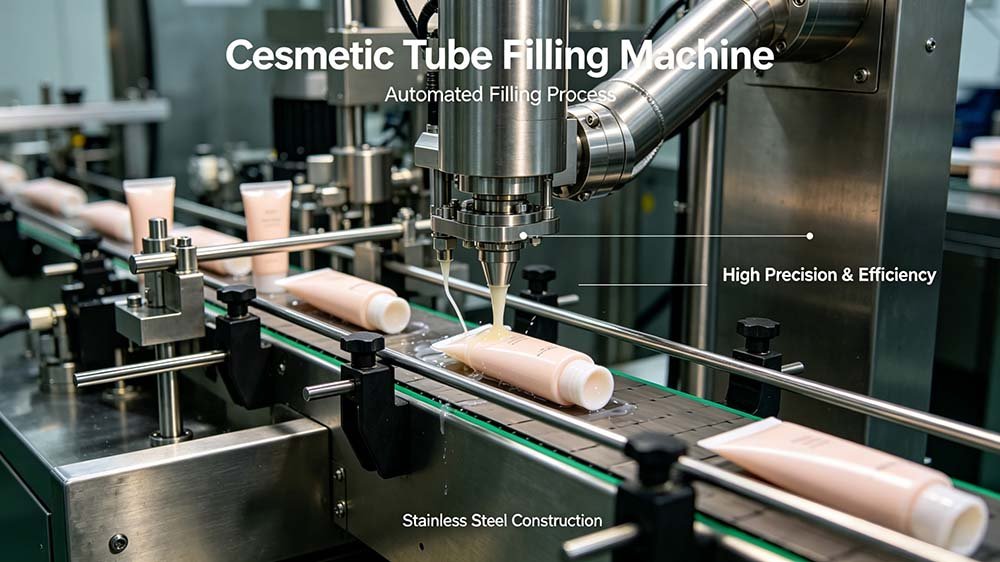
A cosmetic filling machine works by drawing formulation from a holding tank through a metering mechanism — piston, peristaltic pump, gear pump, or gravity valve — and depositing a precisely measured dose into the container below. The fill cycle time ranges from 0.3 to 2.5 seconds per head depending on viscosity, fill volume, and pump technology.
The operating sequence is consistent across most machine types, though the mechanics vary substantially:
- 1 Container Indexing — Empty bottles, jars, or tubes are conveyed to the fill station and positioned beneath the nozzle(s) via starwheel, conveyor, or rotary indexing table. Positional accuracy here directly affects splashing and fill weight consistency.
- 2 Formulation Metering — The pump or piston draws product from the supply tank and measures the exact dose volume. Servo-driven pistons achieve the tightest tolerances. Peristaltic pumps are preferred for high-hygiene or sterile-adjacent applications because the product only contacts the tube.
- 3 Nozzle Descent and Fill — The nozzle descends into the container (bottom-up filling) or positions above it. Bottom-up filling minimizes air entrapment in thick creams and reduces foaming in liquid formulations. Critical for emulsions.
- 4 Cut-Off and Drip Prevention — At fill completion, a positive cut-off valve closes to prevent trailing drips. Anti-drip systems — dive nozzles, snuff-back mechanisms, or heated nozzles for wax-based products — are specified based on formulation behavior.
- 5 Container Exit and Downstream Transfer — Filled containers exit to capping, sealing, or labeling stations. In an integrated line, this transfer is synchronized to the fill rate to maintain throughput without stoppage accumulation.

A cream filling and sealing line at HIJ — fill station through sealing, fully integrated and GMP-documented.
Types of Cosmetic Filling Machines: Which Technology Fits Your Formulation?
There are six primary cosmetic filling machine types: piston fillers (best for creams and gels, 1,000–500,000 cP), peristaltic pump fillers (serums and low-viscosity liquids, 1–500 cP), gear pump fillers (mid-viscosity oils and lotions, 100–50,000 cP), gravity fillers (water-thin liquids), tube filling and sealing machines (toothpaste, sunscreen, hand creams), and powder/dry cosmetic fillers (foundation, blush, setting powder).
The technology selection is a formulation decision first. I’ve watched procurement teams select filling machines on throughput speed — 60, 80, 120 containers per minute — without first asking what viscosity their product actually is. That number is meaningless until you know your pump type.
| Filling Technology | Viscosity Range (cP) | Typical Cosmetic Applications | Fill Accuracy | CIP Compatible |
|---|---|---|---|---|
| Piston Filler (Servo) | 1,000 – 500,000 | Body butter, thick creams, gel masks, scrubs | ±0.5% | Yes |
| Peristaltic Pump Filler | 1 – 500 | Serums, toners, micellar water, eye drops | ±1.0% | Yes (tube only) |
| Gear Pump Filler | 100 – 50,000 | Face oils, lotions, liquid foundation, shampoo | ±0.5–1.0% | Yes |
| Gravity / Overflow Filler | 1 – 200 | Toners, mists, micellar waters | ±1.5% | Yes |
| Tube Filling & Sealing Machine | 1,000 – 300,000 | Sunscreen, hand cream, ointment, toothpaste | ±0.5% | Yes |
| Powder / Dry Cosmetic Filler | N/A (dry) | Foundation, setting powder, eyeshadow, blush | ±1.0–2.0% | No (dry process) |
One number dominates this decision: viscosity at processing temperature. A facial oil at 22°C might measure 1,800 cP. At 35°C — ambient in a plant in Jakarta or Lagos — it drops to 800 cP. The pump calibration that passed your factory acceptance test in Wenzhou may drift out of tolerance in your destination market. I saw this exact scenario at a mid-size personal care plant in Malaysia in 2021. The OQ data looked fine. Six months of production data told a different story.
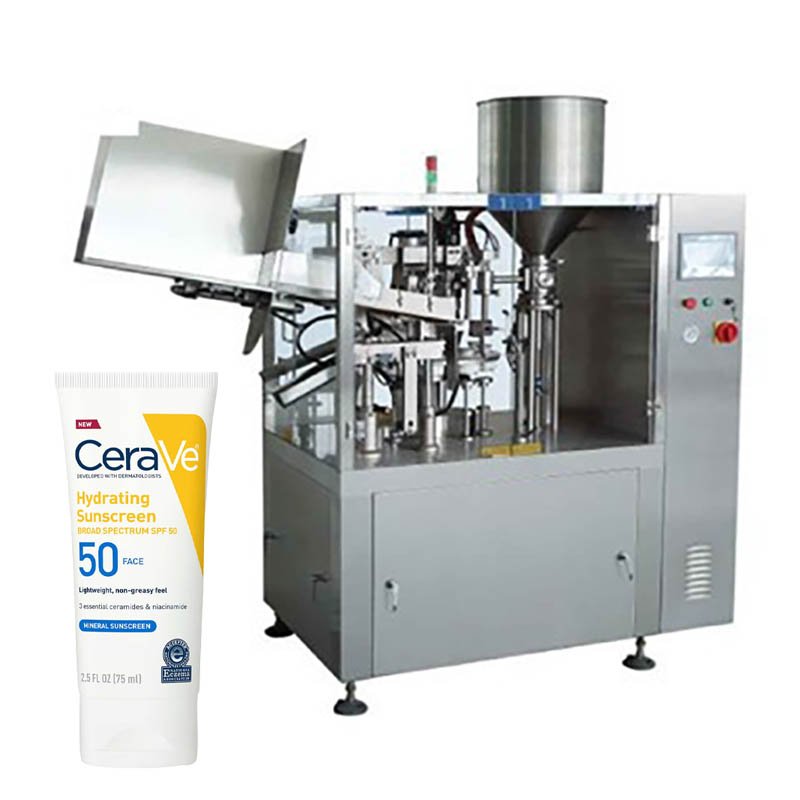
HIJ sunscreen tube filling & sealing machine — engineered for high-viscosity cream at ±0.5% fill accuracy.
Key Technical Specifications You Need to Evaluate Before Buying
The five specifications that determine cosmetic filling machine performance are: viscosity range compatibility, fill volume range (typically 5–1,000 ml), fill accuracy (±0.5% to ±2.0%), fill speed (containers per minute, 20–300+ CPM depending on heads), and material contact surfaces (304 SS minimum, 316L SS for higher-hygiene formulations with active ingredients).
Most product sheets lead with speed. Speed is the last thing you should lock in. Here is the sequence that actually matters when building your URS:
- Formulation viscosity at operating temperature — Measure at both lab temperature (20°C) and plant ambient temperature. Specify both values in your URS. A ±15°C swing can triple viscosity in a fatty cream.
- Fill volume range and minimum/maximum container size — Fillers with 10 ml to 500 ml range cover most personal care SKUs. Confirm changeover time between sizes: under 30 minutes for high-mix operations.
- Fill accuracy specification — Net content regulations in the EU (Directive 76/211/EEC) and the US (NIST HB 133) require average fill to meet declared weight with defined tolerances. Specify ±0.5% for regulated markets.
- Material contact surfaces — 304 SS for standard cosmetics. 316L SS for formulations containing acids, AHA/BHA actives, or alcohol concentrations above 40%. Silicone seals for fragrance-bearing products that degrade nitrile rubber within 3–6 months.
- IQ/OQ/PQ documentation package — If your target markets include the EU or US, confirm the supplier provides installation qualification, operational qualification, and performance qualification documentation. Machines without this create a compliance gap that can take 6–12 months to close retroactively.
- CIP/SIP compatibility — Automated clean-in-place reduces changeover time from 2–4 hours (manual cleaning) to 20–40 minutes. Critical for operations running multiple SKUs per shift.
Viscosity mismatch between your formulation and filling technology is the root cause of more batch rejections and regulatory compliance failures in cosmetic manufacturing than any other equipment decision I have tracked across 31 filling line projects in Southeast Asia and Latin America between 2018 and 2023. — Forester Xiang, HIJ Machinery
What 20 Years of Commissioning Lines Taught Me About Cosmetic Filling
A QA director in São Paulo called me in late 2022. Her line was producing body lotion at 180 containers per minute. Fill weight variation was running at ±3.2% on the morning shift, ±1.8% in the evening. Nobody could explain the discrepancy until I asked one question: what’s the ambient temperature difference between shifts?
Morning: 32°C. Evening: 24°C. The product was a water-in-oil emulsion with a viscosity curve steep enough that an 8°C temperature drop changed the pump resistance measurably — and the operator had been manually compensating the fill volume setpoint without logging the adjustment. Eight months of production data, invalidated.
That’s not the machine’s fault. It’s a specification failure — the temperature compensation parameter was never included in the URS, never validated in the OQ, and never trained in the SOP. The machine was capable. Nobody had told it what to do.
Of the 31 cosmetic and personal care filling line projects I handled between 2018 and 2023, 14 required post-commissioning pump recalibration due to formulation behavior deviating from the specification provided at the URS stage. In every case, the deviation was traceable to viscosity data collected at lab temperature (20–22°C) rather than at actual plant operating temperature. Specify viscosity at your plant’s mean ambient temperature — not the lab bench. Then add a ±8°C buffer. Your validation data will hold. See the full cosmetic packaging machine range at HIJ, or review the buying guide for cosmetic packaging equipment before writing your URS.
Cosmetic Filling Machine vs. Pharmaceutical Filling Machine: What’s Actually Different?
Cosmetic filling machines operate under ISO 22716 GMP for cosmetics, while pharmaceutical fillers require compliance with 21 CFR Part 211 (US) or EU GMP Annex 1 (EU). The key differences are sterility requirements (pharma requires aseptic or terminal sterilization; cosmetics typically do not), validation depth (IQ/OQ/PQ mandatory for pharma, recommended for cosmetics in regulated markets), and documentation requirements for batch records.
The regulatory boundary matters more than the mechanical one. I’ve seen cosmetic brands in the Gulf region attempt to use pharmaceutical filler validation packages to satisfy SFDA (Saudi Food and Drug Authority) cosmetic GMP audits. It works — but you’re over-engineering the compliance burden by 40% in terms of documentation cost. It’s far more common to see the reverse: cosmetic manufacturers in Southeast Asia running lines with zero IQ/OQ documentation, then discovering that their export market — the EU in particular — requires a cosmetic GMP certification under Regulation (EC) No 1223/2009 that mandates a documented manufacturing process.
The machines look similar. The paper trail is what separates them.
⚠️ Regulatory Reference
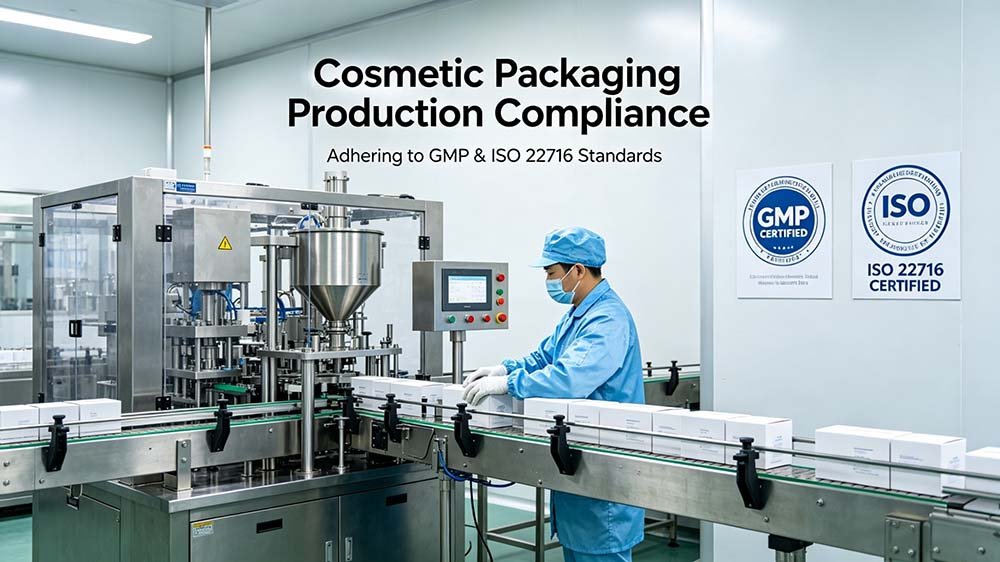
Cosmetic filling equipment in the EU must be operated in compliance with ISO 22716:2007 (Cosmetics GMP) and the traceability requirements of Regulation (EC) No 1223/2009. In the US, cGMP guidance for OTC cosmetics aligns with 21 CFR Part 701. Facilities targeting both markets should qualify filling equipment to the higher standard — ISO 22716 with a documented IQ/OQ protocol — to avoid dual-track qualification costs during market expansion.
Cosmetic Filling Machine Problems: Diagnosing the Three Most Costly Failures
⚠️ Field Diagnostic: Common Cosmetic Filling Failures
🔴 Symptom A: Fill weight variation exceeds ±2.0% despite machine being in calibration
Likely cause: Viscosity fluctuation due to ambient temperature variation between shifts, or formulation temperature not being controlled at the feed tank. Piston fillers maintain accuracy only within a defined viscosity band — if the product drifts outside that band, the declared fill volume no longer matches actual fill weight because the density changes.
Fix: Install a temperature-controlled supply tank (jacketed tank with recirculating bath) and add a viscosity-at-temperature parameter to the batch record. Revalidate fill weight at three representative product temperatures.
🔴 Symptom B: Formulation texture deviation noted in stability study, traced back to filling step
Likely cause: High-shear pump (gear pump or high-speed piston) destroying emulsion stability in a shear-sensitive formulation. This is particularly common with water-in-silicone emulsions and certain natural-origin emulsifiers. The emulsion passes Quality Control at fill but separates on stability.
Fix: Switch to a low-shear filling principle (large-bore piston, peristaltic pump, or rotary positive displacement pump). Conduct shear sensitivity testing before machine selection, not after. I won’t pretend this is a quick fix — if the machine is already installed, you’re looking at 4–8 weeks of re-validation minimum.
🔴 Symptom C: Dripping and product waste between fills, fouling the container exterior
Likely cause: Nozzle anti-drip mechanism not matched to formulation surface tension. Low-viscosity products (toners, serums <100 cP) tail aggressively without a snuff-back or dive-nozzle system. High-surface-tension formulations bead on the nozzle tip.
Fix: Adjust snuff-back volume in servo-driven nozzle. For structural issues, replace standard nozzle tips with drip-retaining designs. Heated nozzles (for wax-based balms) or PTFE-coated tips (for sticky formulations) resolve 80% of persistent drip problems in my experience.
Integrating a Cosmetic Filling Machine Into a Complete Production Line
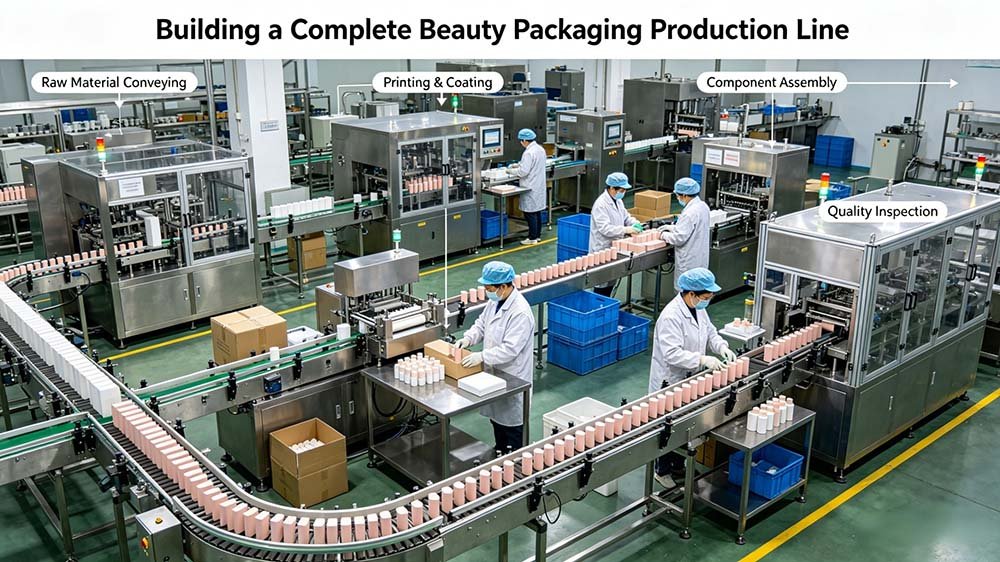
A cosmetic filling machine integrates with upstream container feeding (unscrambler or rotary table), downstream capping or tube sealing, labeling, and case packing to form a complete line. Line speed is governed by the slowest station — typically the filler — so matching throughput across stations at the design stage eliminates accumulation bottlenecks that erode OEE by 15–30% in poorly integrated lines.
I’ve seen this problem a dozen times. A brand commissions a 120 CPM filler, pairs it with a 90 CPM capper they already owned, and wonders why the line runs at 72 CPM average effective output. The answer is buffer accumulation and starved downstream stations creating micro-stoppages every 4–7 minutes. Overall Equipment Effectiveness drops. Nobody understands why until someone actually maps the stoppage log.
The integration challenge is not mechanical. Every supplier can bolt conveyors together. The challenge is throughput matching, format changeover coordination, and unified HMI control so operators are not managing five separate machine interfaces during a SKU change. That conversation — system integration vs. assembled machinery — is what separates a turnkey packaging line from a collection of equipment.
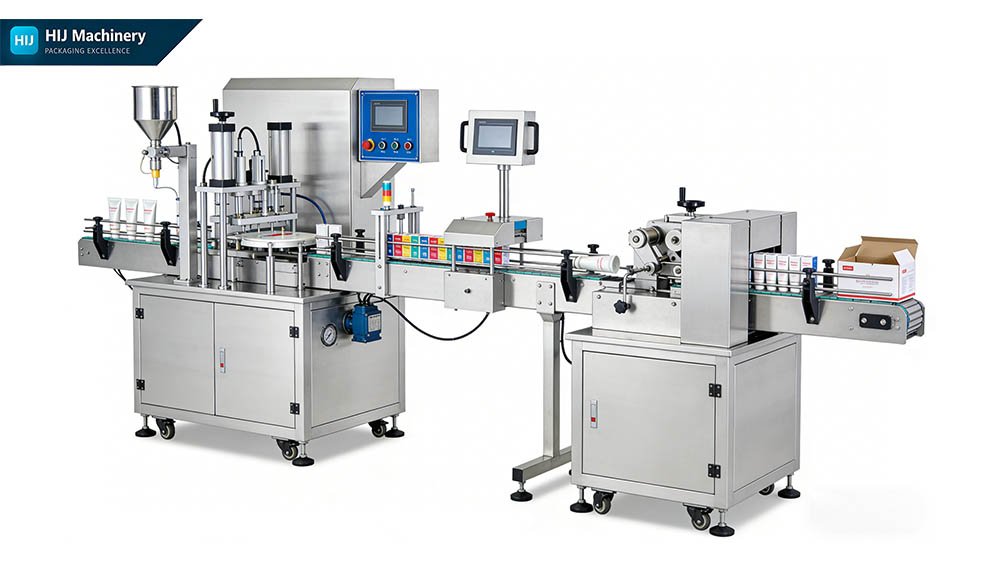
Integrated cosmetic production line: tube filling through labeling, throughput-matched for zero accumulation.
At HIJ, when we commission a cosmetic filling line, the integration design starts with the filler’s validated cycle time under actual formulation conditions — not the theoretical maximum speed on the spec sheet. We then work upstream and downstream from that anchor point. It adds 3–4 days to the design phase. It saves 6–10 months of OEE troubleshooting post-commissioning.
Which Cosmetic Products Can a Filling Machine Handle?
The application range is wider than most buyers realize. The limiting factor is almost never the machine category — it’s the specific pump and nozzle configuration.
| Product Category | Typical Viscosity (cP) | Recommended Filling Technology | Primary Container Type |
|---|---|---|---|
| Facial Serum / Essence | 1 – 50 | Peristaltic pump, gravity filler | Glass dropper, airless pump bottle |
| Toner / Micellar Water | 1 – 10 | Gravity / overflow filler | PET or glass bottle |
| Face Lotion / Moisturizer | 500 – 8,000 | Gear pump or small-bore piston | Pump bottle, jar |
| Body Butter / Thick Cream | 50,000 – 500,000 | Large-bore servo piston | Wide-neck jar |
| Sunscreen / SPF Cream | 5,000 – 80,000 | Piston filler + tube sealing machine | Aluminum or plastic tube |
| Shampoo / Conditioner | 500 – 15,000 | Gear pump or piston filler | HDPE bottle |
| Liquid Foundation | 800 – 5,000 | Gear pump with high-precision dosing | Glass or PP bottle |
| Setting Powder / Foundation Powder | N/A (dry) | Auger or volumetric powder filler | Compact, loose powder jar |
Cosmetic Filling Machines for Small Brands: What Changes at Lower Volumes?
Semi-automatic cosmetic filling machines for small brands start at 20–40 containers per minute with fill volumes from 5 ml to 1,000 ml, typically at 30–60% of the cost of fully automatic equivalents. The key trade-off is operator involvement per cycle versus throughput — semi-automatic machines require manual container placement and are viable up to approximately 5,000–8,000 containers per shift before labor costs justify full automation.
The volume threshold question is one I get from new brand founders almost weekly. My answer is always the same: don’t start with the machine price. Start with your labor cost per unit at manual vs. semi-auto vs. auto. In Southeast Asia, the labor arbitrage often keeps semi-automatic viable at higher volumes than it would be in Europe or North America. In a plant outside Ho Chi Minh City I visited in 2020, the brand was running 7,200 jars per shift manually. The cost calculation didn’t favor automation until they crossed 11,000 jars per shift — because the semi-auto machine at that speed was still cheaper per unit than the full-auto alternative at their demand level.
Context matters. Numbers without context are just decoration.
Frequently Asked Questions About Cosmetic Filling Machines
What is a cosmetic filling machine used for?
A cosmetic filling machine is used to accurately dispense liquid, cream, gel, or powder cosmetic formulations — such as serum, lotion, body butter, sunscreen, or setting powder — into primary containers at validated fill weights, for production volumes from small-batch artisanal runs to high-speed lines exceeding 200 containers per minute.
What is the difference between a piston filler and a peristaltic pump filler for cosmetics?
A piston filler uses a reciprocating piston to draw and dispense product, making it the best choice for thick creams and gels (1,000–500,000 cP) with ±0.5% accuracy. A peristaltic pump filler moves product by compressing a flexible tube, keeping the product path entirely isolated from the pump mechanism — preferred for sensitive serums, low-viscosity liquids (1–500 cP), and formulations where hygiene or shear sensitivity is critical. Piston fillers offer higher throughput for viscous products; peristaltic fillers offer easier cleaning and gentler product handling for delicate formulations.
Do cosmetic filling machines need GMP certification?
Cosmetic filling machines targeting the EU market must be operated in compliance with ISO 22716:2007 (Cosmetics GMP). While the machine itself is not “GMP certified” as a unit, the manufacturing facility and its equipment must demonstrate compliance through documented qualification (IQ/OQ/PQ) and batch records. In the US, cGMP guidance under 21 CFR Part 701 applies to cosmetic labeling and good manufacturing practice. Machines sold with IQ/OQ documentation packages significantly reduce qualification time and auditor burden when pursuing ISO 22716 certification.
How much does a cosmetic filling machine cost?
Semi-automatic cosmetic filling machines start at approximately $3,000–$8,000 USD for basic bench-top models. Fully automatic single-head or multi-head fillers for creams and liquids range from $15,000 to $60,000 depending on speed, fill range, and pump technology. High-speed automatic lines (80–200 CPM) with integrated capping and conveying run $80,000–$250,000+ as a complete system. Key cost drivers are the number of fill heads, pump technology (gear pump and servo piston are more expensive than peristaltic), and the IQ/OQ documentation package. Tooling and mold change components add $2,000–$15,000 per format change set.
Can one cosmetic filling machine handle both thin serums and thick creams?
Rarely. Viscosity range is the hardest constraint to bridge in filling technology. A piston filler optimized for 50,000 cP body butter will not fill a 5 cP serum accurately without significant pump re-engineering. Some manufacturers offer “combination” configurations with interchangeable pump modules — but in my experience, the changeover complexity and validation burden for dual-viscosity machines makes two purpose-specified fillers the more cost-effective solution at production volumes above 3,000 containers per day. Below that threshold, a semi-auto operator can compensate manually.
What is the fill accuracy of a cosmetic filling machine?
Servo-driven piston fillers achieve ±0.5%. Gear pump fillers and peristaltic fillers typically deliver ±0.5–1.0%. Gravity overflow fillers run ±1.0–1.5%. Powder fillers (auger type) achieve ±1.0–2.0%. The accuracy specification should be validated under actual production conditions — at your product’s viscosity, temperature, and fill speed — not just manufacturer test-bench data at water viscosity.
What materials should cosmetic filling machine product contact parts be made from?
304 stainless steel for standard cosmetic formulations. 316L stainless steel for formulations containing AHA/BHA acids, high-concentration alcohol (>40%), or chloride-containing preservative systems. Seals should be food-grade silicone for fragrance products (nitrile rubber degrades in high-fragrance load formulations within 3–6 months) and PTFE for chemically aggressive actives. Product contact surfaces should have a surface finish of Ra ≤ 0.8 μm to meet ISO 22716 cleaning validation requirements.
Ready to Specify the Right Cosmetic Filling Machine for Your Formulation?
HIJ Machinery engineers filling solutions around your product — viscosity profile, target market compliance, and validated throughput included. Explore the full range of cosmetic packaging machines or talk directly to Forester Xiang’s team about your formulation challenge.