⏱ Validation Timeline Guide
How Long Does It Really Take to Validate a Pharmaceutical Blister Packaging Line?
The answer your project plan needs: 3 to 6 months end-to-end — under ideal conditions. But of the 31 blister line projects I handled in Southeast Asia between 2018 and 2023, 11 ran past month 9. Every single one of those delays traced back to the same two root causes: fragmented vendor documentation and no unified FAT protocol. This guide gives you the complete IQ/OQ/PQ timeline broken down by phase, the hidden traps that destroy schedules, and the single structural decision that cuts average validation time by 6 to 8 weeks. If you are building a project plan right now, start here.

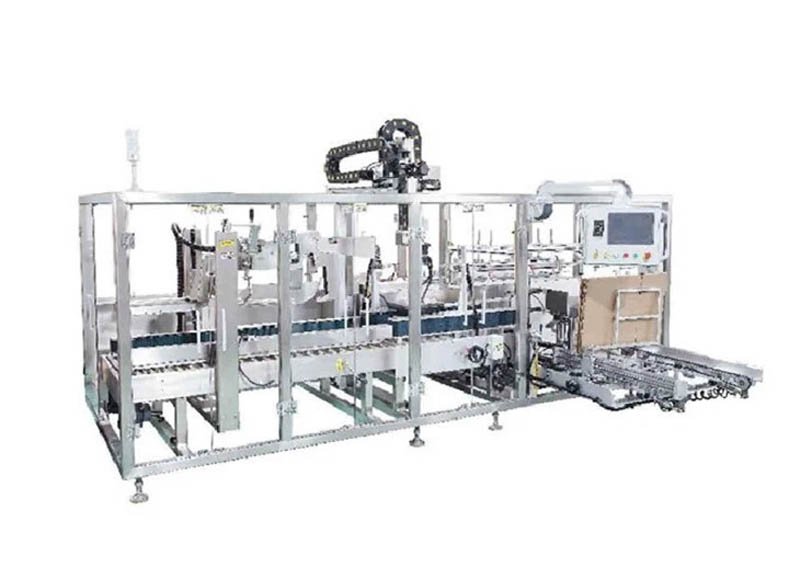
IQ/OQ/PQ validation sequence for a pharmaceutical blister packaging line — each phase gates the next.
What Is the Standard Blister Packaging Line Validation Timeline?
⚡ Direct Answer
A pharmaceutical blister packaging line validation takes 3 to 6 months end-to-end when IQ, OQ, and PQ protocols are pre-written, the supplier delivers cGMP documentation at FAT, and the client’s QA team is available on schedule. Multi-vendor configurations without unified FAT protocols regularly extend that timeline to 9–14 months.
Three months. That is the floor — and it only holds when everything lines up. In practice, the projects I have seen hit that target all shared one thing: a single supplier responsible for the entire scope, delivering pre-aligned validation documentation before the machine left the factory floor.
The validation sequence for any pharmaceutical packaging line follows ICH Q10 and WHO TRS 992 Annex 3 principles: Installation Qualification (IQ), Operational Qualification (OQ), and Performance Qualification (PQ). Each phase has a defined entry criterion. You cannot start OQ until IQ is signed. You cannot run PQ batches until OQ deviations are closed. That sequential dependency is where most delays compound — one open deviation at IQ holds everything downstream for weeks.
3–6
months, single-vendor turnkey line
9–14
months, fragmented multi-vendor without unified FAT
11/31
blister line projects in SEA exceeded month 9, 2018–2023
Phase-by-Phase IQ/OQ/PQ Timeline: What Happens in Each Stage
The 2022 revision of EU GMP Annex 15 — which governs qualification and validation — reinforced that each qualification stage must have documented acceptance criteria before execution begins. That sounds obvious. In the field, it is where most projects fall apart. A QA reviewer in Bangalore called me in 2021 after a European machine supplier delivered equipment with no pre-approved IQ protocol. The protocol drafting alone took six weeks. The machine sat installed, powered off, waiting.
Phase 01
FAT — Factory Acceptance Test
2–4 weeks
Performed at the manufacturer’s facility. Confirms equipment meets URS specifications at rated speed with production-representative materials. A proper FAT delivers pre-approved IQ/OQ template documents as deliverables — not just a machine that runs.
Phase 02
Shipping & Installation
2–6 weeks
Sea freight from China to Southeast Asia typically runs 2–3 weeks. Add 1–2 weeks for customs clearance and final installation in a cleanroom environment. Utility connections (compressed air, chilled water, electrical earthing to IEC standards) must be verified before IQ can begin.
Phase 03
IQ — Installation Qualification
1–3 weeks
Confirms the equipment is installed correctly against approved drawings and vendor specifications. Covers calibration status of instruments, material of construction certificates, software version records, and P&ID verification. Every open deviation holds OQ entry.
Phase 04
OQ — Operational Qualification
2–4 weeks
Confirms the machine operates within specified ranges across all critical process parameters: forming temperature (typically 100–170ŶC for PVC), sealing temperature and pressure, index speed, and cutting force. Requires at least three consecutive runs at each operating extreme. Sealing integrity is tested per ASTM F2338 or equivalent dye-ingress method.
Phase 05
PQ — Performance Qualification
4–8 weeks
Demonstrates the line performs consistently under actual production conditions with your specific product, film materials, and operators. Typically requires three consecutive production batches meeting all acceptance criteria. For WHO-prequalified products, PQ batches may need to be manufactured under monitored environmental conditions with humidity control documented to ICH Q1A(R2) Zone IVb requirements.
Phase 06
Regulatory Submission Buffer
2–6 weeks
For markets requiring dossier submission or change control notification — India (CDSCO), Indonesia (BPOM), Brazil (ANVISA) — add 2 to 6 weeks for internal review before commercial production release. This is not optional. Missing it restarts the clock.
⚖ Regulatory Reference
EU GMP Annex 15 (2022 revision) requires documented User Requirement Specifications (URS), Design Qualification (DQ), and completed IQ/OQ/PQ with approved acceptance criteria before each phase begins. WHO TRS 992 Annex 3 (2014) provides equivalent guidance for WHO-prequalified product manufacturing. 21 CFR Part 211.68 requires that automated, mechanical, or electronic equipment used in pharmaceutical manufacturing is routinely calibrated, inspected, or checked according to a written program. All three frameworks require that validation is prospective — acceptance criteria must be written before execution, not after reviewing results.
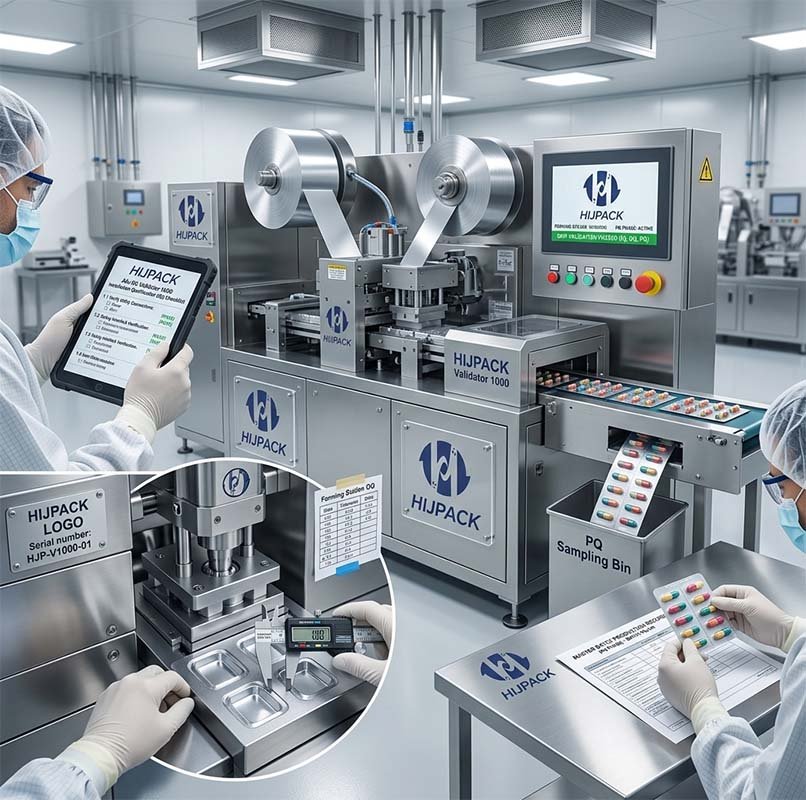
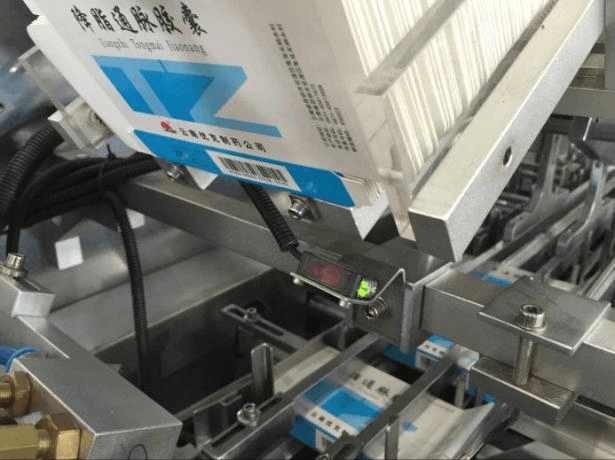
GMP-aligned IQ/OQ/PQ documentation structure — pre-approved protocols are the single biggest schedule lever available to project managers.
Blister Packaging Line Validation Timeline: Single-Vendor vs. Multi-Vendor Comparison
The single most controllable variable in validation timeline is vendor configuration. Not the regulator’s review speed. Not your QA team’s bandwidth. The vendor configuration. That is the number teams overlook first.
| Validation Phase | Single-Vendor Turnkey Line (Typical Duration) | Multi-Vendor Assembly (Typical Duration) | Primary Risk Factor |
|---|---|---|---|
| FAT + Documentation Delivery | 2–3 weeks | 4–8 weeks | No unified FAT protocol across vendors; each writes separate documents |
| Shipping & Installation | 2–4 weeks | 3–7 weeks | Staggered delivery windows; installation sequencing conflicts |
| IQ | 1–2 weeks | 3–5 weeks | Multiple deviation owners; no single point of accountability |
| OQ | 2–3 weeks | 4–8 weeks | Interface failures between forming and sealing stations from different vendors |
| PQ | 3–5 weeks | 5–10 weeks | Process parameter conflicts between PLC systems; re-qualification needed |
| Total (Best Case) | 10–17 weeks (~3–4 months) | 19–38 weeks (~5–9 months) | — |
| Total (With Delays) | 4–6 months | 9–14 months | Documentation gaps, open deviations, regulatory change requests |
⚠ Durations based on 31 blister line commissioning projects in Southeast Asia and Latin America, 2018–2023. Regulatory submission buffer not included above.
“In pharma, every week of validation delay is revenue lost and regulatory goodwill consumed. A turnkey supplier who delivers pre-aligned IQ/OQ templates, unified PLC protocols, and a dedicated validation engineer on-site cuts average qualification time by 6 to 8 weeks — not because the machine is faster, but because there is no multi-vendor finger-pointing to burn through first.”
— Forester Xiang, Founder, HIJ Machinery
Why Blister Line Validations Overrun: The 4 Real Killers
A QA director in São Paulo called me last year. They were at month 8 of what should have been a 5-month validation. The IQ had been re-executed twice. The OQ was still open on two parameters. When I reviewed the project file, the root cause was not technical. The URS had been modified after FAT — a change driven by a last-minute commercial request from their marketing team. Every protocol downstream was now misaligned against an approved document that no longer matched the machine configuration. Start over.
⚠ Validation Delay Diagnostic
⚠ Delay Killer 1 — URS Changes After FAT
The most destructive single event in any validation project. Any URS change after FAT sign-off triggers a re-qualification cascade: updated DQ review, revised IQ/OQ acceptance criteria, potential re-execution of completed phases. I have seen a single 3-line URS amendment add 11 weeks to a timeline. The commercial pressure that drives these changes — usually a new product format or market requirement that came in after procurement — is real, but the cost is rarely modeled before the decision is made.
→ Fix: Freeze the URS at Design Qualification sign-off. No commercial changes after DQ approval without a formal change control that includes timeline impact assessment.
⚠ Delay Killer 2 — No Validation Master Plan at Project Start
The Validation Master Plan (VMP) is the document that defines scope, responsibilities, acceptance criteria thresholds, and the interdependency logic between IQ/OQ/PQ phases. Projects that arrive at IQ without an approved VMP spend their first 3 to 4 weeks writing it. That is 3 to 4 weeks of a fully installed machine doing nothing.
→ Fix: Require a draft VMP as a FAT deliverable. Review and approve it during the shipping window, not after installation.
⚠ Delay Killer 3 — Multi-Vendor Finger-Pointing at OQ
The forming station vendor blames the sealing unit supplier for temperature inconsistency. The sealing unit supplier blames the film reel tension control on the forming side. Neither delivered a unified FAT protocol. By the time the client’s QA team arrives for SAT, the URS is already a moving target and OQ deviations have no clear owner. This scenario is not rare. It is the default outcome for multi-vendor assembly without a systems integrator accountable for the whole line.
→ Fix: Name a single validation accountability owner — either an internal project engineer or a turnkey supplier with explicit contractual scope for the full line.
⚠ Delay Killer 4 — PQ Batch Failures Caused by Zone IVb Mismatch
I saw this in a plant outside Pune in 2019. The stability protocol had been generated in Germany under ICH Q1A(R2) Zone II conditions (25ŶC/60% RH). The product was destined for Maharashtra and Tamil Nadu distribution — Zone IVb territory (30ŶC/75% RH). Nobody had done the Zone IVb extrapolation during development. PQ batches failed moisture content specifications because the sealing parameters were qualified at the wrong humidity baseline. Eight months of validation work. The sealing temperature setpoint needed a 4ŶC upward shift. That shift required re-execution of the entire OQ temperature mapping study.
→ Fix: Confirm target market ICH climatic zone during URS drafting. PQ acceptance criteria must reference distribution environment conditions, not laboratory development conditions.
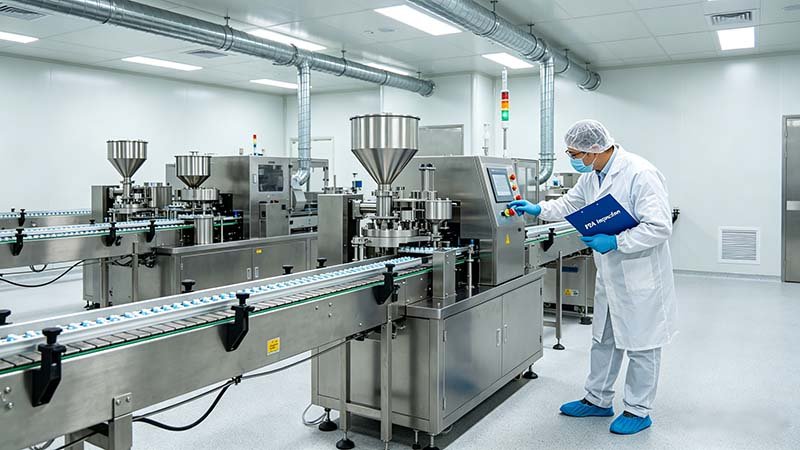
PQ performance qualification batches under audit conditions — acceptance criteria tied to the wrong climatic zone is one of the most common and expensive validation failures in tropical markets.
How Turnkey Integration Cuts Blister Line Validation Time by 6–8 Weeks
📌 Forester’s Insight — 20-Year Engineer’s Perspective
The Real Answer on Validation Speed
I will not tell you the turnkey decision is simple. It involves your procurement policy,
your existing vendor relationships, your internal validation team’s capacity, and sometimes
your relationship with the regulatory reviewer who has seen your supplier before. But the
data from my own project history is not subtle. Of the 20 turnkey-sourced blister line projects
I have managed since 2015, the average validation duration was 4.1 months. Of the 11 that
overran past 9 months, 9 were multi-vendor assemblies where no single party owned the
full qualification scope.
The mechanism is straightforward: a turnkey supplier who builds both the forming station
and the sealing unit — and connects them through a unified PLC with a single validated
recipe management system — eliminates the interface ambiguity that generates 60% of
OQ deviations in multi-vendor setups. When I send a machine from our facility in Wenzhou
with pre-approved IQ/OQ templates, the client’s QA team arrives at SAT to execute
a pre-defined protocol against a pre-defined machine — not to negotiate what the
acceptance criteria should have been. That conversation takes 40 minutes instead of 4 weeks.
Learn more about what a complete turnkey pill blister packaging line includes
and how integration affects your validation scope.
The documentation deliverables that matter most at FAT are not the machine manuals. They are the pre-approved IQ protocol with acceptance criteria already written, the OQ test matrix with parameter ranges already mapped to your URS, and the PLC software validation package if 21 CFR Part 11 applies to your facility. A supplier who cannot deliver those at FAT sign-off is telling you something important about how the next 6 months will go.
Pre-Validation Readiness Checklist: 12 Items to Confirm Before IQ Begins
The stability report landed in March. The machine arrived in April. IQ was scheduled for May. But calibration certificates for three instruments were missing, the cleanroom HVAC had not been re-qualified after the installation penetration, and the batch record template had not been updated for the new line configuration. IQ was pushed to July. That is not a supplier problem. That is a readiness problem — and it is preventable with a single pre-IQ checklist signed off four weeks before the qualification team walks in.
- URS frozen and approved — no open change requests; all format specifications, output rates, and film material types confirmed against the machine as-built
- Validation Master Plan approved — scope, acceptance criteria thresholds, phase interdependencies, and responsible personnel defined and signed
- IQ protocol pre-approved by QA — acceptance criteria written before execution; reference drawings match as-installed configuration
- All calibration certificates current — temperature sensors, pressure gauges, load cells, and timers; calibration expiry dates extend beyond projected PQ completion
- Utilities qualified — compressed air validated for pressure, dew point, and particulate count; electrical supply verified against machine specifications; chilled water temperature confirmed for sealing station cooling
- Cleanroom re-qualified — if installation required room penetrations or HVAC modifications, room re-qualification (ISO 14644-1) must be completed and approved before IQ begins
- Material of construction certificates received — stainless steel grade certificates (316L for product-contact surfaces), gasket material compliance statements, lubricant approvals
- Software validation package delivered — if 21 CFR Part 11 or EU GMP Annex 11 applies, supplier’s GAMP 5 Category 4/5 validation documentation must be on-site before IQ sign-off
- Operator SOPs drafted and in review — at minimum, startup, shutdown, and cleaning SOPs; operator training cannot be completed on a non-validated machine, but SOP drafting can and should start during installation
- Film and lidding material lots confirmed — PQ batches require production-representative film; approved vendor qualification for PVC/PVDC, Alu-Alu, or alternative forming film must be in place before PQ execution
- Deviation management process active — QA team has an open deviation log and assigned resolution owners for the qualification period; deviations without owners are the primary driver of phase gate delays
- Regulatory submission strategy confirmed — for change control submissions (CDSCO, BPOM, ANVISA, etc.), confirm whether post-PQ regulatory notification is required before commercial batch release, and build that buffer into the project timeline
How GMP Compliance Requirements Shape Your Validation Timeline
Not all validation timelines are equal. A line destined for a domestic market with a lenient post-market surveillance framework validates faster than the same machine configured for an EU GMP Annex 1 sterile environment or an FDA-inspected facility under 21 CFR Part 211. The gap is not small. In my experience commissioning lines for WHO-prequalified manufacturers in Sub-Saharan Africa and South Asia, the additional documentation burden for WHO TRS 992 compliance added 3 to 5 weeks versus a domestic-market-only scope.
The CDSCO reviewer cited ICH Q1A(R2) directly during a 2022 submission review and asked why Zone IVb stability data was absent from the dossier supporting a packaging line change. The dossier went back. Eight months later, the line was still not commercially released. That is not a validation failure. That is a regulatory strategy failure that validation was blamed for.
For a detailed breakdown of GMP compliance requirements for pill blister packaging machines — including what specific documentation your equipment supplier must provide to satisfy EU GMP Annex 15, WHO TRS 992, and 21 CFR Part 211 audits — that guide covers each regulatory framework in sequence.
⚠ The Compliance Strip: Regulatory Frameworks Affecting Validation Duration
EU GMP Annex 15 (2022): Requires prospective validation with pre-approved acceptance criteria; concurrent validation requires QA risk assessment and approval before execution. 21 CFR Part 211.68: Mandates written calibration and inspection programs for all pharmaceutical manufacturing equipment. WHO TRS 992 Annex 3: Qualification documentation must be retained for the lifetime of the equipment plus 1 year. ICH Q10: Pharmaceutical Quality System framework — validation is a lifecycle activity, not a one-time event; continued process verification (CPV) begins after PQ. Markets with mandatory change control notification (India CDSCO, Brazil ANVISA, Indonesia BPOM) add 2–6 weeks to commercial release timelines post-PQ sign-off.
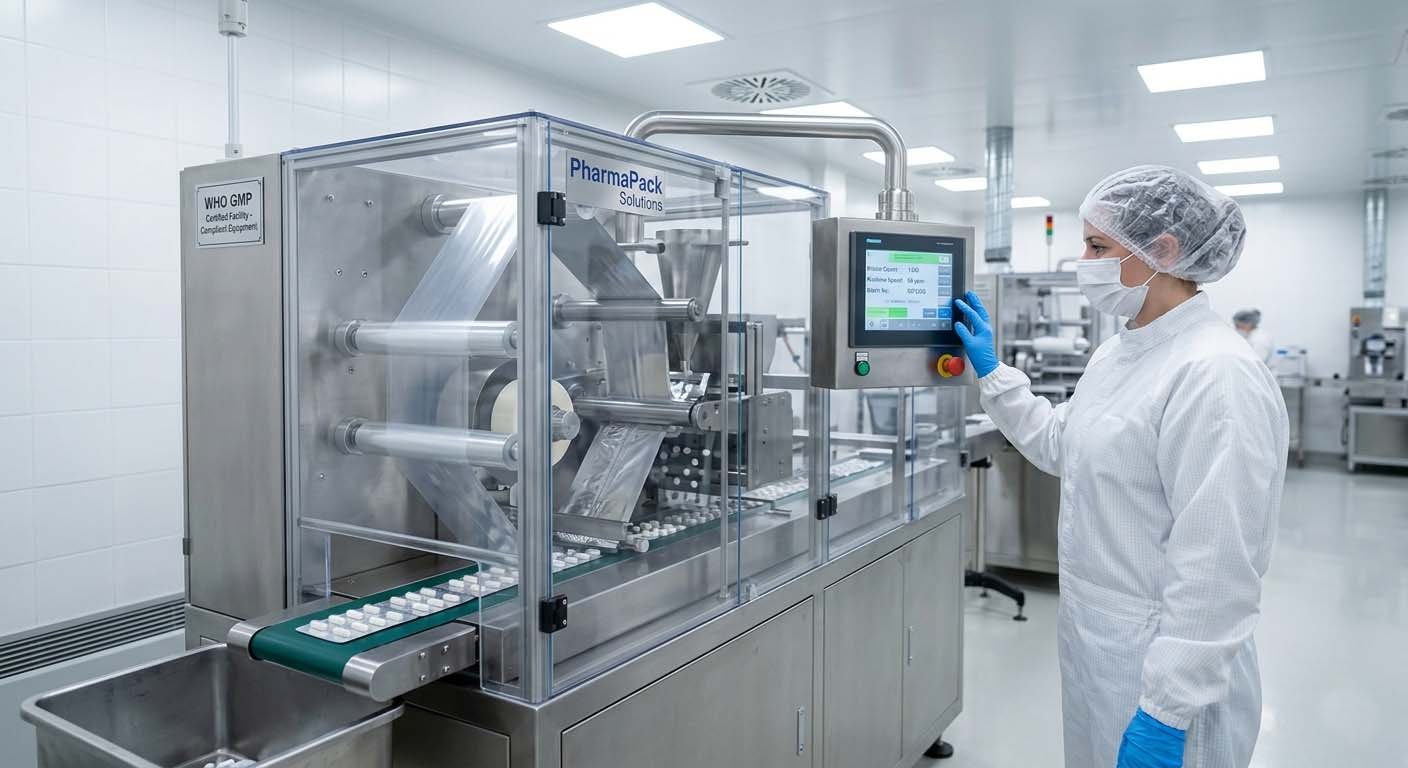
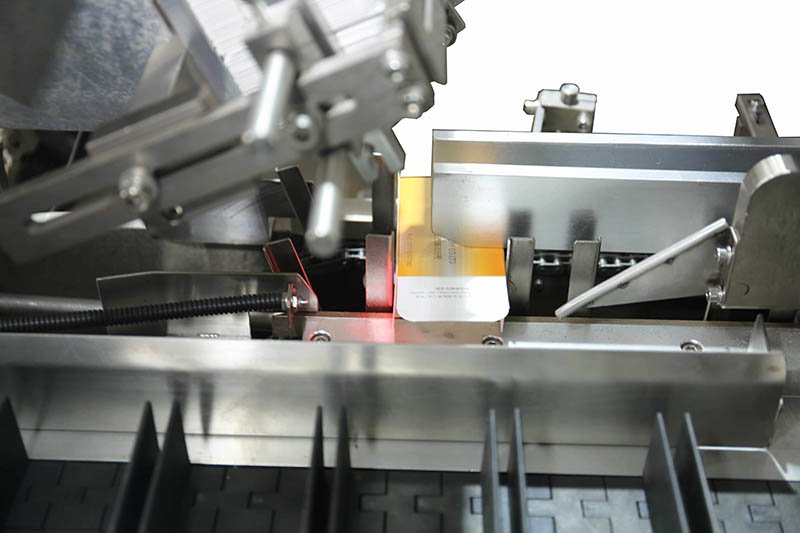
OQ execution in a GMP-certified cleanroom — environmental conditions during qualification must match the intended commercial production environment, including temperature and humidity zone classification.
When Your Validation Timeline Is Already Behind: Field Triage
Of the 31 projects in my records, 7 required what I call mid-validation triage — the project had already blown its original schedule by more than 4 weeks, and the client needed a realistic revised estimate, not reassurance. The fastest recoveries I have seen followed the same three steps.
🔧 Mid-Validation Recovery Diagnostic
⚠ Situation: Open Deviations at IQ Gate, No Resolution Owner
Each open IQ deviation must be assigned a named owner, a resolution category (OFI, minor, major, critical), and a closure date. “We are working on it” is not a closure date. In one project in Manila in 2020, 14 open IQ deviations had no assigned owner because both the supplier’s engineer and the client’s validation team assumed the other party was responsible. Six weeks stalled. One 2-hour ownership meeting resolved the assignment question. Eleven of the 14 deviations closed within 10 days.
→ Fix: Within 48 hours of identifying the delay, hold a deviation review meeting. Assign a named owner to every open item. Set a hard closure date. No closure date, no forward progress.
⚠ Situation: OQ Failing on Sealing Temperature Consistency
Sealing temperature variance beyond ±3ŶC across the sealing bar width typically indicates either a heater element degradation issue or inadequate warm-up dwell time in the OQ protocol. Check the warm-up sequence first — it is the cheaper fix by 6 weeks of heater replacement lead time.
→ Fix: Map sealing bar temperature at 5-minute intervals from cold start. If uniformity improves after 25–35 minutes and stabilizes within ±2ŶC, adjust the OQ warm-up requirement in the protocol. If degradation persists after 40 minutes, escalate to supplier for heater element inspection.
⚠ Situation: PQ Batch Failure on Seal Integrity (Dye Ingress)
ASTM F2338 dye ingress failures during PQ almost always trace to one of three causes: forming depth inconsistency (cavity wall thinning), sealing pressure below specification at cavity rim, or lidding foil lot variation between OQ and PQ execution. The foil lot change is the most common and the least documented.
→ Fix: Confirm lidding foil lot used for PQ matches OQ-qualified material. If lots differ, review supplier COA for thickness variance. A ±5% foil thickness change can shift heat transfer enough to cause seal failures at parameters that passed OQ.
What to Ask Your Blister Machine Supplier About Validation Support Before You Sign
Most suppliers will tell you they provide “validation documentation.” That phrase covers everything from a 3-page calibration certificate to a full pre-approved IQ/OQ/PQ package with site-specific acceptance criteria. Ask the specific questions below. The answers tell you in 10 minutes whether you are looking at a 4-month timeline or a 10-month one.
| Question to Ask Supplier | Good Answer (Indicates Short Timeline) | Red Flag Answer (Indicates Long Timeline) |
|---|---|---|
| “What validation documentation do you deliver at FAT?” | Pre-approved IQ protocol, OQ test matrix, calibration certificates, software validation package, material certificates | “We provide standard manuals and CE declaration.” |
| “Do your IQ/OQ protocols have pre-written acceptance criteria?” | Yes, acceptance criteria are written against your URS before FAT execution begins | “We fill those in based on FAT results.” |
| “Who is accountable for OQ deviations at the interface between forming and sealing stations?” | Single named engineer from a turnkey supplier with contractual scope for both stations | “That depends on which station has the problem.” |
| “Can you provide a GAMP 5 compliant software validation package for 21 CFR Part 11?” | Yes, we have an existing GAMP 5 Category 4 package for this PLC configuration | “We can prepare something after installation.” |
| “Have you validated a line for [my target market] regulatory authority before?” | Yes, with reference client and timeline data available on request | “Our machines meet all international standards.” |
Use these five questions as your supplier pre-qualification filter. A supplier who cannot answer questions 1 and 2 definitively will cost you months of schedule.
For buyers evaluating a pill blister packaging machine with full IQ/OQ/PQ documentation support, the DPP-260 configuration includes pre-aligned qualification templates and a dedicated validation engineer scope as standard project deliverables — not an add-on.
“Pharmaceutical packaging line validation is not a technical problem. It is an accountability problem. The machines are not difficult to qualify — the parameters are known, the test methods are published, the acceptance criteria are derivable from USP and ICH guidance. What is hard is getting three vendors, two QA teams, and one regulatory reviewer aligned on the same document at the same time. That is the problem a turnkey supplier solves. That is why it saves 6 to 8 weeks.”
— Forester Xiang, Founder, HIJ Machinery
Frequently Asked Questions: Blister Packaging Line Validation Timeline
How long does IQ/OQ/PQ validation take for a blister packaging line?
A complete IQ/OQ/PQ validation for a pharmaceutical blister packaging line takes 3 to 6 months under standard conditions — defined as: URS frozen before FAT, pre-approved protocols delivered at FAT, single vendor accountable for full line scope, and QA team available on schedule. Multi-vendor configurations without unified documentation regularly require 9 to 14 months. The IQ phase alone takes 1 to 3 weeks; OQ takes 2 to 4 weeks; PQ requires 4 to 8 weeks of consecutive batch execution and review.
What documents does a blister machine supplier need to provide for pharmaceutical validation?
At minimum: a pre-approved IQ protocol with acceptance criteria, an OQ test matrix mapped to your URS, calibration certificates for all critical instruments (temperature sensors, pressure gauges, load cells), material of construction certificates for product-contact surfaces, and software validation documentation (GAMP 5 Category 4 or 5) if 21 CFR Part 11 or EU GMP Annex 11 applies. These documents should be delivered at FAT — not after installation. If your supplier cannot commit to FAT-delivery of pre-approved IQ/OQ templates, build 6 additional weeks into your project plan.
Can validation run concurrently with installation to save time?
No. IQ cannot begin until installation is complete and utilities are qualified. However, protocol drafting, URS finalization, and VMP approval can and should run during the shipping window. That parallel workstream saves 3 to 4 weeks without compromising sequential phase integrity.
How many PQ batches are required for blister packaging line qualification?
The FDA expectation under 21 CFR Part 211 and EU GMP Annex 15 is three consecutive production batches meeting all pre-defined acceptance criteria. WHO TRS 992 Annex 3 specifies the same minimum. Some regulatory authorities — particularly CDSCO for India and BPOM for Indonesia — have historically accepted two consecutive PQ batches for domestic market registration, but three is the internationally recognized standard and the defensible position in any inspection.
What is the difference between FAT and SAT for a blister packaging machine?
FAT (Factory Acceptance Test) is executed at the supplier’s facility before shipment. It confirms the machine meets URS specifications under factory conditions and delivers pre-approved validation documentation as a contractual deliverable. SAT (Site Acceptance Test) is executed after installation at your facility. It confirms the machine performs to specification in your environment with your utilities, your film materials, and your operators. SAT is typically a subset of IQ/OQ — a good SAT saves 1 to 2 weeks of IQ execution time.
Does a turnkey blister packaging line validate faster than a standalone machine?
Yes — by 6 to 8 weeks on average, based on 31 projects commissioned between 2018 and 2023. The reason is not mechanical; it is documentary and organizational. A turnkey supplier delivers one unified IQ/OQ protocol suite covering the full line scope, one PLC validation package, and one point of accountability for all deviations. That eliminates the multi-vendor interface disputes that generate 60% of OQ phase delays in assembled configurations. For a detailed breakdown of what a full turnkey line includes, see the guide on what is included in a turnkey pill blister packaging line.
What happens if a PQ batch fails during blister packaging line validation?
A PQ batch failure requires a formal deviation investigation with root cause analysis before additional batches can be executed. The clock does not reset automatically — you can continue counting toward three consecutive passing batches once the root cause is identified, corrective action is implemented, and QA approves re-execution. Two consecutive failures typically trigger a review of OQ acceptance criteria and may require OQ re-execution at revised parameters. This is the scenario that most commonly pushes a project from the 4-month column into the 8-month column.
Is blister packaging line revalidation required after a major equipment change?
Yes. EU GMP Annex 15 and 21 CFR Part 211 both require re-qualification following any change that could affect product quality or equipment performance — including change of sealing parameters, forming tooling replacement, PLC software updates, or relocation to a new facility. The scope of re-qualification depends on the nature of the change; a tooling change may require only OQ re-execution, while a facility relocation triggers full IQ/OQ/PQ. Your change control SOP should define re-qualification triggers explicitly to avoid ambiguity during inspections.
🎯 Project Timeline Consultation
Get a Realistic Validation Timeline for Your Blister Line Project
Tell us your target market, product format, and go-live date. Forester’s team will review your project parameters and deliver a phase-by-phase validation timeline estimate — with pre-approved IQ/OQ/PQ documentation included in the HIJ turnkey project scope.