How Does a Pill Blister Packaging Machine Work?
A pill blister packaging machine runs through four mechanically synchronized stages — thermoforming, product filling, heat sealing, and die cutting — each governed by PLC-controlled servo parameters that must be matched to your specific film-foil combination. Get one parameter wrong, and you don’t get a packaging defect. You get a compliance problem. I’ve seen that distinction cost plants eight months of revalidation. This guide breaks down every stage with the engineering specifics that actually matter when you’re commissioning a line.
A pill blister packaging machine works by heating PVC, PVDC, or cold-form Alu-Alu film to create product cavities (forming), loading pills into those cavities (filling), bonding aluminum lidding foil using heat and pressure at 180–220°C (sealing), and then punching individual blister cards to final dimensions (cutting). The entire cycle is synchronized by a PLC-controlled drive system — on high-speed pharma lines, this executes at 150 to 500 blisters per minute depending on format size and film type.
The complete operating cycle of a pill blister packaging machine runs through four mechanically linked stages — forming, filling, sealing, and cutting — all executing in continuous sequence under PLC supervision. Each stage hands output directly to the next. There is no buffer zone. That’s the design principle that makes these machines fast, and it’s also the design principle that makes parameter drift dangerous.
The machine pulls forming film from a roll mounted at the feed end. The film moves forward in indexed steps — the distance of one blister card per stroke. At each index position, one or more processing stations act on the film simultaneously. By the time the film exits the die-cutting station, fully formed, filled, sealed, and punched blister cards drop onto the outfeed conveyor. On a mid-range pharmaceutical line running 260 mm stroke, the entire four-stage sequence completes 60 to 120 times per minute.
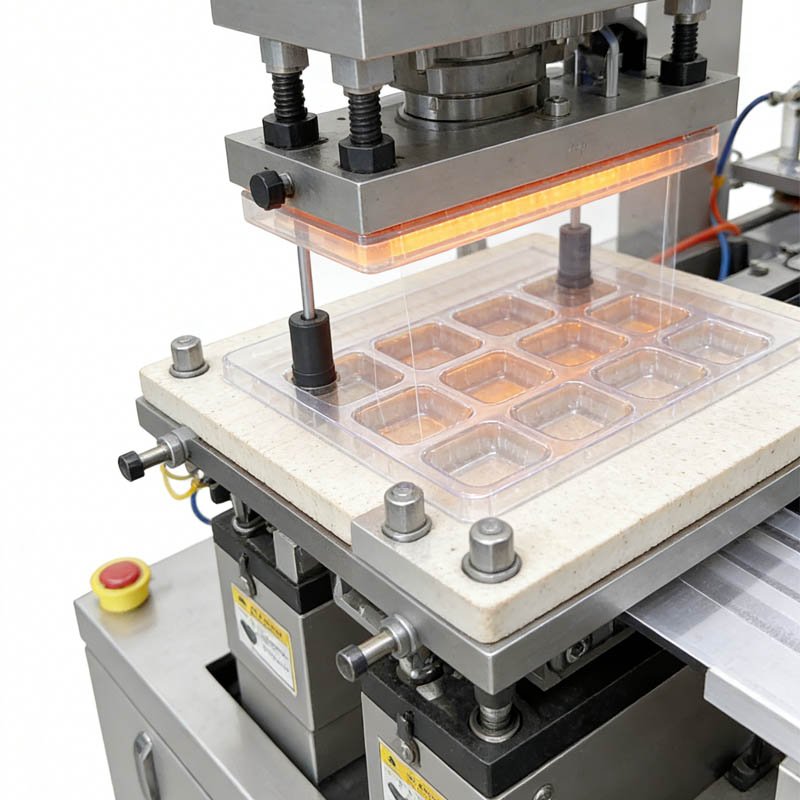
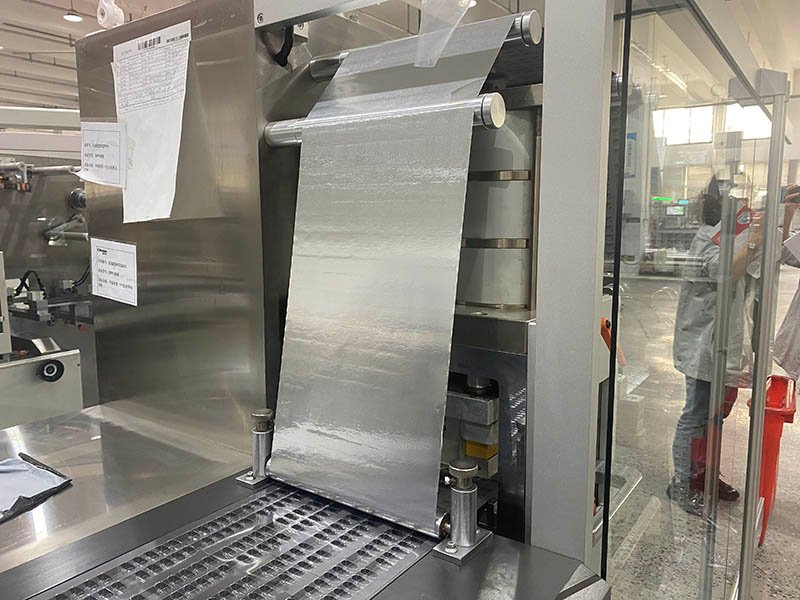
Forming station of a pharmaceutical pill blister packaging machine — PVC/PVDC film enters the heated forming die, which shapes individual cavities to product dimensions.
The step-by-step process below maps each stage. But understanding how it works mechanically is only half the picture. The half that kills projects is understanding how each stage interacts with your specific film specification, product geometry, and regulatory documentation requirements — and that’s where I’ll add the field context that spec sheets don’t include.
The forming film roll — PVC, PVDC, or cold-form Alu-Alu laminate — mounts on a dual-roll holder at the machine’s feed end. A tension control system maintains consistent film feed across the full roll diameter, from fresh spool to near-empty. Pre-heating plates raise the film to forming temperature: 130–160°C for standard PVC, lower for PVDC composite films which have a narrower forming window. Film that arrives at the forming station below its minimum forming temperature tears. Above the maximum, it thins unevenly and produces undersized cavities.
The forming station is where the film becomes a blister. A matched set of forming dies — upper and lower — compresses the heated film under pressure, typically 6–8 bar, stretching it into precisely dimensioned cavities. The cavity geometry is determined by the tooling mold, which must be machined to your specific product dimensions plus a clearance factor of 0.3–0.5 mm depending on tablet or capsule shape. On cold-form Alu-Alu lines, the forming mechanism uses cold pressure rather than heat — the aluminum laminate is pressed into shape without thermal softening, which is why cold-form cavities are less dimensionally precise but dramatically more moisture-protective. For moisture-sensitive APIs, that tradeoff is not optional.
The formed film with open cavities indexes forward to the filling station. On pharmaceutical lines, product loading uses brush feeders, vibratory feeders, or — for precision applications — robotic pick-and-place systems. The brush feeder is the most common: a rotating brush sweeps tablets across the cavity field, dropping one per pocket by gravity. Speed matters here. A filling station running at 120 cycles/min must place tablets reliably at every index position. Miss-fill rates above 0.3% trigger GMP non-conformances on most regulated lines. Camera-based vision systems integrated post-fill detect missing or broken tablets before the film reaches the sealing station — at HIJ, we specify this as standard on cGMP-configured lines.
The filled forming film feeds into the sealing station, where aluminum lidding foil is unwound from an upper roll and pressed against the forming web. Heated sealing plates contact both surfaces simultaneously, applying 180–220°C and 4–6 bar pressure for a controlled dwell time — typically 0.3 to 1.2 seconds depending on film thickness and line speed. The heat-activated lacquer coating on the lidding foil bonds to the forming film surface. Seal integrity, measured via ASTM F2338 dye-ingress or USP <1207> vacuum decay methods, must show zero dye penetration across the full sealing land area. A cold spot — a sealing plate with localized temperature drop of even 8–10°C — produces micro-leaks invisible to the naked eye but detectable in container closure integrity testing.
The sealed web moves to the die-cutting station, where a punch-and-die set cuts finished blister cards to final dimensions. Rotary punch tooling is standard on high-speed lines; flat-die cutting is used where card geometry requires unusual shapes or very tight dimensional tolerances. The die-cutting station also perforates cards — individual perfs, score lines, or child-resistant notches — all of which require separate punch elements in the tooling set. Waste film skeleton is wound onto a separate take-up roll. Finished blister cards exit onto the outfeed conveyor, typically feeding directly into a cartoner. That transition point — blister machine outfeed to cartoner infeed — is where integration errors most often cause line shutdowns.
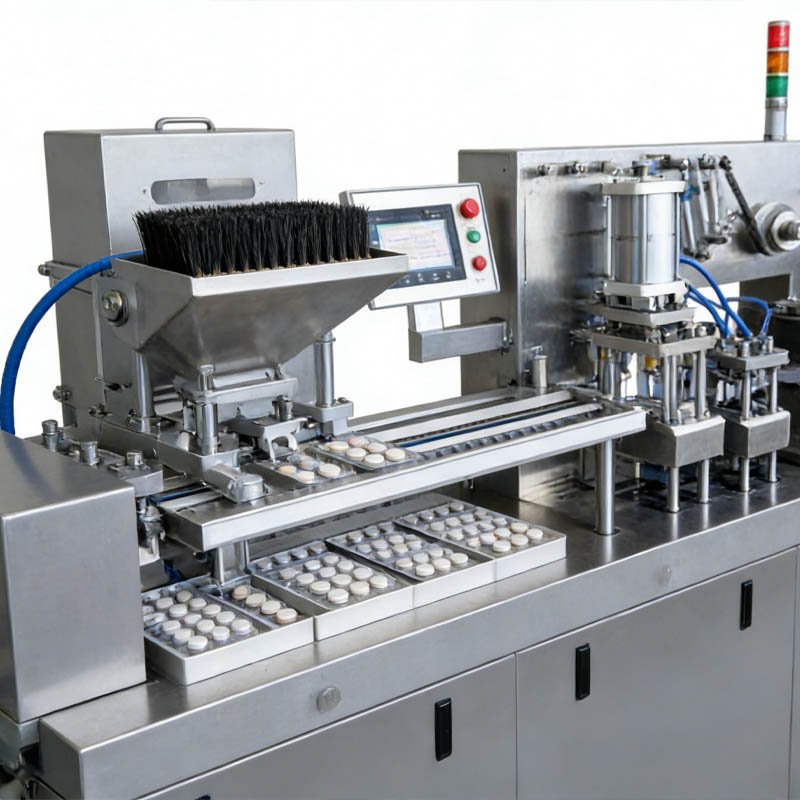
Brush-type automated feeding station — tablets are swept across the formed film web, dropping one per cavity. Miss-fill detection occurs at the integrated vision station immediately downstream.
The PLC runs everything. Every forming temperature, every sealing dwell time, every film index length, every reject gate trigger — all of it lives in the PLC program. On a cGMP-compliant line, that program is validated under 21 CFR Part 11: electronic records, audit trail, role-based access control, and change control documentation. The PLC is not just a machine controller. It’s a compliance document.
I had a conversation with a QA director in Lagos in 2022. His team had purchased a low-cost blister line without requesting the PLC validation package. Eight months after commissioning, a WHO inspector asked for the audit trail on sealing temperature deviations. It didn’t exist. The line was quarantined for three months while the software documentation was retrofitted. That’s not an edge case — of the 31 blister line projects I handled in Southeast Asia and Africa between 2018 and 2023, nine involved some version of that same compliance gap.
Servo drives govern the film indexing mechanism — the step-and-repeat motion that advances the web from station to station. Servo precision directly determines cavity position accuracy relative to the sealing die and cutting punch. On a 260 mm stroke machine running 80 cycles/min, positional repeatability must hold to ±0.2 mm across the full stroke. Drift beyond that tolerance causes sealing-land narrowing, which is a seal integrity failure waiting to happen.
The sealing station temperature range of 180–220°C is not a target — it is a validated corridor. Every degree outside that corridor is either a weak seal or a burned film. Either way, it’s a batch documentation event. Budget lines ship without validated PLC protocols, and that gap costs more to close than the price difference between machines.
— Forester Xiang, HIJ Machinery
| Stage | Critical Parameter | Typical Specification Range | Failure Mode If Out of Range | GMP Documentation Requirement |
|---|---|---|---|---|
| Film Loading | Film tension / feed rate | 5–15 N tension, ±2% consistency | Wrinkled cavities, mis-indexed web | Tension parameter in batch record |
| Thermoforming | Forming temperature / die pressure | 130–160°C / 6–8 bar | Thin walls, cavity deformation, film tear | Temperature log per batch, OQ protocol |
| Product Filling | Miss-fill detection rate | ≤0.3% miss-fill per 10,000 cavities | Empty blisters pass to seal station | Vision system reject log, 21 CFR Part 11 |
| Heat Sealing | Sealing temperature / dwell time | 180–220°C / 0.3–1.2 sec | Micro-leak, delamination, burned foil | Thermocouple calibration cert, batch log |
| Die Cutting | Punch-die clearance / positional accuracy | ±0.2 mm positional tolerance | Narrow sealing land, card dimension OOS | Dimensional check IQ/OQ record |
PVC at 250 μm passes 4–6 g/m²/day moisture vapor. That’s the number that determines whether your product is compatible with blister packaging at all. For hygroscopic APIs — the kind that show 0.8% w/w moisture uptake at 75% RH within 30 days — standard PVC is not packaging. It’s a controlled degradation schedule.
Three film families run on pharmaceutical blister lines. Each requires different machine settings, different tooling geometry, and in the case of cold-form Alu-Alu, a different forming station architecture entirely.
- PVC (Polyvinyl Chloride) — 200–300 μm: The baseline forming film. Thermoforms readily at 130–150°C, compatible with standard single-station sealing. Moisture vapor transmission rate (MVTR) of 4–6 g/m²/day. Appropriate for non-hygroscopic solid oral dosage forms in ICH Zone I and II markets.
- PVDC-coated PVC — 250/40–90 μm composite: PVDC (polyvinylidene chloride) coating reduces MVTR to 0.2–1.0 g/m²/day depending on coating weight. Forming temperature window narrows compared to plain PVC — typically 140–160°C with tighter ±3°C tolerance. Required for Zone III/IVa markets or moderately moisture-sensitive APIs.
- Cold-Form Alu-Alu — OPA/Alu/PVC laminate: MVTR drops to 0.02–0.5 g/m²/day — up to 300x lower than standard PVC. The machine’s forming station must use a cold-pressing mechanism rather than heat forming. Forming speed is lower (typically 40–80% of thermoform speed), and tooling clearance must account for the limited elongation of aluminum laminate. Required for highly hygroscopic APIs, photosensitive compounds, and Zone IVb tropical markets.

Sealing station operating at 180–220°C — heated plates press aluminum lidding foil against the filled forming web. Dwell time, temperature uniformity, and plate parallelism all determine seal integrity per ASTM F2338 and USP <1207> standards.
Post-fill vision inspection is not optional on a cGMP blister line. The FDA’s 21 CFR Part 211.68 requirement for automated processes includes computer-controlled inspection as a validation element when the output directly affects product quality. That regulation doesn’t specifically name blister machine vision systems — but FDA Warning Letters from 2019 to 2023 cite camera inspection absence in eight documented pharmaceutical packaging citations. I use that number when clients ask whether vision inspection is worth the budget.
On a properly configured line, a camera system positioned between the filling station and sealing station captures an image of every cavity field at every cycle. The image processing algorithm checks for: present product (missing tablet), correct product orientation where shape-critical, broken tablet detection where fragment size exceeds the rejection threshold, and foreign particle presence. Blisters that fail any check trigger a downstream pneumatic reject gate. The rejected card diverts before outfeed. The reject event logs to the PLC audit trail with timestamp, station ID, and failure category — the exact data structure required for 21 CFR Part 11 compliance.
Container closure integrity testing for sealed blister packs is governed by USP <1207> and ASTM F2338. WHO TRS 992 Annex 3 specifies packaging qualification requirements for pharmaceutical products distributed in developing markets — including mandatory MVTR testing at 40°C/75% RH (Zone IVb conditions) for tropical market registration. EU GMP Annex 1 (2022 revision) extends contamination control strategy requirements to primary packaging equipment, including blister machines operating in classified environments.
Two machine architectures execute the blister packaging sequence differently. The choice changes your forming quality, your line speed ceiling, and your validation complexity.
Flat-plate machines — the DPP series that represents the majority of pharmaceutical installations globally — use flat forming dies that press against the entire blister card area simultaneously. Every cavity forms at the same time. Sealing likewise uses flat plates covering the full card. This produces excellent dimensional uniformity and consistent seal quality across the card width. The forming-to-sealing station relationship is rigid — changing card format requires complete tooling changeover. On a well-tooled line like the HIJ DPP-260 pill blister packaging machine, a full tooling change runs 45–90 minutes with trained operators following a documented changeover SOP.
Roller-type machines use rotary forming and sealing stations — the film wraps around a heated drum, and cavities are formed as the drum rotates. Continuous motion rather than step-and-repeat. The speed ceiling is higher — roller machines can run 400–600 cards/minute — but cavity depth is limited by drum geometry, and cold-form Alu-Alu is generally incompatible. For high-volume, single-SKU thermoform production, roller architecture makes sense. For a mixed-product pharmaceutical line with multiple tablet formats, flat-plate gives you the validation flexibility you need.
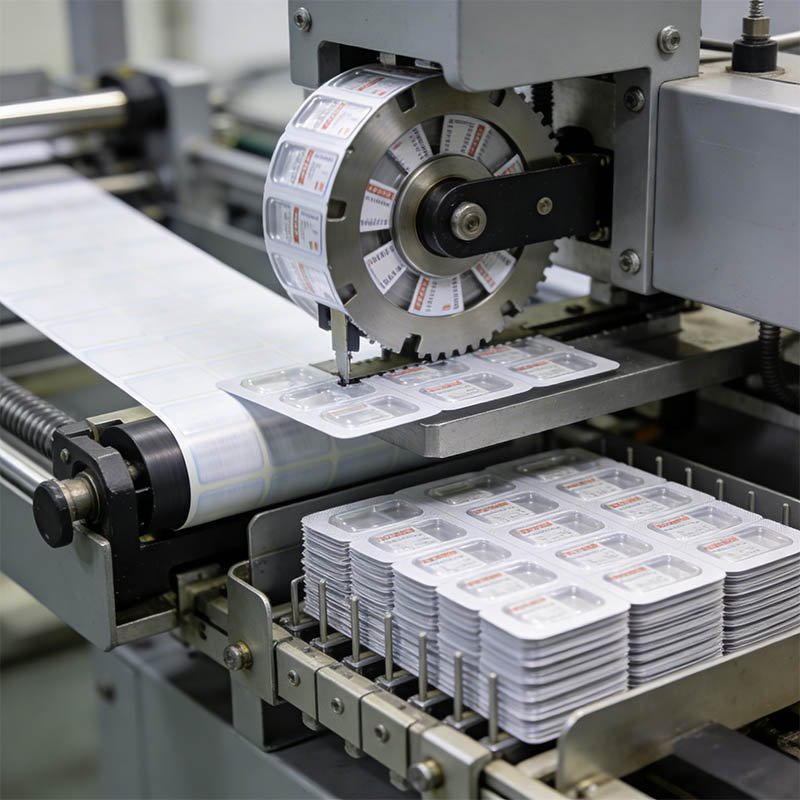
Die-cutting station using rotary punch tooling — the sealed blister web is punched to final card dimensions, with waste film skeleton winding onto a separate take-up roll. Positional accuracy at this station must hold to ±0.2 mm relative to the sealing land.
The forming, filling, sealing, cutting sequence is not where most blister line failures originate. I’ve seen more batch losses caused by the film-to-machine interface than by the machine itself. Buyers select a machine based on speed specs, then discover the sealing station can’t maintain consistent 180–220°C thermal output under eight-hour continuous production. That’s not a machine fault — it’s a thermal equilibrium problem that wasn’t validated during FAT. Budget machines rarely ship with validated PLC protocols or cGMP-compliant documentation, leaving your FAT/SAT process exposed. Before signing any purchase order, demand a full URS review against your forming film — whether PVC/PVDC, Alu-Alu, or cold-form — and verify the machine’s changeover architecture supports your SKU range. At HIJ, every line ships with validated PLC protocols, thermocouple calibration records, and IQ/OQ documentation ready for your regulatory submission. That’s not marketing. It’s eight months of revalidation time I’ve watched other buyers lose.
The blister machine does not operate in isolation. Its outfeed connects — directly or via conveyor — to a cartoner, which loads finished blister cards into folding cartons. That connection point is where I spend a disproportionate amount of time on every project I commission.
The blister machine’s outfeed speed — cards per minute — must match the cartoner’s infeed speed within a defined tolerance window. Too fast, and cards pile up and jam. Too slow, and the cartoner starves and produces empty carton rejects. On a properly engineered line, a buffer conveyor with sensor-controlled speed regulation sits between the two machines. The PLC on each machine communicates via a standard I/O handshake — start, stop, fault signals. Missing or incorrectly wired handshake signals are the single most common commissioning delay I encounter.
For lines where the blister machine feeds directly into a high-speed output configuration, the synchronization architecture must be planned at the design phase — not retrofitted after installation. I won’t tell you this integration is simple. It involves servo communication protocols, card pitch timing, carton infeed geometry, and sometimes a frank conversation about whether the cartoner you already own is compatible with the blister machine you’re about to order.
Three things. Not one of them appears prominently in a typical spec sheet. I know because I’ve reviewed hundreds of them.
First: thermal management architecture. The sealing station must maintain ±2°C uniformity across the full plate surface for the duration of an eight-hour production shift. That requires zone-controlled heating, not single-point thermocouple feedback. Budget machines use a single heater and a single thermocouple. Temperature drift is inevitable. On a validated pharmaceutical line, you need multi-zone PID control with independent thermocouple logging per zone. When the inspector asks for your sealing temperature trend data for Batch 2024-11-07, that data must exist and be retrievable by batch number within five minutes.
Second: servo precision and repeatability. The film index servo must hold positional repeatability to ±0.2 mm across 10,000 consecutive cycles — not just the first 100 during FAT. This requires servo motor specification, gearbox quality, and a mechanical design that isolates the index drive from vibration generated by the forming and sealing stations. I’ve seen lines where the forming station vibration degrades servo encoder signals after 18 months. The manufacturer had never run a 12-month endurance test.
Third: documentation package. A pill blister packaging machine that cannot ship with an IQ protocol template, OQ test script, calibration certificate package, spare parts list, and PLC ladder diagram is not a pharmaceutical machine. It’s a food-grade machine with a pharmaceutical price tag. The documentation is not an add-on. It’s the machine. For an overview of what a complete blister packaging machine actually is at the system level, the blister packaging machine definition guide covers the full machine taxonomy before you go into process detail.
A pill blister packaging machine forms cavities by heating PVC, PVDC, or cold-form Alu-Alu film to 130–160°C, then pressing the softened film against a matched forming die under 6–8 bar pressure. The die geometry determines cavity shape and depth — machined to your product dimensions plus a 0.3–0.5 mm clearance factor. Cold-form Alu-Alu uses pressure without heat, producing superior moisture protection but slower forming speeds and less dimensional flexibility.
The sealing station on a pharmaceutical blister packaging machine operates at 180–220°C, with dwell time between 0.3 and 1.2 seconds depending on line speed and film thickness. The specific setting for your line is determined during process validation — it’s not a fixed default. Temperature uniformity across the plate matters more than the nominal setpoint: a ±2°C tolerance across the full sealing area is the validated threshold for most pharmaceutical applications.
Speed depends on machine type, format size, and film. Flat-plate pharmaceutical blister machines typically run 60–200 cards per minute for standard tablet formats. High-speed roller-type machines reach 400–600 cards per minute on thermoform film. Cold-form Alu-Alu lines run at 40–80% of equivalent thermoform speed due to the cold-pressing forming mechanism. For a detailed breakdown of output calculations by machine model and product format, the pill blister packaging machine speed and output guide covers the math behind real production planning.
Too low: the heat-activated lacquer on the lidding foil doesn’t fully activate. The seal appears visually complete but fails dye-ingress or vacuum decay testing under USP <1207>. Micro-leaks allow moisture vapor transmission, compromising API stability. Too high: the lidding foil burns or discolors, the forming film deforms under excessive heat, and the sealing land area may show adhesive bleed-out — creating dimensional non-conformances on the finished card. Both failure modes can pass visual inspection entirely, which is why in-process container closure integrity testing is mandatory on regulated lines.
Yes, with tooling changes. The forming dies and filling station components must be changed to match the product geometry. Capsules require different cavity depth and sidewall angle compared to round or oval tablets. Changeover time on a well-designed pharmaceutical blister line runs 45–90 minutes with documented SOPs. Lines designed for multi-product use should have a quick-release tooling system — tool-less or single-bolt changeover — and each format’s parameters stored as a PLC recipe for recall without re-entry.
Thermoform uses heat to soften the forming film (PVC or PVDC) into cavity shapes — fast, flexible, lower film cost. Cold-form presses an Alu-Alu laminate into shape without heat — slower, less dimensionally precise, but with moisture vapor transmission rates 10 to 300 times lower than thermoform PVC. Cold-form is required for highly hygroscopic APIs, photosensitive compounds, and products registered for Zone IVb tropical markets where ICH Q1A(R2) long-term stability testing at 40°C/75% RH applies.
Yes — any blister packaging machine used in pharmaceutical production for regulated markets requires IQ (Installation Qualification), OQ (Operational Qualification), and PQ (Performance Qualification) under WHO TRS 992 Annex 3, EU GMP Annex 15, and equivalent national standards. For US market production, 21 CFR Part 211 governs equipment qualification and 21 CFR Part 11 governs computerized systems including the PLC and any electronic records generated by the machine. The machine supplier should provide IQ/OQ protocol templates and a calibrated instrument package as part of the standard delivery scope.
The PLC (Programmable Logic Controller) controls every operating parameter: forming temperature zones, sealing temperature and dwell time, film index length and speed, vision system integration, and reject gate triggers. On a cGMP-compliant line, the PLC operates under 21 CFR Part 11 — electronic audit trail, role-based access control, parameter change logging, and batch record generation. The PLC program is a validated document, not just machine software. Changing a sealing temperature setpoint must be controlled, recorded, and reviewable. That’s not optional on a regulated line — it’s the compliance architecture.
Every HIJ pill blister packaging machine ships with validated PLC protocols, IQ/OQ documentation templates, thermocouple calibration records, and a full technical review against your forming film specification. Talk to Forester’s engineering team before you finalize your RFQ.