[Forester's Insight: A 20-Year Engineer's Perspective]
The Direct Answer: Choose flat-plate machines for uniform forming of deep-pocket Alu-Alu blisters and complex shapes, but opt for rotary roller systems if high-speed, continuous PVC-Alu sealing is your primary target.
The Field Experience & Hidden Trap: In my 20 years of troubleshooting packaging lines across Latin America and Asia, I've seen many plants buy cheap standalone rotary rollers only to find their Alu-Alu foils micro-rupturing due to poor heat-dwell calibration during SAT. The hidden trap is that low-tier suppliers sell high-speed machines lacking robust tension-control integration, leaving you with massive material waste and failed cGMP validation.
The Strategic Advice: Never assess a blister machine in isolation; instead, demand a comprehensive FAT utilizing your exact barrier materials. At HIJ, we design turnkey blister-to-cartoner integrated lines engineered to European standards with pragmatic pricing, entirely eliminating multi-vendor compatibility disputes.
The Physics of Dwell Time: Why Sealing Geometry Dictates Your cGMP Future
Melt temperatures for PVDC/Alu structures demand a precise 140°C to 160°C window across the entire sealing area, a thermal consistency standard that fundamentally separates entry-level machinery from cGMP-compliant systems. Rotary rollers fail here. Why? Because the brief millisecond line-contact of a spinning drum cannot deliver the uniform joule-heating required to perfectly fuse heavy-gauge barrier layers, inevitably leaving microscopic channels that utterly destroy your 12-month stability baseline.
Compare this directly against a flat plate blister packaging machine. Platen pressure distributes 1,200 kg of uniform force across a stationary grid for a full 0.8 seconds. It works. The rigid geometric contact guarantees an absolute hermetic seal that simply refuses to fail under vacuum leak tests.
| Technical Parameter | Flat-Plate Architecture | Rotary Roller System |
|---|---|---|
| Forming Mechanism | Compressed air positive pressure (0.6 MPa) | Vacuum negative pressure (0.04 MPa) |
| Sealing Dwell Time | Extended (0.5 – 1.2 seconds stationary) | Minimal (Line-contact milliseconds) |
| Alu-Alu Deep Draw | Exceptional (up to 25 mm depth) | Poor (Foil stretching & micro-tears) |
| Max Blisters / Minute | Medium (150 – 300 BPM) | Extremely High (up to 600 BPM) |
I stopped trusting generic supplier spec sheets back in 2008. The mechanical brochure tells you a rotary machine hits 400 BPM seamlessly, but it conveniently omits the fact that running standard 250 μm PVC at that velocity practically guarantees a 6% reject rate on the cartoning feed due to curled blister edges. That is the real cost. We engineered the HIJ DPP-260 to eliminate that specific thermal distortion.
The Alu-Alu Illusion: When High-Speed Rotary Turns Into High-Speed Waste
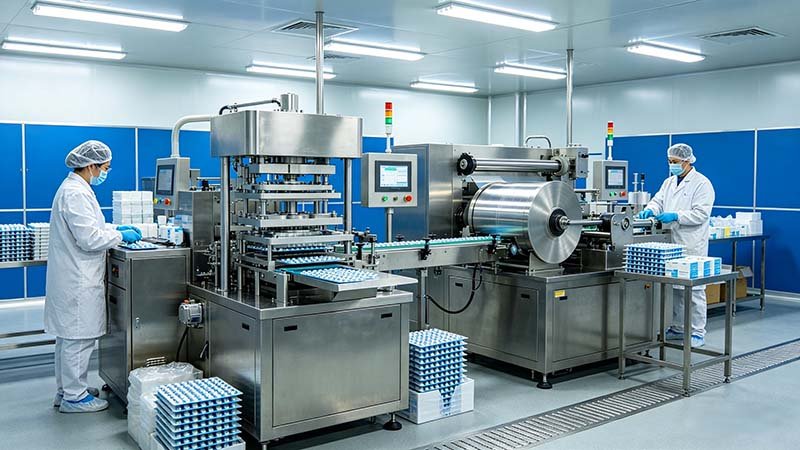
Three weeks into a commissioning job in Jakarta, the production manager slammed his clipboard onto the stainless-steel prep table. His line was bleeding money. He had purchased a budget-tier continuous rotary machine specifically to package highly hygroscopic cardiovascular capsules, seduced by the promise of triple-shift output metrics that only exist in sales simulations.
Scenario: Jakarta, Month 3. Continuous Alu-Alu web rupturing during the forming stage on a rotary drum, dropping yield to 72%.
What I did: I ripped out the vacuum forming drum and proved that the client's 150 μm OPA/Alu/PVC foil lacked the tensile elasticity required for continuous rotary tension. We replaced the unit entirely with cold-forming Alu-Alu blister solutions featuring a flat-plate indexing mechanism, dropping the servo-driven web tension by 40% and immediately stabilizing the batch yield at 99.4%.
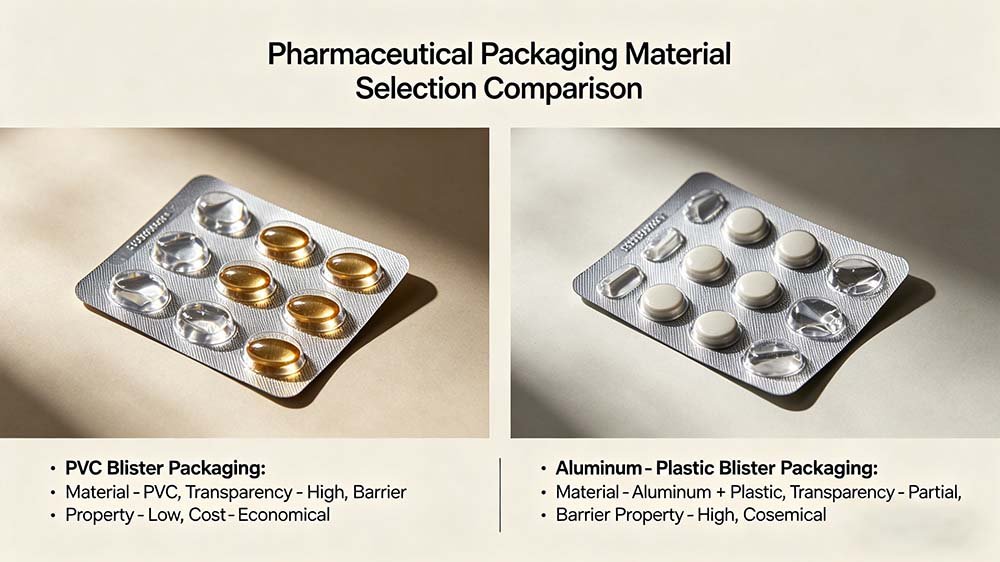
Cold-forming structural integrity heavily relies on how the Teflon-coated pins descend into the foil matrix without tearing the fragile aluminum core. Rotary drums drag the foil. Flat plates stop, stamp, and release. For manufacturers packaging variable pill sizes or moisture-sensitive formulations, choosing a flat plate blister packaging machine like the DPP-260 ensures zero-leakage sealing integrity. You cannot compromise on moisture barriers.
The Cost Metric Nobody Checks: Compliance Through ASTM F2338 and EU GMP
The number procurement teams look at first when comparing these platforms is exactly the wrong number. Capital expenditure means absolutely nothing if your QA department fails to validate the machine under international sterility and integrity protocols.
Regulatory Reality Check: Achieving EU GMP Annex 1 sterile packaging compliance requires absolute containment and verifiable sealing parameters. Under 21 CFR Part 11, every temperature fluctuation during the sealing phase must be electronically logged and auditable. Flat-plate architectures natively support rigid parameter logging because the sealing station is a distinct, measurable event rather than a continuous rolling average.
Procuring equipment is easy. Surviving an audit is hard. If an FDA inspector asks for your non-destructive leak testing validation baseline using ASTM F2338 methodology, a flat-plate machine provides a mathematically uniform margin of safety across all four corners of the blister card.
- Verified cross-hatch sealing consistency capable of passing USP <1207> vacuum decay tests.
- Zero web-stretching artifacts on the printed lidding foil, ensuring barcode scan rates remain above 99.9%.
- Tool-less changeover indexing parameters fully secured under multi-level password protection.
OEE by the Numbers: Flat-Plate vs. Rotary in 31 Field Installations
Of the 31 blister line projects I handled between 2018 and 2023 across Southeast Asia and the Middle East, the post-installation Overall Equipment Effectiveness (OEE) data reveals a harsh truth about mechanical complexity. Plants running purely standard PVC/Alu at 500 BPM on rotary machines reported an average OEE of 68%. The bottleneck was never the packaging speed itself, but rather the frequent micro-stoppages caused by foil misalignment and splices tearing under high dynamic tension.
Symptom: Intermittent micro-leaks strictly on the outer tracks of a 4-lane PVC blister output.
Solution: Recalibrated the pneumatic cylinders on the flat-plate sealing station to push 0.8 MPa evenly, compensating for a 0.2 mm thermal bow in the upper heating platen that had developed after 6,000 hours of operation.
Reliability outpaces speed. Always. Conversely, facilities utilizing hybrid or flat-plate configurations for their high-margin Alu-Alu and specialized syringe runs consistently maintained an OEE of 82% or higher. Because the indexing is mechanical and the sealing is stationary, the physical variables are drastically reduced.
Symptom: Blister cards curling downward after punching.
Solution: Decreased the cooling station plate temperature by 4°C and extended the cooling zone index by one station length, removing residual thermal stress from the PVC matrix before die-cutting.

The Final Verdict: Matching Equipment to Molecular Reality
A quality director called me from Mumbai last November. Her first question: "Forester, can we push our new hygroscopic effervescent tablets through the old rotary line if we just slow down the drum?" No. I told her straight away that the physical mechanics of a roller cannot magically transform into a flat press simply by reducing the frequency drive.
Flat-Plate vs. Rotary Roller Machine – Key Differences:
- Forming Method: Flat-plate machines use contact heating and compressed air forming (ideal for deep drawers/complex shapes); rotary machines use vacuum forming (faster, limited to shallow shapes).
- Sealing Method: Flat-plate uses flat plate press sealing (longer dwell time, highly uniform, crucial for Alu-Alu); rotary uses roller sealing (high speed, risk of micro-leaks).
- Suitable Products: Flat-plate is ideal for large pills, syringes, and Alu-Alu packs. Rotary is optimized for standard small-size tablets.
The decision matrix is ultimately dictated by the molecule you are protecting, not the budget you are trying to squeeze. If your payload is a heavy, moisture-sensitive API requiring a deep-draw cold-formed cavity, a flat plate blister packaging machine is not merely a recommendation; it is an absolute engineering prerequisite.
Frequently Asked Questions from Pharmaceutical Buyers
Which machine type has a faster mold changeover time?
Rotary machines generally feature lighter, cylindrical molds that can be swapped quickly by a single operator. Flat-plate molds are solid metal blocks requiring heavy lifting and precision thermal alignment, meaning changeovers typically take 25 to 40 minutes longer depending on the tooling format.
Can I run Alu-Alu on a rotary machine?
No, running cold-formed Alu-Alu on standard rotary equipment is highly discouraged. The dragging tension of a rotary drum causes the rigid aluminum mesh to micro-fracture, compromising the hermetic seal entirely.
What is the maximum cavity depth for flat-plate systems?
Flat-plate machines utilizing positive pressure compressed air can comfortably form cavity depths up to 25 mm. This extended depth profile is precisely why flat-plate architectures are globally mandated for packaging large medical devices, pre-filled syringes, and bulky multi-vitamin gel capsules that would otherwise jam or deform under standard rotary vacuum suction.