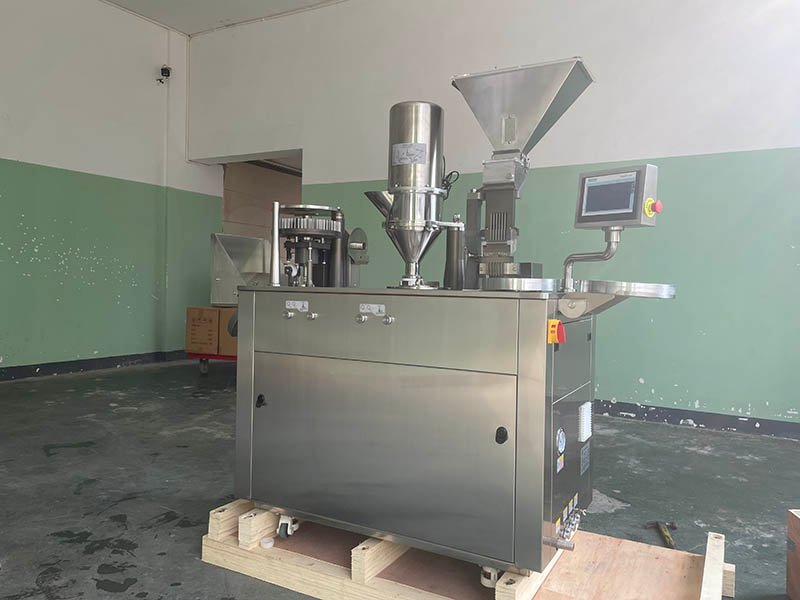
Tamping pin systems compress powder into the bores of a rotating dosing disc in successive stages, forming a coherent slug that is transferred into the capsule body — the standard choice for free-flowing powders and granules. Dosator systems plunge a hollow cylinder directly into the powder bed and draw a measured slug into the tube — better suited to cohesive, sticky, or low-dose formulations. Neither is universally “better”: the correct system is decided by your powder’s flow behavior, which is why HIJ configures its capsule filling machines with either technology after free filling trials with your actual formulation.
Key Takeaways
- The powder decides, not the catalog. Bulk density, cohesion, particle size distribution, and moisture sensitivity determine which dosing system will hold weight consistency at production speed.
- Tamping pin = staged compression in a dosing disc. Best for free-flowing powders and granules; weight is tuned via powder bed height, tamping pressure, and disc bore volume — delivering ±2% accuracy on HIJ NJP-Series machines.
- Dosator = direct slug capture in a cylinder. Shines on cohesive and poorly flowing blends, and on low fill weights where a stable slug must be formed from minimal material.
- Changeover and cleaning differ. Each system has its own tooling set, wear parts, and cleaning profile — relevant to multi-SKU B2B operations planning changeover budgets.
- Borderline powders get tested, not guessed. Free filling trials with your formulation settle the question empirically before you commit capital.
Once a B2B buying team has settled machine class and capacity — the subject of our capsule filling machine overview — the next specification decision is the one that most directly controls filling quality: the dosing system. Two technologies dominate hard-capsule powder filling worldwide, and the wrong choice shows up as weight variation, capping problems, and yield loss that no amount of operator skill fully fixes. Here is how each system works, where each wins, and how to decide for your formulation.
How Tamping Pin Dosing Works
The tamping system is built around a rotating dosing disc that sits inside the powder hopper beneath a controlled powder bed. As the disc indexes, sets of tamping pins press down into the disc bores in successive stages, each stage compacting a little more powder into the bore. By the final station, the bore contains a coherent slug of highly repeatable weight. At the transfer position, ejection pins push the slug down into the waiting capsule body — the mechanism we walk through station-by-station in our NJP rotary cycle guide.
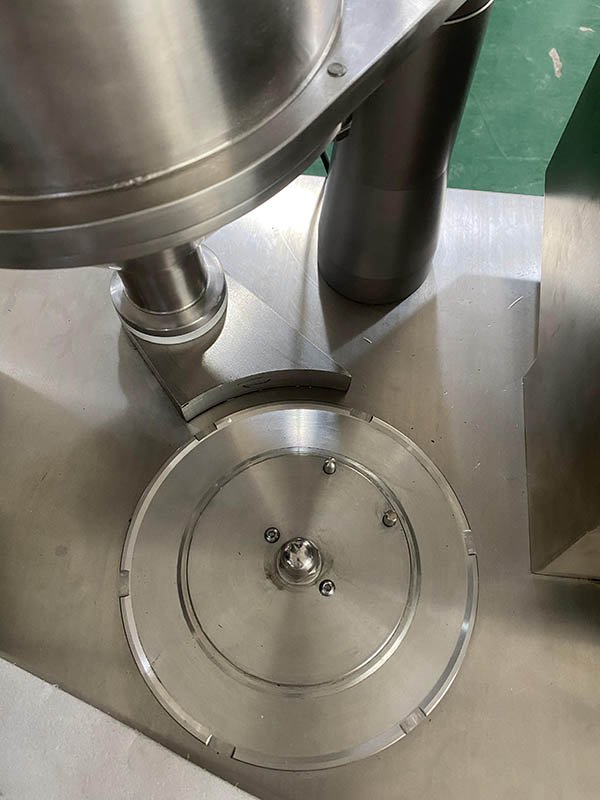
Weight control lives in three parameters — powder bed height, tamping pressure, and disc bore volume — all recipe-stored on the Siemens PLC. Because the slug is built gradually from a maintained powder bed, the system rewards powders that flow consistently and refill the bed evenly between cycles. On HIJ NJP-Series machines this configuration delivers ±2% dosing accuracy at up to 120,000 capsules per hour.
Where Tamping Pin Wins
- Free-flowing powders and granulated formulations with stable bulk density
- Medium to high fill weights where a robust slug forms naturally
- High-speed continuous production — the staged process is inherently smooth at rotary speeds
- Formulations sensitive to over-compression: total compaction force is distributed across stages and kept low compared with tableting
How Dosator Dosing Works
A dosator is a hollow cylinder with an internal piston. The cylinder plunges directly into a powder bed of controlled depth; powder enters the tube and is lightly compacted against the piston, capturing a slug whose weight is set by the piston position (dosing chamber volume) and the powder bed depth. The dosator then lifts, moves over the capsule body, and the piston ejects the slug directly into it.
Because the slug is captured in one direct action from the bed — rather than built stage-by-stage — the dosator tolerates materials that bridge, rat-hole, or smear in a dosing disc. It is the configuration we specify on the powder capsule filling machine platform when trials show a formulation is too cohesive for stable tamping.
Where Dosator Wins
- Cohesive, sticky, or poorly flowing powders — including many botanical extracts and fine APIs
- Low fill weights and low-dose formulations, where a small, stable slug must be formed from minimal material
- Powders prone to segregation: the short path from bed to capsule limits opportunities for the blend to separate
- Formulations needing minimal compression, since compaction inside the tube is light and adjustable
Tamping Pin vs Dosator: Head-to-Head
| Criterion | Tamping Pin (Dosing Disc) | Dosator (Cylinder & Piston) |
|---|---|---|
| Ideal materials | Free-flowing powders, granules | Cohesive, sticky, fine, or poorly flowing powders |
| Slug formation | Built in successive tamping stages in disc bores | Captured in one direct plunge into the powder bed |
| Weight adjustment | Powder bed height, tamping pressure, disc bore volume | Piston position (chamber volume), powder bed depth |
| Low fill weights | Possible, but slug integrity limits how low | Strong — small chambers form stable low-dose slugs |
| High-speed rotary duty | Excellent — native to NJP-class rotary machines | Good — speed governed by plunge-and-transfer cycle |
| Segregation-prone blends | Managed with gentle agitation and short pathways | Naturally short path limits separation |
| Cleaning & changeover | Disc and pin sets swap tool-free; flat surfaces clean fast | Cylinder/piston sets removed as units; bores need attention |
| Wear parts | Pins and disc bores | Cylinder bores and piston seals |
A Decision Framework by Powder Behavior
In practice, the selection conversation starts with five questions about your formulation — the same ones our engineers ask before any filling trial:
- Does it flow? Consistent flow through a funnel test points to tamping; bridging and clumping point to dosator.
- What is the fill weight? Very low doses favor the dosator’s small-chamber slug capture.
- Is the blend segregation-prone? Multi-component blends with divergent particle sizes benefit from the dosator’s short path — or from re-granulating the formulation for tamping.
- Is it moisture-sensitive or hygroscopic? Either system can be run with dehumidified enclosures; what matters is how the powder bed behaves as ambient exposure accumulates.
- Is it abrasive? Mineral-heavy and botanical formulations wear tooling; hardened dosing components extend service life on both systems.
Note that this decision is about powder in hard capsules. Oils and suspensions bypass both systems entirely in favor of pump dosing on a liquid capsule filling machine, and pellets use counting tooling on the automatic NJP platform.

Buying teams sometimes arrive with the dosing system already written into their URS — copied from a previous machine or a competitor’s brochure. I always ask the same question: has this exact formulation, at this exact fill weight, actually run on that system? Powders are humbling. I have seen “easy” excipient blends misbehave the moment a new supplier changed particle size distribution, and “impossible” sticky extracts run beautifully once the bed depth and tamping profile were tuned.
This is why we refuse to specify a dosing system from a datasheet alone. Send us a few kilograms of your real blend; we run it on both configurations if the case is borderline, and you receive the weight-variation data from each. The system that wins in the data is the one that goes in your machine — and that same data becomes the baseline for your FAT. It costs you a powder sample and saves you a wrong machine.
What This Means for Your Purchase
Specify the dosing system in your URS as an outcome, not a technology: “demonstrated weight variation within ±X% at rated speed with our formulation” is a requirement every serious vendor can be held to at FAT, whichever system they propose. Sizing the machine around that demonstrated performance — rather than brochure claims — is covered in our size selection guide, and the cost implications of tooling and configuration choices are broken down in the capsule filling machine price guide.
About HIJ Machinery & This Article
HIJ Machinery (legal name: Wenzhou Trustar Machinery Technology Co., Ltd) is a pharmaceutical, nutraceutical, and food packaging machinery manufacturer founded in 2004 in Rui’an, Wenzhou, Zhejiang, China. The company configures its NJP-Series and powder capsule filling machines with tamping-pin or dosator dosing based on customer powder trials, and exports to 30+ countries. HIJ equipment is cGMP-ready and CE-marked, manufactured under ISO 9001 manufacturing standard.
This article was written and reviewed by Forester Xiang, founder and chief engineer of HIJ Machinery, based on 20+ years of encapsulation engineering experience and 100+ pharmaceutical facility audits. Contact: hijpackingmachine.com/contact-us
Frequently Asked Questions
What is the difference between tamping pin and dosator dosing?
A tamping pin system builds the powder dose gradually, compressing powder into the bores of a rotating dosing disc in successive stages before transferring the finished slug into the capsule body. A dosator captures the dose in one action, plunging a hollow cylinder into the powder bed and drawing a measured slug against an internal piston. Tamping suits free-flowing powders and granules; dosators suit cohesive, sticky, and low-dose formulations.
Which dosing system is more accurate?
Neither system is inherently more accurate — accuracy depends on matching the system to the powder. A tamping-pin configuration on HIJ NJP-Series machines delivers ±2% dosing accuracy with free-flowing materials, while a dosator will typically outperform tamping on cohesive or very low-dose formulations where a disc-built slug becomes unstable. The reliable comparison is empirical: run your formulation on the candidate system and evaluate the weight-variation data.
Which system is better for sticky or poorly flowing powders?
Dosator systems generally handle sticky, cohesive, and poorly flowing powders better, because the slug is captured directly from the bed in one short action rather than depending on powder refilling disc bores consistently between tamping stages. That said, many borderline formulations run well on tamping systems once bed depth, tamping pressure, and hopper agitation are tuned — which is why filling trials, not assumptions, should make the call.
Can one capsule filling machine use both tamping pin and dosator systems?
The dosing station is a configuration choice made when the machine is specified and built, and each system uses its own tooling set. Machines are ordered in one configuration for their intended product range; operations running formulations that genuinely require both technologies typically dedicate a machine to each, or consolidate formulations toward one system. Discuss your full product portfolio with the manufacturer before specifying, so the configuration covers your realistic SKU range.
How do I know which dosing system my formulation needs?
Send a sample of your actual production blend for filling trials. HIJ runs free trials at the Rui’an facility, testing borderline formulations on both tamping and dosator configurations and returning the weight-variation data from each, so the choice is made on evidence with your real powder. The winning configuration is then specified in your machine and demonstrated again at the Factory Acceptance Test before shipment.
Let Your Powder Make the Decision
Send Forester your formulation type, fill weight, and target output — and arrange free filling trials with your actual blend. You’ll get weight-variation data, a dosing system recommendation, and a detailed quotation, usually within 48 hours.
Get Free Turnkey Quote