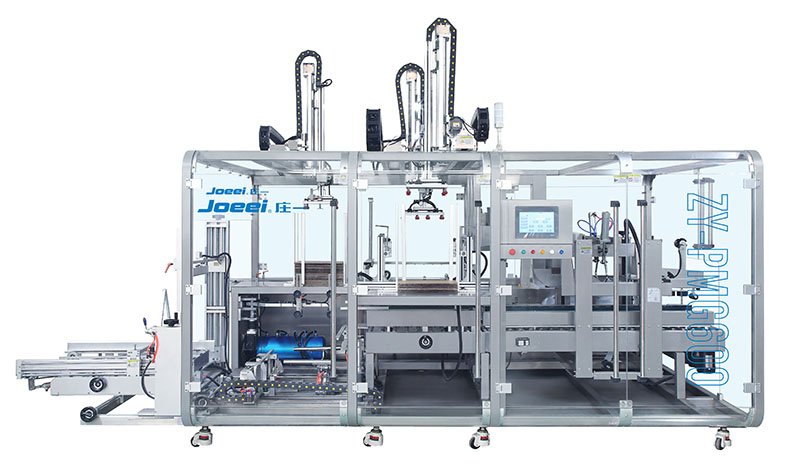
Quick Answer — Featured Snippet
An automatic blister packing machine works by moving a continuous base film (PVC, PVDC, or aluminum) through seven synchronized stations: (1) film feeding, where the roll-stock is unwound and guided into the machine; (2) heating, where a heated plate softens the film to a pliable state; (3) cavity forming, where compressed air or a mechanical punch presses the softened film into a mold to create product-shaped pockets; (4) product filling, where tablets, capsules, or other items are placed into the cavities by gravity or a brush/vibratory feeder; (5) heat sealing, where an aluminum lidding foil is bonded to the filled web under precisely controlled temperature and pressure; (6) batch printing, where a hot-stamp or inkjet unit imprints the lot number and expiry date; and (7) die-cutting, where a punching die cuts the sealed web into individual finished blister cards. The entire sequence is driven by a servo motor and PLC, ensuring every station operates in precise synchronization.
Table of Contents
Why Understanding the Working Principle Matters Machine Overview: The Anatomy of a Blister Packer Station 1 — Film Loading & Feeding Station 2 — Heating Station Station 3 — Forming Station Station 4 — Product Filling Station Station 5 — Heat Sealing Station Station 6 — Batch Printing Station Station 7 — Perforating & Die-Cutting Thermoforming vs. Cold Forming: Which Do You Need? Case Study: DPP-260 Fully Automatic Blister Machine 3 Common Process Failures (and How to Prevent Them) Frequently Asked QuestionsWhy Understanding the Working Principle Matters
“Before you evaluate a machine’s price, evaluate its process. That’s the single most expensive mistake I see buyers make — and I’ve seen it cost companies months of rework and hundreds of thousands in regulatory penalties.”
— Forester, Founder, HIJ Machinery
After two decades of commissioning blister lines across Asia, Europe, and Latin America, I have watched the same pattern repeat itself: a purchasing team focuses entirely on price per unit and output speed, signs the contract, and three months later discovers that the forming station temperature isn’t consistent across the full web width — resulting in weak cavities, product damage, and eventually a batch recall.
The blister packing machine is not a single device. It is a multi-station process system in which each station must operate within tight tolerances and synchronize perfectly with every other station. If forming temperature drifts by 10°C, cavities come out shallow. If sealing pressure is uneven, you get micro-leaks invisible to the naked eye that only fail during accelerated stability testing. If die-cutting force is inconsistent, you get ragged edges that block automated cartoning downstream.
Understanding how this machine actually works puts you in the driver’s seat — whether you are validating a new line, troubleshooting an existing one, or comparing vendor proposals. Let’s go station by station.
Machine Overview: The Anatomy of a Blister Packer
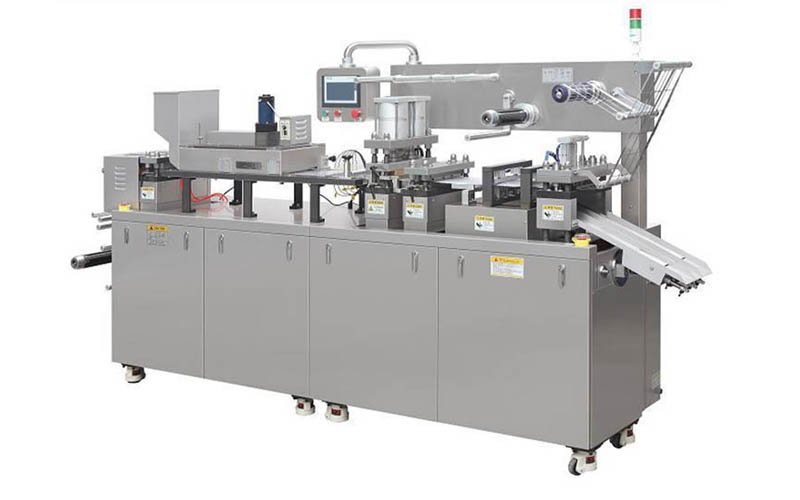
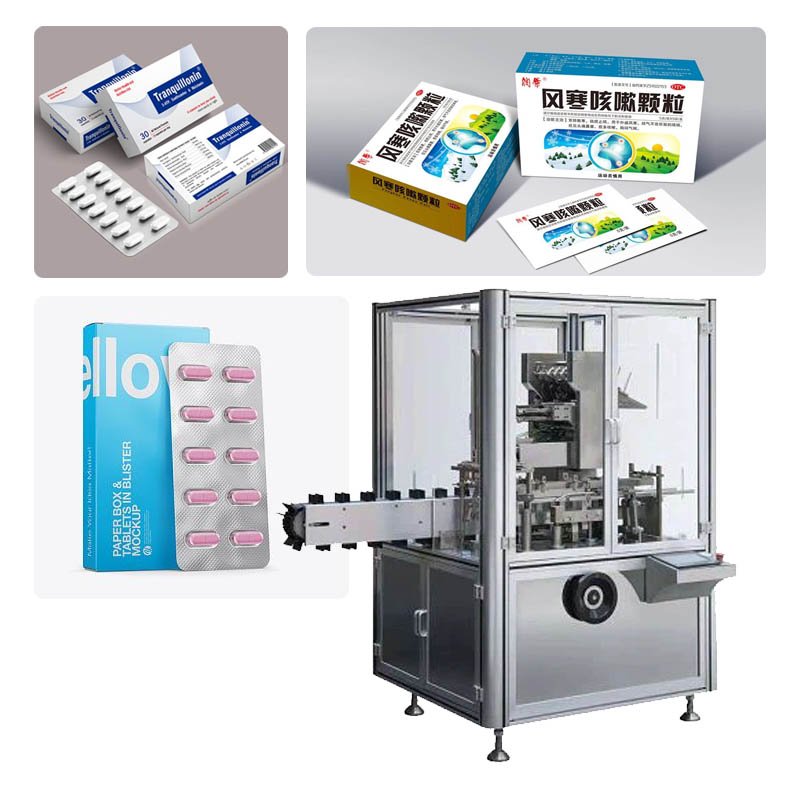
Before diving into individual stations, it helps to see the full picture. A standard automatic blister packing machine is essentially a horizontal conveyor system where a continuous web of base film travels left to right, being transformed at each station along the way. The finished blister cards exit at the far end, ready to be fed into a blister cartoning machine for secondary packaging.
7-Station Process Flow
Each of these stations is mechanically linked through a cam-driven or servo-driven indexing mechanism. The film advances in precise, repeatable increments — called the stroke length — which determines how far the web moves between each operational cycle. On the HIJ DPP-260, this stroke is servo-controlled, meaning you can adjust it digitally from the HMI without changing mechanical components.
Key Concept — Indexing: “Indexing” refers to the step-and-repeat motion of the web. During the pause between each index (called the “dwell period”), all stations operate simultaneously. This parallel processing is what allows a single machine to achieve high throughput without each station waiting for the others.
Station 1 — Film Loading & Feeding
Film Loading & Feeding Station
The process begins before a single blister is formed. The base film — typically PVC, PVDC-coated PVC, PET, or for cold-forming applications, aluminum foil — is loaded onto a dual-roll holder at the rear of the machine. The dual-roll design (standard on machines like the DPP-260) allows operators to prepare a second roll while the first is still running, minimizing changeover downtime.
Tension control is critical here. If the film feeds with inconsistent tension, the entire web alignment downstream is compromised — leading to misaligned cavities, poor sealing registration, and off-center die-cutting. Modern machines use either a dancer-roller system or a servo-controlled feed motor to maintain constant, adjustable tension across the full production run.
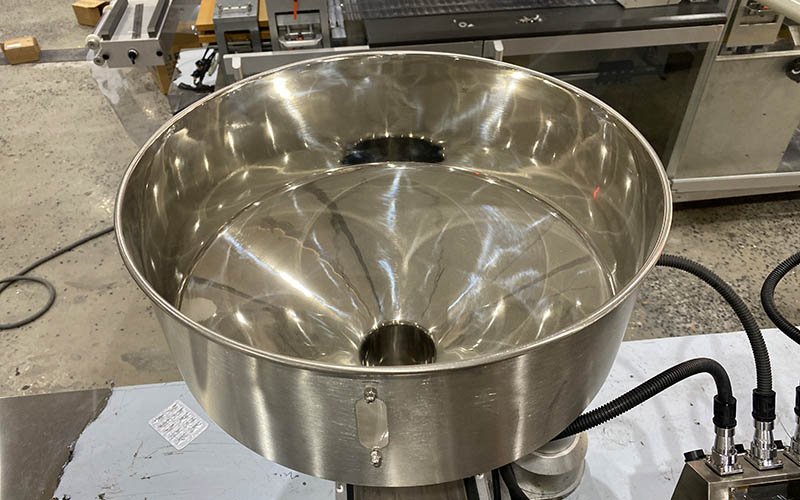
- Base film materials: PVC (most common), PVDC/PVC (enhanced moisture barrier), PET (cleaner tear, recyclability), PCTFE/Aclar (ultra-high moisture barrier for hygroscopic drugs), Alu foil (cold-forming only)
- Typical film thickness: 0.15–0.35mm for PVC; 0.04–0.08mm aluminum for cold form
- Film width compatibility (DPP-260): Up to 130mm forming width
Station 2 — Heating Station
Heating Station
The PVC/PET film cannot be mechanically formed into precise cavity shapes at room temperature — it would simply crack or tear. The heating station uses a flat heating plate, typically made of stainless steel with embedded ceramic or cartridge heaters, to uniformly raise the film temperature to between 120°C and 150°C.
The key performance metric here is temperature uniformity across the full width of the heating plate. A variation of more than ±5°C can cause the film to form unevenly — pockets will be shallower on the cooler side, leading to product movement inside the blister and potential content damage during downstream handling.
On entry-level machines, temperature is controlled by a simple thermostat relay. On production-grade pharmaceutical machines, a PID (proportional–integral–derivative) temperature controller with multiple heating zones maintains accuracy to ±2°C. Always ask your vendor: how many independent temperature zones does the heating plate have?
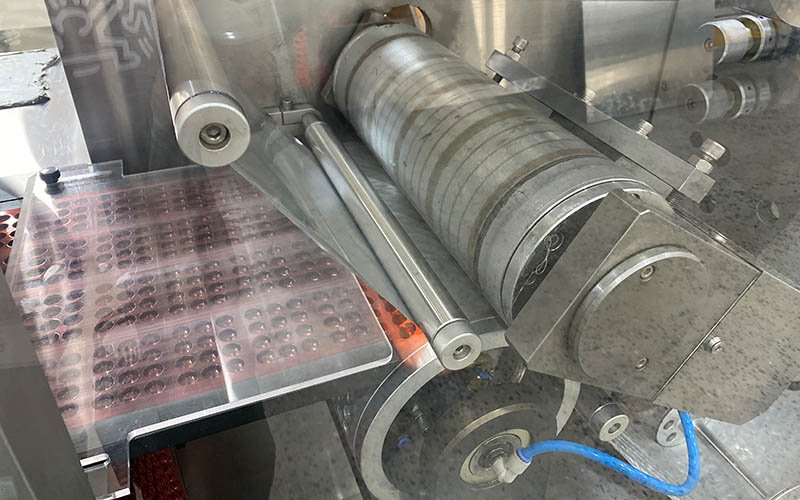
Common Mistake: Running the heating temperature too high to speed up cycle time. Overheating degrades the film’s molecular structure, reduces its sealing affinity with the lidding foil, and in extreme cases causes the film to thin out unevenly — creating micro-pinholes that compromise product protection. Never exceed the film manufacturer’s recommended forming temperature.
Station 3 — Forming Station (Cavity Creation)
Forming Station
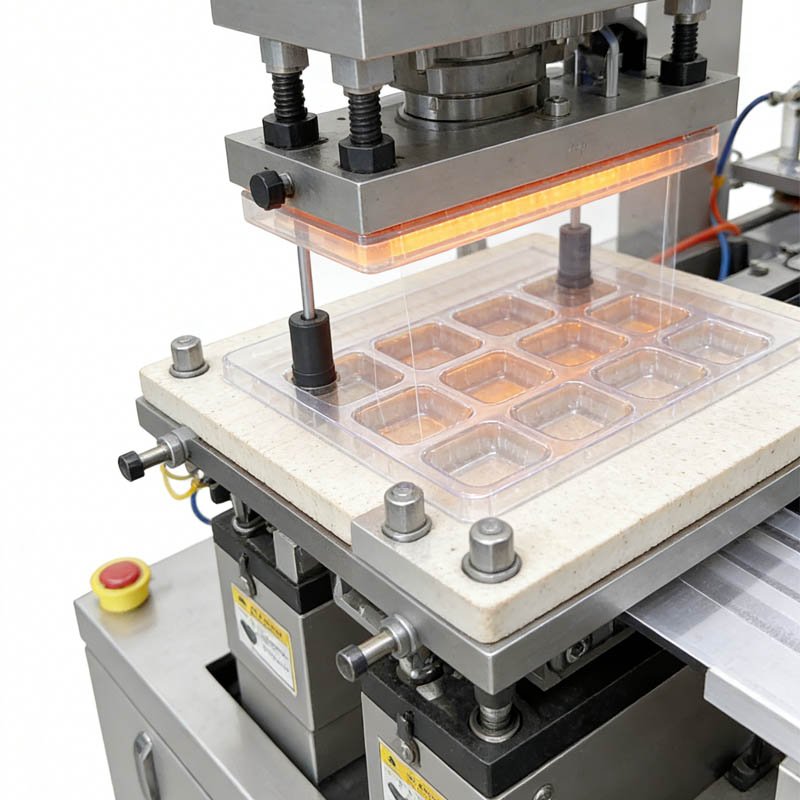
This is the heart of the machine — where the softened film is transformed into the characteristic pocket shapes that give blister packaging its name. There are two primary forming methods:
Positive-pressure (compressed air) forming: Compressed air (typically 5–8 bar) blows the heated film downward into a cooled female mold. The film conforms to the cavity shape as it cools and solidifies. This method produces clean, consistent cavity walls and is the standard for most pharmaceutical and food blister applications.
Mechanical (plug-assist) forming: A male plug mechanically pushes the film into the female mold. This method provides better material distribution in deep-draw cavities and is often combined with compressed air for complex shapes. The HIJ DPP-260 uses a combination of plug-assist and compressed air forming, enabling cavity depths of up to 25mm.
Forming Mold Design & Quick-Change Systems
The forming mold (also called the “forming die” or “forming tool”) is a custom component machined to match your specific product dimensions — tablet diameter, capsule length, cavity depth, and cavity layout (e.g., 4×5, 2×7). Mold changeover is one of the most time-consuming maintenance activities on a blister line. On the DPP-260, HIJ has implemented a tool-free quick-change mold positioning system that reduces full mold swap time from the industry average of 45 minutes down to approximately 15 minutes.
Buyer Checklist — Forming Station: Ask for the maximum forming depth. Ask whether the mold is water-cooled (essential for fast cycle times). Ask about quick-change tooling options. Request a sample cavity test run with your actual product before committing to a mold design.
Station 4 — Product Filling Station
Product Filling Station
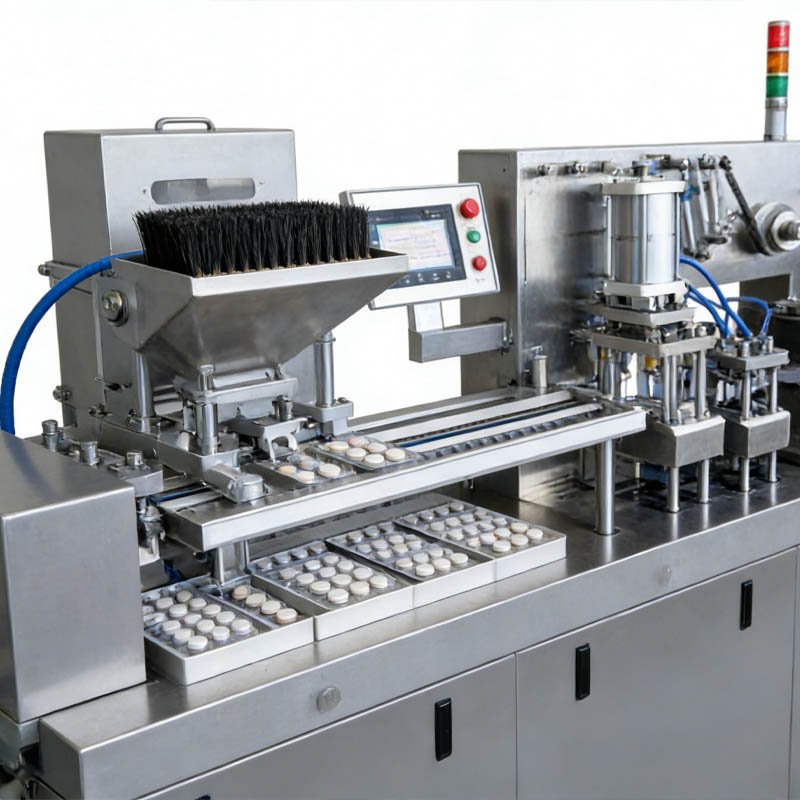
Once the cavities are formed, the web moves forward to the filling station where product — tablets, capsules, softgels, chocolates, or medical devices — is loaded into each pocket. The filling mechanism varies depending on product type and required fill rate:
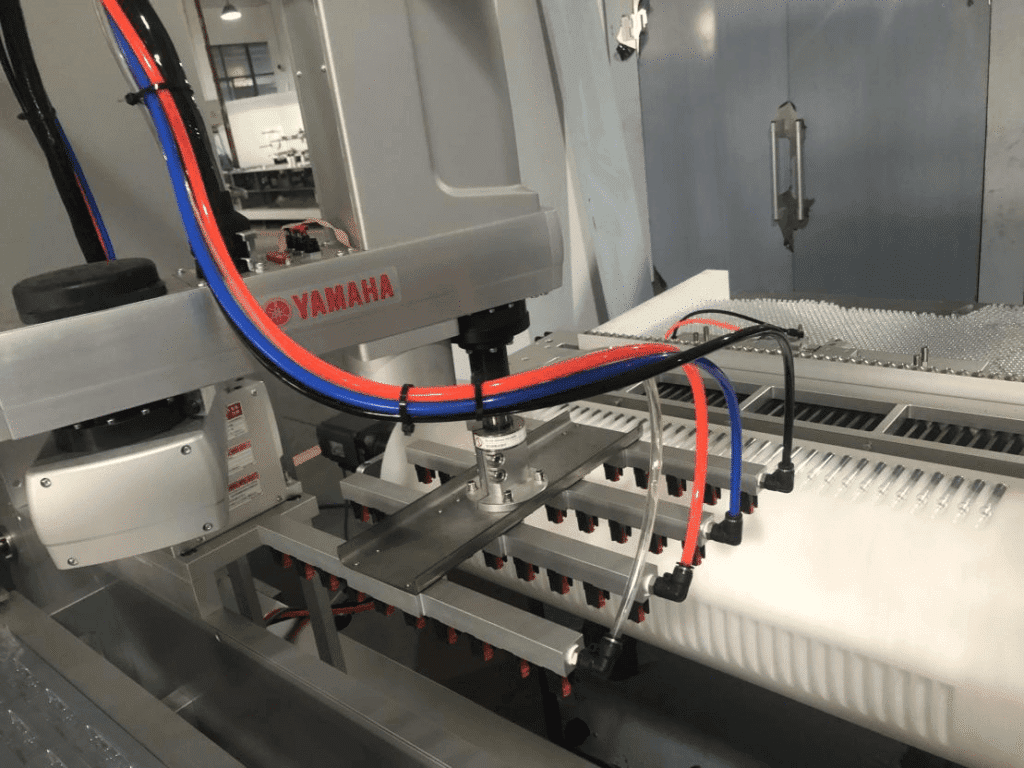
- Gravity/vibrating hopper feeder: The most common method for round tablets. Product falls by gravity through a fill channel into the cavities as the web pauses beneath. A vibrating platform encourages product flow. Simple, reliable, minimal product damage.
- Brush feeder: Rotating brushes sweep products across the web surface, pushing them into cavities. Better suited for oval or irregularly shaped tablets that may not flow well by gravity alone.
- Vibratory feeder with reject/return: Products that miss cavities are re-circulated, reducing waste. Standard on modern pharmaceutical-grade machines.
- Pin/pusher feeder: Used for specialty items like soft capsules, ampoules, and medical devices where gentle handling is critical.
After filling, a camera-based vision inspection system (optional on some machines, standard on GMP-compliant lines) photographs each cavity. Any empty cavity, broken tablet, or foreign object is flagged and the corresponding blister card is automatically rejected downstream — before sealing, which is the correct point for rejection in a validated pharmaceutical process.
Station 5 — Heat Sealing Station
Heat Sealing Station
The sealing station is where the lidding foil — typically a heat-seal coated aluminum foil — is pressed against the filled blister web under precisely controlled temperature and pressure. The heat activates the heat-seal lacquer on the foil’s inner surface, bonding it permanently to the flat rim (the “land area”) of the formed web.
The sealing die configuration can be either a flat-plate sealer (most common, operates during the web’s dwell period) or a continuous rotary sealer (used in very high-speed lines). Flat-plate sealers provide better pressure distribution and are simpler to validate in pharmaceutical applications.
Three parameters govern seal quality — and all three must be validated and locked in your batch records:
Temperature
Typically 120–200°C depending on foil/film combination. Must be uniform across full sealing width.
Pressure
Applied by pneumatic or servo cylinder. Must be calibrated and consistent — uneven pressure causes partial seal failure.
Dwell Time
Duration the die holds under pressure. Shorter dwell = weaker seal. Must be validated for each product/material combination.
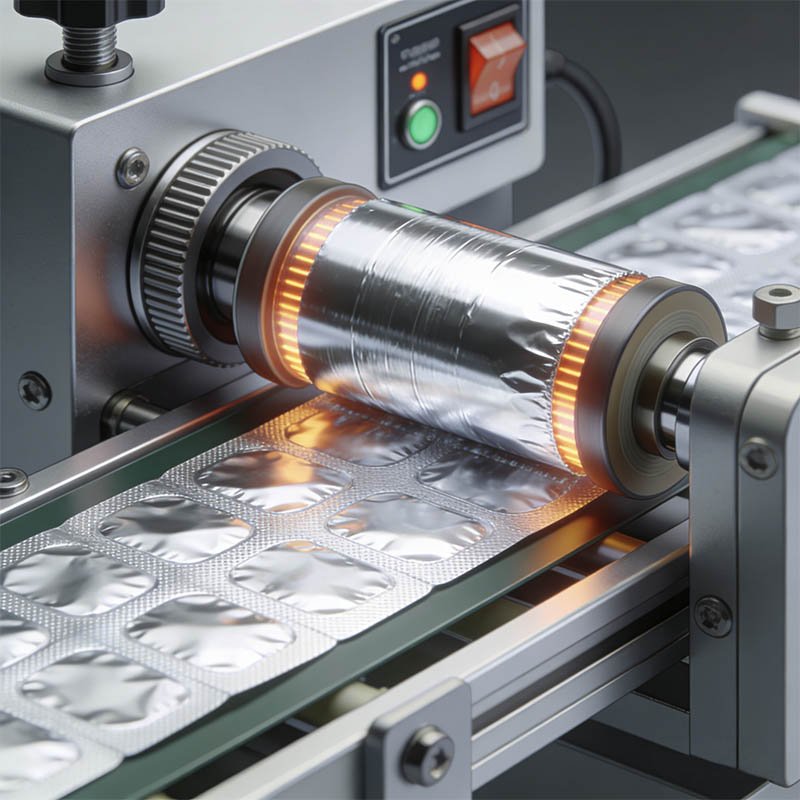
A properly sealed blister pack should pass a standard peel strength test (typically 15–25 N per 15mm width for pharmaceutical applications) and show no delamination, tenting at corners, or visible channels. If you’re running a GMP-validated line, seal integrity testing should be included in your IQ/OQ/PQ documentation. For guidance on selecting the right machine for pharmaceutical compliance, visit our full blister packing machine range.
Station 6 — Batch Printing Station
Batch Printing Station
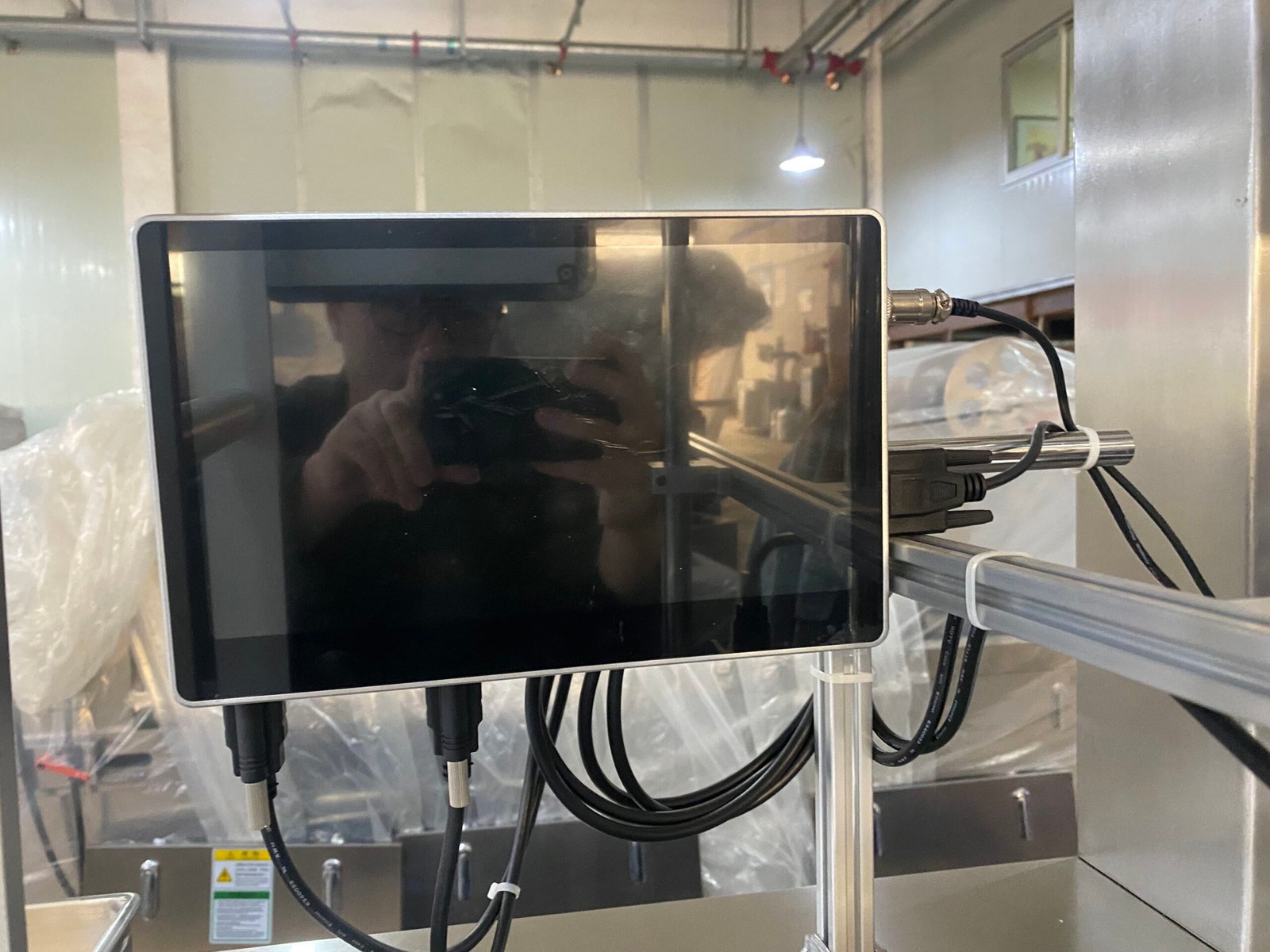
Regulatory requirements in virtually every market mandate that each blister pack carries a printed batch/lot number, manufacturing date, and expiry date. In pharmaceutical manufacturing, this traceability information is non-negotiable — and it must be legible, durable, and tamper-evident.
The printing station is positioned immediately after the sealing station (before die-cutting) so that information is applied to the finished, sealed web while it is still in a continuous flat format — ensuring consistent print registration relative to each blister unit.
Two printing technologies are common in blister line applications:
Hot-Stamp Printing
A heated metal die embosses/stamps ink from a foil ribbon onto the lidding surface. Text is fixed — ideal when batch-specific information changes between runs but layout is consistent. Excellent adhesion, resistant to abrasion.
Best for: Standard lot/expiry printing. GMP-preferred due to tamper evidence.
Inkjet Printing
A non-contact inkjet head sprays ink onto the foil surface. Highly flexible — can print variable data, barcodes, QR codes, and serialization numbers. No tooling changes needed for different text content.
Best for: Serialization, unit-level traceability, variable data printing per 21 CFR Part 11.
Station 7 — Perforating & Die-Cutting Station
Perforating & Die-Cutting Station
The final station converts the continuous sealed web into individual, finished blister cards. This station typically performs two operations in sequence:
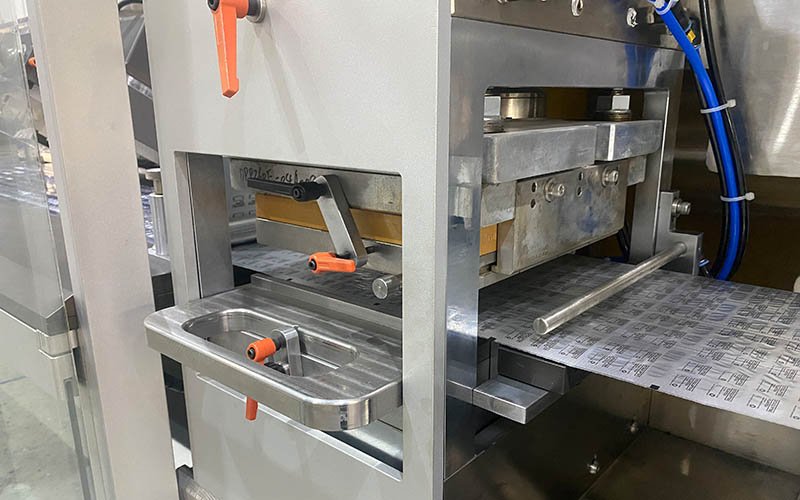
Perforating/scoring: A roller die or flat die punches tear lines between individual blister units or rows. This creates the breakable divisions that allow patients to separate individual doses without tearing the packaging — a critical feature for dose compliance in pharmaceutical products.
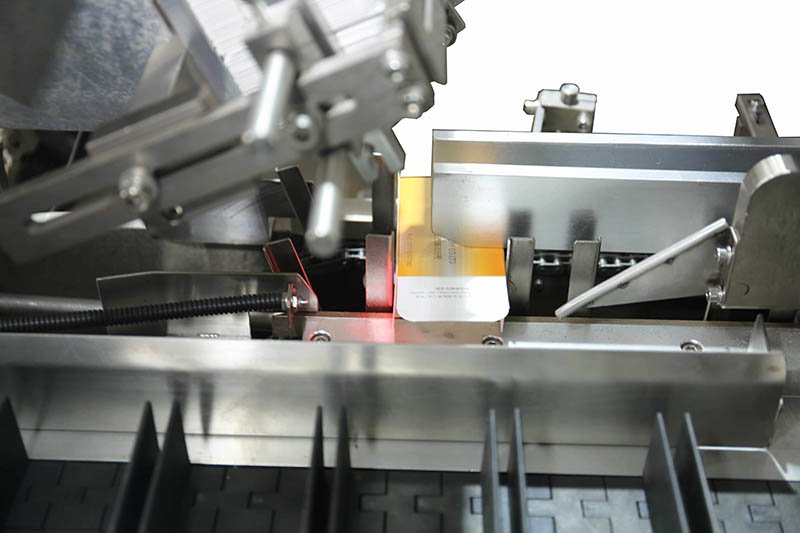
Die-cutting (punching): A hardened steel punch die cuts through the sealed web along the outer perimeter of each blister card, producing a clean-edged finished product. The die-cutting force must be precisely calibrated — too light and the cards remain connected; too heavy and the punch “crushes” the cavity edges, distorting the shape.
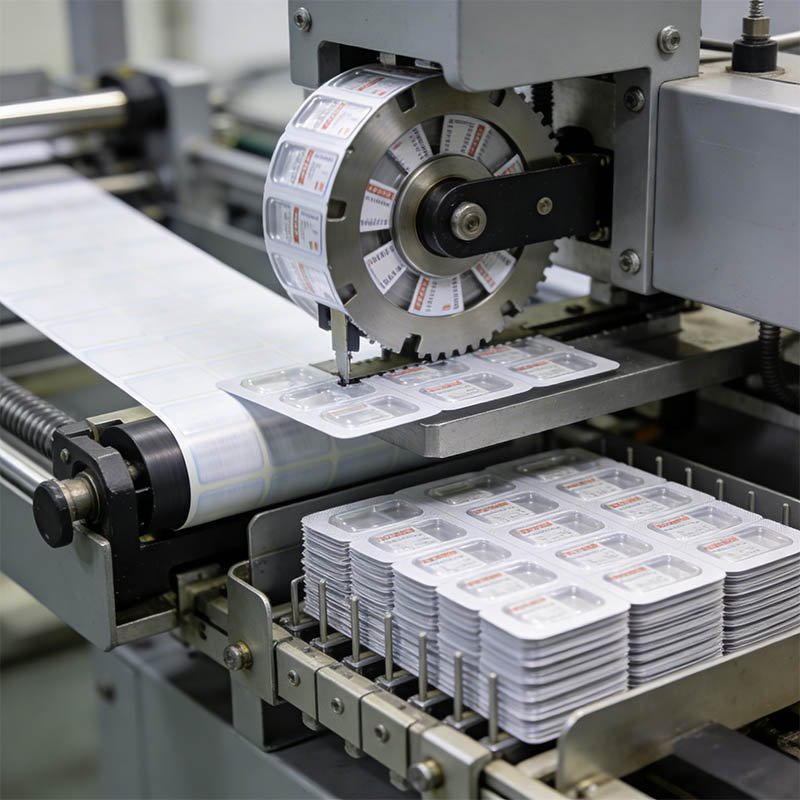
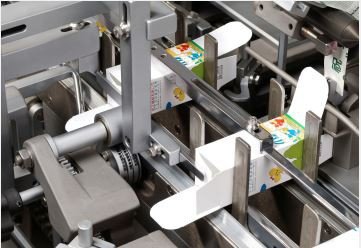
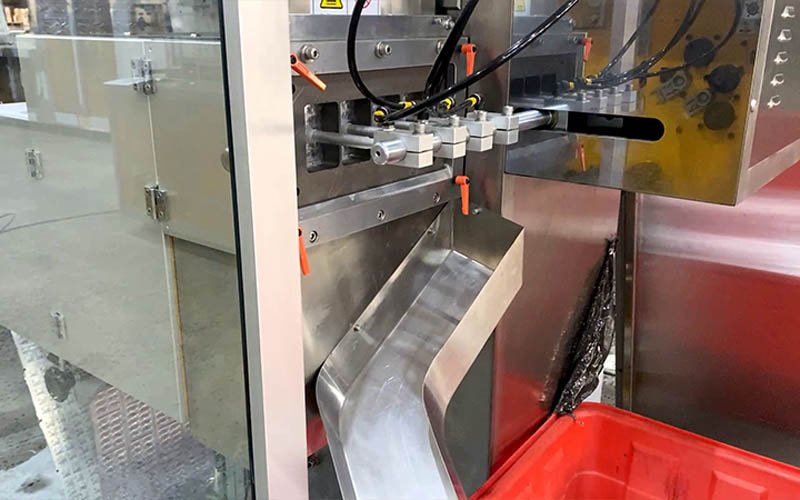
After die-cutting, the finished blister cards travel on an output conveyor to either a manual collection point or, in a fully integrated line, directly into the infeed of a blister cartoning machine. The waste skeleton (the leftover web after punching) is typically wound onto a separate take-up reel for scrap disposal.
Thermoforming vs. Cold Forming: Which Technology Do You Need?
Before specifying a blister machine, the single most important technical decision is the forming method — and it is driven entirely by your product’s stability requirements, not by your preference or budget.
| Parameter | Thermoforming (PVC/PET) | Cold Forming (Alu-Alu) |
|---|---|---|
| Forming Mechanism | Heat + compressed air or mechanical punch | Mechanical punch at room temperature |
| Base Film Material | PVC, PVDC/PVC, PET, PCTFE | Aluminum foil laminate (Alu/PVC/Alu or Alu/OPA/Alu) |
| Moisture Barrier (MVTR) | Low to Medium (0.1–15 g/m²/day depending on film) | Extremely Low — effectively zero permeation |
| Product Visibility | Transparent — patient/pharmacist can see product | Opaque — no visibility of contents |
| Production Speed | Higher — typically 40–200+ strokes/min | Lower — typically 20–60 strokes/min |
| Tooling Cost | Lower | Higher (requires more robust tooling) |
| Best Application | Standard OSD drugs, nutraceuticals, confectionery | Moisture/light-sensitive drugs (hygroscopic APIs, biologics) |
| HIJ Machine Model | DPP-260, DPP-250 | HIJ DPH-300 Alu-Alu |


Case Study: How the DPP-260 Implements All 7 Stations
To make this all concrete, let’s walk through the HIJ DPP-260 Fully Automatic Blister Packing Machine as a practical example. This is our flagship mid-range model, designed specifically for pharmaceutical and nutraceutical manufacturers who need GMP compliance, servo-driven precision, and rapid changeover capability without the capital cost of a high-speed production machine.

Forming Width
130 mm
Max Forming Depth
25 mm
Output Speed
40–80 cycles/min
Control System
Siemens PLC
Drive System
Servo Motor
Compliance
GMP / CE
What Makes the DPP-260 Different at Each Station
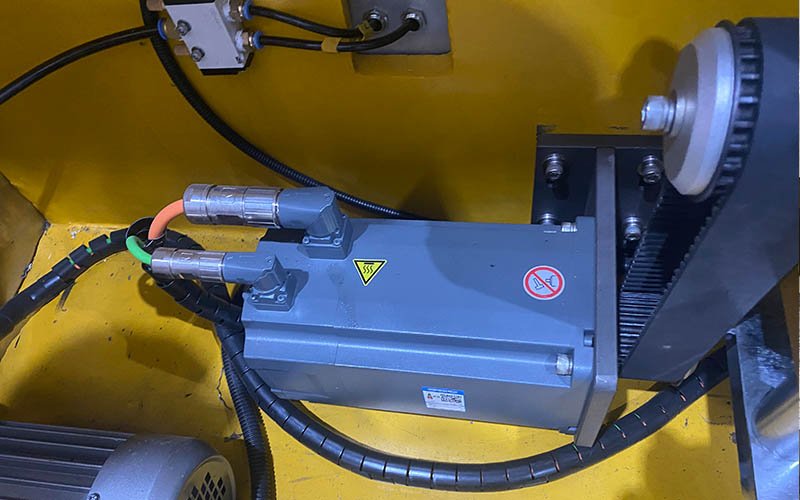
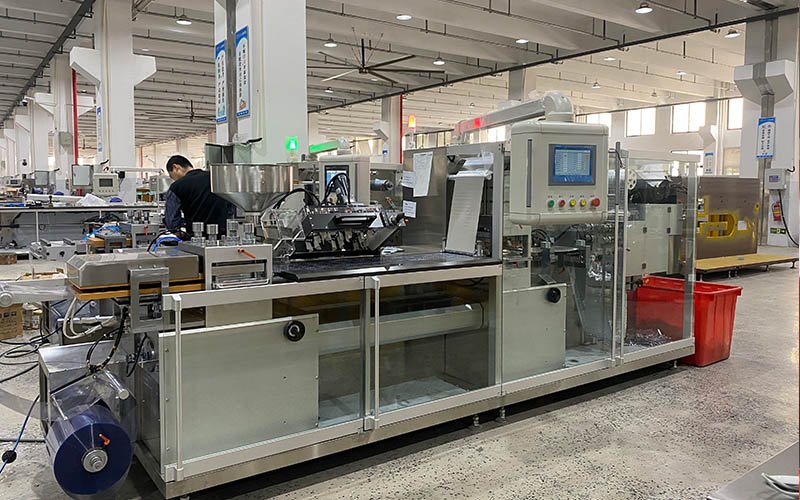
- Station 1 (Film Feed): Dual-roll holder with servo tension control. Feed accuracy ±0.5mm per 100mm advance.
- Station 2 (Heating): Multi-zone PID-controlled heating plate. Temperature uniformity ±2°C across full 130mm width.
- Station 3 (Forming): Plug-assist + compressed air. Water-cooled mold. Quick-change tooling reduces mold swap to ~15 minutes.
- Station 4 (Filling): Compatible with gravity hopper, brush feeder, and vibratory feeder. Optional vision inspection system available.
- Station 5 (Sealing): Servo-controlled sealing cylinder. Temperature, pressure, and dwell time all independently programmable via HMI.
- Station 6 (Printing): Compatible with hot-stamp, inkjet (optional), and laser coding systems. Print registration accuracy ±1mm.
- Station 7 (Die-Cutting): Precision hardened steel punch die. Adjustable cutting force. Integrated waste take-up reel.
3 Common Blister Machine Process Failures — and How to Prevent Them
In two decades of servicing pharma clients worldwide, I have seen the same root-cause failures come up repeatedly. Here are the three that cause the most production losses — and the simple process controls that prevent them:

From the Founder’s Desk
“I built HIJ around a simple conviction: a client who understands their machine will never be held hostage by a supplier. The 7 stations I’ve described here aren’t just mechanical steps — they are the 7 critical control points of your product quality. Master them, and you own your process. Let them remain a black box, and you’re one bad batch away from a compliance crisis.”
— Forester, Founder & CEO, HIJ Machinery | 20 Years in Pharmaceutical Packaging
Tell Us Your Product. We’ll Recommend the Right Machine.
Whether you’re packaging round tablets, oval capsules, softgels, or specialty dosage forms — HIJ’s engineering team will analyze your requirements and match you with the correct machine configuration, forming mold design, and line integration solution.
Explore Related Resources
Frequently Asked Questions
How does an automatic blister packing machine work — in simple terms?
An automatic blister packing machine takes a flat roll of plastic or aluminum film and transforms it into sealed product packages through seven automated stations: it first softens the film with heat, then presses it into cavity shapes (like small cups), fills those cavities with your product (tablets, capsules, etc.), seals a foil lid onto the top, prints batch information, scores tear lines, and finally punches out individual blister cards — all in one continuous, synchronized process.
What is the difference between thermoforming and cold forming in blister machines?
Thermoforming uses heat (120–150°C) to soften PVC/PET film before pressing it into cavity shapes with compressed air or a mechanical punch. It runs faster and costs less but offers limited moisture barrier performance. Cold forming (Alu-Alu) mechanically deforms aluminum foil at room temperature without heat — it offers near-zero moisture and oxygen permeation, making it essential for hygroscopic or light-sensitive drugs. The choice depends entirely on your product’s stability requirements, not budget.
What factors affect sealing quality in a blister packing machine?
Sealing quality depends on three primary variables: temperature (the sealing die must reach and maintain the correct temperature uniformly across its full width — typically 120–200°C), pressure (applied by pneumatic or servo cylinder — uneven pressure causes partial seal failure on one side of the web), and dwell time (how long the die holds under heat and pressure). All three must be validated and recorded in batch documentation for GMP compliance.
How fast does an automatic blister packing machine run?
Speed depends heavily on the machine model and product type. Entry-level semi-automatic machines produce 20–40 blisters/min. Mid-range automatic machines like the HIJ DPP-260 run at 40–80 cycles/min depending on cavity layout. High-speed pharma production lines reach 200+ strokes/min. However, speed should always be validated against seal integrity — running above the machine’s validated rate is a common GMP compliance risk that can result in batch rejection during regulatory audits.
Can one blister packing machine handle both tablets and capsules?
Yes. Most automatic blister machines, including the HIJ DPP-260, can handle both tablets and capsules by changing the forming mold (to match the product shape and size) and adjusting the filling station configuration. Round tablets typically use gravity feeders; oval tablets and capsules work better with brush or vibratory feeders. With a quick-change mold system, the full changeover can be completed in approximately 15–20 minutes, minimizing production downtime between product runs.
What materials are used as the base film in blister packaging?
The most common base films are: PVC (polyvinyl chloride) — economical, widely available, most common worldwide; PVDC-coated PVC — improved moisture barrier; PET — cleaner tear line, better recyclability; PCTFE (Aclar) — ultra-high moisture barrier for hygroscopic drugs; and Aluminum foil laminates — used exclusively in cold-forming (Alu-Alu) applications for maximum product protection. The lidding material is almost always aluminum foil with a heat-seal lacquer coating.
What GMP requirements apply to blister packing machines in pharmaceutical manufacturing?
GMP-compliant blister machines must meet several requirements: all product-contact surfaces should be SUS316L stainless steel with no dead corners; the machine must support IQ/OQ/PQ validation documentation; sealing parameters (temperature, pressure, dwell time) must be recordable and retrievable; if operating under 21 CFR Part 11, the machine’s HMI and data logging system must comply with electronic records requirements; and the machine should support cleaning validation procedures. HIJ’s machines are designed with GMP compliance as a baseline requirement, not an optional add-on.
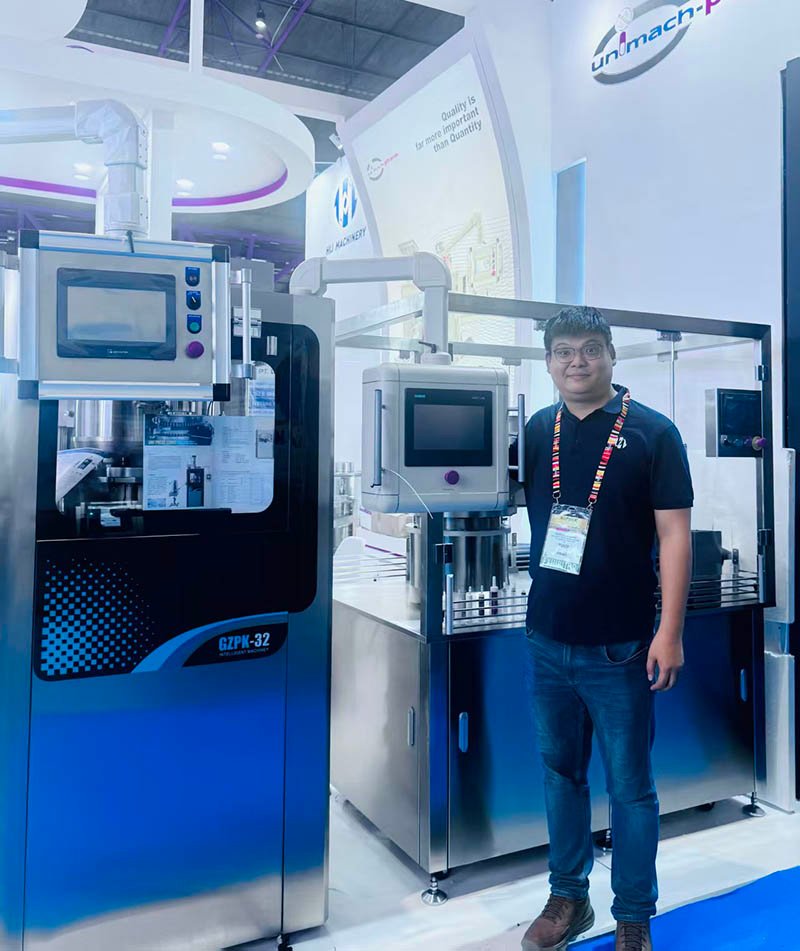
Forester
Founder & CEO, HIJ Machinery | 20 Years in Pharma Packaging
Forester founded HIJ Machinery after two decades of hands-on experience commissioning pharmaceutical and packaging production lines across Asia, Europe, and Latin America. He has personally overseen the installation of blister packing lines for over 100 clients ranging from generics manufacturers to multinational pharmaceutical companies. His engineering philosophy is simple: equipment should serve the process, and the process must serve the patient.