🆡 [Forester’s Insight: A 20-Year Engineer’s Perspective]
The Direct Answer: While Alu-Alu offers the ultimate impermeable barrier for highly sensitive drugs, PVDC serves as the optimal mid-range moisture shield, whereas PVC alone should be restricted to low-sensitivity formulations with short shelf-lives.
The Field Experience & Hidden Trap: In my 20 years of troubleshooting packaging lines across Southeast Asia and Latin America, I've seen manufacturers purchase premium Alu-Alu foil only to suffer micro-fractures and seal failures. The hidden trap is that cheap blister machines lack the precise PLC-controlled forming depth and pneumatic tension required for cold-forming; competitors won't tell you that sub-par tooling will secretly stretch aluminum past its tensile limit, destroying your barrier integrity.
The Strategic Advice: Never select your pill blister packaging materials without validating your machinery's mechanical compatibility through rigorous FAT/SAT protocols. At HIJ Machinery, we advocate for turnkey integration where the blister machine and material specifications are engineered together, delivering European-standard sealing precision at pragmatic pricing to eliminate multi-vendor disputes.
PVC at 250 μm Passes 1.2 g/m²/day of Water Vapor. That Ends the Conversation.
Data refuses to negotiate with procurement budgets. When selecting pill blister packaging materials, physics dictates shelf-life stability long before your marketing team designs the outer carton. PVC (Polyvinyl Chloride) dominates the global baseline simply because it thermoforms beautifully at 130°C. Yet, its molecular structure resembles a microscopic sieve.
Barrier Properties Comparison (WVTR):
- Alu-Alu: WVTR = 0.00 g/m²/day. Ultimate moisture and light barrier. Requires flat-plate cold forming.
- PVDC (Triplex): WVTR = 0.11 – 0.20 g/m²/day. High barrier, transparent.
- PVC: WVTR = 1.2 – 2.0 g/m²/day. Low cost, low moisture barrier. Suitable for stable pills only.
I frequently stare down these exact specifications during initial project consultations. The reality? A moisture-sensitive effervescent tablet housed in standard 250 μm PVC will degrade by month four in a Zone IVb climate (30°C/75% RH). That is a guaranteed failure. You either step up to PVDC coatings or leap entirely to cold-formed aluminum.

My engineering team at HIJ Machinery maps material selection directly to machine capabilities. You cannot just swap material rolls on a Tuesday and expect the same sealing integrity. The thermodynamic requirements shift violently.
Three Weeks Into a Jakarta Commissioning Job, the Aluminum Tore.
The production floor was 24°C, but the factory manager was sweating. They had imported a batch of premium 45 μm OPA/ALU/PVC foil to protect an expensive cardiovascular API. During the dry run on a legacy rotary machine they bought second-hand, the Alu-Alu cavities kept emerging with microscopic pinholes at the corners. Why? Because aluminum does not thermoform.
It stretches under brutal mechanical force. Alu-Alu requires a dedicated cold-forming station. The forming punches must drive into the aluminum laminate with exactly calculated radius curves, driven by servo motors that do not hesitate or vibrate. The legacy machine's pneumatic cylinders were fluctuating by just 0.4 bar. That tiny variance was enough to breach the foil's tensile limits.
The Scene: Jakarta, 2021. The leak detection bath was filled with blue dye, and 40% of the Alu-Alu packs failed USP <1207> vacuum testing.
What I did: I halted the line immediately. We bypassed the factory's fluctuating central air supply and installed a dedicated pressure regulator for the forming station. I then realigned the mechanical punch depth by exactly 0.5 mm using a micrometer, adjusting the Teflon-coated forming dies to reduce friction. The micro-tearing stopped instantly. The final yield stabilized at 99.7%.
This is why Alu-Alu vs PVC blister packaging is never just a material debate. It is a mechanical ecosystem debate. Aluminum demands precision. If your machine's indexer drifts by 1 mm, the sealing station will crush the blister pocket perimeter, compromising the very 0.00 WVTR barrier you paid a premium to achieve.
Thicker PVDC Does Not Automatically Fix Your Stability Protocol.
Procurement directors love PVDC (Polyvinylidene Chloride). It offers a beautiful compromise: transparency for patient compliance and a formidable moisture barrier. The standard Triplex configuration (PVC/PE/PVDC) layers a PE core between the structural PVC and the barrier PVDC coating (often 40 g/m² or 90 g/m²).
Here is the trap. I constantly see facilities ordering 90 g/m² PVDC to pass accelerated stability tests, only to discover their blister machine's heating plates cannot penetrate the thicker mass at 45 cycles per minute. The film warps. The edges curl. The knurled sealing pattern looks aggressive, but internally, the lidding foil hasn't fused with the PVDC layer.
Global pharmaceutical regulators no longer accept visual inspections for blister integrity. Under EU GMP Annex 1 and FDA 21 CFR Part 211, deterministic leak testing methods are mandatory. If your PVDC layer suffers thermal degradation due to incorrect heating zone calibration, the package will fail non-destructive vacuum decay testing, leading to immediate batch quarantine.
To process high-grammage PVDC, you must deploy extended pre-heating zones. Our HIJ thermoforming machines utilize multi-stage contact heating to slowly raise the polymer's core temperature without scorching the surface. The transition must be graceful.
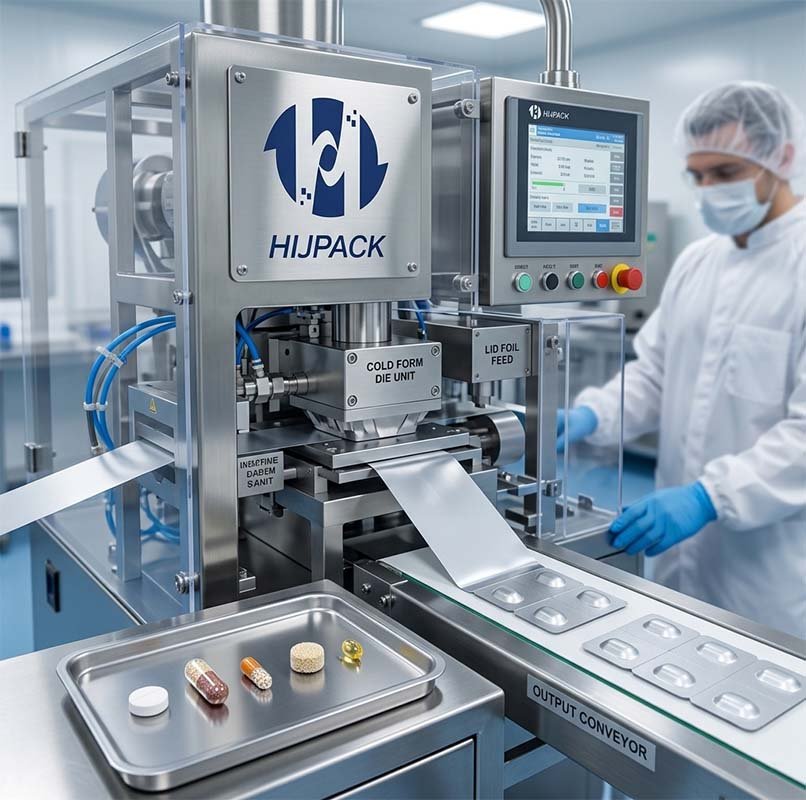
- Temperature Delta: PVDC requires 15-20°C higher forming temperatures than standard PVC.
- Cooling Matrix: Chilled water circulation (around 12°C) in the forming molds is non-negotiable to set the polymer instantly.
- Shrinkage Control: PVDC has a high memory effect; servo-driven traction rollers must grip the web tightly to prevent web-shrinkage before sealing.
Of the 31 Blister Line Projects I Commissioned, 14 Required a TCO Realignment.
Between 2018 and 2023, analyzing Total Cost of Ownership (TCO) across our installations revealed a stark pattern. Clients initially balk at the cost of cold-forming materials. PVC foil costs roughly $2.50 per kg. Alu-Alu foil? Upwards of $6.00 per kg. The CFO immediately vetoes the aluminum.
They are looking at the wrong spreadsheet. Yes, the raw material cost per pill blister packaging material is higher. But what is the cost of a Class II recall when a hygroscopic antibiotic degrades at pharmacies in Manila? The real math includes product shelf-life extension. Alu-Alu guarantees 36 to 48 months of absolute stability for zero-tolerance APIs.
Symptom: Finished PVDC/Alu blister cards curling upwards immediately after the punching station.
Solution: The tension between the heavy PVDC web and the thin aluminum lidding foil was mismatched. I reduced the unwinding brake tension on the lidding foil by 15% and increased the upper heating plate temperature by 4°C. The differential cooling stress equalized, and the cards punched out perfectly flat.
When migrating from PVC to high-barrier materials, operators must understand the thermal dwell time. A machine running PVC at 60 blisters per minute might only achieve 40 bpm with Triplex PVDC if the heating zones are too short. You cannot cheat thermodynamics. We deliberately over-engineer our turnkey pharmaceutical solutions with elongated heating stations precisely to handle these complex multi-layer polymers without sacrificing output speed.
A Quality Director Called Me. Her Question Changed The Blueprint.
A quality director from Bogota called me last Tuesday. Her first question: “Forester, can we push Alu-Alu through our standard rotary PVC line if we just change the molds?”
Absolutely not. Rotary continuous sealing is magnificent for thermoformed PVC because it offers high-speed line contact. However, Alu-Alu blister cavities are inherently rigid. If you force an aluminum pocket through a rotary sealing drum, the curvature of the drum distorts the cold-formed pocket, cracking the seal at the apex. When running high-barrier cold-formed Alu-Alu materials, the mechanical punch and flat-sealing mechanism of a dedicated tablet blister packing machine is mandatory to prevent aluminum tearing.
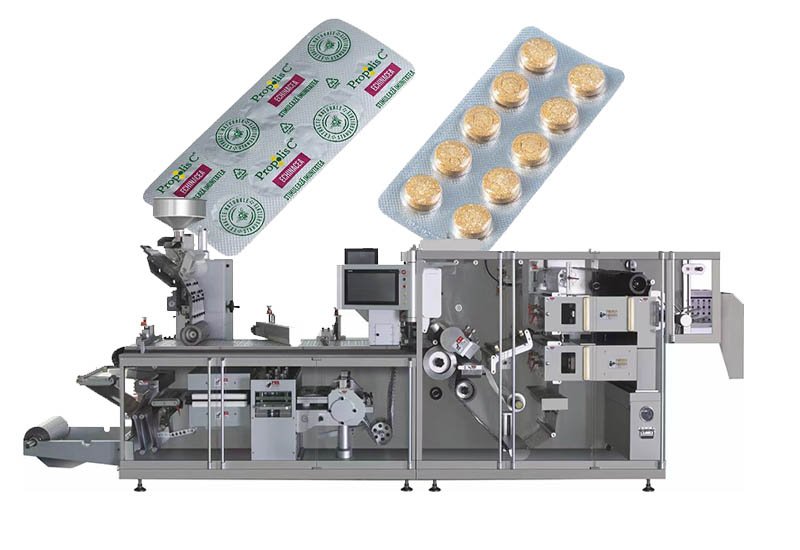
You need a platen (flat) sealing system. A massive upper plate descends, applying a ton of uniform pneumatic pressure across a perfectly flat geometric plane. The knurled grid bites into the aluminum lidding foil and the Alu-Alu base simultaneously, creating a hermetic cross-hatched weld that will survive a 600 mbar vacuum decay test.
Symptom: Intermittent unsealed patches in the center of a 4-lane Alu-Alu configuration.
Solution: Thermal expansion had warped the legacy sealing plate by 0.2 mm in the center. We retrofitted a HIJ CNC-machined hardened steel sealing plate with dynamic spring-loaded compensation, guaranteeing uniform pressure distribution regardless of thermal expansion. The leaks vanished.
Our HIJ DPP-series machines are engineered with this exact duality in mind. By utilizing track-mounted, quick-change stations, operators can slide out the thermoforming heating plates and slide in the cold-forming punch mechanics in under 40 minutes. You get the baseline economy of PVC/PVDC processing and the ultimate barrier protection of Alu-Alu on the same chassis.
Frequently Asked Questions
Alu-Alu (cold-formed aluminum) is the only material that provides an absolute barrier with a WVTR of 0.00 g/m²/day. Unlike transparent polymers, the aluminum foil completely blocks moisture, oxygen, and UV light, ensuring long-term API stability.
It depends entirely on your machine’s heating capacity and cooling molds. Because PVDC has a higher mass and requires a higher softening temperature, you must possess extended pre-heating zones and robust chilled water circulation to form the cavities without warping.
The cost disparity stems from both the raw material composition (OPA/Alu/PVC laminates are structurally complex to manufacture) and the packaging footprint. Cold-formed aluminum cannot be stretched as deeply or closely as thermoformed PVC; therefore, the blister cavities must be spaced further apart, consuming more overall square footage of material per pill.
Ready to Bulletproof Your Packaging Line?
Don’t let subpar tooling destroy your premium materials. Let our engineers map your API stability requirements directly to machine mechanics.
Get Free Turnkey Quote