📊 Cost Analysis — Pharmaceutical Packaging
How Much Does Blister Packaging Cost Per Unit? The Real Number — and What Inflates It
The quoted range is $0.008 to $0.06 USD per blister card. Most buyers focus on machine price. That’s the wrong number to start with. Film waste rate, reject rate, tooling amortization, and compliance readiness together account for more than 70% of your true per-unit cost — none of which appears on a supplier’s spec sheet.
I’ve walked production floors in Jakarta, São Paulo, Nairobi, and Lahore. The plants bleeding margin aren’t the ones that bought expensive machines. They’re the ones that didn’t model the full cost before they signed the purchase order.
📍 Direct Answer
Blister packaging cost per unit typically ranges from $0.008 to $0.06 USD per card, depending on material (PVC vs. Alu-Alu), production volume, tooling amortization, reject rate, and compliance overhead. For a mid-volume pharmaceutical line running 150–200 blisters per minute with standard PVC/Aluminum lidding, expect $0.012–$0.022 per card under normal operating conditions. Alu-Alu cold-form packaging adds $0.015–$0.03 per card in material cost alone. These figures assume a reject rate below 1.5% and validated equipment.
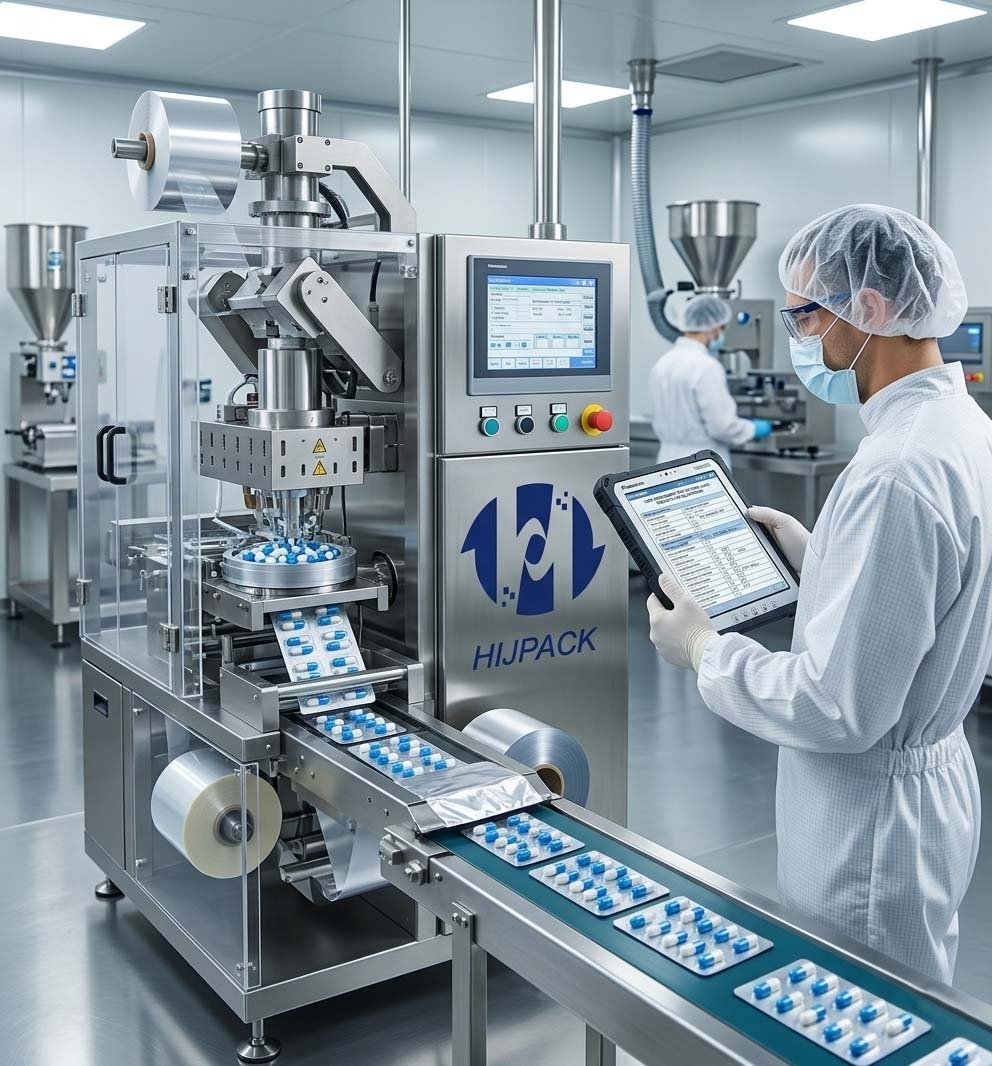
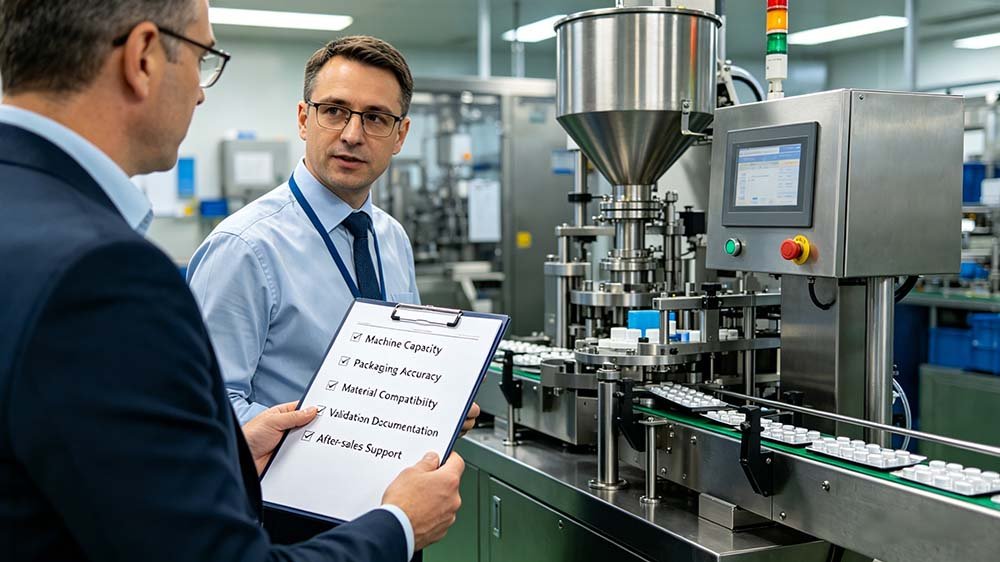
The four cost drivers that determine blister packaging cost per unit — film material, tooling amortization, reject rate, and compliance overhead.
What Does Blister Packaging Cost Per Unit Actually Measure?
Blister packaging unit cost measures the total expenditure required to produce one sealed blister card — covering material, energy, labor, tooling depreciation, and waste — divided by total good-output cards produced. It is not the machine purchase price divided by projected lifetime output. That calculation tells you almost nothing useful.
I make this distinction because I’ve seen it done wrong too many times. A procurement director in Lahore showed me a spreadsheet in 2021. He’d taken the machine price, divided it by 200 million cards over 10 years, and arrived at $0.002 per card for equipment amortization. Technically correct. But his film waste rate was running at 6.3%, his reject rate was hovering around 4%, and nobody had factored in the quarterly tooling maintenance at $3,800 per mold set. His real cost was closer to $0.031 per card — more than 15 times his model.
The correct cost-per-unit model has six components. Each one matters independently.
- Material cost: forming film (PVC, PVDC, Alu-Alu) + lidding foil, priced per square meter and converted to per-card cost based on cavity layout and blister dimensions.
- Tooling amortization: mold set cost (typically $4,000–$18,000 per SKU) divided by expected cycle life (300,000–800,000 impressions depending on material and maintenance protocol).
- Energy cost: heating plates, sealing stations, and drive systems — typically $0.0008–$0.003 per card at industrial electricity rates.
- Labor cost: operator hours divided by good output cards per shift — highly variable by country and automation level.
- Reject and waste cost: the most dangerous variable. A 4% reject rate on a 150-BPM line means you’re discarding 6 blister cards per minute and all associated material, labor, and drug product.
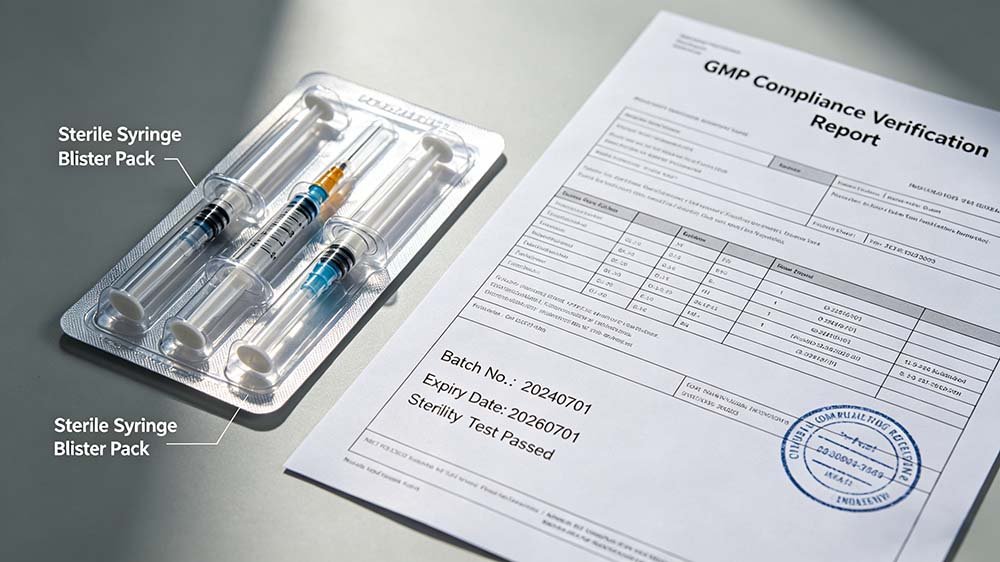
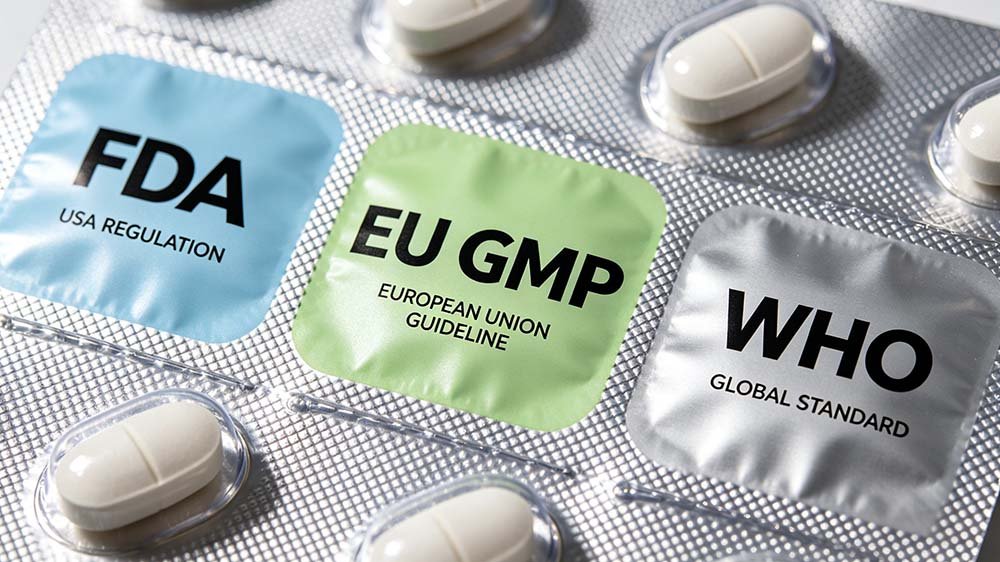
- Compliance overhead: IQ/OQ/PQ validation amortized over production volume, batch documentation labor, and audit-readiness maintenance. This is frequently zero-rated in cost models and shows up as a surprise during the first FDA or EU GMP inspection.
Film Material: The Single Largest Per-Unit Cost Variable
PVC/Aluminum blister packaging costs $0.005–$0.014 per card in forming film alone for a standard 10-cavity tablet blister. Alu-Alu cold-form packaging costs $0.018–$0.038 per card in material cost for the same format. That difference — $0.013 to $0.024 per card — compounds to $104,000–$192,000 per year on an 8 million card annual run.
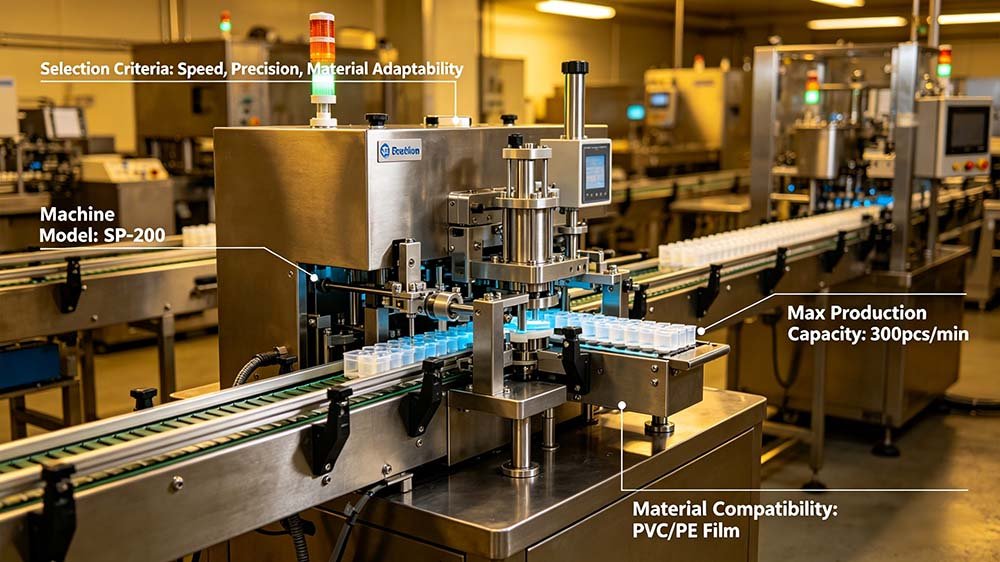
I’ve had this conversation dozens of times. A QA director in São Paulo asked me why her Alu-Alu line was 2.3x more expensive per card than the thermoform line running adjacent to it. The answer wasn’t complicated. Cold-form aluminum uses a three-layer OPA/Alu/PVC laminate structure — material cost is simply higher, forming speed is slower (60–120 BPM vs. 150–300 BPM for thermoform), and film waste during changeover is significantly greater because Alu-Alu film does not stretch predictably under temperature variation.
The decision between PVC and Alu-Alu isn’t a cost decision alone. It’s a drug stability decision first. If your API requires moisture vapor transmission below 0.5 g/m²/day — which standard PVC at 250μm cannot achieve — you’re paying the Alu-Alu premium because the alternative is a stability failure at month 12 and a batch recall. The cost of a recall dwarfs the material cost differential by a factor that makes the per-card calculation irrelevant. For a deeper look at how packaging format choices interact with machine selection, the DPP-260 pill blister packaging machine handles both PVC and Alu-Alu formats, which matters for plants that run mixed product portfolios.
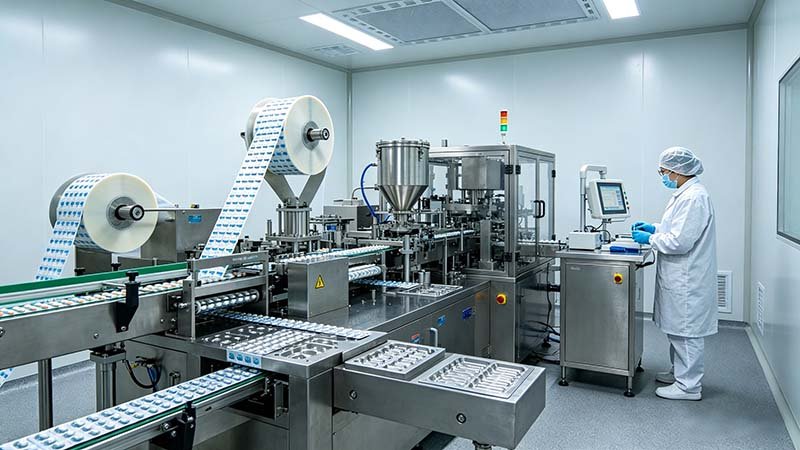
PVC versus Alu-Alu blister packaging cost per card across volume tiers — material cost differential compounds significantly at annual volumes above 5 million cards.
Blister Packaging Cost Per Unit: PVC vs. Alu-Alu vs. PVDC Comparison
Blister packaging cost per unit differs significantly across the three primary forming materials used in pharmaceutical production. The table below uses a standard 10-cavity, 80mm × 57mm blister card as the reference format at 150 BPM production speed and 8 million cards annual volume.
| Cost Component | PVC / Alu Lidding | PVDC / Alu Lidding | Alu-Alu Cold Form |
|---|---|---|---|
| Forming film (per card) | $0.005–$0.010 | $0.010–$0.018 | $0.018–$0.038 |
| Lidding foil (per card) | $0.002–$0.004 | $0.002–$0.004 | $0.003–$0.006 |
| Tooling amortization (per card) | $0.001–$0.003 | $0.001–$0.003 | $0.002–$0.005 |
| Energy cost (per card) | $0.0008–$0.002 | $0.001–$0.002 | $0.001–$0.003 |
| Labor (per card, automated line) | $0.001–$0.004 | $0.001–$0.004 | $0.002–$0.005 |
| Typical reject rate | 0.5–2.0% | 0.5–2.0% | 1.0–3.5% |
| Estimated total per card | $0.008–$0.022 | $0.014–$0.030 | $0.026–$0.060 |
| Moisture barrier (MVTR) | 4–6 g/m²/day | 0.5–2 g/m²/day | 0.02–0.5 g/m²/day |
| Typical application | Non-hygroscopic APIs, temperate markets | Moderate humidity sensitivity, EU/US markets | Hygroscopic APIs, tropical Zone IVb markets |
| Reference format: 10-cavity blister card, 80mm × 57mm, 150 BPM production speed, 8M cards/year. Costs in USD. Labor rates based on Southeast Asia / South Asia industrial benchmarks. Energy at $0.08–$0.12/kWh. Reject cost allocated proportionally. | |||
The per-unit number buyers obsess over is the material line. The number that actually destroys margin is reject rate — because it multiplies every other cost. A 4% reject rate on Alu-Alu at $0.045 per card means you’re discarding $0.0018 of material per good card produced before you count drug product loss, rework labor, or batch documentation time. — Forester Xiang, HIJ Machinery
The Reject Rate Trap: Why 4% Costs More Than You Think
Of the 31 blister line projects I handled in Southeast Asia between 2018 and 2023, 11 required a root-cause investigation for cost overruns within 18 months of commissioning. In 8 of those 11 cases, the primary driver was reject rate — not machine downtime, not material price increases, not labor cost escalation.
Here’s the math that makes reject rate so dangerous. A plant running 150 BPM on an 8-hour shift produces approximately 72,000 blister cards per shift. At a 4% reject rate, 2,880 cards are discarded. On PVC at $0.015 per card in material alone, that’s $43.20 in film loss per shift. Across 250 production days, two shifts per day: $21,600 per year in film waste alone, before drug product loss. If the rejected cards contain tablets at $0.08 per tablet with 10 tablets per card, add another $57,600 in API loss annually. That’s $79,200 per year from a 4% reject rate that most production managers classify as “acceptable.”
It’s not acceptable. That’s the number.
⚠️ Reject Rate Diagnostic — Three Patterns I See Most Often
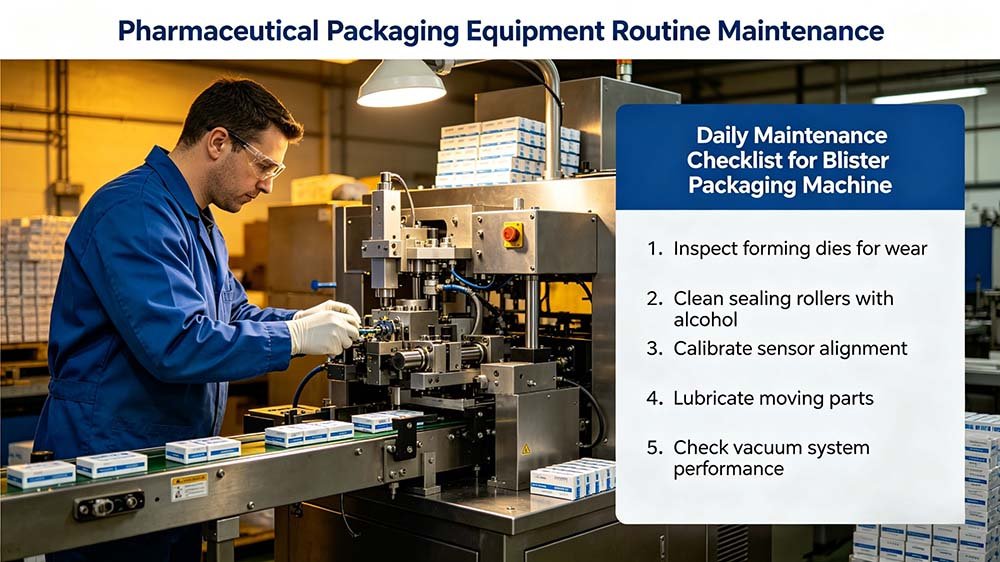
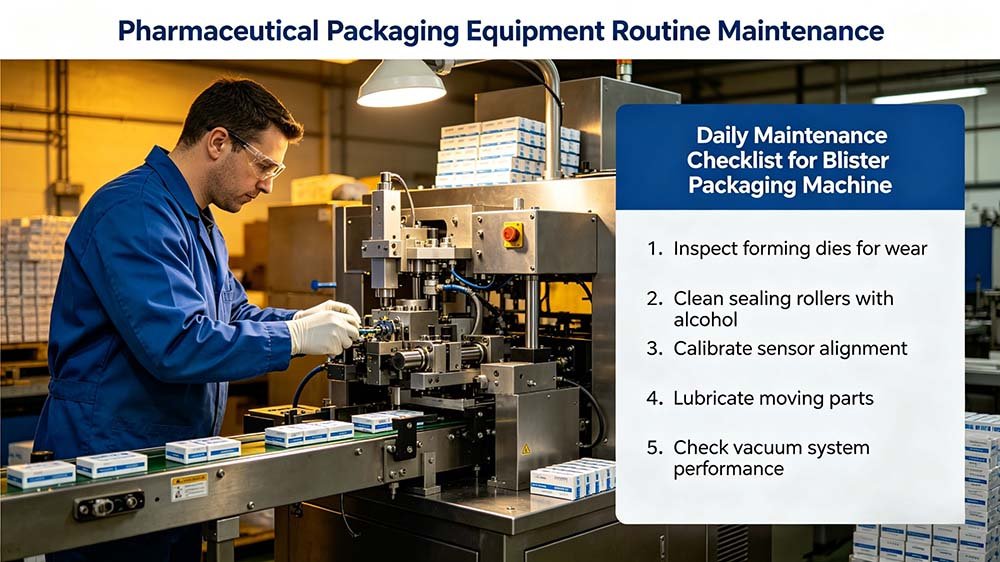
Symptom: intermittent seal failures detected by camera vision system or, worse, during downstream leak testing. Cause: worn heating element calibration or ambient temperature variation in non-climate-controlled production areas. Fix: servo-controlled sealing with real-time temperature feedback loop — standard on modern machines, retrofittable on older lines with a PLC upgrade. Until fixed, expect 1.5–3.5% seal-related rejects compounding material and drug product cost.
Most common on flat-plate machines running PVC at lower-than-specified forming temperatures to save energy. The outer cavities form correctly; the center cavities underform by 0.3–0.8mm. Tablets seat incorrectly, triggering camera rejection downstream. The fix is correct forming temperature with verified uniformity across the full plate surface — not a cost reduction measure.
Each product changeover generates 8–25 meters of film waste during rethreading and parameter stabilization, depending on operator skill and machine design. On a plant running 12 SKUs with 3 format changes per week, this adds $1,800–$6,500 annually in film waste that never appears in the reject rate metric — because it’s recorded as “startup waste,” not rejection.
Tooling Cost: The Per-Unit Variable Nobody Amortizes Correctly
A blister packaging mold set for a standard 10-cavity tablet format costs $4,000–$18,000 depending on material (aluminum, steel, or hardened steel), complexity, and supplier country. Chinese tooling runs $4,000–$9,000. European tooling runs $9,000–$18,000. The expected cycle life differs proportionally: 300,000–500,000 impressions for aluminum tooling versus 600,000–800,000 for hardened steel.
At 500,000 impressions on a $6,500 mold set, tooling contributes $0.013 per card. At 800,000 impressions on a $14,000 hardened steel set, the contribution is $0.0175 per card — slightly higher, but the mold lasts 60% longer and produces significantly more consistent cavity depth across its life. Plants running hygroscopic APIs on Alu-Alu typically find that mold consistency matters more than mold price.
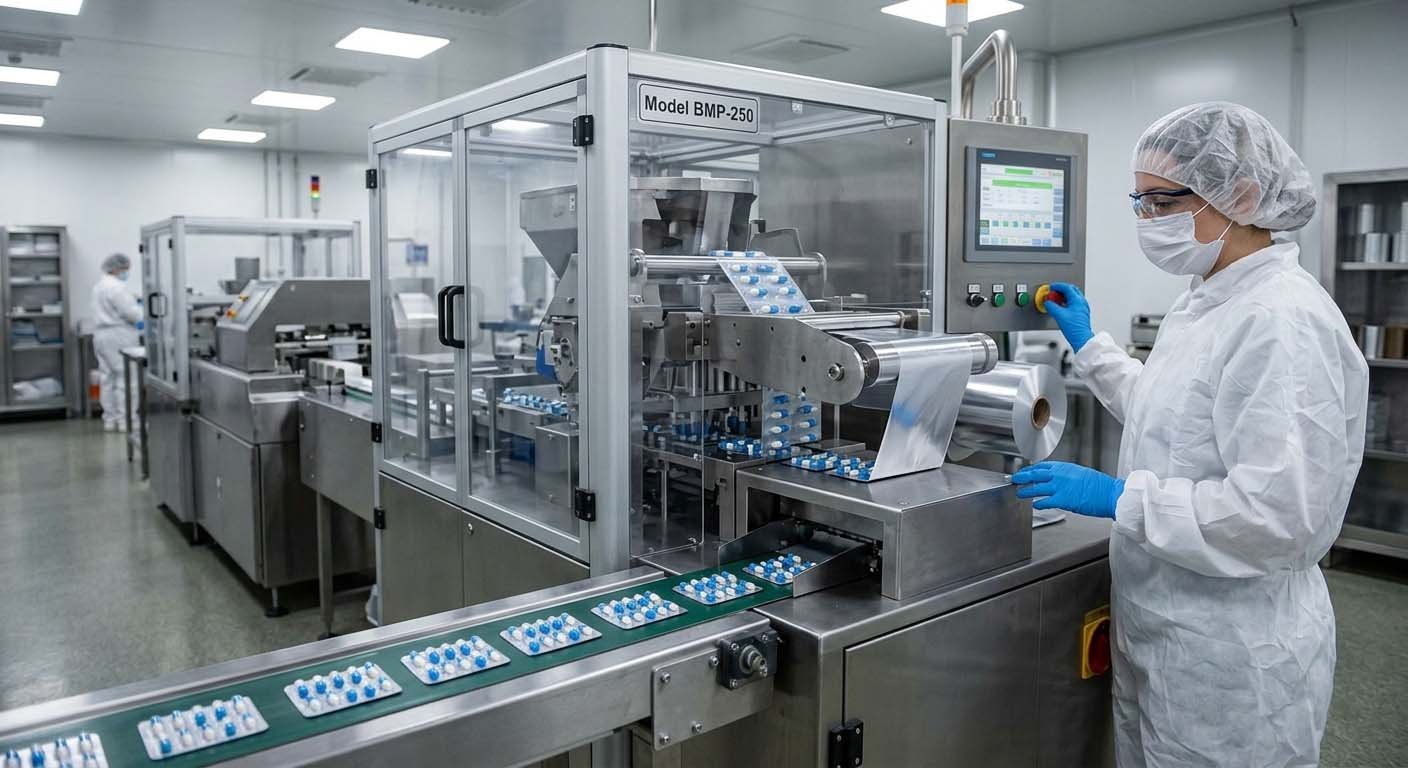
Tooling mold cost and expected cycle life directly affect blister packaging cost per card — a factor frequently under-modeled in capital expenditure planning.
How to Calculate Tooling Cost Per Blister Card
The formula is straightforward. Take your mold set cost, divide by expected cycle life in impressions, and divide again by cards per impression (which equals 1 for most standard single-row molds, or 2 for dual-track formats).
Example: $7,200 mold set ÷ 450,000 impressions ÷ 1 card per impression = $0.016 per card in tooling cost alone. If your annual volume is 5 million cards, tooling replacement will cost $80,000 over the mold’s service life — or $16,000 per year amortized at equal production rates. This is a real line item. It belongs in your unit cost model.
💡 Forester’s Insight — A 20-Year Engineer’s Perspective
The direct answer: Blister packaging cost per unit typically ranges from $0.008 to $0.06 USD, but that number alone is meaningless — what destroys your margin is everything the quote doesn’t show you.
The field experience and hidden trap: In my 20 years of walking production floors from São Paulo to Jakarta, I’ve watched buyers celebrate a “cheap” blister line, only to bleed cash within 18 months. The machine ran, but the forming film yield was poor, the reject rate quietly sat at 4–6%, and nobody had validated the equipment against cGMP standards — meaning costly rework before any FDA or EMA audit. The darkest trap? Standalone machines from fragmented suppliers with zero FAT/SAT documentation, leaving your QA team holding the liability.
The strategic advice: Before chasing per-unit cost, audit the total cost of ownership: tooling changeover time, film waste rate, compliance readiness, and after-sales support SLA. At HIJ, our philosophy is Turnkey integration — feeding, forming, sealing, and cartoning engineered as one validated system — so your per-unit cost is predictable, your compliance is documented, and your multi-vendor disputes simply don’t exist. If you’re starting with the machine budget question rather than the unit economics model, I’d suggest reading our pill blister packaging machine cost breakdown first — it covers the capital side of the equation in the depth it deserves.
Volume Tiers: How Production Scale Drives Per-Unit Cost Down
Blister packaging cost per unit falls significantly as annual production volume increases, primarily through tooling amortization dilution, film purchasing leverage, and labor efficiency gains on automated lines. The relationship is not linear — it’s step-function.
| Annual Volume (Cards) | Estimated Cost / Card (PVC) | Estimated Cost / Card (Alu-Alu) | Primary Cost Driver |
|---|---|---|---|
| Under 500,000 | $0.035–$0.060 | $0.055–$0.090 | Tooling amortization dominant; film at spot pricing |
| 500K – 2M | $0.018–$0.035 | $0.038–$0.060 | Labor cost diluting; still mostly manual or semi-auto |
| 2M – 8M | $0.012–$0.022 | $0.026–$0.045 | Automated line; film contract pricing begins |
| 8M – 25M | $0.009–$0.016 | $0.020–$0.032 | Film volume contract; multi-cavity tooling; OEE >85% |
| Above 25M | $0.008–$0.013 | $0.016–$0.026 | High-speed line; dual-track tooling; minimal labor per card |
| Estimates based on Southeast Asia and South Asia production environments. PVC = 250μm PVC forming film + 25μm Alu lidding. Alu-Alu = OPA/Alu/PVC cold-form laminate + Alu/PVC/Alu lidding. Reject rate assumed at 1.0–1.5% for optimized lines. | |||
The jump from under 500,000 cards annually to 2–8 million cards is where most mid-size pharmaceutical manufacturers find the biggest cost reduction opportunity. It’s not a machine upgrade — it’s a volume consolidation decision. Plants running 6 different products at 400,000 cards each on six separate small machines are paying 3–4x more per card than a plant that consolidates to two mid-speed lines with faster changeover tooling and shared operational management.
Compliance Overhead: The Cost That Doesn’t Appear in Your Quote
FDA enforcement records for 2019–2023 show packaging as the root cause in 12% of pharmaceutical recalls — the figure I reach for when procurement teams argue that an unvalidated low-cost line is “good enough for now.” Good enough for now is a temporary condition. A recall is not.
IQ/OQ/PQ validation for a single blister packaging line typically costs $28,000–$85,000 in external CRO or internal QA labor, plus documentation time. Amortized over a 10-year operational life at 5 million cards per year, that adds $0.0006–$0.0017 per card — entirely manageable. But plants that skip validation and get caught during an audit face a different calculation: production shutdown at $12,000–$40,000 per day while rework documentation is generated, plus the cost of retrospective validation across all affected batches.
I won’t tell you the compliance cost model is simple. It depends on your target market, your product classification, the experience of your QA team, and whether your equipment supplier provides FAT/SAT documentation as standard. At HIJ, we supply IQ/OQ/PQ protocol templates as part of the machine handover package. That doesn’t replace your validation effort — but it reduces it by roughly 30–40% compared to generating protocols from scratch.
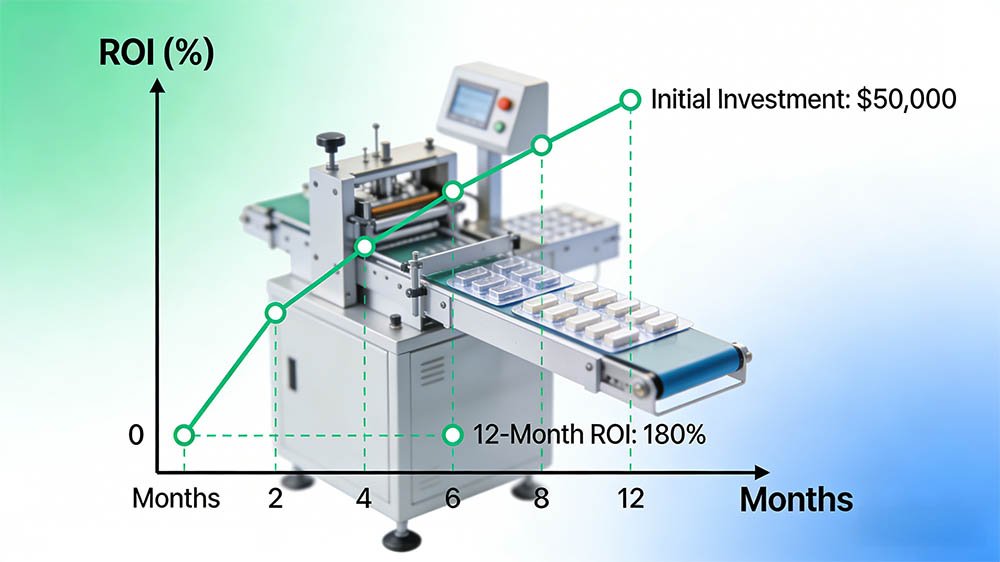
Per-unit cost reduction trajectory as annual blister card volume scales from 500K to 25M+ — the largest cost gains occur between 500K and 5M cards annually.
Blister Packaging vs. Bottle Filling: Per-Unit Cost Comparison
Blister packaging costs $0.008–$0.06 per unit; bottle filling typically costs $0.004–$0.025 per unit at equivalent volumes. Bottle filling has lower per-unit packaging cost in most volume tiers. Blister packaging wins on stability protection, tamper evidence, and per-dose compliance — which is why it dominates in regulated pharmaceutical markets despite the higher per-unit cost.
The decision between blister and bottle is not purely a cost calculation. It’s a product-market-compliance decision with cost as one input. A hygroscopic API targeting Zone IVb tropical markets cannot realistically use HDPE bottles without desiccant, and the desiccant cost largely closes the per-unit gap. A product with 3-year shelf life claims in high-humidity markets is almost always a blister candidate, regardless of unit cost differential. If you’re weighing both formats seriously, our comparison of pill blister packaging versus bottle filling covers the decision framework across six variables beyond unit cost.
Frequently Asked Questions: Blister Packaging Cost Per Unit
❓ What is the average blister packaging cost per unit for pharmaceutical tablets?
Blister packaging cost per unit for pharmaceutical tablets averages $0.012–$0.022 per card for standard PVC/Aluminum packaging at mid-volume production (2–8 million cards annually) running at 150 BPM. This includes forming film, lidding foil, tooling amortization, energy, and labor at Southeast Asia / South Asia production cost levels, assuming a reject rate below 1.5%. Alu-Alu cold-form packaging for the same format runs $0.026–$0.045 per card.
❓ How does reject rate affect blister packaging cost per card?
Each 1% increase in reject rate adds approximately $0.0003–$0.0008 per good card produced in material waste cost alone — before accounting for drug product loss, rework labor, or batch documentation. On a line producing 5 million cards annually with tablets at $0.06 per tablet and 10 tablets per card, moving from 1% to 4% reject rate adds roughly $90,000 per year in total waste cost. Reject rate is the highest-leverage variable in blister packaging unit economics and the one most frequently underreported in production dashboards because it appears as “startup loss” or “quality hold” rather than a continuous cost line.
❓ Is Alu-Alu blister packaging always more expensive per unit than PVC?
Yes, by a significant margin. Alu-Alu cold-form blister packaging costs $0.015–$0.03 more per card in forming material alone compared to standard PVC. Production speed is also lower — 60–120 BPM for Alu-Alu versus 150–300 BPM for thermoform PVC — which increases labor and fixed cost per card. The premium is justified when your API is hygroscopic, when target markets are tropical Zone IVb (ICH Q1A(R2)), or when regulatory dossier requirements specify cold-form packaging based on stability data.
❓ How much does blister packaging tooling cost per card?
Tooling amortization adds $0.001–$0.016 per card, depending on mold cost ($4,000–$18,000 per set), cycle life (300,000–800,000 impressions), and annual production volume. At 5 million cards per year with a $7,000 mold set and 500,000-impression service life, tooling costs approximately $14,000 per year — or $0.0028 per card. This is small as a percentage of total unit cost but becomes significant for low-volume SKUs where the mold cost amortizes slowly.
❓ Does machine price affect blister packaging cost per unit?
Machine purchase price typically contributes $0.0005–$0.003 per card in amortized equipment cost — a small fraction of total unit cost. A $120,000 blister packaging machine amortized over 10 years at 5 million cards per year contributes roughly $0.0024 per card. The machine price matters far less to per-unit economics than film material, reject rate, and tooling choices. Where machine quality does affect unit cost is indirectly — through reject rate, OEE (Overall Equipment Effectiveness), and maintenance frequency. A machine that runs at 95% OEE versus 82% OEE produces 15% more good output from the same fixed cost base.
❓ How do I reduce blister packaging cost per unit?
The four highest-leverage cost reduction actions, ranked by impact: First, reduce reject rate below 1.5% through sealing temperature calibration, forming parameter optimization, and vision inspection system deployment. Second, negotiate film supply contracts at annual volumes above 2 million cards to move from spot pricing to contract pricing (typically 8–15% savings). Third, optimize cavity layout per blister card — adding one cavity row without changing blister dimensions reduces per-tablet cost proportionally. Fourth, consolidate SKU production onto fewer, faster machines to improve tooling and labor cost amortization. Operational efficiency improvements consistently outperform material switching as a cost reduction strategy. For the full capital expenditure picture, the pill blister packaging machine cost breakdown covers equipment investment alongside running cost structure.
❓ What is a realistic blister packaging cost per unit for small-volume pharmaceutical production?
Small-volume pharmaceutical production under 500,000 cards annually typically costs $0.035–$0.06 per card for PVC packaging. Tooling amortization dominates at these volumes — a $6,500 mold set amortized over 300,000 impressions adds $0.022 per card in tooling cost alone. Small-volume producers should evaluate semi-automatic equipment with interchangeable tooling platforms rather than dedicated high-speed lines to manage capital and tooling cost efficiently.
❓ Does compliance validation add significantly to blister packaging cost per unit?
IQ/OQ/PQ validation adds $0.0006–$0.002 per card amortized over a 10-year line life at mid-volume production — a small per-unit addition. The risk of skipping validation is not measured in per-unit cost; it is measured in production shutdown days and retrospective validation costs during regulatory inspection, which can range from $60,000 to several hundred thousand dollars in a single audit event.
Know Your Real Per-Unit Cost Before You Sign Anything
I’ll walk through your product format, volume, and target market and give you a per-unit cost model — not a brochure. The DPP-260 pill blister packaging machine handles both PVC and Alu-Alu forming and is built to deliver the reject rates and OEE numbers your unit economics require.