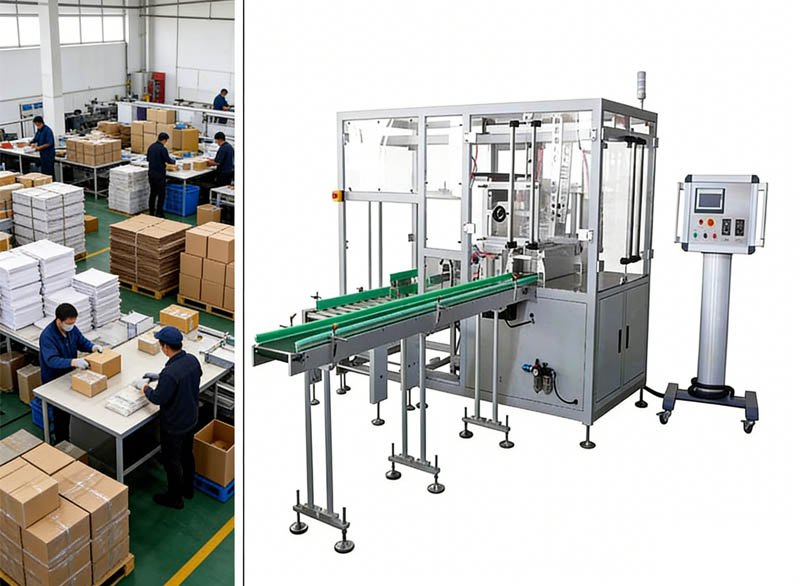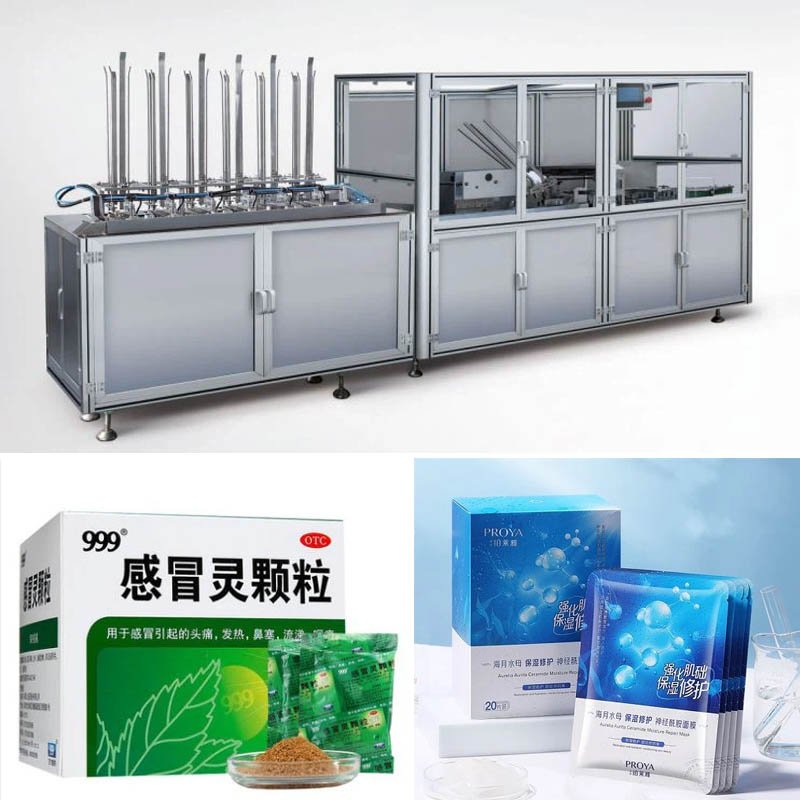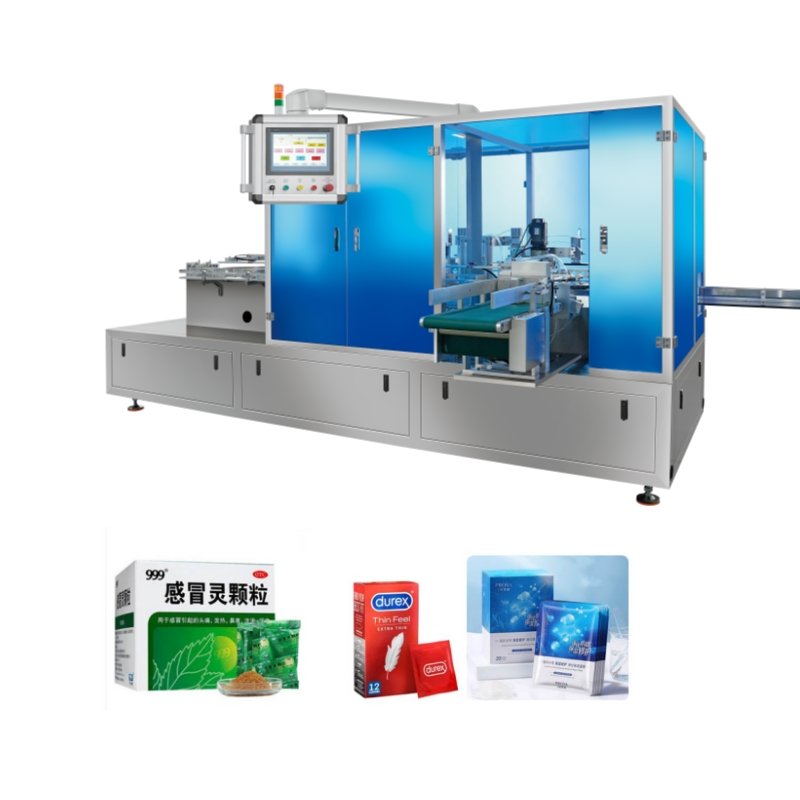
Quick Answer: Does a Case Packer Beat Manual Packing?
For multi-shift lines where case packing occupies 4 or more operators per shift, a fully automatic case packer typically pays back in 1–2 years through labor savings, error elimination, and damage reduction — and keeps paying for the following 10+ years of machine life. For single-shift, low-volume operations the payback stretches, and a semi-automatic or compact all-in-one solution may be the rational choice. The decision is arithmetic, not philosophy: fully loaded labor cost × shifts × years, plus the cost of packing errors, versus total project cost.
Key Takeaways
- Count fully loaded labor cost — wages plus benefits, supervision, recruitment churn, and absenteeism cover — not base salary. That figure is typically 25–40% above the payslip.
- Manual packing’s hidden costs are usually bigger than its visible ones: short-count claims, damaged product, rework, and customer chargebacks rarely appear in the packing line’s budget, but they belong in this calculation.
- ROI scales with shifts: the same machine that pays back in 3+ years on one shift pays back in roughly a year on three shifts.
- Automation also buys what money can’t easily measure: auditable counts, consistent seal quality, and end-of-line output that scales without hiring.
- Run the model with real quotes: get an application-specific FOB price for the HIJ-CP500 side push case packing machine and see our case packing machine price guide for full budget brackets.
The True Cost of Manual Case Packing
Visible cost: the packing crew
A manual case packing station on a mid-speed line typically ties up 4–8 operators per shift: erecting cases, counting product, loading, taping, and moving finished cases. Multiply the headcount by your shift pattern and by fully loaded cost per operator — base wage plus statutory contributions, benefits, supervision share, recruitment and training churn, and absenteeism cover.
Hidden cost #1: errors that reach the customer
Manual counting drifts, especially in hours seven and eight of a shift. A short-count case that reaches a distributor or chain pharmacy becomes a claim, a credit note, and a mark against your vendor scorecard — B2B customers measure and remember these. A machine that verifies the array before every push, like the collation check described in how a side push case packer works, makes the short-count case structurally impossible rather than statistically rare.
Hidden cost #2: product damage
Hand-packed product gets dropped, squeezed, and stacked unevenly. For printed pharmaceutical and cosmetic cartons, damage discovered at the customer’s incoming inspection is the expensive kind — the product is fine, the shipment is rejected anyway.
Hidden cost #3: the ceiling on growth
Manual packing capacity scales only by hiring. Every upstream investment — a faster cartoning machine, a second blister line — eventually queues behind the same packing table. The end of the line quietly sets the speed of the whole plant.
The ROI Model: A Worked Example
| Input | Sample assumption | Your number |
|---|---|---|
| Operators replaced per shift | 5 | ______ |
| Shifts per day | 2 | ______ |
| Fully loaded cost per operator per year | US$12,000 | ______ |
| Annual labor cost of manual packing | 5 × 2 × $12,000 = $120,000 | ______ |
| Annual cost of errors, damage & claims (estimate) | $15,000 | ______ |
| Total annual cost of manual packing | $135,000 | ______ |
| Total automation project cost (machine + freight + install + spares) | $75,000 | ______ |
| Remaining operators after automation (supervision) | 1 shared operator ≈ $18,000/yr | ______ |
| Net annual saving | $135,000 − $18,000 = $117,000 | ______ |
| Simple payback | $75,000 ÷ $117,000 ≈ 7.7 months | ______ |
Sensitivity is straightforward: halve the shifts and the payback roughly doubles; halve the wage level and it doubles again. That is why the same machine is an obvious buy for a two-shift plant in one market and a marginal one for a single-shift plant in another — and why the honest answer starts with your inputs, not the vendor’s brochure.
When Manual (or Semi-Automatic) Still Wins
- Genuinely low volume: if case packing occupies fewer than 3–4 operators across all shifts, full automation rarely clears a two-year payback. A semi-automatic sealer or a compact all-in-one opening-loading-sealing machine captures most of the benefit at a fraction of the cost.
- Extreme SKU chaos: if formats change hourly and runs are tiny, changeover time can eat the speed advantage — though modern tool-free changeover has moved this threshold far lower than most buyers assume.
- Unstable or irregular products that would force you into premium robotic loading before the volume justifies it. Review the technology fit in our guide to case packing machine types.
The ROI That Doesn’t Fit in the Spreadsheet
Three benefits consistently show up in post-installation reviews without ever appearing in the original justification: auditability — every case has a verified count and consistent seal, which matters when your customers audit you; stability — output no longer depends on staffing a hard-to-fill, high-turnover role; and scalability — the next volume increase is a parameter change, not a recruitment campaign. For B2B suppliers selling into regulated or chain-retail channels, the first of these alone has won contracts.
Forester’s Insight
“In 20+ years of walking factories, I’ve noticed the ROI conversation always starts with wages and always ends somewhere else. Plant managers justify the machine on labor savings — but a year later, when I ask what actually changed, they talk about the claims that stopped and the customer audits that got easier. The spreadsheet gets the machine approved; the consistency is what they’d refuse to give back.“
“My advice: build the model with your CFO’s numbers, not the vendor’s. Use your real fully loaded labor cost, your real claims history, and a written quoted price with freight and commissioning included. If the payback still clears two years on honest inputs, wait. If it comes in under 18 months — and on multi-shift boxed-product lines it usually does — every month of delay is money you chose not to keep.”
— Forester Xiang, Founder & Chief Engineer, HIJ Machinery
Frequently Asked Questions
How many operators does a case packing machine replace?
A fully automatic case packer typically replaces 4–8 manual packing operators per shift — the crew that erects cases, counts, loads, and seals — leaving one supervising operator shared across the end of line. The exact figure depends on your current line speed and how many manual tasks (erection, loading, sealing) the machine absorbs.
What payback period should I expect from case packing automation?
On multi-shift lines where packing occupies four or more operators, honest models typically land between 8 months and 2 years. The dominant variables are shift count and fully loaded wage level: more shifts and higher wages shorten payback proportionally. Single-shift, low-wage operations should run the same arithmetic and may find semi-automation is the better answer.
Should I use base salary or fully loaded cost in the ROI model?
Fully loaded cost. Add statutory contributions, benefits, supervision share, recruitment and training churn, and absenteeism cover to the base wage — for most operations that total runs 25–40% above the payslip. Using base salary alone systematically understates the saving and can wrongly kill a project that clears the hurdle on real numbers.
Does automation eliminate packing errors completely?
It eliminates the count and orientation errors that dominate manual packing claims, because sensors verify the array before every load cycle and the machine will not push an incomplete group. Upstream defects — a damaged carton arriving from the cartoner — still need upstream controls, which is one reason integrated line projects outperform machine-by-machine automation.
What is the working life of a case packing machine?
A well-maintained case packer built on standard industrial components — Siemens PLC control, standard pneumatics, servo drives — routinely runs 10 years and beyond. That is why payback analysis understates the true return: a machine that pays back in 18 months then delivers eight or more further years of labor savings at minimal cost.
Is semi-automatic a sensible middle step before full automation?
Yes, when volumes are genuinely low or capital is constrained. A semi-automatic sealer or compact all-in-one machine removes the most error-prone tasks at modest cost. The caution: if your volume is already growing, buying the interim step twice — semi-auto now, full automation in two years — often costs more than specifying the automatic machine correctly the first time.
About the Author & Publisher
This ROI analysis is written and reviewed by Forester Xiang, Founder & Chief Engineer of HIJ Machinery (legal name: Wenzhou Trustar Machinery Technology Co., Ltd), a pharmaceutical, cosmetic, and food packaging machinery manufacturer founded in 2004 in Rui’an, Wenzhou, Zhejiang, China. Forester has 20+ years of packaging machinery engineering experience, has completed 100+ pharmaceutical facility audits, and has delivered equipment to customers in 30+ countries.
HIJ Machinery manufactures case packing machines, cartoning machines, and complete turnkey packaging lines, all supplied with cGMP-ready, CE-marked designs and documentation that supports the customer’s own validation program (IQ/OQ/PQ).
Run the Model with a Real Quoted Price
Send your product dimensions, packing array, and shift pattern — we’ll return a formal FOB quote plus a payback estimate built on your own labor numbers within 24–48 hours.
Get My Quote & ROI Estimate